We investigated narrative production among bilingual preschool English–Hebrew children with and without specific language impairment (SLI) in an attempt to characterize their narratives in both languages in terms of macrostructure and microstructure features and mental state terms (MSTs). The overarching aim was to distinguish children with typical language development (TLD) from those with SLI.
MACROSTRUCTURE
The story grammar model proposes a universal organizational framework for story knowledge in terms of setting and episode structure (e.g., Mandler, Reference Mandler and Nilsson1979; Stein & Glenn, Reference Stein, Glenn and Freedle1979; Trabasso & Nickels, Reference Trabasso and Nickels1992). A wide variety of data collection procedures have been used to study story grammars in diverse populations, including bilingual children (Fiestas & Peña, Reference Fiestas and Peña2004; Gutiérrez-Clellen, Simon-Cereijido, & Wagner, Reference Gutierrez-Clellen, Simon-Cereijido and Wagner2008; Pearson, Reference Pearson, Verhoeven and Lundquist2001, Reference Pearson, Oller and Eilers2002; Pearson & de Villiers, Reference Pearson and de Villiers2005; Uccelli & Paéz, Reference Uccelli and Páez2007) as well as bilingual children with language impairment (e.g., Cleave, Girolametto, Chen, & Johnson, Reference Cleave, Girolametto, Chen and Johnson2010; Gutiérrez-Clellen, Simon-Cereijido, & Leone, Reference Gutiérrez-Clellen, Simon-Cereijido and Leone2009; Iluz-Cohen & Walters, Reference Iluz-Cohen and Walters2012; Simon-Cereijido & Gutiérrez-Clellen, Reference Simon-Cereijido and Gutiérrez-Clellen2009).
Westby (Reference Westby, Catts and Kamhi2005) makes use of the goal–attempt–outcome (GAO) schema to encode children's narratives as a more straightforward way to capture “children's developing ability to understand narrative structures” (Faulkner & Coates, Reference Faulkner, Coates, Faulkner and Coates2011, p. 15). A goal is what the character aims to accomplish in the story. Goals are defined operationally as the main character's reaction to an initiating event. A story can have several characters with different goals, and the encounter between the characters is what drives the story. The attempt reflects the character's efforts to achieve a goal, and the outcome expresses whether the character reached the goal. If the character has achieved his goal, the story ends or a new goal is introduced. If the character has not achieved her goal, then she makes further efforts to achieve it (Trabasso & Stein, Reference Trabasso, Stein, Haith, Benson, Roberts and Pennington1994; Trabasso, Stein, Rodkin, Park-Munger, & Baughn, Reference Trabasso, Stein, Rodkin, Park Munger and Baughn1992).
In a comparison of story generation with retelling in children age 2 years, 4 months to 4 years, 2 with and without SLI, Kaderavek and Sulzby (Reference Kaderavek and Sulzby2000) found that both groups of children used more features of written language (e.g., richer lexical diversity, more utterances, and longer clauses) when retelling stories, indicating a sensitivity to contextual clues. Both groups produced oral narratives in which the middles and ends were explicitly marked significantly more often than in “retold” narratives (oral narrative M = 13% vs. retold stories M = 2%). Children with SLI had particular difficulty with morphosyntactic features, for example, less frequent use of past-tense verbs in both tasks and use of personal pronouns in their oral narratives. These results support the use of retelling tasks as a tool for language assessment, because with the benefit of a model text, it taps into higher order language skills and enables children with SLI to perform at a level more revealing than does story generation.
The narratives of monolingual children with SLI of different developmental stages, from preschool through late elementary school, have been found to differ from those with TLD in topic maintanence, event sequencing, informativeness, and referencing of events and individuals (Biddle, McCabe, & Bliss, Reference Biddle, McCabe and Bliss1996; Gagarina et al., Reference Gagarina, Klop, Kunnari, Tantele, Välimaa and Balčiūnienė2012; Lucas, Reference Lucas1980; Merritt & Liles, Reference Merritt and Liles1987; Olley, Reference Olley1989; Roth & Spekman, Reference Roth and Spekman1986). Investigating macrostructure in Estonian children with TLD and SLI, Soodla and Kikas (Reference Soodla and Kikas2010) found that narratives in both groups reflected age-expected story grammar structures similar to those produced by English-speaking children. Children with TLD demonstrated better ability to begin a story, as evidenced by a significant group effect for the “setting” category; children with higher language competence also produced significantly more story information units. The well-established models of story grammar categories can thus serve as a basis for language assessment of macrostructure in typically developing as well as language impaired populations.
MICROSTRUCTURE
Microstructure elements cover a wide range of linguistic features, including general measures of length and lexis, aspects of morphosyntax and discourse, and uniquely bilingual phenomena such as code switching and code interference. Microstructure elements are language specific, and it is inevitable that some will differ across languages. The narratives of monolingual children with SLI were found to differ from those with TLD in morphosyntax (e.g., Reilly, Losh, Bellugi, & Wulfeck, Reference Reilly, Losh, Bellugi and Wulfeck2004) and verbosity/story length (Schneider, Hayward, & Dubé, Reference Schneider, Hayward and Dubé2006; Strong & Shaver, Reference Strong and Shaver1991). Narratives of children with and without SLI have been found to differ in syntactic complexity (Liles, Duffy, Merritt, & Purcell, Reference Liles, Duffy, Merritt and Purcell1995; To, Stokes, Cheung, & T’sou, Reference To, Stokes, Cheung and T'sou2010). Several productivity and complexity measures (e.g., Gillam & Johnston, Reference Gillam and Johnston1992; Newman & McGregor, Reference Newman and McGregor2006), including story length as measured in words; mean length of communication unit (C-unit; in which each clause with its modifiers forms one C-unit) and the number of minimal terminable units (T-unit; where each independent clause and all subordinate clauses attached to it form one T-unit; Hunt, Reference Hunt1965); ratio of complex T-units per narrative; frequency of grammatically well-formed T-units; and frequency of subordinate clauses. More tense-marking errors (e.g., omissions and overregularization) have been found in the narratives of children with SLI (Botting, Reference Botting2002; Norbury & Bishop, Reference Norbury and Bishop2003). Reilly et al. (Reference Reilly, Losh, Bellugi and Wulfeck2004) found that children with SLI made more morphological errors (e.g., errors in verb auxiliaries, determiners, and number marking) than children with TLD.
MSTs
When telling a story, a narrator is said to have the capability of forming mental representations of the story's characters while taking into consideration the listener's perspective. In narrative theory, mental states are grounded in Labov's (Reference Labov1972, Reference Labov1997, Reference Labov2013) notion of evaluation that focuses on the protagonist's perceptions and thoughts.
Mental states are also central to the study of theory of mind (Curenton & Justice, Reference Curenton and Justice2004). They allow inferences to be made about what other people believe to be the case in a given situation, which in turn allows one to predict what they will do (Baron-Cohen, Leslie, & Frith, Reference Baron-Cohen, Leslie and Frith1985; Premack & Woodruff, Reference Premack and Woodruff1978). In order to form mental representations of the story's characters for the listener, the narrator needs to address their mental state, that is, the information regarding what the story's characters say, want, intend, or think (Burns, deVilliers, Pearson, & Champion, Reference Burns, de Villiers, Pearson and Champion2012) and to form mental representations of the listener's mental state and knowledge (Curenton & Justice, Reference Curenton and Justice2004). This literature by and large focuses on pragmatic aspects of mental states.
Textual clues to mental states in narratives are expressed in part as “metaverbs,” that is, metalinguistic and metacognitive verbs, as well as perceptual, motivational, physiological, consciousness, and emotion terms, and mental and linguistic verbs (Greenhalgh & Strong, Reference Greenhalgh and Strong2001). The use of metaverbs in narrative production reflects awareness of the goals and intentions of characters and contributes to the comprehension and construction of coherent narrative schemas and mental representations (Westby, Reference Westby, Catts and Kamhi2005).
Various classifications of MSTs have been proposed. Westby (Reference Westby, Catts and Kamhi2005) divides metaverbs into metalinguistic verbs (referring to acts of speaking, e.g., shout, say, and call) and metacognitive verbs (referring to acts of thinking, e.g., think, wonder, know, and forget) and also includes a category of emotion words (e.g., sad, happy, and angry). Finer distinctions have been made among perceptual, motivational, mental, physiological, consciousness, and emotion terms (Baron-Cohen et al, Reference Baron-Cohen, Leslie and Frith1985; Füste-Hermann, Silliman, Bahr, Fasnacht, & Federico, Reference Füste-Hermann, Silliman, Bahr, Fasnacht and Federico2006; Greenhalgh & Strong, Reference Greenhalgh and Strong2001). These taxonomies represent a wide range of lexical and cognitive abilities, with some of the terms being more linked to the events in the narrative and others to the storyteller's metacognitive abilities.
Investigation of MST productions to examine differences among English monolingual, Spanish monolingual, and Spanish–English bilingual children ages 9 and 11 was carried out by Füste-Hermann et al. (Reference Füste-Hermann, Silliman, Bahr, Fasnacht and Federico2006). In this study, the authors also examined lexical diversity (measured by type–token ratios) and lexical depth (measured by an analysis of variation in the meaning of the verb think) with an eye toward characterizing language impairment. Using a narrative elicitation task based on the book Frog, Where Are You? (Mayer, Reference Mayer1969), the authors found that English monolinguals produced the most MSTs for all verb categories. Regarding lexical depth, English monolinguals generated the most varied meanings of the verb think. The authors concluded that it is difficult to measure lexical diversity and depth in a culturally diverse group, because everything from vocabulary size to length of T-units has a socially driven component.
The present study investigates the following research questions focusing on the use of macrostructure, microstructure, and MSTs to distinguish the first language (L1) and second language (L2) narratives of children with TLD from those with SLI.
1. Which macrostructure components, microstructure features, and MSTs best differentiate L1 and L2 production?
2. Which of these best differentiate the narratives of children with TLD from those with SLI?
The child's macrostructure abilities (including production of initiating events, goal statements, reactions, and attempts to reach goals) provide an indication of an understanding and awareness of intentionality and the goal-directed behavior of the story's characters (e.g., Gagarina et al., in press), and in this regard all children are expected to perform similarly. Thus, our working hypothesis is that story structure should be invariant across a bilingual child's two languages. This hypothesis has already found widespread support (e.g., Fiestas & Peña, Reference Fiestas and Peña2004; Iluz-Cohen & Walters, Reference Iluz-Cohen and Walters2012; Pearson, Reference Pearson, Oller and Eilers2002; Uccelli & Páez, Reference Uccelli and Páez2007). Microstructure features, including measures of length, morphosyntax, and complex syntax, are expected to show differences across L1 and L2 as well as to distinguish children with TLD from those with SLI, with advantages for the stronger language and for children with TLD. Finally, we speculate that children with TLD will use more, and more diverse, MSTs in comparison to children with SLI.
METHOD
Participants
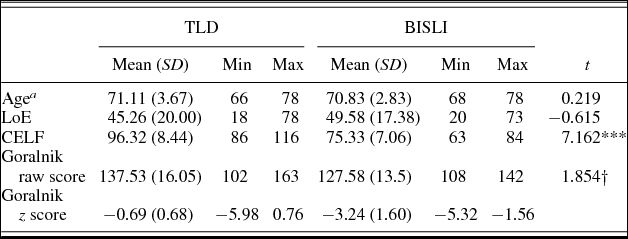
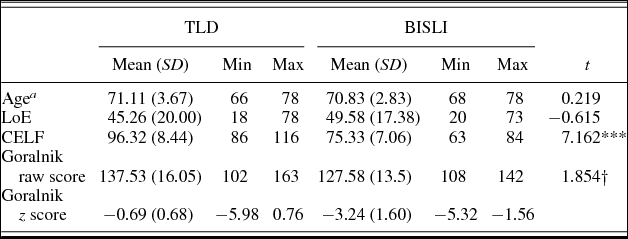
Thirty-one L1/English–L2/Hebrew bilingual preschool children aged 64–78 months participated in the present study. Children were divided into two groups, as follows: 19 typically developing bilingual children (TLD) who scored at or above the monolingual norm in at least one of their languages and 12 bilingual children diagnosed with SLI (BISLI) who scored below the norm on tests in both languages. The TLD group included 9 balanced bilinguals and 10 who were L1 dominant, reflecting the heterogeneity of this population. Because these children did not differ significantly in age, length of exposure (LoE), and L1 standardized test scores, they were collapsed into a single group (TLD). More than three quarters of the participants were born in Israel, only 7 having been born in the United States and having immigrated prior to the age of 5. All children came from homes where both parents spoke English, and all children attended publicly supported preschools in Israel where the language of instruction was Hebrew, for at least 2 years. Parental consent was secured, and the study was approved by the university institutional review board and by the Israeli Ministry of Education. Parents completed a detailed questionnaire on their child's language history and current language use, and LoE to L2 was determined in months based on their report. In most families parents used English as the sole or primary language of communication; only in 6 of the 31 families, one or both parents used Hebrew with their children. In half the cases (N = 16) the children were reported to speak both L1 and L2 with their siblings, the remainder of the children using English only. Five parents reported that their children attended a 1-year English-speaking preschool program from age 3 to 4. Children's LoE and proficiency information are presented in Table 1.
Background and proficiency information of the participants in two bilingual groups
Note: TLD, Typical language development; BISLI, bilingual specific language impairment; LoE, length of exposure to second language; CELF, Clinical Evaluation of Language Fundamentals.
aAges are in months.
†p < .01. ***p < .001.
Two language proficiency tests were administered:
1. L1/English proficiency: Clinical Evaluation of Language Fundamentals Preschool 2 (CELF; Wiig, Secord, & Semel, Reference Wiig, Secord and Semel2004), which includes subtests for expression, receptive language, language content, and language structure
2. L2/Hebrew proficiency: Goralnik Screening Test for Hebrew (Goralnik; Goralnik, Reference Goralnik1995), which includes subtests for vocabulary, sentence repetition, comprehension, expression, pronunciation, and storytelling
The CELF and Goralnik scores were used (along with parent questionnaire data) to divide children into groups. Children with TLD compared with monolingual norms in at least one of their languages, while those with BISLI differed in both languages. As mentioned above, there were no significant differences between the groups in chronological age and LoE to L2. The criterion for BISLI was 1 SD below the mean on standardized English testing and 1.5 SD below the mean on standardized Hebrew testing. The Hebrew cutoff point conforms to former studies of bilingual children in Israel (Armon-Lotem, Reference Armon-Lotem2014; Iluz-Cohen & Armon-Lotem, Reference Iluz-Cohen and Armon-Lotem2013). While CELF scores are monolingual normed percentiles, Goralnik scores are raw scores reflecting a cumulative total out of 180 points. To allow for a more transparent comparison with monolingual norms, the last row of Table 1 presents the standardized z scores of the Goralnik, calculated using age-appropriate monolingual means as given in the manual. As seen in Table 1, all children with TLD met the monolingual norms in their L1/English, but many were still behind in their L2/English. This pattern is typical of English–Hebrew bilinguals in Israel due to the prestige of L1/English (Altman et al., Reference Altman, Burstein-Feldman, Yitzhaki, Armon-Lotem and Walters2014). The discrepancy between L1 and L2 abilities of the children with TLD resulted in a significant difference between the groups in L1 but only a nearly significant difference in L2 (p = .07).
Procedure
To test the impact of bilingualism and SLI, we used narrative scripts in both languages, which were accompanied by a sequence of six multicolored pictures as detailed in the introduction to this Special Issue. Two unfamiliar stories, Baby Birds and Baby Goats, were used in a retelling task. Each story began with a setting statement, giving the time and place and introducing the main characters of the first episode of the story. There were three episodes per story, each episode consisting of (a) a goal statement, (b) an attempt to reach the goal, and (c) an outcome of the attempt. Scripts contained 176 to 180 words, respectively, and each one included 12 MSTs.
The child heard the story narrated by the research assistant and followed along by looking at the pictures. Next, the child was asked to retell the story while looking at the pictures. The child performed the narrative tasks in both languages in separate language sessions conducted by native speakers of English and Hebrew. The administration of the two language sessions was counterbalanced. Sessions were held 1 to three 3 apart.
Data analyses
Narratives were transcribed using the Child Language Data Exchange System (MacWhinney, Reference MacWhinney2000). All narratives were transcribed by graduate students (based on transcription guidelines for each language) and reviewed by the first author. For 20% of the data, recordings were transcribed again and compared to the original transcriptions. Any word that was omitted or replaced was counted as an error. Interrater reliability was 97%. Utterances were divided into C-units. Each C-unit consisted of one main clause or a main clause with a single subordinate clause.
Narratives were coded for macrostructure, microstructure, and MSTs, and an analysis of morphosyntactic errors was conducted.
Macrostructure
Macrostructure was presented in terms of the proportion of goals, attempts, and outcomes produced in the total story retelling (nine possible) as well as the proportion of goals, attempts, and outcomes produced per episode (max 3). In order to examine the complexity of the narrative in terms of GAO elements, a measure labeled GAO complexity was calculated, where use of A/AO was assigned 1 point; the presence of G, or GA/GO, 2 points; and complete GAO sequences, 3 points. The categories were mutually exclusive, and all possible responses appeared on the coding sheets. The coding sheet was designed this way to make the scoring task transparent and avoid the need for interrater reliability.
Microstructure
Microstructure was analyzed in terms of total number of word tokens (TW) and number of different words (NDW), as well as mean length of C-units (MLCU) and average length of the three longest C-units (MLCUmax).
Error analysis focused on general-purpose verbs, use of pronouns, and morphosyntactic errors. The use of general-purpose verbs (aka GAP verbs and light verbs) has been addressed in the literature (Clark, Reference Clark1978, Reference Clark and Mueller Gathercole2009; Huttenlocher, Smiley, & Charney Reference Huttenlocher, Smiley and Charney1983; Rice & Bode, Reference Rice and Bode1993). It was expected that both populations will use general-purpose verbs: bilinguals due to competition in the lexicon, which might affect their lexical retrieval, and children with SLI due to their more restricted vocabulary (also measured in the present study by NDW). In addition, we expected bilingual children with SLI to use more general-purpose verbs because their lexical retrieval capacity is affected by both sources of difficulty. Pronouns have a dual role as functional categories and cohesion markers. This makes them a potential source of divergence between the studied populations (Fiestas & Peña, Reference Fiestas and Peña2004; Iluz-Cohen & Walters, Reference Iluz-Cohen and Walters2012; Pearson, Reference Pearson, Oller and Eilers2002; Uccelli & Páez, Reference Uccelli and Páez2007). Children with SLI are expected to rely on pronouns more heavily, again due to their more restricted vocabulary, which can impact cohesion. This is less typical of bilingual children.
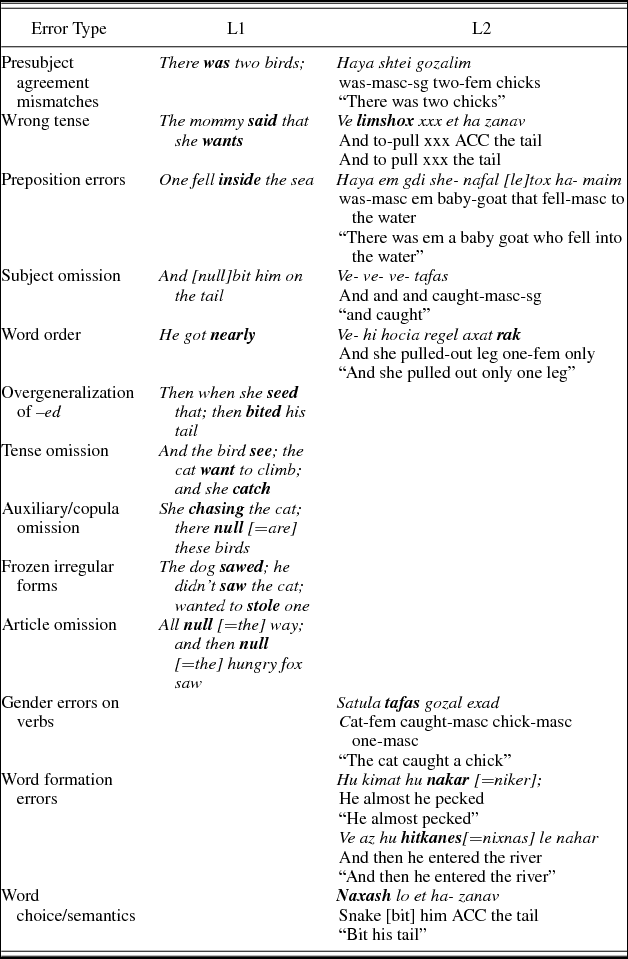
For the analysis of morphosyntactic errors, all errors found in the data were identified, coded, and classified by the locus of the error (verb morphology split into tense and agreement, argument structure, determiners, prepositions, complementizers, etc.) and by the type of error (substitution, omission, or addition). Errors were further divided into those driven by interference from the other language and those that are language internal, reflecting the independent development of the particular language. The classification was motivated bottom-up by the data and informed by findings from previous studies of bilingual children and children with language impairment. These classification principles resulted in the error types outlined with examples from our data in Table 2. Some errors were language specific, while others depended on the specific properties of each language.
Examples of error types
The relative frequency of errors was calculated for each child separately, by dividing the raw frequencies of each error type by the number of C-units the child produced. These relative frequencies were used in the statistical analyses. For the presentation in the tables, the means of these relative frequencies were multiplied by 10. We shall refer to this relative frequency of errors per 10 C-units as the rate of errors. This calculation was used in order to allow for comparison between languages and between individuals due to differences in story length. This measure was preferred to dividing errors by total possible instances (Paradis, Reference Paradis2005; Zdorenko & Paradis, Reference Zdorenko and Paradis2008), because it could be applied to a wide variety of errors in which obligatory context is not transparent. Calculating errors in this way, in an open task like narrative production, avoids instances in which a specific grammatical structure may or may not be obligatory.
Interrater agreement was calculated taking all agreed-upon errors out of all errors for the different error categories for 20% of the data in both L1 and L2 and was found to be 89% overall. Disagreements were resolved by a third rater. When examining all errors, the auxiliary errors were relatively harder to agree upon in both languages.
MSTs
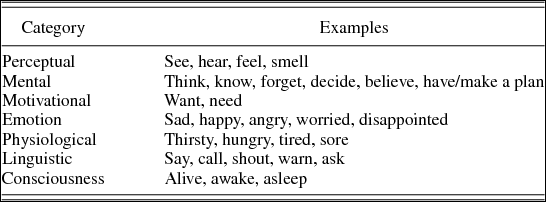
MSTs were assessed by dividing the number of MSTs by content words for each of the categories. The MSTs used for each category appear in Table 3.
Mental state categories and examples1
RESULTS
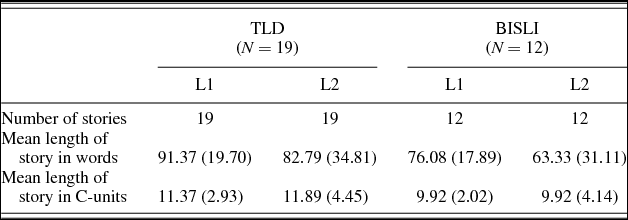
An analysis of narrative length (Table 4) will be followed by analyses in terms of macrostructure, microstructure (including an error analysis), and MSTs.
Productivity measures for narratives of children with TLD and BISLI in L1 and L2

Note: TLD, Typical language development; BISLI, bilingual specific language impairment; L1, first language; L2, second language.
A Language (L1, L2) × Group (TLD, BISLI) mixed analysis of variance (ANOVA) performed on mean length of story in words (TW) yielded a trend toward a significant difference between L1 and L2, F (1, 29) = 3.465, p = .07, η2 = 0.107, and a significant difference between the two groups, F (1, 29) = 4.446, p < .05, η2 = 0.133. Longer story retellings were produced in L1, and by the TLD children. An ANOVA conducted on mean length of story in CUs showed no L1–L2 differences, F (1, 29) = 0.109, p = .74, η2 = 0.004, and no group differences, F (1, 29) = 2.649, p = .114, η2 = 0.084. No significant interactions were found.
Macrostructure
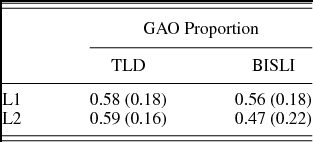
The means and standard deviations for the proportion of G, A, and O components out of nine for each group and language are presented in Table 5.
Means (standard deviations) of goals, attempts, and outcomes proportion in L1 and L2 narratives for children with TLD and BISLI
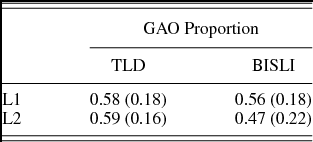
Note: L1, First language; L2, second language; TLD, typical language development; BISLI, bilingual specific language impairment; GAO, goal–attempt–outcome.
A Group (TLD, SLI) × GAO Sequence (GAO1, GAO2, GAO3) × Language (L1, L2) ANOVA was performed. Data are presented in Figure 1. This analysis yielded a significant effect for GAO per episode: F (2, 28) = 10.571, p < .001, η2 = 0.430, but no significant group effect: F (1, 29) = 2.736, p = .109, η2 = 0.086, or language effect: F (1, 29) = 0.547, p = .466, η2 = 0.019. Pairwise comparisons indicated that the GAO per episode score was significantly lower in the first episode as compared to Episodes 2 (p = .016) and 3 (p < .001). The analysis did not reveal significant interactions.
Proportion of goals, attempts, and outcomes produced per episode (max 3) in children with typical language development and bilingual children diagnosed with specific language impairment.

Next, GAO complexity was analyzed using nonparametric tests because this construct was measured using ordinal data. A Wilcoxon signed rank test revealed that there was no significant difference between L1 (M = 3.84, SD = 1.81) and L2 (M = 3.74, SD = 2.02) in terms of GAO complexity (Z = –0.280, p = .780). Children with TLD and children with SLI had similar story grammar complexity scores in L1 (U = 91.5, p = .353) and L2 (U = 78.5, p = .143). A Friedman test revealed no differences among the three episodes in terms of GAO complexity in L1, χ2 (2) = 1.81, p = .405; however, there was a significant difference in L2, χ2 (2) = 9.44 p < .01. Post hoc analysis using Wilcoxon signed rank tests with a Bonferroni correction (p < .017) revealed that the first episode was significantly less complex compared to the second episode (Z = 2.473, p = .013); the difference between the first and third episodes approached significance (Z = 2.132, p = .033); and the difference between the second and the third episodes was not significant (Z = 0.833, p = .405).
In sum, there were neither group nor language differences regarding GAO proportion and GAO per episode. Bilingual children with and without BISLI produced narratives with similar GAO proportions in both languages. Nevertheless, a difference was found between the different episodes, where fewer GAO elements were found in the first episode in comparison to the second and third episodes in L2 only.
Microstructure
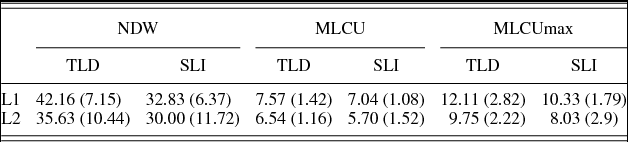
The microstructure analysis of narratives included measures of lexis (TW and NDW) and morphosyntax (MLCU and MLCUmax). Descriptive statistics for the microstructure elements covering lexical abilities are presented in Table 4 and Table 6.
Means (standard deviations) for lexical and morphosyntactic microstructure in L1 and L2 narratives for children with TLD and BISLI

Note: L1, First language; L2, second language; TLD, typical language development; BISLI, bilingual specific language impairment; NDW, number of different words; MLCU, mean length of C-unit; MLCUmax, mean length of the three longest C-units.
A Language (L1, L2) × Group (TLD, BISLI) ANOVA examining NDW showed that children with TLD used significantly more different words than the children with SLI: F (1, 29) = 7.440, p = .01, η2 = 0.204. In addition, L1 narratives contained a higher number of word types than L2 narratives: F (1, 28) = 4.100, p = < .05, η2 = 0.128. The interaction of group and language was not significant.
Two further analyses of microstructure examined measures of utterance length in children's narratives: MLCU and MLCUmax. Again Language (L1, L2) × Group (TLD, BISLI) analyses were conducted. A trend toward a significant difference was found in MLCU between groups, F (1, 29) = 3.373, p = .07, η2 = 0.104: children with TLD used longer utterances compared to children with BISLI. Similarly, when measuring MLCUmax, the longest utterances produced by children with TLD were significantly longer than the longest utterances produced by children with BISLI: F (1, 29) = 5.314, p < .05, η2 = 0.155. The main effects of language and the interactions were not significant.
An analysis of covariance with LoE as a covariate was conducted for sentence length because the correlations were significant only for the sentence length measures; a marginal effect was found for MLCU, F (1, 28) = 3.726, p = .06, η2 = 0.117, and a second analysis of covariance showed a significant effect for MLCUmax, F (1, 28) = 4.449, p < .05, η2 = 0.137. As indicated by the partial eta values, the covariate explained 12% and 14% of the variance for these two measures. For all other microstructure measures, LoE had no such impact.
In sum, there were higher scores on lexical measures in L1 than in L2 and higher scores on both lexical and syntactic complexity measures among bilingual children with TLD compared to bilingual children with BISLI.
Error analysis
General-purpose verbs
A difference was observed in the use of lexis, in particular verbs, where general-purpose verbs (e.g., get and go) were used instead of more specific verbs (e.g., catch and fly). The use of general-purpose verbs (do and go) was recorded in L1 and L2, and frequencies were divided by the number of C-units. A Language (L1, L2) × Group (TLD, BISLI) ANOVA yielded a significant main effect for group, F (1, 29) = 4.470, p < .05, η2 = 0.134, but no significant main effect for language, F (1, 29) = 1.216, p = .279, η2 = 0.040. Children with SLI used a higher rate of general-purpose verbs (M = 0.25, SD = 0.25 and M = 0.28 SD = 0.30 in L1 and L2, respectively) compared to children with TLD (M = 0.25, SD = 0.017 and M = 0.09, SD = 0.12 in L1 and L2, respectively). The interaction of language and group was not significant.
Pronoun use
Instances where children used pronouns instead of protagonists’ names were counted. The frequencies were divided by TW. A Language (L1, L2) by Group (TLD, BISLI) ANOVA revealed a significant main effect for group, F (1, 29) = 5.539, p < .05, η2 = 0.160. Children with SLI used pronouns with a higher frequency (M = 0.02, SD = 0.03 and M = 0.08, SD = 0.06 in L1 and L2, respectively) than did children with TLD (M = 0.02, SD = 0.02 and M = 0.04, SD = 0.04). The ANOVA also revealed a significant main effect for language: F (1, 29) = 14.939, p = .001, η2 = 0.340. A higher proportion of pronouns was used in L2 narratives (M = 0.06, SD = 0.05) compared to L1 narratives (M = 0.02, SD = 0.03).
Morphosyntactic errors
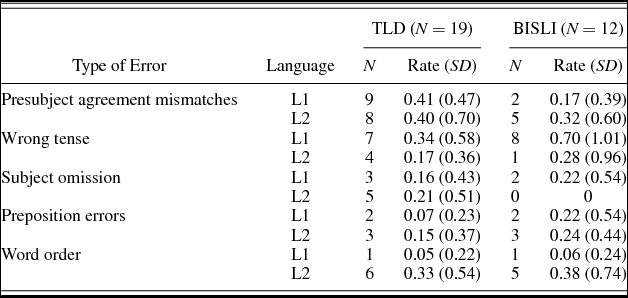
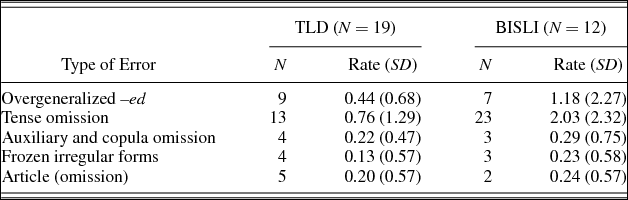
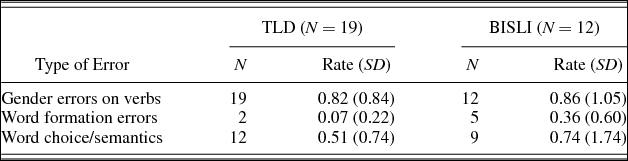
The narratives in both languages were coded for morphosyntactic errors. The frequency of each error type was divided by the number of C-units for that narrative and multiplied by 10 (see Tables 7, 8, and 9 for the respective error types). Examples for the different errors were presented in Table 2. Because of the low frequency of individual error types in each error category and the large number of error categories, the error category data will be mostly descriptive and errors relate to errors in L1 and L2 for both groups of children (Table 7), errors which are unique in L1 (Table 8), and those that are unique to L2 (Table 9). Nonparametric statistics are provided where appropriate.
Frequency (N) and mean (standard deviations) rate of errors in L1 and L2 for both groups of children

Note: L1, First language; L2, second language; TLD, typical language development; BISLI, bilingual specific language impairment; Rate, relative frequency of errors per 10 C-units.
Frequency (N) and mean rate (standard deviations) of errors unique in L1/English narratives of children with TLD and BISLI

Note: L1, First language; TLD, typical language development; BISLI, bilingual specific language impairment; Rate, relative frequency of errors per 10 C-units.
Frequency (N) and mean rate (standard deviations) of errors unique in L2/Hebrew narratives of children with TLD and BISLI

Note: L2, Second language; TLD, typical language development; BISLI, bilingual specific language impairment; Rate, relative frequency of errors per 10 C-units.
Tables 7–9 show that both groups of children had difficulties in the same linguistic domains. The majority of the errors related to use of morphosyntactic categories, but errors were also observed in word order in both languages (see Table 7) and in word formation and word choice in L2 (see Table 9). Yet, as shown below, some errors were equally frequent for both children with TLD and children with SLI, while others (mostly those related to verbal tense) were more frequent among children with SLI, distinguishing the two groups.
In both languages, children with and without SLI showed evidence of agreement mismatches with feature reduction when the copula was in presubject position. In English this was manifested in the use of singular instead of plural, and in Hebrew it was reflected mainly (but not only) in the use of masculine instead of feminine forms.
In both languages, tense inflection was erroneously used. In English, this was manifested as divergence from the narrative anchor tense, switching to inflected forms in the present tense, which occurred twice as much among children with BISLI, while in Hebrew, it was a nonsystematic substitution of the tense inflection.
Subject omission with inflected verbs was found twice in English, in what appears to be cross-linguistic influence from Hebrew, a null subject language; in Hebrew subjects were omitted to achieve cohesion, but only by children with TLD. Finally, preposition errors, in particular substitutions, offered another window into cross-linguistic influence in both languages for both groups. In Hebrew, however, only children with BISLI had difficulty inflecting the preposition, using an ungrammatical synthetic form, axarey hu “after he” instead of the inflected form axarav “after him.”
The majority of the errors were found on verbs, and these took different forms in L1 English and L2 Hebrew. In L1 English, omission and substitution of tense (overgeneralization of –ed and frozen irregular forms) were most frequent among the narratives from the BISLI group. One child with BISLI (mel510) had three tense omissions, where she used bare forms of the verb (root infinitives) instead of the correct past tense form: “the cat want to climb; and she catch; the dog want to catch the cat.” For tense omission on main verbs, a Kruskal–Wallis test compared children with BISLI to children with TLD attained significance, H (2) = 4.396, p = .036. Similarly, overgeneralization of inflections was found among BISLI children three times as frequently as among their peers with TLD. This error type was found most often for regular past-tense endings, either on the base form or added to a frozen inflected past-tense form. Some children producing overgeneralizations made the error on a particular verb, and then repeated it several times throughout the narrative. Yak601, a child with TLD, made four such errors throughout his narrative, all with the frozen form sawed: “birds sawed the cat; cat sawed the baby bird; and he sawed; the dog sawed that.” Others, for example, Shs601, a child with BISLI, had three instances of frozen inflected forms for three different verbs: “goat sawed [ = saw]; he camed; the bird bited it.” When all English tense-related errors were combined in a single category, a nonparametric statistical analysis was performed due to abnormal distribution of the data. A Kruskal–Wallis test comparing children with BISLI to children with TLD on the rate of tense errors yielded a near significant result: H (1) = 3.419, p = .064. A higher rate of tense-related errors was found among the children with BISLI.
In L2/Hebrew gender errors on main verbs and auxiliaries predominated, and almost all participants produced at least one gender error. The frequencies were similar among both children with and without SLI, as revealed by a Kruskal–Wallis test for the rate of gender errors for main verbs as a dependent variable: H (1) = 0.011, p = .915. Most gender errors were related to the use of the word cipor [bird] (one of the protagonists in the Bird story), which is, in Hebrew, a feminine noun grammatically but with no feminine morphology on the singular or plural forms. Another source of gender errors comes from the use of the noun xatul [cat] (another protagonist in the Bird story). Some children referred to xatul as feminine: ve- az ha- xatul barxa [and then cat-msc ran-fem] or ve- xatul ro’ah otam [and cat-masc saw-fem they-acc]. The majority of word choice errors (9 out of 17) were produced by two BISLI children. For example, child Ahd608 said ve- az hu hexzik et et ha- katan [and then he held-masc acc acc the little-adj-acc], thus failing to produce the correct nominal. The same participant used many deictics (ele [these]) instead of lexical referents. Finally, a unique difficulty emerged with word formation, where BISLI children used the wrong conjugation of the verb, for example, nakar for niker (pecked), which sometimes yielded a different meaning, for example, hitkanes “gathered” for nixnas “entered.” A Kruskal–Wallis test comparing children with BISLI to children with TLD yielded a trend toward significance using these derivation errors as a dependent variable: H (1) = 2.810, p = .094. Unlike errors in L1, tense-related errors were less frequent in Hebrew narratives, and the distribution of these errors among proficiency groups was similar.
MSTs
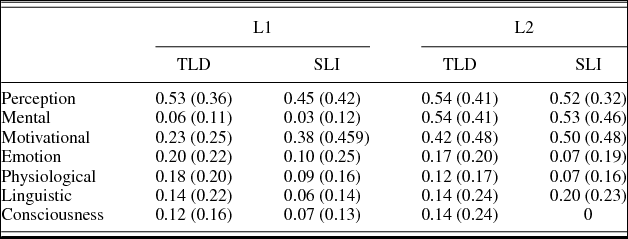
Frequency of use of MSTs was calculated as a ratio of the number of MSTs divided by content words. MSTs were coded for the categories of perceptual, mental, motivational, emotion, physiological, linguistic, and consciousness terms. Table 10 displays these ratios (as multiples of 10 for more facile reading). The most frequent MSTs used in the narratives in both languages were see, think, decide, want, sad, happy, mean, brave, safe, danger/afraid, hungry, said, told, and shout; in L2 the MSTs called, scream, laugh, and ask were used as well. Table 10 displays category means and standard deviations for L1 and L2 for both groups.
Mean ratios (standard deviations) of MSTs (per 10 content words) in L1 and L2 for the seven categories for children with TLD and SLI
Note: MSTs, Mental state terms; L1, first language; L2, second language; TLD, typical language development; SLI, specific language impairment.
A Group (TLD, SLI) × Language (L1, L2) × MST type ANOVA revealed a significant main effect for language, F (1, 29) = 8.792, p < .01, η2 = 0.233. More MSTs were produced in L2 narratives (M = 0.3) compared to L1 narratives (M = 0.2). No significant main effect emerged for group, F (1, 29) = 0.656, p = .425, η2 = 0.072, nor was the Group × Language interaction significant, F (1, 29) = 0.159, p = .693, η2 = 0.005. The difference between MST types also yielded a significant main effect, F (6, 24) = 12.221, p < .001, η2 = 0.753. Finally, a significant interaction of language and MST type resulted, F (6, 24) = 8.518, p < .01, η2 = 0.680. Post hoc Bonferroni analysis of the interaction showed a significant difference between L1 and L2 for mental verbs (p < .001) and for consciousness terms (p < .05). Specifically, narratives contained a higher ratio of mental verbs in L2 (M = 0.52) than in L1 (M = 0.04) and a higher ratio of consciousness terms in L1 (M = 0.1) compared to L2 (M = 0.03).
One child, Ayl509 (BISLI), who favored perception verbs in L1, produced many MSTs in retelling the “Baby Birds” story in L1. Four of them were perceptual (each of the characters “saw” the others doing something before any action was described), as seen in the following narrative:
(1) One day the bird saw the baby's cat and then he said good morning. And then the cat saw the babies and the ima [=mother] flied away. And then the ima [=mother] came back and didn't saw the cat. And then the dog saw him. Then he pulled him off and everybody was sad.
Her L2 story had five MSTs, out of which only one was a perceptual MST, the remainder being emotional (2), linguistic (1) and mental verbs (1).
Ram507 (TLD) favored the Motivational verb category in L2; six of his seven MSTs were raca [wanted].
(2) ve- hu raca tehacil oto. hu raca lidxof oto. ve- hu raca lalexet axavar. ve- az hu raca litfos oto. ve- az ha cipor raca raca laazor.
and he wanted-masc save-INF him. he wanted-masc push-INF him. and he
wanted- masc go-INF after-him. and then he wanted-masc catch-INF him. and
then the bird- fem wanted-masc wanted-masc help-INF
“and he wanted to save him. he wanted to push him. and he wanted to follow
him. and then he wanted to catch him. and then the bird wanted wanted to help.”
This stands in marked contrast to his L1 story, where three of his eight MSTs were mental and motivational verbs.
(3) The ima [ = mother] thinks that the baby birds are hungry.
So the cat wanted to eat one.
And then the dog wanted to help. (Ram507, L1)
In a further analysis of MSTs by story structure categories, a higher proportion of MSTs (per total number of mental state words) were produced in initiating events (M = 1.61, SD = 1.56 and M = 1.65, SD = 1.80 for L1 and L2, respectively) in comparison to MSTs prior to (e.g., the birds were hungry) and following each episode (e.g., the birds were afraid), (M = 0.45, SD = 0.81 and M = 0.29, SD = 0.46 for L1 and L2, respectively). Because these data were not normally distributed, a Friedman nonparametric test was conducted to examine differences in the use of MSTs between initiating events and reactions and the proportion of MSTs as dependent variables. The analysis showed greater use of MSTs in initiating events in comparison to reactions prior to and following each episode. This finding held in both L1, χ2 (1) = 12.80, p < .001, and L2, χ2 (1) = 14.727, p < .001.
The following example of a child with TLD, Yeh510, shows five MSTs in total, with four of them in a single initiating event. (The fifth occurred in the goal statement of the first episode.)
(4) The mom saw that the baby goat fell into the water. The fox came running and then he said, “Oh, who do I see here?” And the bird saw that.
In L2, six of the seven MSTs from this child's narrative occurred in an initiating event, as seen in the two excerpts below.
(5) ima gozala sham’a raata she- ha- gozalim shela raevim.
mother-nom chick-nom heard-fem saw-fem that the chicks-nom her hungry-pl
“the mother chick heard saw that her chicks are hungry.”
(6) ve- az ha xatul exad raa she- ha- ima ‘azva et ha- bait. ve- az ha- kelev raa she- ha- gozal be- sakana.
and then cat-masc one-masc saw-masc.sg that the mother left-fem ACC the home. and then the dog saw-masc that the chick in danger.
“and then one cat saw that the mother left home. and then the dog saw that the chick is in danger.”
In summary, there were more MSTs in L2 than in L1, and there was an interaction between language and MST type, where more mental verbs appeared in L2 narratives and more consciousness terms in L1. Perception verbs (“see”) were the most prevalent MST type in both L1 and L2 narratives. Finally, MSTs were found more in initiating events than in macrostructure categories before and after these events.
Relationships among macrostructure, microstructure, and MSTs
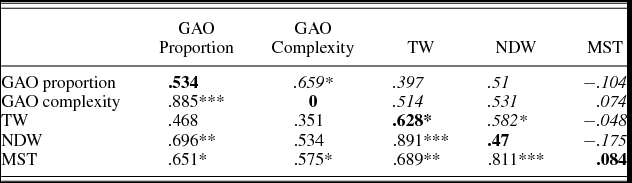
In an effort to examine the relationship among macrostructure, microstructure, and MSTs, Pearson correlations were calculated for macrostructure (GAO proportion and GAO complexity), microstructure (TW and NDW) and MSTs (percentage MSTs per content words) as seen in Table 11 for children with TLD and Table 12 for children with SLI.
Correlations among macrostructure, microstructure, and MSTs for children with TLD
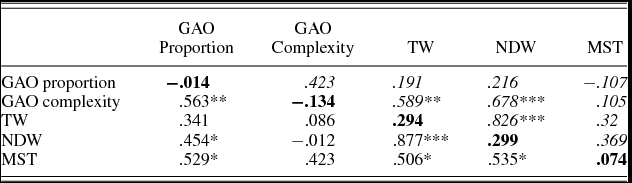
Note: MSTs, Mental state terms; TLD, typical language development; GAO, goal–attempt–outcome; TW, total words; NDW, number of different words.
Correlations among macrostructure, microstructure, and MSTs for children with SLI
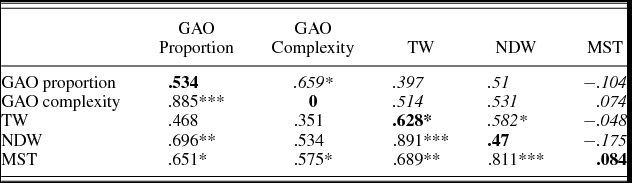
Note: MSTs, Mental state terms; SLI, specific language impairment; GAO, goal–attempt–outcome; TW, total words; NDW, number of different words.
Three sets of correlations are presented in Table 11 and 12, within L1–L1 and L2–L2 (both in italics in the upper right and lower left portions of the table) and between L1 and L2 (in bold along the diagonal), the latter being indicative of transfer between languages. Correlation analyses were performed for each group separately as seen in Tables 11 (TLD) and 12 (SLI). Within microstructure, significant correlations resulted between TW and NDW in L1 and L2 for both children with TLD (r = .826, p < .001 and r = .877, p < .001 for L1 and L2, respectively) and for children with SLI (r = .582, p < .05 and r = .891, p < .001 for L1 and L2, respectively). Between macrostructure and microstructure, narratives of children with TLD yielded significant correlations within L1 between GAO complexity and the two microstructure measures (TW and NDW; r = .589, p < .01 and r = .678, p = .001). For these same children (TLD), within L2 correlations for children with TLD were significant between MST ratios and GAO proportion (r = .529, p < .05), TW (r = .535, p < .05) and NDW (r = .529, p < .05).
For children with SLI within L2, significant correlations were observed between the macrostructure and microstructure measures GAO proportion and NDW (r = .696, p < .05). In addition, the ratio of MSTs correlated significantly with all four macro- and microstructure measures: GAO proportion (r = .651, p < .05), GAO complexity (r = .575, p = .05), TW (r = .689, p = .01), and NDW (r = .811, p = .001). The only significant cross-language correlation for children with SLI was observed for the TW measure (r = .628, p < .05).
In summary, MSTs overall yielded significant correlations with all four macro/micro measures in L2, but none in L1; in addition, MSTs were not significantly correlated cross-linguistically. Correlations conducted separately for the data from children with TLD and SLI showed that for both groups, correlations between MSTs and all but one (macrostructure) measure were significant for L2 but not for L1.
DISCUSSION
The discussion reviews the main findings for each of the components of the narrative analysis and discusses them in turn, focusing on L1–L2 differences and ways in which to distinguish the narratives of bilingual children with SLI from those with TLD.
Macrostructure
The findings for macrostructure confirm previous research with bilingual children, both with TLD and with SLI (Pearson, Reference Pearson, Oller and Eilers2002; Simon-Cereijido & Gutiérrez-Clellen, Reference Simon-Cereijido and Gutiérrez-Clellen2009; Iluz-Cohen & Walters, Reference Iluz-Cohen and Walters2012). Data from the children in the present study showed invariant performance on macrostructure in L1 and L2 and no group differences. Children with both TLD and SLI showed similar patterns for use of goals, attempts, and outcomes and similar levels of macrostructure complexity in both L1 and L2. Mean use of GAO categories ranged from 0.47 to 0.59, complexity from 2.00 to 2.53, with a slight, but nonsignificant trend for lower use/complexity in the L2 of children with SLI. Moreover, children from both groups exhibited the same trend across the three macrostructure categories, with smaller numbers of goals, attempts, and outcomes in the first versus second and third episodes in the narratives. This may have been a result of a natural warming up to the story retelling experience. LoE showed no influence on macrostructure.
Microstructure
Findings also conform to previous research with bilingual children for microstructure, showing the predicted direction in which children with SLI perform less well than those with TLD, in particular for lexical productivity, tokens, and types as well as one measure of length, MLCUmax. At the outset of the paper, we reviewed a wide range of microstructure features for which significant differences were found between monolingual children with SLI and TLD. These features included story length, morphosyntax, syntactic complexity, and grammatical well-formedness. Of particular note in this literature for the findings here are the reports of more errors of omission and overregularization of tense (Botting, Reference Botting2002; Norbory & Bishop, Reference Norbury and Bishop2003) and morphological errors in auxiliaries, determiners, and marking of number (Reilly et al., Reference Reilly, Losh, Bellugi and Wulfeck2004). These are the same phenomena we have reported above for bilingual children with and without SLI. The remainder of this section on microstructure features attempts to show that narrative microstructure is the core of the problem for SLI in bilingual as well as in monolingual children.
Error analysis showed that inflection errors involving tense, number, and gender, and the use of general-purpose verbs were most prevalent overall. Children with TLD had fewer errors, and these were distributed across multiple error types, while children with BISLI had more errors concentrated in tense and inflection types, with a significant difference from children with TLD in L1/English, but not in L2/Hebrew. Moreover, the inflection errors differed across the two languages. While errors of number in the presubject position were found in both languages, gender errors were unique to Hebrew, which, unlike English, makes use of grammatical gender in subject–verb agreement; tense errors were unique to English, whose inflection system is morphologically sparse.
Number errors were mostly evident in the presubject position in Hebrew and existential sentences in English, where a dummy subject is used in the presubject position and the thematic subject is postverbal. In these contexts, children were found to use the singular inflection, not anticipating the following noun. This error is typical of younger children but is also attested in adult speakers (Borer, Reference Borer1974).
Some gender errors were found in Hebrew in the presubject position, but a major source of gender errors was agreement with particular protagonists, cipor “bird” and xatul “cat.” In Hebrew, all nouns are lexically marked with grammatical gender, and the verb must agree with it. Often grammatical gender is matched with the morphological ending of the noun, but not always. One such exception is cipor “bird,” which has masculine morphology but feminine grammatical gender. The children in the present study appeared to use morphological gender as a cue to grammatical gender. In making reference to the bird, “cipor” in Hebrew, children relied on its form and inflected the verb as masculine rather than feminine, as is typical of younger children and second language learners (Armon-Lotem & Amiram, Reference Armon-Lotem and Amiram2012). Another source of gender errors came from the use of the noun xatul “cat” (another protagonist in the Bird story), which is masculine, but often used in slang interchangeably with its feminine counterpart (xatula). The confusion generated by these two protagonists was evident by the use of pronouns of the opposite gender. Another possible source for these gender errors lies in the high frequency, among the frequently used general-purpose verbs, of irregular verbs in which the masculine form ends with –a, typically associated with feminine forms in Hebrew (e.g., haya “was,” ra’a “saw,” ba “came,” asa “did,” and ala “climbed”). At least some of the errors stem from this kind of overgeneralization, beause the children used the correct pronoun or even a noun clearly marked for feminine and still used the wrong verb form. Both number and gender errors did not distinguish children with TLD from children with SLI.
In contrast, the nature of tense errors was found to differ across groups of children with TLD and BISLI and to manifest itself differently in the two languages studied here (cf. Armon-Lotem, Reference Armon-Lotem2010). In Hebrew, tense errors are restricted to particular inflections (not necessary in stories in the present study), while in English tense errors are manifested across the board as omission of –s in the present tense and –ed in the past tense, as well as overgeneralization and overregularization of inflected forms. As expected, in the present study such errors were more frequent in L1 English for children with BISLI, on main verbs, auxiliaries, and the copula. Tense difficulties had an impact on the use of anchor tense in the narratives of children with BISLI, who found it more difficult than children with TLD to maintain the past tense in which the story was told to them.
These findings for verbal inflections are in line with Paradis's (Reference Paradis2010) argument that there are some structures where performance points to a temporary lack of opportunity for mastery, whereas other structures mark underlying difficulties. In the present study, number or gender errors, especially in L2 Hebrew, are traced to lack of opportunity for mastery, because they are tied to particular lexical items or particular syntactic positions, which have not been fully acquired. By contrast, tense errors, while found in both languages, vary in form and syntactic position, applying to main verbs, auxiliaries, and modals, and are not tied to particular lexemes. They take a language-specific form, depending on attested vulnerabilities for each of the languages involved and are possibly motivated by underlying difficulties within this system.
Several other errors, with rather low frequencies, were unique to children with BISLI. These included the choice of the wrong conjugation in Hebrew, also reported by Ravid, Levie, and Ben-Zvi (Reference Ravid, Levie, Ben-Zvi, Levy and Schaeffer2003) for monolingual Hebrew speakers with SLI and frozen inflected forms in English, which have been reported for monolingual English speakers with SLI (e.g., Marshall & van der Lely, Reference Marshall and van der Lely2012), as well as a difficulty with inflecting prepositions and the Hebrew accusative case marker. By contrast, subject omission was found more among children with TLD who seemed to be overusing it as a cohesion marker, in a way typical of adult L2 Hebrew speakers (Berman & Neeman, Reference Berman, Neeman, Berman and Slobin1994). Some of the errors could be attributed to cross-linguistic interference. In addition to subject omission, these include preposition substitution and insertion as well as some adverbial misplacement, which were counted under syntactic errors in L1.
Finally, L2 narratives of children with BISLI had more general-purpose verbs and more substitutions of pronouns for character names. These latter two phenomena may represent compensatory mechanisms for difficulties with lexical access, a compromise made for the sake of fluency, rather than a true error. Thus, these children may opt to get the story across without using the lexis of the original script. To illustrate, a child with SLI seemed at times to be stuck to one verb throughout the narrative: “Once upon a time &the &baby &went (.) [//] they went. Once upon a time &the &bird &went [//] the mommy bird went to get food. And &the &birds &waited &for &the &mommy &birds [/] the birds waited for the mommy bird. And then a cat came. Then when the mommy cat came.” The outcome of this compensatory mechanism that may be triggered by vocabulary deficits is difficulty with narrative cohesion, previously observed by Liles et al. (2005) and Norbury and Bishop (Reference Norbury and Bishop2003).
Thus, microstructure features, in particular those revealed by error analysis, were shown to distinguish narratives of children with TLD and SLI. Moreover, the differences in errors in L1 and L2 narratives show the value of testing in both languages.
MSTs
Examination of MSTs was undertaken in the present study in order to widen the scope of narrative analysis and to look at this feature in the framework of macrostructure and microstructure. MSTs were found to be more numerous in L2 narratives and in initiating events. MSTs were more often perceptual, mental, and motivational verbs in both L1 and L2 narratives. In addition, a Language × MST interaction emerged, showing more mental verbs in L2 narratives than in L1 narratives and more consciousness terms in L1. This interaction can be explained both by the length of the narratives and by the kind of input the children receive in each language. In terms of narrative length, L2 narratives were shorter, and lower frequencies of MSTs could have led to higher ratios in L2 than in L1. The type of the input refers to the different formal and informal L1 and L2 settings the child is exposed to. In the L2 preschool setting, mental verbs such as think, know, forget, decide, believe, or have/make a plan are used on a daily basis. They feature in discussion groups led by the preschool teacher when presenting a story, its outcomes, and even in the presentation of the daily schedule. Consciousness verbs such as alive, asleep, and awake are less associated with the preschool's curriculum, and therefore may appear more in the home setting, usually occurring in L1.
Frequencies can give a general impression, but they do not always yield answers to specific questions. Based on the frequency data, we learned that the most prevalent MSTs were perceptual and motivational in both L1 and L2 narratives. This is not surprising, because verbs like see and want are characteristic of early acquisition (Bowerman, Reference Bowerman, Morehead and Morehead1976; Tomasello, Reference Tomasello1992). In order to try to clarify the difference in MSTs’ frequency mentioned above (beyond the [arti]fact that the L2 narratives were shorter and lower frequencies of MSTs led to higher ratios in L2 than in L1) and in the hope of uncovering more subtle differences between narratives of children with TLD and SLI, we examined the particular MSTs used.
The mental terms found in both L1 and L2 narratives of children with SLI were see and want, with some linguistic verbs (shout and call) in L2 narratives. The narratives of children with TLD showed more varied use of MSTs, in L1 characterized by emotion terms (mean and safe) and mental terms such as decide, think, and know, none of which were found in narratives of children with SLI. In the L2 narratives of children with TLD, this varied use of MSTs included mental, emotional, physiological, consciousness, and linguistic terms, only the latter appearing in the narratives of children with SLI. The importance of this notion of variation; that is, the more ways a child has to say something or carry out a speech act has been treated in child language (Clark, Reference Clark1990) and in child bilingualism (Walters, Reference Walters2005). For the children with SLI, this limited variety ties well with their limited vocabulary, observed in this study as well. It seems to suggest that at least in terms of MSTs, the vocabulary is restricted to earlier acquired MSTs, indicating a possible delay in lexical acquisition. This suggestion should be checked in future studies for other lexical categories.
Correlations of MST measures with macro- and microstructure variables within each language showed an asymmetry between L1 and L2, with significant correlations for L2 but not for L1. This asymmetry was true for the narratives of children with TLD and SLI alike.
The higher proportion of MSTs in L2 than in L1 and their correlation with both macrostructure and microstructure measures for children with TLD and SLI should be seen in light of the nature of MSTs used. Their higher frequency in L2 can be attributed to the use of early acquired verbs from the perceptual and motivational categories (see and want). The significant difference favoring L2 for mental verbs is consistent with this pattern. Along with intact macrostructure, the more frequent use of MSTs in L2 may be indicative of developing narrative abilities. This is especially highlighted by the use of mental verbs. In addition, the role of the preschool Hebrew/L2 curriculum and setting may be apparent as well.
The correlation of MSTs with both macro- and microstructure measures highlights the dual nature of MSTs in L2. Mental states involve goals and intentions, features of macrostructure, while their instantiation in different lexical categories are properties of microstructure. The child's ability to produce a coherent narrative (including initiating events, goal statements, and reactions, and attempts to reach goals) provides an indication of an understanding and awareness of intentionality and the goal-directed behavior of the story's characters (Gagarina et al., in press; Westby, Reference Westby, Catts and Kamhi2005). In addition, the use of MSTs is also an indication of an understanding of the lexical and pragmatic means to encode goals and intentions (microstructure).
Bilingual aspects of narrative production
The findings showed invariance across languages for macrostructure features, differences for microstructure features in particular for errors, and differences in use of MSTs, general-purpose verbs, and pronouns. These differences are discussed here, along with the relevance of LoE, which did not have much impact on the variables investigated here.
Many studies of sequential bilingual preschool children show better performance in L2 than in L1 after 5 years of exposure. In the present study of children with shorter exposure and from enclaved neighborhoods, L1 performance exceeded L2 performance for tokens, types, and both MLCU and MLCUmax. English, the children's L1, makes greater use of auxiliaries and function words, resulting in larger word counts than in L2/Hebrew. Thus, the typological characteristics of English versus Hebrew may explain the better performance in English. Nevertheless, there is also room to claim that better performance in L1 may be due to better proficiency in L1 at this stage of development. On the L2 side, the higher frequency of MSTs in L2 for both children with TLD and SLI points to their incipient narrative abilities. This is especially highlighted by the use of mental verbs.
General-purpose verbs and extended pronoun use, found more in L2, can also be seen as an acceptable, albeit not preferred, strategy for retelling a narrative, which gets the message across pragmatically without breaking any grammatical rules and thus allows allocation of limited resources to other aspects of microstructure.
The study of the narratives of bilingual English-Hebrew children, whose home language has high prestige, and whose societal language is important for integration and has ideological support (Altman, Burstein-Feldman, Yitzhaki, Armon-Lotem, & Walters, Reference Altman, Burstein-Feldman, Yitzhaki, Armon-Lotem and Walters2014; Armon‐Lotem, Altman, Joffe, Oz‐Abutbul, & Walters, Reference Armon-Lotem, Altman, Joffe, Oz-Abutbul, Walters, Grüter and Paradis2015) allows us to examine the interaction between these sociolinguistic factors and unique aspects of bilingualism, such as LoE and proficiency in L1 versus L2. The finding that L2 proficiency develops as a function of more exposure is robust (e.g., Paradis Reference Paradis2010, Reference Paradis2011; Unsworth, Reference Unsworth2013). However, unlike previous studies, LoE in the present study was not found to be a strong predictor of higher proficiency. An analysis of covariance conducted for the different microstructure variables, with LoE as an intervening variable, showed that only sentence length (MLCU and MLCUmax) was influenced by LoE, accounting for 12%–14% of the variance. A closer look traced this outcome to its correlation with TLD children's scores, and not with those of SLI children, as has also been reported by Blom and Paradis (Reference Blom and Paradis2014). This reflects the limited use that children with SLI make of language experience and their need for more intensive exposure.
We conclude then that the preschool children from English-speaking homes/neighborhoods in the present study get less exposure to L2, which, along with the prestige of English, contributes to L1 maintenance. While the parents of these children were ideologically motivated to immigrate to Israel, Hebrew was not seen as a means to social integration, as it is in many other immigrant groups. Thus, the children, especially at preschool age, may be less motivated to succeed in the new language.
Summary and conclusion
This paper analyzed retold narratives of bilingual children with TLD and with SLI in both L1 and L2. Narratives were examined for macrostructure (e.g., goals, attempts, and outcomes), microstructure (e.g., length, lexis, and morphosyntax) and MSTs. Using stories matched for macrostructure, microstructure, and mental state elements across languages (L1/L2), it was found that macrostructure analysis confirmed previous findings showing similar performance in both languages for children with TLD and those diagnosed with SLI. Consistent with previous findings, microstructure analysis of verbal productivity, length of C-units, lexical diversity, and the use of general-purpose verbs (do and make) distinguished children with TLD from those with SLI. Error analysis of morphosyntax, syntax, and lexical semantics showed that tense errors were most prevalent among error types. Error analysis also uncovered important L1–L2 differences: general-purpose verbs and substitution of pronouns for character names were more numerous among children with SLI in L2. Analysis of MSTs yielded similar frequencies for the two groups and greater use in L2. Perception, mental, and motivational verbs were the most prevalent MST types, and mental verbs accounted for most of the L1–L2 difference.
In conclusion, group differences were found primarily for microstructure measures (productivity and lexical diversity), and it was necessary to conduct more fine-grained error analysis and to examine the lexis of MSTs in order to get at potential ways to distinguish narratives of children with TLD from those with SLI.
ACKNOWLEDGMENTS
This research was initiated within COST Action IS0804 Language Impairment in a Multilingual Society: Linguistics Patterns and the Road to Assessment (http://www.bi-sli.org). It used the design developed by Working Group 2 under the leadership of Natalia Gagarina and Joel Walters. We thank Eva Dubinsky for coding. This research was supported by the Israel Science Foundation (Grant 779/10).