IntroductionFootnote *
The recent victory of Mayawati in the Uttar Pradesh elections has been hailed as a ‘spectacular display of subaltern power’ by a leading Indian newspaper.Footnote 1 The questions remain: who are these subalterns? To what extent do they form a coherent block, with similar fears, hopes and aspirations, and how are subalterns’ visions of the state, social justice and equality articulated? In the past two decades a number of studies have sought to answer some of these questions from a broadly political and economic perspective. In such analyses, emphasis is directed to the role played by competing social interest groups (based on kin, class and caste) and the ways in which they have been able to benefit from state redistributive policies, translating these into political and economic power (Brass Reference Brass1991; Jaffrelot Reference Jaffrelot1998, Reference Jaffrelot2000; Pai Reference Pai2002; Rudolph, S. and Rudolph, L. Reference Rudolph and Rudolph1987).
Such an analysis, however, has been vigorously challenged from a broadly postcolonial perspective, which is critical of an instrumentalist approach (Fuller and Harriss Reference Fuller, Harriss, Fuller and Benei2000; Jeffrey and Lerche Reference Jeffrey, Lerche, Fuller and Benei2000; Gupta Reference Gupta1989, Reference Gupta1995; Kakar Reference Kakar1996). Gupta, for example, laments the effacement of the subalterns from the political process, to the extent that they figure only as peons in the hands of political elites. Accordingly, subalterns remain faceless masses, ‘mobilized, controlled, manipulated, organized, led, betrayed, handed resources, given incentives, and provided supplies’ by various interested political parties and politicians (Gupta Reference Gupta1989: 796). Gupta's own work on rural North India (Reference Gupta1995, Reference Gupta1998) is partly designed to counter such homogenizing tendencies, by detailing how subordinate populations encounter, imagine and contest the ‘state’ in their everyday lives. For Gupta, subaltern agency becomes all the more visible if the ‘state’ itself is not conceived as a reified entity distinct from society, but rather as a more disaggregated one, permeating through society as a series of discourses, policies, institutions and functionaries, scattered across a range of sites and linked to nationalist proclamations in complex and indeterminable ways (see also, Aretxaga Reference Aretxaga2003; Das and Poole Reference Das and Poole2004; Mitchell Reference Mitchell1991; Trouillot Reference Trouillot2001).
This paper draws on the insights generated by Gupta and others to explore the effects and the presence of the state in the everyday lives of marginalized populations as it is historically encountered in diffuse ways: as an idea, an imagined community (Anderson Reference Anderson1991), a set of images, ideological constructs, projects, institutions and functionaries. Such an analysis is useful for providing a deeper appreciation of how subordinate populations perceive Indian democracy and their own positions within the shifting and porous state-society nexus. An investigation of the relationship between subalterns and the state in real life is critical for revealing the limitations associated with the political economy approach, which tends to view subordinate populations as overly-determined by structural factors, mystification and oppression, effectively rendering them unaware of their own true interests.
Interestingly, within the growing body of literature about the rise of subalterns to political prominence in North India and their ability to manipulate state power and authority, one trend is noticeable—a positive emphasis on political empowerment amongst underprivileged populations. Studies investigating casteism, communalism and class relations, particularly in India's most populous state of Uttar Pradesh, tend to stress the processes of social empowerment, voting patterns and successful political mobilisation amongst the upwardly mobile peasantry and ex-untouchable groups, or dalits. The people largely absent from the scholarly radar, however, are those disaggregated castes and communities situated just above the ritual pollution line and associated with the service and artisan occupations—also labelled as the ‘Most Backward Class’ (MBC).Footnote 2 In fact, if MBCs are mentioned at all, they function as shorthand, to remind the reader that a category of marginalized groups remain oppressed and destitute, unable to develop a coherent ideological and political programme and hence gain access to state institutions and power (Jeffrey and Lerch Reference Jeffrey, Lerche, Fuller and Benei2000; Pai Reference Pai2002; Jaffrelot Reference Jaffrelot2003). Consequently, MBCs are rendered an abstract category, undermining a comprehensive understanding of the power relations and social agency informing structures of domination and politics of identity in Uttar Pradesh (UP). Indeed, save from such passing references, there has been hardly any systematic research into their political symbols, initiatives and preferences, and the nature of their relationship with society and the nation-state.Footnote 3 This study aims to fill that gap. It looks at one of the main castes within the MBC category, the Mallah caste, and its struggle to be recognized as a group of fully fledged citizens of the Indian nation-state.Footnote 4 It examines the social, political and economic strategies that members of this caste employ to engage with, infiltrate and contest state discourse, institutions and actions of the nation-state; and the social and economic discrimination they experience in their everyday lives.
This paper has two goals: first, to account for the diversity of experiences, needs and aspirations of those groups who have been ‘cast away’ from the newly empowered subaltern category; and second, to provide a detailed examination of the dialogical relationship between one particular caste group, the Mallahs, and the nation-state. The paper is divided into three sections. It begins with questioning some of the reasons proposed by scholars of the political economy persuasion for the Mallah caste's participation in the Ayodhya movement in UP during the early 1990s. It argues that, to fully appreciate the appeal of the Bharatiya Janata Party (BJP) and HindutvaFootnote 5 more broadly, we must carefully trace the historical encounter of the Mallahs with the state, in which marginalization, dispossession and exclusion constituted a part of everyday life. The second section illustrates the point, by discussing colonial discourse and reform, during which Mallahs came to be legally defined as a ‘criminal caste’. It goes on to examine the postcolonial period where the disjuncture between state discourse and how it came to be imagined, interpreted and experienced by the Mallahs at the grassroots level, is crucial for our understanding of the processes and practices involved in the formulations of political strategies of subalterns towards the state. This section focuses on the example of a development project launched by the central government to clean the river Ganga and the communicative, symbolic and practical strategies employed by members of the Mallah caste to contest what they perceive to be an existential threat to their livelihoods and social identity. The third section investigates the political imaginary of the Mallahs, examining the innovative and creative ways in which members of the community link myths, symbols and everyday practices to their political struggles in order to be heard as legitimate members of society and the nation-state. This is expressed in their active role in the Ayodhya Movement, and subsequently through the legendary figure of Phoolan Devi, herself a member of the Mallah caste. Phoolan Devi's entry into the political terrain of UP generated and reflected an important shift in the political trajectory of the Mallahs of UP. Finally, the conclusion offers further reflection on the process of identity formation as maintained and produced though the experience and encounter with the modern nation state.
This paper draws upon material collected during fieldwork between the years 2001 and 2006, primarily in Banaras, UP. Much of the material was given to me by members of the Mallah community, who kept meticulous records of minutes from community meetings, press releases and newspaper reports pertaining to their community over the years. These documents offer insights into the discursive construction of the state and the way in which it is shaped and mediated through public discourse and practice (Gupta Reference Gupta1995, Warner Reference Warner2002). While such documents offer the basis for this paper, a year of sustained ethnographic research has provided the context for understanding the behaviour and cultural practices affecting the day-to-day lives of the Mallahs of Banaras, their engagement with the state, and their social and environmental surroundings.
The Political Economy of Uttar Pradesh and the MBCs
It is problematic to speak of the subalterns as a homogenous group of people, sharing similar social, political and economic difficulties and challenges. In UP, studies of political mobilisation and empowerment of peasant castes have focused on the outcome of state interventions through land reform and affirmative action politics, which generated new caste-based constellations, marked by the bureaucratic category of ‘Other Backward Class’ (OBC). More recently, scholarship has concentrated on the political rise of the dalit assertion movement, culminating in the sweeping electoral victory of the Bahujan Samaj Party (BSP). However, it is surprising that, given the attention devoted to the study of low caste politics in North India, hardly any in-depth research has been done on the MBCs. A notable exception here is Pai and Singh's study (Reference Pai and Singh1997) based on fieldwork conducted in Western UP, where they argue that the continuous jostling for political supremacy amongst the dominant OBCs and dalits has relegated the MBCs to the margins, yet they still form a distinct collective identity and effective political force. One reason they cite for such political marginality is the occupational regional disparity among the various sub-castes clubbed together as MBCs. Another reason is the absence of any charismatic leadership around which MBCs can coalesce and with which they can identify themselves. Education and low literacy levels are additional factors mentioned as inhibiting the growth of political consciousness among MBCs. Pai and Singh conclude that such factors led many of the MBCs to join the Hindu fundamentalist movement in the early 1990s, as they observe:
The Ayodhya movement led by the BJP has had the maximum impact upon them. The lack of any cultural movement among them, unlike the Ambedkarisation process among dalits, and their relatively more backward educational and political level made them more susceptible to the impact of Hindu communalism (Pai and Singh Reference Pai and Singh1997: 1358).
In other words, political inclinations and actions are explained by reference to leadership, structural and economic parameters. Accordingly, the authors maintain that with the demise of the Congress Party in UP in the late 1980s, and the rise of party politics, MBCs are ‘political orphans’, yet to find an alternative for representation of their specific socio-economic needs’ (Pai and Singh Reference Pai and Singh1997: 1361). Nevertheless, if Pai and Singh's proposition that MBCs are yet to forge a distinctive collective identity, suggesting that they follow one political party or ideology en-mass seems antithetical to their argument. The problem, of course, lies in categorisation itself. The term ‘MBCs’ is a recent popular category emerging from within the particular caste discourse of UP politics, and as such it has very little material basis apart from within the discourse that enables it.Footnote 6 It cannot be assumed to have an explanatory capacity outside that very discourse itself. Instead, the notion of MBCs must be conceptualised as an instrument of classification, part of the arsenal of technologies of governance deployed by the ‘state’ and various stakeholders to produce knowledge and to influence social practice, within an amplified discourse of caste politics. Outside this discourse, however, the category of MBCs can, at best, only partially capture the aspects of the everyday lives of those marginalized populations said to constitute the category. Hence, explaining MBCs’ political action and participation in the Ayodhya movement as a default option, dismisses all other considerations that inform everyday life and political action by implication, in favour of an ill-defined category of experience. Rather than referring to fixed nodes of identity, which would inhibit the possibility of accommodation and strategic articulations, a complementary approach would be to consider subaltern identities as a product of social relationality, which must be investigated empirically and historically (Somers Reference Somers1994). The next section seeks to place the process of marginalization historically and the encounter that Mallahs have had with the modern state. Within this process emerges the important dimension of creativity and social agency involved in the formation of a constructed identity, implicated in wider cultural and institutional formations of the nation-state.
From Criminals to Freedom fighters
Studies of colonialism frequently highlight the homogenising and controlling tendencies of the modern colonial state, carried out through administrative and legal institutions, designed to produce disciplined, organised and productive subjects (Cohn Reference Cohn1987; Yang Reference Yang1985). As recent studies have shown (Radhakrishna Reference Radhakrishna2001; Tollen 1991), ideas regarding criminality and what constituted illegal behaviour in the imperial system were shaped by the British experience of criminality in their own society, as well as by the colonial perceptions of Indian society itself—one dictated by the despotic rule of ‘tradition’ and the caste system.
One of the most effective ways to discipline those subjects deemed unruly was to list them under the ominous category of ‘criminal castes’. Under British colonial rule, the discourse of criminality, partly endorsed by local elites, was premised upon a polar view of Indian society, divided into itinerant and sedentary communities (Nigam Reference Nigam1990; Freitag Reference Freitag1991). Various marginal, low status groups identified in official literature as ‘wandering, itinerant tribes’ were almost automatically labeled as criminally disposed and subjected to new surveillance and control methods.
Not surprisingly, therefore, the Mallah caste, described in the ethnographic register as a ‘caste of boatmen and fishermen, who also engaged in acts of banditry and theft’, was listed as a criminal tribe under the Criminal Tribes Act (1871).Footnote 7 Notifying certain groups as criminals under the Act had significant implications for the life-chances of members of the group. It not only amplified their social marginalization, for any interaction with such groups could be seen as a breach of the law, but also severely restricted members of such castes from accessing state institutions (Freitag Reference Freitag and Yang1985; Tiwary Reference Tiwary2001).
Nevertheless, such practices of legibility and control (Aretxaga Reference Aretxaga2003) enacted by the modern colonial state, unleashed new forms of identity politics, based on the totalising category of caste, and articulated through the vehicle of caste associations (sabhas). These associations were actively engaged in the process of forging collective caste-identities (to fit categories stipulated by the state), contesting their degraded status and engaging in various strategies designed to uplift their caste's status. One such strategy noted by Census officials was to petition officials to be enumerated under more dignified names. The Mallah caste, for instance, adopted the auspicious title of ‘Nishad’ to denote their extolled mythical ancestry and elevated position within the Hindu social hierarchy (Jaffrelot Reference Jaffrelot2003).Footnote 8 While such acts of Sanskritisation rarely achieved the goal of social mobility amongst the lowest castes, and particularly those notified as criminal castes, they did have a more lasting effect of forging a collective ‘imagined community’, investing it with a sense of solidarity and loyalty. Thus, the encounter with the modern colonial state contributed to the further marginalization and stigmatisation of the community, but as such also had the effect of shaping trans-local community identities. For the Mallahs this meant that caste associations were actively engaged in formulating new articulations of collective memory based on myths and historical narratives positively linking the castes to society and the project of nation-state building. Such caste and community associations, in various local permutations, continued to serve as the mouthpiece for marginalized populations during the postcolonial period, in which they consciously sought to inscribe themselves into the master narrative of citizenship and nationalism promoted by the state.
Postcolonial Ambitions: the Nation-State and the Nishads
For people who were marginalized and dispossessed under colonial rule, independence brought new hopes of occupational opportunities and restoration of their rights over natural resources. A policy of positive discrimination was maintained in order to provide equal opportunities and empower the lower castes/classes suffering social oppression and caste prejudice. Nehru's vision of a modern Indian state endorsed such social programs imbued with ideas of progress and scientific rationalism, alongside an emphasis on technological development and industrialisation. The ushering in of a new post-independence era, in which the entire population would participate in and benefit from the ‘nation building’ project presented the state as the protector and regulator of socio-economic justice, motivated by Gandhian ideology which emphasised charity and social consciousness. It is against this context that the words of the following handbill (translated from Hindi), circulated by a boatman community in Banaras in 1979, offers a fascinating account as to how the Nishad community sought to embed themselves into the narrative of nation-building:
Nishad Samaj is a massive community, which has always made sacrifices to safeguard the Nation. History is the witness that civilisation and culture originated and developed from the valleys and rivers. This means that the Nishads have been the creators of civilisation and culture. The Nishad community has contributed to India by making it prosperous through trade, water transport and international relations. The Nishads have played an important role in the freedom struggle and continue their work of saving lives during devastating floods. They remain the vigilant guards of the Nation and true servants of society. . . after independence it was expected that the Nishads would receive justice and equal opportunities to develop, but this did not happen. In this democracy the agricultural farmers are secure and stable, becoming officers [of the state] while the water farmers (jal karsak), the Nishads, are deprived of their ancestral rights and traditional professions. And through the auction of these professions a handful of people are exploiting them, making money. . . . Is this not a black spot on democracy? This black spot needs to be wiped out. . . Footnote 9.
In Banaras, community associations continue to issue press releases and handbills, such as the one quoted above. In this handbill the boatman community is inscribed into the spatial, political and symbolic structures of the nation state. The author does so by invoking ideas derived from the national discourse prevalent under colonial rule, which promoted unity, political consciousness, freedom, the eradication of poverty and subjugation of low castes, and the notion of economic and political independence. The rhetoric in the bill outlines the unique features of the community by virtue of their occupation and thus their contribution to the nation and its society (i.e., in trade, communication and diplomacy). Having established their loyalty to the nation state—as participating in a shared Indian history and the struggle against colonial oppression—the Nishad community inveighs against the failure of the state to deliver on its promises of just, democratic rule. It is evident that the Nishads see their community as treated unfairly compared with the ‘praised’ agriculturalists of India.
Citing the example of the agricultural farmers—the ‘favoured sons of the nation’—the handbill emphasises the uneven, ‘step-motherly’ approach of the state towards their community. Here the document seems to refer to those state interventions, mentioned earlier, which benefited the dominant peasant groups, such as the Ahirs (Yadavs) and Jats, in the land and agricultural reforms. Throughout my fieldwork members of the boatman community repeatedly likened the way the Indian state treats them to that of a step-mother's relationship with her step-children (is tara ka to sautela behavar karte hei).
Using the term ‘step-mother’ frames the relationship between the community and the Indian state in kinship terms. As the Osellas (Reference Osella, Osella, Fuller and Benei2000: 138) observe, embedded in this language of kinship intimacy are ideas about ‘moral responsibility, reciprocity and patronage’. When boatmen use the term ‘step-mother’, they are suggesting that their expectations from the state have not been met. The term also indicates a feeling of being sidelined and mistreated by the ‘mother-nation’ (Bharat Mata), who favours her other sons. Boatmen thus seek to differentiate themselves from these once marginalized castes, which are still considered part of the Shudra or ‘backward classes’, but which have now become increasingly prosperous.
Significantly, therefore, on the top of the bill (and many others like it) are printed the slogans, ‘Victory/praise to the Nishad’ (Jai Nishad), ‘Victory/Long-live the water-farmer’ (Jal kisan zindabad), or ‘Victory/praise to India’ (Jai Bharat). The saying echoes the famous slogan of India's late Prime Minister, Lal Bahadur Shastri, in the mid 1960s: ‘Jai Jawan, Jai Kisan’ –(Honour the Soldier, Honour the Farmer), coined in the wake of the 1965 war with Pakistan. The use of this slogan was to evoke sentiments marking the boatmen's unwavering loyalty to the modern Indian nation-state (Bharat Mata or ‘Mother India’).Footnote 10
The handbill continues to specify a list of the boatmen's demands from the government. These demands are designed to establish their traditional rights to practice their customary occupations, including fishing, agricultural cultivation on the riverbeds, sandmining, all of which have been under threat from various state and non-state agents. Most importantly, the handbill conveys an ambivalent relationship towards the ‘state’. On the one hand, the community denounces the state for failing to deliver on its promises of equal opportunity, economic growth and welfare for their community; it condemns the modern state's intrusive and meddlesome practices and policies, which it sees as detrimental to the community's economic security. On the other hand, it clearly calls for the state to intervene and provide the boatmen access to employment in the public sector and to implement reservation policies. While the content of this handbill is aimed at promoting community consciousness and mobilisation, similar ideas continue to be circulated in press releases issued by various boatman community associations in Banaras. In most, the struggle for official recognition constitutes a prominent theme, which can be fully understood only when looking at the realities of everyday life, where the nationalist discourse of citizenship ‘clashes with the actual experiences of marginalization, disempowerment and violence’ (Aretxaga Reference Aretxaga2003: 396). One of the most violent expressions of state power and authority, often couched in the most non-political and benevolent terms, is expressed through the imperative of social and economic development.
In the Name of Mother Ganga: Development and Everyday Life
The political discourse of development is one way in which the nation-state seeks to exercise its power and legitimatise its authority as an entity concerned for the welfare of its citizens (Gupta Reference Gupta1995). This was very much the case with Rajiv Gandhi's much celebrated waste management plan to clean the river Ganga. The Ganga Action Plan (GAP) offered a perfect opportunity for declaring the nation-state's commitment to the environment and citizens of India who were dependent upon the river, but also to those for whom the Ganga performs a range of religious functions. This was a time of political instability and uncertainty; and ‘Mother’ Ganga was seen as a symbol that could generate support from various social segments of the population cutting across class and caste divides (Ahmed Reference Ahmed, Chapman and Thompson1995). Banaras was chosen as the most fitting place to launch the GAP. With ritual fanfare, Rajiv Gandhi emphasised the GAP as the ‘people's plan’, with public participation, public health and a clean administration proclaimed as the key ingredients to its success (see Gandhi Reference Gandhi1987). While development projects are always connected to wider regional and transnational concerns of the state (Alley, Reference Alley2002), this section will focus on the localised expression of this development programme, and its impact on those people at the margins of the state, and on their everyday lives.
Soon after the GAP was launched local authorities in the city were pressured to produce fast results in cleaning the river. This was focused primarily at the local level, where people with a living relationship with the river experienced a top-down development approach. Directly or indirectly, the majority of the population in Banaras depends on pilgrimage and tourism as its major source of income. Pandas (priests), Doms (a caste working in the cremation ghats), merchants, dhobis (washermen), Yadavs (buffalo herders) and boatmen, are all especially reliant on the river and its banks for their livelihood.
In Banaras, the implementation of the GAP proved most detrimental to the boatmen's economy. New policies were introduced, including a ban on fishing and restrictions on other central aspects of their livelihood, including the cultivation of land along the river, and the eradication of sandmining from the riverbed on the eastern side of the river. The government claimed that fish helped in the decomposition of corpses and other organic material thrown into the river and thereby reduced pollution. Boatmen argue that such perceptions are misleading, and that the real cause of pollution is the continual flow of factory effluent and urban sewage into the river. Once more the caste and community associations provided the mouthpiece for boatmen to express their voice in public, articulating the collective plight of the community, and mobilising people for collective action against the state. In one press release submitted to a local newspaper, a leading member of the community was quoted: ‘The government has banned fishing in the name of cleaning the Ganga. . . . The boatmen who depend on fishing for their economic survival have been brought to the verge of starvation’.Footnote 11
In Banaras, fishing has long been a controversial activity. Crucially, the boatmen's complaints about the fishing ban are not only directed at the state, but also reflect an ongoing concern regarding their own place in the social fabric of Indian society. Early in my field research the matter of river pollution and the ban on fishing was raised in an interview with a boatman named Ramprasad:Footnote 12 ‘There is a ban on fishing in the river on the pretext of cleaning the Ganga (Ganga pradushan ke nam par). Religious leaders and local pandas want to ban fishing because they consider it as killing animals (jiv hatya) in a holy place. For us, the Nishads, it is our birth right (hamara janm sid adhikar hei) to fish and we will continue to do so as our ancestors did’.
As a result of the ban on fishing many boatmen have resorted to fishing secretly at night. As one boatman explained: ‘Since about two years ago it has been illegal to fish in the Ganga, so we fish at night and bribe the police to avoid harassment. I usually give them some of the catch and during festivals we give them either cash or whisky’. So while bribery and corruption is fed by the ban, boatmen do not consider paying off the police as immoral, rather it is the only way to deal with local officials: the pragmatics of everyday life. In this sense, fishing reminds us of what Scott (Reference Scott and Colburn1989) refers to as ‘everyday forms of resistance’, a practice which technically does not require a high degree of co-operation. Moreover, such practice is seen as ideologically justifiable because it is derived from the common belief that fishing is the Mallahs’ traditional right, something denied to them by the state and local Brahmins. However, resistance by the subordinate boatmen to the imposed ban on fishing is not exclusively confined to ‘everyday forms’ or expressed within the boundaries of ‘hidden transcripts’, where boatmen subvert the authority and morality of state policy and Brahminical ideology and practice. Boatman associations continue to engage in more open political action, circulating petitions, press releases and performing occasional protests, where they coherently articulate their moral and political objections to government policies.
Consider, for example, the following press release portraying the Nishads as a conscious community actively supporting the government plan to clean the river:
. . .On July 4th 1999, as previously scheduled, the members of the Nishad community assembled at 8am on Assi ghat and cleaned the banks of the Ganga until Dashashvamedh ghat [the main ghat]. . . . In this first phase of this campaign to clean the river, the community joined hands and raised their voices calling slogans, like: Ma Ganga ki Seva, Mallah Karega (Mallahs will perform the service for Mother Ganga), Ganga Seva, Bharat Seva (Service to Ganga is service to the Nation). . . . Nishad Ekata Zindabad (the Nishads stand firm and united). In addition, members of the community used their boats and motorboats to collect rubbish from the river. . . . Concluding the program in Dashashvamedh ghat, a senior member of the community said: ‘Whoever cleans Ganga Ma clearly deserves to be called Gangaputra’. . . . Mr. Nishad then appealed to sanitation workers and members of the community to take a pledge to clean the bank of the Ganges on their ghats. . . prominent members of the community participated in the event. . . .
This press release neatly sums up the way in which boatman associations seek to gain broad recognition and visibility in the public realm as a community working for the greater good of society. By organising such events, boatman associations are also able to engage with the state and local authorities in a collaborative fashion, joining forces with the administration to clean the river, not least by using their boats and motorboats for the task. By presenting their campaign as a grassroots one, instigated by purely devotional motives, boatmen are subverting what James Scott (Reference Scott1990) calls the ‘public transcript’. That is, at one level, boatmen demonstrate compliance and conformity with ‘how the dominant groups would wish to have things appear’ (1990: 4). At another level, they are able to ‘infiltrate the public transcript with dissent and self-assertion’ (1990: 138). In other words, rather than be viewed as breaching the law (e.g., by fishing and contributing to the pollution in the river) or overtly contesting Brahminical power by declaring themselves Gangaputra—a term commonly associated with Brahmin priests—boatmen employ devotional idiom and practice in a sufficiently ambiguous fashion to express their dissatisfaction with government policies and infuse it with their own message.
The fraught relationship with the state is in stark contrast to the way boatmen view their longstanding and everyday relationship with the river Ganga. Referring to themselves as ‘Gangaputras’ and the river as their ‘mother’, boatmen argue that by virtue of their intimate relationship with the river ‘since time immemorial’, they are entitled to certain rights and privileges (Doron Reference Doron2006). For example, fish are regarded as the sacred gift of Mother Ganga (Ganga ka prasad) to the boatmen. By claiming the title ‘Gangaputra’, boatmen declare both their opposition to local forms of domination (symbolic and material), and also delineate their extolled position within a parallel national-narrative imbued with symbolic and religious significance.
The GAP offers a powerful illustration of the way in which the discourse and practice of development with its professed aim of ‘inclusion’ clashes with the experience of dispossession and exclusion at the level of everyday life. Importantly, however, it also highlights the social agency and struggle of the marginalized for legitimacy as fully fledged members of society and rightful citizens of the state. Nevertheless, the encounter with the state remains fraught with difficulties, many of which are ‘experienced close to the skin, embodied in well-known local officials, through practices of everyday life’ (Aretxaga Reference Aretxaga2003: 396). Police harassment, along with everyday experiences of humiliation, social dislocation, the loss of traditional occupations and the feeling of continuous discrimination by the state constitute a threat to their social identity.
It is this material and symbolic threat to identity and the feeling of social and political exclusion that has been a central motivating factor for members of the Nishad community to participate in the Ayodhya movement. As we shall see, those at the margins of the state, like the Nishads, are constantly engaged in the narrative construction of identity (Somers Reference Somers1994), which informs social practice and is embedded in structural and cultural relationships. This form of identity construction emphasises the selective appropriation of stories, myths and symbols, designed to firmly position the community within the wider discourse of the state and society.
The Fantasy of Inclusion and the Reality of Exclusion: From Ramraj to Eklavyaraj
If under the canopy of the modern nation-state and its official secularism, marginalized communities perceived and experienced the state as removed and oppressive, the Hindutva movement seemed to offer an alternative imaginary for the disempowered and dispossessed. As Jafferlot (Reference Jaffrelot2000: 104) observes, ‘Hindutva ideology relies on an organic view of society where castes are seen as the harmonious limbs of the same body’. The essence of this utopian Hindu vision of inclusion and belonging is encapsulated in the images and mythological allusions such as the sacred cow, Mother India and spectre of Ramraj: the just and celebrated reign of Lord Ram. The BJP employment of Ramraj as a political goal was not a novel one, but, partly due to the popular televised serialization of the epic story, the party was able to promote its vision of Ramraj with renewed zeal (Lutgendorf Reference Lutgendorf1990, Reference Lutgendorf and Lorenzen1995). While this was certainly seen as an appealing framework for the ‘Hindu Majority’ which the rightist parties sought to mobilise, it was less so for dalits and their leaders who consciously distanced themselves from the BJP, a party perceived by them as dominated by upper caste (manuvadi) ideology (Pai Reference Pai2002: 163). Importantly, mobilisation around the fantasy of Ramraj should not be seen as solely based strategic manipulations by Hindu nationalists. For many groups considered within the Hindu fold (i.e., those above the pollution line), like the Nishads, the restoration of the golden age of Ram, where social inequalities and discrimination are invalid and inoperative, was seen as an opportunity to gain social and political recognition as legitimate sons of the nation-state. As we shall see, narratives, collective memory and symbols are employed by the Nishads selectively in ways that can empower and reinforce their sense of being and meaning, which are embedded in everyday life and practice. For members of the Nishad community, mythological figures and Hindu cultural symbols such as Ganga and the idea of Ramraj had strong resonance with their own group identity and the way they sought to project it. It enabled boatmen to shift from a discourse of abandonment and oppression, available to them under the modern state, to one of empowerment and privilege.
During my fieldwork, the concept of Ramraj was often invoked to denote the Nishad community's paramount role in defending and serving Lord Ram while in exile. The most prominent and revered figure amongst the Nishads is Guharaj Nishad (King Guha, also known as Nishadraj), whose role in the Ramayana is continuously talked about and celebrated; his figure is worshiped regularly. A temple on the riverbank (established in 1979) dedicated to Guharaj Nishad, provides a focal point for community events, ranging from schooling and community association meetings to ritual celebrations and the anniversary of Nishadraj's birthday. On numerous occasions, Nishads related to me the story of how King Guha protected and served Lord Ram and his wife Sita during his travels. Guharaj Nishad appears in the televised epic as the king of the Nishad tribe, depicted as a group of brave, devoted and loyal people to Ram. The role of the Nishads, and particularly the episode in which a boatman (Kevat) ferries Ram, Sita and Lakshman across the river Ganga, is re-enacted throughout North India during the annual Ramila performances. The renowned devotional episode depicting the encounter between the boatman, Guharaj Nishad, and Ram is visible across Banaras in wall paintings, and various bazaar booklets. Elsewhere, I have elaborated on the meaning and symbolic and strategic importance of the Kevat narrative in the everyday lives of boatmen in Banaras (Doron Reference Doron2005, In press). For the present purpose, however, it is important to highlight the role of Guharaj Nishad, as it appeals to the wider Nishad community, regardless of their occupation, economic inequalities, age or gender. Informants often ended their retelling of the central role of Guharaj Nishad in the Ramayana by noting that only two people were never ‘farewelled’ by Lord Ram, Guharaj Nishad and Lord Hanuman (Ramayan mein do logon ka viady nahin hua hei Nishadraj aur Hanuman ka).Footnote 13 Equating Nishadraj with Hanuman is a culturally significant statement, bearing in mind that Hanuman is considered the paramount devotee of Ram, where his masculinity and martial attributes have made him a popular figure across North India, especially amongst those espousing Hindutva ideology and militancy (Lutgendorf Reference Lutgendorf1994).
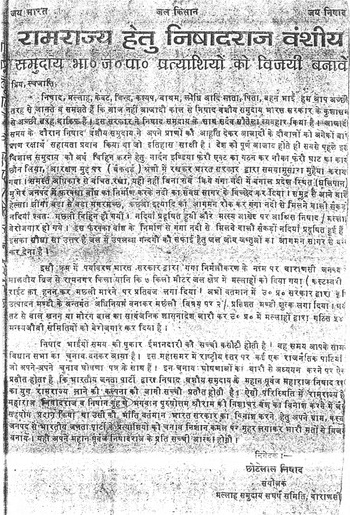
In joining the Hindutva movement, the Nishads sought to gain social legitimacy and recognition. By locating themselves within the Ramayana narratives, they endowed themselves with a sense of solidarity, identity and belonging. Moreover, this strategy was employed to gain a foothold in state institutions, via the BJP. For example, it was during BJP rule that a large statue of Guharaj was erected near the Mallah-dominated village of Chunnar, 40 km from Banaras. The inauguration ceremony was led by a senior BJP Minister, and a poster commemorating the event was distributed across eastern UP, and was often hung in Nishad households. Nishad support for the BJP was also publicly expressed on the river Ganga in the sacred city of Banaras just prior to the UP assembly election in 1991. According to local newspapers, the Mallah community organised a massive boat procession, in which thousands of people participated, carrying flags, banners and loudspeakers, and shouting slogans, such as ‘Jai Sri Ram’ (victory to Lord Ram), expressing their unflinching support for the BJP and the construction of the Ram temple in Ayodhya.Footnote 14 A handbill circulating at the time clearly articulated a message of support for the BJP (see Figure 1 below):
The time has [come] to vote for the election. Having minutely observed the election manifestoes of the various competing parties, it seems that the BJP are the true supporters of Ramraj: the era envisaged by our great forefather of the Nishad dynasty—the great Guharaj Nishad. Under such circumstances the Nishad community should elect the BJP candidates to topple the government of India. As Maharaj Nishadraj extended his coorporation to Lord Parsuram to eliminate the devil dynasty. To support the BJP would be a true tribute to our great forefather, Nishadraj.
The handbill calling the Nishads to support Ramraj and the BJP.

As with the previous handbill mentioned earlier, at the top of the bill appears the captions, ‘Victory to India’, ‘Victory to the water farmers’, and ‘Victory to the Nishads’. The content itself is equally revealing, for while the handbill exhibits political preferences made on the basis of a rational examination of the parties’ manifestos, the ‘natural’ inclination of the community to support BJP is duly emphasized.
Importantly, the appeal to primordial loyalties is couched within the realm of the rational. That is, Nishads make a covenant with the BJP, based on a perception of the past, with a prospect of a better future envisaged under its leadership. Such calculations based on trust belie any notion of ‘false consciousness’ or ‘elite manipulations’ (cf. Guha, S. Reference Guha2007). This point was further illustrated when Mallah support for the BJP was abandoned in the subsequent 1993 elections. The sentiment is aptly captured in a press release published in a local paper, under the title ‘Who will listen to what the Mallah community has to say?’. The article, written by the general secretary of the caste Association, Mallah Samuday Sanrghash Samity (MSSS), is worth quoting at some length:
The incarnation of Lord Ram took place during the Treta age. Ram, having heard and accepted what Nishadraj advised him, blessed him to join mainstream society, forgetting the past. Since then the Mallah community has contributed to the progress of this country. However, the rulers, landlords and state officials have always looked at our vast community with contempt. . . . Despite a constitution being established [in India], injustice has been done to our important community at every level. . . . The community has no famous leader in the political history of India, and while merchants and farmers have the backing of strong organizations, we water farmers do not have any national leader. The reign of Lord Ram is no more. Advani and Kalyan Singh have been talking about the reestablishment of Ramraj falsely in order to capture power. However, under the rule of Kalyan Singh, the ban on fishing in the Ganges caused the economic displacement of thousands of families of fishermen in Banaras. To further the dream of Ramraj will be no less than death for the Mallahs. The MSSS requests the president and the Chief Minister of UP to remove the ban on fishing in the Ganges and give the Mallahs their customary rights of fishing so they may save themselves from starvation. . . . Let us see whether the Chief Minister will listen to the Mallahs or not.Footnote 15
Similar to the other press releases, the caste's role in the project of nation-state building is glorified. The interesting difference here is the clear articulation of disillusionment from both ‘secular’ and ‘religious’ avatars of the state—both have been tested and proven as insufficient frameworks of inclusion, which would facilitate the upward mobility, political recognition and social acceptance of the Mallahs. From this point onwards, one can detect an important shift in the discourse: marginality no longer implies ‘victimhood’, nor does it suggest duty and obligation towards the state, rather it denotes defiance and distinction—producing a heightened sense of entitlement derived from being relatively deprived—‘caste away’.
Phoolan Devi and the Eklavya Raj
Phoolan Devi's entry to the political arena in the late 1990s came at a time when caste mobilisation and electoral competition in UP was rife. The demise of BJP rule and the emergence of newly formed alliances between the OBC based Samajwadi Party (SP) and dalit-based Bahujan Samaj Party (BSP), only heightened the awareness amongst Mallahs that within the gambit of identity politics, they were once again left behind. Whether Phoolan Devi herself should be seen as an ‘elite manipulator’ of cultural symbols, seeking to mobilise her community for political goals, remains an open question, especially considering her affiliations with the Samajvadi Party. Nevertheless, Phoolan Devi, herself a member of the Mallah caste, could also be seen as the embodiment of what the Mallahs felt and experienced in their everyday encounters with the state and social injustice. Phoolan Devi was seen as a person who had succeeded in overcoming extreme poverty, illiteracy and gender and caste discrimination to effectively fight these structures of oppression, and champion the causes of the downtrodden and dispossessed sections of society. It therefore seems that, as Kakar (Reference Kakar1996: 155) observed in a related context, Phoolan Devi is best seen as a person who ‘both mirrors her listeners’ sentiments and gives them birth’. Following is an examination of Devi's use of what came to be a key component in the Mallah construction of identity in UP: the story and symbolism of Eklavya Nishad. It is argued that, for the Nishads, the story of Ekalvya constitutes a powerful example of the historical and contemporary injustices suffered by the community, and emphasises the way in which economic marginalization is intrinsically related to broader patterns of caste prejudice and ideological domination.
This story is a branch within the Hindu epic Mahabharata, and is essentially about a young prince, called Eklavya Nishad, and his ardent devotion to his guru. It tells of the young Eklavya who wanted to learn archery from Drona, a Brahmin who taught warrior princes the mastery of weaponry. The latter refused to accept him as his student since he was a low caste Shudra. Motivated by supreme devotion and determination Eklavya installed a clay figure of his guru Drona to worship and practise archery before it. Before long he became an unrivalled archer. Meanwhile, Drona was determined to make his favoured disciple, Arjuna, the most competent archer in the land. However, following an incident on a hunting trip, Drona and Arjuna became aware that there existed an archer even more accomplished than Arjuna. To their surprise this was the low caste Eklavya, who attributed his skilled archery to Drona. As his guru, Drona demanded the disciple pay his customary fee (dakshina) in the form of his right-hand thumb. Undaunted, and with due humility and devotion, Eklavya cut off his thumb and placed it at the feet of his guru. Thus, Eklavya could no longer remain the best archer in the land.
The story of Eklavya is subject to various interpretations, according to one's ideology. From an ‘orthodox’ Hindu perspective, one could argue that Drona's refusal to take Eklavya as his disciple is consistent with the principle of dharma and karma. That is, because of Eklavya's low caste status, he is barred from engaging in the art of war, which is restricted to the Kshatriya (warrior) caste, to which Arjuna belongs. His attempts to become an archer are therefore a breach of the social hierarchy of the caste system (Varnadharma). However, other elements in the story, especially Eklavya's inferior status and his virtuous qualities of diligence, bravery and unflinching devotion, have made this story very popular amongst low caste groups across India. One telling has it that it is Arjuna, threatened by Eklavya's superior skills, who requests that Drona protect his favoured student's status, by eliminating Ekalavya's ability to shoot. This telling emphasises the lengths that upper castes will go to, in order to maintain their customary superiority.
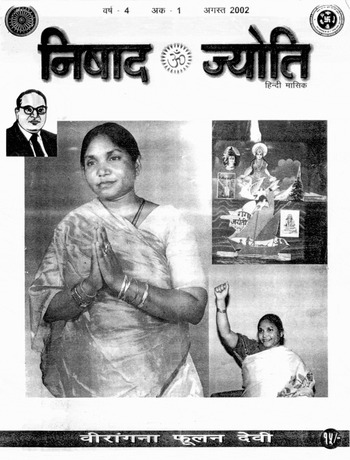
For the Nishads, Eklavya is a hero, whose devotion and sacrifice must be celebrated and commemorated. Once, when discussing the story with a leading member of the community, Bhayalal Nishad, I was handed the caste journal, the Nishad Jyothi (see Figure 2). Bhayalal said, ‘You see the Brahmins who hold the knowledge of the puranas try to cover up such good stories about the Mallahs, because they want to continue to exploit us and treat us like dirt, but now the truth is being revealed’. Indeed, it is in caste journals where one can find overt challenges to upper caste power, where traditional texts are being reinterpreted by the Nishads. These journals serve as a platform for members of the community to raise their fears about their current position and to voice their longstanding grievances and mistrust of Brahminical ideology and the state.
Phoolan Devi on the cover of the Nishad Jyothi. Note the symbolism of the boat on the Ganga and the figure of Guharaj Nishad in the right-hand corner, and a drawing of Ambedkar in the left-hand corner.

In one issue of the Nishad Jyothi was a commentary interwoven within the Eklavya story, authenticated by direct Sanskrit quotes from the Mahabharata epic. In this narration, Eklavya is extolled for his bravery, devotion and moral integrity as opposed to the cowardly and selfish natures of Drona and Arjuna. In addition, the article highlights that in the Mahabharata itself it is said that Drona's demand from his disciple should not be seen as that of guru-dakshina but rather as a salary or wage (vetan).Footnote 16 The implication is that Eklavya, rather than Drona, upheld the ‘true’ principles of dharma and reciprocity by unquestionably allowing his guru to have his thumb. Such interpretations of the story suggest that even within the framework of guru-chela, where the act of giving dakshina is sanctioned, Drona's behaviour cannot be justified. His motivations were flawed and his request unjust.
The narrator then takes the liberty to retell and interpret this myth and the source text in a way consistent with indigenous tradition, thus convincingly and authoritatively presenting those views echoing contemporary low caste sentiments. For example, he laments that despite Drona and Arjuna's contemptible behaviour, ‘. . . politicians and bureaucrats continue to honour Dronacharya and Arjuna for their heroism and courage, rather than admire the true devotee (guru-bhakt), son of the Nishads, Eklavya, who they feel ashamed of’.Footnote 17 The author continues to argue that it is because of ‘Brahminical domination (Brahmanvadi) that the ordinary man (the son of the Nishads) cannot achieve greatness’. He states ‘if he [Eklavya] had been born into a family of Brahmins, he would be able to attain the status of a great man (Mahapurush)’.
The narrator thus highlights the existing hierarchical order and the social political structure as represented by the Brahmin (Drona) and the Kshatriya (Arjuna) respectively, while Eklavya, the Shudra, is the repressed within it.Footnote 18 As such, the story is employed to emphasise the marginalization of the community, both in the past and today. The text is re-appropriated to serve as a ‘cultural weapon’, to use de Certeau's term (Reference de Certeau1988), providing a vehicle for the author to expose the hypocrisy and violence of elite ideology and its oppression of low castes. Thus, by interpreting the Eklavya myth in light of contemporary fears, ambitions and aspirations of the Nishads, the narrator invites his audience to ‘remember anew’ past deeds, and construct their social and political identity accordingly.
As we have seen, Mallah caste associations have made a conscious effort to engage with the state, but the experience of betrayal and marginalization by the state in its various guises (secular and religious) seems to have highlighted their historical and ongoing position of rejection, much like unwanted children. Not surprisingly therefore, Phoolan Devi was seized and hailed by Mallahs as a leader who was particularly suitable and able to appreciate and articulate their predicament in the upper echelons of governance. As a member of the federal parliament from the mid-1990s until her murder in July 2001, Phoolan Devi was a vociferous campaigner against upper caste oppression and a strong advocate for the rights of the poor and marginalized sectors of Indian society. When released from jail in 1993, Phoolan Devi launched a group by the name ‘Eklavya Sena’ (the army of Ekalvya). This group, which was initially formed to teach self-defence to low caste people, soon became a leading organisation protecting and fighting for the rights of backward castes all over North India. The following excerpt from a local newspaper indicates how she used the myth to promote her cause:Footnote 19
The story of the legendary tribal hero of the Mahabharat, Eklavya, plays a pivotal role in all her election meetings. ‘Eklavya was our king. Now, we shall establish “Eklavya raaj” [Eklavya's rule] and ensure that the poor get justice and honour,’ is her message to the downtrodden before they go to the polls (Kumar Reference Kumar1999: 16).
By using the term ‘Eklavyaraj’, Devi was consciously invoking and reversing the utopian ideal of Ramraj—the righteous reign of the divine prince Ram—which in this context refers to the Brahmin-Kshatriya dominant socio-political order. Her call to establish ‘Eklavya raj’ was thus an overt challenge to the ideology of social hierarchy propounded by the dominant elites. It is important to emphasise that Devi's use of Ekalvya reflected her own experience, while resonating strongly with how Mallahs perceived their own encounter with the nation-state and society.
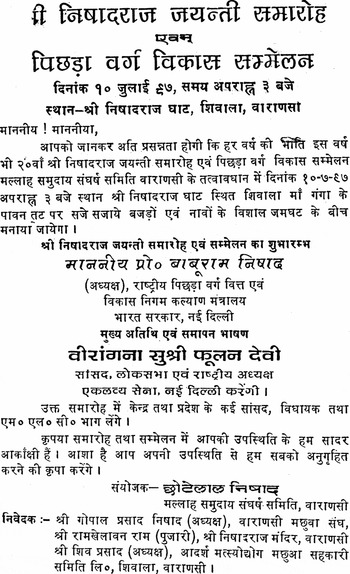
In July 1997 Phoolan Devi was invited by members of the Mallah community of Banaras to participate in the annual celebrations of the Nishadraj Jyanti. The celebrations marked the twentieth anniversary of the building of a local temple dedicated to Guha Raj Nishad. Prior to this much-publicised event numerous pamphlets, handbills and press releases were distributed, hailing Phoolan Devi as a daughter of the Nishads, president of the Eklavya sena, and a celebrated MP (see Figure 3).
Printed leaflet inviting people to participate in the Nishadraj Jyanti in Banaras, July 1997.

The cultural event had a distinctly political angle, orchestrated by the local Mallah Association (MSSS) with the backing of the National Backward Class Development Finance and Development Cooperation. Thus, the cause of the Nishad/Mallah community to restore their traditional rights (e.g., fishing and sandmining) was placed in the wider context of government policies and social and economic displacement of the backward and disadvantaged sections of the population in India.Footnote 20 Such strategies of forming alliances across the caste and class divide, however, rarely achieved their aims of programmatic reforms. Following Devi's murder various political parties sought to claim her as theirs to draw the valuable electoral support of those lower Shudras—the MBCs.Footnote 21 However, it seems that within the continuing ‘caste wars’ and competitive electoral politics of UP, the Nishads, rather than relying on the tenuous nature of these strategic alliances, are increasingly focusing on maintaining and nourishing their own distinct identity and sense of self esteem, as this recent excerpt from a caste journal suggests:
We have observed that members of our own community prepare in advance to celebrate the festivals of Ramnaumi and Sri Krishan Janmastami with fervour and gaiety. However, it is a matter of great sorrow that our community hesitates in celebrating the anniversary and memorial days of the great heroes of our own society, like Lord Ved Vyas, Maharaj Kalu Deewar, Maharaj Guharaj Nishad, the great archer Veer Eklavya, and Brahmshri Valmiki. The result is that those other communities, such as Sweepers, fraudulently snatch our great gods, proudly declaring themselves Valimikis, celebrating his anniversary with fervour. Meanwhile, Brahmins have grabbed Ved Vyas making him a Brahmin hero. If we fail to raise our awareness they will also grab Eklavya from us.Footnote 22
The author goes on to detail the heroic feets of Eklavya and his army in their battle against the evil army of the Yadavs. As with other similar texts, this one draws its authority by quoting obscure Sanskrit verses, followed by a translation for the layman. More importantly, such articulations can only be understood amid the flurry of caste politics in UP, and the way in which the Nishads imagine the nexus between state and society.
Conclusion
In this paper I examine one major caste group lumped under the category of MBCs. By looking at their encounter and experience with the nation-state, I have sought to explain the logic, meaning, structures and internal modes of operation of the Mallah caste in its bid to be heard as a marginalized community amidst the flurry of caste discourse and politics in UP. Certainly, within the Nishad community there are various fractures and power struggles (Doron, In press), but the point to emphasise here is that members of the community are consciously engaged in a process of identity formation, maintained and produced through their encounter and experience with state and society.
Labelled as a ‘criminal caste’ under the colonial state, the Mallah caste were subjected to new forms of stigma and disciplinary regimes, furthering their economic and social marginalization. State development projects implemented by the postcolonial state on behalf of the nation (and the river Ganga) proved equally detrimental to the Mallah community and its primary source of livelihood. Such negative encounters at the level of everyday life directly implicated members of the community with the state, in what was a struggle not simply about economic, political and social empowerment and recognition, but was also a struggle over the interpretation of what constitutes democracy, social justice and Hindu tradition. The Hindutva framework with its visions of Ramraj was seen as a particularly suitable opportunity for the Nishads—the natural allies of Lord Ram—to reinscribe the community into the political imaginary of the nation-state. The employment of Ramraj as an unifying and inclusive symbol illustrates the sophisticated modes of appropriation deployed by Mallahs to overcome the tradition-modernity, state-society divide.
Nevertheless, the realities of everyday life and the spectre of caste wars further intensified the feelings of neglect and social dislocation by the Mallah community. This resulted in a conscious shift, stimulated by Phoolan Devi, in which the fantasy of inclusion was replaced by an empowering discourse of rejection and repudiation, aptly captured in the story of Ekalvya. The utopian vision of Ekalvyaraj thus stands as a metaphor, reflecting the needs, wants and ambitions of the community. Moreover, it operates as a meaningful discursive device, distilling a sense of entitlement and privilege amongst the Mallahs, as they attempt to locate themselves within the social and political environment of UP. Such attempts highlight the experimentation, and trial and error characterising the Mallah's political preferences and strategic affiliations, which is itself indicative of a clear sense of political dynamism. These people are not simply being acted upon or manipulated, rather they act for themselves, in culturally meaningful ways, in order to further their interests.
Political economists have rightly observed that the BSP is increasingly targeting Brahmins, Muslims and MBCs to expand its support base (Jafferlot Reference Jaffrelot1998), and whether this means the demise of caste politics remains a debatable issue. More importantly, though, at the grassroots level, Mayawati's rule continues to be perceived as primarily benefiting the dalits. This is specifically evident in Mayawati's symbolic politics and what has been recently described in the weekly magazine, India Today, as the ‘dalitisation of the state’, referring to the colonisation of time and space by dalit icons and cultural projects.Footnote 23 This ‘dalitisation’ of space is evident in Banaras, much to the chagrin of the Mallah population. For example, a statue of Ambedkar was placed at the entry to Sarai Mohana, a village with an overwhelming majority of Mallahs and only a limited population of dalits. Likewise, the most southern ghat in Banaras, Raj ghat, where the largest concentration of Mallahs resides, is dominated by a high rising temple dedicated to the untouchable saint Ravi Das, frequently visited by multitudes of pilgrims from all over India and the diaspora, including prominent politicians. At the northern end of the city, adjacent to Assi ghat, another symbol of self-glorification, popularly known as Mayawati Park, bears further testament to dalit rule in UP. Throughout this author's fieldwork, members of the Nishad community referred to the political domination of dalits with a mixture of frustration and envy. One boatman describes Mayawati's political opportunism, noting a shift in strategy from an avowedly anti-upper caste one (tilak, tarazu aur talwar, inko maro jutey char) to one where she has become their friend (tilak, tarazu aur talwar yea Mayawati ke hei yaar).Footnote 24 The recent victory of Mayawati is a strong reminder to the Nishads that their struggle and encounter with the state remains fraught with ambiguities and contradictions, effectively rendering them as people who have been progressively ‘caste away’.