Risk-taking behaviors involve potential danger or harm to the individual while also providing an opportunity to obtain reward (Leigh, Reference Leigh1999). Based on this definition, research has traditionally focused on antisocial behaviors, such as criminal activity, substance and tobacco use, as well as unsafe sexual practices (DiClemente, Hansen, & Ponton, Reference DiClemente, Hansen and Ponton1995; Zuckerman, Ball, & Black, Reference Zuckerman, Ball and Black1990). Despite important advances, questions still remain regarding strategies for prevention and treatment of antisocial risk-taking behaviors (Nation et al., Reference Nation, Crusto, Wandersman, Kumpfer, Seybolt and Morrissey-Kane2003). Therefore, it is important to elucidate early behavioral and cognitive markers that predict the development of later risk-taking behaviors.
An ecologically valid behavioral measure that assesses the propensity for risk taking is the balloon analogue risk task (BART; Bornovalova et al., Reference Bornovalova, Cashman-Rolls, O'Donnell, Ettinger, Richards and deWit2009; Lejuez, Aklin, Bornovalova, & Moolchan, Reference Lejuez, Aklin, Bornovalova and Moolchan2005; Lejuez, Aklin, Jones, et al., Reference Lejuez, Aklin, Jones, Strong, Richards and Kahler2003; Lejuez, Aklin, Zvolensky, & Pedulla, Reference Lejuez, Aklin, Zvolensky and Pedulla2003; Lejuez et al., Reference Lejuez, Read, Kahler, Richards, Ramsey and Stuart2002, Reference Lejuez, Aklin, Daughters, Zvolensky, Kahler and Gwadz2007; Wallsten, Pleskac, & Lejuez, Reference Wallsten, Pleskac and Lejuez2005; White, Lejuez, & de Wit, Reference White, Lejuez and de Wit2007, Reference White, Lejuez and de Wit2008). The BART is a computerized task that can be used to index real-world risk-taking behavior. In this task, participants accumulate money or points by pressing a button that inflates a simulated balloon. Each balloon has an explosion point, which results in loss of all points that have been accumulated for that balloon. The BART has been associated with adolescent and adult sensation seeking, impulsivity, and deficiencies in behavioral constraint (Bornovalova et al., Reference Bornovalova, Cashman-Rolls, O'Donnell, Ettinger, Richards and deWit2009; Lejuez et al., Reference Lejuez, Read, Kahler, Richards, Ramsey and Stuart2002). In addition, riskiness on the BART has been found to correlate with addictive, health, and risk behaviors, such as smoking, substance use, sexual behavior, and delinquency in young adults (Lejuez, Aklin, Jones, et al., Reference Lejuez, Aklin, Jones, Strong, Richards and Kahler2003; Lejuez et al., Reference Lejuez, Read, Kahler, Richards, Ramsey and Stuart2002) as well as in adolescents (Lejuez, Aklin, Zvolensky, et al., 2003; Lejuez et al., Reference Lejuez, Aklin, Bornovalova and Moolchan2005, Reference Lejuez, Aklin, Daughters, Zvolensky, Kahler and Gwadz2007).
Individual differences in early temperament and personality have been found to influence developmental pathways to psychiatric problems as well as pathways to normative functioning (e.g., Caspi, Moffitt, Newman, & Silva, Reference Caspi, Moffitt, Newman and Silva1996; Degnan & Fox, Reference Degnan and Fox2007; Kim, Cicchetti, Rogosch, & Manly, Reference Kim, Cicchetti, Rogosch and Manly2009; Lahat, Hong, & Fox, Reference Lahat, Hong and Fox2011; Pérez-Edgar & Fox, Reference Pérez-Edgar and Fox2005a) and may play an influential role in the development of risk-taking behaviors. Williams et al. (Reference Williams, Fox, Lejuez, Reynolds, Henderson and Pérez-Edgar2010) used a multilevel approach to predict substance use from behavioral inhibition (BI), a temperament identified in infancy and characterized by heightened negative affect, vigilance toward novelty, and withdrawal from unfamiliar social situations (Fox, Henderson, Marshall, Nichols, & Ghera, Reference Fox, Henderson, Marshall, Nichols and Ghera2005; Kagan, Reznick, & Snidman, Reference Kagan, Reznick and Snidman1988; Kagan & Snidman, Reference Kagan and Snidman1991). The findings indicated that high BI observed during infancy was associated with increased risk for substance-related problems in adolescence among boys, whereas high BI protected against substance-related problems in adolescence among girls. In addition, high BI increased the risk for substance-related problems during adolescence among high risk-taking children. In contrast, high BI protected low risk-taking children from substance-related problems in adolescence (Williams et al., Reference Williams, Fox, Lejuez, Reynolds, Henderson and Pérez-Edgar2010). Although BI individuals display risk-taking behaviors such as substance use, it is likely that they are turning to substance use as a means for coping with social situations (Arnett, Reference Arnett2001) and not because of a temperamental tendency toward taking risks.
Another temperament that is likely to be associated with propensity for risk-taking behaviors is exuberance. Often contrasted with BI, temperamental exuberance has been defined by positive reactivity to novelty, approach behavior, and sociability (Putnam & Stifter, Reference Putnam and Stifter2005). During infancy and toddlerhood, this temperament is characterized by positive affect, motor reactivity to novel stimuli, and positive social behavior (Calkins, Fox, & Marshall, Reference Calkins, Fox and Marshall1996; Degnan et al., Reference Degnan, Hane, Henderson, Moas, Reeb-Sutherland and Fox2011; Fox, Henderson, Rubin, Calkins, & Schmidt, Reference Fox, Henderson, Rubin, Calkins and Schmidt2001; Hane, Fox, Henderson, & Marshall, Reference Hane, Fox, Henderson and Marshall2008; Park, Belsky, Putnam, & Crnic, Reference Park, Belsky, Putnam and Crnic1997). Children with an exuberant temperament are also characterized by impulsivity, sensitivity to reward, fearlessness, and risk taking (Fox et al., Reference Fox, Henderson, Rubin, Calkins and Schmidt2001; Polak-Toste & Gunnar, Reference Polak-Toste, Gunnar, Marshall and Fox2006; Rothbart & Bates, Reference Rothbart, Bates, Damon and Eisenberg2006).
Exuberant temperament is associated with both adaptive and maladaptive social–emotional outcomes (Eisenberg et al., Reference Eisenberg, Fabes, Guthrie, Murphy, Poulin and Shepard1996; Rothbart, Ahadi, & Hershey, Reference Rothbart, Ahadi and Hershey1994). For example, according to Depue and Collins (Reference Depue and Collins1999), individuals with a bias toward behavioral approach, rather than patterns of behavioral withdrawal, display positive affect and approach only when goals are not being blocked. However, when goals are blocked such individuals may display frustration and even aggression toward the blocking stimulus. Furthermore, parent-rated positive affect in school-aged children has been linked to externalizing problems (Degnan et al., Reference Degnan, Hane, Henderson, Moas, Reeb-Sutherland and Fox2011; Eisenberg et al., Reference Eisenberg, Fabes, Guthrie, Murphy, Poulin and Shepard1996; Putnam & Stifter, Reference Putnam and Stifter2005; Rothbart et al., Reference Rothbart, Ahadi and Hershey1994; Stifter, Putnam, & Jahromi, Reference Stifter, Putnam and Jahromi2008).
There is also evidence that exuberant temperament is associated with adaptive outcomes. For example, infants who respond positively to novel sensory stimuli show less inhibition and more sociability in infancy and childhood (Fox et al., Reference Fox, Henderson, Rubin, Calkins and Schmidt2001; Hane et al., Reference Hane, Fox, Henderson and Marshall2008). In addition, preschool children characterized as confident and outgoing, characteristics associated with exuberance, displayed less behavioral control but better social skills as adults (Caspi et al., Reference Caspi, Harrington, Milne, Amell, Theodore and Moffitt2003). Moreover, children with a greater likelihood of displaying a high, stable exuberant profile during early childhood were found to display greater social competence and less social reticence at 5 years of age when interacting with an unfamiliar peer (Degnan et al., Reference Degnan, Hane, Henderson, Moas, Reeb-Sutherland and Fox2011).
Although the underlying neurobiology involved in exuberant temperament is subject to debate, it is likely that positive reactivity and approach to novelty result from either increased activation of the behavioral activation system (BAS), decreased activation of the BI system, or activation in motivational systems involved in processing of anticipation and saliency of reward (Depue & Collins, Reference Depue and Collins1999; Gray & McNaughton, Reference Gray and McNaughton2000; Panksepp, Reference Panksepp1998; Zuckerman, Reference Zuckerman1991). According to Gray (Reference Gray1982), increased BAS activity leads to greater approach and impulsivity. In addition, according to Depue and Collins (Reference Depue and Collins1999), approach behavior involves dopaminergic projections to brain regions associated with processing of reward. Candidate genes that modulate dopamine, such as dopamine receptor D4, dopamine transporter, and catechol-O-methyltransferase, have been found to play a role in impulsivity (see Kreek, Nielsen, Butelman, & LaForge, Reference Kreek, Nielsen, Butelman and LaForge2005) and dopamine receptor D4 has also been found to be involved in risk taking and novelty seeking (Lusher, Chandler, & Ball, Reference Lusher, Chandler and Ball2001; Schinka, Letsch, & Crawford, Reference Schinka, Letsch and Crawford2002). Therefore, increased activation in these systems may lead individuals to approach and experience greater positive affect in response to reward (Depue & Collins, Reference Depue and Collins1999; Polak-Toste & Gunnar, Reference Polak-Toste, Gunnar, Marshall and Fox2006).
The multifinality of developmental pathways associated with exuberance underscores the importance of identifying possible moderators of maladaptive outcomes (Cicchetti & Rogosch, Reference Cicchetti and Rogosch1996). Recent research has pointed to the role of executive function (EF) in the regulation of motivated and risk-taking behavior (for a review, see Somerville & Casey, Reference Somerville and Casey2010). EFs are generally thought to underlie one's ability to control thoughts, behavior, and impulses; to create long-term goals while ignoring distracting information; and to play a significant role in decision making (Bunge & Crone, Reference Bunge, Crone, Rumsey and Ernst2009; Zelazo, Carlson, & Kesek, Reference Zelazo, Carlson, Kesek, Nelson and Luciana2008). Thus, exuberant children and adolescents with poor EF abilities may be at particular risk for negative outcomes resulting from high levels of impulsivity and risk-taking behaviors.
An additional finding that likely has considerable influence on the behaviors and outcomes of exuberant children is that EF is often impaired in light of emotionally charged interactions. This reduced cognitive control is especially pronounced during adolescence when rates of risky behavior, such as substance use, increase (Casey, Getz, & Galvan, Reference Casey, Getz and Galvan2008). For example, adolescents have been found to make riskier choices compared to adults when a reward was given during decision making (Figner, Mackinlay, Wilkening, & Weber, Reference Figner, Mackinlay, Wilkening and Weber2009). Furthermore, in the presence of peers, adolescents, but not adults, showed increased activation in reward-related brain regions, such as the ventral striatum and orbitofrontal cortex, and this activation predicted subsequent risk taking in a simulated driving task. In addition, brain areas associated with EF were less strongly recruited by adolescents than adults (Chein, Albert, O'Brien, Uckert, & Steinberg, Reference Chein, Albert, O'Brien, Uckert and Steinberg2011). These studies show that risky choices tend to peak during adolescence and it is likely that EF would play a similar role in younger children with high-risk tendencies, such as exuberant children.
Two components of EF that may be relevant for risk-taking behavior are attention shifting and inhibitory control. Attention shifting is the ability to flexibly reallocate attention within one's internal and external environments to support goal-directed behaviors or meet task demands (Pérez-Edgar & Fox, Reference Pérez-Edgar and Fox2005b). It also involves the ability to switch between different tasks. For example, 3-year-olds have been found to perseverate on a single task despite being given a new task with new rules. In contrast, by 5 years of age, most children are able to switch tasks immediately when instructed to do so (Zelazo et al., Reference Zelazo, Carlson, Kesek, Nelson and Luciana2008). According to Lonigan and Vasey (Reference Lonigan and Vasey2009), attention shifting could reduce a child's level of fear or negative affect by facilitating the disengagement of attention from negative thoughts or threatening stimuli and focusing attention on more positive and adaptive stimuli. Similarly, attention shifting could play a role in uninhibited children's risk-taking behavior by allowing a child to focus on adaptive stimuli and keep multiple outcomes in mind (such as both reward and punishment).
Another EF ability, inhibitory control, is the capacity to inhibit a dominant response in favor of a more appropriate or subdominant response (Rothbart, Ellis, Rueda, & Posner, Reference Rothbart, Ellis, Rueda and Posner2003). This EF ability could help a child modulate the expression of an inappropriate or maladaptive response, aiding in adaptive social and emotional development (Kieras, Tobin, Graziano, & Rothbart, Reference Kieras, Tobin, Graziano and Rothbart2005). Thus, inhibitory control could play a role in risk taking by inhibiting maladaptive risky choices in favor of more balanced decisions. It is important to note that BI and inhibitory control represent different constructs and may interact to result in developmental outcomes. BI refers to a temperamental style characterized by high levels of fearful reactivity to novelty (e.g., Fox et al., Reference Fox, Henderson, Marshall, Nichols and Ghera2005), whereas inhibitory control is a higher order cognitive process that involves the ability to inhibit and override dominant responses and behaviors in favor of more appropriate responses (Rothbart et al., Reference Rothbart, Ellis, Rueda and Posner2003). Behaviorally inhibited individuals may be high or low on inhibitory control, and individuals who are not behaviorally inhibited may perform well or poorly on inhibitory control tasks.
The manner in which attention shifting and inhibitory control contribute to adaptive behavior may differ as a function of a child's style of temperamental reactivity (Eisenberg et al., Reference Eisenberg, Sadovsky, Spinrad, Fabes, Losoya and Valiente2005; White, McDermott, Degnan, Henderson, & Fox, Reference White, McDermott, Degnan, Henderson and Fox2011). For example, high levels of attention shifting have been found to decrease the risk for anxiety problems in children with high levels of BI, whereas high levels of inhibitory control increased this risk for anxiety symptoms (White et al., Reference White, McDermott, Degnan, Henderson and Fox2011).
The purpose of the current study was to examine whether attention shifting and inhibitory control play a role in risk-taking behavior on the BART among children who are prone to temperamental exuberance. Although previous work has examined either one of these EF abilities independently in relation to outcomes, few have included both of them in the same study. Attention shifting may play a role in participant performance on the BART, as the potential gain of accruing a greater reward must be balanced against the potential risk of losing all money accrued for that balloon (Bornovalova et al., Reference Bornovalova, Cashman-Rolls, O'Donnell, Ettinger, Richards and deWit2009). In addition, inhibitory control may be important for performance on the BART with regard to withholding risky pumping of balloons.
The present study provides a longitudinal investigation of the moderating role that EF plays in the relation between exuberant temperament and risk-taking propensity. We focus on the interplay between temperament and cognitive processes in order to predict the propensity for risk-taking behavior and thus present a multilevel analysis of how this behavior unfolds (Cicchetti & Toth, Reference Cicchetti and Toth2009). Applying a multilevel approach to the investigation of developmental trajectories that lead to antisocial risk behaviors is important for understanding adaptive and maladaptive developmental processes (Cicchetti & Valentino, Reference Cicchetti, Valentino and Masten2007). Temperament has been thought to initially stem from a biological predisposition (Kagan, Reznick, & Snidman, Reference Kagan, Reznick and Snidman1987; Kagan & Snidman, Reference Kagan and Snidman1991), whereas EF involves processes at the cognitive level. We expected to find a positive association between exuberance and propensity for risk taking. Furthermore, in light of the role that EF has been found to play in risk-taking behavior, we expected this association to be particularly pronounced among children relatively low in attention shifting and inhibitory control.
Methods
Participants
As part of a longitudinal study, families from a large metropolitan area in the United States were contacted by mail and were screened by phone in order to insure that infants were born full term and had not experienced any serious illness or developmental problems. Seven hundred seventy-nine infants, who met these criteria, were brought into the lab at 4 months of age for temperament screening, during which positive and negative affect and motor reactivity to novel stimuli were assessed (for a complete description of the recruitment and selection process, see Hane et al., Reference Hane, Fox, Henderson and Marshall2008). Of this sample, 291 infants (135 males, 156 females) representing the full range of patterns of reactivity were selected and invited to continue participation in the larger longitudinal study. Of these infants, 187 (64.30%) were Caucasian, 41 (14.10%) were African American, and 63 (21.50%) were of other various ethnic backgrounds. Most mothers were at least college graduates (84.40%) or high school graduates (15.60%).
Procedures
Following the temperament screening at 4 months, infants visited the lab again at 9, 24, 36, 48, and 60 months of age. At 9 months of age behavioral and affective reactivity were assessed using emotion-eliciting paradigms adapted from the Laboratory Temperament Assessment Battery (Goldsmith & Rothbart, Reference Goldsmith and Rothbart1999). When children were 24 and 36 months, behavior and affect were observed during BI (Fox et al., Reference Fox, Henderson, Rubin, Calkins and Schmidt2001) and risk-taking (Kochanska, Reference Kochanska1995; Pfeifer, Goldsmith, Davidson, & Rickman, Reference Pfeifer, Goldsmith, Davidson and Rickman2002; Putnam & Stifter, Reference Putnam and Stifter2005) paradigms. At 48 months, children were brought into the laboratory for various assessments including measures of EF using the Dimensional Change Card Sort (DCCS; Zelazo, Reference Zelazo2006), Day–Night Stroop (Gerstadt, Hong, & Diamond, Reference Gerstadt, Hong and Diamond1994), Grass–Snow Stroop (Carlson & Moses, Reference Carlson and Moses2001), as well as the verbal IQ subtest of the Wechsler Preschool and Primary Scale of Intelligence (Wechsler, Reference Wechsler2002). Finally, at 60 months children were brought into the laboratory for an additional assessment, which included a risk-taking propensity measure, the Youth BART (BART-Y; Lejuez et al., Reference Lejuez, Aklin, Daughters, Zvolensky, Kahler and Gwadz2007).
Measures
Longitudinal exuberance profiles
In order to examine the associations between longitudinal patterns of exuberance and risk-taking outcomes at 60 months, the longitudinal exuberance profiles created by Degnan et al. (Reference Degnan, Hane, Henderson, Moas, Reeb-Sutherland and Fox2011) were used. Using longitudinal exuberance profiles provides an index of the stability or level of exuberance over time. These profiles were created using a latent profile analysis (Gibson, Reference Gibson1959) in order to produce a measure of the probability of membership in a high exuberance profile. Measures included in the profile analysis included observed measures of positive reactivity during the temperament screening at 4 months (Hane et al., Reference Hane, Fox, Henderson and Marshall2008); positive approach behavior at 9 months (Goldsmith & Rothbart, Reference Goldsmith and Rothbart1999); and positivity, approach, and sociability during the BI (Fox et al., Reference Fox, Henderson, Rubin, Calkins and Schmidt2001) and exuberance/risk-taking (Putnam & Stifter, Reference Putnam and Stifter2005) paradigms at 24 and 36 months of age.
During the 4-month screening, infant behavior during the reactivity paradigm was subsequently coded as follows: a motor reactivity score was obtained by summing the frequencies of arm waves, arm wave bursts (several waves in rapid succession), leg kicks, leg kick bursts, back arches, and hyperextensions throughout the paradigm. A positive reactivity measure was derived from these data, which included frequencies of positive affect and motor reactivity codes. Coders achieved intraclass correlation coefficients (ICCs) ranging from 0.80 to 0.92 (see Hane et al., Reference Hane, Fox, Henderson and Marshall2008).
At 9 months of age, infants completed a number of tasks from the Laboratory Temperament Assessment Battery (Prelocomotor Version 3.1; Goldsmith & Rothbart, Reference Goldsmith and Rothbart1999), including masks, unpredictable toys, puppets, and peek-a-boo. A positive approach measure, coded in epochs, was derived from these data and included the following codes: intensity of smiling, positive motor behavior, peak to joy, attention toward puppets, and approach toward stimuli. Reliabilities across 20% of the cases were achieved separately for each of the scales during each episode. The κ values ranged from 0.75 to 0.92 (M = 0.85) for the puppet codes, 0.81 to 0.84 (M = 0.83) for the peek-a-boo codes, 0.59 to 0.98 (M = 0.78) for the unpredictable toy codes, and 0.76 to 0.97 (M = 0.85) for the mask codes. ICCs computed for latency to joy during puppets (r = .93) and peek-a-boo (r = .84), as well as duration of attention to the puppets (r = .97), showed good interrater reliability (see Degnan et al., Reference Degnan, Hane, Henderson, Moas, Reeb-Sutherland and Fox2011).
At 24 and 36 months of age, children were assessed for exuberant affect and behavior during the standard BI paradigm (Fox et al., Reference Fox, Henderson, Rubin, Calkins and Schmidt2001; Kagan, Reznick, & Snidman, Reference Kagan, Reznick and Snidman1987), as well as the exuberance/risk-taking paradigm (Kochanska, Reference Kochanska1995; Pfeifer et al., Reference Pfeifer, Goldsmith, Davidson and Rickman2002; Putnam & Stifter, Reference Putnam and Stifter2005). At 24 and 36 months, the BI paradigm included a freeplay task, a stranger approach task, a robot task, and a tunnel task. At 24 months, the exuberance/risk-taking tasks included asking children to stick their hands into a black box, climb up steps to jump onto a mattress, watch a confetti popper, and approach a vacuum cleaner. At 36 months, the exuberance/risk-taking tasks included asking them to put on a blood pressure cuff, jump on a trampoline, touch a gorilla mask, climb up steps toward the wall, touch a realistic-looking snake, touch an unpredictable mechanical dragon toy, and sit close to the experimenter to read a book. Three measures were derived from data collected at 24 and 36 months of age: positivity, which included codes for smiling and positive vocalizations; approach, which included codes for speed to touch/approach the stimuli, distance from mother, speed to vocalize, activity level, number of prompts (reversed scored), degree of approach, and willingness to perform each task; and sociability, which included codes for proximity, talking, smiling, gesturing, and verbal initiations (all toward the experimenter). Interrater reliability for these continuous measures ranged from 0.60 to 0.98. An overall subscale of exuberance was computed at 24 and 36 months of age as the average of positivity, approach, and sociability (see Degnan et al., Reference Degnan, Hane, Henderson, Moas, Reeb-Sutherland and Fox2011).
Degnan et al. (Reference Degnan, Hane, Henderson, Moas, Reeb-Sutherland and Fox2011) estimated longitudinal latent classes using the above measures of exuberance at 4, 9, 24, and 36 months. Two profiles (high exuberance and low exuberance) were found to provide the best fitting model. The high exuberance profile (n = 83, 28%, 50 females) displayed a higher percentage of membership in the 4-month positive group (46%) and higher levels of 9-month positive approach, 24-month exuberance, and 36-month exuberance. The low exuberance profile (n = 208, 72%, 105 females) displayed a lower percentage of membership in the 4-month positive group (31%) and lower levels of 9-month positive approach, 24-month exuberance, and 36-month exuberance (for more details, see Degnan et al., Reference Degnan, Hane, Henderson, Moas, Reeb-Sutherland and Fox2011). Individual probabilities of membership in the two profiles were computed and the present study includes the probabilities of membership in the high exuberance profile as the measure of exuberance across early childhood. The latent profile analysis was computed using all 291 participants who had data for at least one time point (i.e., 4 months of age). Reasons for missing data during these and subsequent visits included refusal by children to perform the tasks, experimenter or technical errors, difficulty scheduling laboratory visits at these ages, family relocation, and permanent attrition.
DCCS
At 48 months of age the children were administered the DCCS (Zelazo, Reference Zelazo2006) in order to assess attention shifting between two sets of rules. Participants were presented with two sorting boxes with a model card mounted on each box and they were instructed to sort cards. In the practice phase they were trained to first sort cards according to one dimension (e.g., color) and then according to the other dimension (e.g., shape). During the testing phase children were presented with cards that vary on two dimensions (e.g., a blue star or a red truck). The sorting cards varied on two dimensions as well (e.g., a red star or a blue truck), but no sorting card matched a model card on either color or shape. In the first test phase (preswitch) participants were asked to sort eight cards according to one dimension (e.g., color), and in the second testing phase (postswitch) they were asked to sort the cards again according to the other dimension (e.g., shape). The order of dimension was counterbalanced, and children's scores were computed according to the percentage of correct postswitch sorts. Of the original 291 participants, 208 had complete DCCS data. No differences in exuberance were observed between participants who had complete DCCS data and participants that did not, t (280.31) = 0.61, p = .54. Children who did not sort correctly on at least 80% of the preswitch trials were excluded from the analysis (n = 27). Thus, DCCS data in the present study included 181 participants.
Day–Night Stroop
At 48 months of age children were also administered the Day–Night Stroop (Gerstadt et al., Reference Gerstadt, Hong and Diamond1994). On this task children are required to inhibit a prepotent response and instead provide a subdominant response. Children were asked to say the word “day” when presented with a picture of the moon and “night” when presented with a picture of the sun. Children were administered up to 10 practice trials until they responded correctly to the consecutive presentation of a day and a night card. The task included 16 test trials, with the sun and moon pictures presented eight times each in a pseudorandom order. Of the original 291 participants, 198 had complete Day–Night Stroop data. No differences in exuberance were observed between participants who had complete Day–Night Stroop data and participants that did not, t (231.02) = –0.27, p = .79. Children who did not get one of each trial type correct during practice trials or who completed less than half of the test trials were excluded from the analyses (n = 24). Thus, the Day–Night Stroop data included a total of 174 participants. The variable of interest was the children's percentage of correct responses on test trials, reflecting a child's ability to inhibit a prepotent response.
Grass–Snow Stroop
An additional inhibitory control task that was administered at 48 months was the Grass–Snow Stroop (Carlson & Moses, Reference Carlson and Moses2001). In this task, unlike the Day–Night Stroop, children are asked to respond by pointing rather than speaking. The experimenter first verified that the child could name the colors of grass and snow by asking “What color is grass?” and “What color is snow?” A large board was then presented that had a white card attached to the upper-left corner, a green card attached to the upper-right corner, and two foam cut-outs shaped like hands centered below the colored cards. The child was told to point to the white card when the experimenter said “grass” and to point to the green card when the experimenter said “snow.” Children received up to 10 practice trials until the child responded correctly to the consecutive presentation of both a grass and a snow trial. There were 16 test trials, with the white and green picture cards presented eight times each in a pseudorandom order. Of the original 291 participants, 198 had complete Grass–Snow Stroop data. No differences in exuberance were observed between participants who had complete Grass–Snow Stroop data and participants who did not, t (232.36) = –1.10, p = .27. Children who did not get one of each trial type correct during practice trials or who completed less than half of the test trials were excluded from the analyses (n = 16). Thus, the Grass–Snow Stroop data included 182 participants. The variable of interest was the children's percentage of correct responses on test trials, reflecting a child's ability to inhibit a prepotent response.
Verbal IQ
The vocabulary and information subscales of the Wechsler Preschool and Primary Scale of Intelligence (Wechsler, Reference Wechsler2002) were administered at 48 months of age. An age-adjusted scaled verbal IQ score was derived from the prorated scores of the two subscales. This verbal IQ score was included in the present analysis in order to control for separate effects that a child's verbal IQ may have on their performance on the EF tasks. Complete verbal IQ data were obtained from 200 participants. No differences in exuberance were observed between participants who had complete verbal IQ data and participants who did not, t (289) = –0.09, p = .93.
BART-Y
At 60 months of age the participants completed the BART-Y (Lejuez et al., Reference Lejuez, Aklin, Daughters, Zvolensky, Kahler and Gwadz2007). The BART-Y is a computerized risk-taking propensity measure that requires participants to inflate computer-generated balloons without popping them in order to earn points. Each pump is worth 1 point, but if a balloon explodes then all points accrued for that balloon are lost. Participants could stop pumping the balloon at any time prior to explosion and allocate the accrued points to a permanent prize meter, and they were informed that they would win a prize in accordance with the points they earned. The task was divided into two blocks consisting of 10 balloons in each block. Dividing the task into two blocks allows the examination of the differences in balloon pumping over time. The dependent measure was the adjusted average number of pumps or the average number of pumps on trials on which a balloon did not explode. This is the standard outcome measure in previous BART studies (e.g., Lejuez et al., Reference Lejuez, Read, Kahler, Richards, Ramsey and Stuart2002, Reference Lejuez, Aklin, Daughters, Zvolensky, Kahler and Gwadz2007). The reliability of the task is supported by robust correlation across blocks within a single session (r = .70; Lejuez et al., Reference Lejuez, Aklin, Daughters, Zvolensky, Kahler and Gwadz2007) and acceptable test–retest reliability across 1-year intervals (Year 1–Year 2, r = .49; Year 2–Year 3, r = .67; MacPherson, Magidson, Reynolds, Kahler, & Lejuez, Reference MacPherson, Magidson, Reynolds, Kahler and Lejuez2010). The validity of the BART-Y has been assessed and the association between BART-Y and risk behaviors remained significant after controlling for demographic variables, impulsivity, and sensation seeking (Lejuez et al., Reference Lejuez, Aklin, Daughters, Zvolensky, Kahler and Gwadz2007). BART data in the present study were obtained from 225 participants. No differences in exuberance were observed between participants who had complete BART data and participants who did not, t (199.76) = 0.71, p = .47.
Results
Descriptive statistics
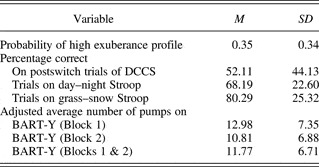
Means and standard deviations of predictor (probability of membership in high exuberance profile and scores on EF measures) and outcome (adjusted average number of pumps on the BART-Y) variables are presented in Table 1.
Means and standard deviations of predictor and outcome variables

Note: DCCS, Dimensional Change Card Sort; BART-Y, Balloon Analogue Risk Task, Youth version.
Preliminary analyses
A series of t tests was used to examine sex differences on all predictor and outcome variables. Significant sex differences were found for Day–Night Stroop, t (144.50) = −2.08, p < .04, and Grass–Snow Stroop, t (140.02) = −3.13, p < .002, with females (Day–Night Stroop, M = 71.43, SD = 20.13; Grass–Snow Stroop, M = 85.65, SD = 20.29) displaying higher scores than males (Day–Night Stroop, M = 64.12, SD = 24.91; Grass–Snow Stroop, M = 73.75, SD = 29.16). No other significant sex differences were found (all ps > .75). Thus, sex was included as a covariate in the regression analysis with the Stroop tasks, but it was removed from all other further analyses.
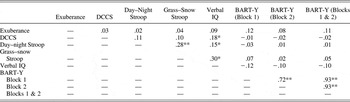
In addition, Pearson correlations were used to examine the relations among predictor and outcome variables, as well as verbal IQ (see Table 2). A significant correlation was found between adjusted average number of pumps on Block 1 and Block 2 of the BART-Y, as well as between Block 1 and the total score on the BART-Y and Block 2 and the total score on the BART-Y. A paired sample t test indicated that the average number of pumps on Block 1 was significantly higher than Block 2, t (218) = 6.37, p < .0001. In addition, a significant correlation was found between the two Stroop tasks. Given this correlation, the Day–Night Stroop and Grass–Snow Stroop scores were averaged to create a composite measure of inhibitory control. No significant correlations were found among the DCCS, the Stroop tasks, the exuberance, or the BART adjusted average number of pumps score. Significant correlations were found between verbal IQ and the EF measures (DCCS score, Day–Night Stroop score, and Grass–Snow Stroop score). Given these effects, verbal IQ was entered as a control variable in all the following analyses.
Correlation between predictor and outcome variables

Note: DCCS, Dimensional Change Card Sort; BART-Y, Balloon Analogue Risk Task, Youth version.
*p < .05. **p < .01.
Effects of exuberance and EF on risk-taking propensity
To examine the moderating role of EF in the relation between the probability of high exuberance and risk-taking propensity, separate hierarchical multiple regression analyses with attention shifting and inhibitory control were computed for Block 1 and Block 2 of the BART-Y, as well as for the two blocks combined. To reduce multicollinearity and aid in interpretation, mean centered predictors were used. Next, the interaction terms were computed as the product between the mean-centered continuous measures of probability of high exuberance and attention shifting/inhibitory control. The first step of the regression analyses included verbal IQ and the main effects of the probability of high exuberance and attention shifting/inhibitory control, as well as gender for the analyses with inhibitory control. To test for significant moderation effects of attention shifting/inhibitory control on the link between the probability of high exuberance and risk-taking propensity, the interaction product term between the probability of high exuberance and attention shifting/inhibitory control was entered in the second step of the regression analyses. Although all of the regression models were examined for significance, the moderation hypotheses were tested by examining the second step for whether it significantly increased the variance explained by the model. Interactions were probed and plotted according to the guidelines by Aiken and West (Reference Aiken and West1991). High and low levels of high exuberance probability and attention shifting/inhibitory control were computed as ±1 SD. Follow-up statistical tests from these probes are reported below.
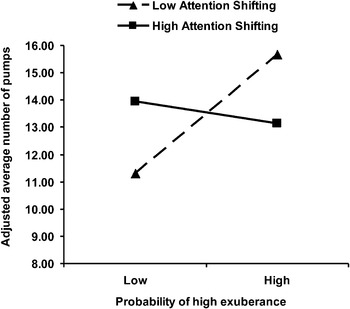
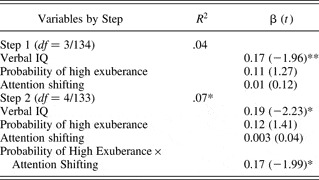
Significant findings were obtained for the regression including attention shifting predicting BART-Y Block 1 only. The addition of the interaction term between the probability of high exuberance and attention shifting significantly improved the model, ΔR 2 = .03, F (1, 133) = 4.00, p < .05 (see Table 3 and Figure 1). The full model with the interaction term was at trend level, F (4, 133) = 2.34, p = .058, explaining 7% of the variance in risk-taking propensity. In addition, verbal IQ was found to significantly predict risk-taking propensity on the BART-Y (see Table 3). No significant results were obtained when including inhibitory control as a moderator.
Joint effect of probability of high exuberance and attention shifting on risk-taking propensity

Hierarchical multiple regression analysis predicting 5-year risk-taking propensity

*p < .05. **p < .058.
Follow-up regressions revealed that the probability of high exuberance was related to risk-taking propensity on BART-Y Block 1 only when children exhibited poor attention shifting. Specifically, within children who exhibited low attention shifting, the probability of high exuberance predicted increased risk-taking propensity on the BART-Y (β = 0.29), t (133) = 2.34, p < .05. However, when children showed high attention shifting, exuberance was not related to risk-taking propensity (β = –0.05), t (133) = –0.46, p = .65.
Discussion
The findings from the current study indicated that attention shifting moderated the link between exuberant temperament and propensity for risk-taking behaviors during childhood. Exuberance was positively associated with propensity for risk taking but only among children with poor attention shifting skills. It is interesting that exuberance was unrelated to risk-taking propensity for children with high levels of attention shifting. At high levels of attention shifting, risk-taking propensity scores were clustered around the sample mean regardless of temperamental exuberance. In addition, inhibitory control did not play a role in risk-taking propensity of high versus low exuberant children. These findings were obtained using a task that assessed the propensity for risk-taking behaviors in childhood. Riskiness on the BART has been associated with antisocial risk behaviors, such as smoking, substance use, sexual behavior, and delinquency in adolescence and young adulthood (Lejuez, Aklin, Jones, et al., Reference Lejuez, Aklin, Jones, Strong, Richards and Kahler2003; Lejuez, Aklin, Zvolensky, et al., 2003; Lejuez et al., Reference Lejuez, Read, Kahler, Richards, Ramsey and Stuart2002, Reference Lejuez, Aklin, Bornovalova and Moolchan2005, Reference Lejuez, Aklin, Daughters, Zvolensky, Kahler and Gwadz2007).
Our study illustrates the importance of a multilevel analysis approach (Cicchetti & Toth, Reference Cicchetti and Toth2009; Cicchetti & Valentino, Reference Cicchetti, Valentino and Masten2007). We predicted the propensity for risk taking, which has been associated with antisocial behaviors, by examining the complex interplay between early temperament and childhood EF. Our findings that attention shifting, but not inhibitory control, interacts with exuberance to predict risk taking underscores the importance of using multiple methods to understand the development of adaptive and maladaptive outcomes.
Why might attention shifting skills, but not inhibitory control, moderate the relations between temperamental exuberance and risk taking? One possibility is the salience of reward or the differential weighing of reward versus punishment that is involved in the particular measure of risk taking used in this study. It is possible that high exuberant/low attention shifting children tend to focus primarily on the reward associated with the behavior and are not able to shift their attention to consider the risk involved. In addition, children with low exuberance who were also low on attention shifting may rigidly focus on the risk of potential loss, and they are unable to shift their attention to the possibility of gaining reward. Although inhibitory control can play a protective role in avoiding risky behaviors, it is possible that for balanced performance on the BART, mere inhibitory control is not sufficient to control risk taking and the ability to flexibly consider different possible outcomes is necessary. These interpretations are in line with the notion that during the BART participants must weigh the potential reward versus punishment with every pump (Bornovalova et al., Reference Bornovalova, Cashman-Rolls, O'Donnell, Ettinger, Richards and deWit2009). The results of the present study indicate that individuals exhibiting high exuberance and poor attention shifting have difficulty with this balancing of gain/loss, which results in high risk-taking behavior. In contrast, for individuals displaying low exuberance and low attention shifting, difficulty in balancing gain/loss results in low risk taking.
Exuberance was only associated with risk-taking propensity when children were relatively low in attention shifting. These results suggest that high attention shifting is important for making balanced decisions involving risk. These findings demonstrate the multifinality of development (Cicchetti & Rogosch, Reference Cicchetti and Rogosch1996), and they are in line with other research demonstrating that attention shifting and inhibitory control have differential influences on the levels of risk or adaptation (White et al., Reference White, McDermott, Degnan, Henderson and Fox2011). For example, White et al. found that high levels of inhibitory control increased the risk for anxiety symptoms among behaviorally inhibited children, whereas high levels of attention shifting decreased the risk for anxiety problems in these children. Taken together, the findings of the current study and White et al.'s study suggest that high levels of attention shifting may serve as a protective factor in the link between temperament and negative outcomes. This conclusion may have important implications for prevention and intervention efforts in the form of training in order to improve attention-shifting skills. Studies have shown that training in a specific EF task can lead to more generalized improvements in EF (e.g., Dowsett & Livesey, Reference Dowsett and Livesey2000; Kloo & Perner, Reference Kloo and Perner2003), and this can be relevant for developmental outcomes.
The hierarchical regression predicting risk-taking propensity from the probability of high exuberance only yielded significant results for the first block of the task. Although risk-taking propensity was highly correlated across the two blocks, which supports the reliability of the BART, the adjusted average number of pumps on Block 2 was lower than on Block 1. This pattern of decrease is in line with previous work (Lejuez et al., Reference Lejuez, Aklin, Daughters, Zvolensky, Kahler and Gwadz2007). The decrease in risk-taking propensity was an overall decrease, with few rank order differences, suggesting that the whole distribution shifted down in Block 2. These lower scores may have limited the power of the regression analysis in Block 2. One possible explanation may be that with time and after experiencing several trials with losses, all participants tend to be more conservative in their responding in order to avoid further loss and thus individual differences fade over the course of the task.
An interesting finding in the present study was the negative relation found between verbal IQ and adjusted average number of pumps in Block 1 of the BART-Y. Although verbal IQ was included in the analysis merely as a control variable, the results suggest that participants with a lower verbal IQ displayed a significantly larger number of pumps, thus showing more risk-taking behavior on the BART-Y. This finding is in line with previous research showing that lower IQ, and verbal IQ in particular, is related to higher delinquent behavior (Lynam, Moffitt, & Stouthamer-Loeber, Reference Lynam, Moffitt and Stouthamer-Loeber1993). Although the BART does not assess delinquent behavior per se, previous research with this task has shown that it is related to risk for delinquency (Lejuez et al., Reference Lejuez, Aklin, Daughters, Zvolensky, Kahler and Gwadz2007).
The findings of the present study are consistent with research on adolescent risk-taking behavior and the role of EF (e.g., Casey et al., Reference Casey, Getz and Galvan2008; Cauffman et al., Reference Cauffman, Shulman, Steinberg, Claus, Banich and Graham2010; Chein et al., Reference Chein, Albert, O'Brien, Uckert and Steinberg2011; Figner et al., Reference Figner, Mackinlay, Wilkening and Weber2009). Taken together, these studies show that reduced EF is associated with the propensity for risky behaviors even during childhood. Casey et al. (Reference Casey, Getz and Galvan2008) proposed a neurobiological model of cognitive and motivational processes to account for real-world adolescent risky behavior, including the functional circuitry between the striatal and prefrontal cortical regions. Furthermore, the strength of the connection between these regions was associated with the capacity to effectively engage in EF (Casey et al., Reference Casey, Epstein, Buhle, Liston, Davidson and Tonev2007; Liston et al., Reference Liston, Watts, Tottenham, Davidson, Niogi and Ulug2006). It is possible that attention shifting moderates temperamental exuberance through altering the activation in the systems underlying positive reactivity and approach tendencies, such as the BAS and BI system (Depue & Collins, Reference Depue and Collins1999; Gray & McNaughton, Reference Gray and McNaughton2000; Panksepp, Reference Panksepp1998; Zuckerman, Reference Zuckerman1991). Attention shifting may modify dopaminergic projections to neural sites involved in encoding the salience of reward stimuli and as a result influence exuberant individuals' balancing of motivations from reward and punishment. Future research should address this question and examine the underlying neural circuits by which attention shifting moderates the association between exuberance and propensity for risk taking.
Several limitations of the present study should be noted. First, our sample included participants from middle-upper social economic status, and it is not clear from our findings whether our results would generalize to high-risk samples. However, given that EF has been found to be impaired in children from disadvantaged backgrounds (e.g., Noble, Norman, & Farah, Reference Noble, Norman and Farah2005), it is likely that temperament would interact with EF to predict risk taking among high-risk populations. Second, although riskiness on the BART has been associated with real-world risk-taking behaviors (Lejuez, Aklin, Jones, et al., Reference Lejuez, Aklin, Jones, Strong, Richards and Kahler2003; Lejuez, Aklin, Zvolensky, et al., 2003; Lejuez et al., Reference Lejuez, Read, Kahler, Richards, Ramsey and Stuart2002, Reference Lejuez, Aklin, Bornovalova and Moolchan2005, Reference Lejuez, Aklin, Daughters, Zvolensky, Kahler and Gwadz2007), these are usually influenced by environmental variables such as peer influence (Allen, Porter, & McFarland, Reference Allen, Porter and McFarland2006) and parental monitoring (Borawski, Levers-Landis, Lovegreen, & Trapl, Reference Borawski, Levers-Landis, Lovegreen and Trapl2003). However, in the present study, the BART-Y does not account for these variables that in reality may play an important role in risk taking. Third and finally, our participants completed the BART-Y at 5 years of age, and we do not know yet whether the BART-Y at this young age would predict later real-world risk behaviors, such as substance use and delinquency. These limitations should be addressed by future work.
In sum, the findings from the present multilevel study suggest a moderating role for certain aspects of EF in the association between exuberant temperament and propensity for risk-taking behavior in childhood. Specifically, we found that children with high exuberance across early childhood and low attention shifting in preschool displayed increased propensity for risk taking on the BART-Y, a task previously associated with antisocial behaviors in adolescence and adulthood. Similar findings were not obtained for inhibitory control, suggesting a differential role for different EFs in young children's risk-taking propensity. The findings of the present study suggest that exuberant temperament may serve as an early marker of later antisocial risk behaviors.