Introduction
Increasing the number of years lived free of activity limitations and reducing the impact of such limitations among older people are key health policy objectives, especially in rapidly ageing countries. In order to achieve these objectives, it is important first to assess the extent, predictors and outcomes of activity limitations among older people. The disability frameworks or pathways proposed by Nagi (Nagi Reference Nagi1965), Verbrugge (Verbrugge and Jette Reference Verbrugge and Jette1994) and the International Classification of Functioning, Disability and Health (ICF) (World Health Organization 2002) provide a conceptual basis for studying the correlates of activity limitations among older adults. These posit that the presence of chronic illness or health conditions can lead to activity limitations. Activity limitations can in turn result in reduced social integration or social participation (Jette Reference Jette2006; Verbrugge and Jette Reference Verbrugge and Jette1994; World Health Organization 2002). Studies have also found that activity limitations among older adults lead to greater use of health services and associate with low income (Branch et al. Reference Branch, Wetle, Scherr, Cook, Evans, Hebert, Masland, Keough and Taylor1988; Foley et al. Reference Foley, Ostfeld, Branch, Wallace, McGloin and Cornoni-Huntley1992; Fried et al. Reference Fried, Bradley, Williams and Tinetti2001; Stoller and Stoller Reference Stoller and Stoller2003). While lack of social integration is known to be an important predictor of mortality, low income among older adults with activity limitations can hamper their ability to seek appropriate health care (Blazer Reference Blazer1982; Chappell and Blandford Reference Chappell and Blandford1987; Seeman et al. Reference Seeman, Kaplan, Knudsen, Cohen and Guralnik1987; Yam et al. Reference Yam, Mercer, Wong, Chan and Yeoh2009). However, the extent of activity limitations and their correlates vary across countries, reflecting varied health-care systems, social policies and environmental characteristics (Chalise, Saito and Kai Reference Chalise, Saito and Kai2008; Ng et al. Reference Ng, Niti, Chiam and Kua2006; Ofstedal et al. Reference Ofstedal, Zimmer, Hermalin, Chan, Chuang, Natividad and Tang2007; Schoeni et al. Reference Schoeni, Liang, Bennett, Sugisawa, Fukaya and Kobayashi2006). Thus, country-specific data on extent and correlates of activity limitations are essential to institute appropriate interventions targeted at the at-risk groups.
Singapore is one of the most rapidly ageing countries in Asia. The proportion of older people in Singapore, aged 65 years and above, currently about 9 per cent, is projected to increase to 18.7 per cent by 2030, as a result of dramatic declines in fertility and increases in life expectancy. In fact, its life expectancy figures (78 years and 83 years for males and females in 2008) are higher than those of other developed countries like the United States of America and United Kingdom (Ministry of Community Development, Youth and Sports 2006; Singapore Department of Statistics 2008). Such rapid increases in the older population have fuelled concerns regarding a concomitant rise in the number with and prevalence of activities of daily living (ADL) and mobility limitations. Although a few population-based studies have investigated these activity limitations among older Singaporeans, they have mainly focused on the extent and predictors and none have considered outcomes such as social integration, use of services and adequacy of income (Chan and Jatrana Reference Chan and Jatrana2007; Ng et al. Reference Ng, Niti, Chiam and Kua2006; Yadav Reference Yadav2001). Thus, these existing studies do not describe the entire continuum of activity limitations as conceptualised by the disability pathways or frameworks.
The objective of the present analysis was therefore to document the extent and predictors of ADL and mobility limitations among Singaporeans aged 55 years and over, and the association of these limitations with social integration, use of services and perceived financial adequacy. We provide policy suggestions based on our results to promote social integration of older people with such limitations and to ameliorate their perceived financial inadequacy.
Materials and methods
Study sample
The study uses data from Singapore's National Survey of Senior Citizens, a nationally-representative survey of community-dwelling citizens and permanent residents aged 55 years and over (older adults), conducted in 2004–05 by the Ministry of Community Development, Youth and Sports. The survey had a target sample of 5,000. This was achieved using a sampling frame of 8,280 randomly-selected households with at least one adult in the eligible age group provided by the Department of Statistics using their national database of dwellings. Adults aged 75 years and over were over-sampled to ensure a sufficient number of respondents in for analysis. Of the 8,280 household addresses, 886 (10.7%) were found ‘invalid’ (the reasons included moved out of household, incorrect address, not in the required age group, vacant household, and deaths). From the remaining 7,394 older adults, 4,591 were interviewed face-to-face using a structured questionnaire, giving a response rate of 62.1 per cent. If there was more than one eligible adult in the household, one was randomly selected for the interview. All survey participants were interviewed at their residence with written informed consent, except that proxies were interviewed if the older person was bedridden and unable to respond to the questionnaire; such proxy interviews were conducted for only 69 (1.5%) older adults. All interviews were conducted in the language or dialect in which the respondents were most conversant (English, Tamil, Malay, Mandarin or any other Chinese-language dialect).
Measurement of ADL and mobility limitations
ADL limitation was self-reported by the respondents, based on the Katz Index of independence in ADLs. The Katz ADL Index has been shown to be a valid and reliable measure of ADL limitation, and includes six activities: bathing, dressing, toileting, transferring, continence and feeding (Brorsson and Asberg Reference Brorsson and Asberg1984). Each ADL item is divided into three levels of functioning – ‘independent’, ‘assistance required’ and ‘dependent’. For scoring the global level of ADL limitation, we used the scoring system of the modified version which has the same six activities but is scored by dichotomising each ADL item into independence and dependence (includes those who require assistance). Then, based on the number of activities in which an individual is independent, it categorises him or her as having full function (independence in all ADLs), moderate limitation (independence in three to five ADL items), and severe limitation (independence in no two or less ADL items) (Wallace and Shelkey Reference Wallace and Shelkey2008). The internal reliability of this measure in the sample was high (Cronbach's alpha −0.92). Principal component analysis found that all six items loaded highly on to a single factor (eigenvalue 4.34) that explained 72.4 per cent of the total variance. Limitation in mobility was ascertained by asking the respondents, ‘Are you able to move around physically without any help?’ Based on the responses, individuals were classified as independent, requiring walking aids and requiring physical assistance (including those bedridden).
Other variables
Information was also collected on socio-demographic characteristics (age, gender, ethnicity, marital status and number of children), self-reported chronic medical conditions (heart disease, diabetes, hypertension, joint/bone problems, lung/breathing problems, hearing problem, eye/vision problem, stroke, cancer, and depression/anxiety/emotional problems), educational status and personal monthly income. Personal monthly income was assessed by asking the participants about their income and allowances from all sources including pensions, rents, dividends, payments from the Central Provident Fund and from other savings, assistance from children, spouse and other family members, and public assistance.
Our measures of societal functioning were based on the ICF definition of participation restrictions which refers to problems that an individual may experience in paid employment, inter-personal interactions and relationships, and community and civic life (World Health Organization 2002). In this study, inter-personal interactions were measured by assessing the older person's involvement with family (co-residence with children, having meals with children/grandchildren at least once a month, spending leisure time with children/grandchildren at least once a month, and discussing important family matters with children), involvement in community and civic activities (termed involvement in society) through their involvement with volunteer work/activity in the last 12 months and in paid employment by asking them about their current employment status (full time/part time). Use of services was ascertained by asking if the respondents had ever used services for older people (residential, community-based centres, and home-based services), type of health services accessed when they were sick (government or private doctor or clinic versus no use/self-medication/traditional healer), and participation in regular health screenings. Indicators of perceived financial adequacy included perceived adequacy of their present income for monthly expenses, perceived adequacy of financial resources to meet future needs and obligations, and perceived inadequacy of their income due to high medical/health-care cost.
Data analysis
Predictors of ADL and mobility limitations were assessed through logistic regression models. We initially used ADL limitation as a three-category response variable, applying multinomial logistic regression models. As the results for moderate and severe limitation, compared to full function, were nearly identical, we collapsed the two categories and dichotomised ADL limitation as dependence in one or more ADLs versus independence in all ADLs (full function) for further analysis. Similarly, multinomial logistic regression models for predictors of mobility limitation (three-category response variable) showed nearly similar odds for the categories of ‘requires walking aids’ and ‘requires physical assistance’, versus ‘independence’. Hence, again we combined these two categories, resulting in a dichotomous mobility variable – limitation versus independence, for further analysis.
The independent variables included age (55–64, 65–74 and ⩾75 years), gender, ethnicity (Chinese, Malay and Indian/Others), marital status (married, never married, divorced/separated and widowed), educational status (whether or not respondents had completed primary education (grade six)), number of children (none or ⩾1), self-reported chronic medical conditions and personal monthly income (<500, 500–1000, >1000 Singapore dollars (S $)). The models were weighted to adjust for over-sampling and non-response in the survey.
The Mantel Haenszel chi-squared test was used to assess the association between limitation in ADL and mobility, on one hand, and social functioning, use of services and perceived financial adequacy, on the other, controlling for age and gender. Chi-squared or Fisher's exact test was used to detect any significant difference in social participation and perceived financial adequacy among those with ADL and mobility limitations by age, gender and co-residence with children. The 5 per cent decision level was applied (p<0.05). These analyses were also weighted to adjust for non-response and over-sampling of adults 75 years and older. Data management and analysis was done using SAS for Windows, version 9.1.
Results
Characteristics of the respondents
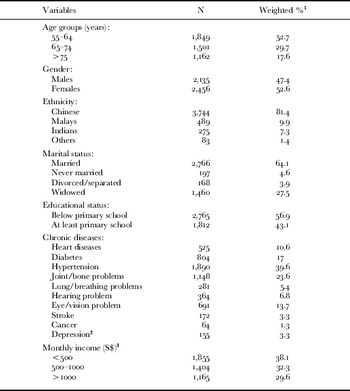
The characteristics of the respondents are shown in Table 1. More than half were aged between 55 and 64 years. The majority were Chinese (81%), and had one or more children (93%). Sixty-four per cent were married and 28 per cent widowed. Their educational level was low, with about 57 per cent not having completed primary education. Close to 38 per cent had a monthly income less than S $500 and only 30 per cent had incomes greater than S $1,000 a month. Further analysis of the age distribution by gender revealed that 20 per cent of women were aged 75 or more years compared to 15 per cent males. Hypertension was the most common self-reported chronic medical condition (40%) followed by joint/bone problems (24%), and diabetes (17%).
Characteristics of the study subjects

Notes: 1. The variables were weighted for non-response and over-sampling of adults aged 75 or more years. 2. Depression, anxiety and emotional problems. 3. In Singapore dollars. Includes income and allowances from all sources including pension, rent, dividends, Central Provident Fund and other savings, assistance from children, spouse and other family members and public assistance.
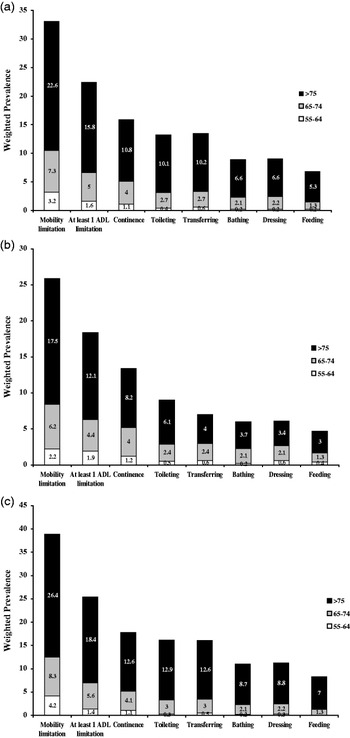
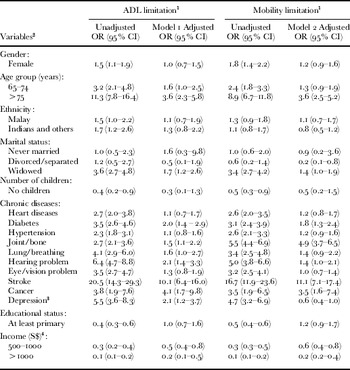
Figure 1 shows the weighted prevalence of ADL and mobility limitations, overall and by age and gender. About 5 per cent of the old adults in Singapore had ADL limitation and 8 per cent had mobility limitation. Dependence in each individual activity and mobility limitation increased with age. Females had higher ADL and mobility limitation than males, the gender difference being more marked among those aged 75 or more years. Table 2 presents unadjusted and adjusted odds ratios for potential predictors of ADL and mobility limitations. In the unadjusted analysis, while females, older age groups (65–74 years and ⩾75 years) and those widowed had a significantly higher risk of ADL and mobility limitations, higher socio-economic status, represented by education and monthly income, was associated with a lower odds for both. All ten self-reported chronic medical conditions were also associated with higher risk for ADL and mobility limitations. The adjusted odds for ADL and mobility limitations are given in Model 1 and Model 2 of Table 2, respectively. Significant predictors for both ADL and mobility limitations were age ⩾75 years, widowed status, diabetes, joint/bone problems, stroke and cancer. In addition, age 65–74 years, hearing problems and depression/anxiety/emotional problems increased the odds of ADL limitation, while being divorced/separated reduced the odds of mobility limitation. A personal monthly income of at least S $500 associated with lower odds of ADL as well as mobility limitations.
Total prevalence of activities of daily living (ADL) and mobility limitations, by age (a); and prevalence of ADL and mobility limitations, by age, among males (b) and females (c).

Predictors for activities of daily living (ADL) and mobility limitations

Notes: The sample size for both models was 4,341. 1. The reference categories for both ADL and mobility limitations are ‘no limitation’. 2. Reference categories for variables are: Males (for gender), 55–64 years (for age), Chinese (for ethnicity), Married (for marital status), More than one child (for number of children), Not having that disease (for each chronic disease), Not completed primary education (for educational status), Less than S $500 (for personal monthly income). 3. Depression, anxiety and emotional problems. 4. Personal (individual) per month.
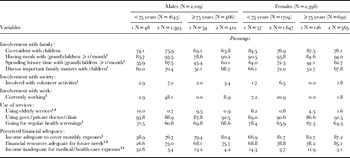
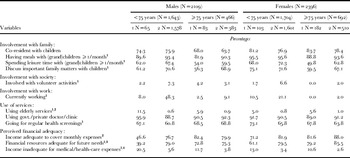
Tables 3a and 3b present the association of ADL and mobility limitations with indicators of social functioning, use of services and perceived financial adequacy, stratified by age and gender. ADL and mobility limitations were significantly associated with lower involvement with family (having meals with children/grandchildren and spending leisure time with them at least once a month), society (involvement with volunteer activities) and work (current work status), controlling for age and gender. Use of services was significantly higher among those with ADL and mobility limitations. A significantly lower proportion of adults with ADL and mobility limitations felt that their present income was adequate to cover their monthly expenses, or to meet their future needs and obligations. A significantly higher proportion of those with ADL limitations felt that the income inadequacy was due to high medical/health-care cost. Perceived financial adequacy was also lower among younger cohorts (aged less than 75 years) compared to those 75 years and older and among males than females.
Association of activities of daily living (ADL) limitations with social participation and perceived financial adequacy

Notes: All percentages are weighted for non-response and over-sampling of adults >75 years. 1=presence of ADL limitations, 2=no ADL limitation. Test is Mantel-Haenszel chi-squared for difference between 1 and 2, controlling for age and gender. 1. Missing values have been excluded from the denominator. Hence, the denominator for each percentage varies. 2. Residential services, community-based centres, home-based services. 3. With adequate financial resources to meet future needs and obligations. 4. Feel that income inadequate given high medical/health-care costs.
Association of mobility limitations with social participation and perceived financial adequacy

Notes: All percentages are weighted for non-response and over-sampling of adults >75 years. 1=presence of mobility limitations, 2=no mobility limitation. Test is Mantel-Haenszel chi-squared for difference between 1 and 2, controlling for age and gender. 1. Missing values have been excluded from the denominator. Hence, the denominator for each percentage varies. 2. Residential services, community-based centres, home-based services. 3. With adequate financial resources to meet future needs and obligations. 4. Feel that income inadequate given high medical/health-care costs.
Among those with ADL and mobility limitations, males aged 75 or more years were significantly less likely to co-reside with children than females in the same age group (69.1% versus 87.5%). Further, among those with ADL and mobility limitations, the proportion who had meals with children/grandchildren at least once a month was significantly higher among those co-residing with children compared to those who did not co-reside with children (90% versus 62.4% for ADL limitations, and 93.6% versus 74.2% for mobility limitations). Co-residence with children, however, did not significantly influence other indicators of family involvement or perceived financial adequacy of older adults with activity limitations (results not shown).
Discussion
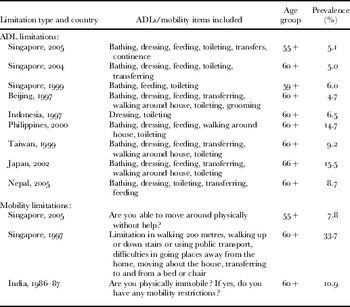
The prevalence of ADL and mobility limitations among Singaporeans aged 55 or more years was found to be 5 and 8 per cent, respectively. Comparisons of the extent of limitations with previous studies have to be with caution because of different ‘old’ age cut-offs and operational measures of ADL and mobility limitations, including the number and content of activities considered and scoring methods (Table 4). With these caveats, the observed prevalence of ADL limitations was similar to previous estimates from Singapore (Chan and Jatrana Reference Chan and Jatrana2007; Ng et al. Reference Ng, Niti, Chiam and Kua2006) but lower than those from most other Asian countries (Chalise, Saito and Kai Reference Chalise, Saito and Kai2008; Ofstedal et al. Reference Ofstedal, Zimmer, Hermalin, Chan, Chuang, Natividad and Tang2007; Schoeni et al. Reference Schoeni, Liang, Bennett, Sugisawa, Fukaya and Kobayashi2006). The lower prevalence of activity limitations in Singapore may arise from the presence of a comprehensive health-care infrastructure in the country, a high emphasis on health promotion and disease prevention programmes that include regular health education, promotion of exercise and outdoor activities, and specific preventive health programmes that are well-funded and co-ordinated at national level (Meng-Kin Reference Meng-Kin1998; Teo, Chan and Straughan Reference Teo, Chan and Straughan2003). The government is also working to create a barrier-free living environment for older Singaporeans and upgrading their houses by including features such as grab-bars in bathrooms/toilets and non-slip floor tiles (Ministry of Community Development, Youth and Sports 2006). The estimated prevalence of mobility limitations is lower than reported previously from Singapore (Yadav Reference Yadav2001). This may indicate a real decrease over time, but may also be due to differences in measurement of mobility status.
Comparison of the prevalence of activities of daily living (ADL) and mobility limitations in selected Asian countries

Within the limitations imposed by the cross-sectional study design, we attempted to identify potential predictors of ADL and mobility, based on causal relations suggested in various disability pathways and frameworks (Jette Reference Jette2006; Verbrugge and Jette Reference Verbrugge and Jette1994; World Health Organization 2002). We found that advanced old age (75 or more years), widowhood, diabetes, joint/bone problems, stroke, cancer, depression/anxiety/emotional problems and low income significantly predicted both ADL and mobility limitation. Advanced old age has been found to significantly increase the risk of ADL and mobility limitations in previous longitudinal and cross-sectional studies (Chiu et al. Reference Chiu, Hsieh, Mau and Lee2005; Guralnik et al. Reference Guralnik, LaCroix, Abbott, Berkman, Satterfield, Evans and Wallace1993; Han Kwee Ho et al. Reference Han Kwee Ho, Taizo, Miyuki, Toru and Kiyofumi2002; Wu, Leu and Li Reference Wu, Leu and Li1999). We observed the same, even after controlling for chronic health conditions and socio-demographic factors. This may be attributed to decreased muscle mass and strength (sarcopenia) (Lauretani et al. Reference Lauretani, Russo, Bandinelli, Bartali, Cavazzini, Di Iorio, Corsi, Rantanen, Guralnik and Ferrucci2003), cognitive decline (Sauvaget et al. Reference Sauvaget, Yamada, Fujiwara, Sasaki and Mimori2002), poor nutritional status or frailty (Fried et al. Reference Fried, Ferrucci, Darer, Williamson and Anderson2004), factors that rise with age among the older people. We found that being widowed increased the risk of both ADL and mobility limitations. Previous research has shown that those widowed, especially men, have a higher risk of disability than those married. This is often attributed to their lower access to medical information and services, higher risk-taking behaviour, weak social ties and networks and increased psychological stress (Goldman, Korenman and Weinstein Reference Goldman, Korenman and Weinstein1995).
The significant association of diabetes, joint/bone problems, stroke, cancer and depression with ADL and mobility limitation corroborates evidence from previous studies (Chen et al. Reference Chen, Yu, Zhang, Liu, Hill and Katzman1995; Dunlop et al. Reference Dunlop, Manheim, Sohn, Liu and Chang2002; Gregg et al. Reference Gregg, Beckles, Williamson, Leveille, Langlois, Engelgau and Narayan2000; Ng et al. Reference Ng, Niti, Chiam and Kua2006; Spiers et al. Reference Spiers, Matthews, Jagger, Matthews, Boult, Robinson and Brayne2005; Valderrama-Gama et al. Reference Valderrama-Gama, Damian, Ruigomez and Martin-Moreno2002). The finding highlights the importance of primary (health promotion) and secondary prevention (early diagnosis and treatment) of these health conditions as key components of the effort to reduce the extent of activity limitations among older people in Singapore. We identified low income as significantly associated with both ADL and mobility limitations. The higher risk among those with low income could reflect differential exposure to factors such as diet, nutritional status and occupation through the lifecourse, which were not measured in the survey. This association may also be an artefact of the way in which activity limitation is measured, as dependency rather than difficulty in performing that activity. Old adults with higher incomes are more likely to be able to purchase an intervention for that difficulty than those with lower incomes. Lower income among older people with activity or mobility limitations may also be a result of their lower involvement in paid employment. Some literature from Singapore documents the association between activity limitations in old adults and their social functioning and participation. Our study found that presence of ADL and mobility limitations was associated with lower involvement with family, society and work, the association being strongest for involvement with work among men less than 75 years of age followed by involvement in leisure activities among women aged 75 years and above. This suggests that the prevention of activity limitations, and reducing dependency among those who already have such limitations may be one way to promote successful, healthy and active ageing in Singapore (Strawbridge et al. Reference Strawbridge, Cohen, Shema and Kaplan1996). Greater focus is recommended on those with the highest risk of activity limitations, i.e. those aged 75 or more years, widowed, with low income and having chronic health conditions.
Perceived financial adequacy is a function of income as well as expenditure. In this study, we measured the perception of financial adequacy of old adults related to both current and future incomes and expenditures. Since the survey did not collect specific data regarding health-care expenditures by the participants, perceived financial adequacy provides an estimate of their financial resources. Perception of financial adequacy (both current and future) was more favourable among older people with no activity limitations (controlling for both age and gender). In addition, financial inadequacy due to health-care expenditures was higher among those with activity limitations. This is not surprising as presence of an activity limitation or an underlying chronic disease implies greater use of health services and hence higher costs of medical/health care (Branch et al. Reference Branch, Wetle, Scherr, Cook, Evans, Hebert, Masland, Keough and Taylor1988; Foley et al. Reference Foley, Ostfeld, Branch, Wallace, McGloin and Cornoni-Huntley1992; Fried et al. Reference Fried, Bradley, Williams and Tinetti2001; Stoller and Stoller Reference Stoller and Stoller2003). In Singapore, despite the presence of insurance schemes like Elder-shield, there can be substantial health-care costs for the older people due to strict trigger criteria (inability to perform three of the six ADLs), low benefit payout (S $400 per month) and capped benefit duration (maximum 72 months) (National Trades Union Congress Income Insurance Co-operative Limited 2010). High health-care costs, in turn, increase the financial burden on older people and strain their financial resources. Lower perceived financial adequacy, especially among those with activity limitations, can possibly affect their willingness to seek appropriate health care.
The observation that those aged 75 or more years had more favourable perceived income adequacy than younger elderly people with the same ADL/mobility status may be because the former may have fewer financial obligations towards children, and lower lifestyle-related expenses (Chan, Ofstedal and Hermalin Reference Chan, Ofstedal and Hermalin2002). Females generally had more favourable perception of income adequacy compared to males with the same ADL/mobility status. Men tend to be the primary breadwinners and economic decision makers in most Singaporean households. Thus, they may feel a greater responsibility in ensuring that their income is sufficient to cover household expenditure (Chan, Ofstedal and Hermalin Reference Chan, Ofstedal and Hermalin2002). Hence, it is understandable that males aged less than 75 years with activity limitations had the least favourable perception of current and future income adequacy compared to all other groups (older males, and females with/without activity limitations).
Strengths and limitations
The study analysed a large and representative sample of old adults in Singapore. The response rate of 62.1 per cent achieved in the survey is typical for surveys conducted in this population and in this age-group. The ethnic distribution of the study participants replicated the distribution of the four ethnic groups in the general population (Singapore Department of Statistics 2001). The study used a validated index to measure ADL among the older people – the Katz Index of Independence in ADL. Using multivariate regression techniques we identify possible levers (risk factors) which can be adjusted to reduce levels of activity limitations among old adults in Singapore. The results also provide new information at the national level of the relationship between activity limitations and levels of social participation, use of services and perceived financial adequacy. All the chronic health conditions and measures of activity limitations were self-reported. Given the study's cross-sectional design, we were unable to distinguish clearly primary health conditions (those that resulted in activity limitation) from secondary health conditions (those that have resulted from a long-standing activity limitation). However, the study has provided an insight into the predictors for activity limitations in older people, and its implications on their social functioning, conceptualising the relationships based on well-established disability pathways and frameworks.
Policy implications
The study findings have implications for health-care providers, public policy makers and researchers. Health-care providers should strive to prevent the onset of activity limitations among older adults. This could be achieved by early diagnosis and effective management of chronic health conditions, especially those known to be risk factors for activity limitations in old age, i.e. diabetes, joint/bone problems, stroke, cancer and depression/anxiety/emotional problems. They should also promote lifestyle modifications, such as in diet and physical activity, among all age groups in an attempt to prevent or delay the onset of such chronic health conditions. As contact with health-care services is higher among old adults with activity limitations, health-care providers can be important players in interventions designed to integrate the disabled older people back into the society. A first step would be to sensitise them to look for social consequences of activity limitations among their older patients with such limitations.
Though Singapore has a vast network of community-based services for old adults with activity limitations, including day-care centres, day rehabilitation centres and various home services (SingHealth 2007), we found that only a small proportion of older adults with activity limitations used them. Low utilisation may be explained by a lack of knowledge about these services, difficulty in accessing these services due to transportation costs and mobility difficulties. Moreover, even though these services are subsidised by the government through means testing, cost of care may be a deterrent in the use of these services. There is thus a need to make the services more known and accessible to older Singaporeans. Family support may also be substituting for formal care of these older Singaporeans. Qualitative studies may be needed to understand any barriers to use of these services. As activity limitation was associated with perceived financial inadequacy, it is important to prepare individuals to deal with possible financial stresses in old age, through appropriate financial planning and education, even before they reach retirement age.
It is important to note that, in the future, increases in ADL and mobility limitations may be particularly high among those identified in this analysis as being at highest risk (those with low income and with certain chronic medical conditions). This raises the parallel possibility that socially-advantaged older adults (with higher income levels) in Singapore may witness a compression in morbidity as they age, and could be a direction for future research. The association of activity limitation with factors we did not measure such as physical activity, nutrition, social isolation, and number and quality of social networks needs to be studied. The availability of longitudinal databases for such research would be a worthwhile investment on which to create evidence-based policy making.
Conclusion
This study has shown that the extent of ADL and mobility limitation among older people in Singapore is 5 and 8 per cent, respectively. Important predictors for activity limitation among older Singaporeans are greater age, being widowed, diabetes, joint/bone problems, stroke, cancer and low income. Individuals with activity limitation have lower involvement with societal activities. They also have less favourable perception of adequacy of their financial resources. The findings underline the importance of involving health-care providers and policy makers to implement interventions to forestall potential functional decline, and to expand services for older people that include sustained integration within the community, and to provide more opportunities for older adults to maintain control over their economic resources.