Introduction
Infections of the eyes of freshwater fish with metacercarial stages of trematodes are common in a wide range of host species worldwide. These stages are capable of causing extensive pathologies to the eye of infected hosts, which may affect vision and interfere with the ability of fish to feed and avoid predators, thereby increasing the chances of transmission to piscivorous bird definitive hosts (Chappell, Reference Chappell1995; Karvonen, Reference Karvonen, Woo and Buchmann2012).
Parasites that infect paired organs, such as eyes, within bilaterally symmetrical hosts may often do so non-randomly, resulting in preferential accumulation in one or other paired structure (Johnson et al., Reference Johnson, Koprivnikar, Orlofske, Melbourne and Lafonte2014). These bilateral asymmetrical infections occur with some consistency in certain host–parasite combinations, but for eye flukes this is not the case as no discernible patterns are apparent between individual studies (Johnson et al., Reference Johnson, Koprivnikar, Orlofske, Melbourne and Lafonte2014).
Random patterns of metacercarial distribution between the eyes of fish have previously been reported by Chappell (Reference Chappell1969), Pennycuick (Reference Pennycuick1971), Bouillon & Curtis (Reference Bouillon and Curtis1987), Machado et al. (Reference Machado, Takemoto and Pavenelli2005) and Shaw et al. (Reference Shaw, Aguirre-Macedo and Lafferty2005). Nevertheless, bilateral asymmetry can occur not only in natural and experimental infections (Rau et al., Reference Rau, Gordon and Curtis1979; Graczyk, Reference Graczyk1991; Karvonen & Seppälä, Reference Karvonen and Seppälä2008) but also concurrently from the same host species in multiple habitats (Muzzall & Peebles, Reference Muzzall and Peebles1987, Reference Muzzall and Peebles1988) as well as from different hosts in the same locality (Ching, Reference Ching1985; Karvonen & Seppälä, Reference Karvonen and Seppälä2008). Bilateral asymmetry can also influence the severity of pathological effects caused by eye flukes (Rintamäki-Kinnunen et al., Reference Rintamäki-Kinnunen, Karvonen, Anttila and Valtonen2004; Karvonen & Seppälä, Reference Karvonen and Seppälä2008) and these in turn may have ecological implications.
The majority of previous studies have examined eye fluke asymmetry in the lenses of fish with only a limited number examining the distribution of metacercariae in the vitreous humour (Wayland & Chubb, Reference Wayland and Chubb2016; Morley & Lewis, Reference Morley and Lewis2019). Similarly, comparative studies on the extent of asymmetry by different metacercarial species in the same host population are also few (Wayland & Chubb, Reference Wayland and Chubb2016; Morley & Lewis, Reference Morley and Lewis2019). Factors that may moderate the development of bilateral asymmetry in fish are poorly known although Morley & Lewis (Reference Morley and Lewis2019) demonstrated that concurrent infections with the larval cestode Ligula intestinalis could influence the symmetrical distribution of one species of eye fluke but not another in a population of roach (Rultilus rutilus) in southeast England.
However, the underlying causes of eye fluke bilateral asymmetry remain unknown. In general the potential mechanisms of parasite bias fall into three main categories: (1) infections are initially symmetrical but bias occurs due to subsequent host or parasite mortalities; (2) parasites that colonize a host either follow or avoid cues established by earlier infections of the same species leading to a density-dependent bias; (3) congenital asymmetry due to host morphology or parasite preferential invasive routes cause uneven probabilities of infection (Johnson et al., Reference Johnson, Koprivnikar, Orlofske, Melbourne and Lafonte2014).
Detailed studies by Johnson et al. (Reference Johnson, Koprivnikar, Orlofske, Melbourne and Lafonte2014) on the consistent right-bias of echinostome metacercariae in frog tadpole kidneys were able to establish that the mechanisms driving this asymmetry was not associated with the first two hypotheses. Instead, bias was likely to be a result of stronger host-derived cues from the right kidney influencing parasite chemoattraction due to this kidney being located more posterior in the body and thereby being closer to the tadpole cloaca where colonizing cercariae enter the host.
This study indicates that host morphological asymmetry is the most likely mechanism influencing the development of metacercarial bias in this host–parasite relationship. It is possible that host morphological asymmetry may also be the prime factor inducing bias in the distribution of metacercariae in fish eyes. However, inconsistent findings with eye flukes suggest that congenital host asymmetry is unlikely to be the cause. Nevertheless, other forms of host asymmetry can occur. For example, fluctuating asymmetry (FA) of fish caused by exogenous stress is widespread and potentially a more promising explanation of eye fluke asymmetry. FA in fish may be caused by biotic factors such as rearing density or condition; alternatively, abiotic stressors such as pH, temperature, chemical pollution or habitat changes may be influential. It may present itself as a range of gross or subtle morphological changes in a variety of anatomical structures of the external and internal body of a fish (Allenbach, Reference Allenbach2011). Consequently any asymmetrical morphological changes due to FA of the target organ or anatomical structures that cercariae penetrate or migrate through to reach the target tissues potentially may inhibit or promote parasite establishment on one or the other paired structure. Furthermore, morphological asymmetry of fish may be an indicator of habitat degradation so that species showing consistent deviations from symmetry under poor conditions could be used as sentinels for monitoring aquatic environmental health (Allenbach, Reference Allenbach2011).
Morley & Lewis (Reference Morley and Lewis2019) showed that biotic stress induced by concurrent infections of L. intestinalis can influence the presentation of eye fluke bilateral asymmetry in freshwater fish populations, but the influence of abiotic stress due to environmental factors remains unknown. In the present investigation, using an existing dataset, eye fluke infections in two fish species are described from a lake in southeast England from 1993 to 1996. This habitat was affected by a severe drought in 1995 and 1996 alongside an intense summer heatwave during 1995. This study therefore considers whether or not such extreme climatic events, which can have a profound effect on host–parasite dynamics (Morley & Lewis, Reference Morley and Lewis2014), are reflected in the occurrence of eye fluke bilateral asymmetry and discusses the potential role of host FA as a responsible factor.
Materials and methods
Fish were sampled from Dinton Pastures, a country park designed for both recreational and wildlife needs and composed of eight lakes of differing sizes. Sampling of fish was undertaken in Middle Marsh Lake (GPS coordinates 51.445878, −0.879324), a secluded area surrounded by rough grassland, scrub and wetland reserved for nature conservation. The lake itself is comparatively small and shallow with approximately 2 acres of open water, ranging in depth from 0.91 to 2.14 m. Fish were seine-netted annually during the month of September between 1993 and 1996 and the samples included perch (Perca fluviatilis), roach (Rutilus rutilus), rudd (Scardinius erythrophthalmus), bream (Abramis brama) and pike (Esox Lucius). Only perch and roach occurred in high enough numbers to allow for appropriate analysis; they were transferred to the laboratory immediately for investigation and the total body length of each host was recorded before they were dissected and examined for eye flukes using standard parasitological techniques (table 1).
The number and length (with standard deviations) of perch and roach sampled from Middle Marsh Lake during the pre-drought (1993–1994) and drought (1995–1996) periods.

Eye flukes belonging to the genera Diplostomum and Tylodelphys were recorded from the lens and the vitreous humour of infected fish. However, identifying metacercariae of eye flukes to species level using only morphological criteria is difficult as several congenic species are known to occur in European freshwater fish (Chappell, Reference Chappell1995). Nevertheless, concurrent sampling of snails from this lake found only three furcocercariae species were present: two strigeoid species and a bird schistosome (Morley, unpublished observations). Both strigeoid species are cercarial morphotypes that correspond with those species that infect fish eyes (Blair, Reference Blair1977) and it is consequently unlikely that a range of eye fluke species are present in this particular habitat. Therefore, for the purposes of this study we have designated the metacercariae as ‘Diplostomum sp.’ from the lens and ‘Tylodelphys sp.’ from the vitreous humour.
In addition, the body cavity of roach was also examined for the larval cestode L. intestinalis as Morley & Lewis (Reference Morley and Lewis2019) established that this cestode species can influence the presentation of bilateral asymmetry in eye flukes. In each year a small number of sampled fish were infected with L. intestinalis (1993 n = 23, 1994 n = 11, 1995 n = 3, 1996 n = 2). These infected fish, although too small in number to allow for suitable analysis between years, may have been a source of bias for the overall results and hence were removed from the dataset before any analysis was undertaken.
Data analysis
The prevalence, mean intensity and mean abundance of eye flukes in the two fish species populations were calculated according to Bush et al. (Reference Bush, Lafferty, Lotz and Shostak1997) and analysed using Quantitative Parasitology 3.0 statistical package (Reiczigel & Rozsa, Reference Reiczigel and Rozsa2005). For analysis of any direct interactions between the occurrence of species of eye fluke within individual fish, data were normalized by sine transformation and, following removal of zeros (fish not infected by any parasite species), analysed by linear regression using SPSS version 21 statistical package. Analysis of eye fluke bilateral asymmetry was undertaken using the software tool ‘Analysis of symmetry of parasitic infections’ (http://wayland.shinyapps.io/aspi), as described by Wayland & Chubb (Reference Wayland and Chubb2016), which analyses bias at both the population and the individual host levels. As the present dataset contained zero counts (individual fish that had no eye flukes in an eye), replicated G-tests of goodness-of-fit were not applicable and hence exact binomial tests were used to test for bilateral asymmetry with this software package. The likelihood of false positives was controlled using the Benjamini and Hochberg method.
Results
Eye fluke infections in perch and roach
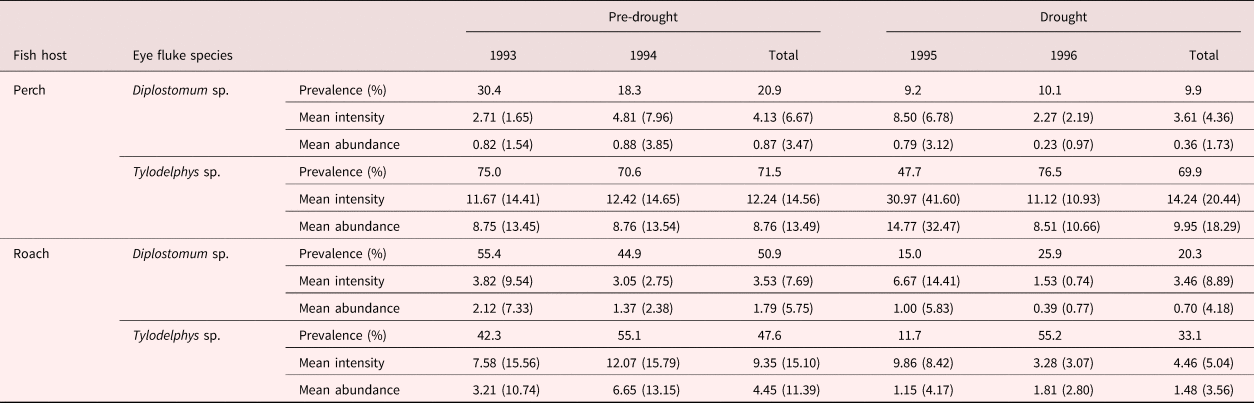
Eye flukes were present in both fish species during each year of study and comprised two species, Diplostomum sp. occurring exclusively in the lens, and Tylodelphys sp. only in the vitreous humour (table 2). The prevalence of Tylodelphys sp. in both perch and roach remained relatively stable over the 4 years except during the heatwave of 1995, when there was a sharp decline compared with other years (chi-square test; perch P ≤ 0.002, χ2 ≥ 9.373, roach P ≤ 0.001, χ2 ≥ 17.533). The mean intensity of Tylodelphys sp. in perch was also significantly different in 1995, showing a large increase compared with other years (Bootstrap 2-sample t-tests P ≤ 0.033, t ≥ −2.476). In contrast, the mean intensity of Tylodelphys sp. in roach remained unchanged except between 1994 and 1996, when drought conditions prevailed, and a significant decline occurred (Bootstrap 2-sample t-tests P = 0.004, t = 3.966). The mean abundance of Tylodelphys sp. in perch remained significantly unchanged throughout the sampling period. In roach the mean abundance of this eye fluke species was also not significantly different between years except for a significant increased abundance in 1994 compared with the other years (Bootstrap 2-sample t-tests P ≤ 0.025, t ≥ 2.12).
Levels of infections (with standard deviations) of two species of eye flukes, Diplostomum sp. and Tylodelphys sp. from perch and roach in Middle Marsh Lake during the pre-drought and drought periods.

The prevalence of Diplostomum sp. in the lens was more variable (table 2). Within perch there was a gradual decline over the study period up to 1995 when prevalence stabilized. There was a significant difference between prevalence levels in 1995/1996 and those occurring in 1993 (chi-square test P ≤ 0.003, χ2 ≥ 8.721). Prevalence in roach was initially more stable between 1993 and 1994 before declining significantly in 1995 compared with these earlier years (chi-square test P ≤ 0.001, χ2 ≥ 14.923) but showing a slight and insignificant increase in 1996 (chi-square test P = 0.143, χ2 = 2.148). The mean intensity of Diplostomum sp. in perch remained stable throughout the study period with no significant changes. In roach mean intensities also remained significantly unchanged except between the years 1994 and 1996 where a significant decline occurred (Bootstrap 2-sample t-tests P = 0.003, t = 3.315). Overall, mean abundances of Diplostomum sp. in perch were not significantly different between years except for 1996 when they were significantly lower than 1993 (Bootstrap 2-sample t-test P = 0.019, t = 2.738). A similar trend in abundance occurred in roach that was also not significantly different between years except for significantly lower levels in 1996 compared to 1994 (Bootstrap 2-sample t-test P = 0.002, t = 3.723).
When comparing the occurrence of eye flukes between the two fish species, infections of perch with Tylodelphys sp. retained both a higher prevalence (chi-square test P ≤ 0.009, χ2 ≥ 6.911) and mean intensity (Bootstrap 2-sample t-tests P ≤ 0.019, t ≥ 2.600), except in 1994, than found in roach. On the other hand, the prevalence of Diplostomum sp. was significantly higher in roach than perch in every year except for 1995 (chi-square test P ≤ 0.002, χ2 ≥ 9.781). Mean intensities of this parasite between the two host species were not significantly different during any year. Mean abundances between the two host species were also not significantly different in any year for Diplostomum sp. but for Tylodelphys sp. were significantly higher in perch during both 1995 (Bootstrap 2-sample t-test P = 0.018, t = 3.352) and 1996 (Bootstrap 2-sample t-test P < 0.001, t = 8.251). Analyses of any specific relationship in individual fish between the occurrence of the two eye fluke species have shown that there were no significant interactions in any sampled year in either perch (linear regression r 2 ≤ 0.099 positive correlation, F ≤ 3.804, P ≥ 0.058) or roach (linear regression r 2 ≤ 0.106 positive correlation, F ≤ 4.035, P ≥ 0.053).
Comparisons of eye fluke infections during the pre-drought (combined 1993 and 1994) and drought (combined 1995 and 1996) periods showed that Tylodelphys sp. in perch demonstrated no significant differences in prevalence (chi-square test P = 0.669; χ2 = 0.182), mean intensity (Bootstrap 2-sample t-test P = 0.278, t = 1.103) or mean abundance (Bootstrap 2-sample t-test P = 0.366, t = 0.863) whereas in roach significant decreases occurred under drought conditions (prevalence, chi-square test P = 0.010; χ2 = 6.700; mean intensity, Bootstrap 2-sample t-test P = 0.009, t = 2.942; mean abundance, Bootstrap 2-sample t-test P = 0.003, t = −3.608). Diplostomum sp., on the other hand, demonstrated a consistent decline in prevalence within both host species with the onset of the drought (chi-square test, perch P < 0.001, χ2 = 12.604; roach P < 0.001, χ2 = 30.101). Mean intensities of Diplostomum sp. showed no significant changes (Bootstrap 2-sample t-test, perch P = 0.673, t = −0.426; roach P = 0.968, t = −0.035) while mean abundances were only significantly different in roach (Bootstrap 2-sample t-test, perch P = 0.051, t = −2.105; roach P = 0.017, t = −2.013).
Bilateral asymmetry of eye flukes
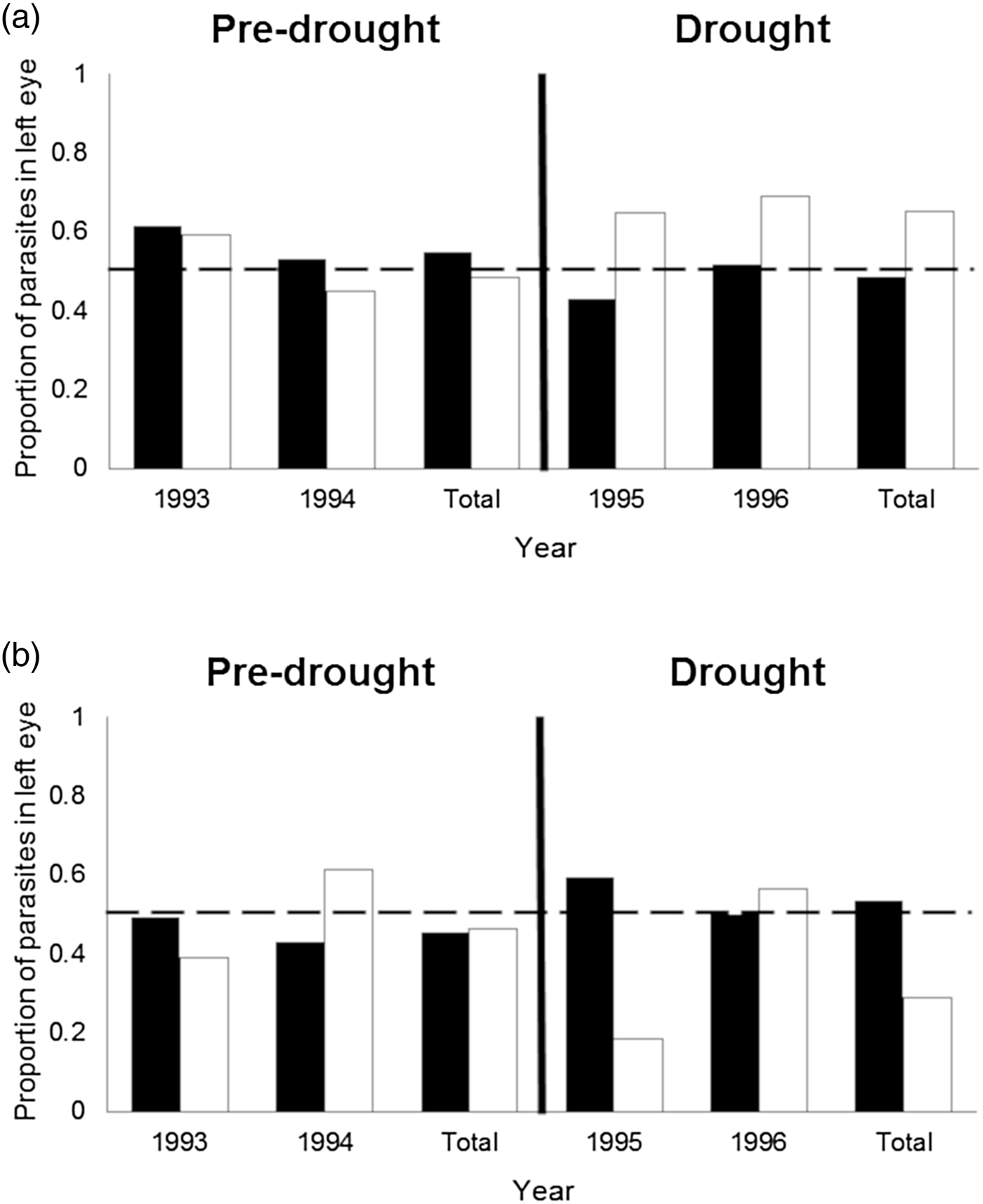
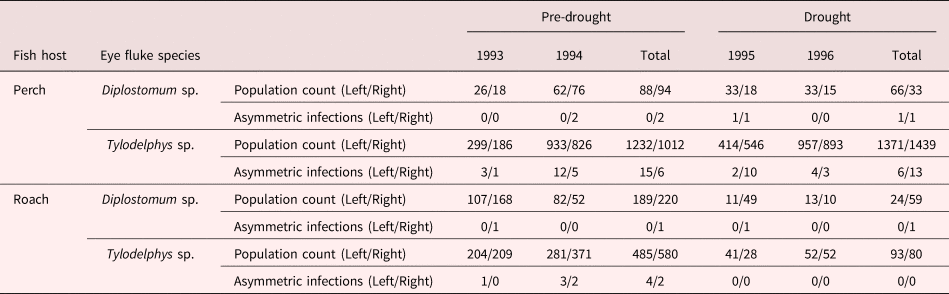
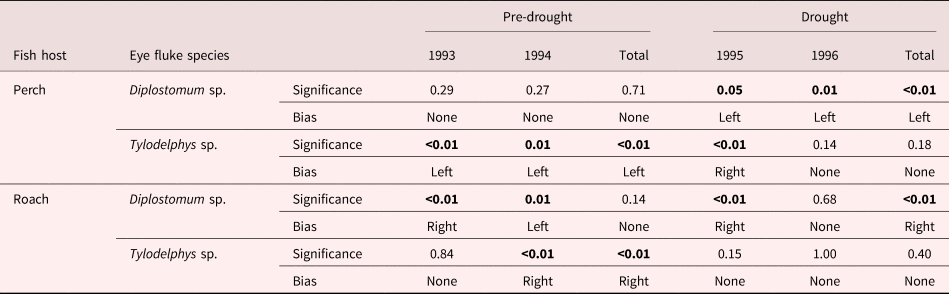
Bilateral asymmetry was a feature of both eye fluke species in the two hosts. However, its occurrence was highly variable from one year to the next, often switching from one side to the other (fig. 1, supplementary figs S1–S4). Similar asymmetry of parasite counts within the fish populations did not always correlate with the presentation of bias shown by individual host infections, although this discrepancy became less pronounced when bias was considered at the larger scale of pre-drought and drought periods (tables 3 and 4). Within roach Diplostomum sp. in the lens demonstrated the most consistent levels of significant asymmetry over time, with the exception of 1996, but did oscillate from one side to the other between years. However, Tylodelphys sp. in the vitreous humour of roach showed significant asymmetry only in 1994. On the other hand Tylodelphys sp. in perch showed significant asymmetry over most years, except during 1996, initially favouring the left side in 1993 and 1994, before switching to the right side in 1995. Diplostomum sp. in perch showed no significant asymmetry in 1993 and 1994 before demonstrating a left-side bias during 1995 and 1996 (table 4).
The proportion of metacercariae in the left eye of (a) perch and (b) roach in the pre-drought and drought periods. Black bars, Tylodelphys sp.; white bars, Diplostomum sp.

Asymmetry of eye fluke population counts and significant bias of individual host infections in perch and roach during the pre-drought and drought periods.

Exact binomial tests of asymmetry of eye flukes and the direction of bias in perch and roach during the pre-drought and drought periods; significant asymmetry in bold.

Nevertheless, a higher degree of conformity in the presentation of asymmetry between the host species was apparent when comparing pre-drought and drought periods. Under pre-drought conditions both host species demonstrated significant asymmetry for Tylodelphys sp. but not for Diplostomum sp. In contrast, during the drought period asymmetry was reversed with Tylodelphys sp. showing insignificant asymmetry in both species and Diplostomum sp. demonstrating significant bias (tables 3 and 4).
Discussion
The occurrence and bilateral asymmetry of the two eye fluke species varied in both fish hosts over the 4-year sampling period with substantial changes coinciding with the onset of an extreme climatic event from 1995 to 1996. A major long-duration drought commenced from the spring of 1995 and continued until the summer 1997 which encompassed one of the lowest 18-month rainfall totals on record (Marsh et al., Reference Marsh, Cole and Wilby2007). In addition, the summer of 1995 was exceptional in the UK for high temperatures and sunshine coinciding not only with low rainfall but also with the warmest 12-month period (November 1994 to October 1995) since records began in 1659. In particular, the ‘high summer’ of July and August 1995 was the hottest and driest 2-month period ever recorded (Hulme, Reference Hulme1997). Records from a local weather station (3 km from Middle Marsh lake, GPS coordinates 51.442, −0.938) indicate that in July and August 1995 mean temperatures were 3.0 and 4.6 °C respectively above average with rainfall levels being 49% and 94% respectively below normal (Thompson, Reference Thompson1996). Water resources were also under stress with river flows in the Thames valley being only 54% of the August average (National Rivers Authority, 1995).
Eye fluke infections in both fish species differed markedly over the study period, with Tylodelphys sp. being more common in perch than roach and vice versa in the case of Diplostomum sp. During 1995, when the region was subjected to an extreme climate, the prevalence and intensity of Tylodelphys sp. decreased significantly in both fish species, likely to be due to unfavourable environmental conditions either for cercarial transmission or reducing the density of molluscan, fish and avian host populations involved in the life cycles of eye flukes. A similarity in infection levels of Diplostomum sp. in roach may be associated with the onset of unfavourable climatic conditions in 1995, although in perch such a decline of this eye fluke species was evident in 1994 and continued throughout the drought period suggesting that more complex factors were involved.
Bilateral asymmetry of eyeflukes may occur in two forms: either as a bias in the overall numbers of the parasite community within the host population or a significant deviation from symmetry within individual fish. The relationship between these two forms is complex and may not necessarily correlate with each other as it is possible to have asymmetry in population counts favouring one side while significant bias in individual fish may favour the other side.
Apart from infection levels, the bilateral asymmetry of eye flukes in both fish hosts was also found to be highly variable. There were only two examples, both in perch, where the annual population of eye flukes demonstrated consistent asymmetry of the same eye-side over consecutive years, i.e. Tylodelphys sp. on the left side between 1993 and 1994 and Diplostomum sp. also on the left side between 1995 and 1996. Bilateral asymmetrical distribution was also more frequent in perch with at least one eye fluke species in each year presenting bias. In general, Tylodelphys sp. was most commonly asymmetric in perch while in roach the opposite was true with Diplostomum sp. generally showing bias.
Nevertheless, when bilateral asymmetry is evaluated during pre-drought (1993/1994) and drought (1995/1996) periods, clear and comparable patterns in both fish species suggest environmental stress may be an influential factor. Under normal and presumably low or undetectable environmental stress conditions during the pre-drought period significant bilateral asymmetry is shown by Tylodelphys sp. in the vitreous humour but not for Diplostomum sp. in the lens. However, the situation is reversed under environmental stress caused by drought conditions with significant asymmetry occurring for Diplostomum sp. but not for Tylodelphys sp. Previous work by Johnson et al. (Reference Johnson, Koprivnikar, Orlofske, Melbourne and Lafonte2014) on the right-bias of echinostome metacercariae in frog kidneys established that host asymmetry is most likely to produce such a bias. It seems likely that reported bilateral asymmetry of other metacercarial species may also be a result of deviations in host morphological characteristics rather than other potential factors. Asymmetry may be due to either endogenous or exogenous factors resulting in congenital or fluctuating asymmetry (FA) respectively. Substantial inconsistencies exist in the presentation of bias in fish eye flukes found in previous studies, e.g. Rau et al. (Reference Rau, Gordon and Curtis1979); Bouillon & Curtis (Reference Bouillon and Curtis1987), most likely to be indicative of exogenous drivers, particularly the effects of stressful environmental conditions on host asymmetry.
A range of morphometric and meristic characteristics have been shown to demonstrate FA in fish under the influence of environmental conditions such as temperature, UV radiation, low pH, habitat characteristics and also pollution (Allenbach, Reference Allenbach2011). For example, FA can significantly alter gill raker morphology or the shape and relative position of the eye by changing postorbital or preorbital distances, or the horizontal anterior–posterior and vertical dorsal–ventral distances (Estes et al., Reference Estes, Katholi and Angus2006; Allenbach, Reference Allenbach2011). Changes in fish morphometric characteristics could either positively or negatively influence the ability of trematodes to successfully establish in either eye of potential hosts.
Larval trematodes migrate through fish using both the circulatory system and loose connective tissue (Johnson, Reference Johnson1971; Höglund, Reference Höglund1991). Migration through the body to the fish eye lens by Diplostomum sp. is considered to occur predominantly through the blood circulatory system (Whyte et al., Reference Whyte, Secombes and Chappell1991; Haas et al., Reference Haas, Wulff, Grabe, Meyer and Haeberlein2007). The mechanism of migration by Tylodelphys sp. to the vitreous humour of the eye is not known, but utilization of blood vessels in a similar manner to Diplostomum sp. seems most likely. Therefore, because the systemic migrations of these two flukes is probably comparable, the specific bias in asymmetry that each shows is likely to be influenced by different kinds of localized morphometric FA of the fish host during the final stages of migration and establishment within the eye or surrounding tissue. This potentially suggests the bias demonstrated by these two eye fluke species may be influenced by different kinds of morphometric FA characteristics of the host fish.
Potential FA morphometric traits of the host that may influence eyefluke occurrence could include differences in the blood circulation system between the right and left side of the head or in the vessels leading to the eyes that are used by these parasites as the main means of final-stage establishment in the eye. Both Rau et al. (Reference Rau, Gordon and Curtis1979) and Muzzall & Peebles (Reference Muzzall and Peebles1988) suggested asymmetry of the circulating system around the eyes as potential mechanisms of eyefluke bilateral bias, possibly associated with additional damage caused by migrating trematodes amplifying this effect leading to inflammation and an increased blood flow to the region which consequently channelled more metacercariae into an already invaded eye. Nevertheless, studying any potential FA of the circulating system of the fish head and eye region, particularly subtle changes, would be difficult and has so far not been attempted.
Although the occurrence of FA in fish is known to be influenced by a range of exogenous factors, certainly some morphological characteristics can be so labile as to demonstrate high levels of asymmetry even under non-stressful conditions, and consequently no asymmetry–stressor relationship may exist (Allenbach, Reference Allenbach2011). Nevertheless, FA, by definition, is a measure of random deviation from perfect bilateral asymmetry, and it is therefore logical to assume that some degree of asymmetry may manifest even under normal environmental conditions (Allenbach, Reference Allenbach2011). Therefore, changes in the presentation of eye fluke bilateral asymmetry under stressful conditions caused by the drought may be the direct result of either an increased or decreased occurrence of host FA or alternatively due to an indirect change in the fish population structure, through either selective predation or natural mortality of either symmetrical or FA fish, thereby increasing or decreasing the frequency of parasite bias within the fish hosts.
An additional influential factor on the presentation of asymmetry could be the lifespan of the metacercariae in the eye. Diplostomum sp. may survive for up to 4 years in the eye lens of roach (Shigin, Reference Shigin1964), whereas Tylodelphys sp. in the vitreous humour will live for a much shorter time, potentially for no longer than a season (Burrough, Reference Burrough1978). Assuming mortality levels of the host population are not significantly changed, these differing metacercarial lifespans could influence the impact of extreme climatic conditions on the occurrence of asymmetry, whereby a relatively long-lived eye fluke species will accumulate in hosts under different levels of exogenous stress, with differing presentations of asymmetry.
Bilateral asymmetry of eye flukes in fish is highly variable not only over time but also between both hosts and trematode species. Such asymmetry appears to be influenced by stressful conditions either of a biological (e.g. Morley & Lewis, Reference Morley and Lewis2019) or of an environmental origin, such as extreme climatic events highlighted in the present study, and these factors may explain the high levels of inconsistency in its occurrence reported by previous studies. Fluctuating asymmetry of fish has been widely promoted as a useful bioindicator of exogenous stressors in a range of habitats (Allenbach, Reference Allenbach2011) whereas parasites have also been suggested as valuable indicators of environmental degradation (Vidal-Martinez et al., Reference Vidal-Martinez, Pech, Sures, Purucker and Poulin2010). The combined potential of bilateral asymmetry of eye flukes in conjunction with host FA as bioindicators of environmental stress would therefore warrant further investigation.
Supplementary material
To view supplementary material for this article, please visit https://doi.org/10.1017/S0022149X19000506
Author ORCIDs
N.J. Morley, 0000-0003-4341-5727
Acknowledgements
We wish to express our sincere and grateful thanks to Simon Bartlam, Countrywide Officer Operations, for his kind permission and assistance in sampling fish from Dinton Pastures Country Park, Berkshire, RG10 OTH both in the present study and our previous publication (Morley & Lewis, Reference Morley and Lewis2019).
Financial support
This research received no specific grant from any funding agency, commercial or not-for-profit sectors.
Conflict of interest
None.
Ethical standards
All procedures performed in studies involving animals were in accordance with the ethical standards of the institution.