Introduction
Neoseiulus fallacis (Garman) (Acari: Phytoseiidae) is an important predacious mite in North American apple orchards and an efficient predator of the European red mite (ERM), Panonychus ulmi (Koch) (Acari: Tetranychidae), two-spotted spider mites (TSSM), Tetranychus urticae Koch (Acari: Tetranychidae), and other phytophagous mites. In the humid central and eastern regions of North America N. fallacis occurs on trees and lower vegetation, whereas in the drier western parts, N. fallacis usually inhabits low and sprawling plants, unless living on irrigated tree crops (Morris et al. Reference Morris, Croft and Berry1996). In winter, N. fallacis finds shelter in the orchard ground cover and feeds upon overwintering two spotted spider mite (Croft Reference Croft1990), apple rust mite Aculus schlectendali (Nalepa) (Acari: Eriophyidae), cyclamen mite Steneotarsonemus pallidus (Banks) (Acari: Tarsonemidae), and tomato russet mite Aculops lycopersici (Massee) (Acari: Eriophyidae) (Rincon Vitova Insectaries 2008). Efficacy of N. fallacis for biological control has been reported extensively. In western and eastern North America, N. fallacis is effective on pest-mite populations on variety of crops including apple, strawberry, corn, soybean, sorghum, and hops (Croft and McGroarty Reference Croft and McGroarty1977; Croft Reference Croft1990; Morris et al. Reference Morris, Croft and Berry1996).
High population of P. ulmi and T. urticae negatively affect plant health, reducing fruit size, increasing the number of premature fruit and causing leaf bronzing (van de Vrie Reference Van de Vrie1985). High ERM populations, relative to predator numbers indicate a low likelihood of control by N. fallacis, necessitating acaricide sprays. However, acaricide usage leads to lower farm profits along with development of resistance, thus is unfavourable to integrated mite management (Villanueva Reference Villanueva1997). In regard to commercial apple production, the maintenance of ERM below economic thresholds is not 100% guaranteed with biological control alone. Successful management of mite pests must use the holistic approach of integrated pest management (IPM). One tool of IPM, the use of pesticides, plays an important role in achieving a marketable crop. Pesticides, however, must be used cautiously, not to interfere with beneficial arthropods’ behaviour or survival. Insecticides used to control arthropod pests may be toxic to N. fallacis, causing disruption to the successful application of integrated mite management through biological control.
Apple orchards in the western and eastern Unites States of America have historically relied heavily on broad-spectrum synthetic insecticides such as organophosphates and carbamates (Jones et al. Reference Jones, Unruh, Horton, Mills, Brunner and Beers2009). Enactment of Food Quality Protection Act led to the restrictions on the use of organophosphate and carbamate insecticides thus eliminating or restricting many of those insecticides important for apple production (United States Environmental Protection Agency 1996). As a result, newer pesticides with novel modes of action and fewer environmental effects have been introduced (Whalon et al. Reference Whalon, Jacobson, Rawlins, Ricks and Swinton1999; Agnello et al. Reference Agnello, Atanassov, Bergh, Biddinger, Gut and Haas2009). However, growing evident has shown that these newer pesticides are not always compatible with the beneficial insects (Agnello et al. Reference Agnello, Atanassov, Bergh, Biddinger, Gut and Haas2009; Wise and Whalon Reference Wise and Whalon2009) and predator mites (Villanueva and Walgenbach Reference Villanueva and Walgenbach2005; Bostanian et al. Reference Bostanian, Thistlewood, Hardman, Laurin and Racette2009; Lefebvre et al. Reference Lefebvre, Bostanian, Mauffette, Racette, Thistlewood and Hardman2012).
Insecticide applications are sometimes followed by serious outbreaks, not of the pest against which they were applied, but of other phytophagous insects and mites which, prior to the treatment were in very small numbers too low to be of economic importance (Abivardi Reference Abivardi2004). Pest resurgence occurrence after application of pesticides exhibiting different modes of action and under different climatic conditions indicates that chemical control in many cases upsets the population dynamics of the pests in question. Van de Vrie et al. (Reference Van de Vrie, McMurtry and Huffaker1972) reported that the outbreaks of P. ulmi in apple orchards have been attributed to the use of pesticides that suppress their natural enemies. The use of synthetic pyrethroid insecticides for example, has been implicated in the reduction of phytoseiid mite species on a number of fruit tree crops in different parts of the world (AliNiazee Reference AliNiazee1984). Synthetic pyrethroids such as permethrin and fluvalinate caused 100% mortality of females Phytoseiulus macropilis (Banks) (Acari: Phytoseiidae) after 72 hours exposure in the laboratory bioassay (Amin et al. Reference Amin, Mizell and Flowers2009). As a result, synthetic pyrethroids have been eliminated from most IPM recommendations and are avoided in most apple production systems (Agnello et al. Reference Agnello, Atanassov, Bergh, Biddinger, Gut and Haas2009; Wise et al. Reference Wise, Gut, Isaacs, Schilder, Sundin and Zandstra2011). Organophosphate insecticides when first introduced were toxic to predaceous mites, but most species are now resistant to the Organophosphates used in apple production. Laboratory “worse case” studies have shown varying levels of direct toxicity of new reduced risk insecticides, including imidacloprid, acetamiprid, and spinosad to predacious mites (Bostonian et al. Reference Bostanian, Hardman, Thistlewood and Racette2010).
Despite past efforts to determine the effects of insecticides on predator mites, there is a gap in understanding the toxicity of several new insecticide classes, including diamides, insect growth regulators, and spinosyns, to predaceous mites in apple production systems. Bioassays that address toxicity, as well as the “lethal time” of new compounds, is needed to fully understand the potential impact of modern IPM programs on predator mite populations. The purpose of this study was to measure the toxicity effects of N. fallacis exposure to foliar applied insecticides belonging to several newer insecticide classes through direct exposure to spray droplets.
Methods and materials
Field sampling
Neoseiulus fallacis were collected in an apple orchard, Malus domestica Borkhausen cultivar Red Delicious (Rosaceae), maintained free from insecticides within the Michigan State University Trevor Nichols Research Center (TNRC) in Fennville, Michigan, United States of America (42.5951°N, 86.1561°W). Field observations to determine the distribution of N. fallacis in the apple orchard were done prior to the beginning of the experiment. A high abundance of predator mites was observed in blocks that contained relatively high levels of grassy groundcover. Collections were done in the morning to ensure a high yield of healthy predator mites. In all, 60–70 apple leaves were collected at random from the tree canopy. Individual leaves were placed in a brown paper bag and transported to the laboratory in a portable ice chest.
Laboratory preparation
Apple leaves were removed from the paper bag and held at room temperature for 10 minutes. Following this, leaves were passed through a mite brush machine and N. fallacis were collected in large size petri dishes (6-cm diameter). They were immediately transferred to small petri dishes (3 cm) that were sealed with a thin layer of Arabic gum to prevent predator mite escapes. Ten adults were placed in each petri dish, with a total of seven replicates of each treatment. The petri dishes were held overnight in a refrigerator at 5 °C before conducted bioassays the following day.
Bioassay
On the following day, the predator mites in each petri dish (3 cm) were treated with 2 mL insecticide solution (field rate equivalent solution) at 20 psi using a Potter Spray Tower® (Burkard Scientific, Uxbridge, United Kingdom (Potter Reference Potter1952) and were allowed to dry between 2.0 and 2.5 hours before the bioassay. Sprays were made to the interior top and bottom of petri dishes. The control treatment consisted of predator mites sprayed with distilled water. Following exposure to the insecticides or control treatment, N. fallacis were hand transferred in group to clean petri dishes using a camel paint brush and stored at 26.8 °C, 60% relative humidity, and photoperiod 16:8 light:dark hours in an incubator. Each of these clean petri dishes was laced with two non-treated leaf discs (2.4 cm) and 10–15 two spotted spider mites as a food source. After 4, 24, 48, 72, and 96 hours the bioassays were evaluated. The numbers of living predator mites were recorded with mortality defined as the mites that were immobile after prodding with a camel hair brush.
Chemical compounds
Insecticides tested in the bioassay were esfenvalerate at 59.31 ppm (Asana .66 EC, 55.46 g active ingredient (AI)/ha in 935 L/ha diluent equivalent) (DuPont, Wilmington, Delaware, United States of America)), spinetoram at 97.35 ppm (Delegate 25 WG, 91.03 g AI/ha in 935 L/ha diluent equivalent) (Dow AgroSciences LLC, Indianapolis, Indiana, United States of America), novaluron at 155.39 ppm (Rimon .83 EC, 145.3 g AI/ha in 935 L/ha diluent equivalent) (Chemtura U.S.A. Corporation, Middlebury, Connecticut, United States of America), chlorantroniliprole at 78.63 ppm (Altacor 35 WG, 73.52 g AI/ha in 935 L/ha diluent equivalent) (DuPont, Wilmington, Delaware, United States of America), acetamiprid at 134.80 ppm (Assail 30 SG, 126.04 g AI/ha in 935 L/ha diluent equivalent) (UPI, King of Prussia, Pennsylvania, United States of America) and carbaryl at 1198.25 ppm (Sevin 4 EC XLR, 1120.37 g AI/ha in 935 L/ha diluent equivalent) (Bayer Corporation, Kansas City, Missouri, United States of America).
Statistical analysis
Adult mortality data were corrected for the check mortality using Abbott’s formula (Abbott Reference Abbott1925). The percentage mortality was arcsine transformed before using analysis of variance (ANOVA) procedures. Treatments means were separated using LSD test at P=0.05 (PROC GLM) (SAS Institute 2002). Tukey’s honestly significant differences test was used for multiple comparisons. The probit analysis was performed to calculate the time (in hours) at which 50% of the mites were killed (LT50), slope of the log time-probit line (±SE), the confidence interval and the fiducial limits.
Results
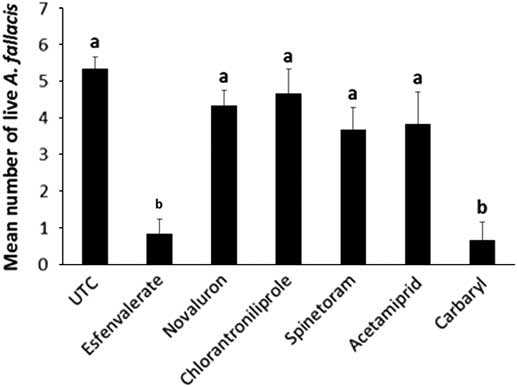
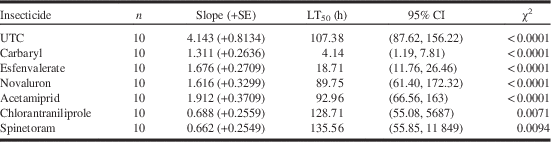
The results from the topical toxicity assay for six insecticides are presented in Figure 1 and Table 1. Predator mite adults exposed to 96-hour topical assays showed significantly higher levels of mortality from the carbaryl and esfenvalerate treatments as compared to the untreated control, whereas other compounds did not cause mortality different than the untreated control (F=10.50, df=6, P⩽0.0001) (Fig. 1).
Mean (±SEM) survival of Neoseiulus fallacis on apple leaf discs following 96 hours exposure to different insecticides. Means with the same letter are not significantly different at α⩽0.05. Mean separation calculated using the Tukey’s honestly significant differences (HSD) test. Data shown are non-transformed means.

LT50 values for N. fallacis mortality after 96 hours of topical exposure to a given treatment insecticide.

The time in hours at which 50% of the predator mites were killed by insecticides (LT50) was calculated as a measure of toxicity from insecticides as exposure time increased. Carbaryl was significantly more toxic to adults of N. fallacis and corrected mortality (Abbott Reference Abbott1925) reached 88% within 96 hours from topical application (Fig. 1). The LT50 of carbaryl was significantly lower as compared to the untreated with the most rapid lethal time LT50 value of 4.14 hours (x 2⩽0.0001) (Table 1). Esfenvalerate was significantly toxic to N. fallacis adults with a mortality rate of 84% after 96 hours exposure to topical application. The LT50 of esfenvalerate showed significantly shorter lethal time as compared to the untreated control with calculated value of 18.71 hours (x 2⩽0.0001). Novaluron and acetamiprid were less toxic to predator mites with 13% and 28% of mortality within 96 hours. The lethal time of novaluron was calculated as LT50 value of 89.75 hours (x 2⩽0.0001), while acetamiprid had lethal activity at the calculated LT50 value of 92.96 hours (x 2⩽0.0001) with overlapped 95% confidence interval. Chlorantraniliprole and spinetoram were the least toxic to N. fallacis adult with 31% and 16% of mortality within 96 hours, and the calculated lethal time showed the slowest lethal activity with LT50 value of 128.71 (x 2=0.0071) and 135.56 hours (x 2=0.0094) respectively (Table 1).
Discussion
This study provides important new information about the direct lethal effects of insecticides to N. fallacis following topical sprays. Results varied quite dramatically from compounds to compound, with some showing relatively little effect while others having high lethality.
Carbaryl was highly toxic to N. fallacis as a result of direct exposure to topical sprays. The LT50 value of this carbamate insecticide showed the least time (in hours) needed to cause N. fallacis mortality. These results agree with those of Edward and Hodgson (Reference Edwards and Hodgson1973) showing that carbamates were highly toxic to an important mite predator in citrus, Stethorus nigripes (Kapur) (Coleoptera: Coccinellidae). Similarly, a two-year field study by Walker and Aitken (Reference Walker and Aitken1996) validated that carbaryl-elevated populations of citrus red mite, Panonychus citri (McGregor) (Acari: Tetranychidae), in California citrus. The toxicity of carbaryl against N. fallacis through direct sprays therefore is likely a primary contributor to any mite flaring associated with the application of this compound.
The pyrethroid esfenvalerate also was highly toxic to the predator mite N. fallacis. From the LT50 value, this compound showed the time it takes to kill 50% of the N. fallacis adult was four fold that of carbaryl, but fast-acting none-the-less. This result is in concordance with Rock (Reference Rock1979) and AliNiazee (Reference AliNiazee1984) who documented mortality to predator mites, N. fallacis and Typhlodromus arboreus Chant (Acari: Phytoseiidae), after exposure to synthetic pyrethroids. Similarly, Cho et al. (Reference Cho, Hong, Yoo, Bang and Lee1997) found high toxicity in a test of esfenvalerate against the insect predator, Harmonia axyridis (Pallas) (Coleoptera: Coccinellidae).
Esfenvalerate, a voltage-dependent sodium-channel agonist is generally is highly active on the nervous system of insects or arthropods (Royal Society of Chemistry 1994). Direct contact through exposure to spray droplets provides the most effective route of entry followed by consumption of spray droplets or dried residue (Kelly Reference Kelley2003). As evident in our study, topical spray exposure demonstrated high mortality to N. fallacis. Since this synthetic pyrethroid is toxic to the predator mite N. fallacis, the application of esfenvalerate would likely reduce the conservation of N. fallacis thus causing pest mite outbreaks.
The insect growth regulator novaluron was relatively nontoxic to adult N. fallacis. The observed lethality time, LT50 value of this compound was slightly shorter than that of the untreated control, but with substantial overlapping of the confidence intervals. The nontoxic effect of novaluron on phytoseiid mites, Galendromus occidentalis (Nesbitt) (Acari: Phytoseiidae) was also reported by Lefebvre et al. (Reference Lefebvre, Bostanian, Thistlewood, Mauffette and Racette2011). In addition, Amarasekare and Shearer (Reference Amarasekare and Shearer2013) observed low toxicity in the adult predatory mired bug, Deraeocoris brevis (Uhler) (Hemiptera: Miridae) after exposure in topical bioassays.
The neonicotinoid acetamiprid was not toxic to N. fallacis. The observed lethality time, LT50 value of this compound was slightly shorter than that of untreated control, but with substantial overlapping of the confidence intervals. Similar result was shown by Pozzebon et al. (Reference Pozzebon, Duso, Tirello and Ortiz2011) who studied the toxicity of thiamethoxam, another neonicotinoid, to Phytoseiulus persimilis (Athias-Henriot) through multiple routes of exposure, with topical exposure resulted in low mortality of predatory mites. They concluded that topical sprays of thiamethoxam might have resulted in less uptake by predatory mites, due to tarsal uptake being more prominent than integument absorption. In addition, the body surfaces of mites were relatively small as compared to the treated leaf and this also suggested the role of residual exposure was superior to the topical exposure (Pozzebon et al. Reference Pozzebon, Duso, Tirello and Ortiz2011). In contrast, Bostanian et al. (Reference Bostanian, Thistlewood, Hardman, Laurin and Racette2009, Reference Bostanian, Hardman, Thistlewood and Racette2010) reported that acetamiprid was moderately to highly toxic to G. occidentalis and N. fallacis in “worst-case” exposure scenario.
Acetamiprid, a first generation neonicotinoid developed by Aventis CropScience (now Bayer CropScience, Leverkusen, Germany) is more effective systemically after foliar application (Horowitz et al. Reference Horowitz, Mendelson, Weintraub and Ishaaya1998). Its low hydrophobicity contributes to its excellent systemic and translaminar activity. Studies by Stein-Dönecke et al. (Reference Stein-Dönecke, Führ, Wienecke, Hartwig and Leicht1992) and Westwood et al. (Reference Westwood, Bean, Dewar, Bromilow and Chamberlain1998) demonstrated that neonicotinoids are mainly acropetally transported in the xylem. Systemic insecticides can contaminate floral nectar when systemically distributed throughout the plant (Lord et al. Reference Lord, May and Stevenson1968) and cause detrimental effects to parasitoids (Cate et al. Reference Cate, Ridgway and Lingren1972). In our study, the low incidence of N. fallacis mortality may be due to lack of exposure to treated plant material or through feeding on treated prey.
The diamide chlorantraniliprole was relatively nontoxic to the predator mite N. fallacis. The observed lethality time, LT50 value of this compound was similar to that of the untreated control, and with substantial overlapping of the confidence intervals. Acute mortality from chlorantraniliprole in topical assays has given diverging results. Amarasekare and Shearer (Reference Amarasekare and Shearer2013) found that chlorantraniliprole were highly toxic to two insect predators, green lacewings Chrysoperla carnea (Stephens) (Neuroptera: Chrysopidae) and C. johnsoni (Henry, Wells, and Pupedis), whereas slight toxicity was observed for G. occidentalis (Nesbitt) in a worst-case exposure scenario in the laboratory.
The macrocyclic lactone spinosyn insecticide, spinetoram, was the least toxic to the adult predator mite N. fallacis when applied topically. There was no significant mortality in predator mite adults and the time taken to kill 50% of the adult population took substantially longer than that of chlorantraniliprole. Nasreen et al. (Reference Nasreen, Mustafa and Ashfaq2003) reported that topical treatments had no significant lethal effect on the insect predator, Chrysoperla carnea, but 100% mortality occurred when adults ingested treated prey. Likewise, no effect on the predation index was observed following exposure of the predatory mite, Euseius tularensis Congdon (Acari: Phytoseiidae), to spinosad (Khan and Morse Reference Khan and Morse2006), another spinosyn. In contrast, high mortality was observed for the predatory mirid bug, Pilophorus typicus Distant (Hemiptera: Miridae), following the exposure to low spinosad concentrations (Nakahira et al. Reference Nakahira, Kashitani, Tomoda, Kodama, Ito and Yamanaka2010).
Active through ingestion, the insecticidal action of spinetoram is from two spinosyns, factor J, XDE-175-J and factor L, XDE-175-L, which causes anomalies to insect nAChR receptors. When ingested, these factors were broadly distributed in tissue, however, the highest concentrations were found in the gastrointestinal tract (Food and Agriculture Organization 2007). Acute mortality from spinosad and spinosyn on predatory mites from exposure to dried residue on leaves has been extensively reported in the past (Villanueva and Walgenbach Reference Villanueva and Walgenbach2005; Van Driesch et al. Reference Van Driesche, Lyon, Stanek, Xu and Nunn2006; Olszak and Sekrecka Reference Olszak and Sekrecka2008; Lefebvre et al. Reference Lefebvre, Bostanian, Thistlewood, Mauffette and Racette2011; Rahman et al. Reference Rahman, Spafforda and Broughtonc2011). Thus, topical exposure of spinetoram from direct sprays is not anticipated as the route contributing to toxicity of this predator or to subsequent mite flaring.
In this study, effects attained by single exposure route, topical spray, varied depending on the insecticide. Conventional insecticides such carbamates and esfenvalerate were highly toxic and their applications in the field need to be carefully considered as to limit interference with the conservation of adult N. fallacis. The reduced risk insecticides novaluron, acetamiprid, spinetoram, and chlorantraniliprole were relatively harmless to predator mites from direct sprays, but impacts of residual exposure on sprayed plant materials must be considered before full integrated mite management recommendations can be made.
Acknowledgements
The authors thank Laura Lamb and Ryan VanDerPoppen for their technical assistance. This study was supported by Michigan Apple Committee and Trevor Nichol Research Center.