Introduction
Monitoring traps to aid in control of coleopteran storage pests have been developed for both commercial use in large-scale industry in developed countries and for small-scale use among subsistence farmers in developing countries (Barak & Burkholder, Reference Barak and Burkholder1985; Collins & Chambers, Reference Collins and Chambers2003; Ukeh et al., Reference Ukeh, Udo and Ogban2008; Campbell, Reference Campbell2012). Conversely, mass-trapping of these pests has been overlooked and underutilized as a pest management tool. Effective mass-trapping requires an understanding of how insects orient towards different stimuli.
Many current trap designs for monitoring insects typically use pheromones or kairomones and rely on olfaction (Likhayo & Hodges, Reference Likhayo and Hodges2000; Hodges et al., Reference Hodges, Addo, Farman and Hall2004; Torr et al., Reference Torr, Mangwiro and Hall2006). Consequently, many studies of insect agricultural pests and vectors focus on semiochemical-mediated anemotaxis behaviour. This is particularly the case in stored product pests. However, colour vision is virtually universal in insects (Briscoe & Chittka, Reference Briscoe and Chittka2001) and plays a role in host location in many species. Neglecting visual responses when designing traps and control strategies presupposes that vision plays no significant part in orientation – or that the resolution of the eyes in tiny insects is too poor for visual cues to be relevant at anything other than close range. However, work on species such as aphids (Kennedy et al., Reference Kennedy, Booth and Kershaw1961; Döring & Chittka, Reference Döring and Chittka2007), tsetse (Green & Cosens, Reference Green and Cosens1983; Green, Reference Green1986; Lindh et al., Reference Lindh, Goswami, Blackburn, Arnold, Vale, Lehane and Torr2012) and Colorado beetles (Otálora-Luna & Dickens, Reference Otálora-Luna and Dickens2011) shows the value of taking multiple stimuli into account.
Colour vision in some insect species has been extensively studied, especially pollinators (Lunau & Maier, Reference Lunau and Maier1995; Chittka & Raine, Reference Chittka and Raine2006), for whom colour is a cue for a specific flower's location, and Drosophila melanogaster (Meigen), where the well-characterized genome has enabled exploration of the genetic and developmental basis of colour vision (Morante & Desplan, Reference Morante and Desplan2008). However, for most insects, particularly those of economic or agricultural significance, colour vision studies are limited to outcome-driven experiments focusing only on relative responses to (often unquantified) colours without consideration of causative physiological or behavioural mechanisms, as has been highlighted by Döring & Chittka (Reference Dyer and Chittka2007). Although this can lead to methods of control, e.g. by sticky traps, it can prove difficult to replicate or refine the effectiveness of a trap – a problem that emerged in control of tsetse, for example, when phthalogen blue dye became unfavourable for safety reasons (Lindh et al., Reference Lindh, Goswami, Blackburn, Arnold, Vale, Lehane and Torr2012). Design of experiments should take into account existing knowledge of insect colour vision, as this can be used to refine control strategies (Lindh et al., Reference Lindh, Goswami, Blackburn, Arnold, Vale, Lehane and Torr2012). Quantification of visual stimuli using a spectrophotometer provides spectral reflectance curves for coloured surfaces, which facilitates investigation of underlying mechanisms of colour-mediated behaviours (Döring et al., Reference Döring, Skellern, Watts and Cook2012).
Various Coleoptera are reported to have colour vision (Briscoe & Chittka, Reference Briscoe and Chittka2001), including tested species in the Glaphyridae (Martínez-Harms et al., Reference Martínez-Harms, Vorobyev, Schorn, Shmida, Keasar, Homberg, Schmeling and Menzel2012), Scarabaeidae, Carabidae, Coccinellidae and Chrysomelidae such as the pest species Leptinotarsa decemlineata (Say) (Colorado beetle) (Döring & Skorupski, Reference Döring and Skorupski2007; Otálora-Luna & Dickens, Reference Otálora-Luna and Dickens2011). It is probable that this is also the case for storage pest beetles, including in Sitophilus zeamais (Motsch.), the maize weevil and Bostrichidae such as Rhyzopertha dominica (F.) and Prostephanus truncatus (Horn) (lesser and larger grain borers). In these cases, combining colour cues with attractive odour cues could enhance the effectiveness of storage pest traps. Past studies of these Coleoptera have most often indicated the presence of three or four photoreceptor types, typically with UV-, blue-, green- and red-sensitivity in the four-receptor species (Briscoe & Chittka, Reference Briscoe and Chittka2001).
Food odours (wheat, maize, etc.) enhance attraction to pheromones in many species, so have potential as low-cost attractants in traps (Likhayo & Hodges, Reference Likhayo and Hodges2000; Bashir et al., Reference Bashir, Birkinshaw, Hall and Hodges2001); but while this may work well for S. zeamais (Ukeh et al., Reference Ukeh, Birkett, Bruce, Allan, Pickett and Mordue2010), the evidence for the R. dominica and P. truncatus responses to host odours is less clear (Fadamiro et al., Reference Fadamiro, Gudrups and Hodges1998; Ukeh & Umoetok, Reference Ukeh and Umoetok2007; Nguyen et al., Reference Nguyen, Hodges and Belmain2008). It is likely that for bostrichids, food is discovered by chance by a few individuals, which then release aggregation pheromones to attract conspecifics. Attraction to host odours may consequently play little or no role. It is also virtually unknown whether, despite their small eyes, visual attraction may be more important in these insects than previously assumed, and little work has been carried out to test this (Reza & Parween, Reference Reza and Parween2006).
In the present study, we used a four-arm olfactometer to test the orientation of three pest beetle species (S. zeamais, P. truncatus and R. dominica) towards host odours (from crushed white maize, a common staple in African countries which suffers severe losses to beetle pests) and colour cues (blue, yellow and green), with options to approach the cues singly (odour or colour) or in combination (odour and colour), in order to evaluate their role in host orientation in these species.
Methods
Insect cultures
Cultures of S. zeamais and P. truncatus from Malawi and R. dominica from Kenya were maintained in Kilner jars on 500 g organic wheat (S. zeamais and R. dominica) or 800 g yellow maize (P. truncatus), on a 14:10 light/dark cycle at 25°C and 60% RH (Jayasekara et al., Reference Jayasekara, Stevenson, Hall and Belmain2005). For each generation, we removed a minimum of 100 mixed-sex adults to fresh medium for reculturing. For experiments, a subsample of the host material (derived from these multiple parents) was removed from the jar and kept in a plastic container (S. zeamais and R. dominica) or screw-topped Kilner jar (P. truncatus), and newly emerged adults were removed daily, ensuring that the experimental individuals were of known age (ranging from 24 h to 6 weeks). As experiments took place over several weeks for each replicate, it is unlikely that experimental individuals were closely related. After removal, we kept insects in temporary holding containers without food for at least 3 h before experiments began in order to ensure motivation to orient towards food. Preliminary studies indicated that the precise period of food deprivation did not affect the response to host odours significantly in weevils or bostrichids.
Before an experiment, we sexed adults of P. truncatus and S. zeamais (using Shires & McCarthy (Reference Shires and McCarthy1976) and Dobie et al. (Reference Dobie, Haines, Hodges, Prevett and Rees1991), respectively), so that this could be included in statistics as an explanatory variable. Determination of the sex of R. dominica individuals non-destructively is impractical, so unsexed individuals were used. Tests took place at 26 ± 2°C and ambient humidity (typically 30–55%).
Olfactometry
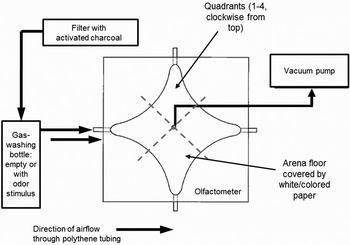
Insects were tested between 09:00 and 18:30 in a separate room to the insect culture room, using a four-arm olfactometer according to a similar paradigm to Arnold et al. (Reference Arnold, Stevenson and Belmain2012) (fig. 1). A four-arm olfactometer allows simultaneous presentation of one or more odours, alongside areas without these odours, but also permits presentation of coloured stimuli to an insect by placing coloured surfaces on sections of the floor of the olfactometer arena. The setup also permits motion tracking via a camera, so insects’ behaviour over a period of time can be monitored rather than merely recording their first decision. In this apparatus, each arm (quadrant) was attached to a gas-washing bottle; air was drawn out of the olfactometer and consequently through each arm, with each airstream being filtered over charcoal (Agilent Technologies, Wokingham, Berks, UK) to remove environmental odours, and then drawn through a gas-washing bottle (empty or containing an odour stimulus) before it entered the arena. Components were connected with 0.6 mm Ø tubing (Tygon, Sigma-Aldrich, St Louis, MO, USA). The arena was continuously video-recorded during the 10-min monitoring period for each insect, using a monochromatic camera connected to a desktop computer running EthoVision 3.1 (Noldus et al., Reference Noldus, Spink and Tegelenbosch2001). This is a motion-tracking software application which can automatically calculate the percentage of time a beetle spends in each quadrant of the arena. Lighting for experiments was provided by high-lux plant growth lamps (irradiance in centre of room: 25.0 μmol m−2 s−1; directly beneath camera: 6.5 μmol m−2 s−1).
Olfactometer, showing the stimulus administration via airflow through one of the four arms. The pump draws air from the central chamber, and thus through each of the arms with an odour stimulus attached. Flow rate was checked regularly, ensuring that it was 200 ml min−1 through each arm (800 ml min−1 through the central hole). A gas-washing bottle connected to a charcoal filter was attached to each of the four arms of the olfactometer.

We presented both odour and colour stimuli simultaneously. In each of two of the gas washing bottles there was 50 g of roughly crushed white maize bought commercially in Malawi (created by placing whole grains in a clean plastic bag and then crushing using a hammer for 3 min per 100 g sample). Maize was found to be the most attractive grain to S. zeamais according to Trematerra et al. (Reference Trematerra, Lupi and Athanassiou2013), regardless of the rearing medium, and therefore we tested how responses to this might be modified in the presence of a different mode of stimulus. The other two bottles in our experiment remained empty. Glassware items were washed with 70% ethanol and allowed to dry if their contents were changed. Ukeh et al. (Reference Ukeh, Woodcock, Pickett and Birkett2012) identified that the major odour components of maize eliciting positive responses from S. zeamais are hexanal, (E)-2-heptenal, and octanal, and that when presented in a three-odour blend, this combination is attractive to this species. In all experiments, one arm of the arena had both colour and odour cues present, one had colour alone, one odour alone and one had neither the colour cue nor the maize odour cue present. Air was drawn through the olfactometer at 800 ml min−1 and arms were calibrated to ensure that airflow through each of the four arms was equal.
The colour stimuli were created by placing coloured paper on the floor of the arena, to cover half the total arena surface (two adjacent quadrants); the other half was covered by plain white paper (which may also have a distinct colouration to insect eyes), and both paper types were then covered by a layer of UV-transparent clear plastic, ensuring that the walking surface was consistent in texture and odour, regardless of the colour. Interior surfaces of the olfactometer, including the floor, were cleaned down with industrial methylated spirits (IMS) after each insect was tested, to minimize contamination of surfaces with insect odours.
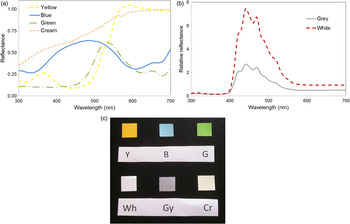
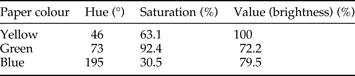
We tested three different colours, appearing yellow, blue and green to human perception (datasets involving each colour are henceforth referred to as ‘yellow trial’, ‘blue trial’, etc.). The blue stimulus, with highest reflectance in the blue (400–500 nm) region generally and a reflectance maximum at 490 nm represents a short-wavelength dominated stimulus of low importance to the insects’ ecology (and therefore is predicted to be of low attractiveness). The green stimulus, with a maximum at 530 nm, corresponds to medium-wavelength dominance and could be considered representative of fresh vegetation. Finally, the yellow stimulus, peaking at 590 nm, is a long-wavelength dominated stimulus and corresponds broadly to the colour of cereals such as ripe wheat and maize and therefore is most ecologically relevant. Spectral reflectance curves for the coloured papers used are shown in fig. 2. We measured these using a procedure as in Chittka & Kevan (Reference Chittka, Kevan, Dafni, Kevan and Husband2005) using an Avantes AvaSpec-2048 spectrophotometer and an AvaLight-DH-S-BAL Deuterium-Halogen light source, calibrated relative to a BaSO4 white standard (Avantes WS-2), using a fine probe (FCR-7UV200–2–1.5 × 100) at 45° to the stimulus surface. The overall irradiance of the three colour stimuli was similar (relative to BaSO4 white standard: blue 94%, green 75% and yellow 95%), so a response to irradiance alone should result in similar observed behaviour of the insects in the presence of all three colours, but particularly blue and yellow. Hue, saturation, brightness value (HSV) figures are provided in table 1 for the three colour paper types, indicative of their appearance to human eyes.
Spectral reflectance curves for (a) the colour stimuli for the main experiment and the control cream stimulus and (b) the stimuli containing optical brighteners: white and grey, and (c) photographs of samples of the stimuli. Spectral reflectance values were measured using an Avantes AvaSpec-2048 spectrophotometer with an AvaLight-DH-D-BAL Deuterium–Halogen light source, relative to a BaSO4 white standard. B = blue, G = green, Y = yellow, Wh = white, Gy = grey and Cr = cream.

Hue, saturation and brightness for colour stimuli used.

We food-deprived insects by keeping them in a container with no food present for between 3 and 48 h (S. zeamais) or between 3 and 24 h (R. dominica, P. truncatus, as these insects show rapid decreases in motility if starved for more than 24 h (Nguyen, Reference Nguyen2008)) to ensure that they were motivated to seek food. We only tested insects that were active and showing no difficulty walking. We tested 30 adults of S. zeamais in the yellow trial, 34 in the blue trial and 30 in the green trial. We tested 75 adults of P. truncatus and 75 of R. dominica in total, 25 per species in each colour trial. We recorded each insect only once, and pseudo-randomized the arrangement of odour and colour arms for each insect so that the odours and colours were never consistently associated with any particular quadrant of the arena (one arm always had both cues, one always had neither and the other two had either odour or colour).
Because beetles may prefer darker areas of the arena rather than specifically the colour, or may find the optical brighteners in white paper to be deterrent, we controlled for these possibilities. We tested 15 insects of S. zeamais with a choice between white paper and grey paper (the same white paper, but printed in uniform grey using a standard desktop printer) (spectrum in fig. 2b), in which the chromaticity of the paper was not altered but the paper reflected less light overall (peak reflectance only 36.6% of the white paper peak). Secondly, we tested 15 further S. zeamais with the white paper replaced by cream paper (spectrum in fig. 2a) that still reflected all wavelengths to some extent but lacked optical brighteners and did not fluoresce, versus yellow paper as previously, to see whether the preference for yellow paper persisted or if it ceased when the other stimulus lacked optical brighteners.
Data analysis
We performed Friedman, Wilcoxon and Generalized Linear Model (GLM) tests in SPSS (SPSS Statistics 19, SPSS Inc., IBM, Chicago, IL, USA). These were performed to investigate both whether insects showed a preference for the coloured or the maize-odour areas of the arena (50% of the total arena in each case), but also to see whether there was maximal preference for the multimodal quadrant of the arena containing both colour and maize odour. The effect of age and/or sex on preferences was also tested by including them as variables (age in hours, sex as a categorical variable) in a GLM analysis, which was performed using a quasibinomial distribution with a logit link to analyse preferences for stimulus-containing quadrants over others.
Results
Sitophilus zeamais
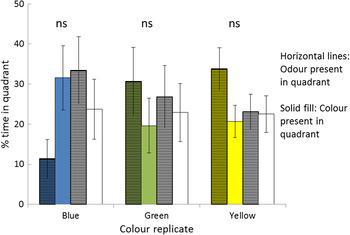
Overall, beetles preferred the quadrants with the odour of maize present (55.7% of time spent there; Wilcoxon test, Z = 1.958, P = 0.050) to quadrants without odour. They also tended to prefer the coloured quadrants to white quadrants, spending 56.1% of their time in the two coloured areas (Wilcoxon test, Z = 1.938, P = 0.053). There were significant differences between the time spent in the four arena quadrants, and beetles preferred the ‘multimodal’ quadrant containing both an odour and a colour cue over the other three quadrants (Friedman test, χ2 = 7.910, P = 0.048) (fig. 3).
Colour and odour preferences of Sitophilus zeamais when presented with maize odours and green, blue or yellow coloured areas on the arena floor. Yellow was significantly attractive in combination with maize odour. Bars show mean ± SEM. N = blue: 34, yellow: 30, green: 30.

Focusing on the individual colours tested, in the yellow trial insects significantly preferred the odour of maize (66.0% of time spent in either maize alone or yellow + maize quadrants, Wilcoxon test, Z = 3.211, P = 0.001). There were significant differences between the time spent in the four arena quadrants, and the quadrant with both the yellow colour cue and the maize odour cue was most favoured (36.6% of time spent there, Friedman test, χ2 = 16.861, P = 0.001).
Although insects in the blue trial spent more time in the presence of colour (56.7% of time in the two coloured quadrants) and maize odour (56.4% of time) than away from the two types of stimuli, these preferences were not significant (Wilcoxon test, colour: Z = 1.188, P = 0.235; odour: Z = 1.222, P = 0.222). During the blue trial, S. zeamais individuals spent most time in the multimodal quadrant containing both blue colour and maize odour, but the preference for this quadrant was not significant (Friedman test, χ2 = 1.735, P = 0.629).
In the green trial, insects spent 60.0% of their time overall in one of the green-coloured quadrants (Wilcoxon test, Z = 1.643, P = 0.110), but they did not differentiate between green colour with an odour cue and green without. The green + maize quadrant was not significantly more attractive than any of the others (Friedman test, χ2 = 3.075, P = 0.380). It appears that the presence of both odour and colour in an area is, in general, attractive to S. zeamais. Yellow colour, in particular, interacted with food odours to enhance attractiveness of an area to this species.
A GLM demonstrated that, although there superficially appeared to be stronger preference in females for yellow and green and males for blue, this was not significant (GLM, colour: F 1 = 0.192, P = 0.663, multimodal: F 1 = 0.148, P = 0.702), and the response to maize odours was similarly independent of sex (GLM, F 1 = 0.546, P = 0.463). Furthermore, age did not affect attraction to colour in general (F 1 = 1.310, P = 0.257), to the multimodal quadrant (F 1 = 0.013, P = 0.911) or to maize odours (F 1 = 3.123, P = 0.083).
Rhyzopertha dominica
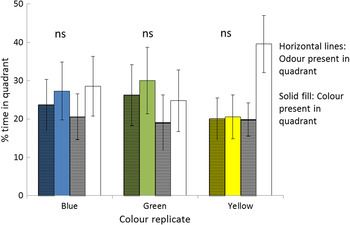
Rhyzopertha dominica adults did not prefer quadrants with maize odour over those without (blue: Z = 0.441, P = 0.659, yellow: Z = 1.546, P = 0.122, green: Z = 0.405, P = 0.685). They also did not exhibit a preference for any of the colours tested (blue: Z = 0.087, P = 0.931, yellow: Z = 1.180, P = 0.238, green: Z = 0.789, P = 0.430) (fig. 4). Furthermore, the multimodal quadrant of the olfactometer, containing both visual and odour cues, was not favoured: beetles spent only 23.6, 20.0 and 26.2% of their time in the colour + maize quadrant in the blue, yellow and green tests, respectively (Friedman test, blue: χ2 = 0.182, P = 0.980, yellow: χ2 = 3.248, P = 0.355 and green: χ2 = 0.217, P = 0.975). Beetles of differing ages did not respond differently to the presence of colour in a quadrant (GLM, F 1 = 1.962, P = 0.167), presence of odour (GLM, F 1 = 1.580, P = 0.216) or to the presence of both cues in the multimodal quadrant (GLM, F 1 = 1.434, P = 0.237).
Colour and odour preferences of Rhyzopertha dominica when presented with maize odours and green, blue or yellow coloured areas on the arena floor. No significant odour or colour preferences were observed. Bars show mean ± SEM. N = blue: 25, yellow: 25, green: 25.

Prostephanus truncatus
Prostephanus truncatus adults similarly showed no preference for the areas of maize odour (Wilcoxon test, blue: Z = 0.637, P = 0.524, yellow: Z = 0.629, P = 0.530 and green: Z = 0.698, P = 0.485). They also showed no preference for coloured quadrants over uncoloured ones (Wilcoxon test: blue: Z = 0.968, P = 0.333, yellow: Z = 0.448, P = 0.654 and green: Z = 0.542, P = 0.588) (fig. 5). The multimodal quadrant of the olfactometer with both odour and colour cues was not favoured over any of the other three quadrants, with beetles spending only 11.4, 33.8 and 30.7% of their time in this quadrant in the blue, yellow and green trials, respectively (Friedman test, blue: χ2 = 3.028, P = 0.387, yellow: χ2 = 2.350, P = 0.503 and green: χ2 = 0.167, P = 0.983).
Colour and odour preferences of Prostephanus truncatus when presented with maize odours and green, blue or yellow coloured areas on the arena floor. No significant odour or colour preferences were observed. Bars show mean ± SEM. N = blue: 25, yellow: 25, green: 25.

No sex or age differences were observed: females and males responded similarly to the colour and odour quadrants compared with quadrants lacking stimuli (GLM, multimodal: F 1 = 0.060, P = 0.807; colour: F 1 = 2.203, P = 0.144; odour: F 1 = 0.346, P = 0.559). Likewise, individuals of different ages did not show different responses to the presence of colour in a quadrant (GLM, F 1 = 1.150, P = 0.700), host odours (GLM, F 1 = 1.366, P = 0.249) or to the multimodal quadrant with maize and a colour cue presented together (GLM, F 1 = 0.684, P = 0.412).
Controls
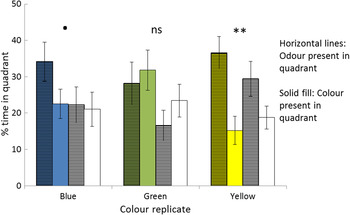
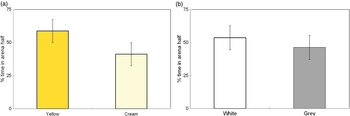
Results for the control tests are shown in fig. 6. Sitophilus zeamais adults tested (N = 27) using the control paradigm were not significantly different in their preference for coloured versus ‘uncoloured’ (white/cream) quadrants compared with those in the original yellow test (Wilcoxon test, Z = 1.016, P = 0.314). This indicates that the yellow preference could not be accounted for by simple repellent effects of optical brighteners as behaviour did not change when they were removed from the experimental setup. In the test of preference for white against grey paper, they showed no significant preference for either condition (Wilcoxon test, Z = 0.369, P = 0.712), indicating that the insects do not simply orient towards the darker area of the arena.
Control results (mean ± SEM) for Sitophilus zeamais presented with (a) yellow versus cream floor covers and (b) white versus grey floor covers. Yellow remains significantly attractive, while the insects showed no preference for white or grey, indicating that chromaticity, rather than overall reflectance, is responsible for the behaviour. N = yellow/cream: 15, white/grey: 15.

Discussion and conclusions
The majority of insects are believed to have some degree of functional colour vision (Briscoe & Chittka, Reference Briscoe and Chittka2001). In beetles, this is often found to be tri- or even tetrachromatic (based on three or four different photoreceptor types), leading to good colour discrimination from UV to orange/red parts of the spectrum. This is especially important for pollinating beetles such as Pygopleurus israelitus (Muche) and South African monkey beetles that recognize brightly coloured flowers by sight (Johnson & Midgley, Reference Johnson and Midgley2001; Van Kleunen et al., Reference Van Kleunen, Nänni, Donaldson and Manning2007; Martínez-Harms et al., Reference Martínez-Harms, Vorobyev, Schorn, Shmida, Keasar, Homberg, Schmeling and Menzel2012), but the ability to discriminate visual cues using colour information is also relevant for many phytophagous insects such as the Colorado beetle Leptinotarsa decemlineata (Döring & Skorupski, Reference Döring and Skorupski2007) and pollen beetles (Döring et al., Reference Döring, Skellern, Watts and Cook2012). Characterizing the importance of cues used in host location in these and other pest insects, including those of stored products, is essential to devising informed control strategies.
Previous work has drawn equivocal conclusions about how P. truncatus and R. dominica orient towards food. While some studies have reported positive attraction in these beetle species towards host (cereal) odours (Bashir et al., Reference Bashir, Birkinshaw, Hall and Hodges2001; Edde & Phillips, Reference Edde and Phillips2006), others have not (Crombie, Reference Crombie1941; Dowdy et al., Reference Dowdy, Howard, Seitz and McGaughey1993; Fadamiro et al., Reference Fadamiro, Gudrups and Hodges1998; Nguyen et al., Reference Nguyen, Hodges and Belmain2008). However, Edde & Phillips (Reference Edde and Phillips2006) recorded the attraction across very small distances (less than 5 cm) (Edde & Phillips, Reference Edde and Phillips2006), and the experiment took place in an enclosed Petri dish in still air. This has the potential to saturate the environment with host odours and any orientation might occur only at close range. As other studies such as Nguyen et al. (Reference Nguyen, Hodges and Belmain2008) and Fadamiro et al. (Reference Fadamiro, Gudrups and Hodges1998) do not provide any evidence of this orientation in these species (Fadamiro et al., Reference Fadamiro, Gudrups and Hodges1998; Nguyen et al., Reference Nguyen, Hodges and Belmain2008), it is instead possible that the insects only responded to high levels of volatiles, higher than what might be encountered in nature. As we were unable to find evidence of any orientation to cereal odours in these two bostrichids, our work supports the view that R. dominica and P. truncatus will most likely encounter host food entirely by chance rather than depend upon host odour-mediated orientation. Recruitment via aggregation pheromones (Dowdy et al., Reference Dowdy, Howard, Seitz and McGaughey1993; Fadamiro et al., Reference Fadamiro, Gudrups and Hodges1998; Bashir et al., Reference Bashir, Birkinshaw, Hall and Hodges2001) as the major method of host location rather than orientation to host odours is also typical behaviour in some other wood-boring beetles (Schlyter et al., Reference Schlyter, Birgersson, Byers, Löfqvist and Bergström1987; Raffa et al., Reference Raffa, Phillips, Salom, Schowalter and Filip1993); however, the situation can grow more complex in some species where there are interactive effects with sex pheromones, heterospecific odour signals and host kairomones, whereas other bark beetle species rely primarily on visual cues for initial approaches to host material (Raffa et al., Reference Raffa, Phillips, Salom, Schowalter and Filip1993). Conversely, we were able to detect preference for maize odours in S. zeamais, which is in agreement with other studies (Ukeh et al., Reference Ukeh, Birkett, Bruce, Allan, Pickett and Mordue2010, Reference Ukeh, Woodcock, Pickett and Birkett2012); thus, our experimental protocol was able to detect an orientation effect when present. This provides a useful comparative view, showing that S. zeamais uses host cues to aid in food location while the bostrichids R. dominica and P. truncatus do not. Unlike Trematerra et al. (Reference Trematerra, Lupi and Athanassiou2013), we did not find a difference between male and female weevils in their responses to maize odours but this could be attributed to a difference in the strain of insect, or precise volatile composition of the maize varieties used. However, like their study, we found that in spite of having been reared on wheat, the S. zeamais adults nonetheless showed a detectable attraction to maize odours when they were presented, indicating that larval experience does not determine food preferences strictly in this species; conversely, P. truncatus, which was reared on maize, showed no orientation towards it. Further research to understand the variability in stored product pest responses to odours is indicated.
We add to the findings on odour-mediated behaviours the novel result that P. truncatus and R. dominica are also not chromotactic; we found no evidence of colour-mediated host-finding in these species, further supporting the above hypothesis that P. truncatus and R. dominica locate food by chance and then attract conspecifics with aggregation pheromone. We argue that it is precisely this evolutionary heritage of random host finding and reliance on aggregation pheromone, that best explains why P. truncatus and also R. dominica are seemingly unaffected by any host odours or colour cues.
We show that the response of S. zeamais to host odour was enhanced by the presence of some colour stimuli. S. zeamais orientated towards quadrants containing any colour stimuli in preference to white paper. These results could not be accounted for either by a negative phototactic response causing orientation towards darker areas of the arena, or a repellency effect of optical brighteners found in commercially available printer paper, suggesting that the chromatic composition of the stimuli were the cause of the observed results. The weevils were most responsive to yellow (in this case, yellow including UV reflectance (fig. 2)). This may resemble the colour of ripe grain (wheat and maize) and, therefore, have adaptive significance, or could be a function of the neurophysiology, as is the case with aphids’ probing responses when moving between differently coloured areas (Döring & Chittka, Reference Döring and Chittka2007). Pollen beetles exhibit a similar preference for yellow stimuli as a result of their green-blue colour opponency (Döring et al., Reference Döring, Skellern, Watts and Cook2012). Whether or not this preference extends to UV-absorbing yellow shades, which can be easily discriminated from UV-reflecting yellow in other insects previously tested (Menzel et al., Reference Menzel, Steinmann, Desouza and Backhaus1988, Reference Menzel, Ventura, Werner, Joaquim and Backhaus1989; Dyer & Chittka, Reference Dyer and Chittka2004; Döring & Skorupski, Reference Döring and Skorupski2007; Döring et al., Reference Döring, Skellern, Watts and Cook2012) needs to be investigated.
It might be argued that colour preferences should not be observed in stored product pests, since their habits are mostly nocturnal (Dobie et al., Reference Dobie, Haines, Hodges, Prevett and Rees1991) and they operate in low-light environments of grain stores. However, grain is not always stored in light-tight environments and besides, most such insects have a dispersal phase and will need visual and/or odour cues in order to navigate outside the stores in order to locate new host material to eat and oviposit on – for example, use of green or yellow colour cues to locate live or drying plant material, or appropriate responses to blue sky. Furthermore, many behavioural experiments are carried out on these insects in lighted conditions and they display a range of behaviours including mating, feeding, etc. (personal observation). One would therefore predict that at least some stored product pests should make use of odour or visual cues when navigating in a lighted environment.
The importance of both colour and odour cues in influencing S. zeamais orientation behaviour, and in particular, the finding that the strongest attraction is observed when both are present, demonstrates that they are well-adapted to finding host material, being able to use either cue alone but improving accuracy by responding more strongly to relevant cues when combined. Conversely, it may be that the visual cues associated with evolutionarily relevant host material either were not similar to any of the cues tested in this study, or else are not distinct enough for the beetles to have evolved to respond to them.
The results of this study show that colour cues are detected by S. zeamais and influence their behaviour. This has significant implications for the development of novel control or, particularly, monitoring strategies and also for experimental procedures on storage pests. If visual stimuli can affect the responses of insects, this must be controlled for in all experiments investigating other factors. Equally, when investigating control strategies such as insecticide-treated bags or pheromone lures, the effect of colour should be considered.
The use of yellow material may serve to enhance the effectiveness of mass-traps for monitoring (or perhaps, but less importantly, direct control) of S. zeamais in cereal stores. There is still considerable scope to refine and develop monitoring traps for specific storage pests, and this species’ responses to odour and colour cues makes it particularly amenable to such methods. Odour and colour cues could potentially be incorporated in low-cost traps for deployment in poor rural areas in developing countries. Similarly, avoiding attractive colours of materials for grain storage facilities and equipment, e.g. promoting blue or white bags over yellow ones, may offer additional protection for stores. Focus now should be on optimizing the combination of colour and odour, possibly also including pheromone lures, to obtain the most attractive assemblage of cues.
Acknowledgements
This work was supported by a grant from the University of Greenwich Higher Education Funding Council for England fund and the European Union's African-Caribbean-Pacific funded ADAPPT and OPTIONS projects (grant number FED/2009/217064 and FED/2013/329-272). The authors thank Natalie Morley, Charles Whitfield, Simon Springate and Dudley Farman for technical assistance.