Background
In the last 20 years, the incidence of obesity during pregnancy has increased. Maternal obesity is associated with increased risk for adverse perinatal outcomes, including preeclampsia, stillbirth, need for resuscitation at delivery, low APGAR scores, and NICU admission.Reference Lu, Rouse, DuBard, Cliver, Kimberlin and Hauth 1 Further, it has been shown that obesity is associated with a chronic inflammatory state that is characterised by cytokine activation and acute phase reactants.Reference Hotamisligil 2 , Reference Wellen and Hotamisligil 3 This metabolic derangement of chronic inflammation is also seen in pregnant mothersReference Schmatz, Madan, Marino and Davis 4 , and neonates born to obese mothers are affected by the maternal biochemical derangements in utero.Reference Bodnar, Ness, Harger and Roberts 5 , Reference Simmons 6 The interaction between these inflammatory derangements and the cardiopulmonary bypass-induced systemic inflammation in the neonatal period is unknown.
The purpose of our study is to examine the association of maternal obesity and excessive weight gain during pregnancy with outcomes of neonates with CHD necessitating cardiopulmonary bypass. As neonates are adversely affected by the deranged inflammatory state of maternal obesity, we hypothesise that the additive inflammatory effects of cardiopulmonary bypass would be disadvantageous to these patients, and that the neonates born to obese mothers or to mothers with excessive weight gain would have increased morbidity after cardiopulmonary bypass compared with neonates who are born to non-obese women or to mothers with appropriate weight gain.
Methods
Patients
We conducted a retrospective review of neonates who underwent cardiopulmonary bypass within the first 30 days of life at our institution between January, 2011 and January, 2013. Patients were excluded from the study if there were no reliable maternal data or if they had chromosomal abnormalities.
Maternal and neonate variables
Clinical and demographic variables were collected from both maternal and infant charts. Data reviewed from maternal records included maternal height and weight during first and third trimesters, weight gain between first trimester and parturition, maternal age, parity, medication use during pregnancy, in vitro fertilisation use, maternal smoking status, diagnosis of maternal or gestational hypertension, presence of pregestational or gestational diabetes, and need for emergent caesarian section. Specific neonatal variables reviewed included birth weight, sex, gestational age, risk adjustment for congenital heart surgery score, postoperative duration of mechanical ventilation, length of stay in the ICU, peak lactate level, peak vasoactive inotrope score, need for extracorporeal membrane oxygenation, and 30-day mortality.
Vasoactive score and definition of maternal obesity
The vasoactive inotrope score used was a modification of the Wernovsky inotrope score as described by Gaies et al.Reference Gaies, Gumey and Yen 7 The definitions of maternal obesity and excessive weight gain during pregnancy in our study were obtained from guidelines established by the American College of Obstetricians and Gynecologists and the Society of Obstetricians and Gynecologists of Canada. Maternal obesity was defined as 1st trimester body mass index ⩾30 kg/m2. The American College of Obstetricians and Gynecologists recommends normal-weight women to gain 11.3–15.9 kg, overweight women to gain 6.8–11.3 kg, and obese women to gain 5–9.1 kg.Reference Davies, Maxwell and McLeod 8 , 9 In this study, normal and overweight mothers were grouped together as non-obese, and a cut-off point of ⩾12 kg was used to define excessive weight gain during pregnancy for non-obese women and ⩾7 kg is used to define excessive weight gain for obese women.
Statistical analysis
Descriptive statistics were used to quantify demographic and clinical characteristics of the study population, including the mean, median, standard deviation, and interquartile range. These characteristics were then compared between neonates born to obese mothers and those born to non-obese mothers, as well as between neonates born to mothers with excessive weight gain during pregnancy and those born to mothers with appropriate weight gain. Specifically, we used t-tests to evaluate differences between groups on continuous variables – for example, maternal age and gestational age – and χ2 tests, or Fisher’s exact tests for variables for which the expected number of observations was <5, to evaluate differences between groups on categorical variables – for example, maternal race or ethnicity and gestational diabetes status. Next, we evaluated the association between maternal obesity – defined dichotomously as body mass index ⩾30 kg/m2 versus body mass index <30 kg/m2 – or maternal weight gain – defined dichotomously as ⩾12 kg gained during pregnancy for non-obese women and ⩾7 kg gained during pregnancy for obese women versus women who did not meet these criteria – and the following outcomes: length of mechanical ventilation, length of stay in the ICU, peak vasoactive inotrope scores, and peak lactate level. Specifically, using simple linear regression, we conducted univariate analyses between maternal obesity and each outcome separately, and between maternal weight gain and each outcome separately. Then we evaluated these same associations using multiple linear regression while adjusting a priori for birth weight of the affected child and risk adjusted congenital heart surgery score category. We evaluated r2 to determine goodness of fit, and we opted not to include other covariates because of the sample size. All analyses were performed using Stata IC v.14.1 (StataCorp, College Station, Texas, United States of America).
Results
Patient characteristics
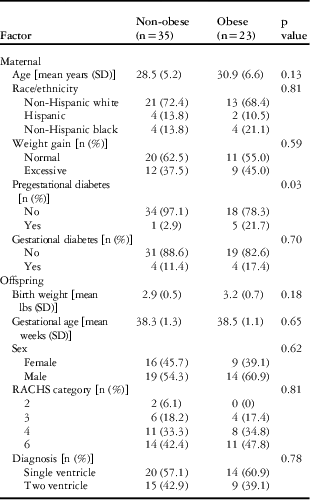
The patient characteristics are displayed in Tables 1 and 2. In all, 85 mother–baby dyads were eligible for study. A total of 27 mother–baby dyads were excluded for incomplete maternal data. A total of 58 mother–baby dyads were studied. In all, 35 neonates (60%) were born to non-obese mothers, and 23 neonates (40%) were born to obese mothers (Table 1). The average maternal age of the entire cohort was 29.4 years, and the majority of the cohort (68%) were non-Hispanic white individuals. There were no significant differences in age, race or ethnicity, or in the incidence of gestational diabetes between the obese and non-obese mothers. There was a higher incidence of pregestational diabetes in obese mothers. The average weight of the offsprings in the cohort was 3.0 kg with 57% being male. Of the offspring in the study cohort, 76% had a risk adjustment for congenital heart surgery category of >4. Of the infants in the study, 59% had single ventricle physiology. There was also no statistical difference in weight, sex, risk adjustment for congenital heart surgery category, and single versus biventricular anatomical difference in infants born to obese versus non-obese mothers.
Selected maternal and offspring characteristicsFootnote * by maternal obesity.

RACHS=risk adjustment for congenital heart surgery
* Note that for some individuals information on certain factors was missing; therefore, variable counts may not equal total sample size
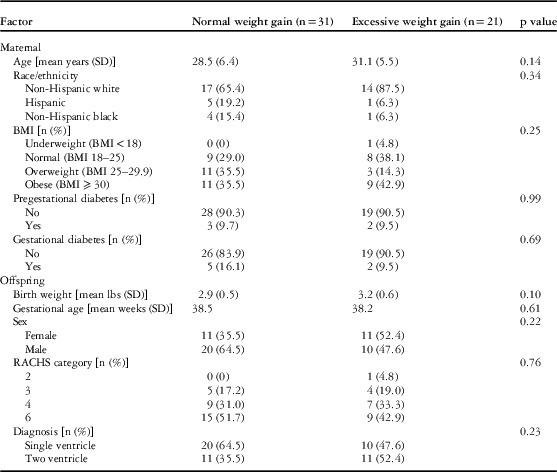
Selected maternal and offspring characteristicsFootnote * by excessive weight gain during pregnancy.

BMI=body mass index; RACHS=risk adjustment for congenital heart surgery
* Note that for some individuals information on certain factors was missing; therefore, variable counts may not equal total sample size
In order to determine the impact of excessive maternal weight gain, we investigated that group of mothers separately. In the same study cohort, 52 mother–baby dyads had data for maternal weight gain available. Of the mothers, 21 exceeded the recommended weight gain of 7 kg for obese mothers and 12 kg for non-obese mothers, whereas 31 mothers had normal weight gain (Table 2). There was also no significant maternal or offspring difference in the two groups.
None of the mothers smoked during their pregnancy as per reports, and no emergent caesarian section was performed on any of the study subjects. None of the neonates in the study were conceived via in vitro fertilisation as per reports.
Outcomes in obese vs. non-obese mothers
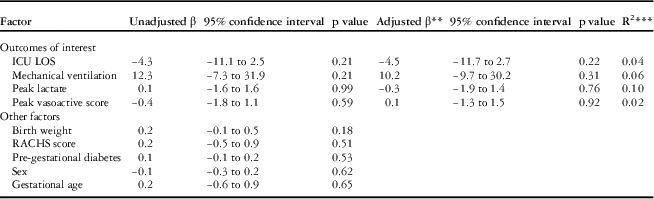
Among neonates born to obese versus non-obese mothers, the mean length of stay in the ICU was 5 days in the obese group and 8.7 days in the non-obese group. The average length of mechanical ventilation was 33.6 hours for the obese group versus 19.4 hours for the non-obese group. Peak lactate level and peak vasoactive score were equivalent between the obese and non-obese groups, as the average peak lactate level was 4.8 mmol/L for the obese group and 5.4 mmol/L for the non-obese group, and the peak vasoactive scores were 11.0 and 10.2 for the obese and non-obese groups, respectively. When linear regression analysis was performed while controlling for birth weight and risk adjustment for congenital heart surgery category, there was no significant association found between maternal obesity and any of the postoperative outcome measures of length of mechanical ventilation, length of stay in the ICU, peak vasoactive inotrope scores, or peak lactate level (Table 3). No patients in the study needed extracorporeal membrane oxygenation or died in the first 30 days.
Relationship between maternal obesityFootnote * and selected clinical outcomes in offspring.

LOS=length of stay; RACHS=risk adjustment for congenital heart surgery
* Maternal obesity defined dichotomously as BMI⩾30 kg/m2 versus BMI<30 kg/m2
** Adjusted for birth weight and RACHS score in the analysis of the “outcomes of interest”
*** Only included for the main outcomes of interest in adjusted models
Outcomes in nominal versus excessive maternal weight gain
In neonates born to mothers with excessive versus nominal maternal weight gain, the average length of stay in the ICU was 4.8 days in the excessive weight gain group and 7.8 days in the nominal weight gain group. The average length of mechanical ventilation was 38 hours in the excessive weight gain group and 19.2 hours in the recommended weight gain group. Peak lactate levels were 4.8 and 5.2 mmol/L in the excessive and recommended weight gain groups, respectively, and the peak vasoactive score was virtually the same between the two groups at 10.3 and 10.2, respectively.
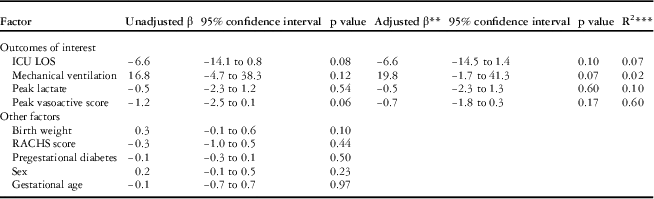
In our linear regression models, there were no significant associations between maternal weight gain and any of the postoperative outcome measures. Interestingly, there was a trend towards significance with longer time of mechanical ventilation for neonates born to mothers with excessive weight gain (p=0.10) but a shorter length of stay in the ICU (Table 4).
Relationship between excessive weight gainFootnote * and selected clinical outcomes in offspring.

LOS=length of stay; RACHS=risk adjustment for congenital heart surgery
* Excessive weight gain defined dichotomously as ⩾12 kg gained during pregnancy for non-obese women and ⩾7 kg gained during pregnancy for obese women versus women who did not meet these criteria
** Adjusted for birth weight and RACHS score in the analysis of “outcomes of interest”
*** Only included for the main outcomes of interest in adjusted models
Discussion
Maternal obesity and excessive weight gain have been shown to be associated with an increased risk for congenital heart disease in the offsrping,Reference Mills, Troendle, Conley, Carter and Druschel 10 , Reference Cedergren and Källén 11 and multiple published studies have shown that maternal obesity is associated with worse obstetrical and neonatal outcomes.Reference Meehan, Beck, Mair-Jenkins, Leonardi-Bee and Puleston 12 – Reference Cedergren 16 We had therefore theorised that this deleterious effect would also be seen in infants with critical CHD undergoing cardiopulmonary bypass and cardiac surgery, one of the most vulnerable neonatal groups. It is therefore most surprising that there was no significant difference between maternal obesity and excessive weight gain during pregnancy and all the postoperative outcomes investigated in our study.
Our study focused on neonates requiring cardiac surgery necessitating cardiopulmonary bypass in the newborn period because we hypothesised that the potential metabolic derangement that is seen in infants born to obese mothers would be compounded by the systemic inflammatory response that occurs after cardiopulmonary bypassReference Paparella, Yau and Young 17 , and we believed that an objective measure of perioperative morbidities such as duration of mechanical ventilation and peak lactate levels would allow us to quantify this effect. Perhaps the lack of effect of the maternal metabolic milieu on neonates after cardiopulmonary bypass might be explained by the utilisation of ultrafiltration during cardiopulmonary bypass and by the routine use of perioperative steroids and peritoneal dialysis for our neonatal surgical patients. These interventions have been shown to ameliorate post-bypass inflammation and to remove inflammatory mediators from the circulation;Reference Sasser, Dabal and Askenazi 18 however, these were applied universally to both groups.
An interesting finding of our study is that patients born to obese mothers or to mothers who have excessive weight gain seem to have a trend toward shorter length of ICU stay when compared to infants born to non-obese or nominal weight gain mothers. This does not reach statistical significance and could merely be a result of the relatively small sample size of our study, as these same patients have a trend toward longer time of mechanical ventilation. This seemingly incongruent fact of longer time of mechanical ventilation with shorter ICU stay could possibly be due our practice of keeping certain postoperative cardiac lesions intubated for a longer period of time: for example, patients with Down syndrome after atrioventricular septal defect repair because of their higher need for sedation and risk for pulmonary vascular reactivity.
The trend towards shorter length of stay in the ICU, however, does beg the question of whether there could be a possible protective effect of maternal obesity or excessive weight gain during pregnancy. This potential protective effect of obesity, termed the obesity paradox, has been observed in some adult studies. Kalantar-Zadeh et al and others have shown that being overweight or obese (body mass index 30–34.9) offers greater survival in adult patients with chronic heart failure.Reference Kalantar-Zadeh, Block, Horwich and Fonarow 19 , Reference Padwal, McAlister and McMurray 20 Other studies have shown a similar protective effect of obesity in patients with chronic renal failure requiring dialysis.Reference Kalantar-Zadeh and Kopple 21 It was hypothesised that excessive adipose tissue can sequester and store toxic lipophilic chemicals that could otherwise be harmful. It is possible that a similar but yet to be delineated process also occurs in utero for obese mothers.
The limitations typically associated with a retrospective review of information are present in this analysis. In addition, a portion of eligible neonates was excluded from the study because of unreliable maternal data; the majority of these were infants born outside our institution. Because of the retrospective nature of this study, we were unable to assess the serum level of inflammatory markers after birth and after surgery. We were therefore unable to assess whether there was deranged inflammation in the neonates themselves. We were also unable to reliably obtain postnatal lab test results for glucose, haemoglobin, etc., and information on maternal peripartum antibiotics use, preoperative length of stay or on the incidence of delayed sternal closure in our study group, and these factors could affect outcomes. Finally, because of our small sample size, we grouped normal-weight and overweight mothers together as non-obese and for comparison against the obese mothers, and this could have confounded the non-obese group. All infants in our study received postoperative prophylactic antibiotics.
In conclusion, despite the known maternal metabolic derangement and the negative impact of maternal obesity on perinatal outcomes, it was not possible to find associations between maternal obesity and excessive weight gain during pregnancy against all postoperative outcome measures in this study. This is the first attempt to examine the association of maternal obesity and excessive weight gain with surgical outcomes of infants with complex CHD. A future prospective study with an even larger sample size would allow better understanding of any undiscovered effect of maternal obesity and excessive maternal weight gain on postoperative outcomes after neonatal cardiac surgical procedures.
Acknowledgements
None.
Financial Support
The authors have no relevant disclosures affecting this manuscript, and there was no grant or other funding obtained for this work.
Conflicts of Interest
None.