The presence of CHD imposes a lifetime risk of greater than average radiation exposure.Reference Glatz, Purrington and Klinger1–Reference Beauséjour Ladouceur, Lawler and Gurvitz2 The cumulative radiation exposure from cardiac imaging and therapeutic interventions in CHD patients can be >20 mSv/year, which exceeds the recommended limit set by the International Commission on Radiological Protection for radiation workers.Reference Glatz, Purrington and Klinger1 This exposure to ionising radiation may be associated with an increased risk of cancer.Reference Danieli, Cohen and Liu3–Reference Andreassi5 This is of clinical importance in patients with CHD who are now living longer and are more susceptible to the potential long-term adverse effects of radiation exposure.
Most of the radiation exposure in patients with CHD comes from cardiac catheterisation procedures.Reference Glatz, Purrington and Klinger1,Reference Walsh, Noga and Rutledge6–Reference Downing, McDonnell and Zhu7 This is due to the use of fluoroscopy during catheterisation. Three-dimensional mapping systems can be used during ablation procedures to reduce/eliminate the need for fluoroscopy and therefore exposure to ionising radiation. These systems use magnetic or electrical fields to create three-dimensional geometric maps of intracardiac structures and track the catheter position. They also create electrical activation wavefront maps which can identify the electrical circuits within the heart. The utilisation of three-dimensional mapping during cardiac ablation procedures decreases the use of fluoroscopy.Reference Clark, Bockoven, Lane, Patel and Smith8–Reference Papagiannis, Avramidis, Alexopoulos and Kirvassilis10
The radiation reduction associated with the use of electroanatomic mapping has been extensively studied in normal cohorts of patients, however there are limited reports on it in patients with CHD. The purpose of this study was to evaluate the radiation sparing benefit of employing three-dimensional mapping during ablations of arrhythmias in patients with CHD and to compare it to outcomes in those without CHD, by controlling other variables, including operating physician, arrhythmia mechanism, arrhythmia location and patient size.
Materials and methods
The study was approved by the institutional review board of each participating centre.
Data were obtained retrospectively from the Catheter Ablation with Reduction or Elimination of Fluoroscopy registry, which is a multi-institutional research database tracking outcome of ablations in which three-dimensional mapping has been utilised in both children and adults from 2006 to present. This is a voluntary database and is not restricted to paediatric patients. At the time of data pull, there were 2146 patients enrolled in the database. Of those 2146 patients, 117 had CHD and were selected for inclusion. Patients who had previous ablations or concurrent diagnostic or interventional catheter procedures and those in whom the precise location of the arrhythmia was not reported were excluded. After those exclusions, 72 patients with CHD remained. From this group, patients with CHD were then matched to patients without CHD by sorting the database for the closest match based on the following criteria, in order: operating physician, arrhythmia mechanism, arrhythmia location, weight and age; 56 CHD patients were able to be matched.
All catheter ablation procedures were performed utilising one of the available three-dimensional electroanatomic mapping systems (EnSite, St. Jude Medical/Abbott or CARTO, Biosense Webster).
The following data were evaluated and compared between the two groups: total procedure time, rate of fluoroscopy use, total fluoroscopy time, acute procedural success, complications and distribution of procedures completed per year. Acute procedural success is categorised as complete success, partial success or failure. Complete success is defined as elimination of tachycardia and all evidence of the mechanism of that tachycardia. Partial success is defined as modification of the tachycardia or incomplete elimination of the underlying mechanism. Failure is defined as no change in the arrhythmia or substrate.
Statistical analysis
Examination of data included calculation of summary statistics and distributional assessments for continuous data and of frequencies and percentages for categorical data. The Sign test and Paired T-test were utilised to assess for potential differences in continuous variables by CHD status. McNemar’s test and Test of symmetry were utilised for examination of potential associations of CHD status with categorical variables. Statistical analyses were completed using SAS 9.4/14.2©. All testing was two-tailed and evaluated at the type I error rate of α = 0.05 level of statistical significance.
Results
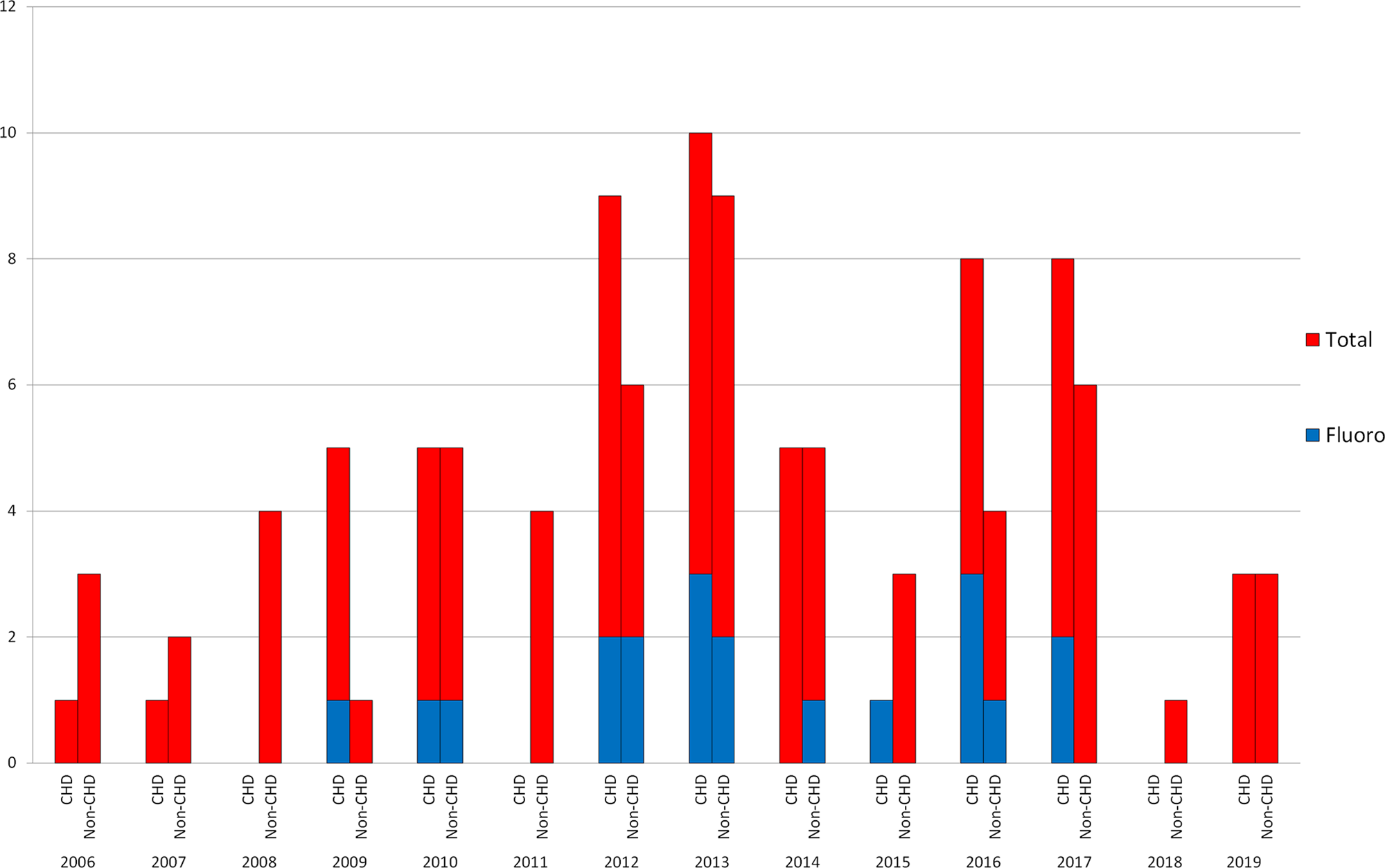
Fifty-six patients with CHD and 56 matched patients without CHD who underwent a catheter ablation procedure using three-dimensional mapping from January, 2006 to December, 2019 were included in the study (Table 1). For the CHD group, the mean age was 17.5 ± 13.7 years and mean weight was 52.0 ± 26.7 kg. For the group with no CHD, the mean age was 12.6 ± 7.1 years and mean weight was 51.0 ± 24.8 kg. There was no statistically significant difference in weight (p = 1.00) or age (p = 0.08), although there was a trend toward older age in the CHD group. Figure 1 shows the distribution of procedures, per calendar year, comparing CHD and non-CHD patients.
Distribution of procedures per year.

Demographic data

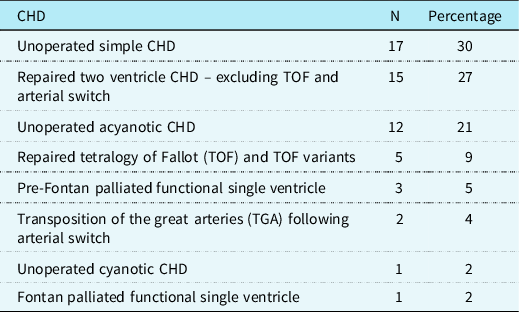
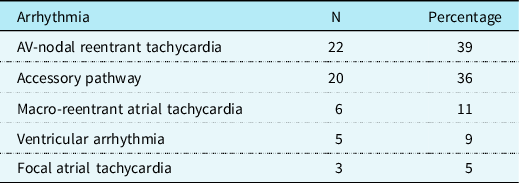
The group with CHD (Table 2) consisted of patients with unoperated simple CHD (17/56, 30%), repaired two ventricle CHD – excluding tetralogy of Fallot and arterial switch (15/56, 27%), unoperated acyanotic CHD (12/56, 21%), repaired tetralogy of Fallot and tetralogy of Fallot variants (5/56, 9%), pre-Fontan palliated functional single ventricle (3/56, 5%), transposition of the great arteries following arterial switch (2/56, 4%), unoperated cyanotic CHD (1/56, 2%) and Fontan palliated functional single ventricle (1/56, 2%). The types of arrhythmias (Table 3) in each group included atrioventricular nodal reentrant tachycardia (22/56, 39%), accessory pathway (20/56, 36%), macro-reentrant atrial tachycardia (6/56, 11%), ventricular arrhythmia (5/56, 9%) and focal atrial tachycardia (3/56, 5%).
Types of CHDs

Types of arrhythmias

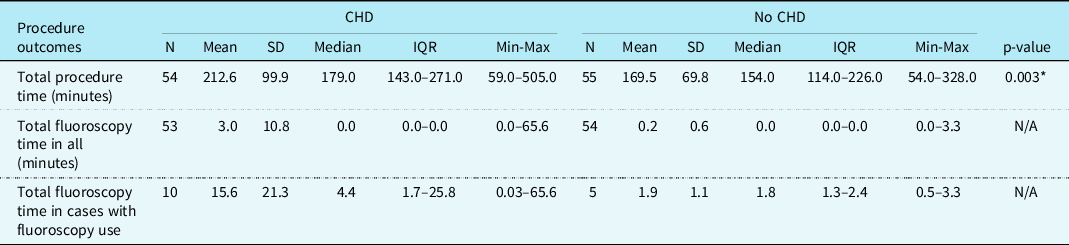
The procedure outcomes are shown in Table 4. In the group with CHD, the mean total procedure time was 212.6 ± 99.9 minutes (range 59.0–505.0 minutes); two patients had missing data for total procedure time. Fluoroscopy was used in 13/56 (23%) ablation procedures. Although fluoroscopy was used in 13 cases, fluoroscopy times were available for only 10. The other three cases reported fluoroscopy dose rather than time. The 10 procedures had a median total fluoroscopy time of 4.4 minutes (Interquartile range (IQR) 1.7–25.8 minutes). The 13 procedures that required fluoroscopy were performed on patients with the following CHDs: repaired two ventricle CHD (6/13, 46%), repaired tetralogy of Fallot and tetralogy of Fallot variants (3/13, 23%), unoperated simple CHD (3/13, 23%) and Fontan palliated single ventricle (1/13, 8%). The indications for fluoroscopy use included transseptal puncture, difficulty with three-dimensional mapping, confirming the location and other. Acute procedural success was achieved in 53/56 (95%) patients; 49 cases had complete success and 4 had partial success. There were no major complications, though there were minor complications in 5/56 (8.9%) patients. These five patients had the following CHDs: repaired two ventricle CHD (1/5, 20%), unoperated acyanotic CHD (3/5, 60%) and unoperated simple CHD (1/5, 20%). The minor complications included transient second-degree heart block (2/56, 3.6%), transient first-degree heart block (1/56, 1.8%), transient low blood pressure (1/56, 1.8%) and haematoma and edoema (1/56, 1.8%).
Procedural outcomes

* Paired T-test.
In the group without CHD, the mean total procedure time was 169.5 ± 69.8 minutes (range 54.0–328.0 minutes); one patient had missing data for total procedure time. Fluoroscopy was used in 7/56 (13%) ablation procedures. Although seven cases used fluoroscopy, fluoroscopy times were available for only five. The five procedures had a median total fluoroscopy time of 1.8 minutes (IQR 1.3–2.4 minutes). The indications for fluoroscopy use included transseptal puncture, confirming the location and other. There was acute procedural success in 54/55 (98%) patients; 51 had complete success and 3 had partial success. Final outcome was not reported in one patient. There were no major complications, though there were minor complications in 2/56 (3.6%) patients. The minor complications included transient complete heart block (1/56, 1.8%) and right external iliac pseudoaneurysm with haematoma (1/56, 1.8%).
Patients with CHD had a significantly higher mean total procedure time compared to patients without CHD (212.6 versus 169.5 minutes, p = 0.003). The majority of the procedures were performed using zero fluoroscopy. The rate of fluoroscopy use trended higher in patients with CHD compared to patients without CHD (13/56, 23% versus 7/56, 13%) but there was an insufficient number of patients to make statistical conclusions. For the procedures in which fluoroscopy was used, the median total fluoroscopy time trended higher in patients with CHD compared to non-CHD patients (4.4 versus 1.8 minutes), but there were too few patients to allow for statistical analysis. The acute success rates were similar in the two groups (p = 0.80). There was no significant difference in the complication rates between the two groups (p = 0.26).
Discussion
The use of an electroanatomic mapping system during ablation procedures has led to significant reduction in fluoroscopy use and therefore radiation exposure.Reference Clark, Bockoven, Lane, Patel and Smith8–Reference Papagiannis, Avramidis, Alexopoulos and Kirvassilis10 Although this has been demonstrated in patients with a normal heart, those with CHD have more complex anatomies and thus more challenges associated with ablations. The major finding of this study is that when three-dimensional mapping is utilised, radiation exposure in patients with CHD approached that of patients without CHD. With the use of three-dimensional mapping, both CHD and non-CHD patients have reduced radiation exposure compared to previously published reports.
Catheter ablation has evolved greatly over the years. When fluoroscopy was the only tool available to visualise the catheter position, radiation exposure was significant. In the Prospective Assessment after Pediatric Cardiac Ablation (PAPCA) multicentre study, Van Hare et al. prospectively evaluated 2761 paediatric patients with a structurally normal heart or trivial CHD who had supraventricular tachycardia due to an accessory pathway or atrioventricular nodal reentrant tachycardia and underwent radiofrequency ablation from 1999 to 2003. The authors reported a mean fluoroscopy time of 38.3 ± 1.5 minutes in their cohort.Reference Van Hare, Javitz and Carmelli11 While Van Hare’s study evaluated patients with normal hearts, data regarding patients with CHD show even greater radiation exposure. Chiou et al. evaluated 600 patients with accessory pathway-mediated tachycardia and 455 with atrioventricular nodal reentrant tachycardia who underwent radiofrequency catheter ablation from 1990 to 1994. Twenty-one patients had CHD. They reported radiation times of 102 ± 27 versus 35 ± 23 minutes for accessory pathway ablation and 62 ± 23 versus 20 ± 11 minutes for atrioventricular nodal reentrant tachycardia ablation in patients with CHD versus patients with no CHD, respectively.Reference Chiou, Chen and Chiang12 The radiation times in patients with CHD are much higher than those reported by Van Hare et al in patients with a normal heart or trivial CHD. With the use of fluoroscopy alone, the long fluoroscopy times resulted in significant radiation exposure during catheter ablations.
In the era of three-dimensional mapping, radiation exposure has markedly diminished. This is true for both patients with normal hearts and those with CHD. Morka et al prospectively evaluated 1280 adult patients with supraventricular tachycardia (174 with structural heart disease, 1106 with no structural heart disease) who underwent ablations using a three-dimensional mapping system (Ensite Velocity) from 2012 to 2017. The majority of those with structural heart disease had acquired disease, with very few congenital defects. The authors reported similar total fluoroscopy times (5.05 ± 5.13 minutes in structural heart disease versus 5.59 ± 7.45 minutes in no structural heart disease), number of applications and radiation doses, in the two groups.Reference Morka, Śledź and Deutsch13 There are two other published studies which evaluated the use of electroanatomic mapping during ablations of arrhythmias in patients with CHD and its effect on radiation exposure. Cano et al evaluated 55 adult patients with CHD (simple, moderate and complex) who underwent ablations via a minimally fluoroscopic approach using the Carto Univu Image Integration Module (IIM) from 2014 to 2017. The authors reported very low levels of radiation exposure using the Image Integration Module. The mean total fluoroscopy times were extremely low (1.94 ± 3.68 minutes for simple CHD, 0.36 ± 0.79 minutes for moderate CHD, 2.21 ± 3.79 minutes for complex CHD) in comparison to previously published data (18.5 ± 10 minutes for simple CHD, 25 ± 14.8 minutes for moderate CHD, 25.6 ± 12.9 minutes for complex CHD).Reference Cano, SaurÍ and Plaza14 The other study by Clark et al retrospectively evaluated outcomes of ablation procedures with and without the use of three-dimensional mapping (Carto 3) in three paediatric and adult groups (normal heart, CHD, those requiring transseptal access) between 2012 and 2015. The mean fluoroscopy times decreased significantly with the use of three-dimensional mapping in all three groups, including those with CHD (16.2 ± 16.2 minutes decreased to 4.2 ± 8.4 minutes in the normal heart group; 15.1 ± 16.0 minutes decreased to 3.2 ± 3.4 minutes in the CHD group; 35.1 ± 29.0 minutes decreased to 12.1 ± 15.1 minutes in the transseptal group).Reference Clark, Sumihara, McCarter, Berul and Moak15 The use of three-dimensional mapping has resulted in reduced fluoroscopy times and therefore radiation exposure during catheter ablations.
The findings in the current study are consistent with the limited published data available. Our study includes data from a multi-institutional database and includes both paediatric and adult patients, complex arrhythmias and complex CHD. Despite including complex atrial and ventricular arrhythmias, the fluoroscopy times for patients with a structurally normal heart are minimal (88% received no fluoroscopy; median fluoroscopy time for those that received fluoroscopy was 1.8 minutes). The fluoroscopy times for the group with CHD approach those of patients without CHD, although they are still slightly greater (77% of CHD patients received no fluoroscopy; median fluoroscopy time for those that received fluoroscopy was 4.4 minutes). Despite including more complex atrial and ventricular arrhythmias, and a broad range of CHD, the median fluoroscopy time was still only 4.4 minutes when three-dimensional mapping was used. Patients with CHD and those without CHD both experienced reduction in radiation exposure with the use of three-dimensional mapping.
Our study also demonstrated that patients with CHD had a higher total procedure time and rate of fluoroscopy use compared to patients with no CHD. This is not surprising given that catheter ablation procedures are more technically challenging to perform on patients with CHD. This may be related to their complex anatomical structures, increased risk of complex arrhythmias, as well as diagnostic and mapping challenges. Arrhythmias can occur due to coexisting abnormalities of the conduction system, haemodynamic effects on the heart structure and/or post-surgical changes.Reference Szili-Torok, Kornyei and Jordaens16 Patients with CHD can have different chamber dimensions, multiple loop circuits and increased ablation lines.Reference Kean, LaPage, Yu, Dick and Bradley17 These complexities can prolong the duration of the procedure and require the use of fluoroscopy. Similar to our findings, Chiou et al reported that procedure times were longer (3.9 ± 0.7 versus 2.4 ± 1.3 hours for accessory pathway ablation and 3 ± 0.7 versus 2.5 ± 0.8 hours for atrioventricular nodal reentrant tachycardia ablation) in CHD patients compared to patients with structurally normal hearts.Reference Chiou, Chen and Chiang12 Morka et al also reported a higher rate of fluoroscopy use in patients with structural heart disease as compared to patients with no structural heart disease (13.2% in structural heart disease and 7.8% in no structural heart disease; p = 0.02). However, they reported similar total procedure times in the two groups (51.2 ± 26.9 minutes in structural heart disease and 49.9 ± 25.2 minutes in no structural heart disease; p = 0.55).Reference Morka, Śledź and Deutsch13 One possible explanation for the discrepancy between studies may be the lack of inclusion of patients with severe CHD in Morka’s study, which could lead to an underestimation of the total procedure time in the CHD group. The study by Clark et al reported higher procedure times in patients with CHD compared to patients with a normal heart, although it did demonstrate a decrease in procedure times with the use of electroanatomic mapping in all groups (155.1 ± 76.6 minutes before three-dimensional mapping and 140.0 ± 84.9 minutes after three-dimensional mapping in normal hearts; 168.9 ± 88.6 minutes before three-dimensional mapping and 163.9 ± 101.6 minutes after three-dimensional mapping in CHD).Reference Clark, Sumihara, McCarter, Berul and Moak15 Although patients with CHD have a higher total procedure time and rate of fluoroscopy use, they have overall reduced fluoroscopy times with the use of three-dimensional mapping versus fluoroscopy alone.
A potential factor that may have influenced fluoroscopy use is the time period in which the procedures were performed. If one group had procedures performed at a relatively earlier time period, the skill level of the operator may have influenced the use and duration of fluoroscopy and possibly led to higher fluoroscopy times. However, our data demonstrated that neither group had the majority of their procedures performed at an earlier time period.
Three-dimensional mapping systems have reduced fluoroscopy exposure in CHD patients to amounts nearly matching patients with structurally normal hearts. In this study, 77% of patients with CHD received zero fluoroscopy, while 88% of patients with normal hearts achieved that benchmark. On average, patients with CHD received only 2.6 minutes more fluoroscopy than patients with normal hearts. This is the first multi-institutional study to compare the radiation exposure associated with the use of electroanatomic mapping in patients with CHD to patients with structurally normal hearts.
Limitations
This was a retrospective study with some missing data noted. Long-term success was not evaluated as we focused only on acute findings. In addition, the sample size was relatively small and raises concern for potential sampling bias. Given that we used a voluntary database, there is no means of assessing how many potential patients were not enrolled. However, the small sample size is also partly due to the fact that we ensured that the study group was closely matched to the cohort group. Specifically, we thought it was important to match the groups by operating physician, given that the physicians’ skill can greatly affect the procedure time and fluoroscopy time.
Conclusion
Using current technology, fluoroscopy can be reduced or eliminated in patients with CHD and those without CHD. In this study, 77% of the CHD patients had their procedures performed without using fluoroscopy, compared to 88% of the non-CHD patients. While there is a trend toward increased use of fluoroscopy and longer fluoroscopy times in the CHD group, there is insufficient number of patients to make statistical conclusions. This approach yielded similar acute success and minor complication rates and no major complications in the two groups. The findings in this study are of clinical importance since patients with congenital heart disease can be exposed to high levels of cumulative ionising radiation. Efforts to further reduce this exposure should be undertaken. In future studies, it will be useful to evaluate the effect of different three-dimensional mapping systems (Ensite versus Carto) on fluoroscopy times and radiation exposure.
Acknowledgements
We would like to thank the Rebecca D. Considine Research Institute for their administrative support.
Financial support
This research received no specific grant from any funding agency, commercial or not-for-profit sectors.
Conflicts of interest
Dr Razminia is a consultant for Abbott. The other authors have no conflicts of interest to declare.