In the context of the collapse of the socialist systems of Eastern Europe over the past decade, it seems quite paradoxical to state a relation between Karl Marx's Capital, Volume 1: A Critique of Political Economy and the emergence of the ‘future’. Marx's theory belongs to the past, as history has shown that its realization failed. In January 2007, Hebbel am Ufer in Berlin invited its audience to Karl Marx: Capital, First Volume, as devised by the German artistic collective Rimini Protokoll, directed by Helgard Haug and Daniel Wetzel. The performance immediately gives rise to the question, why stage this complex theory after its evident failure in the recent past?
It seems as if Rimini Protokoll took this paradox as a challenge to analyze Marx's Capital and its role in the so-called globalized world. Haug and Wetzel describe their two-step approach in the programme notes. The first phase of their theatrical research led them to speak to people in Düsseldorf, Frankfurt, Zürich and Berlin. They met with people who had made Marx's theory their life's project, but also with people who were not at all interested in his theories. More importantly, they located people who were interested in working on this topic for a stage production. The next step was to create an environment in which these so-called ‘experts’, with their different attitudes towards and varied experiences of Marx's Capital, could work together constructively, and thus find a way to stage their encounters. The theatre became a laboratory, in which Haug and Wetzel worked with the ‘experts’ on the paradox of connecting Marx's Capital to the present – or even to the future. Finally, during the performance, the ‘experts’ appeared on stage to relate particular episodes from their lives – all connected to Marx's Capital.
As their biographical backgrounds are completely different, the performance offers a wide-ranging perspective on its central topic. The people onstage, the ‘experts’, are Sascha Wernecke, founder of a socialist organization; Franziska Zwerg, an interpreter who grew up in the German Democratic Republic; trade unionist and electrician Ralph Warnholz; Christian Spremberg, a blind call centre agent, who dreams of winning the game show Who Wants to Be a Millionaire?; economic historian and statistician Thomas Kuczynski; historian and film-maker Talivaldis Margevics from Latvia; author Ulf Mailänder; and corporate consultant and 1960s socialist activist Jochen Noth.
I will focus on the relationship between past, present and future in my reflections on this work and how these different layers of time were expressed and experienced in the performance. To approach these aspects, it seems useful to have a short look at Marx's theory and its history.
Productive processes
The first edition of Marx's Capital was published in 1867 – a time undergoing numerous changes: one of the major influences on self-understanding and social structuring within European societies was increasing industrialization. Europe was situated between the conservative authority of reigning monarchs on the one hand, and the rising confidence of the upcoming middle and working classes on the other. The historian Walter Euchner described Marx as a sensible analyst of social processes and changes who anticipated developments in modern industrial society.Footnote 1As predicted, capitalism became the most influential system in the world. Marx's work can be divided into two interdependent spheres: firstly, the analysis of social systems focusing on industrial and economic developments in Western societies; and secondly, the articulation of political statements and the conception of social alternatives. From this point of view, Marx's work offers a description and also formulates an appeal. While The Communist Manifesto, for example, mainly consists of formulations aimed at raising political consciousness, Marx's Capital analyzes the developing economic systems of Western societies by focusing on the consequences for the working class. He defines terms such as ‘work’, ‘capital’ and ‘commodity’, and thus describes a process that organizes and constitutes a whole society, generally based on the principle of exchange. The circulation of goods and the exchange of work and money represent a never-ending process aiming at the accumulation of capital. Marx describes a system with a growing complexity and differentiating structures.
Emphasizing the process-oriented nature of industrialized society, Marx anticipates its development while accounting for the historical background of his own theory at the same time. Analyzing basic elements of the capitalist system, Marx offers a perspective on the future, which relies on the current social circumstances. But, as Friedrich Engels pointed out in the foreword to the 1888 edition of The Communist Manifesto, the historicity of the theory itself makes it necessary to adapt it to political and social circumstances and changes. From this point of view, Marx approaches the future in two ways: he describes and analyzes society, and anticipates its development, while demanding that future generations of philosophers and scientists redo and adapt his work in their turn. Marx's Capital contains a dimension both of being and of ‘not-yet-being’ at the same time.
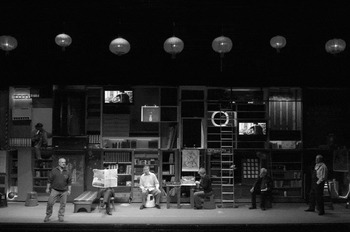
Karl Marx: Capital. First Volume, by Rimini Protokoll, directed by Helgard Haug and Daniel Wetzel. Photo by Sebastian Hoppe.

These modes of description and analysis as an approach towards the future can also be seen as basic elements of the Rimini Protokoll performance based on Marx's Capital. It seems that scientific and artistic work is interrelated, as both approaches are based on concepts, observations and analysis. Using theatre and its medial implications, transitoriness and liveness, the performance reflects its own dependence on time and shows how theatre relates to the future.
Reading Marx the simple way – by performing it
As mentioned above, the work of Rimini Protokoll differs from what we usually experience in the theatre in one significant respect: the performers are not trained, professional actors – their professionalism instead lies in their knowledge of a certain topic, such as the central terms and aspects of Marx's Capital, as well as their own individual experiences. The performance consists of biographical fragments, narrated by the performers themselves. The different episodes are brought together to create a theatrical collage of stories.
As the audience enter the auditorium, the ‘experts’ or performers are already waiting on the stage. They are standing or sitting in front of, or sitting on, the oversized multifunctional wall system at the back of the stage – basically wherever they have found space on the wall's folding bed, next to the slot machine, within the kitchen unit, on the window shelf or just in between numerous editions of Marx's Capital. Other than the books, different parts of the wall, such as the bed or the kitchen, indicate different rooms that are meant to point out locations throughout the performance. Smooth music is played while the spectators take their seats, creating an atmosphere familiar from big department stores. Suddenly, the music of the well-known game show Who Wants to Be a Millionaire? begins to play and the blind ‘expert’ Christian Spremberg describes his dream of winning the show in order to become rich. He introduces himself to the audience as an amateur DJ and call centre agent. During the performance he plays several songs from different eras to accompany the various time periods introduced by the ‘experts’. A conversation between him and Thomas Kuczynski about the first main aspects of Marx's Capital begins as follows: while Kuczynski owns an edition in Braille, which is useless to him, Christian Spremberg has only a print edition, which he, in turn, cannot read. Explaining the Marxist terms of value and use value, they exchange their editions, which have not been of use to either of them.
This scene could be taken as a pivotal scene, a short introduction to Marx's terminology. The performance connects passages of Marxist theory to concrete situations from the experts’ lives. Telling their stories chronologically, the performers begin in 1944 with the memories of Talivaldis Margevics, the oldest expert, and finish with their collective vision for the year 2015. Focusing on specific years and the epochs between them, the performance gives an overview of the historical and political background for this particular reading of Marx's Capital. Ranging from the Eastern and Western parts of Germany to Latvia (through Margevics), the performance offers multifaceted perspectives on Marx's theory and (contemporary) society. Furthermore, leftist student activities in the 1960s, as well as contemporary unemployment rates and the social politics of reunified Germany, are addressed. The ‘experts’ are of different ages, and they embody different experiences and views of certain epochs as well as their historical circumstances. The performance randomly highlights the years 1944, 1966, 1969 and so on, and proceeds in this manner into the present and to the future year 2015. Talivaldis Margevics remembers his family's flight from the Russian occupation and the decision to return to Latvia after the war ended because his mother felt homesick. On their exhausting way back his mother was asked at a station to place her son with a farmer to ensure that he would grow up without suffering either from hunger or from poverty. She was offered food and milk in exchange for her son. Through this story of being made into a commodity, Margevics explained Marx's terms of value and exchange value.
Jochen Noth, a socialist activist in the 1960s and today a successful economist focusing on China, describes his experiences as a student around 1966 as follows: Noth took part in a short-film project against liberalism and the bourgeois middle and upper classes. The film shows him, the protagonist, defecating on a carpet at the centre of a living room. During the performance, this act is projected onto large flat screens that are built into the multifunctional bookshelf. The black-and-white film contrasts with another colour fragment played shortly thereafter, which shows Jochen Noth today, burning paper money in public and inviting passers-by to join him. Even though both short films portray a critical attitude towards money and capitalism, they also illustrate that time has passed by contrasting two different periods in the life of the ‘expert’. The images of Jochen Noth thus become a medium indicating the process of ageing. While his message remains more or less the same, the appearance, voice and movements of the ‘expert’ have changed significantly, giving rise to the question of what happened in the meantime. Is it not contradictory that a leftist activist becomes an established economist? The films present a common principle that the performance as a whole is based on: as the ‘experts’ describe different moments in their lives the performance shows apparent contradictions. Concurrently these contradictions are negotiated as they belong to the same narrator, to the same life. The performance thus creates moments that oscillate between some form of coherence and its opposite, evoking a certain ambivalence in the audience.
The performance highlights diverse episodes from the ‘experts’ lives, juxtaposing them while foregrounding disparities and disruptions in and between them. Franziska Zwerg, a Russian–German interpreter, describes her childhood and youth in the former German Democratic Republic, which has hardened her attitude towards the Soviet Union. After German reunification, she travelled to Russia and discovered her interest not only in the Russian language but also in its culture, population and countryside. Narrating the story of her life, she describes this change in her attitude, which arose from historical and political circumstances. Contrasting these two biographical episodes the performance shows a never-ending process of transformation regarding concepts and attitudes, which were revised and corrected continuously in the lives of the ‘experts’, turning them in new directions.
The performance not only shows individual development but also a historical process and the predominant discourses of a society during particular epochs – related to socialism and Marxist theory. For example, the activism of the 1960s described by Jochen Noth contrasts with the beliefs of twenty-one-year-old Sascha Warnecke, who has just refounded a socialist organisation (Sozialistische Deutsche Arbeiterjugend – SDAJ) in Düsseldorf in the former West Germany. While it was not uncommon among students and young people in the 1960s to be dedicated to ideologies critical of capitalism, Sascha Wernecke's activism is an exception nowadays and thus marks a change in social values.
Focusing on terms such as ‘labour’, ‘money’, ‘capital’ and ‘employment’, the performance not only deals with essential aspects of Marx's theory, but also uses central ‘formal’ moments of Marx's Capital. These are the mode of description and analysis for the creation of further concepts and visions. The ‘experts’ describe moments in their lives, when their own future took unexpected turns. They had to reflect on their experience (of the past), the actual (present) situation and their expectations (towards the future) to cope with new situations. Experience and memories, and reflection of what was and actually is and what will be also become crucial for the spectators’ perception, as shown in the example below.
To experience the future
One story in Rimini Protokoll's Karl Marx: Capital, Volume 1 differs from all the others. When Ulf Mailänder, author and coach, enters the stage, he initially pretends to be the real-estate agent and investment adviser Jürgen Harksen. In this role he describes Harksen's career, starting out as an undereducated young man and becoming an established businessman in Hamburg's high society. Gaining the trust of rich and successful fellow businessmen, he fraudulently acquired a luxurious living standard. He offered advertising space on a spacecraft to his clients, claiming that other companies, such as Coca-Cola, had already rented one of these spaces. Harksen's sophisticated means of ‘moneymaking’ exudes a certain charm, which captivates the smirking audience. In the end Mailänder gives up his role and confesses to be Harksen's biographer. Being fascinated by the salesman who had taken advantage of the circulation of capital, he began work on the biography and edited it. By pretending to be Harksen and then switching to his own identity, he confronts the spectators with their own thwarted expectations. One could say that the audience take on the role of the cheated rich from Harksen's story. The audience obviously experience this situation as a very intense moment: the expectations of how the story might continue, visions of the narrated situations, and the created atmosphere all collapse and fail at once. Following the new ‘offer’ of the ‘expert’, the spectators have to renew their understanding of Mailänder's story.
This scene plays with the audience's expectations and positions them as a fundamental element of the performance. Expecting and conceptualizing its course, and imagining the further steps onstage, as well as envisioning the end, go hand in hand with the perception of the performance which leads to the ‘experience’ of the (near) future. The performance offers a ‘here and now’, which inherits a potential of what will happen next. As far as expectations might fail, the spectator has to reconsider and to reanalyze the circumstances of the scene to arrive at new concepts and understandings. The performance not only presents these dimensions of experience, reflection and expectation, related to the different layers of time, but makes the spectator him- or herself experience them at the same time.
Rimini Protokoll's Karl Marx: Capital, Volume 1 shows this dependency as an ongoing and never-ending process. Following the chronological structure, the performance does not end in the present. The experts stand in a row and each delivers his or her own vision of the year 2015, of what he or she is going to do then: the economist Jochen Noth wants to visit China one more time; the socialist Sascha Wernecke expects the completion of the revolution, and so on. The performance ends and does not end as it opens itself towards a vision of the future. The last phrase of the performance, Marx's maxim in life, points towards the mode of expectation, conceptualization of the future, and analysis of changing circumstances: ‘Everything is doubtful’.