Introduction
When the People's Republic was established in October 1949, the new leadership knew they had a painstaking task ahead of them. After so many years of war, the population was in a critical condition and China's manufacturing industry and agricultural sector had reached their lowest peak. The world was heading decidedly towards ever-greater division, which would limit the choice in military and economic alliances. Mao Zedong decided to make a radical change by steering the Chinese economy towards heavy industry to equip the country with a solid base in case of foreign aggression.Footnote 1 With the signing of the Sino-Soviet Treaty of Friendship, Alliance and Mutual Assistance in 1950, China started a huge programme of industrial and technological exchange with the Soviet Union. The partnership led to the conclusion of 156 major projects. Out of the first 50 projects realized before 1953 in the most urgent sectors—coal, electricity, steel and iron, non-ferrous metal, the chemical and engineering industries, and the military—44.7 per cent were in the energy sector.Footnote 2
The First Five-Year Plan (1953–1958) resulted in a good economic performance for the country and proved highly beneficial for the population at large.Footnote 3 However, it is difficult to trace a straight line forwards. In 1955 criticisms of the slow pace of transformation led to the speeding up of land collectivization and nationalization of company ownership. Mao's firm belief in accelerated growth would eventually lead to the Great Leap Forward.
The push for research in oil extraction and refinery was an integral part of Mao's vision of a strong and independent China. New explorations had already started in the early 1950s and reached a first peak in 1958. In the early 1960s, alongside the new autarkic line deriving from China's attempts to distance itself from the Soviet Union, the search for independence in energy sources found its expression in the ideology of ‘self-reliance’.Footnote 4 China reduced its oil imports, eventually becoming an oil producer in 1963.Footnote 5 Though never able to produce a wide range of products, China maintained this status for slightly more than a decade. Any desire for energy self-sufficiency was abandoned after 1978, as the huge economic development process started by Deng Xiaoping meant that the country needed to rely on imports to support this major effort.Footnote 6
As noted by several economists, the single most important statistic around China's planned economy is that 50 per cent of the machinery and equipment required for the First Five-Year Plan had to be imported.Footnote 7 Reflecting Mao's famous statement about the need for China to ‘lean on one side’, most came from the Soviet Union and Socialist bloc countries. From 1952 to 1953 China's trade with the Socialist bloc expanded by 25 per cent. During the Korean War, China's trade with the West plummeted due to American- and UN-imposed embargoes. However, as soon as the war ended, China's trade with non-Socialist Europe grew much faster than its trade with the Socialist bloc: between 1953 and 1958 imports from the former more than quadrupled.Footnote 8 In real figures, numbers are relatively small: at its peak, trade turnover (exports plus imports) was US$4.3 billion in 1959. China's international trade was not large in comparison to its national income.Footnote 9 However, it is important to analyse the nature of the imports, which comprised fertilizers, capital goods, and foodstuff. Until 1960, capital goods formed the biggest portion of China's imports (65 per cent of the total in 1959), thus confirming the importance of the investment programme for industrialization. China exports were agricultural products and textiles. When we consider that China's biggest textile output (cotton and silk) was of agricultural origin, the importance of agriculture increases. Throughout the Mao years, China's basic trade pattern was exporting agricultural-based products in return for capital goods.
In order to understand how international commerce operations were actually handled by Socialist China, we need to remember that in Socialist economies foreign trade is a state function.Footnote 10 It is, therefore, intimately connected with foreign affairs, representing a true ‘arm of the state’. However, foreign trade is not situated at the centre of a Socialist economic system, rather at its periphery. Responsibility for the full employment of the population is at the core of a Socialist economic system. All foreign trade operations are subordinated to the fulfilment of this imperative, and are overseen by state import–export corporations. The dynamics of exports are determined only after the country has stated what needs to be imported, and this often leads to the coexistence of import hunger and export aversion.Footnote 11 Such stringent state controls result in an excess of structures and in a situation where there is far more bargaining within the Socialist bureaucracy than there would be with the foreign buyer, seller, or bank. According to Kornai, the complication and lengthiness of decision-making exacerbates the inflexibility of trading and credit activity, causing foreign trade to be the sector in which the largest number of hierarchical organizations accumulate, most of the time overlapping, and thus creating slowness and lack of coordination exactly where speed and accuracy are supposed to play such a decisive role.Footnote 12
The heavy legacy of semi-colonial economic exploitation meant that the PRC's system of foreign trade was very much linked to projecting a new image of the country to the world. The Moscow International Economic Conference of 1952 and the Geneva Conference of Indochina of 1954 not only represented important moments for the construction of Socialist China's system of diplomatic relations, but also corresponded to milestones in the development of a new way of dealing with foreign economic relations. The Moscow Conference hosted delegations from 49 countries, offering business people the first opportunity to interact directly with the PRC's main import–export corporations; contracts were signed with companies from Britain, France, Italy, Belgium, West Germany, the Netherlands, Switzerland, and Finland.Footnote 13 It also represented a first step for Western-based, pro-Socialist organizations to find customers and manage commercial negotiations. In Geneva, trade-related issues were discussed between Chinese authorities and more structured Western business delegations.Footnote 14
In 1952 the PRC Ministry of Foreign Trade was founded. The same year saw the creation of the China Council for the Promotion of International Trade (hereafter the China Council), modelled on a similar Soviet organization. Its function can be described as pre-eminently one of ‘liaison’, not officially under government control and not authorized to handle business operations. Its main role during the Cold War was to manage the PRC's economic relations with countries outside the Socialist bloc. Both the Ministry of Foreign Trade and the China Council coordinated with the Ministry of Foreign Affairs and used the network of trade offices established by PRC embassies abroad. The PRC embassy in Bern worked as the gateway for those European countries that had not yet opened official relations with China.
Actual business negotiations were handled by state-owned monopolistic corporations, organized by sector of activity. They acted as real commercial agents, usually receiving between 2 and 3 per cent from the Ministries for each operation performed.Footnote 15 Among them, the most relevant for this study are the China National Import–Export Corporation and China National Technical Import–Export Corporation. Until the mid-1950s, the former played a coordinating role for all China's import operations; later these were distributed among the various sectorial corporations.Footnote 16 Soon after the Moscow Economic Conference of 1952, the China National Import–Export Corporation opened an office in East Berlin, which greatly facilitated contacts with European business people, especially with those whose governments had not yet established official relations with China. Those countries that had recognized the PRC in the early 1950s, such as Britain, the Netherlands, Denmark, as well as neutral countries such as Switzerland, Sweden, Norway and Finland, had their own direct channels.
Starting in 1957, China offered an interesting opportunity to ‘peek at the Chinese market’ by holding the first International Canton Fair which was held in the southern city of Guangzhou twice a year (spring and autumn) and hosted delegations from all over the world. As it operated with few restrictions regarding the country of origin of businessmen, the Canton Fair represented China's most important window on the world under Mao.Footnote 17
Among the Western European companies interested in China in the 1950s and 1960s, some had already started doing business with China in the early decades of the twentieth century, for example, the German company BASF, British ICI, and Italian Montecatini. None of them, however, had maintained their strongholds after the foundation of the People's Republic in 1949, after the new government decided to enact a policy of nationalization. As a result, during the first half of the 1950s most foreign companies had to close down and move out of China. Other companies were new to the market, including the Italian National Hydrocarbon Holding (ENI), which forms our case study. As this article will show, a micro-analysis approach of Western sources can be much more revealing than might be expected.
Whereas the activities carried out by Western industrialists in China were documented, it is very difficult to match this evidence with Chinese original sources. Archival material related to the post-1949 economy and foreign trade is considered ‘sensitive’, as are documents related to foreign relations. There is little availability of materials on foreign trade under Mao, apart from the space dedicated to it in the few books addressing the Chinese planned economy.Footnote 18 It would be desirable in future research to carry out more in-depth studies at the micro-level, here including the Chinese cadres who handled foreign trade operations. Many of them were active in the Guomindang era and had an operational knowledge of the capitalist system. Ji Chaoding (Chi Chao T'ing), vice-chairman and secretary general of the China Council, was an eminent economist and lived extensively in the United States. Lesser known characters, such as Chen Ming or Xie Qizhu, had first-hand experience in international trade and finance, and added a business-oriented flair to Socialist China's operations in the 1950s and 1960s.Footnote 19
This article intends to assess the role played by business relations in the development of Cold War dynamics among states in opposite ideological camps. By making consistent use of materials from ENI's historical archive, it will analyse a little-known period in the company's history: the first decade of ENI's China operations: 1956–1965.Footnote 20 In so doing, the article sets out to evaluate the business strategy devised by ENI managers and to assess ENI's role in the making of an independent Italian diplomacy towards China. In a setting so highly motivated by ideology, how ‘pure’ could business relations be? Could ENI's business with a Socialist country be profitable? How favourable were the effects of such exchanges on the Chinese economy?
Moreover, the article will assess the reasons that led a company owned by an American ally to pursue years of business negotiations with Mao's China, when this could evidently be deemed provocative by Italy's main ally. Was there a mere business interest behind ENI's decision to negotiate with Mao's China? Or were political considerations involved?
The article aims to add to the general understanding of China's attitude to foreign powers during the first two decades after the founding of the PRC. An analysis of operations and strategies in the chemical and petrochemical industries is revealing of the rationales behind the decisions of China's leaders in industrial policy as well as of their attitude to foreign companies. Was there specific coordination with foreign trade and technical cooperation? Did ENI make any contribution to China's achievement of self-reliance in petroleum production, so actively sought-after under Mao?
Finally, the article will channel attention to a period in China's economic history that has been long overlooked. The literature has focused on China's reform and opening-up, but the country's miraculous growth post-1978 remains difficult to explain without looking at an earlier phase of its development.Footnote 21
Western European industrialists in Mao's China: out of the door, back through the window
The bipolar paradigm saw the American capitalist system juxtaposed with the Soviet Union Socialist system. Two informal committees—the Coordinating Committee (alternatively called Cocom or the Paris Committee, created in 1947) and the Chincom (or China Differential), created in 1952—composed of representatives from Japan and all 15 NATO members actively enforced commercial restrictions to strategic trading with the Soviet Union, Eastern Europe, and China.Footnote 22 In accommodating the Americans’ harsh attitude towards Socialist China, the Chincom list contained a larger number of goods.Footnote 23 Many of them were items that China's fast industrialization was in need of and was keen to import.
This strategy of economic containment devised by the United States shaped the contours of the East–West confrontation. Nevertheless, the allies did not fully agree nor comply with the imposed restrictions.Footnote 24 Recent research has pointed out that business and technological exchanges were very frequent and relevant to the development of both Eastern and Western Europe during the Cold War and that ‘the highest level of political decision making was not the only motor of change’.Footnote 25 What we now know suggests that, similarly, the Iron Curtain that was in place between China and the Free World was more porous than previously believed. Economists and political analysts of the time were well aware of NATO countries’ increasing share in the China trade in the mid-1950s.Footnote 26 Significantly, in 1957–58 the volume of China's trade with the Soviet Union dropped for the first time since the PRC was established.Footnote 27
There was frequent dissent among American allies regarding the necessity of keeping a different—and stricter—list for China. Not all governments agreed that the size and strength of the industrial base would decide the outcome of a war between the capitalist and the Socialist blocs. The British thought that the next war would be a short nuclear one, and any restriction on the enemy's industrial development was irrelevant.Footnote 28 Britain never made any secret of the fact that it considered the PRC to be a valuable trading partner and accompanied this with formal recognition as early as 1950. The French were not keen on the embargo but before de Gaulle's presidency, they maintained a soft approach: though encouraging the initiatives of individuals in the commercial field, the government strictly contained Sino-French trade within the limits of the embargo. In Italy in the 1950s a group of intellectuals, businessmen, and politicians repeatedly asked the government to send an official trade delegation to China and to soften the embargo.Footnote 29 British commercial interests in China challenged its alliance with the United States, culminating in the former withdrawing from Chincom in 1957. All other member countries, except for the United States, followed the British. The effects of such a liberating move were immediately evident. From 1957 to 1958 the value of West German and British exports to China surpassed those from East Germany and Czechoslovakia.
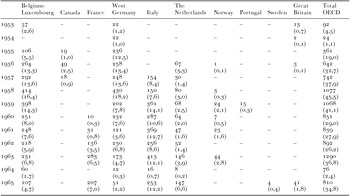
As Liu demonstrates in her pioneering 1971 study, the import of fertilizers—especially during the 1950s—was crucial to China so that it could expand its textile exports and, consequently, be able to pay for capital goods. The main producers of fertilizers were Japan and Organization for Economic Cooperation and Development countries (see Table 1). Until 1958, China's fertilizer imports from these countries increased fast, reaching 77 per cent of the total. In 1959 Japan was excluded for political reasons, then it gradually made a comeback, passing Organization for Economic Cooperation and Development countries in 1964–66.Footnote 30 The changes in the percentage of total imports show that the Chinese market played an important role in the (chemical) fertilizer industries of the exporting countries. Belgium and West Germany led the market until 1958, then it was the turn of France, Italy and the Netherlands.Footnote 31 Import–export policies acquire a much more complex aspect when we analyse the activities of Western European industrialists in China. Among the leading European chemical companies (Bayer, Hoechst, BASF, Rhone Poulenc, ICI, Vickers-Zimmer, Montecatini), we find ANIC, a subsidiary of the Italian state energy company, ENI. ANIC's deal(s) in the mid-1950s provided a timely opportunity for it to gain an advantage in the struggle against its main competitor, the Italian private company Montecatini.
Chinese fertilizer imports from Organization for Economic Cooperation and Development countries.

Source: Liu Jung-Chao (1971). China's Fertilizer Economy, Aldine Publishing, Chicago.
As already pointed out, among the companies interested in the Chinese market were those that had been involved in China's economy during the period of semi-colonial exploitation and who decided to continue to do business with China after 1949. The case of British companies is unusual because of the British colonial presence in Hong Kong. Moreover, since Britain never severed official ties with China, several British business delegations were already visiting the country in 1953. Most notably, the Hongkong and Shanghai Banking Corporation and the Chartered Bank were the only Western banks allowed on Chinese territory throughout the Mao years.Footnote 32 Some West German companies resumed business with China very early on: BASF was operating through the German-Danish trading company, Jebsen, by 1956.Footnote 33 Bayer, Mannesmann, and Verein Deutschen Maschinenbau visited China in 1957 along with a semi-official organization which signed a private trade agreement with the China Council, regulating exchanges of goods for DM100,000.Footnote 34 Between 1956 and 1957, two French trade delegations visited China; they comprised representatives of French institutions and of important companies, such as Schneider, Alsthom, Neyrpic, Saint-Gobain, and Pechiney.Footnote 35 In the mid-1950s Italy's biggest chemical company, Montecatini, signed many contracts in China through Comet, a trading company led by politician and middleman, Dino Gentili, who had special ties with the Italian Socialist Party.Footnote 36
The early 1960s as a turning point in China's industrialization strategy and self-reliance
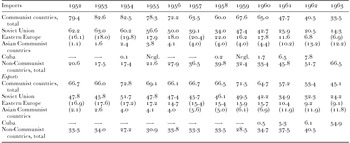
Whereas the 1950s witnessed a rapidly industrializing China, the 1960s show a much different picture: the Great Leap Forward caused the death of millions, while the ideological dispute with Moscow became serious and China found herself isolated and needy. In the early part of the decade, China had to turn to the West to import grain to lift its population out of starvation. The sustained upward trend of imports up until 1959 was followed by a sharp drop from 1960 to 1962, which in turn was followed by a gradual recovery; by 1966 the volume of international commerce had again reached the 1959 peak (see Table 2). As soon as the country recovered from the worst consequences of the Great Leap Forward, relations with Western European industrialists entered a new, more ‘professional’ phase. The first signs were seen in late 1961, when the Chinese purchased Viscount aircrafts from the British manufacturer, Vickers. The year 1962 saw a revival of interest in the fertilizer market, this time also aimed at developing production facilities. In 1963, the Chinese bought a urea production plant from the Dutch company, Continental Engineering (V.N.F. Stork Verkspoor), which was the trigger for the purchase of equipment, patents, and know-how to build ammonia plants from the Italian firm, Montecatini, and of a synthetic ammonia plant from the British company, Humphreys and Glasgow.
Direction of Socialist China's foreign trade, 1952–63, adjusted (in per cent).

Source: Eckstein, Communist China Economic Growth, p. 286.
In the same period, the effects of the ideological dispute with Moscow left China isolated in the Socialist bloc. During the early 1960s—in response to China's independence from the Soviet Union—the country increased its strategy of self-reliance, which included testing the first atomic bomb and expanding explorations in oil production, oil imports, as well as in the import of pipes and refining plants.
Although the 1960s brought the discovery of new oil fields, China was never able to produce all types of oil, and constantly looked for new providers. From 1963 to 1966, Chinese import–export corporations were very active buying technology, machinery, and plant from all over the world. Notwithstanding the Sino-Soviet dispute, China was still able to obtain oil rigs, turbo drills, seismic equipment, and core sampling plant from Hungary, Romania, and East Germany.Footnote 37 They also obtained catalytic cracking and platforming technology made with American technology and imported from Cuba.Footnote 38
The Chinese entered negotiations for oil refineries and petroleum equipment with the German firm, Lurgi; French firms, Speichem and Technip; and Italian firm, ENI. The Chinese also targeted metal and machinery companies, for example, the German firm, Mannesmann, and Italian company, Innocenti. By 1962 it was clear that the Sino-Soviet split would not have an easy resolution, and the Chinese market became ever more alluring for Western companies. The year 1963 marked the emergence of uncertainty and ambivalence in America's China policy, fuelled by the debate on what was best for American business interests. Chincom forbade the sale of petrol, as well as the sale of ‘petroleum refinery equipment’ and ‘oil well drilling and exploration equipment’, which were specifically mentioned on the British lists.Footnote 39 Nevertheless, many grey areas allowed trading opportunities that crossed the boundaries of capitalist and Socialist blocs. In order to start producing planes, China needed to buy fuel and lubricants from abroad. Although the United States had placed a ban on American companies trading with China, they knew that it would be hard to prevent Western European companies from trading in those items, especially British and Dutch companies, which continued to own large storage tanks along China's coastal ports, from where they could easily provide petrol to Chinese government-owned companies.Footnote 40
ENI's economic interests and Mattei's international vision
The narrative of this article will closely follow the case of Italy's state holding, ENI. The company was founded in 1953 in an effort to restyle the energy sector and give the Italian government a strong hold over the sector.Footnote 41 The new holding company was given shares in Agenzia Generale Italiana Petroli (the national energy distribution company created by the fascist regime), Società Nazionale Metanodotti (an engineering company), Nuovo Pignone (a mechanical company acquired in 1954), and ANIC (a chemical company). Given the extremely strong and promising conditions of the Italian chemical and petrochemical sectors in the mid-1950s, it was hoped that this bold state project would be very successful. History has shown that the Italian government's reconstruction and economic planning was flawed. Above all, its basic decision to provide help to the Italian Mezzogiorno (southern Italy) by mandatory redirection of some companies’ investments to the region, caused damage to a promising industry without bringing any positive improvement to those affected areas. Eventually, the efforts of ENI and its competitor, Montecatini, to keep up with other international actors clashed when the commitment to help develop the Italian Mezzogiorno (along with a number of other wrong financial decisions) distracted considerable resources from more successful projects.
The history of the Italian holding is tightly linked to ENI's first president, Enrico Mattei, a gifted entrepreneur and a man with keen political acumen. He took advantage of two favourable historical junctures: first, in the post-Second World War years Italy was taking off as an industrial power and as a consumer society; second, the oil industry was in ascension and Italy, Germany, France, and Japan—the four largest consumers of oil products after the United States and Britain—had an opportunity to take independent economic action and acquire more political status. In the political realm, Mattei had solid alliances, as he had fought during the war as a partisan and acquired an anti-fascist reputation. Moreover, he had embraced the ideals of the progressive left-wing Italian Catholics, and developed a close friendship with some important figures who had played a role in founding Italy's Christian Democratic Party (Democrazia Cristiana). Such ideals included a belief in strong state intervention in the economy and a leading role for the managers of state-owned companies. During the Reconstruction years, the Italian government deliberately chose to put state companies into competition with the private actors in areas where the state did not have any monopoly. This needs be underlined here, for ENI was the expression of such political will. Men like Mattei were deliberately chosen because the political class of the time—though responsible for making such decisions—did not have a clear commitment to economic planning. The rivalries and the ideological ambiguities within the Christian Democrats meant that almost every decision was put in the hands of the managers, which meant that they needed to have great personal ability.Footnote 42
In 1948 the Christian Democrats won the absolute majority in the elections. This gave Mattei a great opportunity, as he was chosen to manage the transformation of the state energy sector. The main problem he had to confront was the lack of vertical integration in the group. ENI had direct control over natural gas, as resources were available in the Po Valley in northern Italy. In the case of petrol, the group's companies would refine and process crude oil and sell the final products, but did not have the advantage of having direct control over crude reserves.Footnote 43 The lack of cheap and controllable sources made ENI much weaker in comparison to other competitors, and this was identified by Mattei as one of the crucial issues to tackle when drawing up a new strategy. In order to fully understand the reasons at the root of the group's actions, we need also to take into account two important areas where Mattei put in a lot of effort: the building of a strong hydrocarbon distribution network, which was realized through the Central European Line; and the strengthening of the petrochemical industry.Footnote 44
Using ENI's research and facilities, as well as harnessing his entrepreneurial attitude and his political capital, Mattei succeeded in finding diversified and cheap sources of oil. His main achievement was to fill the gaps in the world oil industry, which by the mid-1950s was facing an imminent crisis in the post-Second World War balance. Making use of the horizontal integration offered by the many specialties of ENI's subsidiaries, starting with the agreement signed with Iran in 1956, ENI developed what has been called ‘formula Mattei’ or ‘formula ENI’: a joint venture in which the producing countries and foreign companies had an equal share in profits.Footnote 45 This kind of contract was also called 75 per cent–25 per cent; the case of Iran exemplifies how they operated. In 1957, AGIP Mineraria (ENI's subsidiary) and the National Iranian Oil Corporation formed a joint venture, the Societé Irano-Italienne des Petroles. The newly formed venture would pay 50 per cent of its profits to the Iranian state through royalties, rights, and taxes. The remaining 50 per cent would be divided between AGIP Mineraria and the National Iranian Oil Corporation. Being a national company of the Iranian state, the outcome was that, for the first time producing countries were receiving 75 per cent of the profits.Footnote 46 Of course, ENI would compensate for this loss by securing more contracts to provide technology and plants through its subsidiaries.
ENI's outward strategy included agreements with Egypt (1954), Iran (1956), and the Soviet Union (1960). In many cases, ENI-designed agreements included machinery and plants, which were provided by its subsidiaries, thus multiplying business opportunities. The cheap energy would prove decisive in ‘fuelling’ the Italian economic miracle. Though ENI's actions under Mattei's leadership have often been defined as an Italian ‘parallel diplomacy’, in reality the group did not fully coordinate with the government. Mattei always adhered to the political current of the left-wing Christian Democrats, albeit frequently being much bolder and more reckless than his spokespeople. His independent attitude soon started to attract hatred and criticism. The State Department of the United States openly accused him of destroying the system of royalties and lowering oil prices. Mattei's career in ENI lasted nine years, ending abruptly with his untimely death in October 1962.Footnote 47
The ‘parallel diplomacy’ conducted by ENI's president was a salient issue with respect to the American-Italian relationship, often arousing suspicion in American officials over the reliability of their Italian counterparts. For these reasons, the American administration strictly monitored both Mattei and ENI, which involved coordinating the efforts of the CIA and American diplomats. ENI's actions intersected with the official relationship between China and Italy on two main occasions: in 1957–58 and in 1962–64.
The ENI group's strategy for China
Enrico Mattei visited China in December 1958. He was received by the Chinese with all the relevant honours: he met Marshal Chen Yi, vice-minister of foreign affairs. He also met Nan Hanchen and Ji Chaoding, respectively the chairman and the secretary- general of the China Council, the non-governmental institution handling economic and friendly contacts with non-Socialist countries.
Owing to Mattei's high political profile, his visit to China has been portrayed as a great achievement for Italy's struggle to establish an independent profile, away from American influence. American intelligence failed to find out about the trip in advance, and only received this information through the Italian press, which published extensive and triumphant reports conveyed directly by ENI. The day after Mattei's arrival in China, the Central Intelligence Agency published a bulletin, provocatively entitled ‘Italian oil czar seeking trade deal with Communist China’.Footnote 48 Although Prime Minister Amintore Fanfani denied knowing about the mission, this cannot be true: Mattei skilfully proposed his trip to the Chinese embassy in Bern, selling it as a replacement of the Italian economic mission, which had been planned since 1954, but which he knew for certain from his political contacts would never have the chance to materialize. These circumstances provoked a harsh reaction in James D. Zellerbach, America's ambassador to Rome. The conversation that he had with Prime Minister Fanfani shows that the American government had long been observing not only Mattei, but also the ambiguous inclination shared by Italian businessmen and politicians towards trading eastwards:
Mattei, like so many Italian businessmen, desires to increase trade wherever it can be done profitably. He sees no reason why Italy should not trade with the Soviet bloc and Communist China.Footnote 49
After an early enthusiastic reaction in favour of the PRC in 1950, Italy had shown an ambiguous attitude towards diplomatic recognition.Footnote 50 Loyalty to the United States, which had economic and political, but most of all security, motivations, caused deep fears within Italian political parties and brought a heavy influence to bear on the government's attitude towards trade. Like other allied countries that relied on American financial help and military protection, Italy was in a delicate position with regard to pursuing an independent policy. In addition, after the Second World War, Italy was the country with by far the strongest Communist party in Western Europe. This last fact particularly fuelled American fears of Italy ‘going Communist’ and motivated close monitoring of the country's political situation.Footnote 51
Initiating commercial contacts with the Chinese had been carefully planned, using political and commercial levers. The first documented (though indirect) contact happened in June 1954 when the Italian businessman, Dino Gentili, first proposed ENI's interests to the Chinese delegation in Geneva.Footnote 52 Direct contacts were started in January 1958 when Franco Micucci Cecchi, a junior staff member in ENI's export department, visited the Commercial Office of the PRC embassy in Bern, carrying a letter of recommendation from former partisan, Ferruccio Parri, as his credentials.Footnote 53 The commercial attaché, Gao Shanglin, officially represented the China National Import–Export Corporation in Western Europe.Footnote 54 Cecchi visited Bern again in April, bringing further information that would be useful for the first sale of ammonium sulphate. In June, ENI marketing manager, Giuseppe Ratti, and Wang Dexin, representative of China National–Import Export Corporation, carried out negotiations in Bern. Ratti, together with ENI vice-president, Eugenio Cefis, met Wang in Bern in July 1958 and later on, alone, in the autumn. At this last meeting, Ratti checked with the consul whether a delegation led by Mattei could take part in the Italian economic mission, which had been planned since 1954 and had again been delayed (Missione Guglielmone). In the summer of 1958 Mattei visited the PRC embassy in Bern, and successfully negotiated the ENI group's visit to Beijing as a replacement of the non-official trade delegation to China.
In organizing ENI's first mission to China, Mattei deployed all his political contacts. The trip was partly orchestrated with the help of Giuseppe Regis, a corresponding journalist for the Italian Communist Party's newspaper, l'Unità, who lived in Beijing and also acted as a commercial intermediary.Footnote 55 Mattei's contacts with the Chinese were also facilitated by the Christian Democrat mayor of Florence, Giorgio La Pira.
At the time of Mattei's trip to China, Sino-Italian negotiations were blocked. The two governments had initially agreed on a first step of setting up trade representative offices in each country. However, the Chinese wanted full diplomatic recognition to accompany the exchange of commercial offices, but Italy had too many political constraints to proceed with this. Mattei certainly discussed politics with the vice-minister of foreign affairs, Chen Yi, yet there is no evidence that they explicitly addressed the issue of diplomatic recognition.Footnote 56 In 1960 and 1961 Mattei paid further visits to Chinese diplomatic personnel in Switzerland, though unfortunately little has been preserved in ENI's archives about these missions. During his visit to Geneva in March 1961, Mattei also arranged a second meeting with Marshal Chen Yi; there are references in the records to the two speaking of China-Italy political relations, as well as of ENI's business with China,Footnote 57 but these are fragments reported by the marketing manager, Giuseppe Ratti. Ratti, who worked so closely on the group's international strategy that he was described as ENI's minister of foreign affairs, attached a political meaning to Mattei's trip.Footnote 58 He believed that, having already opened a road to the Soviet Union, Mattei could make a difference in breaking China's complete isolation. However, even Ratti made no mention of specific Sino-Italian political issues being addressed by Mattei when he met with Chinese personalities. Unfortunately, Mattei's political papers are lost and it is therefore impossible to know exactly what political aims the ENI president pursued with the Chinese and how feasible he thought his proposals were.
A careful examination of the available documents shows that Mattei was rather pragmatic and that an economic strategy prevailed over whatever political vision he might have had of Chinese-Italian diplomatic relations. Already in the mid-1950s it was well known among European companies that China was in dire need of fertilizers, especially nitrate-enhanced products, since the Chinese soil lacked this element.Footnote 59 By the time of Mattei's visit to Beijing, ANIC—the chemical subsidiary of ENI group—had already signed two contracts with the China National Import–Export Corporation for the total sale of 30,000 metric tonnes of ammonium calcium nitrate.
Immediate profits in the chemicals trade pushed ENI's first contacts with China and provided a timely opportunity to strengthen ANIC in the competition with its main national rival, Montecatini. The commercial battle had started at the end of the Second World War, with the competition to acquire mining concessions in the Po Valley, which ANIC secured in the end.Footnote 60
After the trip led by Mattei, the group and its subsidiaries exchanged visits, and made commercial inquiries and counter-offers, mainly relying on the commercial attaché in Bern. ANIC had some success in trading fertilizers, while reporting a less enthusiastic response to its own engineered synthetic rubber, Europrene. In 1958 ANIC signed two contracts: the first one for the sale of ammonium nitrate; the second one for ammonium sulphate and ammonium calcium nitrate. At the time of Mattei's trip to China in December 1958, ANIC's representative, Ratti, and China National Import–Export Corporation representative, Wang Dexin, had just signed a second contract in The Hague (on 29 October 1958). Footnote 61
Aside from the trade in chemicals, which was never ENI's main focus, the group cultivated the Chinese market for the extraction, refinery, and production of materials from oil. ENI's interest in cooperating regarding the extraction, refinery and derivatives from oil had already emerged in 1956, when ENI subsidiary, Società Nazionale Metanodotti, sent the young engineer, Giovanni Muratori, on an exploratory trip to China. Muratori reported that, although oil production was not considerable, the PRC's new government was financing large investments in extraction, thus confirming what we now know to be one of the biggest experiments in China's industrial history.
Muratori highlighted that the perforation and transportation of oil wells represented quite a serious problem because of China's vast territory. This had the potential to provide an interesting opportunity for future cooperation, but he underlined that the time was not yet right.
It is interesting to note that Giovanni was the son of Spartaco Muratori, an engineer who had worked as a senior consultant for the Italian trading company, Comet, and was actually based in Beijing at the time his son was undertaking his exploratory trip. There is reason to believe that, following Gentili representing ENI's interests in Bern in 1955, Mattei and Gentili finalized an agreement, and Spartaco helped his son in setting up some crucial contacts.Footnote 62 Giovanni was received by the vice-director of the Institute of the Petroleum Industry and by a number of high-level officials, who were to become key figures in the development of Società Nazionale Metanodotti's cooperation in petroleum processing.
Though no documents show how preparations for the mission proceeded, it was certainly not by chance that Muratori junior carried out his scouting mission when Mattei—having finished ‘restyling’ ENI and its associates—was exploring new routes for Società Nazionale Metanodotti.Footnote 63 During this phase, the group's main purpose was to acquire new providers of oil. The strategy included extensive exploratory activities, spanning a wide geographical range from Africa to Asia and various parts of the Soviet Union.
It is important to note how the outward expansion activity was a defining characteristic of AGIP Mineraria from its very inception. In this respect, Mattei's actions were a continuation of this pattern; in many cases he had pre-existing contacts in countries such as the Soviet Union, which had been Italy's major source of oil during the fascist regime, and Libya.
Overall, the exploratory and expansion phase, which culminated in 1956–57, saw no immediate returns; the costs of these activities would only be seen after Mattei's death. The Chinese case is no different. Here, the outcome was influenced by the internal situation in China, namely the Great Leap Forward.
Mao's ‘petroleum rush’
The relevance of the first contact between the Società Nazionale Metanodotti and China in 1956 acquires more importance when it is connected with Mao's push to develop the petroleum industry. The Communists inherited a few small petroleum fields in the northwest (notably, Yumen) and a shale plant in Manchuria from the Nationalists.Footnote 64 With the help of Soviet experts, an assessment was made that a much larger area of the country was likely to offer prospects for oil extraction. From 1949 to 1955 the number of geological workers in China increased from 18 to 6,000.Footnote 65 Between 1950 and 1958 Fushun functioned as a national model, and from 1958 to 1962 Yumen became the centrepiece of the PRC's oil industry. Eventually, when neither Fushun nor Yumen could fulfil the country's energy needs, in 1963 Daqing emerged as the PRC's new model oilfield.Footnote 66 During the 1950s China's investment in the petroleum industry increased constantly, reaching a peak in 1958–62, when three major oilfields—Daqing, Shengli, and Dagang—were discovered.Footnote 67 At this time, the Sino-Soviet split not only precluded Russian cooperation, but also hampered contributions from other Socialist bloc countries. As a result, Western Europe became a source for obtaining the necessary technology.
In 1958 Deng Xiaoping was appointed vice-premier with special responsibility for the petrol-chemical sector, and the Institute of the Petroleum Industry was transformed into the more powerful Ministry of the Petroleum Industry.Footnote 68 The most critical aspect of Mao's 1958 decisions regarding petroleum industry policy was the deployment of the People's Liberation Army in the form of a ‘Petroleum Division’ of about 30,000 army troops. Evidence shows that Daqing was less the product of selfless proletarian work and more a carefully planned operation. Many of the leaders appointed by the Great Helmsman at the head of the Ministry of the Petroleum Industry could boast a loyal revolutionary past and were thus already very familiar with the military: Yu Qiuli, the newly appointed minister, was a Long March veteran; other leaders, such as Kang Shi'en, Tang Ke, and Song Zhenming all came from the military and some of them had experience in the field. Kang Shi'en, for example, was a geologist and had received training in the Soviet Union. As a further enhancement of the strength of this group, leading officials from the Ministry were supported by extremely capable engineers and technicians. This group of experts was responsible of the exploitation of Daqing and, ultimately, for its miraculous success, which fuelled the proletarian demagogical discourse of the early 1960s. The leaders of the Ministry proved to be highly capable as well as non-conventional in that they very effectively related to foreigners. The so-called ‘petroleum faction’ received Mao's praise and protection. In 1963–65 Yu Qiuli and his close partners were among the officials appointed by Mao to be the new architects of the Third Five Year Plan.Footnote 69
Whether by chance or by calculation, the year of Mattei's visit to China—1958—proved to be a good year for ENI to start cooperating with China. Following the enquiries made by the Italians during their December 1958 visit, Chinese officials began to show the first signs of interest in petrochemical and oil products. In the spring of 1959 they sent a technical mission to visit ENI's plants. The delegation was led by Liu Fang, vice-president of the Chinese Association of Chemistry and the Chemical Industry, and included two members of the China Council: Chen Fengping, deputy director of the research department, and Liao Heshu, attaché. Most notably, three engineers from the Ministry of the Petroleum Industry also took part. Having been defined by the China Council itself as a ‘technical’ mission, the delegation did not include representatives of import–export corporations, as this would have attached a ‘commercial’ aspect to the visit. The delegation spent ten days in Italy and visited Nuovo Pignone, ANIC, STANIC, the IROM Refinery, and Cortemaggiore. The latter was a car fuel distributing company, and IROM was the group's main refinery. Based in Porto Marghera, Venice, it was a joint venture between ENI and BP.
The abovementioned visit did not bring any concrete developments in the perforation, refinery, or the petrochemical fields, but this was probably intentional. During 1959 China's economy was moving rapidly, the technical aid provided by the Soviets had not yet reached completion, and the Great Leap Forward had not yet turned into a disaster.
In the autumn of 1959, a delegation from ENI was invited to take part in the 10-year celebrations of the founding of the PRC. Mattei kindly declined the invitation, and Cefis and Ratti flew to Beijing to represent the group. As a sign of the distinction accorded to them, ENI delegates met high level Chinese officials such as Nan Hanchen and Ji Chaoding, who had already met Mattei on ENI's previous visit to China.
Cefis and Ratti also met the leaders of the China Machinery Import–Export Corporation, which showed an interest in buying perforation equipment and pipelines.Footnote 70 They also met with the newly appointed vice-minister of the Ministry of the Petroleum Industry, the same Liu Fang who had led the technical mission to Italy just a few months before.Footnote 71 This time the Chinese leaders showed an interest in exploration devices, compressors, and oil and natural gas pipes, and asked for prices ‘in order to conduct a preliminary study and check the convenience’.Footnote 72 The interest shown was still limited, and did not involve making any commitment, but it was nevertheless an opening. The fact that Liu Fang, who in his previous, more technical capacity had led the mission to Italy earlier in April, was among the hosts was a very good sign of the continuity of China's interest in the products offered by the Italian company. This fact further proves that a Chinese strategy had already been drawn up at the time the technical mission took place. Now, in his new political role, Liu Fang was certainly there to start negotiations based on the data that had been collected a few months before.
Exploiting the potential: ENI's engagement in the petrochemical trade
In 1960 one more deal supported ENI's decision to prioritize the chemicals aspect of their business: the Chinese bought 17,000 tonnes of rubber from ENI. In the latter part of that year, however, ENI staff noticed a decline in Chinese interest. Although other providers experienced this too, there is no mention of the domestic difficulties in China at the time.Footnote 73 We now know that during this period China had been precipitated into the tragedy of the Great Leap Forward, but it appears that until early 1961 no one in the West knew exactly what was happening in China.Footnote 74 In the tragic epilogue of the Great Leap Forward, Mao Zedong and his faction kept out of politics for a while.Footnote 75 Between 1960 and 1961, Zhou Enlai and Liu Shaoqi took the lead and started Economic Readjustment, which lasted until 1965.Footnote 76 The new policy not only offered new opportunities for chemical fertilizer plants, but opened up the market to petrochemicals as well.Footnote 77
In the latter part of 1961, as business was resuming, the ENI-Società Nazionale Metanodotti visit to China was being planned.Footnote 78 The purpose of the visit was to discuss with relevant Chinese organizations in Peking the possibility of collaborating in: drilling for oil and natural gas; transporting oil and natural gas; oil refining, including provision of complete refineries; and providing petrochemicals (including supplies of plants, with particular reference to those based on natural gas), chemicals (including nitrogenous fertilizers, synthetic rubber, and other products) as well as instruments and automatic equipment.Footnote 79
The Chinese wanted to keep the delegation's arrival in China on 19 February 1962 a secret from the Italian authorities.Footnote 80 This is understandable: on the government front, Sino-Italian talks were progressing at a much slower pace. In 1962 the Chinese invited representatives of the Italian Trade Commission in Hong Kong to take part in the Canton Fair for the first time. This led to the reopening of government talks about sending an official Italian economic delegation to China.
Soon after the trip to China in March 1962, Ratti and Gao Xingsun from the China National Technical Import–Export Corporation negotiated the sale of a combined plant for the production of acetylene, ammonium, and urea. The trip also received the political blessing of Chen Yi, the vice-premier and foreign minister, who spent time with the delegates. In these turbulent times, this was a clear signal that ENI could count on China's new economic leaders, although it is unclear the extent to which the Italians knew about the power shift that had taken place between Mao and the opposing factions.
Despite the confidentiality that the Chinese had asked for, however, news of the mission and of the political blessing it had received soon reached the Italian government. The Italian consul in Hong Kong commented bitterly that the ENI representatives had not lent a hand to the Italian government bodies, and only cared for their own business. He noted that the Chinese even paid tribute to the delegation with honours usually reserved for foreign MPs.Footnote 81
By the time ENI signed a big contract with Morocco the inevitable clash with the government had already taken place. Fanfani, who was at this stage both premier and minister of foreign affairs, refused Mattei's participation in the official visit to Morocco that he and the Italian president had organized. It appears that there was an underlying tension between Mattei and the Italian political authorities. In the case of Fanfani, the relationship was mixed: the latter would never look for an open fight, but he was scared of Mattei's tough personality and aware that he could never control him.Footnote 82
This time, the clash between ENI and the Italian government happened against the backdrop of a very tense international atmosphere. During the Kennedy years, the American economic lobbies were not particularly happy to see Canada providing large quantities of grain to China and urged Congress to revise America's China policy. However, as Kochavi's book has shown, the Kennedy administration did nothing to alleviate tensions between the United States and China.Footnote 83 The United States reinforced its ties with Taiwan and insisted that the Italians hamper the PRC's desire to obtain a seat at the United Nations. Although Italy was eager to at least extend official economic recognition to China, the Americans had a very strong influence on its policies and, as a result, the process was delayed in the years 1962–1963.Footnote 84
In his final report, Ratti, head of ENI's delegation, mentioned that China had just emerged from a terrible economic crisis. He further referred to the fact that the Chinese had presented a long list of requests for plants from the Società Nazionale Metanodotti. The Italian company was capable of providing some of them directly (petroleum processing), but in others (petrochemical products), it would have to secure licences from other European companies.Footnote 85 As for fertilizers, during the same visit the Chinese complained about the limited amounts that ANIC had sold them, despite having offered China unconditional collaboration. Ratti explained to his co-workers that the prices of the Chinese market were not appealing, but he omitted to mention this to the China National Technical Import–Export Corporation. In fact, during the negotiations, Ratti lamented China's lack of planning. As for synthetic rubber (Europrene), the price offered by the Chinese for ANIC's 7,000 tonnes, was too low, so no deal was closed.
It appears that already by early 1962 the market for fertilizers had become much too competitive and was not lucrative enough for ENI. When in the autumn of the same year, most big Western European chemical fertilizer producers formed the Zurich-based cartel, NITREX AG, ENI did not join it. The cartel, formed with the express purpose of coping with the vast buying power of developing countries’ state trading organizations, sold 1.08 million tonnes of fertilizer to the PRC.Footnote 86 As observed by Liu, the formation of a cartel in chemical fertilizers was a coherent and much expected step, since the prices set by Organization for Economic Cooperation and Development countries for China had remained nearly unchanged throughout the 1950s.Footnote 87
On 19 December 1963, the Società Nazionale Metanodotti Progetti and the China National Technical Import Corporation signed a contract for the sale of a combined plant for the production of aromatics, to be delivered within 18 months.Footnote 88 The price requested was US$5 million, which the Chinese would pay back over five years, once ENI obtained the authorization of the Italian government. The plant, destined for Fushun, was to serve the nearby Daqing refinery. The contract was the kick-off point for a marked Chinese interest in petrochemical plants, which rolled out over the next few years.
Mattei was not destined to see these outcomes. On 27 October 1962, he died in a plane accident. A successor was immediately found in Professor Marcello Boldrini, one of the founders of the Christian Democratic Party and Mattei's political mentor. The chief decision maker, however, was the vice-president, Eugenio Cefis, who would eventually become ENI's new president in 1967.
Regardless of the many negotiations that took place, the 1963 agreement remained the only contract signed between the Società Nazionale Metanodotti and the Chinese until 1965. Can this slow-down be ascribed to the change in ENI leadership after Mattei's death? The research shows that it was the Chinese who harboured doubts and, in fact, the signing of the 1963 contract was preceded by tensions. In November–December 1962, ENI hosted a large Chinese technical delegation for three weeks. The arrival of the delegation was delayed for almost a month, probably as a result of the international tensions generated by the Cuban missile crisis, which the Chinese did not take lightly. When ENI's export manager, Armani, met the Chinese commercial consul, Gao Shanglin, in Bern in mid-November 1962, he had to reassure Gao several times that ENI's new president was following Mattei's line. Gao even threatened to send the Chinese technical delegation back to China if they did not receive their visas to visit Italy soon.
The delegation was led by Zhu Jianpai, a chief manager with the China National Import–Export Corporation, and included officials from the Corporation, technical personnel from the China National Technical Import–Export Corporation, and Gao Shanglin himself, who would take care of the commercial aspects of the mission.Footnote 89 Its main aim was to assess the technical level of ENI's plants and subsequently make a decision about purchasing several plants which had been the subject of negotiations that had been taking place since ENI's spring visit to China. During the talks, the Chinese complained about technicalities and the slowness of negotiations. Moreover, they expressed surprised that there were machines of foreign provenance in ENI plants, which was surely an aspect that had come to their notice before.Footnote 90
The mission did not bring any outcome. An explanation of this failure is that already by late 1962 the Chinese had offers of technology from various competitors, comprising a much larger group than the year before. Was the technology so very different from that offered by the Società Nazionale Metanodotti? It seems unlikely, as most of the technology offered by European competitors was really very basic, likely to have been available since before the Second World War and in fact the same technology that ENI and other European companies provided in the early 1960s to other developing countries.Footnote 91
In November 1964, the China National Technical Import–Export Corporation signed a contract for the purchase of a ‘state-of-the-art’ polypropylene polymerization and fibre plant worth US$7.3 million from Vickers-Zimmer. Apart from a pilot plant in Frankfurt, only two other similar plants existed in the world—one in the United States and the other in Argentina.Footnote 92 However, the Società Nazionale Metanodotti was also able to provide this technology. This corroborates the thesis that the Chinese wanted a variety of providers.
The largest and most thrilling project to be negotiated was no doubt the sale of the two petrochemical plants. The parties agreed to carry out the final negotiations in Beijing in late 1963. However, on his return from Bern, where he had been getting visas for the delegates, Tosoni, an ENI engineer, reported an ‘unusually cold’ attitude on the part of the Chinese commercial office, which ‘advanced serious doubts on the negotiations for the sale of the reforming and aromatics plants’. Tosoni offered an explanation for such a change in attitude: ‘they expressed their deep concern on the petroleum agreement signed by the group with the Soviet Union, fearing that it might tie ENI too much to the USSR and prevent it from doing more business with China’.Footnote 93 This, despite the fact that ENI's first agreement with Soviet Russia was signed as early as 1960: if this had been a serious concern for the Chinese, it would surely have come up earlier? It is possible that the Chinese were really overreacting about ENI's involvement with the Soviet Union. After Chinese leaders from the moderate faction attempted to reconcile with the Communist Party of the Soviet Union in 1962, there was an abrupt change of wind: Mao realized that in order to get back to power, he could not repair the Split.Footnote 94 The year 1963 marked the point of no return. This left the Italians with the feeling that the Chinese were using this issue as a negotiation tactic.
China goes ‘shopping’ for plants in Europe
In the years 1963–1964 China increased its acquisition of Western technology. A valid hypothesis is that already by late 1962 the Chinese had a much greater array of technology on offer from various competitors. Italy had proved to be not bold enough, but this was not the case with France or Britain. By the early 1960s de Gaulle's France was becoming more and more ambitious and autonomous (from the Americans) in its foreign policy, particularly regarding China.Footnote 95 And Britain had spent the 1950s re-establishing the global sterling trading network which was crucial for its internal economy. Though Britain could not afford to oppose American strategic economic measures, it had expanded to non-Western markets willing to use the sterling and to so-called ‘soft currency’ areas, including Soviet Russia. China mostly used sterling in international trade and as a result it was a very important market for the United Kingdom. Besides, China maintained financial and trade links with the British colony of Hong Kong, making the link even stronger.Footnote 96
In the spring of 1963 Lu Xuzhang, vice-minister of foreign trade, was invited to pay an extensive visit to Britain, at the expense of the British government. During his three-week stay, he called on several British firms and met important political figures.Footnote 97 In the autumn, Lu Xuzhang made a second tour, this time visiting France and the Netherlands. The benefits to local industry were immediately visible: in 1963 the China National Technical Import–Export Corporation bought a plant of prilled urea from the Dutch company, Continental Engineering Company, and a plant for synthetic ammonia from the British company, Humphreys and Glasgow.Footnote 98 In January 1964 the French company, Speichimi (together with Melle) sold a plant for the production of butanol, hexanol ed ethylene to the China National Technical Import–Export Corporation. Speichimi had taken part in the trade delegation organized by the Conseil National du Patronat Français (the French Federation of Industrialists), which visited China in September 1963, in the very delicate lead-up to de Gaulle's official recognition of the PRC.Footnote 99
Although Italy was not granted a ministerial visit, 1963 was a good year for Italian big business. The chemical giant, Montecatini, which had been a protagonist in the Chinese chemical trade in the 1950s, signed a contract for the sale of two fertilizer plants. In the same year, the Società Nazionale Metanodotti sold their its plant to the China National Technical Import–Export Corporation, while ANIC signed an important barter agreement.Footnote 100
In the wake of China's favourable attitude, and of the momentous French recognition of the PRC, the conditions were finally right for Italy to accomplish a long overdue achievement. The Italian government resumed talks with China over the exchange of economic missions and, finally, in 1965 the Italian Institute of Foreign Trade (Istituto per il Commercio Estero) led the first Italian economic delegation to China. Thus, the opening of the office of the Italian Trade Commission in Beijing was ratified.Footnote 101 Until official recognition took place in 1971, the Italian Institute of Foreign Trade was Italy's highest official representation in China, with symmetrical representation in the China Council office in Rome.
The critical issue of ENI's relations with the Soviet Union is not referred to again in the papers after the episode that took place in the autumn of 1963 in Bern. It might have been a tactic by the China National Technical Import–Export Corporation to spice up the pre-negotiation phase, or it might have been a warning of Beijing's sensitivity on this issue, which contributed to cooling down ENI's high hopes. The episode revealed to the Italians a different China, that is, one that was developing its own identity and was willing to set its own rules. Detecting a marked change in the attitude of the Chinese, in December 1964, ENI's new management organized a high-profile delegation with the precise aim of ‘launch[ing] again ENI's name in China’.Footnote 102 The delegation visited Beijing and was invited to two dinner parties organized by the president of the China Council, Nan Hanchen, and by the vice-president, Lei Renmin. In those meetings, ENI delegates met many high-ranking officials. However, the most productive meetings were those with the director of the China National Technical Import–Export Corporation, Shang Fucheng, and with its engineers and managers. From these meetings, the Società Nazionale Metanodotti received a new list of plants that the Chinese were interested in buying, including detailed requests for technology, which the Chinese knew the Italian group had been providing in other countries of the world (for example, a plant for the production of poly iso butylene provided to the Zarcua refinery, Jordan).Footnote 103
The new strategy produced positive outcomes. A delegation from ENI visited China again in March 1965, together with the official trade delegation led by the Italian Institute of Foreign Trade, during which they visited the Shanghai Refinery.Footnote 104 On the same trip, while acknowledging that tough competition priced them out of selling fertilizer plants and simple technology, the Società Nazionale Metanodotti decided to take a step up in the business relationship by offering the Chinese the ultimate technology in refinery and petrochemicals. As a sign of renewed appreciation towards the Italian state holding, the Chinese agreed to host a resident ENI observer in Beijing for a period of six months renewable (the Chinese asked that this concession not be publicized as this could jeopardize relations with other Italian companies).Footnote 105 It is likely that ENI's positive reception by the Chinese was influenced by the official exchange of economic offices signed with Italian Institute of Foreign Trade. However, once more, ENI proved to be one step ahead of its own government as its engineer, Giampietro Spinazzi, set up an unofficial office in a hotel room in Beijing, which he managed directly until the end of the 1960s. Though informal, this solution enabled the Società Nazionale Metanodotti to coordinate the delivery of machineries and plants in Fushun and Daqing (northeastern China), which proved critical in consolidating the presence of the ENI group in the early 1970s.
Conclusions
From the analysis offered in this article it is possible to draw three main conclusions.
First, however difficult it is to analyse business relations within the framework of the Cold War, the present case study offers consistent evidence that, for a number of Western European companies, ideological constraints were not enough to prevent them from doing business with Mao's China. In the period examined, ideological concerns had to be an integral part of a company's foreign strategy. In the case of ENI, some of these constraints even worked to its advantage. As a state holding, ENI was considered more reliable by the Chinese Communists, could deploy transversal political contacts, and was able to trade with very limited recourse to Communist intermediaries. This facilitated ENI's actions, which were the fruit of a carefully planned strategy towards China. The strategy involved first collecting information for the feasibility of their ultimate objective—petroleum outsourcing and petrochemical industry—then introducing the market to ‘easier’ and already tested products (chemical fertilizers commercialized by ANIC), eventually building an integrated action incorporating the complete network of ENI subsidiaries, and culminating in the Società Nazionale Metanodotti's contract of 1963. Under Mattei's leadership, the group planted the seeds for solid cooperation in petroleum processing, which still exists today.
Second, albeit no consistent proof exists, it is likely that Mattei discussed Italian recognition with the Chinese cadres, even though this had no results. Evidently, it was not within Mattei's gift to help Italy solve the complex problem of diplomatic recognition. It also needs be acknowledged that, with his outspoken attitude, Mattei was a cause of friction among Italian MPs and made many enemies even within his own party. Furthermore, both the Ministry of Foreign Affairs and the Ministry of Foreign Trade appeared to have been in competition with Mattei as well as with his successors.
The third and final conclusion relates to the role of foreign trade between the West and Mao's China, and to the PRC's alleged inadequacy in doing business. The analysis of East-West cooperation in the chemical and petrochemical industries unveils a much more multi-faceted image of Chinese economic planning and party bureaucracy at the time. The existence of rich information networks and trade practices—much more dynamic than one would expect—shows the extent to which China possessed a concrete, alternative path to ‘Soviet style’ modernization, well before the Sino-Soviet split took place. In particular, it is shown that during the 1950s until the mid-1960s connections with Western Europe functioned as levers for a cautious but determined reconfiguration of hierarchies in the Socialist world that would attenuate Soviet control.
Archival materials show that, despite pressing economic and political constraints, most of the time Chinese officials were aware of prices and commercial strategies, as well as of the up-to-date trends in the industry of the time. Commercial consul, Gao Shanglin, handled negotiations very effectively, by no means interfering or causing delays with pointless administrative requirements. By observing his attitude, as well as that of other PRC officials in those years, one might even question Kornai's eminent opinion that there was an embedded inadequacy in Socialist countries with regard to external trade practices.
Such results contribute to an alternative depiction of the Mao years as a missing link in the long process of reversing China's negative image as a country exploited by imperialist powers, going back to the unequal treaties of the nineteenth and early twentieth centuries. Starting from early 1970s, there was a rising trend towards resuming foreign trade and many of the business actors—big companies in heavy industry, chemicals, energy, and transportation—would lead the way in the early years of Deng Xiaoping's reforms, showing that we can detect a continuity between pre- and post-1978 economic reforms.