1. Background
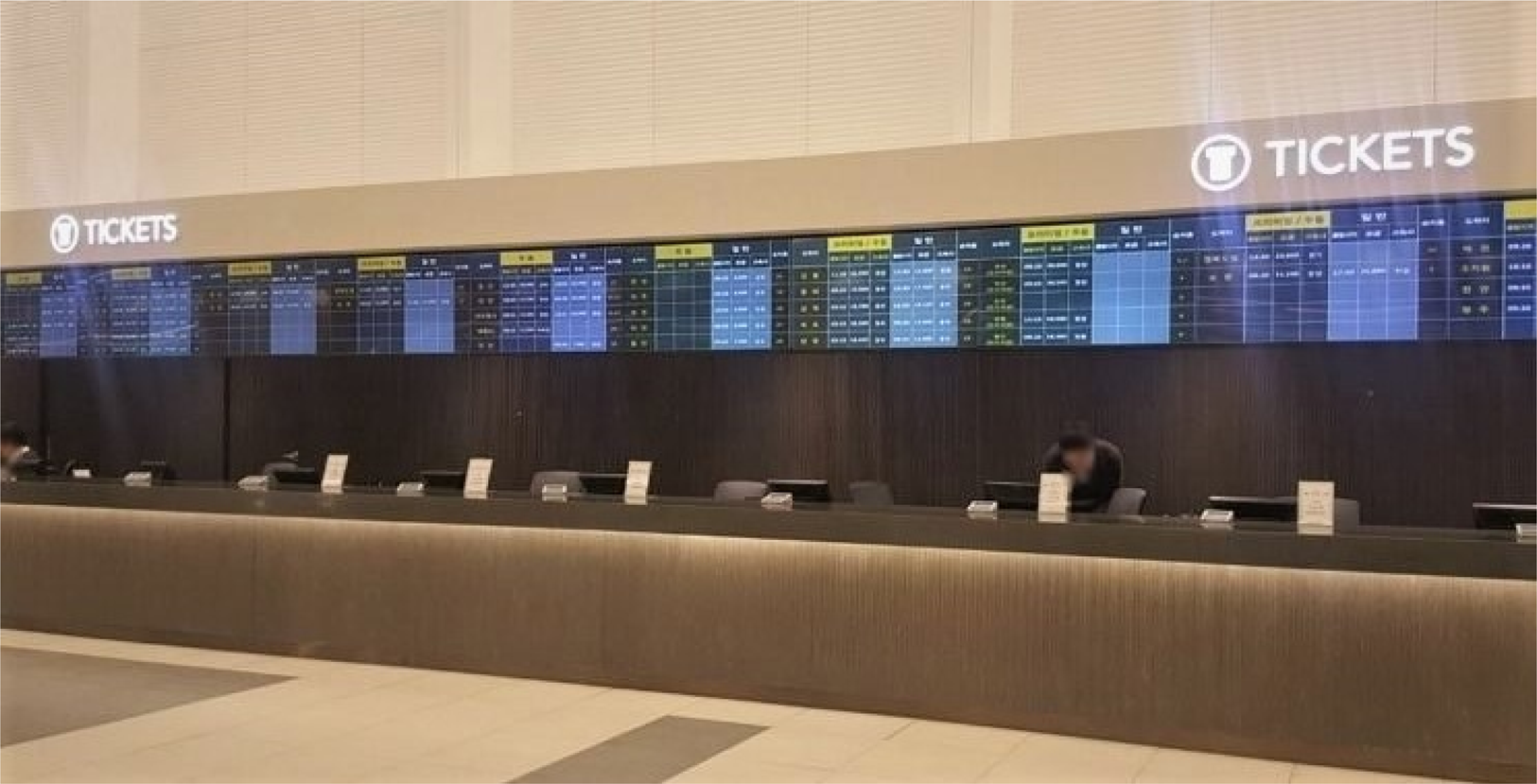
The newly renovated Seoul Express Bus Terminal, which reopened at the end of 2019, has caused an uproar among the South Korean public. The fact that its ticket booth sign is written only in English – ‘TICKETS’ – was pointed out by one Twitter user (see Figure 1), and the message went viral among internet users. It took only a week or so for the issue to make headlines in Yonhap News – one of the major news agencies in South Korea (hereafter ‘Korea’) that provides news articles and pictures for newspapers, TV networks, and online media. The news article criticised that not only the ticket booth sign but also the sign of a nearby drug store is written exclusively in English – ‘pharmacy’.
Ticket booth in the Seoul Express Bus Terminal

The salient presence of English in the linguistic landscape of the Outer and Expanding Circle countries mainly because of the visual appeal of its foreignness (Backhaus, Reference Backhaus, Heinrich and Ohara2019) is not unheard of, and its extensive use in the Korean linguistic landscape has been reported in numerous studies (e.g., Lawrence, Reference Lawrence2012; Lee, Reference Lee2019; McPhail, Reference McPhail2018). However, perceptions of the Korean public vis-à-vis this practice have rarely been explored thus far despite scholarly observations that nationalistic language attitudes in Korea are just as prominent as the heated pursuit of English (J. S.–Y. Park, Reference Park2009). Considering that language attitudes are socially produced and contribute to reproduction in certain contexts, it is necessary to conduct perception studies reflecting both the individual and collective understandings of a community to add further layers to linguistic landscape research. For this purpose, the author performed a thematic analysis of the comments on the news stories relating to the aforementioned issue to extract ‘hidden insights from vast amounts of semi-structured and unstructured . . . data’ (Khan, Reference Khan2015: 1) generated by online news users through the interactive features of news and social media websites.
2. Methodology
For the analysis, 1057 comments posted between late December 2019 and early February 2020 were retrieved. They were written in response to (1) the tweet message that initially raised the issue; (2) the news article released on the Yonhap News website and Korea's major web portals, such as Naver, Daum, and Nate; and (3) the news article shared on the Facebook page of Dispatch, a Korean news agency. The approximately one-month window was deemed an adequate amount of time for data collection because almost all the comments had been posted on the same day (or the next) that the news articles were released. All of the selected comments were individually copied and pasted into a Word document and were then imported into NVivo, a qualitative data analysis software. Here, replies to comments were excluded from the dataset because they often simply echoed the commenter's opinion or were irrelevant to the topic (e.g., social exchanges among online acquaintances/friends). Also excluded were comments that were irrelevant to the topic (e.g., incomprehensible or blank comments, advertisements). After data cleaning, 673 comments remained.
The data analysis involved the iterative and recurrent phases of coding, categorising, and recoding before a whole picture could emerge. Conceptual codes were first assigned to each comment, these codes were compared and contrasted, and sets of similar codes were then grouped into conceptual categories (Lankshear & Knobel, Reference Lankshear and Knobel2004). When the classification decisions were not inherently obvious, the author sought a second opinion from a professor colleague with extensive experience in sociolinguistic research. Although there was a general consensus about the data classification (correlation coefficient r = .84), the discussion process at times resulted in the parties making adjustments to bring their differing categorisations into alignment. To increase the consistency and accuracy of the data classification, the above-mentioned process was repeated once more within six weeks. All of the comments, except for one, were written in Korean, and they were translated verbatim into English.
3. Findings and discussion
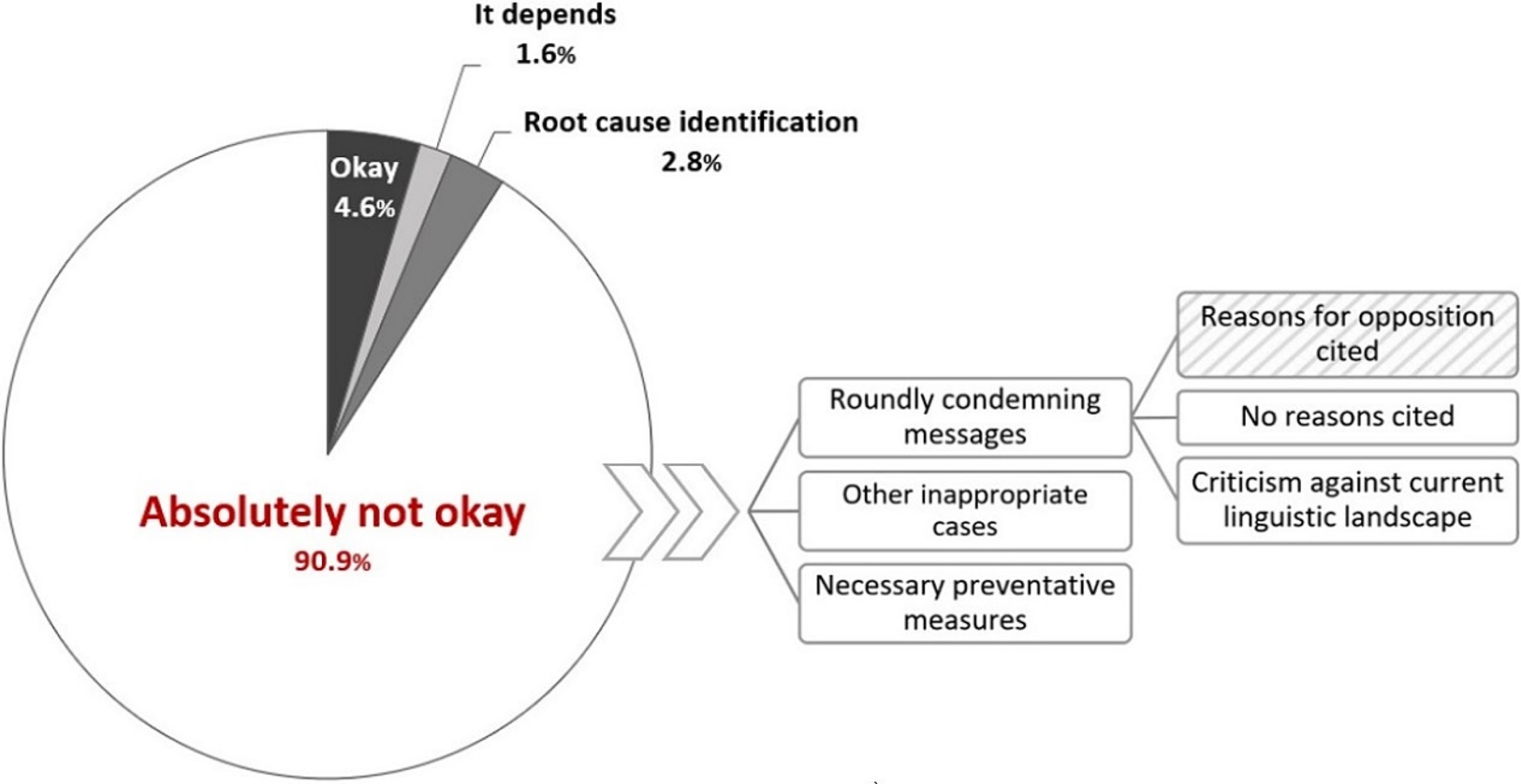
The 673 comments chosen for analysis could be classified into two broad categories: commenter's opinion about the issue (n = 654; 97.1%) and comments identifying the root causes of the practice (‘root cause identification’) (n = 19; 2.8%). (Due to rounding, the percentages add up to 99.9%, not 100%.) Of the 654 comments pertaining to commenters’ perspectives on the use of monolingual English signage in public buildings, 612 (90.9%) showed unfavourable attitudes towards the practice; 11 (1.6%) expressed a flexible stance; and 31 (4.6%) displayed no negative attitudes on the part of the commenters, with 29 adopting ‘no big deal’ attitudes and the remaining two actively supporting the use of monolingual English signs (see Figure 2).
Responses to monolingual English signs in public buildings
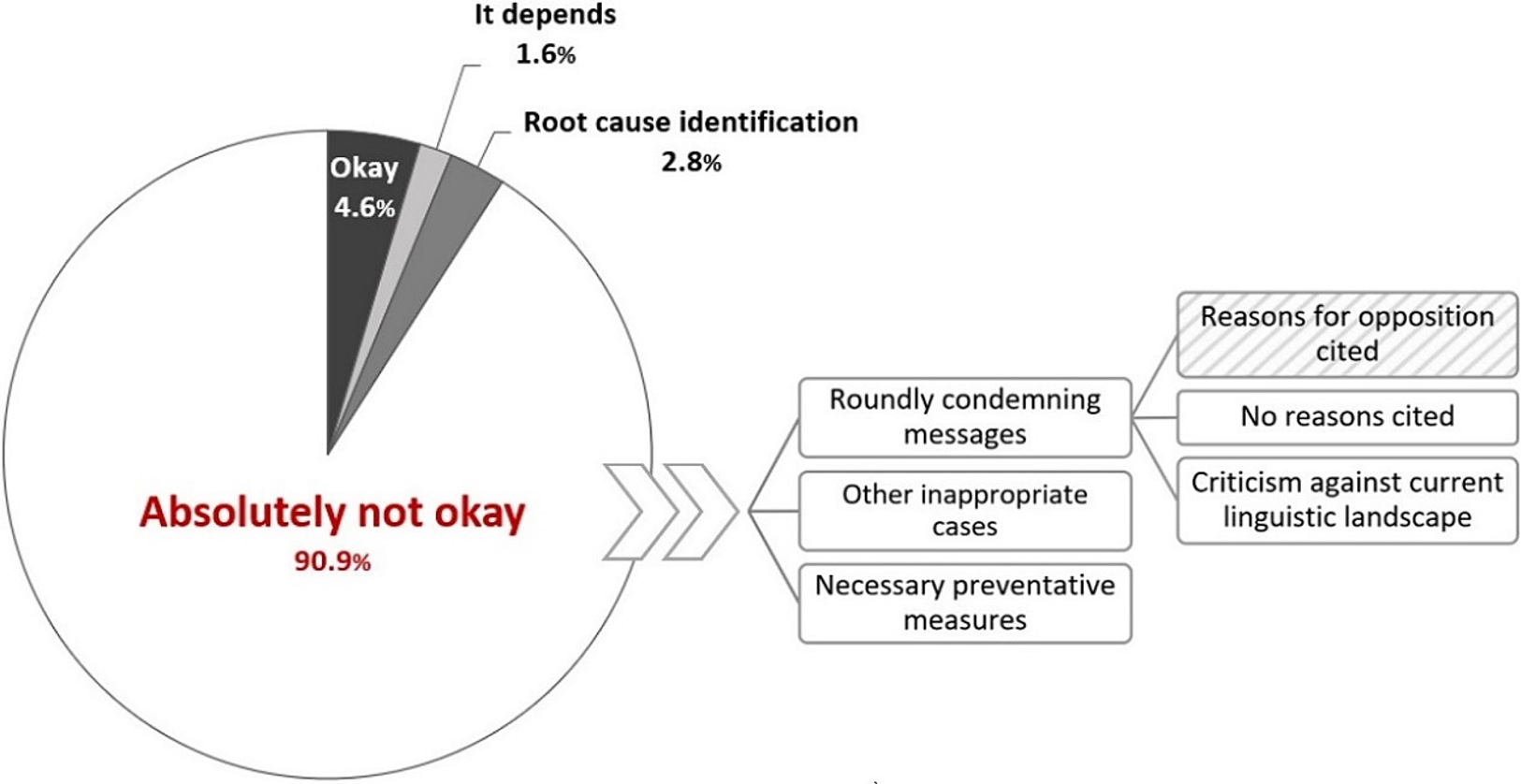
Of the 612 comments disapproving of the use of monolingual English signage in public buildings, 528 contained roundly condemning messages (Category I), 74 reported other inappropriate cases of the use of monolingual English signs, and 11 suggested necessary measures to prevent such practices from reoccurring (such as boycotting and levying fines). Of the comments in Category I, 443 contained specific reasons for opposing the practice (Category II, marked with diagonal stripes in Figure 2); 70 expressed an unfavourable view with no explicit reason cited; and 15 criticised Korea's current linguistic landscape in general, stating that it seems to be swamped with foreign languages, resulting in the weakening of the national linguistic identity. The thematic analysis was conducted on Category II. In addition to voicing criticism, 89 of the comments in Category I offered a suggestion concerning desirable adjustments to monolingual English signage in public buildings. The findings are discussed in the following subsections, showing exemplary comments (Cs) associated with the key themes.
3.1 Reasons for not opposing the use of monolingual English signage in public buildings
Of the 31 (4.6%) commenters who were not against using monolingual English signage in public buildings, the majority (n = 19) cited that this practice is not a serious issue because both tickets and pharmacy are basic words that most Koreans are familiar with.
[C1] What's all the fuss about? Seriously, can you think of any of your friends and acquaintances who might not know what the words tickets and pharmacy mean? People seem to vent their anger on anything these days.
The second most common reason given (n = 5) was that people do not read signs to determine where to purchase tickets or drugs. The commenters almost unanimously used the phrase ‘by the look/ambiance’, as exemplified in C2. The two commenters who directly supported the use of monolingual English signs displayed a proactive orientation towards bilingualism, as shown in C3.
[C2] Can you not tell by the look of it [pharmacy]? There must be wall-mounted drug cabinets, and people wearing white medical gown coats must be standing behind the counter, right? What else can the place be besides a pharmacy?
[C3] Let's face it. Korea cannot survive global competition without actively embracing Englishisation. It will drag us down if we insist on using only Korean, which is used only by Koreans. English should be adopted as an official language. That way, we can make our country a more attractive investment destination, as is the case for Hong Kong and Singapore.
Interestingly, there were wide individual differences among the commenters who took a flexible attitude (n = 11; 1.6%). Most of them related that ‘using the monolingual English sign “TICKETS” seems all right, but the “pharmacy” sign is too much’, as ‘pharmacy’ is not a universally accessible word. In contrast, a small percentage of the commenters found the ‘pharmacy’ sign acceptable because it was being used by a small business but did not approve of the ‘TICKETS’ sign. It was also pointed out that the display of the ‘TICKETS’ sign at the bus terminal – as opposed to an international airport – seems excessive given that all express (intercity) buses are for domestic travel in Korea, and thus, most riders are Koreans – because of the geographic and political situation, overseas travel is impossible by bus (the only country that South Korea borders is North Korea).
3.2 Reasons for opposing the use of monolingual English signage in public buildings
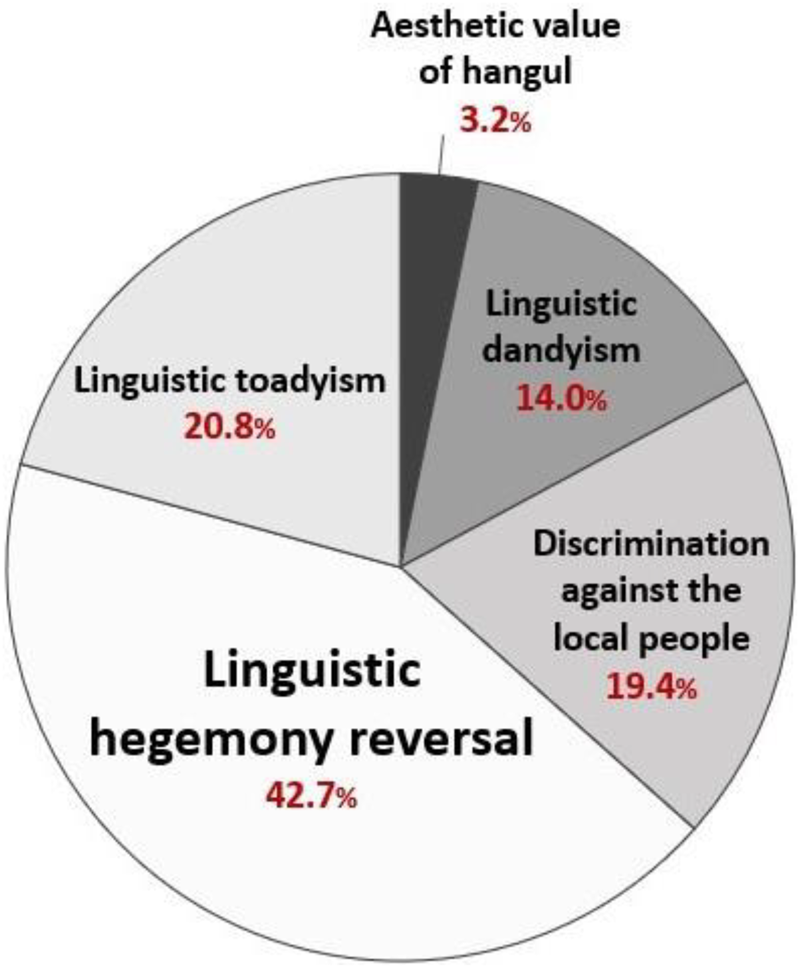
The thematic analysis of the 443 comments citing reasons for opposing monolingual English signage in public buildings identified five emerging themes (see Figure 3).
Reasons for disapproving the practice
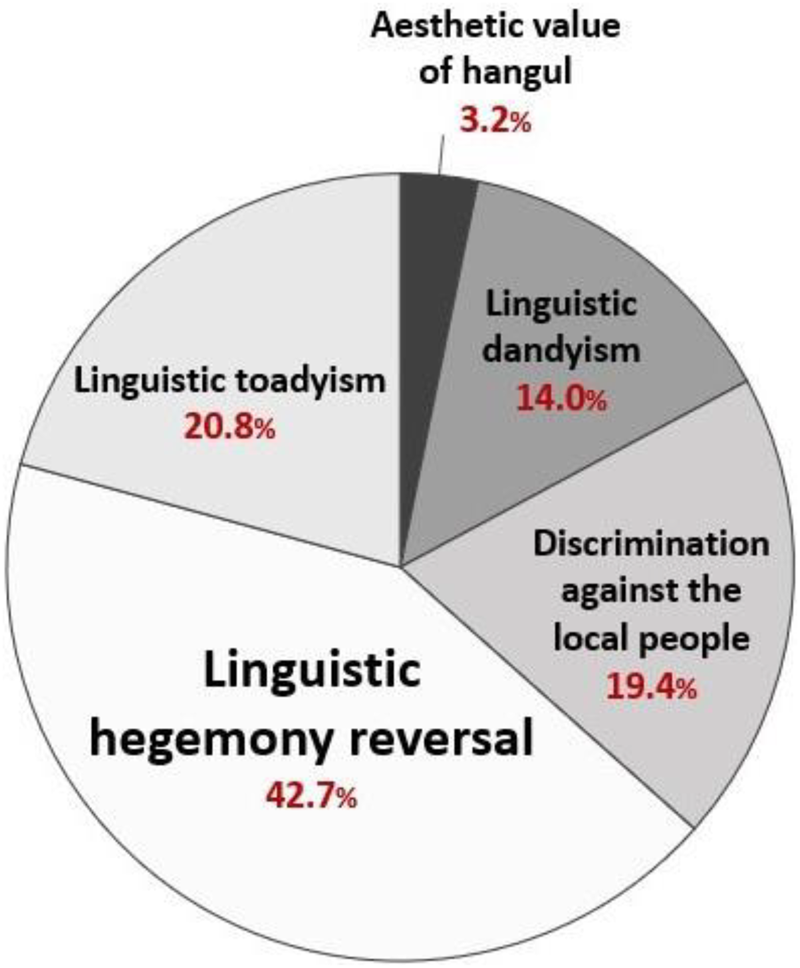
As illustrated in Figure 3, by far the most salient theme concerned the hostility harboured by the Korean general public, who viewed the practice as indicative of ‘improperly reversed linguistic hegemony’. The feeling of pride in the Korean language and its alphabet, hangul, and the consequent resentment towards English–Korean displacement were openly expressed in 42.7% of the comments (n = 189). Notably, the commenters displayed a strong script-related linguistic nationalism, confirming King's (Reference King and Simpson2007: 221) observation that ‘common confusion between or outright conflation of language and script is especially pronounced in Korea’, where hangul for many people has ‘come to be synonymous with the Korean language’. The comments fitting into this theme were distinctive for their use of the keyword ‘hangul’ and/or ‘Sejong the Great’ (1397–1450), during whose reign hangul was officially promulgated.
[C4] Sejong the Great would turn in his grave! What's the world coming to? Why do we bother to commemorate ‘Hangul Day’? Let's abolish it and designate ‘English Day’ as a new national holiday! Shame on us! [Koreans celebrate the promulgation of the Korean indigenous script with a national holiday – ‘Hangul Day’ – on 9 October every year.]
[C5] BTS [a seven-member Korean boy band] and Bong Joon–ho [an Oscar-winning Korean film director] are trying their hardest to make known the Korean culture worldwide, while we Koreans are busy embellishing the country with English. From the look of it, it's hard to tell whether it's Korea or America. Nothing's written in hangul . . . Is English now an official language?
The second most common theme concerned ‘linguistic toadyism’, comprising 20.8% of the data (n = 92). The comments falling into this theme lend support to Heller's (Reference Heller and Heller2007) view that language practices are not inherently linguistic but rather social and political. These comments suggested that the practice of using only English on public building signs is a self-despising attitude that idolises the cultural image of an Other – the United States – rather than one's own (J. S.–Y. Park, Reference Park2009). Phrases manifesting the commenter's nationalistic language attitude were commonly employed in the comments, including ‘lack of linguistic pride’ and ‘linguistic toadyism’ itself.
[C6] It's not the first time that something like this has made headlines. It feels like we Koreans simply can't get over English toadyism. We'd just as soon become the 51st state of the United States now that we are already living in the Republic of Komerica! [The original Korean term for ‘Republic of Komerica’ was ‘대한미국’ – a freshly coined compound of the underlined syllable blocks in ‘대한민국’ /dæ-han-min-guk/ (Republic of Korea) and ‘미국’ /mi-guk/ (The United States of America).]
[C7] Can't we please have a little bit of linguistic pride now? The popularity of K-pop is driving a global boom in learning Korean, but we are occupied with using English as much as possible, whenever possible. I totally understand why we are almost obsessed with the English language, but I fear we have gone too far. It's about time we re-establish our linguistic pride. We are among a handful of the peoples who have their own alphabets, for crying out loud!
Almost equally common as the second theme was the theme concerning the public perception of the use of monolingual English signage as ‘discrimination against the local people’, which appeared in 19.4% of the comments (n = 86). The commenters pointed out that such a practice is inconvenient for senior citizens in particular, many of whom are not used to English as a lingua franca. This result is interesting because ageism is prevalent in Korea in regard to English proficiency, and senior citizens’ lack of bilingual skills is often ‘a source of mockery’ (Lee, Reference Lee2014: 44), not a cause of concerned attention, in an increasingly English-oriented Korean society.
[C8] Some foreigners might use the Seoul Express Bus Terminal, but Korean users heavily outnumber them. Of course, globalisation is an irreversible process, and we need to treat foreigners well, but public buildings should be designed to make their own people [Koreans] comfortable, not them [foreigners].
[C9] Korea is one of the fastest greying societies, and these English-only signs are inconsiderate and negligent of senior citizens or those who are illiterate in English. How would you feel if your grandma or grandpa cannot purchase a ticket because of the English-only ‘TICKETS’ sign?
The fourth theme, constituting 14.0% of the data (n = 62), had to do with seeing the practice as ‘linguistic dandyism’, thereby identifying unnecessary/excessive use of English as pretension to a privileged social status. As J. S.–Y. Park (Reference Park2009) has noted, such hostile criticism is deemed to be based in part upon nationalistic views that alignment with English is a disloyal act of self-denial.
[C10] I find it difficult to believe that some people still think using English makes them look cool. The one who authorised the sign must be either half-witted or demented.
[C11] Now it's official that we Koreans are the most pretentious group of people in the world! Look what we did! The Seoul Express Bus Terminal is located at the very centre of Gangnam [one of Seoul's busiest districts] in Korea, not the United States of America, for God's sake! Someone please go check whether they only accept US dollars there!
The last theme, representing 3.2% of the data (n = 14), concerned favouring the use of Korean over English because of the ‘aesthetic value of hangul’. In line with a newspaper report that Korean youth prefer shop names and labels in hangul to faux-posh foreign names (Chosun.com, 9 October, 2018), the commenters pointed out that more hangul signs should be placed because of the script's uniqueness and exoticness.
[C12] Lots of foreigners say that hangul is such an attractive script that is unique and stylishly foreign. We should consider mandating hangul signs in both the public and private sectors. After all, what they really want while traveling in a foreign country is a feeling of exoticness, not the convenience of a complete understanding of their new environment.
[C13] Hangul signs are prettier than those written in the Roman alphabet. Unlike in the past, there are many stylish, characterful hangul fonts available these days. Someone who hasn't caught up with the growing trend seems to have designed the sign. What a pity . . .
3.3 Underlying factors contributing to exclusive use of English on public building signage
Of the 673 comments analysed, 19 (2.8%) addressed the possible causes underlying the use of monolingual English signage in public buildings. Over two-thirds of the commenters ascribed this practice to the well known ‘English fever’ (Krashen, Reference Krashen2003: 100) or the collective neurosis of English frenzy rampant among Koreans. As described in J.–K. Park (Reference Park2009), learning English is a national obsession, and competition for learning English is relentless because the most powerful means to achieve upward social mobility and economic prosperity is often indexed through a person's competence in English.
[C14] We asked for it. Once babies start to babble, we begin to teach them English, paying more than twice the salary for English-speaking nannies if only we can afford them. It's interesting that most of the commenters here advocate the importance of prioritising Korean over English [when it is now public knowledge that learning English borders on a national obsession in Korea]. Whose tune should I dance to?
The remaining opinions are related to ‘the pharmacy being part of the UK-based Boots store’ and ‘the multiculturalisation of Korean society’. As succinctly described in Kim (Reference Kim and Kim2014), the relatively homogeneous society of Korea has experienced an inflow of newcomers such as migrant workers and international marriage migrants since the late 1980s. According to government data, the number of foreign residents has topped 2.5 million, accounting for approximately 4.9% of the nation's total population as of the end of 2019.
[C15] I think it [the use of monolingual English signs] is a transitional phenomenon towards the multicultural society that Korea is becoming. We have no other choice but to come to grips with the fact that Korea is no longer a nation-state.
3.4 Desirable adjustments to monolingual English signage in public buildings
The analysis of the 89 comments that made suggestions regarding desirable adjustments to monolingual English signage in public buildings indicated that almost three-quarters of the commenters (n = 64) believed that using both Korean and English is desirable (see C16). Of these 64 commenters, the majority (n = 47) insisted that Korean should be put first and English next, while the remaining commenters did not specify a sequence. Some commenters elaborated further upon how these two languages should be placed, as exemplified in C17.
[C16] I don't get it. How can anybody with common sense come up with such a ridiculous idea of using only English, not both, on public building signs? Make that single-celled amoeba put up a Korean sign! Right now!
[C17] Korean should be placed at the centre in a large font size, and English next to it in a smaller font size within parentheses. We are living in Korea, where the Korean language should come first and then English as a lingua franca, not the other way around.
Approximately 21% of the commenters (n = 19) stated that monolingual Korean signage should become the norm, leaving English juxtaposition as an option. The remaining six commenters suggested adding a pictogram to the existing English sign for those with literacy difficulties or installing a new sign using Korean and a pictogram or only a pictogram.
[C18] If the signs were designed that way truly for the convenience of foreigners, it'd be better to add a pictogram so that the message can be understood independently of language and culture.
4. Conclusion
The analysis of user-generated comments on news sites and social media has provided insight into Koreans’ perceptions of the use of monolingual English signage in public buildings. The practice was shown to be unfavourably viewed by a vast majority of the Korean public and was perceived to be incongruous with the context, representing ‘improperly reversed linguistic hegemony’, ‘linguistic toadyism’, ‘discrimination against the local people’, or ‘linguistic dandyism’. The distinctive aesthetic qualities of hangul were also cited as an underlying reason for opposing monolingual English signs. These findings suggest that although the hegemonic status of English, as a lingua franca and as the language of opportunity, is well justified in Korean society – a product of neoliberal globalisation that emphasises the instrumental value of English (Sun & Rong, Reference Sun, Rong, Bonnet and Siemund2018) – this does not necessarily mean that Koreans are eager to prioritise the English language over their own. Rather, the results seem to indicate that ‘pursuit of English coexists side by side with resistance towards English, thus rendering Koreans’ relation to the language ambivalent’ (J. S.–Y. Park, Reference Park2009: 51–52).
As discussed earlier, the use of monolingual English signage in public buildings is largely regarded as a serious attack on Korea's linguistic identity, indicative of a distorted practice of bilingualism in which a foreign language takes precedence over the local language for no good reason. However, it might also be possible to read into the public uproar provoked by the ‘TICKETS’ sign – a minute detail of the discursive practices constructing the global ascendancy of English – the venting of Koreans’ pent-up pressure deriving from the seemingly never-ending struggle with English-language learning. Coupled with nationalist sentiments, chronic fatigue from living in a competitive Korean society where English skills stubbornly remain a ‘value-added commodity’ (Lee, Han & McKerrow, Reference Lee, Han and McKerrow2010: 353) and the lack thereof is seen as a considerable handicap might have triggered the public furore. Although further inquiry is required, the following comment, among others, hints at such a possibility:
Enough is enough! If foreign travellers don't know how ticket booth or pharmacy signs read in Korean, let them learn these words! Don't force us to study English for them! English for the college entrance exam, pre-employment tests, job promotion, and now foreign travellers . . . what next?
The dust (seems to have) settled when news was released shortly after the public uproar that the Korean term for ‘ticket booth’ was added to the sign. Just as private individuals act as contributors to the shaping of the media flow through their involvement in participatory culture (Fuchs, Reference Fuchs2014), the voices of those who ‘engage with the participatory potential for sharing and commenting on news’ (Kalogeropoulos et al., Reference Kalogeropoulos, Negredo, Picone and Nielsen2017: 1) seem to now wield as strong an influence as those of policymakers in resolving disputed issues in society.
As the saying goes, language is a mirror of society, and the ‘TICKETS’ sign might be a reflection of the status that English has in Korea. Future studies might take into account how social factors (e.g., education, occupation, cultural and ethnic variations, and age distribution) affect people's perspectives on the issue – determinants that might well have influenced the findings but could not be examined in this study due to the anonymous nature of online comments. More rigorous research on public perceptions vis-à-vis the use of English in the Outer and Expanding Circle countries is needed to gain a deeper understanding of the multifaceted nature of the social practices that surround English and the increasing forces of globalisation.
 SUGENE KIM is an associate professor of English studies at Nagoya University of Commerce & Business in Japan. Her main research specialisations are in academic writing, second language (L2) acquisition, and morphosyntax within the framework of pedagogical grammar. She has related interests in sociolinguistic variation and World Englishes. She has published research articles mostly concerning academic literacy development and L2 writing pedagogy. Email: sugene_kim@nucba.ac.jp