INTRODUCTION
Genetic diversity is often suspected to play an important role in the defence against parasite infection (Lively and Dybdahl, Reference Lively and Dybdahl2000; Sandland et al. Reference Sandland, Foster, Zavodna and Minchella2007) by decreasing both the probability of encounter (the encounter filter) and the probability of successful infection (the compatibility filter) (Combes, Reference Combes2001). Both filters result from the co-evolution of hosts and parasites. The encounter filter results from all the factors that influence the exposure of the host to infection by the parasite such as microhabitat use, temporal pattern of activity and any behavioural process that influences host-parasite proximity. The compatibility filter depends mainly on the efficiency of the internal defences of the hosts against focal parasite strains (detection ability versus camouflage, ability of the parasite to escape the immune response of the host). Despite the great interest of considering infection dynamics in its usual evolutionary theatre (the natural environment), it is often not possible to disentangle the respective effects of these two filters because of the multiplicity of factors that are interacting. However, we should be able to assess in the field the final consequences of variation in the genetic diversity of one of the interacting species. In this respect, the question of the genetic characteristics of the host is of particular interest.
Hybridization zones could provide an opportunity for assessing the influence of genomic variation on the issue of parasite infection by making it possible to compare parental individuals to hybrids when they share the same habitats (Dupont and Crivelli, Reference Dupont and Crivelli1988; Wolinska et al. Reference Wolinska, Keller, Bittner, Lass and Spaak2004, Reference Wolinska, Keller, Manca and Spaak2007). This issue is not easily predictable since it depends on the genetic relatedness between parental species. When the parents are phylogenetically distant, one can expect that the hybridization of their genomes results in breakdown of gene coadaptations leading to decreasing the efficiency of the defence mechanisms particularly when the interaction exhibits high specificity (Fritz et al. Reference Fritz, Moulia and Newcombe1999; Bakke et al. Reference Bakke, Soleng and Harris1999; Buchmann and Lindenström, Reference Buchmann and Lindenström2002; Moulia and Joly, Reference Moulia, Joly, Thomas, Guégan and Renaud2008). In such a case, the hybridization zone appears as a tension zone where the fitness of the hybrids is lower than that of the parents. In contrast, when the hybridizing populations are genetically close or compatible, one expects that some heterosis effects give the hybrids an advantage over the parental individuals especially when both are similarly exposed to parasites. Heterosis, named also hybrid vigour, expresses all the fitness benefits a phenotype can gain from higher genetic diversity (Moulia et al. Reference Moulia, Le Brun, Loubes, Marin and Renaud1995) through richer enzymatic systems and broader range of sensitivity to antigens. Whatever the mechanisms involved, we finally expect that both prevalence and intensity of parasites would differ between hybrids and parental individuals within a given hybridization zone as a result of differences in coevolutionary pathways between the two host-parasite pairs, even if they share the same habitat.
The water frog hybridogenetic complex is a valuable candidate for addressing this question because it produces fully heterozygous hybrids. Hybridogenesis is a hybridization system characterized by a pre-meiotic exclusion of one of the parental genomes in the germ line of the hybrids (Schultz, Reference Schultz1969; Vrijenhoeck, Reference Vrijenhoeck1994). As a consequence, hybrid individuals only produce gametes carrying the genome of one of the parental taxon. In water frog hybridization systems, the hybrid lineage (Rana esculenta in the present study) is maintained by backcrossing with the parental species (R. lessonae), whose genome is excluded from the germ line (Tunner, Reference Tunner1974; Graf and Polls-Pelas, Reference Graf, Polls Pelaz, Dawley and Bogart1989). Since hybrid females breed mainly with R. lessonae males over their own (Abt and Reyer, Reference Abt and Reyer1993; Lengagne et al. Reference Lengagne, Grolet and Joly2006, Reference Lengagne, Plénet and Joly2008), they thus restore a hybrid phenotype for their progeny. Because the parental males are deprived of any descent, this hybridization system comes under the definition of a “sexual parasitism” (Joly, Reference Joly2001). Therefore, the hybrid's lineage shows more or less similar characteristics as F1 hybrids, with maximum heterozygosity at each locus. It becomes hence possible to test if maximum heterozygosity results in overdominance of resistance as expected under the heterosis hypothesis (Moulia, Reference Moulia1999). In adult hybrid frogs, the intensity of lung parasites (Nematoda and Trematoda) is often lower in hybrid individuals than in parental ones, suggesting a higher ability of the hybrids to cope with this risk (Joly et al. Reference Joly, Guesdon, Fromont, Plenet, Grolet, Guegan, Hurtrez-Bousses, Thomas and Renaud2007). However, difference in parasite intensity in adult frogs could be due to random variation in exposure to parasites due to difference in habitat use between parental and hybrid individuals (Hellriegel and Reyer, Reference Hellriegel and Reyer2000; Pagano et al. Reference Pagano, Joly, Plénet, Lehmann and Grolet2001). This caveat can be avoided by studying infection at the tadpole stage since the two taxa lay their eggs simultaneously at the same spawning sites (usually at mixed chorus places) from which the tadpoles disperse toward the same shallow zones of the ponds (Plénet et al. Reference Plénet, Joly, Hervant, Fromont and Grolet2005; Lengagne et al. Reference Lengagne, Plénet and Joly2008). The tadpoles are therefore supposed to be exposed to similar infection risks. We expect first a difference in parasite intensity between hybrid and parental tadpoles as a global consequence of their genetic peculiarity. Moreover, because heterosis effects are suspected to explain the great success of hybrid lineages in most natural environments (Tunner and Nopp, Reference Tunner and Nopp1979; Hotz et al. Reference Hotz, Semlitsch, Gutmann, Guex and Beerli1999), we are also tempted to predict lower infection rates in the hybrid tadpoles. Another advantage of working with tadpoles is that the modifications of their morphology induced by their development provide a biological temporal scale that allows an analysis of the dynamics of the infection.
We have investigated these hypotheses by comparing both parasite intensity and prevalence between hybrid and parental tadpoles in several populations of the Rana esculenta hybridization complex in Western Europe (composed of the parental R. lessonae and the hybrid R. esculenta). In order to take into account the potential influence of habitat on infection rates, we have spread our sampling over 2 contrasted habitats such as fishponds and fluvial marshes.
Materials and methods
Study sites
We sampled tadpoles in 2 regions to consider the influence of habitat at a large scale. The first region is the Dombes plateau (North-East of Lyon, France), which consists of a 150 m thick glacial alluvium deposit where clay and silt substrata made it possible to build up around 1000 large fishponds during the Middle-Ages. The shallowness of these ponds provides favourable conditions for water frog breeding and growth. The second region is the Lavours marsh (80 km east of Lyon), which consists in a large alluvial peat bog within the Rhone river floodplain (detailed descriptions of the distribution of water frogs in this marsh in Pagano et al. Reference Pagano, Joly, Plénet, Lehmann and Grolet2001). Ponds are frequent in the floodplain but characterized by a great diversity of morphology and functioning according to disturbance frequency by floods (Joly and Morand, Reference Joly and Morand1994). For the Dombes plateau, we sampled two ponds within the estate of the Pierre Vérots Foundation, Saint-Jean-de-Thurigneux: Boufflers (45°56′44″N 4°55′08″E, D1) and Riquet (45°56′32″N 4°55′02″E, D2), and a third pond just outside of the boundaries of the Foundation estate: Vernange pond (45°56′29″N 4°55′57″E, D3). For the Lavours marsh, we sampled a pond in the peat bog (45°50′08″N 5°45′17″E, L1) and small oxbow lakes close to the Séran river (45°49′43″N 5°45′04″E, L2).
Sampling, taxon identification, age estimation and measurements
Since proportions of each taxon within samples were only known a posteriori, a minimum of 150 tadpoles was sampled at each site. Because of the anatomical and histological changes implied by metamorphosis, we only examined tadpoles before they reached the climax stage (Gosner, Reference Gosner1960). To lower sampling bias, different capture methods (landing nets, pond nets and Surber samplers) were used at the same time in all the different microhabitats of each site.
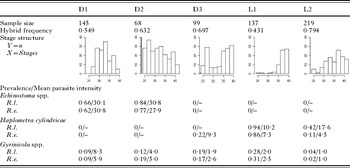
We spanned the sampling of the different sites on 3 years: D1 and D2 in 2000, L1 in 2004, and D3 and L2 in 2005. Sampling sessions occurred from mid-June to mid-July. After each capture day, we brought alive the collected tadpoles to the laboratory and placed them by groups of 30 individuals into tanks (L×W×H=32·5×17·5×18·5 cm) oxygenated with an aerator. We kept the tanks at room temperature with natural photoperiod. We fed the larvae with frozen spinach ad libitum until treatment. The maximum duration of such storing was 10 days. The tadpole was anaesthetized by adding ice to water in a Petri dish. We first determined development stage using the Gosner's key (Gosner, Reference Gosner1960). The tadpole was then weighed before decerebrating it with a needle and dissecting it to search for parasites. The tadpole was then frozen for taxon identification (R. lessonae, or hybrid R. esculenta) by means of starch gel electrophoresis (zymograms) (Pagano et al. Reference Pagano, Joly and Hotz1997) using lactate dehydrogenase (LDH-B; EC 1.1.1.27) and mannose-6-phosphate isomerase (MPI; EC 5.3.1.8) enzymes. All collected tadpoles belonged to the water frog hybridogenetic complex (R. lessonae+R. esculenta). After taxon identification, 688 tadpoles remained for statistical analyses (Table 1).
Tadpole sample structure and prevalence of the parasites
(R.l.: R. lessonae (parental). R.e.: R. esculenta (hybrid).)

Parasite diversity
After the opening of the general cavity, the different organs to be analysed (intestines, liver, lungs, nephric system, heart and gills) were removed. The majority of parasites were observed alive, then fixed in para-formaldehyde 5% and kept in an Eppendorf tube or on slide glasses for subsequent identification. Parasite prevalence (presence of parasite), parasitic intensity (total number of individuals for each parasite taxon), and parasite diversity (total number of parasite taxa found on a single host) were estimated.
We focused on 3 genera of parasites. (1) Gyrinicola sp. (Oxyuroidea: Pharyngodonidae), intestinal nematodes with direct life cycles. Females produce eggs re-emitted in the habitat via the tadpoles' faeces. Those eggs undergo a dormancy phase and are then absorbed by the next year's tadpoles, thus renewing the infection (Volgar, Reference Volgar1959; Adamson, Reference Adamson1981; Planade et al. Reference Planade, Bain, Léna and Joly2008). (2) Echinostomes (Echinostoma and Echinoparyphium, Echinostomidea: Echinostomatidae), trematodes with an indirect life cycle, encysting in the tadpoles' nephric system (Lo, Reference Lo1995; Thiemann and Wassersug, Reference Thiemann and Wasserzug2000a). Tadpoles are intermediate hosts of these parasites which infect the intestines of aquatic birds and mammals, their final hosts (Holland et al. Reference Holland, Skelly, Kashgarian, Bolden, Harrison and Cappello2007). (3) Haplometra cylindracea Zeder 1800 (Trematoda: Plagiorchiidae), trematodes with an indirect life cycle with frogs as final host. The first host is a snail, usually of genus Lymnaea. In the tadpoles, they encyst in the anterior part of the general cavity (Grabda-Kazubska, Reference Grabda-Kazubska1970). After excystation, the trematodes migrate across the general cavity to the lungs, their target organ, right after the tadpole's metamorphosis (Grabda-Kazubska, Reference Grabda-Kazubska1970; Prudhoe and Bray, Reference Prudhoe and Bray1982).
Data analysis
The main objective of these analyses was to test whether parasite prevalence, as well as infection intensity, differed between the hybrid and the parental host taxa. For this purpose, we used a hurdle framework to model intensity, i.e. the count of parasites per individual. This model framework assumes that 2 distinct processes sequentially apply to generate counts (Mullahy, Reference Mullahy1986; Zorn, Reference Zorn1996; Potts and Elith, Reference Potts and Elith2006) using a 2-part modelling approach: the first part uses a binary response to model zero counts and, conditional on a positive outcome, the second part uses a zero-truncated standard count distribution (usually a Poisson or negative binomial one) to model positive counts. This method has a direct application in epidemiology since it allows estimation of both prevalence (i.e. presence) and infection intensity (Potts and Elith, Reference Potts and Elith2006). Unexplained heterogeneity or positive contagion is also a common phenomenon in parasite epidemiology (Wilson et al. Reference Wilson, Grenfeld and Shaw1996; Boag et al. Reference Boag, Lello, Fenton, Tompkins and Hudson2001). Such a phenomenon is usually handled by specifying a negative binomial distribution, which allows estimation of a dispersion parameter accounting for the unexplained heterogeneity. For each parasite species we constructed 2 general model forms: hp (Hurdle Poisson Model), using a zero-truncated Poisson distribution, and hnb (Hurdle Negative Binomial Model), using a zero-truncated negative binomial distribution, in order to model positive counts. As intensity could also vary according to the sampled site and to the developmental stage of the host, these variables and all the first-way interactions were also introduced as explanatory terms in all general models. The same set of explicative factors was introduced within both the 2-stage processes. These two general model forms were structured as follows:

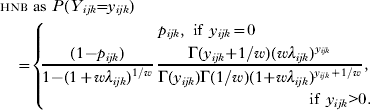
With log(λijk)=η1ijk=μ1+α1i+β1j+γ1x ijk+(αβ)1ij+γ1ix ijk+γ1jx ijk and  , where P(Y ijk=y ijk) is the probability to observe y ijk, the actual number of parasites for the k hosts belonging from the i taxon caught at the j site, λijk is the predicted mean number of parasites for this subject, p ijk is the probability that the count for this subject is a structural zero and w is the dispersion parameter of the negative binomial distribution such that var(Y ijk)=λijk+wλijk2. λijk is expressed as a linear combination of the explanatory terms, η1ijk, through a loge-transformation and p ijk is expressed as a function of the same set of explanatory terms, η2ijk, through a logit transformation. For both linear combinations of the explanatory terms, μ is the mean linear predictor, α.i the effect of the i th taxon, β.j the effect of the j th site, (αβ).ij the interaction between the i th taxon with the j th site, γ.x ijk the effect of the developmental stage of the host, γ.ix ijk the interaction between the developmental stage and the i th taxon, γ.jx ijk the interaction between the developmental stage and the j th site.
The model form was selected using the Akaïke's information criterion (AIC). Given the model form selected, each explanatory term was then examined by computing the aicc weight of all nested models (AICcW: Burnham and Anderson, Reference Burnham and Anderson2002). AICcW expresses the relative support of the model (given the data) and is bounded between 0 and 1. The evidence ratio (E.R.) in favour of each term was computed as follows:  , where w T is the sum of aicc weights across all the models where that term is included. When E.R.=1, the term does not contribute to the model. When E.R. exceeds 1, its value indicates the contribution of the term to the support of the model. There is no limit for these positive values. One may note that, even if the explanatory term has actually no predictive value, its associated weight, w T, is always greater than 0. Because of this, it is also convenient to compare w T to w 0T, the weight of the explanatory term that should be observed in the absence of relation with the dependent variable (Burnham and Anderson, Reference Burnham and Anderson2002). We therefore generated 1000 random samples by permuting the dependent variable, from which the weight of each explanatory term was computed in the same way as w T. For each explanatory term, the median of the 1000 generated weight values was w 0T. All analyses were performed with the nlmixed procedure (SAS Institute, 2000).
Results
The parasite diversity was low (3 genera), but strongly varied according to the pond sampled (Table 1). Gyrinicola sp. was found at every site. Nevertheless, only 6 tadpoles were found to be infected by Gyrinicola sp. at L2 (2 from R. lessonae and 4 from R. esculenta). This site was therefore not retained in the following analyses concerning Gyrinicola genus. Echinostomes were only present at D1 and D2, whereas H. cylindracea was only found at the L1, L2 and D3 sites. Moreover, in the case of H. cylindracea there was a strong bias of prevalence in favour of R. esculenta at the D3 pond where none of the 36 R. lessonae tadpoles sampled were infected, while 18 out of the 83 R. esculenta tadpoles sampled were infected. This feature of our data set made analyses problematic. In particular, this caused redundancy in the model parameter space (Burnham and Anderson, Reference Burnham and Anderson2002). To avoid this problem, we separately analysed the data collected at ponds L1 and L2 from that collected at pond D3. Furthermore, for this latter analysis, taxon effect was not introduced as an explicative term in the model since all infected hosts belonged to R. esculenta at site D3.
Selection of the general model form
Whatever the parasite species, both the nb model form and the hp model are poorly supported when compared to the hnb model form (Table 2). According to these results, it appears that both a zero inflation phenomenon and unexplained heterogeneity (and/or positive contagion) were present in our data sets. A model form handling both these two features was used to perform the following analyses.
AIC support according to the general model forms for each parasite species
(With pn the number of parameters. (1) Interaction D3∗R.l. non estimable (no infected R. lessonae in D3). The selected model is the most parcimonious, i.e. that diving the lowest Akaike value. Used distributions: P, Poisson; NB, Negative Binomial; HP, Hurdle Poisson; HNB, Hurdle Negative Binomial.)

Influence of taxon, developmental stage and site on parasite prevalence and intensity
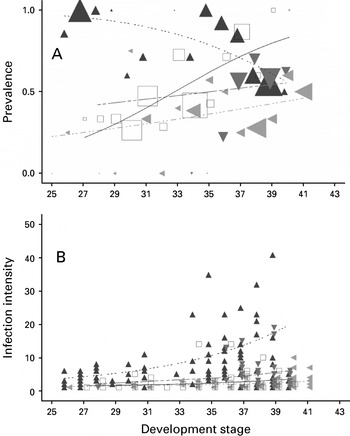
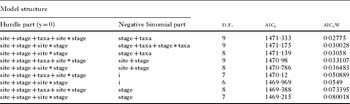
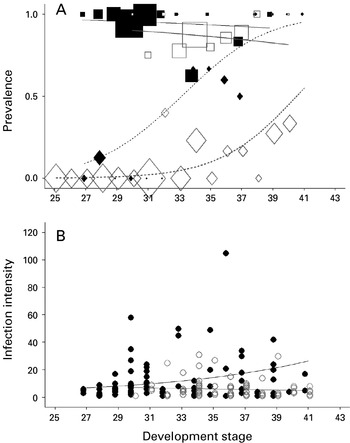
Gyrinicola sp. As indicated by the aicc best ranked model (aiccw=0·35, Table 3), the sampled site and the host developmental stage affected both prevalence and infection intensity, but the effect was interactive for the former and additive for the latter. Therefore the host genome (taxonomic assignation) did not influence either parasite prevalence or infection intensity. The same conclusion can be drawn from the E.R.s, since E.R. values in favour of a taxon effect are inferior to 0·18 (Table 3). The prevalence varied according to the host developmental stage in relation to the sampled site (Fig. 1A), while these two factors had an additive effect on infection intensity (Fig. 1B). The influences of those factors are well supported given the sum of Akaike weights across all the models that include these effects (Table 3). As seen in Fig. 1B, the predicted infection follows an accumulation pattern. The interactive effect between the sampled site and the developmental stage on the prevalence is strongly supported according to the Akaike weight of the models that include such an effect (Table 3): the E.R. in favour of an interaction between host developmental stage and sampling site is 99. The additive effects of the site and the stage on infection intensity are also relatively well supported (Table 3): the E.R.s in favour of a simple effect are respectively 2·59 for the sampled site and 2·46 for the host's developmental stage; while the E.R. regarding an interaction involving one of these terms is less than 0·18.
Prevalence (A) and infection intensity (B) of Gyrinicola sp. according to the explicative terms retained in the aicc best ranked model. According to this model, pond (··· ··▴: D1, – – —  :D2,
 : D3, ––□: L1) and developmental stage have an interactive effect on prevalence and an additive one on infection intensity. Lines indicate predicted effects while forms indicate observed values. Each predicted effect is estimated using model-averaging method (i.e. averaged estimate across all the models that contain this effect). Forms are slightly displaced on the horizontal axis for the sake of clarity and their size is proportional to sample size.

Top: model selection for the Gyrinicola species. Only well supported models are presented (i.e. for which the difference in AIC with the lowest AIC value is less than 2). Bottom: evidence support of explicative term for the Gyrinicola species
(Significant explanatory terms are given in bold characters (i.e. E.R.T>E.R 0Tupper lim 95%). The terms that cannot be interpreted because already involved in a significant interaction are shaded.)


Echinostomes
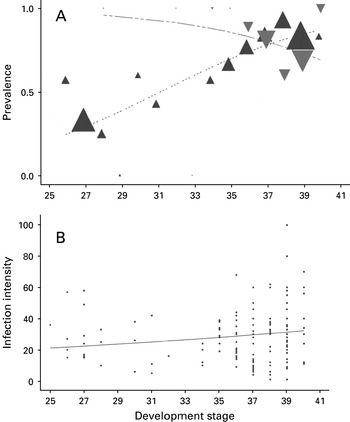
As indicated by the model with the best aicc rank (aiccw=0·08, Table 4), prevalence was affected differently by the host developmental stage according to the site (Fig. 2A) while infection intensity varied according to the stage (Fig. 2B). However, one may note that this model is not particularly supported given the data, as indicated by its very low Akaike weight. An effect of the taxon on the prevalence as well as on infection intensity is poorly supported by the Akaike weight (Table 4). There is good support in favour of an effect of the host's developmental stage on the prevalence, varying according to the site, as shown by the Akaike weight. There is, however, no clear evidence that the variables have any effects on infection intensity. The highest supported effect is that of the host developmental stage (Table 4) but the E.R. is only of 0·85 (within the E.R.0 Tupperlim. 95%).
Prevalence (A) and infection intensity (B) of Echinostomes according to the explicative terms retained in the aicc best ranked model. According to this model, prevalence is influenced by an interactive effect of developmental stage and pond (··· ··▴: D1, – – —: D2) while infection intensity only varies according to developmental stage (––––•). See Fig. 1 for more detailed information about the legend.

Top: model selection for the Echinostome species. Only well-supported models are presented (i.e. for which Δ aicc ⩽2). Bottom: evidence support of explicative term for the Echinostome species
(Explicative term contained in the aicc best ranked model are indicated either in bold if significant. Shaded characters express main effects for which no conclusion can be drawn (i.e. terms implicated in a significant interaction).)


Haplometra cylindracea
As outlined above, the interactive effect of the host's taxon according to the sampled site could not be estimated through the whole data set. The selected model built for L1 and L2 is site+stage+taxon+site∗stage+site∗taxon for prevalence, and stage+taxon+stage∗taxon for infection intensity, best ranked by the aicc (aiccw=0·15, Table 5). The effects of the site on the prevalence, in interaction with the taxon on the one hand, and with the stage on the other hand, are respectively mildly (E.R.=3·55) and strongly (E.R.=99) supported (Fig. 3A), but the interaction taxon∗stage does not affect prevalence (E.R.=0·37, Table 5). Infection intensity is significantly affected by an interaction between taxon and stage (E.R.=1·04, Fig. 3B), while the interaction taxon∗site has a greater effect than site∗stage, even if they are not significant (Table 5; E.R.taxon∗site=1 and E.R.site∗stage=0·19).
Prevalence (A) and infection intensity (B) of Haplometra cylindracea according to the explicative terms retained in the aicc best ranked model. According to this model, prevalence is influenced by developmental stage in interaction with both taxon and sampled site (–––▪: R. lessonae at L1, ······◆: R. lessonae at L2, –––□: R. esculenta at L1, ······◊: R. esculenta at L2) while the infection intensity is influenced by developmental stage in interaction with taxon (––––•: R. lessonae, ––––○: R. esculenta). See Fig. 1 for more detailed information about the legend.

Top: model selection for Haplometra cylindracea. Partial analysis made on the L1 and L2 sampled site. Only well-supported models are presented (i.e. for which Δ aicc ⩽2). Bottom: evidence support of explicative term
(Partial analysis made on the L1 and L2 sampled site. See Table 4 for the meaning of the character fonts used.)


Discussion
The purpose of this exploratory study was to assess differences in infection probability between hybrid and parental tadpoles across 2 contrasted habitats. No difference in intensity between hybrid and parental tadpoles was detected with Gyrinicola and Echinostomes. For Gyrinocola, this may be consistent with the biology of this species that is suspected to provide some advantages to the tadpoles by increasing digestive efficiency (Pryor and Bjorndal, Reference Pryor and Bjorndall2005). Therefore, this parasite may not exert a sufficient pressure at the tadpole stage to induce a detectable variation between host taxa (Derothe et al. Reference Derothe, Loubes, Perriat-Sanguinet, Orth and Moulia1999).
In contrast, Echinostomes can induce mortality when infection occurs at early developmental stages (early Gosner 25 stage in Rana pipiens, Schotthoefer et al. Reference Schotthoefer, Cole and Beasley2003). It remains after metamorphosis in the frog's body, becoming thus able to infect terrestrial vertebrates that feed on juvenile or adult frogs (Thiemann and Wassersug, Reference Thiemann and Wasserzug2000a). Infection intensity increases linearly according to developmental stage, suggesting neither mortality effect nor acquired immunity and consequently no difference between host taxa (expected response curves in Raffel et al. Reference Raffel, LeGros, Love, Rohr and Hudson2009). However, the evaluation of tadpole infection by Echinostome metacercariae is biased by the impossibility to differentiate dead from live cysts (Holland et al. Reference Holland, Skelly, Kashgarian, Bolden, Harrison and Cappello2007). On the other hand, Echinostomes are not very specific with respect to their second intermediate hosts, and are able to infect many different species, even other taxa (Prudhoe and Bray, Reference Prudhoe and Bray1982). It is unlikely that they would be better/worse at infecting hybrids if they can easily infect the vast majority of amphibian species.
We detected differences between host taxa with respect to infection by Haplometra cylindracea, but not in all sites. Our results suggest higher susceptibility of the parental species (R. lessonae) in the case of H. cylindracea at L1 and L2 ponds. R. lessonae tadpoles are more likely to get infected and infection intensity is higher. The higher prevalence at these ponds suggests conditions favouring parasite attacks. L1 and L2 ponds are shallow and of small circumferences, increasing the proximity to the cercariae which could reach higher density in the pond substrate (Thiemann and Wassersug, Reference Thiemann and Wasserzug2000b). R. esculenta could gain advantage of hybrid vigour in increasing activity to avoid the cercariae (Koprivnikar et al. Reference Koprivnikar, Forbes and Baker2006) or exhibit a greater burst of activity that would more efficiently dislodge the parasite (Thiemann and Wassersug, Reference Thiemann and Wasserzug2000b). However, at D3 pond, no R. lessonae were found to be infected by H. cylindracea, thus suggesting that the pressure of infection is lower in large fishponds. L1 and L2 ponds both exert high physical constraints on the tadpoles (anoxia for the peat bog, temporary habitat for the Séran oxbow lakes) in comparison to D3 site. Thus, regarding H. cylindracea, infected hybrids might have higher survival than parental tadpoles at L1 and L2 because their overall fitness is higher thanks to heterosis. This hypothesis converges with the results obtained at adult stage (Joly et al. Reference Joly, Guesdon, Fromont, Plenet, Grolet, Guegan, Hurtrez-Bousses, Thomas and Renaud2007) thus supporting Moore's hybrid superiority model which predicts that hybrids are fitter than parental species in intermediate or extreme habitats (Moore, Reference Moore1977). Another hypothesis could be that the parasite itself may prefer one taxon to the other, as demonstrated for Ribeiroia ondatrae cercariae facing a community of anurans in North-America (Johnson and Hartson, Reference Johnson and Hartson2009).
Variation in parasite intensity between hybrid and parental species could be explained in two different ways, with opposite outcomes in the interpretation of the data. The first one, and most common, is that a high intensity is characteristic of a higher susceptibility to the parasites (Sage et al. Reference Sage, Heyneman, Lim and Wilson1986; Whitmam, Reference Whitman1989). The second one is that a higher intensity indicates higher tolerance to parasites. The lower infection rate of the other species is hence explained by a lower tolerance threshold beyond which individuals die (Fritz et al. Reference Fritz, Nichols-Orians and Brunsfeld1994; Moulia, Reference Moulia1999). Moreover, it could be possible that the apparent tolerance/resistance to a given parasite within a hybrid zone could rapidly evolve along time as a consequence of density-dependent selection (Wolinska et al. Reference Wolinska, Lively and Spaak2008), thus resulting in both temporal and spatial variation of parasite intensity in the different host taxa.
The developmental stage is the only explanatory variable that can be used as a predictor of parasite intensity. Indeed, regardless of site and parasite, infection intensity increases significantly depending upon the larval stage. This suggests that the parasites identified here are non lethal at least above a size threshold (Echinostomes have been shown to induce mortality when infecting tadpole early stages, Schotthoefer et al. Reference Schotthoefer, Cole and Beasley2003) and do not induce an acquired immunity (Rousset et al. Reference Rousset, Thomas, De Meeüs and Renaud1996, Holland et al. Reference Holland, Skelly, Kashgarian, Bolden, Harrison and Cappello2007, Raffel et al. Reference Raffel, LeGros, Love, Rohr and Hudson2009).
The two trematodes were never observed simultaneously (no Echinostomes at L1, L2 and D3, no H. cylindracea at D1 and D2). This variation in the composition of the parasite community can be explained by the possible lack of other hosts at some of the sites. The proximity and the broad ecological similarity of sites D1, D2 and D3 would discredit this hypothesis, but 3 years elapsed between D1/D2 and D3 samplings. The management of the ponds for fish farming implies their complete dry up every 3 years. Consequently, either intermediate hosts (snails) or the parasite itself could have been eliminated at D3.
The outcomes of the present study focusing on the larval stage diverge from those of the study of lung parasites at the adult stage done at Dombes fishponds (Joly et al. Reference Joly, Guesdon, Fromont, Plenet, Grolet, Guegan, Hurtrez-Bousses, Thomas and Renaud2007). This study showed variation in susceptibility to parasites between taxa, hybrid individuals appearing less infected than parental ones. However, and as previously said, the risks of biases are high in a descriptive study of parasite intensity in the adult frogs because of possible variation of behaviour between taxa that could enhance variation in the exposure to parasites. Despite a large sampling effort, we failed at detecting a clear influence of the hybrid status, and consequently of heterozygosity, on infection rates of tadpoles in the field. This result is surprising given the multiple obvious facts supporting tolerance variation between hybrid and parental water frogs due to either a heterosis effect (Tunner and Nopp, Reference Tunner and Nopp1979; Semlitsch, Reference Semlitsch1993; Hotz et al. Reference Hotz, Semlitsch, Gutmann, Guex and Beerli1999) or a codominance effect (Plénet et al. Reference Plénet, Hervant and Joly2000a, Reference Plénet, Joly, Hervant, Fromont and Grolet2005). It is also surprising with respect to studies in other taxa such as mice, which have shown a depression of hybrid resistance to infection (Moulia et al. Reference Moulia, Le Brun, Loubes, Marin and Renaud1995; Derothe et al. Reference Derothe, Porcherie, Perriat-Sanguinet, Loubes and Moulia2004). Another hypothesis for explaining the absence of apparent influence of genome on infection rates is that the immune system of the tadpoles is not as efficient as that of the adults, thus impairing any chance of detecting a difference in susceptibility between taxa.
Within the hybrid genome, and because of the lack of recombination, the hemigenome ridibunda presents all the features resulting from a clonal transmission. As a consequence we can expect that the actual hemiclones ridibunda in the hybrid populations have resulted from a strong interclonal selection. The few studies that have characterized these hemiclones have found a very low diversity, the populations having only one or two dominant hemiclones (Hotz et al. Reference Hotz, Uzzell and Berger1997; Colon, Reference Colon2004). This hemiclonal selection has probably led to a good co-adaptation of the genomes of the parental species that could compensate for outbreeding effects such as those suspected to be responsible for the ‘wormy’ mice (Moulia and Joly, Reference Moulia, Joly, Thomas, Guégan and Renaud2008). With respect to the hypothesis of lower parasite intensity in hybrids as a result of a heterosis effect, we suspect that heterosis is more likely to apply for ecological factors that have not a species-specific action such as temperature (Negovetic et al. Reference Negovetic, Anholt, Semlitsch and Reyer2001) or oxygen availability (Plénet et al. Reference Plénet, Pagano, Joly and Fouillet2000b) than for more or less specific parasites.
On the other hand, parasitic intensity results from multiple ecological and evolutionary influences, making statistical relationships weak. The difference of parasites' life cycles and the diverse habitat pressures need to be controlled in order to elucidate the influence of each explanatory variable. Furthermore, such field approaches of infection levels within hybrid zones would take advantage of monitoring prevalence and intensity over several generations of hosts and parasites in order to investigate the dynamics of their relationships. We can conceive that variation in infection levels between parental and hybrid populations could be explained by coevolutionary oscillations generated by frequency-dependent selection (Red Queen hypothesis: Wolinska et al. Reference Wolinska, Lively and Spaak2008). Such oscillations could explain both temporal and spatial variation of parasite prevalence/intensity. Finally, whereas the present study establishes infection patterns in the field, which is an inescapable step to describe the interplay between hosts and parasites in their natural environment, only an experimental approach would allow thorough testing of a heterosis effect on parasite intensity.
We are indebted to the Pierre Vérots Foundation and its manager, M. Benoît Castanier, for having authorized sampling in their estate and for providing facilities. We also thank the Natural Reservation of the Lavours Marsh, and its manager M. Fabrice Darinot, for having authorized sampling. The French Ministry of Environment and the Préfecture de l'Ain also authorized this work. We thank Dr Robin Gasser and two anonymous referees for their constructive comments on the manuscript.