Mineral extraction has caused social conflict and ecological degradation across Africa. This article focuses specifically on one example, the Niger Delta scene of oil exploration as presented in Michael Watts and Ed Kashi’s multimedia project, Curse of the Black Gold: 50 Years of Oil in the Niger Delta. Footnote 1 Analyzing photographs, essays, and a poem from the collection showing the infringement on human and nonhuman bodies due to fossil fuel extraction, I read the Delta, inscribed in Watts and Kashi’s image-text, as an ecology of suffering and as a site of trauma. I argue that Curse of the Black Gold provides inklings of trauma of the future before concluding with a brief discussion of the representational ethics of the image-text, which on the one hand is useful for creating awareness of ecological degradation, but which on the other hand, exploits the vulnerability of the depicted while also leaving behind an ecological footprint. This essay expands our understanding of representations of the Niger Delta crisis and reorients the temporality of postcolonial trauma beyond the usual considerations of the past and present to the future.
Exploitation is the currency of the Delta, and it predates the oil carbon economy. As Ike Okonta and Oronto Douglas explain it in Where Vultures Feast, “The exploitation of the peoples of the Niger Delta and the devastation of their environment” started not with the discovery of oil but with slavery in the fifteenth century and the oil palm business that replaced it in the nineteenth century.Footnote 2 This account returns us to the fifteenth century, a period of global expansion, of the “discovery” of the New World and other parts of the globe and the tremendous loss that followed. The point then is that the story of the Niger Delta has been of the “theft of the body,” in Hortense Spillers’s terms,Footnote 3 one that from the beginning denied the humanity of the people, one that ultimately resulted in millions of bodies taken forcefully, separated from kin at home, and for those who arrived in the New World, further separated from newly reconstituted family and friends. Add to the foregoing forms of violence the physical flagellation, and it makes sense that slavery has yielded a critical harvest on its traumatic dimensions.Footnote 4
In Cathy Caruth’s influential definition, “Trauma describes an overwhelming experience of sudden or catastrophic events in which the response to the event occurs in the often delayed, uncontrolled repetitive appearance of hallucinations and other intrusive phenomena.”Footnote 5 Caruth’s definition privileges individual psychological manifestations of trauma and links the phenomenon to a catastrophic event. A singular traumatic stressor and a psychological focus also underline Dori Laub’s claim that “massive trauma precludes its registration; the observing and recording mechanisms of the human mind are temporarily knocked out, malfunction.”Footnote 6 These pioneering contributions to humanistic conceptualizations of trauma have been critiqued for a restricted psychic orientation tied to a Western understanding of the self and suffering, and the emphasis they place on catastrophic events such as the Holocaust.Footnote 7
Postcolonial scholars, especially, have objected to the undue focus on the individual and on a catastrophic event when articulating trauma. Stef Craps, for instance, rejects the “traditional event-based model of trauma, according to which trauma results from a single, extraordinary, catastrophic event” for “a model of trauma which … can account for and respond to collective, ongoing, everyday forms of traumatizing violence.”Footnote 8 As he reminds us, “Current trauma discourse has difficulty recognizing that it is not just singular and extraordinary events but also ‘normal,’ everyday humiliations and abuses that can act as traumatic stressors.”Footnote 9 For Craps, this decolonized view of trauma is crucial for apprehending “traumas of non-Western or minority populations for their own sake.”Footnote 10 In Jay Rajiva’s words, postcolonial trauma encompasses “individual trauma—which may include physical injury (including the experience of rape), the experience of living through instances of displacement, conflict, violence, and environmental disaster, and the psychic trauma that often result from one or more of the foregoing—and the collective trauma of a given postcolonial region at a specific historical moment.”Footnote 11 Trauma, in this framing, is psychic and physical, and it is anchored in a collective. Even when trauma is apprehended in individual terms, it is often done in relation to the collective or community.
Postcolonial trauma, as the foregoing demonstrates, broadens the parameters of trauma theory so that it speaks to the multiplicities of violence, suffering, and abuses that ensue from various forms of colonialisms: slavery, formal colonialism proper, and the neocolonial manifestations of subjugation, subtle and overt. It is akin to “the experience of social suffering” that Jeffrey C. Alexander delineates in his work on social trauma.Footnote 12 For the reader wondering why trauma is the privileged framework for this article, it is so because Watts and Kashi’s rendition of the Delta situates it as the site of multigenerational violence inflicted on the people and nonhuman—land, water, and so forth, by oil operations in the region. The violence inflicted on the Delta community has resulted in environmental degradation, loss of human and nonhuman lives, displacement—among other characteristics of postcolonial trauma mentioned earlier. What makes Curse of the Black Gold particularly insightful for my analysis is that it emphasizes the multiplicities of traumatic stressors by demonstrating the link between oil exploration and previous forms of traumatic violence, such as slavery and colonialism, while orienting us to the ongoing wounding from petroviolence and attuning us to the aftermath that is yet to emerge. In focusing on the everyday stressors that Craps describes, I limit my analysis to the physical and material manifestations of petroviolence, although I do not rule out the possibility of trauma’s psychological imprint.
Postcolonial scholars such as Samuel Durrant and Abigail Ward have delineated trauma’s psychological implications.Footnote 13 Ecocritics have also attended to similar concerns in their work. For instance, Stephanie LeMenager’s reading of mostly literary narratives identifies “petromelancholia,” which she links to “the feeling of losing cheap energy that came relatively easily, without tar sands extraction, ultradeep ocean drilling, and fracking.”Footnote 14 Ursula Heise too identifies the mobilization of melancholy and mourning in narratives devoted to species extinction or the threat of impending loss.Footnote 15 In contrast, the cultural forms I discuss here, mostly photographs, essays, and a poem from the collection, do not allow for the elaboration of interiority that would permit a productive exploration of the psyche. Rather these images and texts foreground a social whole under dislocation by oil violence. The image captions, for instance, do not name the photographed thereby asking us to consider them as representative of the larger community. They may stand as individuals, but their appearance is most fruitfully read as evidence of a collective wounding. The essays and literary components too may be signed by their authors, but they speak for or in the name of the larger Niger Delta.
This essay contributes to the growing body of scholarship attentive to the particularities of traumas in the postcolony. Watts and Kashi’s work foregrounds the multivalent locus of traumatic stress as a result of oil exploration in places such as the Niger Delta. Oil is an instance of Timothy Morton’s “hyperobjects,” which are “massively distributed in time and space,” and its exploration falls within the category of Rob Nixon’s “slow violence,” a “violence that occurs gradually and out of sight, a violence of delayed destruction that is dispersed across time and space.”Footnote 16 As such, an account of the suffering and abuses resulting from that extractive industry must be sensitive to an extended temporality, hence the accent on future iterations of trauma in this article.
Curse of the Black Gold: 500 Years of Trauma in the Delta
Watts and Kashi’s work sculpts the “ ‘timeless’ duration, relentless repetition, and narrative splitting off associated with trauma.”Footnote 17 One fruitful place to commence this investigation of Curse of the Black Gold is its fragmentary form, which attests to the challenge of articulating trauma. Composed of essays, photographs, and fiction, but also of poetry, interviews, and a letter, this work challenges generic boundaries. To an extent it can be described as a photographic essay, but what do we do with the fiction and poetry that it includes? The photographs and essays appear as documentary material, but isn’t this will-to-nonfiction thwarted by the obviously constructed poetry? Disparate genres collected in the book announce a search for an appropriate form to carry the weight of the Delta experience. The disparate items in the collection attest to the plurality of factors engendering trauma in the Delta. In short, Watts and Kashi’s work bears the mark of trauma at the level of form.
In Picture Theory, W. J. T. Mitchell states that the text of the photo-essay “like the photograph … admits its inability to appropriate everything that was there to be taken and tries to let the photographs speak for themselves or ‘look back’ at the viewer.”Footnote 18 Mitchell adds that “it is at such moments of inadequacy, perhaps, that a mixed, hybrid discourse like that of the photographic essay emerges as a historical necessity.”Footnote 19 I take from Mitchell’s contribution “inability” and “inadequacy,” which register the enormity of oil violence in my context. To return to the primary text here, the incorporation of multiple genres also represents the inadequacy of each form to capture the magnitude of the violence brought about by oil in the Delta. Neither essay nor photograph is adequate to the task. It doesn’t even seem that both are enough to capture the outcome of the dangerous liaisons between the oil companies and the government in Nigeria. The book needs additional materials in the form of poems on the Delta, interviews, and a letter by Nobel laureates decrying the devastation of the Delta. Formal heterogeneity is fundamental to Curse of the Black Gold. The various genres in the collection register the multiplicities of stressors and their impacts, including the displacement that is central to the workings of postcolonial trauma.
In Writing History, Writing Trauma, LaCapra grapples with the challenge of “how to represent trauma and how to give a place in historiography to the voices of victims and survivors.”Footnote 20 The essay form is one vehicle of accounting for trauma in the multimedia project. G. Ugo Nwokeji, Ukoha Ukiwo, and Watts, in their essays, locate the current Delta crisis in a longer narrative of exploitation.Footnote 21 The title of Nwokeji’s piece is “Slave Ships to Oil Tankers,” and later in the essay he makes the connection clearer by suggesting that “the long and violent passage of the slave ship … may help us understand the deeper and multiple meanings of the oil tanker.”Footnote 22 The ship and tanker stand here for two axes of evil, slavery and petrocapitalism, which share certain similarities despite their divergences. In both economies the Niger Deltans have been at the losing end, with their geography supplying the “commodities”—human and nonhuman—flowing outward to other climes. The flow to other parts of the world, in both cases, happens by water. Slavery and petrocapitalism represent massive gains for other places but have brought ecological devastation and other forms of loss to the region. The local beneficiaries in both slavery and the oil business are a small elite profiting from the status quo. Both economies violently extract energy from the Niger Delta. It is relevant for this analysis of the link between oil and slavery that people in the region believe that oil emanates from the bodies of their kin sold into slavery.Footnote 23 Whatever we may think of this perspective, it makes clear the connection between the two economies in the Delta milieu.
Conceived in socioeconomic or mythical terms, the crude oil business manifests traumatic repetition, albeit a different one that does not necessarily emanate from the victim. Scholars of trauma from Freud to Caruth have analyzed the repetitive compulsion in trauma victims that make them relive their experience in dreams, nightmares, and other symptoms. This form of repetition, the “experience of hypnotic imitation or identification” in the victim marks Ruth Leys’s mimetic trauma theory.Footnote 24 Repetition works differently in this postcolonial rendition of trauma. First there is a pluralizing of traumatic events and activities that shifts the agentive focus of repetition to the perpetrator(s). I am not suggesting here that postcolonial subjects do not suffer the kind of intrusive symptoms that characterize psychological trauma; my point rather is that focusing on physical wounding, as I do in this piece, helps to appreciate the multiple violences enacted on the region by external actors as well as the internal violences that they catalyze. Moving us away from psychological symptoms to the structural causes also deepens the opportunity for social transformation to remove the traumatizing events rather than merely encouraging individual healing in a repressive status quo.
In Watts and Kashi’s work, repetition appears in the connection among slavery, the oil palm business, and the carbon economy, as well as in the fact that this point is repeated by many of the book’s interlocutors. Where Nwokeji writes of the slave ship informing the oil tanker, Watts posits that “oil tankers lined the Cawthorne Channel like participants in a local regatta, plying the same waterways that, in the distant past, housed slave ships and palm oil hulks.”Footnote 25 Ukiwo’s essay begins, “The Niger Delta stands today—as it has for five centuries and more—at the epicenter of a violent economy of extraction.”Footnote 26 Just from this sentence, one can notice that the author cannot do away with the past. He wants to write of the Delta today, of the contemporary moment, but the em dash formally breaks the thought and returns us to earlier moments of violence and displacement. Ukiwo is finally able to return to the present as it manifests in oil exploration, but the future horizon is unclear, which explains the uncertainty in the questions with which he ends his essay: “Might the glory days of the Oil Protectorates be made anew? Could black gold—the fuel of modern capitalism—hold the key to the future prosperity of the Niger Delta?”Footnote 27
The questions with which Ukiwo ends his reflection capture the high expectations following the discovery of oil in Oloibiri in the present-day Nigerian state of Bayelsa in 1956. Andrew Apter has written of the spending spree that the Nigerian state embarked upon using oil money. Apter writes of “Nigeria’s goal as a developing country, to build an efficient and productive industrial economy.”Footnote 28 In short, oil appears early on as what Sara Ahmed would call a “happy object,” a kind of object “imbued with positive affect.”Footnote 29 Despite the early promise of oil earnings, unfortunately the answer to Ukiwo’s questions remains negative. As Apter notes, the government promoted “relatively little domestic production. If new wealth flowed into private hands, little was invested in private industry, since it was mainly acquired through patronage networks that provided coveted access to state resources and revenues.”Footnote 30 Moreover, as some of the images shown following demonstrate, the area that has produced the oil wealth remains marginalized and extremely underdeveloped while oil earnings are transferred to Nigerian cities outside the Delta and abroad. Omolade Adunbi’s work on ancestral claim to oil ownership in the Delta shows how the region’s devastation contrasts with the transformation of Abuja “from a rural village into a wealthy modern city, embodying a spectacle of oil wealth.”Footnote 31 Ahmed’s warning “that the objects one recalls as being happy [do not] always stay in place” strikes a chord in the Delta context where the expectations of oil modernity were summarily dashed with the region’s exclusion from the benefits of oil.Footnote 32 The negative turn from the blessing of petromodernity to the curse of primitive accumulation has also precipitated other traumatic events: the Nigeria-Biafra civil war that had oil as the unspoken undertone, incessant national and regional conflicts stoked by the slick oil, the martyrdom of Saro-Wiwa, killed for his activism against exploitation and degradation in the Delta, among others.
In the aftermath of Saro-Wiwa’s death in the hands of General Sani Abacha’s military junta in 1995, Ato Quayson argues for extending the protocols of literary tragedy to understanding everyday suffering.Footnote 33 It is telling that Quayson’s example is drawn from the Niger Delta, where the discovery of oil has resulted in ecological degradation and political repression. Where oil from the Delta has enriched local and national elites and swelled the profit column of the oil companies’ accounting books, Adunbi reminds us that the region is still “suffering from environmental degradation and lacking basic infrastructure such as electricity, piped water, roads, schools, hospitals, and telephone services.”Footnote 34 Contributors to Cyril Obi and Siri Aas Rustad’s edited volume also detail the environmental pollution to land and water in the Delta as well as the suppression of dissent by successive governments in Nigeria.Footnote 35 To counteract these devastating consequences of oil modernity, Saro-Wiwa, on whom Quayson confers the role of tragic hero, mobilized his Ogoni people to push for self-determination and the control of oil resources.Footnote 36 The hero’s action precipitated his martyrdom on the trumped up charge of inciting the murder of rival Ogoni leaders by youth accusing them of conniving with the government and Shell Oil.Footnote 37 Saro-Wiwa, before his death, warned that his nonviolent approach will be superceded by violent means of protesting the Nigerian state and oil companies’ mistreatment of the Delta. It took less than ten years after Saro-Wiwa’s death for the materialization of “the turn to violent resistance,” which “took place in the context of prolonged military rule, marginalization and repression of community protests.”Footnote 38
All these interlinked events corroborate the fact that we cannot assume a singular traumatic event in the postcolony. Stef Craps’s suggestion that “traumas sustained by the formerly colonized and enslaved are collective in nature and impossible to locate in an event that took place at a singular, historically specific moment in time” should guide us.Footnote 39 In terms of the Delta, we have to speak of multiple events that persist in the every day, bearing in mind Craps’s delineation of “ ‘normal,’ everyday humiliations and abuses that can act as traumatic stressors.”Footnote 40 We can categorize the “performance of violence” in the region into two categories: “self-inflicted by acts of community protests” and those “more devastatingly visited upon the ecosphere by the technologies and politics of oil production.”Footnote 41
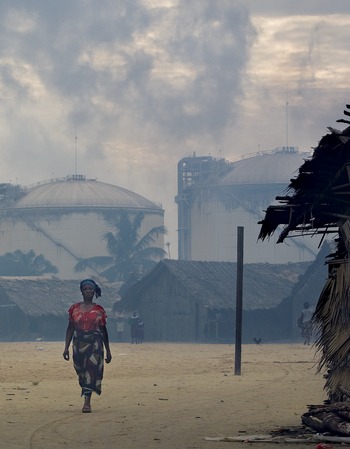
To return to LaCapra’s point about how to reinscribe the voices of trauma victims into history, we can say that the photographs are indispensable for subaltern speech here. Where the elites appear as authors of written text and as interview subjects, images recode the lives of ordinary people, script the fractious intimacy of humans with nonhuman hydrocarbon technologies, and expose the assaults on everyday life. On the book cover is the image of a local woman captured in motion while another, going about her business, can be seen with her back to the camera in the background (figure 1). Also in the background we barely see the outlines of three schoolchildren and we can make out three thatch huts, obviously homes of the community members. Looming large in the image are massive oil installations—“carbon energy machine[s]” in Timothy Mitchell’s termsFootnote 42—dwarfing the humans in this photograph. From these installations, smoke billows, making for a cloudy sky and a dimly lit picture. Through the smoke, we can see outlines of a brighter sky; oil pollution obstructs the climatic rhythm. We can already see how oil darkens rather than illuminates the people’s lives and “its enmeshment in the ‘everything else’ that we know and do.”Footnote 43 Oil is the ostensible king while the humans look cowed before it. This is a panoramic image that wraps over onto the back cover. The fact that it’s a panorama shows the extent to which oil has overtaken everything.
Front cover.

The conditions of the homes are pitiable, returning us to the thatch huts in Chinua Achebe’s early fiction. The difference, of course, is that this setting is not from the nineteenth or early twentieth century predating oil modernity. This picture is the scorecard from the Niger Delta, fifty years after the discovery of oil in commercial quantity. These people live every day with the smoke and pollutants from the oil infrastructure while they remain in extreme poverty. We will have to turn the pages to encounter more images of the rot and rut in the Delta.
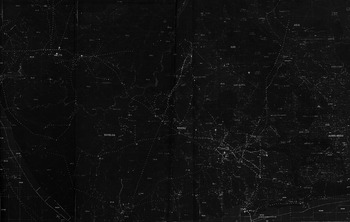
It is significant that the first two spreads make use of a black background, therefore foregrounding the message on the cover. The first spread, which is repeated at the end of the multimedia work, is a map of the Delta (figure 2). Because this book is “extroverted,” which in Eileen Julien’s term means it is geared toward a Western reader, some form of geographical orientation seems necessary.Footnote 44 Yet we can barely decipher this map with the black background and the faint contrastive light mapping on it. Sites of trauma are darkened sites; they remind us of the violence that has scarred the land and its people, as well as our inability to fully account for the magnitude of the suffering. We can thus interpret this spread as an enplotment of trauma’s unknowability. This initial spread reminds us that the Niger Delta is a site of traumatic events that go back centuries.
Inside front cover.

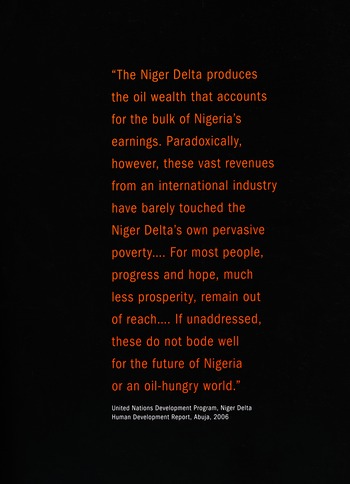
The darkness of the initial pages continues on the next spread of Curse of the Black Gold, which contains an excerpt of a 2006 United Nations Development Program’s Niger Delta Human Development Report (figure 3).Footnote 45 Printed in orange above the black background, the message registers the disjuncture of a region that “produces the oil wealth that accounts for the bulk of Nigeria’s earnings,” but where the earnings “have barely touched the Niger Delta’s own pervasive poverty.”Footnote 46 This message appears in orange as a reminder of the uninterrupted gas flaring happening in the region; this color also alludes to Shell, the major oil company in the region, whose operation in Ogoniland was fundamentally responsible for Saro-Wiwa’s murder. In the color coding of this message can also be found echoes of the fires from oil spills that have rocked the Delta over the years.
Excerpt of United Nations Development Program Report.
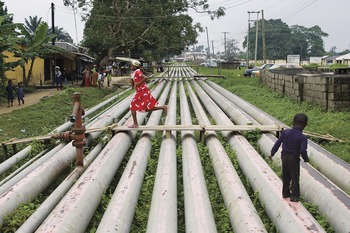
We need to turn only one more page to see further evidence that oil is seared into the lives of these communities. The fog has lifted on this colored spread, but the pictorial perspective foregrounds oil pipelines that are just a few feet away from the houses (figure 4). One must look beyond the oil infrastructure to catch glimpses of domestic life in the houses and shops. This relegation of the people’s life to the background links this spread to the book cover, where again the prominence of the oil machinery dwarfs the inhabitants of this space. On the pipelines we can see a little boy who seems to be finding his balance while an older girl earnestly runs across them. To leave pipes exposed as they are here, and in residential areas, heightens the risk of spills and fires even as it denotes the fractious intimacy or the dangerous entanglement of human and machine.
Children play on the oil pipelines in Okrika. This conflict-ridden oil-producing town ten miles to the southeast of Port Harcourt on the Bonny River has experienced oil leaks and oil fires along these pipelines, which run directly through the town on the way to the coast terminal managed by the Nigerian National Petroleum Company (NNPC).

In this spread and in others that follow, the viewer can decipher “the devastating material effects and unimaginable disproportionalities” that Jennifer Wenzel marshals as evidence of “petro-magic realism.” If “petro-magic offers the illusion of wealth without work,” Wenzel describes how “petro-magic realism pierces such illusions, evoking a recognizably devastated, if also recognizably fantastic, landscape.”Footnote 47 The devastated landscapes evoked in the photographs demonstrate the violence of petromodernity. As the reader flips through the pages, taking in further examples of the incredible human-machine intimacy, what emerges is confirmation of Allan Sekula’s description of photographs as “documents of the ‘microphysics’ of barbarism.”Footnote 48 In some images, the women are drying the local staple, garri, with heat from nearby gas flares. In others, combustible refined oil is sold in the gallons by the roadside, with cars and motorcycles driving by; the aquascape of the region is also overwritten with oil structures competing for space with human swimmers and fish. We must note the enmeshment of bodies here—of the human and the technological, and the corrosivity of such intermingling.
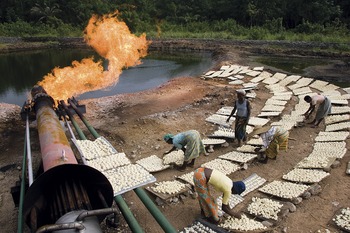
The captions accompanying the photographs remind the reader of the high incidence of diseases in this region, many of which are connected to oil. It is no surprise that the book includes more than one picture of women baking their garri with gas flares. On one hand, this repetition foregrounds the prevalence of the practice, but it also highlights the health implications of the activity. According to Susan Sontag, “while the image … is an invitation to look, the caption, more often than not, insists on the difficulty of doing that.”Footnote 49 There is always the possibility that the images of the women surrounded by cassava and gas flares may attract some viewers, captivate them with its symmetry and strange stunning quality (figure 5). The caption that follows, however, resists such lure when it illuminates the health dimension of the women’s activities: “Life expectancy is short for the Urhobo people, as pollutants from the flares cause serious health problems.”Footnote 50 Not only are the women directly exposed to the flare, but this danger extends to members of their family and others who will purchase the staple and consume it. In “The Author as Producer,” Walter Benjamin asserts: “What we must demand from the photographer is the ability to put such a caption beneath his picture as will rescue it from the ravages of modishness and confer upon it a revolutionary use value.”Footnote 51 The captions in Curse of the Black Gold fulfill the Benjaminian task. In the example of the image with the women baking their garri, the caption moves it away from aesthetic pleasure, something for enjoyment, instead orienting us to the health challenges and the infrastructural lack—amid plenty—that informs their action.
In the oil town of Afiesere, local Urhobo people bake krokpo-garri, or tapioca, in the heat of a gas flare. Since 1961, when the Shell Petroleum Development Company first opened this flow station, residents of the local community have worked this way. Life expectancy is short for the Urhobo people, as pollutants from the flares cause serious health problems.

Ultimately, we can say that Watts and Kashi “confirm very soberly their solidarity with the proletariat” as Benjamin requires of the “author as producer.”Footnote 52 By not focusing only on elite forms of cultural production, by visually presenting the lived experience of the ordinary people and their labors as well as their perils, Curse of the Black Gold represents a broad spectrum of the Delta ecosphere. Although garri processing is a form of female labor in the text, the men are also seen engaged in manual forms of labor no less arduous and hazardous.
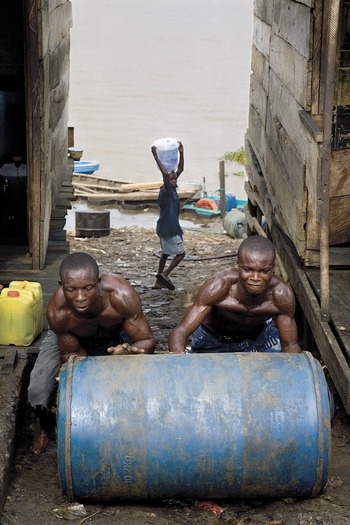
If “oil encourages fetishistic representations of its value as a magical property detached from labor,” as Ross Barrett and Daniel Worden claim in their introduction to Oil Culture, Curse of the Black Gold visualizes the toxic labor of oil exploration.Footnote 53 There are images of bare-chested men engaged in manual labor, often in the oil industry. In one, two young men roll a visibly heavy barrel of gas, their sweat, bulging and defined muscles, as well as facial contortion expressing the enormity of their task (figure 6). The men rolling the barrel of gas appear bent, are wearing only pants, and their upper bodies appear shiny and glistening from the oil and perspiration. At stake in this image and others like it is the exertion of labor in productive economies that hardly reward the Black body as well as the iteration of the Delta as site for energy extraction.
Workers push heavy barrels of gas up from the waterfront into the main market of Yenagoa, capital of the oil-rich state of Bayelsa.

Because the physical and psychological wounding in the Delta does not stay in the past or stay contained in the present, it is appropriate to consider traumas of the future here. Trauma studies have focused mainly on the past, but in light of the bombing of the World Trade Center and Pentagon in 2001, as well as catastrophic weather events such as Hurricane Sandy in the United States, critical attention has started to shift toward the traumas of the future. Jacques Derrida’s reflection on the September 11, 2001, attacks in the United States raises the specter of this form of trauma. In his words, “We must rethink the temporalization of a traumatism if we want to comprehend in what way ‘September 11’ looks like a ‘major event.’ For the wound remains open by our terror before the future and not only in the past.”Footnote 54 The traumatic event(s) is/are not located solely in the past but also in the idea that the United States shares the vulnerability that has been associated with less-powerful countries of the world. The breach of the homeland sundered the illusion of national security while raising the stakes for surveillance at home and abroad. That the 2001 attacks (9/11) happened meant that they could happen again, hence the trauma that Derrida painstakingly articulates in his dialogue with Giovanna Borradori.
Brian Massumi shares Derrida’s conviction that 9/11 opened up a new regime of unforeseen threat and thus exploded our sense of security. For Massumi, the “threat is from the future. It is what might come next. Its eventual location and ultimate extent are undefined. Its nature is open-ended… . Even if a clear and present danger materializes in the present, it is still not over. There is always the nagging potential of the next after being even worse, and of a still worse next again after that.”Footnote 55 E. Ann Kaplan calls this “pretrauma” in her study of futuristic disaster narratives.Footnote 56 Locating the source of pretrauma or trauma of the future in ecological disaster has relevance for the concern of this essay. What is also interesting is Kaplan’s claim that the “pretrauma genre emerges as Eurocentric cultures become newly aware of the uncertainty of human futurity.”Footnote 57 This new awareness further demonstrates the privilege of Western societies spared the violence that they have directly or indirectly visited on non-Western countries, until recently. “Prisoners of geography,” such as those in the Niger Delta, the territorial features of which have turned into their undoing, do not share this nascent sense of uncertainty.Footnote 58 Places such as the Niger Delta have been continuously subject to Eurocentric colonial violence over centuries, long before bombings and climate change became palpable risks. I will argue here that the young children whose images appear in the book, and the imagery of wounding that is encoded in a poem by Uche Peter Umez constitute the vectors of trauma of the future in the collection.
In the earlier discussion of the two young men rolling a heavy barrel of oil on the ground, what I declined to mention was the boy in the background hawking sachet water (figure 6). The camera shot freezes him in motion with his face and body turned to the camera and the young men laboring under the weight of oil. Considering that the photographer had the option of cropping out the boy while editing the photograph and chose not to, this image invites us to read the boy’s gaze in light of the men’s labor. In her recent work, Tina Campt asks that we embrace “the choice to ‘listen to’ photographs.”Footnote 59 In Campt’s telling, “Listening to images is constituted as a practice of looking beyond what we see and attuning our senses to the other affective frequencies through which photographs register.”Footnote 60 She concedes photographs’ quietude but cautions that “quiet must not be conflated with silence.” She asserts that “quiet registers sonically, as a level of intensity that requires focused attention.Footnote 61 If Campt’s insights are brought to my analysis, we can ask: What does this photograph tell us about the boy? We should also ask what thought is running through the boy’s mind as he watches his older compatriots. We don’t know if this boy is in school or not; is he hawking water full time or is this an after-school activity? Even if he is in school, the dilapidated school structure in another spread does not register a solid educational engagement for the kids. In short, to return to the image, the boy’s look speaks of his vulnerability. For Fred Moten, the “meaning of a photograph is cut and augmented by a sound or noise that surrounds it and pierces its frame.”Footnote 62 The boy’s presence pierces and augments the picture’s frame. His presence, the footsteps underpinning his motion, and his gaze are practically audible, distracting us from the noise of the rolling barrel and the “moaning,” groaning, and “mourning” of the men laboring behind it;Footnote 63 yet the aural quality the boy brings to the picture cooperates with the aural-visual image before him to underscore the precariousness of existence in this clime. As he watches the older men from behind, the picture seems to be registering the sight before him as the zenith of his ascent. The image suggests that the weight of the boy’s labor will not get lighter, that with the passage of time, its heaviness will be akin to the weight borne by the men pushing the oil drum. If he is standing upright in the image, the sight before him gives the impression of a bent posture in the future, indicative of the battering of everyday life in such a place. Perhaps the boy is asking himself if this is the lot that awaits him and if he can transcend such circumstances. This photograph is an archive of uncertainty and stasis for the boy and for the men, whose hard labor symbolizes the Herculean tasks confronting young people in this environment.
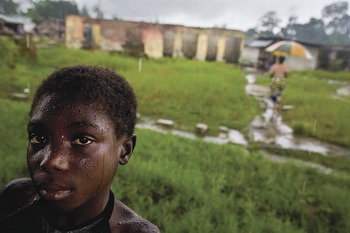
Another image is worth discussing here. It is a close-up shot of a girl’s face and shoulder covered in rain droplets (figure 7). Behind her in the distance is a destroyed building where at least the roof, doors, and windows are missing. The caption for the photograph informs us that the location is Odiama, “a town that was attacked and destroyed by the Nigerian Military Joint Task Force.”Footnote 64 The girl appears superfluous to the destruction captured in the image and the accompanying caption. But is she really? Although she appears “at the edge of sight”—to use the title of Shawn Michelle Smith’s bookFootnote 65—at the margin of the photograph, she is the focus of the image and thus deserves attention. We see only her face and shoulders with the rest of her body outside the picture frame. This composition signals the girl’s marginality just as the distance between her and the destroyed building indicates her “dislocation from the communal web of kinship.”Footnote 66 Capturing the face of the child in extreme close-up and with the rain water evoking tears highlight her vulnerability and can be read, in Levinas’s term, as an invitation to respond to the face of the Other.Footnote 67 But we can also ask what kind of future awaits children who are subject to the continuous violence in the region. Is anything being done so that these children will not continue in the traumatic cycle of violence they witness every day? There is no easy answer to these questions, but unless things change for the better as the editors of Curse of the Black Gold hope, it won’t be farfetched to conclude that not only is the future of these kids bleak, the entire region and possibly the entire country are also at risk. If the status quo remains, these kids could constitute, in Derrida’s words, “the open threat of an aggression capable one day of striking,” therefore deferring and extending the cycle of trauma in the Niger Delta.Footnote 68
Odiama is a town that was attacked and destroyed by the Nigerian Military Joint Task Force as part of Operation Restore Hope in 2005. At least seventeen people were killed, and virtually all of the buildings and homes were burned down or destroyed. The population had been nearly 15,000; since the attack, however, only 2,500 residents have returned to start rebuilding their homes, businesses, and lives.

The future dimension of trauma being charted also appears in one of the poems in the work, “Dark Through the Delta.”Footnote 69 Umez is a contemporary Nigerian poet currently studying for a doctorate in English in Alberta, Canada. Isidore Diala contends that Umez’s craft is “consumed by a passionate concern for social injustice and ameliorating the miserable lot of the downtrodden” and that he “sheds a sober but always compassionate light on the many inadequacies of the national life that threaten to make Nigeria a pariah nation.”Footnote 70 Diala describes “Dark Through the Delta” as a “stirring evocation of the mood of continuing cynical despoliation” and sees the poem as “painting a haunting scene of utter decay and abandonment.”Footnote 71 The first four stanzas of the poem capture the devastation to the river, land—the elemental media, so to speak. The stanzas also capture the rust of canoes and nets as well as the hoes and cutlasses, all farming and fishing equipment.
The fifth stanza shifts to the kite, a bird of prey, “hovering” in the sky. Hovering here registers a shift in tense from the past and present of earlier stanzas toward the future. The kite is waiting to kill or for some creature to die from oil’s strangulation, therefore constituting the sign of future trauma. The poem attunes us specifically in this stanza to the unhappened, to the yet to come. In my reading, the poem proceeds in the last two stanzas to underscore an itinerary of a traumatic future:
I see the fat of the land
being eaten out
by the burgeoning pollution,
by the intricate machinery of oil greed
Considering that the Niger Delta is a site of primitive accumulation and the instantiation of what the African political scientist Jean-François Bayart terms the “politics of the belly,” it makes sense that Umez draws on alimentary imagery, of consumption, of food and eating, to describe the despoliation of the land.Footnote 72 The poet’s choice of imagery is equally consistent with Achille Mbembe’s conclusion in On the Postcolony that eating and festivities are primal for African rulers and their modes of governmentalities.Footnote 73 What interests me, though, is the continuity marked by the tense (being eaten). Umez’s poem registers the wounding of the land, its evisceration by oil greed, but then this incident is not just located in the past or present as in earlier stanzas. Umez’s choice of grammatical tense extends the duration of this eating and wounding to the future. The final stanza continues this attunement to the yet-to-come:
behold, it is the fortune
of my hapless kin
being eroded, stealthily eroded …
The present continuous tense “being” is repeated to foreground the fact that the erosion of fortune lasts beyond the immediate present. The reference to the “hapless kin” evokes the children in the photographs, whose future is jeopardized by the primitive accumulation of the elites and devastation in the region. “Hapless” recalls the misfortune in the Delta, but the word can also be read as a phonic approximation of “helpless,” which in this case characterizes children’s dependence on their parents or guardians. Seen this way, “hapless kin” can be read as children, dependents of the poem persona, whose inheritance—the fortune—is repeatedly under attack just as present global consumption levels imperil the planet for future generations. But we must not stop here.
One critical intervention that Cajetan Iheka’s Naturalizing Africa makes in African literary studies is to challenge the anthropocentric conceptualization of the environment and model a critical practice attentive to human-nonhuman entanglement. As an example of what the author terms “aesthetics of proximity” in that book, Umez’s poem highlights other ecological components including the river, the land, and the cloud imperiled by oil exploration.Footnote 74 Focusing on these constituents makes for an expansive understanding of “kin” in the final stanza, one that acknowledges the shared vulnerability on display throughout the poem, linking humans and other aspects of the ecosystem together. Take for instance the “nets frayed and flung away” in the second stanza. The decommissioned nets suggest the unavailability of fish, either killed by the “grime” in the river in the fourth stanza or driven farther into the ocean. Interestingly, fish are not mentioned, underscoring their disappearance or even extinction, a point buttressed by the fact that this stanza has the fewest lines in the poem, only two. The formal economy of the stanza particularly addresses the species scarcity suggested by the discarded nets. My point is that “hapless kin” should be read ecologically, to embrace the various life forms under threat in this ecology of risk. Ultimately, the poem ends in ellipsis suggesting incompleteness, irresolution, and the continuation of the traumas articulated in the poem. Moreover, the poem persona is unsure of the future shape of the metaphorical and physical cannibalization of the Niger Delta. The uncertainty registered in the ellipsis thus evokes the threat the future holds for the Delta.
Yet Watts and Kashi make clear that these people are not mere victims but survivors as well. Although many of the images and written texts paint a realistic picture of gloom, the images of children playing and women dancing speak to the presence of life, zest, and vivacity in the Delta. Moreover, the pictures showing kings and Queen Georgina Tenalo of Ogoniland reveal that the Delta is not altogether a lawless space but a place with some form of constituted authority and order. We see a space where women such as the queen and dancing women are not mere victims but are agents at the forefront of addressing the violence in the region. Curse of the Black Gold pushes back against the idea of victimhood, and women play a critical role in forging the image of the Delta as a lived space populated by active agents working toward social transformation.
Limits of Witnessing
Nevertheless, there is room to argue that Curse of the Black Gold courts sensationalism in its portrayal of catastrophe. To flesh out this position, we can turn to the email exchange between Kashi and Jomo Gbomo, the spokesman for the militant Movement for the Emancipation of the Delta (MEND) and the visual portrayal of the Black men. In one email to Gbomo, Kashi writes, “I have spoken with my man in Port Harcourt and he sounds a bit skeptical but he told me that a leaking well that he showed us last week has exploded and is on fire. This is exactly what we need for our work.”Footnote 75 This is a clear demand for the image of disaster. Such stories sell well and enable the quick cultivation of what Michael Warner calls “mass subjectivity.”Footnote 76 It can be argued that the rhetorical force of a burning well serves the purpose of the book, which Watts explains as a “better and deeper understanding of what it will take to defuse and rebuild the violent economies of the Niger Delta.”Footnote 77 Such an image, however, derives rhetorical power from its provenance in Africa. Sontag is indeed right that such “sights carry a double message. They show a suffering that is outrageous, unjust, and should be repaired. They confirm that this is the sort of thing which happens in that place.”Footnote 78 The exotic space of the Other on fire can attract sympathy, but it also confirms a particular narrative of violence—the kind that Valentin Mudimbe labels “Africanism”—that has shaped the (mis)understanding of the continent for centuries.Footnote 79
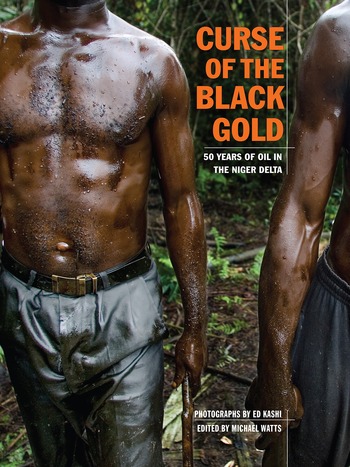
Watts and Kashi’s treatment of the Black male body is also problematic and deserves scrutiny. It is a positive development that women are spared sexualization in this collection, but the transposition of such structure of feeling in the portrayal of the half-clad men is problematic. This is more the case when the image is on the front jacket covering the book (figure 8). Where the image that appears in the text shows two men, the version on the cover jacket crops out the figure on the right, leaving only his arm visible. With the second young man almost cropped out, the other male body stands out on the cover. As Nicholas Mirzoeff suggests, the body stands for itself in representation but also aligns with other discursive protocols.Footnote 80 One such protocol is that which hypersexualizes the male Black body, and that trope is as old as slavery. As shirtless male bodies appear covered in oil and sweat, with broad chests and bulging muscles on the cover and within the text, there is the danger of their exoticization or the authorization of the “superexploitation of the black body as muscle-machine.”Footnote 81 The body here is the “source of an irresistible, destructive sensuality” and holds “potential for pornotroping” with hints of the admixture of violence and sensuality.Footnote 82 With this image on the front jacket, the viewer is already drawn into the exotic economy before opening the pages. Black skin in black mask (made of oil) on the front page and later in the work return us to Fanon’s Black Skin, White Masks with all the sexist baggage imposed upon the Black body in the racist economy that the text divulges.Footnote 83 To put it in other words, the effort put into capturing the men’s labor and the strength that shines through their muscles is consequential; yet the dangerous liaison with the discourse of Black male hypersexuality, which can potentially blunt the critical edge of Watts and Kashi’s project, is hard to miss.
Book jacket, front cover.

In the end the larger question concerning ethics is the extent of the book’s immersion in oil. LeMenager and Sean Cubitt, among others, have written of the ecological footprint of print and electronic media. In the words of LeMenager, “Apart from the resources used to print the book, many other processes like transportation of the books consume a considerable amount of energy.”Footnote 84 This energy currently comes mostly from oil. Curse of the Black Gold, while critiquing the culture of oil in the Delta, relies on oil for its own production and distribution. Both Watts and Kashi record multiple trips to Nigeria and the Delta, travel involving long flights on planes fueled by oil. These flights, no doubt, generate carbon footprints. Moreover, the processing of the film, the making of the paper on which the words and images appear, and the book’s journey from its publisher to libraries and private owners make use of petroleum energy.
The most troubling aspect of the work’s indebtedness to oil, however, is the revelation in the acknowledgments that “the Bayelsa Government, through the services of Von Kemedi and Governor Timi Sylva, also contributed financial support.”Footnote 85 Sylva, the then-governor of Bayelsa, is the only elected top government official whose photograph is in the book: Is his appearance tied to his patronage? Curse of the Black Gold is stuck in oil like the people whose lives it illuminates. Because Bayelsa is a major oil producing state with most of its revenue coming from oil rent, it is plausible that Watts and Kashi’s book is partly funded by the same oil economy it condemns. This funding arrangement combines with the processes of production and distribution to highlight the limits of projects such as Watts and Kashi’s. They are crucial for creating awareness of ecological problems, especially those occurring in faraway places, and for mobilizing resistance against the devastation of the ecosphere. The multimedia text also affords the apprehension of postcolonial trauma and offers intimations of the yet-to-come. However, Curse of the Black Gold remains linked in some fashion to the cultural logic of exploitation and degradation. Despite its shortcomings, including its indebtedness to oil at the levels of production and distribution, Curse of the Black Gold is an outstanding exposé on oil violence. It demonstrates that sharp critiques are possible at scenes of culpability.