The golden age of the exploration of the Silk Road during the early part of the twentieth century saw a series of foreign expeditions to Chinese Central Asia, many of which returned home with rich collections of manuscripts and antiquities. The best known of these were conducted by the Swedish explorer Sven Hedin (1865–1952), Hungarian-born British archaeologist Sir M. Aurel Stein (1862–1943), Germans Albert Grünwedel (1856–1935) and Albert von Le Coq (1860–1930), and Russian Sergei Oldenburg (1863–1934).Footnote 2 Although Japanese exploration attracted less attention in the West, it nevertheless resulted in a substantial collection of medieval manuscripts and other artefacts. Between 1902 and 1914 Count Ōtani Kōzui 大谷光瑞 (1876–1948), the twenty-second Abbot of the Nishi Honganji 西本願寺 branch of the Jōdo Shinshū sect 浄土真宗, planned and financed three expeditions to western China, with the aim of carrying out excavations of Buddhist sites and collecting archaeological material. Ōtani also recognized the significance of promoting their results outside of Japan and integrating them into current geographical and archaeological knowledge in the West. He had been in contact with the Royal Geographical Society (RGS) and continued to send to the society maps, photographs and other information about his expeditions.
However, in 1914 Ōtani was forced to resign from his position because of a financial scandal within his sect; he left Japan for good and thus did not have the time, energy or motivation to organize and publicize the results of the expeditions. The collection gradually became dispersed, and the promised scientific reports of the trips were never written. As a result, in comparison with the abundant documentation of European explorers of Chinese Central Asia, the Japanese expeditions are far less well known and there are significant gaps in their history, including detailed routes and dates, or the provenance of particular artefacts.
The Royal Geographical Society (RGS) Archives in London contain a small lot of material related to the Ōtani expeditions which has thus far escaped the attention of those working on the history of the exploration of Central Asia. The material consists of a map, some photographs and a short typescript of a report of the expedition. Together, they can help us shed additional light on the details of the two trips led by Tachibana Zuichō 橘瑞超 (1890–1968) between 1908 and 1914. The material also reveals that there had been repeated efforts to communicate the results of the Japanese expeditions with the RGS in an attempt to publicize them in the West, even though much of this information never appeared in print. We also know from Stein's correspondence with John Keltie (1840–1927),Footnote 3 secretary of the RGS, that the Society was in fact contacted by Ōtani on other occasions with regard to submitting information about the Japanese expeditions to Central Asia; these letters, however, are now lost and cannot be accounted for. This is why the material at the RGS Archives is especially helpful for demonstrating the significance of the society from Ōtani's point of view.
1. The two expeditions led by Tachibana
The key figure behind the Japanese exploration of Central Asia was Count Ōtani Kōzui, who organized a series of expeditions to historical Buddhist sites in western China, Tibet and India.Footnote 4 As a close relative of the imperial familyFootnote 5 and heir to the abbotship of the Nishi Honganji sect, one of the largest Buddhist organizations in the country with over ten million followers, he was in a unique position to be able to envision, finance and execute this massive enterprise as a semi-private venture without government involvement or aid. During the abbacy of his father Ōtani Kōson 大谷光尊 (1850–1903), Japanese Buddhism was in a state of crisis as a result of imperial efforts to establish Shintō as a state religion. Buddhist organizations were faced with the need to adapt. The Honganji carried out a series of changes, including the introduction of an internal parliamentary system and complete educational reform. One of the important efforts in dealing with suppression was to dispatch clerics overseas to establish contacts with other Buddhist communities and to learn about their practices.Footnote 6
Buddhism in Asia as a whole was in decline. Kōzui, who embarked on extensive travels while his father was still alive, witnessed this state of affairs in China, Sri Lanka and India. It was after these experiences that he sailed to Europe, ultimately arriving in London in March 1900, with the aim of studying theoretical and practical aspects of Western religions.Footnote 7 It is reasonable to assume that his purpose in staying overseas for this extended period was to study missionary activities and religious policies in Europe. In other words, he was trying to find alternative models for the survival of Buddhism, rather than being involved in its academic study.Footnote 8 At the same time, whenever he could, he visited leading Buddhist scholars and Orientalists, including such names as Édouard Chavannes in Paris or Arminius Vámbéry in Budapest.Footnote 9 In addition, he was deeply inspired by the Central Asian explorations of Sven Hedin and Aurel Stein, especially with regard to the ancient ruins in Chinese Turkestan, which he understood to have once served as a major route in the transmission of Buddhism to China. He also felt that, as a religious leader in Japan, it was his responsibility to investigate the ancient sites of Buddhism.Footnote 10 As a result, when the time came to return to Japan, he decided to travel with a handful of followers through Russia and Chinese Central Asia and do his share of exploration. The Nishi Honganji supported the enterprise and provided the financial means. The Japanese party left London in August 1902 and this trip became the first of a total of three expeditions to Xinjiang, known today as the Ōtani expeditions.
Although Ōtani led the first expedition (1902–04) in person, he had to cut short his participation and return to Kyōto when his father died in January 1903. His followers stayed behind for another year but eventually the project was suspended because Ōtani had his hands full with the task of taking over the leadership of Nishi Honganji from his late father.Footnote 11
The second expedition took place in 1908–09, when two young men travelled through Mongolia to western China. Tachibana Zuichō, an eighteen-year-old priest of the Nishi Honganji sect, was appointed leader of the two; he also came to represent the expedition in the eyes of the world. Despite his young age and fragile physique, Tachibana proved to be an able explorer who over the next four years traversed thousands of miles in the most difficult conditions. As his experience and confidence grew, he also became involved in the study of old Uighur manuscripts that he discovered in China, publishing a number of academic papers on the subject. The other member of the team was Nomura Eizaburō 野村栄三郎 (1880–1936), one of the very few followers of Ōtani who were not Buddhist priests. His father had worked in his youth for the Nishi Honganji Temple and the young Nomura grew up partly within the confines of the Temple and in close connection with the abbot's family. Back in 1899, his brother had accompanied the young Ōtani on a trip to China, but died in Henan province from a sudden illness. At the start of the 1908 expedition, Nomura was already a veteran of the 1904–05 Russo-Japanese War, a fact that later became significant in the eyes of the Russian and British authorities in Kashgar.Footnote 12
On reaching Xinjiang, the two explorers separated and Tachibana travelled south through the Lop Desert where he found, among other things, a small group of early-fourth-century documents written by Li Bo 李柏, a historically attested figure who served as the chief administrator of the Western Dominions 西域長史. It was the discovery of these documents and several others that made Tachibana's name known in the West, in no small part due to the positive introduction by E. Denison Ross (1871–1940), the first scholar to see the manuscripts, in December 1909 straight after the end of the expedition. At the time, Ross was principal of the Calcutta Madrasah and an authority on Uighur and other Central Asian languages. He wrote an account of Tachibana's expedition for The Times and also publicized it in his private correspondence with European scholars such as Aurel Stein and Albert von Le Coq.Footnote 13 Although this article appeared anonymously, Ross acknowledges having been behind it in his private correspondence. Thus in a letter to Stein, he writes:
You will see in the Times of the week in which you peruse these lines and [sic] account of a young Jap's journey over your ground. He has got a large mass of MSS. chiefly Chinese. One of the Later Han period. Hensman & I put the article together from the very indistinct account we received verbally from Count Otani. You will probably meet these gentlemen in London, as they are on their way to Europe via Egypt …Footnote 14
In the letter Ross remarks that Tachibana has been following Stein's tracks, as if sensing Stein's disapproval of the Japanese enterprise, and thus in a sense violating an unwritten gentlemanly code about respecting one another's territory. In another letter dispatched on the same day to Le Coq, Ross is much more sympathetic towards Tachibana, even if discontented that he is not allowed full access to the manuscripts:
Please look out in the Times for an article on a young Jap. traveller who has lately been passing through Calcutta with the great Count Otani. It was principally written by me – and is being posted by this mail – which circumstance will give only a clue to the date of appearance.
Young Tachibana only had 2 scrolls with him, one a very long one in good healthy Uïghur – I hope to identify the sutra in a few days – and the other contained Chinese on one side (a portion of a sutra) and Mongolian forsooth on the other. Have you among your old treasures any Mongolian Buddhist texts? I don't remember seeing any. I will tell you more about these MSS. when I have examined them more carefully – or rather the photographs of them. For the Count only allowed me to look at them once and took them away again: but he has promised me photos in return for my having initiated Tachibana into the mysteries of the Uïghur alphabet! They are rum beggars these Japanese, always so mysterious and always keeping back so much. The more I see them, the less I understand them!Footnote 15
These items of correspondence show the speed with which news about the results of Tachibana's expedition spread to Europe, and leading scholars working on manuscripts excavated in Chinese Central Asia knew about it shortly after his arrival in Calcutta. In this case, this was in large part due to Ross' excitement and eagerness to tell others about the new manuscripts he had been shown by Ōtani.
Following the expedition, Tachibana did not return to Japan but joined Ōtani in India so that they could travel together to Europe.Footnote 16 Ōtani himself came to London to take part in the Japan–British Exhibition at Shepherd's Bush, but his main goal was to organize the next trip. Besides purchasing the necessary equipment he was actively engaged in promoting the cause of his expeditions, publicizing them and securing recognition.Footnote 17 As a result of his efforts, shortly after their arrival in England Tachibana was elected a member of the RGSFootnote 18 and became recognized as an accomplished explorer. He was also able to meet Stein, Hedin and Le Coq before embarking on his next voyage, known today as the third Ōtani expedition.
On this trip Tachibana's companion was not Japanese but a young Englishman named A. O. Hobbs. They travelled via St Petersburg and approached Xinjiang from the Russian border. After digging together in Turfan they separated: Tachibana travelled once more through the Lop Desert, while Hobbs transported the bulk of their luggage to Kucha where the two of them had planned to reunite at a later date. However, while the Japanese team leader was exploring the desert, Hobbs contracted smallpox and died within a few weeks. By the time Tachibana arrived in Kucha, the Englishman's body had been transported to Kashgar under the directions of George Macartney, the British Consul General. Tachibana rushed to Kashgar and was able to attend the funeral at the British consular cemetery.Footnote 19 Following his companion's death, Tachibana continued his trip alone until Ōtani sent Yoshikawa Koichirō 吉川小一郎 (1885–1978) to relieve him. The two explorers met in Dunhuang and shortly after acquiring a large lot of manuscripts at the Thousand Buddha Caves, Tachibana returned to Japan with the most precious finds.Footnote 20
2. Problems with documentation
The archaeological spoils of the three expeditions were first housed at Nirakusō 二楽荘, Ōtani's villa on Mount Rokkō 六甲 above the Bay of Kōbe 神戸. At certain times these items were on display to the general public. When, in 1914, Ōtani stepped down from the leadership of his sect, he moved his operational bases to Shanghai, Dairen (Dalian) and Port Arthur (Lüshun). At this time part of the collection from Villa Nirakusō was moved to Port Arthur, including the Dunhuang and Turfan manuscripts, numismatic items, the Gandharan sculptures and several mummies. Today these items are in the collection of the Lüshun Museum, with the exception of those Dunhuang manuscripts that had been lent to Beijing Library (today's National Library of China).Footnote 21 In addition, after the Second World War part of the material from Lüshun was moved back to Japan and deposited at the Nishi Honganji Temple in Kyōto where it lay forgotten for many years. After Ōtani's death, while organizing the personal belongings he had left behind at the Nishi Honganji, two large wooden boxes were found, which were transferred into the collection of Ryūkoku University 龍谷大学 in 1953.
Apart from the above material, part of the original collection was sold, together with Ōtani's villa, when he found himself in financial difficulty. These items were subsequently donated to the Government-General of Korea, and today form part of the collection of the National Museum of Korea. In addition, the National Museum at Kyōto and the National Museum at Tōkyō hold a small number of items from the original Ōtani collection. Finally, there are some items that found their way into private collections.Footnote 22 It is likely that in time more items will come to light.
The scattered nature of the collection unsurprisingly poses a serious hindrance to research. We are lucky to have the Saiiki kōko zufu 西域考古圖譜 (Illustrated Catalogue of the Archaeology of the Western Regions), the illustrated catalogue of selected items from the Ōtani expeditions, which was published before the dispersal of the collection.Footnote 23 Unfortunately, the whereabouts of many of the items from this catalogue are currently unknown and are considered either lost or unrecognized in other collections.
In addition to the dispersal of the archaeological material, much of the documentation of the expeditions is also missing, which is a major drawback for studying the history of the collection, or reconstructing the itinerary and main events of the trips. The diaries and field records of the expedition members were published more than twenty years afterwards in 1937, in the two-volume Shin Saiiki ki 新西域記 (New Record of the Western Regions).Footnote 24 Unfortunately, by this time Tachibana's records had perished when his home temple in Nagoya burned down in a fire. Although Tachibana published two accounts of his second trip, both were written with a popular audience in mind and thus only contain a general description of the expedition.Footnote 25 In order to reconstruct a detailed chronology and sequence of events for this journey, it is necessary to gather bits of information from personal correspondence and contemporary newspaper reports. We are fortunate that the material in the RGS Archives has survived and it is surprising that it has not been noticed by researchers in the past. The archive contains an expedition report, a map and a number of photographs, which are all extremely valuable in supplementing our knowledge of the details of Tachibana's exploration in Xinjiang.
3. Material in the RGS Archives
Chronologically, the first group of material on the Japanese expeditions in the RGS Archives consists of a nine-page typescript detailing Tachibana's discoveries during his 1908–09 trip, accompanied by a letter written by Aurel Stein to John Keltie, secretary of the RGS.Footnote 26 The typescript is a short and rudimentary description of the archaeological results of the expedition, referred to in the catalogue as “Brief notes on a Japanese archaeological expedition to Sinkiang”.Footnote 27 It is divided into five sections: 1) Manuscripts; 2) Sculpture; 3) Fresco paintings; 4) Old coins; and 5) Miscellaneous. To this list a separate text was added with the title “History of Lop-nor”. Stein's letter to Keltie of 31 July 1910, to which these nine pages were attached, describes how he had tried to make the text suitable for publication in the Geographical Journal. The letter reads as follows:
Dear Dr. Keltie,
I return herewith the notes on Tachibana's journey, having marked in the proof such corrections as seem obviously necessary to enable the average reader to follow the account. I have, of course, not attempted to put all historical or philological remarks straight, as this would practically mean rewriting a great portion of the paper. It seems better to preserve its flavour as long as the purport of T.'s observations can be made out!
Corrections in pencil (by Dr. Giles's hand?) seem to show that some spasmodic attempt has been made to introduce some system into the transcription of Chinese names, but given up again. I am sorry, I could not make up this awkward defect without sacrificing a good deal of time.
The note on the ‘History of Lop-nor’ is so crude that its reproduction would in my opinion be of no use to the geographical reader. The points alluded to in it are accessible to any student who can consult the available translated extracts from the Chinese Annals. But they are presented here in a way which is likely to confuse. I cannot believe that any competent Sinologist has revised this and suggest omission.
As the form & arrangement of this paper differ so much from the usual standard of the Geogr. Journal it might be well to explain in a footnote that the paper is a necessarily imperfect rendering of the author's original Japanese account & that no systematic revision was found practicable.
Believe me yours very truly,M. Aurel SteinAs can be seen, Stein wrote this in response to Keltie's request to evaluate and revise Tachibana's expedition report. Fortunately, the letter with Keltie's request has also survived and is now held at the Library of the Hungarian Academy of Sciences. It was written over two months earlier, on May 11, and reads as follows:
Dear Stein,
I am sending you the paper which Count Otani has sent me on the expedition of Mr Tachibana through Central Asia. You will see that I began to cut down the typed paper, but I gave it up in despair. Would you mind looking through the material and telling me whether you think there is anything in it that might be published in the Journal? I should be much obliged,
Yours Very Truly,J. S. KeltieThe margins and the back of Keltie's letter are covered in Stein's notes in pencil, detailing Tachibana's route through Turkestan in 1908–09, most likely extracted from the material that came together with the letter.Footnote 28 These notes, however, do not fully match the information in Tachibana's report at the RGS Archives. Some information (e.g. “Silk weaving different at different periods”) can be found in both places, but there are many details in the notes that cannot be found in the typed report. For example, the information about leaving China and meeting Ōtani in Sonamarg must definitely come from some other source. Consequently we must assume that there was yet another document, the whereabouts of which is still unclear. Another possibility is that Stein recorded this information during his personal meeting with Tachibana in London in August 1910, although the notes include phrases such as “Extract from Annals”, and “Medley of European information”, which suggests that it was probably extracted from a written source. Also, in several instances Stein uses quotation marks to cite an original text, including the particular spelling of “Lulan”.
As for Tachibana's typescript, it never appeared in The Geographical Journal or, for that matter, anywhere else. In view of the above items of correspondence we can see today that it was principally due to Stein's unenthusiastic response to Keltie regarding its value. Indeed, two years later in a letter to Stein, Keltie makes the following remarks about Tachibana's expedition:
I have a letter from Otani in Japan saying he will forward me a detailed account of Tachibana's journeys. If they are not more intelligibly written than the account of his previous journey I am afraid I shall not be able to make any use of them. However, I hope they will be in a better shape than before and that the results will be of some value. I shall be glad to let you know when I receive them.Footnote 29
These comments obviously refer to the problems with the account of the previous expedition which was rejected after its negative assessment by Stein. It also confirms that the problem was ostensibly with written presentation, rather than with the scientific value of the results of the trip.
Under the same pressmark in the RGS Archives (JMS/7/129) as Tachibana's report and Stein's letter to Keltie is a five-page handwritten proposal with the title “New exploration in Chinese Turkestan and Mongolia”.Footnote 30 The single pressmark indicates that these documents must have arrived at the RGS at the same time. However, unlike the rest of the material, this manuscript does not relate to the 1908–09 expedition but is rather a brief plan for a new one. According to this plan, Tachibana intended to return to Chinese Turkestan via Russia, meeting up there with Hashiramoto Zuishun 柱本瑞俊 and Aoki Bunkyō 青木文教.Footnote 31 The manuscript was written in the first person and signed by Tachibana Zuichō. Unlike the typescript report examined by Stein, this writing was accepted by The Geographical Journal for publication and, in a somewhat rephrased form, came out in its April 1910 issue.Footnote 32
Ōtani probably submitted all of the above material to the RGS in April or May 1910, while he and his followers were in London. The archives, however, also hold some later material: of particular interest is a large square map, held in the Map Room, showing the routes of Tachibana's first (1908–09) and second (1910–12) trips to Xinjiang.Footnote 33 The map, together with a set of photographs, must have been sent to the RGS sometime after 1912, most likely at the end of 1913: we know this because the January 1914 issue of the Geographical Journal published a notice entitled “Mr. Tachibana's Second Expedition to Central Asia”, which begins: “This traveller, whose plans before starting on his second expedition for archaeological research in Central Asia were outlined in the Journal, vol. 35, p. 448, sends us a brief narrative of the completed expedition, accompanied by a map, on which the route is clearly shown”.Footnote 34 This must be the same “detailed account” which, Keltie wrote to Stein (see letter of 11 September 1912 above), he was expecting from Ōtani. As for the map mentioned here, it is undoubtedly the one currently held in the RGS Archives, which must have been received shortly before the above notice appeared in print.Footnote 35
At the top of the map sheet is a smaller (1:7,500,000) map of Central Asia occupying about one quarter of the entire space. It bears the title “Map of Central Asia, showing the routes of Mr. Tachibana's Journey, 1908–1912”. The route of the first trip is marked with a dotted line, the second with a continuous one. The larger part of the sheet shows an enlarged section (1:1,500,000) of the desert route from Turfan to Kucha, proceeding in a V-shape via Loulan, Abdal, Miran, Charkalik, Cherchen and Bugur. The title for this larger part is “Sketch map illustrating a portion of the Takla-Makan and the Lob Desert, by Mr. Zuicho Tachibana, 1911–1912”. The routes for both trips are executed in a highly professional manner, with keen attention to detail. Different topographic features are marked in different colours. The captions and titles are written with a very careful hand, showing that the map was prepared by a person trained in cartography. An apparent feature of the map is that for identification purposes it uses toponyms and descriptions from Stein's maps as the basic description of the area, while also inserting a number of new details. It is obvious that Tachibana tried to penetrate places where neither Stein nor Hedin had been, and populate the white spaces of earlier maps with data. This is particularly true for his second trip, and we can see that between the two expeditions Tachibana's focus changed from archaeological to geographical. This must have been partly because he had been elected a member of the RGS in the spring of 1910 while he was in London and saw that these kinds of results yielded the highest acclaim and recognition. Since Japan had only recently risen to the rank of advanced nation and had not been part of colonial exploration, it must have been a tremendous honour for a Japanese man to gain membership of the Society.Footnote 36 As a result of this recognition, instead of collecting archaeological material, Tachibana seemed eager to explore new territories and survey areas unexplored by those before him. His routes were mostly new, and he went to places where others had not yet ventured.Footnote 37
What makes the map in the RGS Archives especially valuable is that it details the dates and places for segments of the expedition for which all other documentation has been lost. It also includes short descriptions of some of the artefacts discovered at particular sites. Therefore this map is a valuable witness to what happened during the last Ōtani expedition and provides important details that were hitherto unknown.
The RGS Archives also hold nineteen photographs from the Ōtani expeditions. All are inscribed with the same date, 1913, although some are marked as having been taken by Ōtani Kozui, and some by Tachibana Zuichō. Knowing the background of the expeditions, we know for sure that they were all shot by Tachibana, although some must have been sent to the RGS by Ōtani, and this must be why the RGS archivist denoted him as the photographer. Based on their pressmarks, we can divide the nineteen prints into three groups: (i) 076701–076711; (ii) 076176; (iii) PR/0902017–PR/0902019. With eleven photographs, group (i) is the largest – all photographs are marked as having been taken in Xinjiang by Tachibana.Footnote 38 They represent the images from Tachibana's expedition, and the date 1913 is most likely the year in which they were sent to the RGS. Group (ii) comprises five prints, all marked as having been taken by Ōtani but with no indication of the general geographical area. And finally, the three prints in group (iii) are all marked as having been shot by Ōtani in Mongolia. Among them is a photograph (PR/090219) of five men in front of a Chinese-style building. The caption for this image reads: “Group at Ulliasutai. Military governor of Mongolia (right), Prince of Mongolia (left)”. This same image has been published recently when part of Tachibana's lost diary of his 1908–09 trip was discovered, only the caption says that these are “Officials in Kulun” (i.e. Urga).Footnote 39
4. The significance of the material in the RGS Archives
Although Ōtani was well aware of the importance of publishing details of his expeditions in The Geographical Journal, Tachibana's report was withheld from publication, primarily because of Stein's unfavourable assessment. In later years, however, Tachibana's original expedition notes were lost in a fire and thus today this report is a valuable source which sheds light on some little-known details of Tachibana's trips. The description of the finds and the photographs are especially promising, as these may modify current knowledge of the expeditions.
First, we should draw attention to information concerning the so-called Li Bo manuscript discovered by Tachibana in the region of Loulan in 1909. This document comprises a group of fragments of draft letters written by the Chief Administrator of the Western Dominions during the Former Liang period (320–376). The manuscript consists of an almost complete sheet of paper with two letters (538A, 538B) and thirty-nine related fragments (8001–8039). Today the manuscript is kept at Ryūkoku University, and it is no doubt the best known item in the Ōtani collection.
Because one of the fragments (Ot.Ry. 8035) contains the words “Your servant Bo speaks to the King of Karashahr” 臣柏言焉耆王, researchers assume that the two main letters (A, B) are also addressed to the King of Karashahr. However, the surviving Chinese words could also be translated as “Your servant Bo speaks, the King of Karashahr…”, in which case there would be no evidence of the letter being addressed to the King. Indeed, there is no reason to limit the addressee of the letters to the King of Karashahr, the manuscript could contain drafts of letters written to several kings in Central Asia. Should this be the case, the date of Li Bo manuscript (538A, 538B) is of utmost significance. Currently there is no agreement regarding its exact date, different scholars date it to ad 325, ad 328, or ad 346.Footnote 40
One of the main questions concerning the Li Bo manuscript is the exact location of its discovery. As mentioned above, there is scant available documentation regarding the routes and specific sites the Ōtani expedition visited. Initially, it was believed that Tachibana found the manuscript somewhere at the lower reaches of the Konche Darya. Stein, based on his personal meeting with Tachibana in London in August 1910, wrote in Serindia that the manuscript came from the site called, in Stein's own nomenclature, LA.Footnote 41 This is the site which Hedin had conjectured to be the ruins of Loulan. In 1959, however, when the historian Mori Shikazō 森鹿三 met Tachibana and enquired about the location, Tachibana specified a photograph of the LK site, not LA.Footnote 42 This led to an academic controversy first in Japan, then also in China.Footnote 43 There had been many attempts to resolve the problem, until Katayama Akio 片山章雄 introduced conclusive evidence that seems to have settled the debate.Footnote 44 Using contemporary records relating to the expeditions, including old newspaper reports, he was able to show more or less conclusively that the Li Bo manuscript had been found at the LA site.Footnote 45 Chinese historians Meng Fanren 孟凡人 and Yu Taishan 余太山 also approved Katayama's theory.Footnote 46
The material from the RGS Archives provides additional support for this theory, corroborating the fact that the manuscript was found at the LA site. In the typescript sent to Keltie, Tachibana describes the discovery of the manuscript, under the subheading “Sven Hedin's Lulan”, as follows:
A most interesting document is an official letter which I found in the fort of Lulan. This is apparently the draft of an official letter, sent from the High Commissioner of a Western province whose name was Li-po, to the local native king, with a formal inquiry after his health. Li-po was commissioner between 312 and 323. The paper is similar to that used in Japan, being made from the bark of a tree. I also found some writing on pieces of wood.
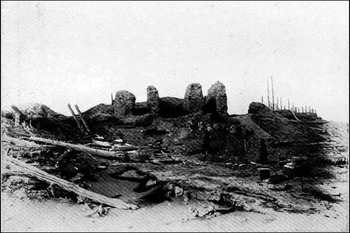
In this description and its heading Tachibana himself unmistakeably identifies the site where he found the Li Bo manuscript as LA. That “Sven Hedin's Lulan” is in fact Stein's LA is also corroborated by one of the photographs from the RGS Archives (076177) which has the caption “Dr. Sven Hedin's Lulan”. The same site is referred to by Stein as the “Ya-mên”, and its identity with “Hedin's Lulan” in Tachibana's report is obvious if we compare the photographs taken by the two explorers where the same structure with three small rooms is clearly discernible (see Figure 1).Footnote 47 Therefore, the material from the RGS Archives is unique in that it is the only source where the location of the discovery of the Li Bo manuscript is confirmed both by a textual record and a photograph.
Stein's photograph of the structure in Serindia (Vol. 1, 376). The original caption reads: “South-west wing of ruin L.A. II, seen from the South-east” (Courtesy of The British Library)

In addition, the Saiiki kōko zufu catalogue contains images of four wood slips with Chinese characters, ostensibly excavated at Altmish-bulak.Footnote 48 With regard to these slips, Katayama Akio has raised the possibility that in reality they too came from Loulan.Footnote 49 The “writing on pieces of wood” which Tachibana mentions in the above excerpt could potentially refer to the slips published in the Saiiki kōko zufu, and the report in the RGS Archives offers supporting evidence for this.
But Tachibana's report holds additional points of interest. For example, items such as a bronze sculpture of the Buddha, and fragments of “fresco paintings” with Chinese and Uighur inscriptions are introduced as having been found in the Turfan region. It is unclear where the sculpture is at the moment, but the frescos could be tentatively identified as the mural fragments from the Bezeklik caves, currently held at the National Museum of Korea. Moreover, photograph 076701 bears the caption “Uigur characters on a brick – unused today. Sinkiang; Phot. Z. Tachibana [1913]”. Since the inscription appears to be part of a Buddhist text,Footnote 50 this is a fascinating example of such work being written in Uighur on a mural.
Photograph 076702 from the RGS Archives bears the following caption: “Part of the middle of the certificate of merit (dated Tang Dynasty 28th Feb 716 A.D.) which is rewarded for distinguished service in war. Discovered in Turfan, Sinkiang”. This is in fact a fragment of the “Li Ciyi appointment decree” 李慈藝告身, the whereabouts of which are currently unknown. This document has been known from photographs only partially, until in 1999 photographs of the complete manuscript were discovered at the Memorial Hall of Tokutomi Sohō 德富蘇峰 (1863–1957), a close acquaintance of Ōtani Kōzui.Footnote 51 As a Tang-dynasty notice of appointment, this is a highly valuable material.
In addition, some of the photographs from the RGS Archives are unknown from other sources, among them: the photographs of cutting across the Taklamakan when Tachibana travelled from Cherchen to Bugur;Footnote 52 the picture of the stūpa Tachibana and Nomura explored at Sirkip (076179);Footnote 53 or the picture of gold diggers (090218), most likely taken in Cherchen. The lower right corner of this last picture has the caption “Mongolia” (written in a different hand, most likely that of an RGS archivist) but elsewhere Tachibana has a detailed description of gold digging in the Altyn Tagh near Cherchen, which is consistent with this photograph: “The way of getting gold dust is extremely primitive. First they dig a deep shaft into the ground, and then they use a bucket to pull up earth and sand from the hole. If they do not find gold among the earth and sand, they dig sideways”.Footnote 54 The photograph fits perfectly with this description of a primitive goldmine, it is likely that the place name “Mongolia” in the caption is a mistake and the picture was actually taken at Cherchen. In one of his talks, Tachibana also claimed that he had made a ring for himself at this place.Footnote 55
5. Closing remarks
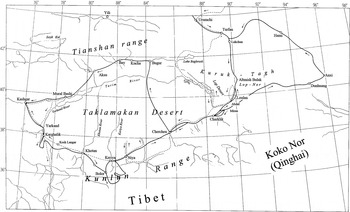
In this paper we have tried to demonstrate the significance of the material from the RGS Archives, showing that it is not only valuable for tracing the provenance of archaeological objects from the Ōtani expeditions but also extremely useful for studying the history of the expeditions. Because of Ōtani's resignation and voluntary exile, this material did not survive in Japan and we are fortunate that it has been preserved in the RGS Archives. At the same time, the fact that such diverse material (reports, photographs, a map) has been submitted to the RGS on more than one occasion demonstrates Ōtani's efforts to integrate the results of the expeditions into the international academic and geographical community. Previous researchers have studied the history of Ōtani expeditions mostly in the context of Japan and its religious-cultural trends at the end of the Meiji era. The material from the RGS Archives, on the other hand, helps to place them in the larger perspective of global world exploration and colonial expansion. They show that the Japanese endeavours were not only heavily influenced by international academic trends but were also consciously trying to become part of this community and have their scientific results acknowledged. Communicating with, and submitting information to, the RGS was a major part of this effort. The material thus clarifies the context of some of the findings of Japanese exploration of Central Asia and exposes traces of the little-studied relationship between Japanese and British scholarly circles in the early twentieth century. Figure 2 presents a map of Tachibana's routes.
Routes of Tachibana's exploration in Xinjiang
The dotted lines show the expedition of 1908–09; the continuous lines that of 1910–12. (Based on the map in Tachibana Reference Tachibana Zuichō 橘瑞超1989)

Appendix A: Report of Tachibana's first trip
Below is a transcription of Tachibana's report of his first trip to Xinjiang. It consists of nine typescript pages. The first five pages are a record of his archaeological discoveries on the expedition; the last four pages represent a separate essay on the history of Lop-nor. We corrected spelling mistakes but retained the orthography of proper nouns and the grammar of the original report, even when it is flawed.
1. Manuscripts.
a. Turfan.
Of the ruins in Turfan, where I obtained a number of manuscripts, mainly Chinese versions of Buddhist sutras, one site seems to be an old sacred library. These manuscripts are show [sic] different dates, extending from 292 A.D. (the oldest date I find in them) to the famous Hsuan Tsang's translation of the sutras, which was made in 660 A.D. It is supposed that at different times they were written and preserved here by priests as a meritorious exercise. An interesting discovery that I made was piece of a manuscripts of Sun-tzu and a fragment of the Lun-yu. The Lun-yu is a work recording the saying of Confucius. Sun-tzu was written about B.C. 500, and has been used among the Chinese as a standard work on tactics and strategy ever since. It is certain that local military officers used to read it. There are also specimens of Chinese block printing. The origin of Chinese printing is obscure, but in the opinion of scholars, it commenced about 960 A.D. in the Sung dynasty, so that these printed fragment can not be dated earlier than that. Beside this, I found a piece of Uigur printing.
b. Sven Hedin's Lulan.
A most interesting document is an official letter which I found in the fort of Lulan. This is apparently the draft of an official letter, sent from the High Commissioner of a Western province whose name was Li-po, to the local native king, with a formal inquiry after his health. Li-po was commissioner between 312 and 323. The paper is similar to that used in Japan, being made from the bark of a tree. I also found some writing on pieces of wood.
2. Sculpture.
Turfan.
There were numerous sculptures made of clay, I found only one bronze image of Buddha, about 3½ inches high, and thinly gilt. All sculpture seem strongly influenced by Gandhara or Graeco-bactrian Art. I am unable to say whether the other images are Buddhas or Bodhisatvas, without further investigation.
3. Fresco paintings.
These were obtained near Turfan. Amidst the ruins of a temple several images of Buddha were found. Each of them is inscribed with a name in Chinese and in Uigur. The Uigur was first known in this country, towards the end of the Tang dynasty or later. In the 9th century when their kingdom was destroyed, the Uigurs came into Turfan and brought their script with them. It had previously been a Tang province, and earlier still it was a kingdom named Kao-chang under a Chinese ruler Chü, so it is certain that the Uigur character was not in use there before the 9th century. The colour of the sculpture is still beautiful.
4. Old coins.
a. Near Turfan.
Many coins obtained here bear the date of the Kai-yuan period, these were coined during the Tang dynasty. I also got coins of the Sung dynasty, besides native money current in Turfan, double the thickness of ordinary square hole coins. These were some silver coins bearing Uigur characters.
b. Sven Hedin's Lulan.
Those I obtained in this fort were the so-called Wu-chu of the Han dynasty, according to Chinese works on Numismatics, with a few exceptions, they were smaller than the standard currency. The reason why no coins of the Tang dynasty were found may be that Lulan was then already in ruins. Others obtained on the southern border of the Taklamakan desert are both of the Han and Tang dynasties.
c. Kucha.
My assistant Mr. Nomura discovered other Wu-chu coins in Kucha, with two Brahmin characters on the obverse. It is interesting that, in this locality two native characters should have been added in this way. There, too were found some Ta-li and Chien-chung coins, these two kinds are very rare even in China proper, because only a few were struck and were in circulation for a very short time. This is especially the case with the Chien-chung coins.
5. Miscellaneous.
Turfan.
A copper seal, it is not clear whether it bears a name or merely a mark. A picture of Buddha painted on canvas, and another on silk. Judging by the weaving, the latter must be later than the Tang dynasty, but prior to the period of Mahomedan influence, this would fix its date as that of the Sung dynasty. If we compare it with the silk of Sung, which came to Japan, it is found to present exactly the same appearance. Silk shows always a different texture according to the period in which it was woven.
History of Lop-nor.
The exact geographical position of Lop-nor was for a long time a vexed question until the point was settled by the two visits of Dr. Sven Hedin. I intend here to say a few words about the changes that have taken place in the neighbourhood of Lop-nor within historical times. Lop-nor was first unknown to the Chinese, somewhat before 122 B.C. But the first work containing a clear statement of its situation is the Shi chi of the famous historian Ssu-ma Chien (about 91 B.C.). At that time Lop-nor was known as “Yen tswe” (or salt lake) being situated 300 li to the west of Yang-quan. It was 300 li long and the same breadth. Now Yang-quan is situated not far from Tun-huang to the S.W. and 300 li west of this, there is the Kum-tagh desert. But it is impossible that there should have been a lake here, it must have lain rather to the north-west on the northern side of the desert is a depression continuing to Kara-nor. Here no doubt in ancient times there was a marsh, but the distance of 300 li is too short. The commentary on the book of Hydrography, written about 500 A.D. motes [sic] the Han Shu as stating the distance to be 1300 li. But the modern text of the Han Shu has “300 li” so that there must be some error. I believe that 1300 li is the correct reading of the Han-Shu and that the error is due to the omission of the character for 1000. Thus it can be assumed that Lop-nor was situated near 90 E. long. Later on, in the Tang dynasty (7th to 9th century A.D.), it is stated that it is 1600 li from the old fortress of Yang qun [sic] to Lulan along the southern shore of the lake. Here we have a difference of 300 li as compared with the correct distance given in the Han Shu. But the discrepancy may arise from some difference in the measure, or in the route taken, or from the fact that the measurement was made from the eastern instead of the western border of the lake, so that we can assume the site to have been the same. According to the Han Shu, the town (capital) of Lulan was situated at a distance of 1600 li from Yang-quan, so its distance from the lake should be about 300 li, as the lake itself is 8300 li from Yang quan. No direction is given, but the distance is further, it must have been to the S.W. The Tang Shu states 1000 li as the distance westwards from the old fortress of Yangquan to Shih-cheng Chen, by the southern shore of “Pu chang hai” (Lop-nor), and past the fortress of Chi-tun, which is only 80 li from Shih-cheng. It was situated 300 li south of Pu-chang hai (Lop-nor). Here we can understand the site of Lulan to be 300 south of the lake, road always leads to west. It is the style of the old Chinese sentence to indicate one direction by means of two; they do not use the same words twice, which would disturb rhetorical balance of the sentence. Thus, “south” in one parts of the sentence and “west” in the other indicate a south western direction. It is a curious linguistic point, but the idiom is often met with in classical Chinese, so that there is no room for doubt. Now we are able to place Lop-nor about 90. E. long. 30. N. lat. and we must believe that its portion is the one which Dr. Sven Hedin discovered. And the Lulan that Dr. Hedin discovered is no doubt one of the fortresses of the Lulan kingdom, though probably not the only one. I should think there were several others. The manuscripts which I got at Hedin's Lulan, speak of a Chinese High Commissioner as going to meet the king of Lulan, but add that when he reached the “head of the sea,” without seeing the king, he sent a letter inquiring after the king's health.
The manuscript appears to be the draft of this letter. “Head of the sea” evidently means the shore of this lake, that is Pu-chang hai or Lop-nor as the Chinese use the character “hai” (sea) for salt water as opposed to fresh water lakes (hu). This, then, would be part of the shore of Lop-nor in the 4th century A.D.
But subsequent to the Tang dynasty the population diminished the whole region was gradually lost sight of. We may be certain that natural changes operated more powerfully after the 9th century than before, because when there are inhabitants they resist nature and keep rivers and lakes to some extent in subjection, unless there happens to be a great natural calamity.
If Holland were uninhabited, the Zuyder Zee would extend its area, and the river Rhine would change its course; much greater changes might be expected to take place in a desert swept by violent storm. I believe that for some distance along the northern shore of Kara Koshuar [sic] explorers will succeed in discovering other ruined fortresses, lakes and marshy beds.
Zuicho Tachibana
Appendix B: Plan of Tachibana's second trip
Below is a plan of Tachibana's second trip to Xinjiang, which came to be known as the third Ōtani expedition. It consists of five handwritten pages, most likely penned by Tachibana himself. There are many grammatical problems in the text but the meaning remains clear throughout the manuscript. Once again, we reproduce the original text as it is, including its often awkward grammar, but have corrected the mistakes in spelling. We also keep the spelling of place names even if it is unsystematic (e.g. Sachu vs. Sachow).
New exploration in Chinese Turkestan and Mongolia.
In last our exploration we left all our excavated things at British Consulate in Kashgar, intending let my assistant Mr. Y. Nomura go back through same way from India. Unfortunately, we could not get permission by Indian Government, to cross the Karakorum Pass. Therefore we reform our exploration into Central Asia from Russia and Chinese route.
Last exploration was chiefly for Archaeology, and in next time Mr. Z. Hashiramoto will join for Natural History. He will entire from Peking to Guchen, via Kwehuacheng, nearly same route as Sir Francis Younghusband took. Then to Kashgar to receive our baggages. On his return journey, I shall meet him at Hami.
If I can get permission from Russian Government I should like to entire from Chuguchuk, then to Guchen. Here and in Turfan I shall do excavation once more. On our next exploration chiefly Mr. B. Aoki will take charge in systematical excavation, and so my duty is to look out the site where excavation to be required. I shall go straight to Sachu. This route was chief high way in Han and Tang dynasties, but now became unknown.
From Sachow I shall return to Hami, then course on in E.N.E. direction till reach to Yellow River near lat. 41° N long. 107° E. The object in this section is to make sure uncertain feature in obscure map. And there is interest that in this part there were several time of war between Chinese Proper and Northern Tribes, namely Hioung-Nu or Shuchu, the Turkish. Probably we shall get a light on historical geography. At the northern part of Yellow River, I want to see fortress ruins of Chin, Han, and Tang dynasties, especially northern mountain of this place. It can be believe there are ruins of Great Wall of Chin.
From there going up to Ningsia then straight west to Lianchow, next to Suchow. In these parts there were once Buddhism flourished. So if fortunately, I could see the Buddhist ruins. If season allow I should like to entire into Kokonor, but if the season bad go back to Lanzhou. From Turfan Mr. Z. Hashiramoto will entire to Eastern Tienshan, to see Geology and Botany. After he finish Tienshan, toward to Ansi, he will examine that either this part is an old bed of lake, or plateau, and to make sure the relation between Lop depression, Edsina depression, and this part. For this purpose will visit two lakes, one at Edsina N.E. of Ansi, the other at Karanor W of Sachow.
Then to Lanchow via Kokonor here we shall meet. After then I shall have no special interest, and will join with him. If it is possible we go to Chengtu along long. 104°, in this part the Botany plentiful. Then follow down Yangtze River. Mr. B. Aoki, from Guchen to Turfan, and to Sachow passing N.E side of Lopnor. Then to Ansi, Suchow, Kanchow, Lianchow, and in Lanchow all of us will meet there.
Then Mr. B. Aoki having our all baggages to take route to Peking or Hankow, via Sian and Honan. The term of this exploration will be 18 months.
by Zuicho Tachibana 禾”、“建平”年號; II. 關於“李柏文書