Kawasaki disease is the main aetiology of acquired coronary artery disease in childhood.Reference Kavey, Allada and Daniels 1 It typically affects pre-school children, but may be diagnosed later on.Reference Manlhiot, Yeung, Clarizia, Chahal and McCrindle 2 Athough no definite aetiology is known, Kawasaki disease seems to cause a transitory dysregulation of the immune system, triggered by unknown common infection(s) in children who have a genetic predisposition.Reference Burns and Newburger 3 , Reference Onouchi 4 Coronary artery complications of Kawasaki disease vary from mild transitory dilatation to severe multilayer destruction of the coronary arterial wall causing aneurysmal deformation.Reference Tsuda, Kamiya, Ono, Kimura, Kurosaki and Echigo 5
Although intravenous immunoglobulin remains the most effective therapy of Kawasaki disease,Reference Newburger, Takahashi and Beiser 6 10–20% of treated patients may not respond to such therapy,Reference Durongpisitkul, Soongswang, Laohaprasitiporn, Nana, Prachuabmoh and Kangkagate 7 , Reference Fukunishi, Kikkawa and Hamana 8 as witnessed by the persistence or the recurrence of fever. These patients are at an even greater risk to develop coronary artery complicationsReference Durongpisitkul, Soongswang, Laohaprasitiporn, Nana, Prachuabmoh and Kangkagate 7 , Reference Fukunishi, Kikkawa and Hamana 8 , requiring an additional dose of intravenous immunoglobulin as well as other anti-inflammatory medications.
Given the importance of coronary artery disease, it is crucial to have diagnostic tools to identify acute cases and treat them quickly with intravenous immunoglobulin in the 10-day window period from the onset of symptoms.Reference Newburger, Takahashi and Gerber 9 Unfortunately, the diagnosis of Kawasaki disease is still based on clinical criteria without reliable biomarkers for diagnostic certainty. Biomarkers are even more necessary in the context of incomplete forms of the disease. It is in this context that our group investigated the utility of N-terminal pro-brain natriuretic peptide, a natriuretic peptide, in diagnosing Kawasaki disease.
Natriuretic peptides such as B-type natriuretic peptide are natural diuretics secreted by the myocardium, especially in situations of increased intra-cardiac pressure and wall stress.Reference de Lemos, McGuire and Drazner 10 The pre-probrain natriuretic peptide, the precursor of brain natriuretic peptide, is a peptide composed of 134 amino acids secreted by cardiomyocytes and cleaved during the first liver passage into probrain natriuretic peptide and an inactive peptide. Probrain natriuretic peptide is then cleaved into an active peptide, brain natriuretic peptide, and an inactive metabolite, N-terminal pro-brain natriuretic peptide.Reference Nakao, Ogawa, Suga and Imura 11 With an improved stability and a longer half-life, N-terminal pro-brain natriuretic peptide (60–120 minutes) was found to be a better biomarker for the diagnosis and prognosis of Kawasaki disease over brain natriuretic peptide (20–30 minutes),Reference Vanderheyden, Bartunek and Goethals 12 , Reference Tang 13 especially in the case of incomplete forms.Reference Dahdah, Siles and Fournier 14 In fact, unlike N-terminal pro-brain natriuretic peptide, brain natriuretic peptide could not discriminate between Kawasaki disease and febrile controls. Several series report the use of N-terminal pro-brain natriuretic peptide for diagnosisReference McNeal-Davidson, Fournier and Spigelblatt 15 – Reference Kawamura, Wago, Kawaguchi, Tahara and Yuge 19 and prognosis of Kawasaki disease, including the presence of coronary dilatationReference Bang, Yu and Han 20 , Reference Kim, Oh, Hong and Sohn 21 and resistance to intravenous immunoglobulin.Reference Kim, Han, Cha and Jeon 22 – Reference Sleeper, Minich and McCrindle 24
Despite the growing interest in natriuretic peptides with respect to Kawasaki disease, very few publications have utilised age-related valuesReference Nir, Lindinger and Rauh 25 or age-adjusted Z-valuesReference McNeal-Davidson, Fournier and Spigelblatt 15 of N-terminal pro-brain natriuretic peptide. In this study, we have set out to investigate the hypothesis that suggests that elevated age-adjusted N-terminal pro-brain natriuretic peptide serum levels at the onset of Kawasaki disease correlate with coronary artery dilatation. The secondary objective was to verify its utility in predicting responsiveness to intravenous immunoglobulin.
Materials and methods
In this prospective study, consecutive patients were recruited with parental consent at the onset of Kawasaki disease up to10 days after the onset of fever. The blood samples were collected before therapy in all cases. Subsequently, serum N-terminal pro-brain natriuretic peptide level was measured using electrochemiluminescence immunoassay template (Roche Diagnostics, Rotkreuz, Switzerland), and Z-values were calculated based on age.Reference McNeal-Davidson, Fournier and Spigelblatt 15 Coronary arteries were measured and the Z-values were calculated based on body surface areaReference Dallaire and Dahdah 26 at onset (W0), weekly for 3 weeks (W1, W2, and W3) for the sub-acute period, and at 2 months (M2) and at 3 months (M3) for the convalescence period. Left and right coronary artery measurements were carried out by experienced echocardiography technicians blinded to the N-terminal pro-brain natriuretic peptide status. The intraluminal diameters of coronary artery segments were measured from inner edge-to-inner edge. The left main coronary artery was measured midway between the ostium and the bifurcation of the circumflex artery and left anterior descending coronary artery in the parasternal short-axis view. The right coronary artery measurements were obtained 3–5 mm distal to its origin in the parasternal short-axis view. In the case of coronary artery ectasia or aneurysms, the portion with the largest diameter was measured instead.Reference Dallaire and Dahdah 26 Coronary Z-value of 2.5 was the cut-off for coronary artery dilation, following the official recommendations by the American Heart Association.Reference Newburger, Takahashi and Gerber 27 Left ventricular shortening fraction was calculated at onset and during convalescence, that is, 2–3 months after onset. The shortening fraction was then adjusted for age,Reference Kampmann, Wiethoff and Wenzel 28 expressed as a Z-value, and compared between individuals with normal or elevated N-terminal pro-brain natriuretic peptide.
Patients were divided into two groups based on N-terminal pro-brain natriuretic peptide Z-values, those with elevated (Z-value>2.0) and those with normal N-terminal pro-brain natriuretic peptide levels (Z-value⩽2.0).Reference McNeal-Davidson, Fournier and Spigelblatt 15
All patients received intravenous immunoglobulin (2 g/kg) at diagnosis, irrespective of their N-terminal pro-brain natriuretic peptide status. A second dose of intravenous immunoglobulin (2 g/kg) was administered 36 hours later in cases of persistent or recurrent fever. Patients who were resistant to the second course of intravenous immunoglobulin received a third course (1 g/kg) in addition to corticosteroids. Anti-inflammatory dose of amino salicylic acid (80–100 mg/kg) was initiated at diagnosis, followed by anti-platelet dose (3–5 mg/kg) from resolution of fever for 3 months or until resolution of coronary artery dilatation, whichever was longer.
Continuous data were expressed as mean±standard deviation, qualitative data were represented in proportions, percentages, and median [range], whenever applicable. Data analysis was performed with SigmaStat 3.5 (Systat, Software Inc., Erkrath, Germany). Odds ratios were calculated with the 95th percentile confidence interval. Correlation analyses were performed for the potential association between N-terminal pro-brain natriuretic peptide status on one hand and coronary artery dilatation, resistance to intravenous immunoglobulin, and left ventricle systolic function on the other hand. A p<0.05 was considered statistically significant.
Results
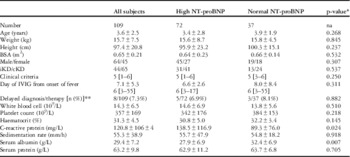
There were 109 patients included during the study period between November, 2005 and March, 2012. The male/female ratio was 1.18/1. Age at diagnosis was 3.79±2.92 years, with the diagnosis established at 6.58±2.82 days from the onset of fever. Of the 109 patients, 72 (66%) had elevated N-terminal pro-brain natriuretic peptide levels at diagnosis, with an average N-terminal pro-brain natriuretic peptide serum level of 3128.4±5985.8 versus 249.9±117.7 pg/ml in those with normal levels (p=0.004). Accordingly, the comparative N-terminal pro-brain natriuretic peptide Z-score was 3.4±1.2 versus 1.2±0.7 (p<0.001). Comparative basic characteristic data are summarised in Table 1.
Anthropometric and basic characteristics of study subjects at diagnosis.

IVIG=intravenous immunoglobulin; NT-proBNP=N-terminal pro-brain natriuretic peptide
* p-value comparative between patients with high and normal NT-proBNP Z-scores
** Presentation or diagnosis after day 10 from onset of fever. iKD, patients with incomplete diagnostic criteria for Kawasaki disease; cKD, patients with complete diagnostic criteria
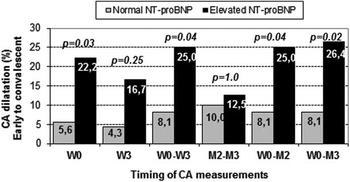
Among the total study population, 18 (16.7%) were diagnosed with coronary artery dilatation at onset. Based on N-terminal pro-brain natriuretic peptide categorisation, there was a significantly higher proportion of such cases with elevated N-terminal pro-brain natriuretic peptide (22.2%), compared with those with normal N-terminal pro-brain natriuretic peptide (5.6%), with an odds ratio of 4.8 [95% confidence interval 1.05–22.4]; p=0.03. The cumulative proportion with coronary artery dilatation from onset to convalescence was 26.4 versus 8.1%, respectively, with an odds ratio of 4.06 [95% confidence interval 1.12–14.8]; p=0.025 (Fig 1). The receiver operator characteristics analysis was similarly favourable for the prediction of coronary artery dilatation. The area under the curve of 0.716±0.059 [95% confidence interval 0.601–0.831; p=0.004] provided N-terminal pro-brain natriuretic peptide Z-score-related specificity and sensitivity levels of 0.889–0.772 and 0.378–0.589, respectively (Table 2). As one cannot determine a single cut-off serum level based on a specific Z-score of N-terminal pro-brain natriuretic peptide, we established the correlates of three Z-score values (2.0, 2.25, and 2.5) corresponding to similar sensitivity values – area under the curve of 0.720±0.057; p=0.003. Accordingly, these serum levels varied between 530 and 660 pg/ml, with specificity values comparable with Z-score-based parameters (Table 2). In contrast, the coronary artery dilatation distribution according to the published upper-limit for age of N-terminal pro-brain natriuretic peptide did not reach statistical significance (19.0 versus 8.3%; p=0.35).
Relationship between N-terminal pro-brain natriuretic peptide (NT-proBNP) serum level upon diagnosis (elevated if Z-score>2.0) and the prevalence of coronary artery dilatation at onset (W0), sub-acute (W3), and convalescent phases (M2–M3). Cumulative prevalence during acute and sub-acute period (W0–W3) and onset to convalescence (W0–M3) are also represented.

Various NT-proBNP prediction levels of CAD at onset of Kawasaki disease.

CAD=coronary artery dilatation; NT-proBNP=N-terminal pro-brain natriuretic peptide
* Specificity based on NT-proBNP Z-scores
** Specificity based on NT-proBNP plasma concentrations
*** NT-proBNP correlates with the related sensitivity in column 2
Cumulative coronary artery dilatation between onset and 3-month follow-up remained significantly predictable by an abnormal N-terminal pro-brain natriuretic peptide Z-score (26.4 versus 8.1%, p=0.025). Nevertheless, there was no predictable value (p=1.0) on the convalescent phase alone, 2–3 months after onset, as witnessed by an odds ratio of 1.28 [0.23–7.30].
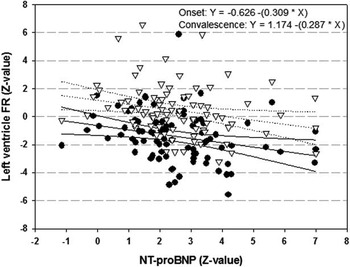
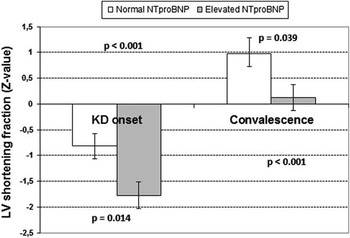
Left ventricle shortening fraction negatively correlated with N-terminal pro-brain natriuretic peptide level (Fig 2), with lower intercept at onset compared with the convalescent phase of the disease (−0.626±0.359 and 1.174±0.377, respectively; p<0.001), but with similar slopes (−0.309±0.120 and −0.287±0.125, respectively; p=0.323). In addition, the fractional shortening Z-value was significantly lower at onset and at convalescence in patients with high N-terminal pro-brain natriuretic peptide levels compared with those with normal N-terminal pro-brain natriuretic peptide levels (−1.77±1.94 and −0.81±1.31, respectively; p=0.014). These values (Fig 3) increased significantly at convalescence in both groups to 0.122±1.83 and 0.98±1.75, respectively (p<0.001 for both).
Scatter plot with linear regression depicts lower left ventricle fractional shortening with higher N-terminal pro-brain natriuretic peptide (NT-proBNP), both at onset (circles) and upon evaluation during convalescence (triangles).

Left ventricle shortening fraction Z-value according to serum N-terminal pro-brain natriuretic peptide (NT-proBNP) status. High NT-proBNP is associated with significantly lower shortening fraction at onset. Despite significant improvement at convalescence, left ventricle contractility remained significantly lower than in cases with normal NT-proBNP.

The secondary study analysed the overall effectiveness of therapeutic response to intravenous immunoglobulin and the regression of coronary lesions at this specific time. In this respect, an elevated N-terminal pro-brain natriuretic peptide level was not predictive of responsiveness versus resistance to intravenous immunoglobulin, either according to the Z-score values (15.3 versus 13.5%, p=1.0) or the upper-limit for age (15.5 versus 12.0%; p=0.55). The receiver operating characteristic analysis did not yield a better prediction level for intravenous immunoglobulin resistance, with an area under the curve of 0.577±0.085 [95% confidence interval 0.41–0.74] (p=0.329). From another perspective, the proportion of patients who developed coronary artery lesions tended to be higher in cases who were resistant to intravenous immunoglobulin, but without reaching statistical significance (Table 3). These proportions varied from 31.25 versus 14.13%, at onset (p=0.096), to 25 versus 10.5%, at convalescence (p=0.163).
Distribution of the presence (CAL+) or the absence (CAL−) of coronary artery lesions according to the responsiveness to IVIG, displayed in accordance with the timing from diagnosis (onset), cumulative with the sub-acute phase (onset–sub-acute), at 2–3 months (convalescence), and cumulatively up to 3 months (onset–convalescence).

IVIG=intravenousimmunoglobulin
Discussion
Coronary dilatation and N-terminal pro-brain natriuretic peptide
The prevalence of coronary artery dilatation in our series was 5.6% in normal N-terminal pro-brain natriuretic peptide patients and 22.2% in those with elevated levels of N-terminal pro-brain natriuretic peptide. This is reminiscent of the prevalence of coronary artery aneurysms and ectasia before and following the era of intravenous immunoglobulin therapy, that is, 15–25% in the absence of intravenous immunoglobulin therapy and 5% in cases where intravenous immunoglobulin is administered within the 10-day effective therapeutic window period.Reference Newburger, Takahashi and Gerber 9 , Reference Falcini 29 Our findings using N-terminal pro-brain natriuretic peptide Z-score stratification are concordant with a recent report on absolute values, where patients with coronary artery dilatation had serum measurements of 2611±1699 pg/ml compared with 1073±1427 pg/ml in those who did not exhibit coronary artery dilatation (p=0.03).Reference Kaneko, Yoshimura, Ohashi, Kimata, Shimo and Tsuji 30 It is also in agreement with a single cut-off value of 1300 pg/ml approach used by another groupReference Yoshimura, Kimata, Mine, Uchiyama, Tsuji and Kaneko 31 who identified the 19 patients who developed a coronary artery lesion out of a total of 80 individuals who had received intravenous immunoglobulin. According to the latter study, such a cut-off value provides 95% sensitivity with a specificity of 85%. Our group had identified the cut-off value of 190 pg/ml to support the diagnosis of acute Kawasaki disease, but not for the likelihood of coronary artery involvement. Based on our workReference Dahdah, Siles and Fournier 14 , Reference McNeal-Davidson, Fournier and Spigelblatt 15 and those of others,Reference Shiraishi, Fuse and Mori 32 however, the use of a fixed cut-off value of N-terminal pro-brain natriuretic peptide serum level is to be avoided because of the wide variation of normal values of N-terminal pro-brain natriuretic peptide during early childhood.Reference Nir, Lindinger and Rauh 25 Alternatively, when we applied suggested age-related values, the analysis did not reach statistical significance, despite a similar trend in the prevalence rates. Not surprisingly, the 190 pg/ml diagnostic cut-off value was not predictive of coronary artery lesions or of intravenous immunoglobulin resistance. This may be interpreted as the need for much higher values (1300 pg/ml) to identify patients at risk for coronary artery involvement and intermediate values (800 pg/ml) to identify the risk for intravenous immunoglobulin resistance.Reference Yoshimura, Kimata, Mine, Uchiyama, Tsuji and Kaneko 31 In our study, we determined the cut-off values using various degrees of the N-terminal pro-brain natriuretic peptide Z-score, a value >2.25–2.5 providing a better specificity while preserving an acceptable sensitivity compared with the diagnostic cut-off Z-value of 2.0. For the sake of comparison, serum concentrations of N-terminal pro-brain natriuretic peptide corresponding to coronary artery involvement detection (530–660 pg/ml) were lower than the previously reported 1300 pg/ml. Nevertheless, knowing the wide variation of N-terminal pro-brain natriuretic peptide serum concentration with age in children, we prefer the Z-score approach to using actual measurements.
Therapeutic response to intravenous immunoglobulin in Kawasaki disease must be viewed from the following two perspectives: one pertaining to the reduction of fever and inflammation and another pertaining to the protection against coronary artery involvement, mainly persistent dilatation and aneurysm formation. As intravenous immunoglobulin is well known to reduce the likelihood of coronary artery involvement, it was less likely that we would detect new onset coronary artery dilatation in children receiving intravenous immunoglobulin within the first 10 days of fever. This is probably the reason why N-terminal pro-brain natriuretic peptide was not predictive of additional coronary artery involvement in the sub-acute and convalescence period. It was, however, significantly associated with the cumulative prevalence. A reduction in N-terminal pro-brain natriuretic peptide serum level during convalescenceReference Dahdah, Siles and Fournier 14 , Reference Kawamura and Wago 18 , Reference Kurotobi, Kawakami and Shimizu 33 is probably reflective of a settled myocardial inflammatory status.
Intravenous immunoglobulin resistance and N-terminal pro-brain natriuretic peptide
In general 10–20% of patients are potentially non-responders to initial intravenous immunoglobulin.Reference Durongpisitkul, Soongswang, Laohaprasitiporn, Nana, Prachuabmoh and Kangkagate 7 , Reference Fukunishi, Kikkawa and Hamana 8 In a series of 129 patients,Reference Kim, Oh, Hong and Sohn 21 107 (83%) responded completely to a single intravenous immunoglobulin course, and 22 patients (17%) required re-treatment due to persistent fever in 14 and re-crudescent fever in 8. In our series, and despite an apparent trend, the presence or the absence of coronary artery lesions was not significantly associated with the responsiveness to intravenous immunoglobulin, at either stage of the disease. A similar trend – 22.73% in resistant patients versus 14.16% in responders to intravenous immunoglobulin, with non-significant p-value – was reported by another group.Reference Kim, Han, Cha and Jeon 22 In another publication, however, the trend was statistically significant (31.8 versus 2.8%, p<0.001).Reference Kim, Oh, Hong and Sohn 21 The association of an increased risk for coronary artery involvement makes it important to establish a predictive factor. To that effect, resistance to intravenous immunoglobulin has been found to be associated not with the serum level of N-terminal pro-brain natriuretic peptide at onset but with a persistent high serum level following intravenous immunoglobulin.Reference Kim, Oh, Hong and Sohn 21 This, in part, goes along with our findings, as onset N-terminal pro-brain natriuretic peptide serum level was not found to be predictive of intravenous immunoglobulin resistance on one hand. On the other hand, our data do not support the relationship of a drop in N-terminal pro-brain natriuretic peptide following initial intravenous immunoglobulin. The discriminative pre-intravenous immunoglobulin and post-intravenous immunoglobulin serum concentrations of N-terminal pro-brain natriuretic peptide seem to be reproduced in a few other series, where a decrease of N-terminal pro-brain natriuretic peptide to the normal range was recorded in patients who were responsive to intravenous immunoglobulin in comparison with resistant patients.Reference Kim, Oh, Hong and Sohn 21 In a more recent retrospective study including 135 patients, there were 16.3% non-responders to intravenous immunoglobulin. The N-terminal pro-brain natriuretic peptide level was 2465.36±3293.24 pg/ml in these patients versus 942.38±1293.48 pg/ml in the responders (p<0.01).Reference Kim, Han, Cha and Jeon 22 In this study, the predictive cut-off point was 1093 pg/ml, with an odds ratio of 7.2 [95% confidence interval 4.2–6.9]. This was not the only group to report such predictive values, with another study having a cut-off value of 800 pg/ml, 71% sensitivity, and 62% specificity.Reference Yoshimura, Kimata, Mine, Uchiyama, Tsuji and Kaneko 31
Myocardial involvement
Left ventricular dysfunction has been previously described in acute Kawasaki disease.Reference Printz, Sleeper and Newburger 34 Correlation with elevated N-terminal pro-brain natriuretic peptide level has recently been described,Reference Sato, Molkara and Daniels 35 corresponding with our findings. Although detectable in cases with normal N-terminal pro-brain natriuretic peptide levels, low left ventricular shortening fraction Z-score is more depressed in cases with high N-terminal pro-brain natriuretic peptide levels. Despite recovery at 2–3 months, left ventricular shortening fraction Z-score remained significantly lower in cases with high N-terminal pro-brain natriuretic peptide levels compared with those with normal N-terminal pro-brain natriuretic peptide at onset. Long-term assessment of myocarditis is, therefore, worth studying in the future.
Study limitations
In this study, all subjects received intravenous immunoglobulin upon diagnosis. It is, therefore, impossible to report the actual N-terminal pro-brain natriuretic peptide predictive value of coronary artery dilatation with respect to the natural history of Kawasaki disease. Furthermore, it is now ethically impossible to conduct such a study where patients would be denied such an effective therapy. In this study, we failed to demonstrate the potential utility of N-terminal pro-brain natriuretic peptide in detecting patients resistant to intravenous immunoglobulin. Although our results are close to previous reports, it is possible that our sample size is underpowered for this aim.
Conclusions
N-terminal pro-brain natriuretic peptide in acute Kawasaki disease correlates with coronary artery dilatation and reduced left ventricular contractility in patients who had received intravenous immunoglobulin within the therapeutic window. Using the definition of an elevated Z-score>2 provides a better standardisation than absolute values in an age group where normal levels vary significantly. At this point, our data do not support previously reported series in terms of the prediction of intravenous immunoglobulin resistance.
Acknowledgements
Philippe Mahouna Adjagba is supported with a fellowship grant from Fondation CHU Ste-Justine.
Financial Support
This research received no specific grant from any funding agency, commercial, or not-for-profit sectors.
Conflicts of Interest
None.