

1. Introduction
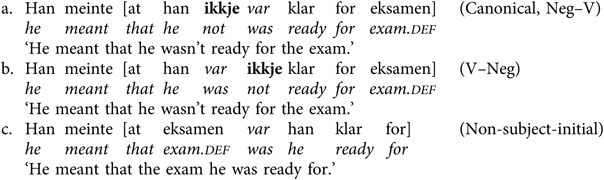
This paper examines a main clause phenomenon (MCP) found in a subset of embedded clauses in Norwegian, where the verb (V) precedes negation (Neg) or other sentence adverbs (V–Neg), as in (1b), instead of following them (Neg–V), as in (1a), which shows the canonical word order.Footnote 1
(1)


Past work on this word order variation (e.g. Vikner Reference Vikner1995; Bentzen et al. Reference Bentzen, Hrafnbjargarson, Hróarsdóttir and Wiklund2007; Wiklund et al. Reference Wiklund, Bentzen, Hrafnbjargarson and Hróarsdóttir2009; Julien Reference Julien2010, Reference Julien2015) has focussed on two inter-related areas: (i) the appropriate syntactic analysis of both word orders, and (ii) the nature and distribution of the pragmatic and semantic contexts licensing V–Neg (since this non-canonical word order is not always permitted).
Despite extensive research on embedded V–Neg, there is no consensus on which environments allow it, how to best analyze it, and where it is licensed. This may be due to the fact that most studies based their conclusions about the licensing of embedded V–Neg on analyses of a restricted set of syntactic environments (complement clauses) and the specific semantic traits of the context.Footnote 3 Further, many of the studies also rely heavily on authors’ intuitions, which may provide biased estimates of the phenomenon’s distribution. Thus, research may have overlooked relevant data on the structure and licensing conditions of embedded V–Neg.
This study aims to fill an empirical gap by providing a comprehensive overview of the distribution of embedded V–Neg in Norwegian natural speech. Such an overview is a prerequisite for developing an accurate analysis of the phenomenon: understanding the distribution of embedded V–Neg can shed light on its function and licensing conditions as well as how it may relate to other main clause phenomena.
To fulfil its aim, the study provides an overview of all embedded clause types with the V–Neg word order in five corpora of spoken Norwegian. It builds and improves on prior corpus studies of this or closely related main clause phenomena in Scandinavian languages (viz. Julien Reference Julien2010, Jensen & Christensen Reference Jensen and Christensen2013, Christensen, Jensen & Christensen Reference Christensen, Jensen and Christensen2015) by offering both frequency information and a more fine-grained taxonomy of embedding environments. The frequency information contributes to determining which examples are representative of the word order’s use in natural speech. The taxonomy helps pinpoint the syntactic, semantic, and pragmatic factors that may govern its distribution, in addition to helping identify the common properties of clauses allowing V–Neg.
All previous accounts of the licensing conditions for embedded V–Neg seem to be correct to some extent, but no approach explains all possible occurrences. This is potentially due to the fact that they do not consider its full distribution. Therefore, the present study asks: Which theoretical direction can best explain the distribution of the data in this corpus?
I examine the verb’s position only as it relates to negation. Other adverbs are excluded from the investigation since adverb type can affect the frequency with which word orders (Verb–Adverb/Adverb–Verb) appear (Christensen et al. Reference Christensen, Jensen and Christensen2015). To avoid the influence of adverb type, I focus on the order of the verb and negation.
The paper opens with a review of the existing literature on the distribution of embedded V–Neg and discusses the seminal studies on the phenomenon. I then examine my own corpus findings, including features such as frequency, contexts allowing or disallowing embedded V–Neg, and the different embedding environments. Lastly, I discuss the implications of these findings for current accounts of V–Neg and show that the data support a more discourse-oriented approach to embedded V–Neg.
2. Distribution: Where is V–Neg found?
There are a number of instances where the canonical embedded clause word order (2a) is changed to a word order resembling that of main clauses. The verb is consistently the second constituent after the complementizer, but the first element varies.Footnote 4
(2)
It can be a subject, as in (2b), in which case we can tell that the word order is non-canonical only if the verb precedes an adverbial or negation, or it can be another argument or adjunct phrase, as in (2c). These configurations are often considered part of the inventory of embedded verb second (V2). Subject-initial and non-subject-initial cases of V2 typically have the same distribution in Mainland Scandinavian (see e.g. Wiklund et al. Reference Wiklund, Bentzen, Hrafnbjargarson and Hróarsdóttir2009), but there is disagreement on whether subject-initial cases should be treated like cases where non-subjects are clause-initial. In this paper, I focus on subject-initial cases, like those in (2b).
2.1 Embedding environments
In this section, I first discuss cases where, according to the existing literature, embedded V–Neg is allowed in complement clauses. Then, I discuss complement clauses claimed to disallow it. Lastly, I explore whether and when V–Neg is possible in adjunct clauses.
2.1.1 Complement clauses
Clause types allowing embedded V–Neg are typically declarative complement clauses, i.e. complement clauses with the complementizer at ‘that’ (Faarlund, Lie & Vannebo Reference Faarlund, Lie and Vannebo1997:983), as in (3).Footnote 5
(3)

Embedded V–Neg clauses can also be predicates in copula constructions, as in (4) below, and complements of nouns, as in (5) (Julien Reference Julien2010:14–15 ex. (20) and (23)).
(4)

(5)

In addition, embedded V–Neg is found in so-called ‘consequence of degree constructions’ (Julien Reference Julien2010, also mentioned in more general terms as embedded V2 in Heycock Reference Heycock, Everaert and van Riemsdijk2006) of the type ‘so X that’, as in (6) (Julien Reference Julien2010:18 ex. (31)).
(6)

These clauses are often overlooked in the literature on embedded V–Neg. It is not clear whether they are so rare that ignoring them is legitimate, so information about the frequency of V–Neg in these clauses may be crucial.
Certain semantic classes of predicates seem to disallow embedded V–Neg in their complement clauses. Embedded V–Neg clauses are normally not found in complements of factive matrix predicates, as in (7), (e.g. Faarlund et al. Reference Faarlund, Lie and Vannebo1997: 983), whereas assertive verbs, such as verbs of saying and thinking (Heycock Reference Heycock, Everaert and van Riemsdijk2006:192) generally allow V–Neg in the complement, as in (8), (examples from Wiklund et al. Reference Wiklund, Bentzen, Hrafnbjargarson and Hróarsdóttir2009).
(7)

(8)

Prior work has tried to understand which verbs allow embedded V–Neg in the complement clause by using a classification system originally proposed by Hooper & Thompson (Reference Hooper and Thompson1973). This classification seems able to predict broad classes of predicates that allow or disallow embedded V–Neg, as shown in Table 1. V–Neg is allowed under strongly (class A) and weakly (class B) assertive matrix predicates and semi-factive predicates (class E). Under factive (class D) and non-assertive (class C) matrix predicates, embedded V–Neg is not allowed (Wiklund et al. Reference Wiklund, Bentzen, Hrafnbjargarson and Hróarsdóttir2009:1917). Although this classification seemingly makes mostly accurate predictions, its appropriateness is debatable. This will be addressed in Section 2.2.
Verb classes according to assertive and factive status (Wiklund et al. Reference Wiklund, Bentzen, Hrafnbjargarson and Hróarsdóttir2009:1917, based on Hooper & Thompson Reference Hooper and Thompson1973).

Lastly, it has been reported that embedded ‘that’-clauses do not permit V–Neg if the matrix predicate is negated, as shown in (9) (Faarlund et al. Reference Faarlund, Lie and Vannebo1997:983; Heycock Reference Heycock, Everaert and van Riemsdijk2006:193).
(9)

However, Bentzen et al. (Reference Bentzen, Hrafnbjargarson, Hróarsdóttir and Wiklund2007:108) argue that this generalization does not hold if the matrix verb is semi-factive. Thus, it is debatable whether negated matrix predicates allow V–Neg and, if so, which ones do.
2.1.2 Ungrammatical environments
According to the literature, a few environments never permit embedded V–Neg: relative clauses, as in (10), and indirect wh-questions, seen in (11) (Franco Reference Franco2010:143).
(10)

(11)

Even though there seems to be agreement on this, it needs to be verified in language production.
2.1.3 Adjunct clauses
It is often claimed that embedded V–Neg is not allowed in adjunct clauses (Faarlund et al. Reference Faarlund, Lie and Vannebo1997). Temporal and conditional clauses, (12) and (13), respectively, block V–Neg (Hrafnbjargarson & Wiklund Reference Hrafnbjargarson and Wiklund2009:29).
(12)

(13)

Also, according to Faarlund et al. (Reference Faarlund, Lie and Vannebo1997:1036), ‘so that’-clauses can never embed V–Neg. Additionally, fordi ‘because’-clauses potentially allow V–Neg, but it is heavily dispreferred (ibid.). Heycock (Reference Heycock, Everaert and van Riemsdijk2006:192–193) also states that in Mainland Scandinavian and Frisian embedded verb second (as a larger category including embedded V–Neg) is not possible in adjuncts, with one exception: ‘rationale clauses introduced by om’t, omdat or omreden dat’, which would correspond to ‘because’-clauses.
Data like (12) and (13) seem to have contributed to the general perception that there is a ban on embedded V–Neg in all adjunct clauses. However, there is evidence that such a ban would be too restrictive. Haegeman (Reference Haegeman, Zanuttini, Herburger and Portner2006a, b, Reference Haegeman2010, Reference Haegeman, Nye, Aelbrecht and Haegeman2012a, b) looks more generally at main clause phenomena (MCP) and argues that some adverbial clauses allow certain MCP, depending on the clause’s degree of integration into the matrix clause. Adverbial clauses that are less integrated into the matrix clause are defined as peripheral. Their function is to structure the discourse, rather than modify the matrix clause. Peripheral clauses are found to allow MCP (ibid.). Bentzen (Reference Bentzen2011) agrees with this claim and argues that V–Neg is allowed in certain adverbial clauses, such as peripheral temporal clauses, peripheral cause clauses with the complementizer fordi ‘because’, and consequence clauses with the complementizer sånn at ‘so that’, as in (14) (example modified from Bentzen Reference Bentzen2011:4 ex. (14)).
(14)

Adverbial clauses that are temporally integrated into the matrix clause and modify the event introduced in its embedding clause are called central. They are claimed to disallow MCP in general (Haegeman Reference Haegeman2012b) and also embedded V–Neg specifically (Bentzen Reference Bentzen2011), as in (12) above. Contrary to Bentzen (Reference Bentzen2011), Hrafnbjargarson & Wiklund (Reference Hrafnbjargarson and Wiklund2009:29) claim that clauses of purpose, in (15), and reason, in (16), should allow embedded V2, which embedded V–Neg is often argued to be a subset of.Footnote 6
(15)

(16)

Lastly, there is also a question of whether concessional clauses allow V–Neg in Norwegian. According to Bentzen (Reference Bentzen2011), concessional clauses with the complementizer selv om ‘even though’ disallow this word order and clauses with the complementizer skjønt ‘although’ allow it. In Danish, selv om ‘even though’ allows the V–Adv word order (Christensen et al. Reference Christensen, Jensen and Christensen2015:106), and fastän ‘although’ allows the seemingly related phenomenon of non-subject topicalization in Swedish (Hrafnbjargarson & Wiklund Reference Hrafnbjargarson and Wiklund2009:29).
A thorough study of the word order in adverbial clauses in Danish finds that the word order V–Adv is quite common in such environments (Christensen et al. Reference Christensen, Jensen and Christensen2015). This may apply to Norwegian as well, since Danish resembles Norwegian in many respects (e.g. general word order). However, embedded negation in Danish seems to have properties diverging from Norwegian in several ways (Eide Reference Eide2002, Ørsnes Reference Ørsnes2012).
It is clear that research on V–Neg in adverbial clauses in Norwegian disagrees on what is possible in spoken language and to what extent one can apply conclusions from related languages. Part of the problem seems to be that the literature is based largely on introspection, not taking into account authentic speech production. The lack of consensus on the status of V–Neg in adverbial clauses makes this phenomenon particularly interesting to study in corpora of spoken language.
2.1.4 Embedded verb type
The literature on children’s acquisition of embedded clauses notes that children use the word order V–Neg in embedded clauses more frequently than adults in Scandinavian languages (Håkansson & Dooley Collberg Reference Håkansson and Collberg1994, Westergaard & Bentzen Reference Westergaard, Bentzen, Gülzow and Gagarina2007, Heycock et al. Reference Heycock, Sorace, Hansen and Wilson2013, Waldmann Reference Waldmann2014). Håkansson & Dooley Collberg (Reference Håkansson and Collberg1994) and Heycock et al. (Reference Heycock, Sorace, Hansen and Wilson2013) also observe that children use the word order V–Neg more often when the verb is an auxiliary than when it is a main verb. It has not been established whether this is a property of adult language. To get a complete picture of V–Neg’s distribution, this question will be addressed in the current study.
2.1.5 Summary
This section provided an overview of claims regarding where embedded V–Neg may be found and showed that there is uncertainty about the scope of the phenomenon. Although there is relative agreement on which complement clauses allow embedded V–Neg, there is disagreement on its distribution in adjunct clauses. Additionally, the research discussed here does not make any claims of exhaustiveness. Thus, we might find V–Neg in environments never considered until now. Claims about the distribution of V–Neg differ substantially, so evidence from natural speech is needed to clarify the phenomenon.
2.2 Approaches to the licensing of V–Neg
Existing approaches to embedded V–Neg can be grouped into two categories according to the licensing conditions they advocate: some claim V–Neg is only possible in clauses that are selected by a predicate of a particular semantic type (Caplan & Djärv Reference Caplan and Djärv2017, Djärv, Heycock & Rohde Reference Djärv, Heycock, Rohde, Bailey and Sheehan2017), while others argue that the licensing of V–Neg is driven by local (clause) pragmatics (Wiklund et al. Reference Wiklund, Bentzen, Hrafnbjargarson and Hróarsdóttir2009, Julien Reference Julien2010, Jensen & Christensen Reference Jensen and Christensen2013).Footnote 7 Teasing the approaches apart is difficult because there is a tight relationship between the semantics of verbs and the discourse-pragmatic properties of the clauses they embed. One might argue that approaches such as Julien (Reference Julien2010, Reference Julien2015) constitute a third category, involving speaker orientation, i.e. the speaker’s connection to the larger pragmatic context. For our purposes, distinguishing between lexical-semantic and pragmatic licensing accounts is adequate.
Most existing approaches deal to some extent with factivity and thus presupposition, given the natural relationship between these two notions (see Karttunen Reference Karttunen1971, Kiparsky & Kiparsky Reference Kiparsky, Kiparsky, Steinberg and Jakobovits1971). I will assume that a presupposition is an implicit expression of a fact or common knowledge (see e.g. Stalnaker Reference Stalnaker and Cole1978) and that factive predicates embed presupposed propositions (Hooper & Thompson Reference Hooper and Thompson1973). Existing proposals on the licensing conditions of V–Neg typically discuss how it is related to assertion. Unless otherwise specified, I will assume that an assertion is a proposition that adds new information to the discourse or is an expression of the utterer’s beliefs (see Hooper & Thompson Reference Hooper and Thompson1973, Wiklund et al. Reference Wiklund, Bentzen, Hrafnbjargarson and Hróarsdóttir2009). In this view, assertivity and presupposition do not overlap.
Authors discussing how embedded V–Neg relates to assertivity and presupposition (e.g. Heycock Reference Heycock, Everaert and van Riemsdijk2006; Bentzen et al. Reference Bentzen, Hrafnbjargarson, Hróarsdóttir and Wiklund2007; Wiklund et al. Reference Wiklund, Bentzen, Hrafnbjargarson and Hróarsdóttir2009; Julien Reference Julien2010, Reference Julien2015; Caplan & Djärv Reference Caplan and Djärv2017; Djärv et al. Reference Djärv, Heycock, Rohde, Bailey and Sheehan2017) follow the tradition of Hooper & Thompson (Reference Hooper and Thompson1973), who in their seminal work discuss the licensing of MCP in embedded clauses. Hooper & Thompson (Reference Hooper and Thompson1973) claim that MCP are only licensed in embedded clauses selected by assertive – not factive – predicates, as shown in Table 1 and examples (7) and (8) above.
Djärv et al. (Reference Djärv, Heycock, Rohde, Bailey and Sheehan2017) show through acceptability judgements that in Swedish, embedded V–Neg is dispreferred in complements of factive predicates and strongly preferred under assertive predicates. However, V–Neg is licensed in the complement of semi-factive predicates in a factive mode (Wiklund et al. Reference Wiklund, Bentzen, Hrafnbjargarson and Hróarsdóttir2009), as are other MCP, as pointed out by Hooper & Thompson (Reference Hooper and Thompson1973). This can be seen when the truth of the complement is entailed even when the matrix predicate is negated, in entailment under negation (Kiparsky & Kiparsky Reference Kiparsky, Kiparsky, Steinberg and Jakobovits1971). Surprisingly, V–Neg is also embedded under factive predicates in texts of certain genres (Caplan & Djärv Reference Caplan and Djärv2017) and under factive predicates in spoken corpus production (Julien Reference Julien2010). These findings show that what licenses embedded V–Neg must be more nuanced than assumed by Hooper & Thompson (Reference Hooper and Thompson1973), leading some to argue that properties other than (non-)factivity make up the licensing conditions for embedded V–Neg. Such accounts typically claim that what licenses embedded V–Neg is not lexical selection, but the pragmatic function within the clause or of the clause in the discourse. I will review a few such accounts.
A typical view of how pragmatic function influences the occurrence of V–Neg advocates that embedded V–Neg is licensed in clauses constituting the core meaning of a sentence, i.e. the part of a clause that can be questioned and denied (Wiklund et al. Reference Wiklund, Bentzen, Hrafnbjargarson and Hróarsdóttir2009:1927). This is referred to as the main point of the utterance (MPU; Wiklund et al. Reference Wiklund, Bentzen, Hrafnbjargarson and Hróarsdóttir2009; the term was introduced by Simons Reference Simons2007), foregrounding (Jensen & Christensen Reference Jensen and Christensen2013) or at-issue-ness (Caplan & Djärv Reference Caplan and Djärv2017). In this view, clauses containing the non-canonical word order V–Neg are claimed to receive more focus, or attention, than their canonical Neg–V counterparts (Jensen & Christensen Reference Jensen and Christensen2013:39–40). Crucially, as pointed out by Wiklund et al. (Reference Wiklund, Bentzen, Hrafnbjargarson and Hróarsdóttir2009), the possibility a clause has of being the MPU never hinges on the V–Neg word order. Thus, these accounts do not claim that a clause’s status as MPU is an explanation for the function of V–Neg or a completely necessary prerequisite for V–Neg. Rather, they show that embedded V–Neg is typically co-distributed with embedded clauses holding the MPU status in a sentence.Footnote 8 Not all pragmatic accounts of embedded V–Neg agree that the MPU approach is correct. The approach has a few problems: an experimental study by Djärv et al. (Reference Djärv, Heycock, Rohde, Bailey and Sheehan2017) suggests that certain manipulations affecting participant perception of MPU do not affect where participants allow V–Neg. Furthermore, some contexts can make up the MPU but still do not allow embedded V–Neg (Julien Reference Julien2015:161). Based on corpus data showing production of V–Neg in clauses embedded under factive predicates, Julien (Reference Julien2010) argues that the licensing of embedded V–Neg is related to assertivity (as a discourse-pragmatic function, not directly determined by lexical properties). Contrary to general views on assertivity as distinct from presupposition (Kiparsky & Kiparsky Reference Kiparsky, Kiparsky, Steinberg and Jakobovits1971), she argues that a presupposed clause can simultaneously be asserted (Julien Reference Julien2010:13). This happens in cases where the speaker utters a presupposed clause that might convey new information to the hearer, e.g. as a reminder. Given the inclusiveness of this definition of assertivity, it is not clear how its impact on word order can be tested: what would be rejected as assertive under this account?
Lastly, a discourse-lexical explanation considers V–Neg licensed by the lexical class of embedding predicates, so the relevant property for licensing is not factivity. Such a proposition is put forward by Caplan & Djärv (Reference Caplan and Djärv2017), who found the V–Neg word order under factive predicates in their study of Swedish. Investigating matrix predicates embedding and not embedding V–Neg, they suggest that another property distinguishes the two types – discourse-familiarity: predicates such as ‘appreciate’ require the content of the embedded clause to be familiar in the discourse and disallow embedded V–Neg, whereas predicates such as ‘say’ might convey discourse-new information in the following complement clause and therefore allow V–Neg.Footnote 9 This can also be seen when assertive predicates such as ‘say’ and ‘think’ are negated: in such cases, they embed discourse-familiar information, as in (17), and rarely embed V–Neg (ibid.).
(17)

Since discourse-familiarity relates to pragmatics, Caplan & Djärv (Reference Caplan and Djärv2017) argue that it is constrained by the semantics of specific predicates, but not determined by it.
To sum up, current approaches provide relatively reliable explanations for where V–Neg is licensed. However, even though they can explain the distribution and licensing of V–Neg, they consider such fine-grained properties that they all find counterexamples. Furthermore, accounts claiming embedded V–Neg is licensed by selection of a matrix predicate cannot explain the licensing of this word order in adjunct clauses. The overview of the distribution of V–Neg in this study will indicate which existing theoretical direction seems most promising in explaining the actual distribution of V–Neg and doing so comprehensively.
3. Corpora and methodology
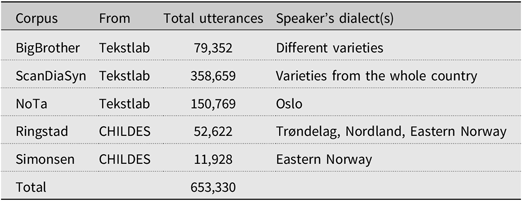
Data were collected from five corpora of spontaneous monolingual speech. Three corpora belong to Tekstlab, University of Oslo, and are the largest accessible corpora of Norwegian natural speech: NoTa (Tekstlab 2004), ScanDiaSyn (Johannessen et al. Reference Johannessen, Priestly, Hagen, åfarli, Vangsnes, Jokinen and Bick2009) and BigBrother (Tekstlab 2009).Footnote 10 Two additional corpora are taken from the CHILDES database: Ringstad (Ringstad Reference Ringstad [Larsen]2014) and Simonsen (Simonsen Reference Simonsen1990). All adult utterances are drawn from the two CHILDES corpora and most are child-directed. Table 2 provides information on the corpora and the number of utterances in each.Footnote 11, Footnote 12
Overview of corpora used in this paper.

The NoTa and the ScanDiaSyn corpora comprise recorded dialogues and the speakers in each dialogue use the same dialect. In this study, these corpora are represented by 117 and 303 speakers, respectively. The BigBrother corpus comprises transcripts of all dialogues between the contestants on the BigBrother TV show in 2001. This study includes relevant data (i.e. production of embedded clauses with negation) from 11 participants. The CHILDES corpora consist of a dialogue between a child and an adult. Data from the Ringstad corpus is child-directed speech produced by five adults, each a close relative of the child, whereas data from the Simonsen corpus come from one speaker, an investigator. The range of speech situations, speakers and dialects represented in the dataset provides a representative picture of the distribution of V–Neg.
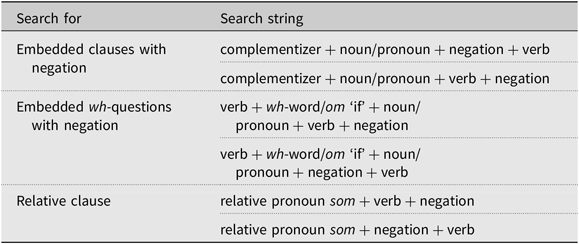
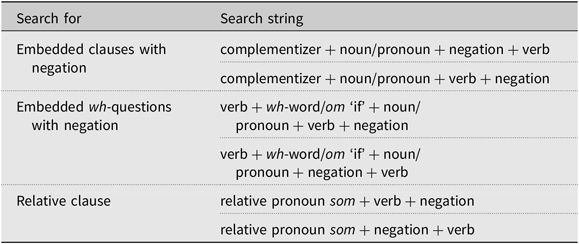
All three Tekstlab corpora are tagged for part of speech (POS), and the search strings used to extract utterances from these corpora can be found in Table A1 in the appendix. The two CHILDES corpora are not tagged, so a manual search was carried out for all complementizers followed by a clause containing negation. Only clauses corresponding to the strings in the Tekstlab search were included in the study.
None of the corpora are tagged for covert elements, so it was not possible to search for embedded clauses without an overt complementizer as this would mean manually searching through all utterances in existing corpora, an overwhelming task. It is not clear, however, that including clauses without complementizers would yield higher numbers of embedded clauses allowing V–Neg. According to Faarlund et al. (Reference Faarlund, Lie and Vannebo1997), the V–Neg word order is not possible in clauses with an omitted complementizer in Norwegian (contrary to the findings for Danish, where the V–Adv word order is more frequent in clauses that lack a complementizer; Christensen et al. Reference Christensen, Jensen and Christensen2015).Footnote 13
Several types of sentences were excluded from the current study even though they were relevant hits in the corpus search. In Norwegian, in addition to occurring pre- or postverbally, negation can also occur directly following the complementizer, as in (18).
(18)

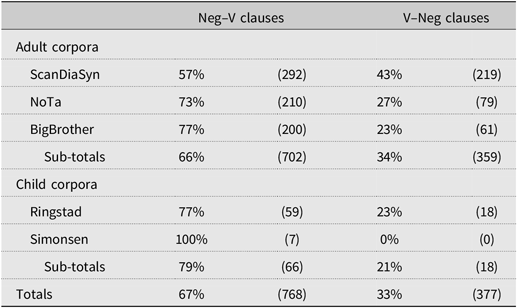
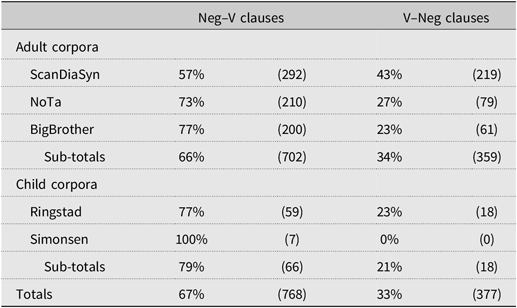
Since this position will not be discussed in this paper, clauses with this word order were excluded. A few clauses with the word order V–Neg were also excluded. This concerns clauses with the initial element for ‘for’. Even though this element looks similar to other adverbial complementizers, it is – according to the Norwegian tradition – classified as a clausal conjunction operator (Faarlund et al. Reference Faarlund, Lie and Vannebo1997:25) and not a subordinator.Footnote 14 Table 3 gives an overview of clauses relevant for this paper.
Number of clauses relevant for this paper (in parentheses), with the percentage given for the proportion of each word order for all relevant clauses.
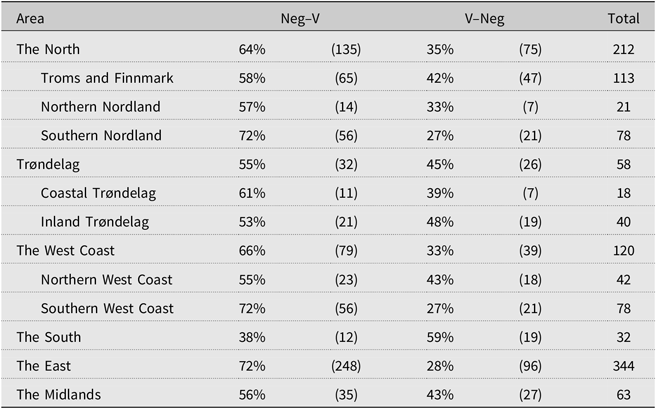
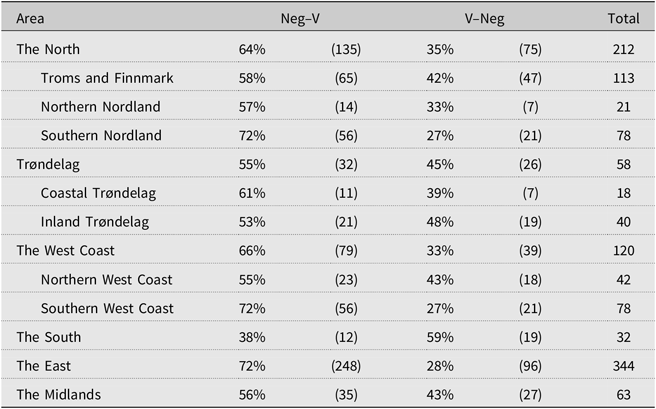
The dialects of all speakers were categorized into one of ten larger dialectal areas (Table A2 in the appendix) according to a map of Norwegian dialects (Mæhlum & Røyneland Reference Mæhlum and Røyneland2012:179 map 6). I verified that V–Neg occurs in all dialects represented in the corpora. Since V–Neg is acceptable in all dialects, no speakers were excluded from this investigation due to dialectal differences. This is in line with Bentzen (Reference Bentzen2014), who found very little geographical variation in judgements of V–Neg (except for V–Neg under semi-factives, where there are some variable judgements). I have listened through a large portion of the data material to exclude possible instances of restarts in speech production. One such restart is used in example (19) for illustrative purposes.
4. Findings
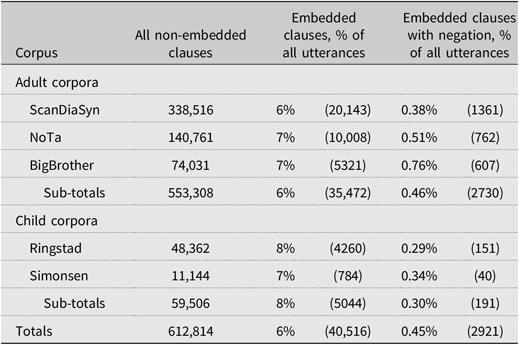
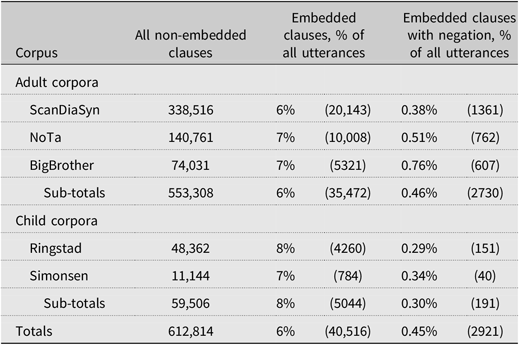
Table 4 provides information on the frequency of embedded and non-embedded clauses. Unfortunately, none of the corpora used allows exclusion of questions, so we cannot ensure that the non-embedded clauses are all declaratives. The embedded clauses include nominal, adverbial, and relative clauses as well as indirect questions. Across all utterances, only 6% contain an embedded clause. Embedded clauses with negation are rarer, constituting only 0.45% of all utterances. This means that embedded clauses containing negation are infrequent in speech.
Overview of relevant corpora numbers. Token numbers in parentheses.
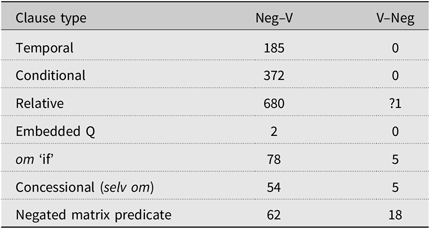
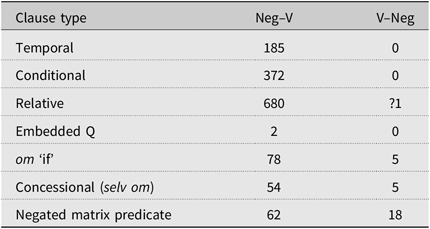
Section 2.1 discussed the environments considered ungrammatical for V–Neg: relative clauses, indirect wh-questions and a few types of adverbial clauses (conditional and temporal) (e.g. Hrafnbjargarson & Wiklund Reference Hrafnbjargarson and Wiklund2009, Franco Reference Franco2010). A search in the corpora shows that V–Neg is not found in any embedded wh-questions, conditional and temporal clauses, or relative clauses.Footnote 15, Footnote 16 The literature also claims that concessional clauses with the complementizer selv om ‘even though’ should not allow V–Neg in Norwegian (Bentzen Reference Bentzen2011), even though this word order is allowed in Danish. Corpus data show that V–Neg surprisingly is found in a few concessional clauses. Table 5 gives an overview of occurences of V–Neg in contexts where it is claimed to be ungrammatical.
Numbers for contexts where V–Neg is claimed to be ungrammatical. These numbers are drawn from the ScanDiaSyn, BigBrother and NoTa corpora. The question mark indicates an occurrence highly likely to be a restart.
According to Faarlund et al. (Reference Faarlund, Lie and Vannebo1997:983), Heycock (Reference Heycock, Everaert and van Riemsdijk2006:193), and others, negated matrix predicates generally do not allow embedded V–Neg (as noted in Section 2.1 above, Heycock (Reference Heycock, Everaert and van Riemsdijk2006) discusses embedded V2 in general, but seems to include embedded V–Neg in this larger category). Twenty-three embedded clauses with V–Neg were found to have a negated matrix predicate. Five of these clauses, such as (19), seemed to be restarts or pauses and were therefore excluded from the data material.
(19)

However, (20) shows that V–Neg is found under negated predicates that are not semi-factive. Thus, we can tentatively conclude that negated matrix predicates do not completely rule out the embedded word order V–Neg.Footnote 17
(20)

4.1 Embedding environments for V–Neg
4.1.1 Complement clauses
Section 2.1 showed that some complement clauses allow embedded V–Neg. This is supported by the corpus data: example (21) shows one finding of V–Neg in a nominal clause embedded with the complementizer at ‘that’.
(21)

Since existing studies do not map the distribution of V–Neg in complement clauses exhaustively, the findings of this study offer new insights into complement clauses in which speakers use this word order.
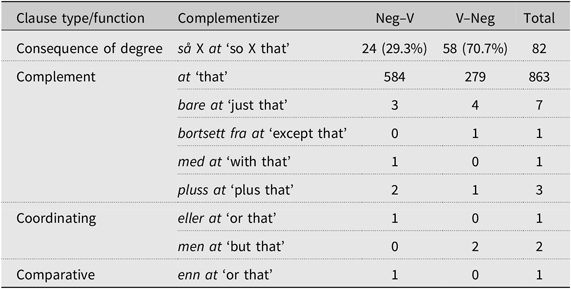
Table 6 maps out the distribution of Neg–V and V–Neg in clauses embedded with the complementizer at ‘that’. As it demonstrates, ‘consequence of degree’-clauses, as in (22), are surprisingly frequent and 70% of these clauses display the V–Neg word order.
(22)

Word order as a factor of clause type and/or function.

Such a high frequency of V–Neg indicates that this clause type might have a particular function rendering V–Neg necessary.
Additionally, Table 6 includes a few instances of coordinating and comparative clauses embedded with the complementizer at ‘that’. Even though there are only a few occurrences of each, they are important to note for understanding the distribution of embedded V–Neg.
4.1.2 Embedding verbs (i.e. matrix predicates)
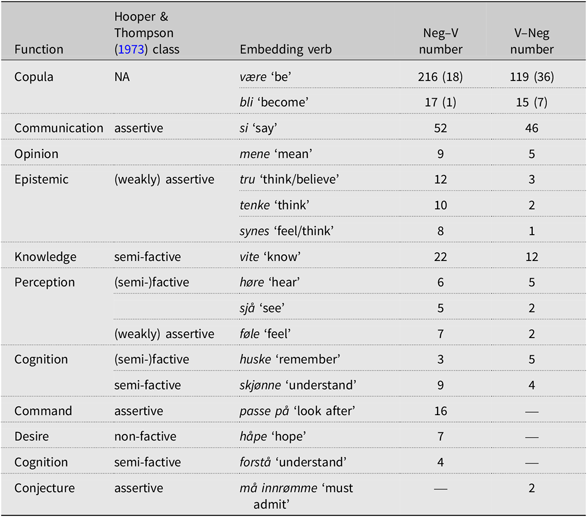
In Section 2.2, we saw that many studies of embedded V–Neg claim that this word order is related to the matrix predicate either by the embedded clause being asserted or presupposed by the matrix predicate or by expressing a particular function in the discourse through the matrix predicate. I have grouped the matrix verbs embedding both word orders and occurring twice or more according to verb function (loosely following Levin’s (Reference Levin1993) classification of verb classes) and pragmatic function (following Hooper & Thompson’s (Reference Hooper and Thompson1973) classes by applying Kiparsky & Kiparsky’s (Reference Kiparsky, Kiparsky, Steinberg and Jakobovits1971) entailment under negation test and Karttunen’s (Reference Karttunen1971) test of embedding semi-factives under a conditional). The results are in Table 7 (a complete version of this table can be found in the appendix, as Table A3).
The most frequent matrix predicates embedding complement clauses with both word orders and the most frequent matrix predicates only embedding one of the word orders classified according to semantic function, loosely following Levin’s (Reference Levin1993) verb classes and classified according to pragmatic function following Hooper & Thompson’s (Reference Hooper and Thompson1973) verb classes. Numbers given in parentheses show occurrences of complement degree clauses (‘so X that’-clauses).
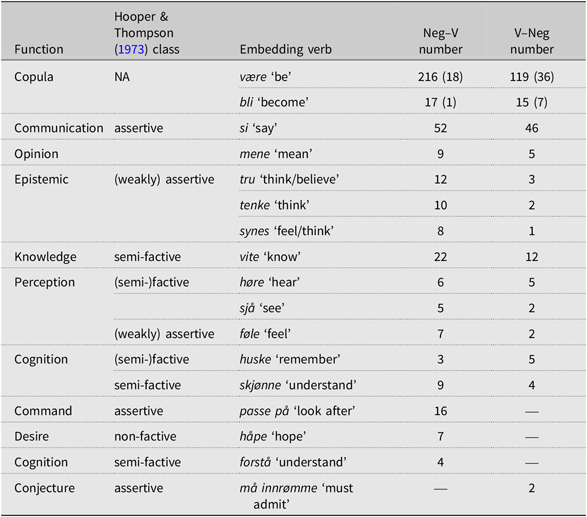
Copula (være ‘be’) is by far the most frequent matrix verb: it embeds V–Neg 119 times and Neg–V 216 times; bli ‘become’ embeds these word orders 15 and 17 times, respectively. The high frequency of copular constructions is surprising, as they are hardly mentioned in the existing literature. I now examine more closely the types of copular constructions instantiated.
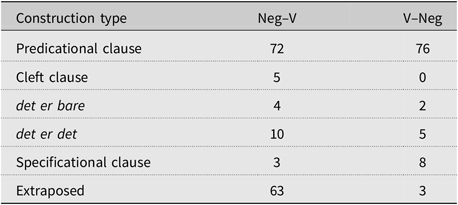
Looking more closely at the copula constructions (være ‘be’), we find the following (overview in Table 8): embedded V–Neg is used mostly in predicational contexts (N = 76), as in (23), where the predicate denotes a property of the subject (a referential det ‘it’, or other expression), or a more general property when the subject is an expletive det ‘it’.
(23)

Overview of the copula constructions embedding the word orders Neg–V and V–Neg.
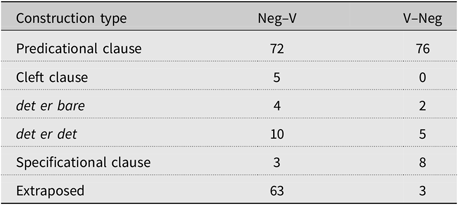
In addition, V–Neg occurs in eight copula clauses with a specificational reading (as described in Mikkelsen Reference Mikkelsen2005), where the predicate identifies the subject, as in (24).
(24)

The V–Neg word order is also found in constructions with an extraposed subject (N = 3), as in (25), where a complex subject is extraposed and referred to by a cataphoric det ‘it/that’ (see Åfarli & Sakshaug Reference Åfarli and Sakshaug2006, Borthen Reference Borthen2011).
(25)

In addition, V–Neg is found embedded in five copula constructions I dub det er det ‘it is that’ (26a) and two I dub det er bare ‘it is just’ (26b).
(26)

The word order Neg–V is generally found in similar environments as V–Neg in copular clauses. However, while Neg–V is found in five clefted clauses, illustrated in (27), V–Neg is not attested in any such clause types in this study.
(27)

Additionally, Neg–V is found in 63 clauses with an extraposed subject, whereas V–Neg occurs in only three such clauses. The significant difference suggests that different clause functions may require different word order, since the verb is constant while the clause function varies.
Predicates other than the copula that embed both word orders frequently (Table 7) can be grouped into verbs of communication (e.g. si ‘say’), perception (e.g. sjå ‘see’), epistemic verbs (e.g. tru ‘think/believe’) and verbs of knowledge (vite ‘know’). The frequently found matrix predicates are assertive (i.e. si ‘say’ and fortelle ‘tell’) and semi-factive (i.e. sjå ‘see’ and finne ut ‘find out’). Predicates never found with embedded V–Neg include predicates of command (passe på ‘look after’) and desire (håpe ‘hope’). The latter supports claims from Hacquard & Lidz (Reference Hacquard and Lidz2018), that attitude verbs expressing preferences do not take complements displaying main clause word order. Passe på ‘look after’ has a commanding function in seven occurrences, as shown in (28a); in the others, it describes someone’s actions, as shown in (28b).
(28)

4.1.3 Adjunct clauses
As shown in Section 2.1, the existing literature does not provide a clear picture of the status of V–Neg in adjunct clauses. Some adverbial clauses are argued to allow main clause phenomena in general (Haegeman Reference Haegeman, Nye, Aelbrecht and Haegeman2012a), and the word order V–Neg/Adv is found in such clauses in Scandinavian languages other than Norwegian (Christensen et al. Reference Christensen, Jensen and Christensen2015), but this possibility is not examined for Norwegian. In the hope of contributing to settling this question, the current section presents all relevant findings of V–Neg in adjunct clauses in Norwegian.
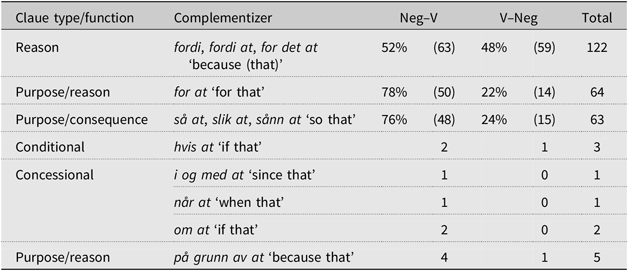
The literature has mainly focussed on the distinction between ‘because’-clauses and ‘so that’-clauses. Table 9 provides counts for V–Neg and Neg–V in both environments, showing that these adverbial clauses seem to allow V–Neg in Norwegian. The V–Neg word order is firstly found in adverbial clauses embedded with a complementizer variation such as fordi ‘because’, fordi at ‘because that’, for at ‘for that’ or for det at ‘for it that’, as shown in (29). (I henceforth use fordi to refer to all these clause types except for at ‘for that’-clauses.)
(29)

Occurrences of V–Neg and Neg–V in adjunct clauses in percentages (token numbers in parentheses).
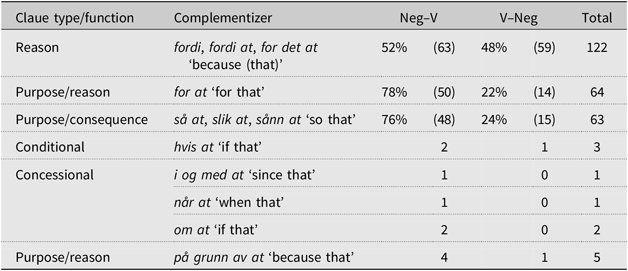
Faarlund et al. (Reference Faarlund, Lie and Vannebo1997:1041) state that clauses embedded under for at ‘for that’ always have the canonical embedded word order (Neg–V). The data in the present study invalidate that: 24% of embedded clauses with negation under for at display the V–Neg word order. However, it seems this complementizer still differs from all other variations of fordi when it comes to licensing the non-canonical word order, as the proportion of Neg–V vs. V–Neg under for at differs from that of other variations of fordi, as shown in Table 9.Footnote 18 Clauses with negation embedded under fordi are split nearly equally between the word orders Neg–V and V–Neg.
V–Neg is also seen in adverbial clauses with the complementizer variation så at ‘so that’, slik at ‘such that’ or sånn at ‘so that’, as in (30), although Neg–V is more frequent in such clauses.
(30)

These findings confirm and expand on Julien (Reference Julien2010), who finds V–Neg in ‘causal subjunctions’ such as slik at and for(di) (at).
Waldmann (Reference Waldmann2014) investigates verb placement under the complementizers for at and så at in Swedish, and finds that V–Neg is used in respectively 77% and 33% of clauses with these complementizers. In Danish, the word order V–Adv is found in 89% of clauses with the complementizer fordi (Christensen et al. Reference Christensen, Jensen and Christensen2015:105). These numbers indicate that there might be a difference in the usage of V–Neg between Norwegian and Swedish, particularly in ‘for that’-clauses (although note that the distribution of V–Adv word order might be slightly diverging from Verb–Negation, since adverbs are found to behave differently in this context, as mentioned previously, e.g. Christensen et al. Reference Christensen, Jensen and Christensen2015).
Table 9 also shows that V–Neg is possible in other various contexts, such as conditional clauses with the complex complementizer hvis at ‘if that’ and concessional clauses with the complex complementizers i og med at ‘since that’, når at ‘when that’, and om at ‘if that’.
4.1.3.1 Adverbial clauses’ function and integration status
In Section 2.1.3, I introduced the claims that adverbial clauses allowing V–Neg (or MCP in general) are less integrated with the embedding clause than adverbial clauses disallowing it (Bentzen Reference Bentzen2011, Haegeman Reference Haegeman, Nye, Aelbrecht and Haegeman2012a). In this section, I look at whether these claims are confirmed by the corpus data.Footnote 19
V–Neg should be allowed in less integrated (peripheral) fordi ‘because’-clauses and disallowed in clauses of a central type, following Bentzen (Reference Bentzen2011) and Haegeman (Reference Haegeman, Nye, Aelbrecht and Haegeman2012a). One way to test whether a clause is one type or the other is to look at the scope of a matrix negation: central clauses fall within the scope of matrix negation whereas peripheral ones do not (Haegeman Reference Haegeman, Nye, Aelbrecht and Haegeman2012a:161).
I applied this diagnostic to the corpora occurrences of ‘because’-clauses where the embedding predicate contains a negation. I also extracted all clauses with the simple complementizer fordi ‘because’ complete enough to perform such a test on (10 clauses with Neg–V and 13 clauses with V–Neg) and inserted a negation in the embedding clause. All clauses with V–Neg seem to be peripheral, as in (31), and all clauses with Neg–V seem central, as in (32), as expected.
(31)

(32)

The ‘because’-clause in (31) seems peripheral as the matrix negation does not scope over it: fordi de ikke har ryggrad (ikke (jeg takler sånne folk)) ‘because they don’t have a spine (not (I deal with such people))’. In addition, it establishes a causal relation between the verbal action in the matrix clause and the speaker’s attitude towards it; it provides the speaker’s evidence for making a claim about not being able to deal with such people. This is in line with what Haegeman (Reference Haegeman, Nye, Aelbrecht and Haegeman2012a:162) describes for less integrated clauses.
The ‘because’-clause in (32) seems to be central and thus more integrated with the matrix clause for two reasons, as described by Haegeman (Reference Haegeman, Nye, Aelbrecht and Haegeman2012a:162). Firstly, it falls within the scope of the matrix clause negation: ikke (du blir stemt ut (fordi de ikke liker deg)) ‘not (you will be voted out (because they don’t like you))’. This can be paraphrased as ‘You will be voted out, not because they don’t like you but for some other reason’. Secondly, the ‘because’-clause expresses a cause for the proposition in the matrix clause: the reason for someone being voted out.
In addition to the embedded clause’s level of integration with the matrix clause, other functions of adverbial clauses are claimed to influence (non-)licensing of V–Neg. For clauses embedded under a slik at ‘such that’ variation, it is claimed that if they express consequence, V–Neg will be allowed; if they express purpose, V–Neg is disallowed (Bentzen Reference Bentzen2011). For many of the clauses in this study embedded under slik at ‘such that’, it is possible to pinpoint whether they are clauses of purpose or consequence.
All clauses with this complementizer containing the V–Neg word order seem to be clauses of consequence, as in (33a). Of the clauses of this type with the Neg–V word order that can be classified, the majority are clauses of purpose, as in (33b), and only a few seem to be clauses of consequence.
(33)

These findings support the claims in Bentzen (Reference Bentzen2011).
4.2 Embedded verb types
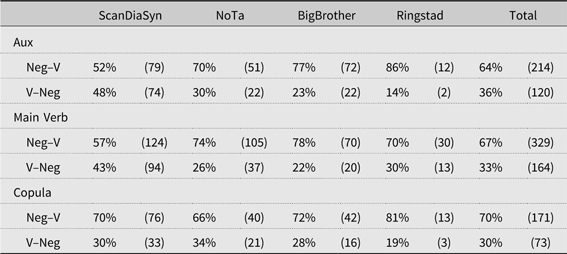
Children have been shown to produce embedded V–Neg more frequently with auxiliary verbs than with main verbs (Håkansson & Dooley Collberg Reference Håkansson and Collberg1994, Heycock et al. Reference Heycock, Sorace, Hansen and Wilson2013). In Section 2.1, I asked whether the same was true of adults. Table 10 shows the frequency of each word order with each verb type (main verb, auxiliary, and copula), for four corpora. If adult language is similar to child language, auxiliaries should occur more frequently than main verbs in V–Neg. Aggregating the total counts across all corpora, we observe that auxiliaries occur at a slightly higher rate with V–Neg (36%) than main verbs (33%) or copula verbs (30%). A chi-squared test of independence was run to determine whether the numerical trend reflects a statistically significant difference. The test included all occurrences of embedded clauses with negation where verb type could be determined across all corpora. The table had three rows corresponding to verb type: auxiliaries, main verbs and copula verbs, and two rows for word order: V–Neg and Neg–V. The association between these two variables was not statistically significant, χ2(2) = 3.05, p = .21, suggesting that word order does not depend on verb type in adult productions.
Occurrences of word order combinations as a function of verb type in percentages (token numbers in parentheses).

4.3 Summary of findings
This section presented data from a large corpus study showing the distribution of embedded V–Neg in Norwegian. There are several findings. Firstly, some environments – relative clauses, indirect wh-questions and temporal and conditional clauses – never contain this word order. This finding supports claims by Hrafnbjargarson & Wiklund (Reference Hrafnbjargarson and Wiklund2009) and Franco (Reference Franco2010). Several types of adverbial clauses frequently embed the word order V–Neg. This is particularly true for fordi ‘because’-clauses and så at ‘so that’-clauses (the latter contra Faarlund et al. Reference Faarlund, Lie and Vannebo1997). Så at ‘so that’-clauses are found to embed V–Neg when they express consequence, but not purpose, supporting claims from Bentzen (Reference Bentzen2011) (contra Hrafnbjargarson & Wiklund Reference Hrafnbjargarson and Wiklund2009). Lastly, fordi ‘because’-clauses embedding V–Neg are found to be of a peripheral, or less integrated, type, as in Bentzen (Reference Bentzen2011) and Haegeman (Reference Haegeman, Nye, Aelbrecht and Haegeman2012a) (the latter not pertaining to embedded V–Neg specifically but MCP more generally). Additionally, even though verb type seems relevant to word order in child production (see Håkansson & Dooley Collberg Reference Håkansson and Collberg1994, Heycock et al. Reference Heycock, Sorace, Hansen and Wilson2013), the current data show that verb type has no effect on word order in adult production.
5. Discussion
In the beginning of the paper, I questioned whether existing accounts of embedded V–Neg have discussed all relevant contexts for V–Neg. As I pointed out, identifying all environments where this phenomenon occurs is crucial for specifying the conditions that license it.
The empirical findings in this study confirm that there are restrictions on the distribution of embedded V–Neg: some clause types simply do not allow this word order in Norwegian. This is true for relative clauses and embedded questions, in addition to temporal and conditional embedded clauses. Despite occurring quite frequently with negation in the corpora, these clauses never display the word order V–Neg.Footnote 21 Section 2 showed that the existing literature does not agree on which environments (dis)allow embedded V–Neg. In addition to confirming syntactic environments disallowing the word order, the present study establishes that this word order is found in a number of clause types previously argued to disallow it. This is true for complement clauses under negated matrix predicates, concessional selv om ‘even if’-clauses, and a number of adjunct clause types (particularly fordi ‘because’- and slik at ‘so that’-clauses). This study also establishes that embedded V–Neg is a robust phenomenon: 33% of all clauses allow it (as shown in Table 3). The same main clause phenomenon is found in very different environments, which raises the question of whether the mechanism responsible for the non-canonical word order is independent of clause type. I advocate an approach that examines the same licensing conditions for the same phenomenon and requires us to look clause-externally.
In Section 2.2, I pointed out that the existing literature on embedded V–Neg explains its licensing conditions to some extent. However, each study finds counterexamples to other studies. The data in the present study suggest that we must dismiss accounts of V–Neg as conditioned on lexical selection by the matrix verb (work building on Hooper & Thompson Reference Hooper and Thompson1973): lexical selection accounts are not able to explain V–Neg in adjunct clauses, as they are not selected by the matrix predicate. As previously explained, the general notion in such approaches is that factivity blocks main clause phenomena (Hooper & Thompson Reference Hooper and Thompson1973). It is also problematic for these approaches that V–Neg is found in the complement of NPs (here and in Julien Reference Julien2010, in particular in consequence of degree-constructions) since it is the selecting verb that is thought to entail factivity, not an NP. The issue of optionality – the ability of a subset of embedded clauses to allow word order alternation – is also not addressed adequately in the literature: environments allowing V–Neg also allow Neg–V, so Neg–V is never disallowed. Assuming that something governs when each word order can occur, existing accounts face a problem. If embedded V–Neg is lexically licensed – by predicates that are non-factive, as in Hooper & Thompson (Reference Hooper and Thompson1973) or predicates that introduce discourse-new-ness, as in Caplan & Djärv (Reference Caplan and Djärv2017) – we are left with no explanation as to why a speaker sometimes chooses the canonical word order Neg–V and sometimes the non-canonical word order V–Neg under the same predicate. In (34), both word orders are found embedded under the matrix predicate veit ‘know’.
(34)

I already dismissed lexical selection accounts based on the fact that adjunct clauses allow V–Neg. Now we see also that these accounts cannot explain word order alternation. However, similar problems arise for more pragmatically oriented approaches as well. Julien (Reference Julien2010) argues that assertion licenses V–Neg: an assertion is made by the speaker adding content to the conversation (see Stalnaker Reference Stalnaker and Cole1978), so it does not seem plausible to claim that a clause such as (35b) is asserted whereas (35a) is not.
(35)

The same problem arises for accounts of main point of the utterance (MPU) and at-issue-ness. An environment that can be the MPU can also display V–Neg (Wiklund et al. Reference Wiklund, Bentzen, Hrafnbjargarson and Hróarsdóttir2009:1927).Footnote 22 This entails that the same environment has the possibility of displaying Neg–V.Footnote 23 An adequate account of V–Neg’s licensing conditions needs to explain the possibility of alternating between two word orders in the subset of clauses allowing V–Neg. The facts laid out here suggest that we might need to look clause-externally and examine the broader discourse. Are certain properties of the discourse what licenses or bans V–Neg?
Caplan & Djärv (Reference Caplan and Djärv2017) suggest that discourse-familiarity is a relevant property: it disallows embedded V–Neg, making V–Neg licensed only in environments where the content of the utterance is not familiar. However, their analysis faces a problem since they claim that discourse-familiarity is a property of a selecting matrix predicate. Based on the data in the present study, we can rule out lexical selection as the primary licenser for embedded V–Neg. Discourse-familiarity in itself might license (or ban) embedded V–Neg, but not as a property of a matrix predicate. In that view, when a speaker expresses a proposition that contains familiar information, V–Neg is not licensed. Familiar information might be something already introduced in the discourse, or information presumed to be known to the participants in the conversation (common ground, background information, or presupposed information; see Stalnaker Reference Stalnaker, Munitz and Unger1974, Reference Stalnaker2002). Thus, V–Neg is licensed in clauses expressing new information.
Assuming that a property of the discourse (such as familiarity) is relevant for licensing V–Neg covers adjuncts, as their ability to allow V–Neg will depend on whether or not the adjunct’s content is familiar. Additionally, it can explain why we find V–Neg under certain matrix predicates and not under others: the matrix predicate might be an expression of the larger discourse-pragmatic function. It then follows that certain discourse-pragmatic properties are typically expressed using verbs of a specific kind, i.e. information known in the discourse might be conveyed through matrix predicates known to be factive. Familiar information might be conveyed through non-factive predicates. Such an approach can potentially explain why the same matrix predicate can embed both Neg–V and V–Neg: a predicate such as si ‘say’ takes complements with both word orders, depending on whether the content of the complement clause is already introduced in the discourse. This suggestion could be compatible with that of Jensen & Christensen (Reference Jensen and Christensen2013), where V–Neg is a foregrounder, i.e. typically focussing new information.
Some of the findings of this study support the claim that familiar information facilitates the word order Neg–V and new information the word order V–Neg. Further specifying what property (or properties) of the discourse might be relevant for licensing V–Neg is a topic for future research, as the following discussion will rest heavily on this author’s introspection. Firstly, some argue that adverbial clauses differ with regard to factuality and presupposition (and thus also familiarity, following Stalnaker’s (Reference Stalnaker, Munitz and Unger1974) definition of presupposition).Footnote 24 The present study confirms that V–Neg is typically found in clauses of reason and purpose. Such clauses are claimed to be non-presupposed (Hengeveld Reference Hengeveld and van der Auwera1998, contra Nordström Reference Nordström2010), i.e. express new information. V–Neg is not found in temporal clauses, which are claimed to be presupposed (Hengeveld Reference Hengeveld and van der Auwera1998:353–357), i.e. express familiar information.Footnote 25
In addition, the current findings reveal a striking discrepancy within copula clauses: while almost none of the V–Neg clauses embedded under a copula were found with an extraposed subject, a large number of the Neg–V clauses were. Extraposed subjects can be said to contain presupposed, i.e. familiar, information (Kiparsky & Kiparsky Reference Kiparsky, Kiparsky, Steinberg and Jakobovits1971:148; Gentens Reference Gentens2015).Footnote 26 This seems to be the case in the extraposed subjects in (36), where the information in the embedded clauses seems known, and the speaker uses the matrix clause to assert something about the presupposed fact in the complement clause/extraposed subject. This is supported by corresponding structures in Kiparsky & Kiparsky (Reference Kiparsky, Kiparsky, Steinberg and Jakobovits1971:148).
(36)

Lastly, it seems that ‘because’-clauses with the two word orders reveal a discourse relevant difference. Whereas adding a contrasting clause, such as ikke fordi jeg er dum ‘not because I am stupid’, at the end of the ‘because’-clause with the word order V–Neg in (37a) produces the infelicitous (38), contrasting the content of the Neg–V ‘because’-clause shown in (37b) is possible.Footnote 27
(37)

(38)

The possibility of contrasting the content of the Neg–V clause, indicates that the utterer could have chosen several possible reasons for the exam going badly. This entails that the participants in the conversation have knowledge that there is a range of reasons why the exam might go badly. Since contrasting the content of the V–Neg clause (37a) yields an infelicitous result, this suggests that the ‘because’-clause with V–Neg does not entail known information, and thus introduces new information or states facts.
Future research should further investigate this distinction between ‘because’-clauses embedding the two word orders as well as the exact properties of discourse relevant to the licensing of embedded V–Neg.
It seems that by pursuing the idea that embedded V–Neg might be conditioned by discourse properties we are able to utilize knowledge from existing approaches, as clause internal pragmatics as well as clause types and matrix predicates will necessarily interact with the larger discourse. Thus, we are not dismissing the promising accounts already advanced, but incorporating what they have shown to be correct in an approach looking at licensing conditions from a different perspective. Furthermore, by looking for discourse properties as licensing conditions for this main clause phenomenon, we investigate the mechanism responsible for the same phenomenon in both complement and adjunct clauses.
6. Conclusion
This paper examines embedded clauses containing negation drawn from five Norwegian corpora. The aim was to determine the distribution of a main clause phenomenon found in Norwegian and other Scandinavian languages: the embedded word order V(erb)–Neg(ation). A complete overview of this word order’s distribution was conducted to help explain which environments allow and disallow it.
The data revealed previously unknown environments allowing V–Neg (concessional clauses) and pinpointed the frequency with which V–Neg is found in thoroughly discussed environments such as complement clauses, and in more uncharted clauses such as adjuncts (purpose and reason clauses) and copula clauses. The latter two are uncharted territory in most previous literature on the topic. Based on these findings, I offered some suggestions for directions research on embedded V–Neg can take in the future – studying how the choice of word order is made based on the discourse-familiarity of its containing clause. I hope this work will stimulate further investigations into the connections between embedded V–Neg and discourse, and the function and structure of the clauses discussed in this paper.
Acknowledgements
I am grateful to Kristin Melum Eide, Dave Kush and Marit Westergaard for providing detailed and constructive comments on this article at various stages in the process. I also wish to thank Kaja Borthen and Andrew Weir for valuable and insightful discussions. I would also like to express my gratitude to two anonymous reviewers and the journal editor Gunnar Ólafur Hansson, whose feedback helped me greatly improve the paper. Any errors are of course my own.
Notes
Appendix. Detailed corpora findings and search information
Search strings used for search in corpora. In all searches the maximum number of elements between the search elements was 1.
Geographical production by the dialectal areas. Occurrences of word order combinations in percentages (token numbers in parentheses).
All matrix predicates embedding a complement clause. Number of consequence of degree clauses in parentheses, i.e. ‘N of clauses (N of consequence clauses)’.