1. Introduction
Institutions, broadly defined as “humanly devised constraints that structure political, economic, and social interactions” (North, Reference North1991), have recently re-entered economic analysis as a key determinant of the wealth of nations. In contrast to formal institutions, which denote state-enforced rules of the game, informal institutions are often referred to as society's culture – here defined as the set of values, beliefs, and attitudes that distinguish one social group from another, shape collective preferences, and determine corresponding norms of behavior.Footnote 1 Despite culture's role in explaining comparative levels of economic development (see e.g. Landes, Reference Landes1998), relatively little attention has been paid to the sources of cultural dynamics across countries, largely owing to vague definitions of culture and relative paucity of data (Guiso et al., Reference Guiso, Sapienza and Zingales2006; Roland, Reference Roland, Scott and Buchmann2015).Footnote 2
Culture has a rich history as the centerpiece in theories explaining economic development of nations (e.g. see works by Karl Marx and Max Weber). Owing to the seminal contributions of Douglass North (Reference North1990, Reference North1991), culture and institutions more generally have gained renewed prominence in the studies of political and economic phenomena. Today, identification of causal mechanisms within the institution–development nexus remains the next major task in new institutionalist and development literatures. This relatively new body of work has focused mostly on the relationship between culture and institutions, as well as the impact on cross-national income levels and the growth of institutional quality (often proxied by measures of political and economic freedoms) and various aspects of cultural attitudes.Footnote 3
However, few studies to date have attempted to examine the drivers of cultural change across countries and time. Though highly persistent, culture is seldom static; given enough time, it can and does change in response to exogenous events and endogenous socio-economic pressures. To explore one potential mechanism, we empirically investigate the impact of economic development – improvements in existential security – on intergenerational cultural shifts within countries. To this end, we use a novel data set on replicated Hofstede (Reference Hofstede1980, Reference Hofstede2001) dimensions of national culture disaggregated by two non-overlapping age cohorts to study whether long-run increases in real GDP per capita incited generational cultural change in up to 72 countries. Some of these dimensions, in particular individualism, were causally linked to economic and institutional development in a number of cross-country studies. To address reverse causality of culture, this paper focuses on the changes in economic circumstances during the coming-of-age period of the younger cohort, to whom these changes come as plausibly exogenous.
The main finding is that more rapid economic growth during the examined period is associated with a more pronounced rise of individualistic and egalitarian values in younger generations around the world. This finding provides some of the first direct evidence on the impact of development on generational cultural shifts within countries, and suggests the existence of a self-perpetuating cycle in which faster-developing countries tend to promote cultural values conducive to long-run growth among youth who, once of age, use those values to further shape their economic and institutional environment. The findings are consistent with the results of a growing empirical literature, as well as theoretical considerations.
The paper proceeds as follows. Section 2 reviews relevant literature on culture and cultural change. Section 3 describes the data. Section 4 discusses the empirical approach. Section 5 develops hypotheses, while section 6 presents empirical results. Section 7 outlines the limitations of the study and offers concluding remarks.
2. Related literature
A vast body of economic literature has argued that culture plays a critical role in development, either by directly influencing economic behavior or by social legitimization of certain formal institutions. For example, trust and civic cooperation – traits often combined under the umbrella term social capital – have theoretically and empirically been linked with higher incomes and growth across countries. Social capital encompasses the set of beliefs and behaviors that facilitate interpersonal interaction and contracting, and thus promote economic activity (Tabellini, Reference Tabellini2010). Guiso et al. (Reference Guiso, Sapienza and Zingales2006) also find that religiosity and certain religious beliefs promote interpersonal trust, but also the propensity to save, an important correlate of long-run growth. Culture can likewise affect development through formal institutions, by providing a foundation upon which different economic and political rules of the game emerge and “stick” within societies (see e.g. Acemoglu and Jackson, Reference Acemoglu and Jackson2017).Footnote 4
Dutch sociologist Geert Hofstede is widely regarded as a pioneer in operationalizing cultural profiles of countries – the broad and stable core values with consistent meaning across societies. In 1968 and 1972, Hofstede surveyed thousands of IBM employees living and working in about 30 countries to gauge cross-national cultural differences in work-related attitudes. Using factor analysis on individuals’ survey responses to 60 value questions, Hofstede (Reference Hofstede1980, Reference Hofstede2001) and collaborators uncovered four – later six – mutually orthogonal cultural dimensions that characterize nations’ “collective programming of the mind:” (1) individualism versus collectivism (2) power distance (3) uncertainty avoidance (4) indulgence versus restraint (5) long- versus short-term orientation, and (6) masculinity versus femininity. The resulting cross-sectional indices, aggregated to the national level and measured on a 0–100 scale, gauge the relative prevalence of these value orientations across countries.Footnote 5
Individualism relates to a heightened sense of personal responsibility, a desire for self-actualization, and a proclivity for personal choice. Its opposite pole, collectivism, emphasizes a need for in-group embeddedness and prioritization of communal over individual interests. Power distance denotes the levels of acceptance and tolerance of unequal power hierarchies by the less powerful members of society. Uncertainty avoidance gauges societies’ level of tolerance and comfort for uncertain, novel, or unpredictable situations. Indulgence/restraint denotes the degree of gratification a society allows itself. Masculinity/femininity denotes the level of preference for achievement and assertiveness as opposed to cooperation, modesty, and care for others. Since being expanded to nearly 80 countries, Hofstede's research on cultural typologies “constitutes by far the most used and cited cultural framework in international business, management, and applied psychology” (Alesina and Giuliano, Reference Alesina and Giuliano2015: 907).
Of the named Hofstede cultural dimensions, uncertainty avoidance, power distance, and especially individualism have been identified in a growing number of empirical studies as causal determinants of economic development. Gorodnichenko and Roland (Reference Gorodnichenko and Roland2011, Reference Gorodnichenko and Roland2017) find that individualistic societies experience higher rates of innovation and long-run economic growth. Ang and Fredriksson (Reference Ang and Fredriksson2018) and Tarabar (Reference Tarabar2017) present evidence that individualism promotes efficiency-enhancing reform across countries.Footnote 6 Klasing (Reference Klasing2013), Kyriacou (Reference Kyriacou2016), and Licht et al. (Reference Licht, Goldschmidt and Schwartz2005, Reference Licht, Goldschmidt and Schwartz2007) show that individualism and/or low power distance are conducive to the rule of law, the absence of corruption, and the quality of governance. Licht et al. (Reference Licht, Goldschmidt and Schwartz2005) further find that societies that tolerate uncertainty are better able to resolve disputes through assertive legal means, resulting in stronger legal protections of creditor rights.Footnote 7
Although a two-way causal relationship between culture and development has long been recognized in social sciences, only a handful of empirical studies to date have investigated whether and how economic change translates into cultural change. In one pioneering article, Inglehart and Baker (Reference Inglehart and Baker2000) use three waves of World Values Survey (WVS) data at three snapshots in time, 1981–1982, 1990–1991, and 1995–1998, to show that increases in economic well-being, proxied by GDP per capita, induced a shift toward more rational, tolerant, and trusting norms in a sample of 65 countries comprising 75% of the world's population. They also find that culture is heavily shaped by tradition and heritage, and that national cultures follow parallel trajectories rather than converging over the course of economic development.
Tang and Koveos (Reference Tang and Koveos2008) extrapolate cultural evolution in a cross-section of 48 countries by obtaining fitted values of Hofstede indices predicted by GDP per capita levels. They argue that the pattern of development captures the aggregate dynamics of inequality, savings, and ecological pattern that induce cultural change. In particular, mass industrialization and the rise in income disparities in developing countries are hypothesized to promote tolerance for inequalities (power distance) and collectivist attitudes. Once economies become more service-oriented, more emphasis is placed on individualization and self-expression, and further prosperity is associated, in line with the Kuznets hypothesis, with lower inequalities and smaller power distance.
Using a sample of up to 71 countries, Kyriacou and López Velásquez (Reference Kyriacou and López Velásquez2015) investigate the effect of interpersonal income inequalities on an aggregate cultural indicator comprised of traits conducive to economic development: trust, control, respect, and non-obedience. The idea is that more pronounced interpersonal inequalities cause mistrust and disrespect between people, who cluster more tightly into smaller social circles of relatives that teach obedience to children and descendants. The Gini measure for inequality is averaged over a 60-year period (1944–2003), while the cultural indicator covers the 1990–2005 period. Consistent with their hypotheses, the authors find evidence of a negative impact of inequality on trust, sense of control, and respect, and a positive impact on obedience.
The above studies provide empirical evidence that the variation of cultural values and attitudes along several different dimensions is consistent with certain patterns of income dispersion between countries. However, the lack of a clear time dimension in culture data may obscure the variation of cultural change across generations within countries and over time, and thus more proximate evidence of any causal relationships. Building on the above works, this paper takes a step in this direction by providing, to my knowledge, a first-time account of generational value shifts in Hofstede dimensions in response to economic change, and thus direct evidence of within-country cultural change.
3. Data
The original Hofstede country scores have received criticism on grounds that they fail to capture the malleability of culture and that, as a result, they may not be representative of contemporary societies (Kirkman et al., Reference Kirkman, Lowe and Gibson2006). To put the validity of Hofstede measures to the test, Beugelsdijk et al. (Reference Beugelsdijk, Maseland and Van Hoorn2015) replicate five of the six Hofstede dimensions using value response data on over 340,000 individuals around the world, surveyed over several waves of World and European Values Surveys between 1981 and 2008.Footnote 8 They identify two non-overlapping age cohorts in nearly 100 countries approximately one generation (~30 years) apart. The older cohort comprises individuals born between 1902 and 1958 and on average in 1941, roughly encompassing working-age adults at the time of original Hofstede studies. The younger cohort comprises of individuals born after 1958 and on average in 1971.
Using correlation, factor, and reliability analyses on national samples of survey responses, Beugelsdijk et al. (Reference Beugelsdijk, Maseland and Van Hoorn2015) reconstruct national scores of Hofstede dimensions for each generational cohort along the original 0–100 scale, concluding that “Hofstede's data … is as relevant now as it was when his work was first published,” and that while intergenerational cultural change can be observed within countries, cultural differences between countries remain overall stable (Beugelsdijk et al., Reference Beugelsdijk, Maseland and Van Hoorn2015: 224). The absolute difference between generational value indices captures the change in national culture within countries, enabling testable hypotheses on factors explaining cultural divergence between two age groups – “young” and “old” – by country.
Based on their data, in the widest available sample of countries the younger generations are on average more individualistic (∆IND = +9.0; N = 77), more indulgent and less restrained (∆IR = +8.2; N = 88), more future-oriented (∆LTO = +4.1; N = 35), while also less power-distant (∆PDI = −11.7; N = 75) and more intolerant of uncertainty (∆UA = +2.6; N = 55).Footnote 9 Of these absolute shifts, individualism, power distance, and indulgence dimensions exhibit highest relative (percentage) changes. This paper is an attempt to explain these generational deviations by relating them to long-run change in real GDP per capita in a cross-country regression framework.
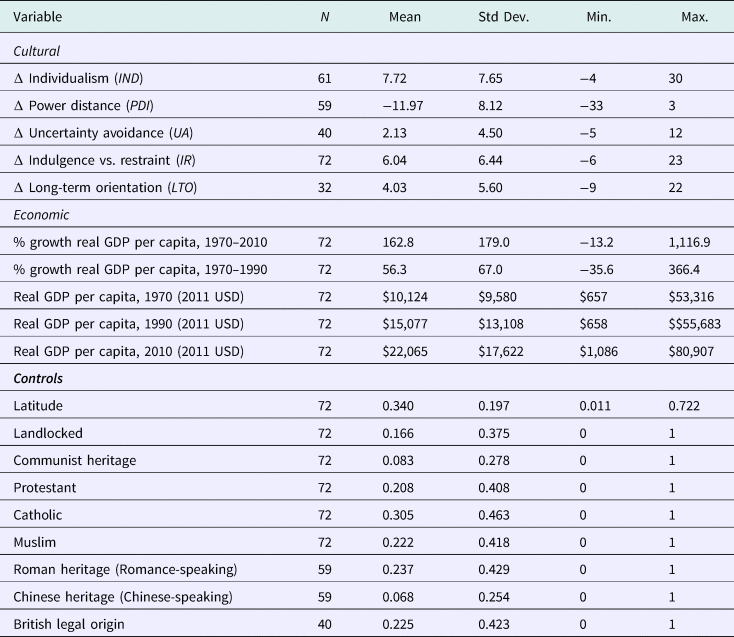
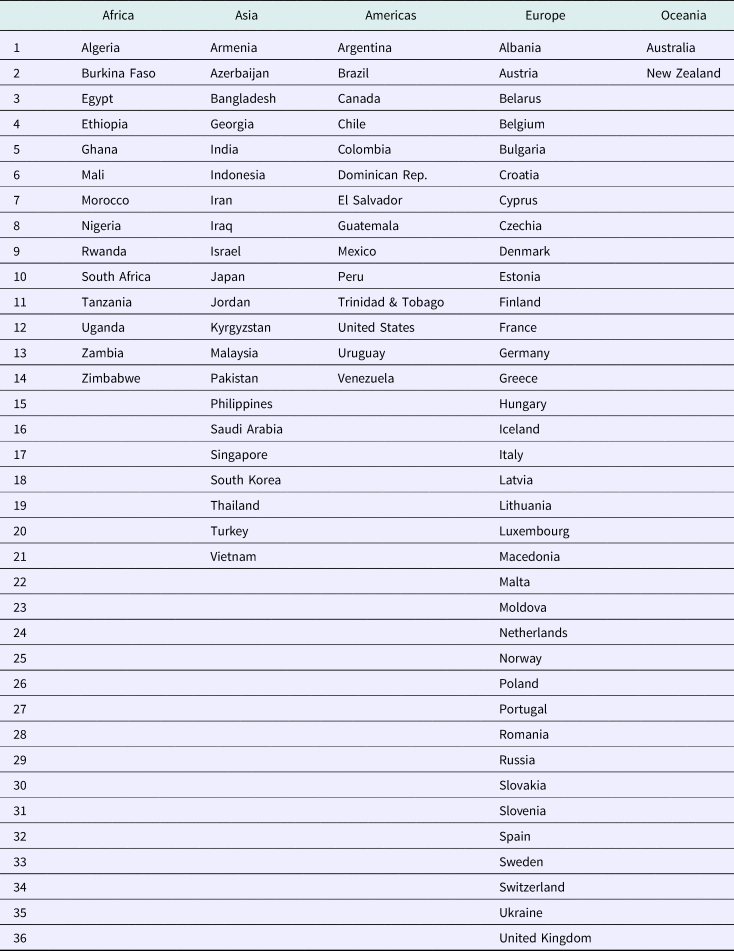
The source of data for GDP is Penn World Tables (version 9.0), and population data are drawn from World Bank's World Development Indicators. Control variables account for geographic, historical, and institutional differences that have conceivably influenced the trajectory of cultural change. Data on ethnolinguistic heterogeneity are taken from the widely used data set provided in Alesina et al. (Reference Alesina, Devleeschauwer, Easterly, Kurlat and Wacziarg2003), and data on latitude and legal origins come from La Porta et al. (Reference La Porta, Lopez-de-Silanes, Shleifer and Vishny1999). Table 1 reports summary statistics of the variables from largest regression subsamples, and appendix Table A1 lists countries in the data set.
Summary statistics of regression variables

4. Empirical framework
The departing assumption is that the cultural formation of individuals is determined by two distinct factors: (1) familial, accounting for the vertical transmission of culture from parents to children either through hereditary traits or upbringing (“nature”), and (2) external, relating to culture-shaping forces outside one's immediate environment (“nurture”). This distinction follows the concepts of vertical and horizontal socialization developed in Bisin and Verdier (Reference Bisin, Verdier, Benhabib, Bisin and Jackson2011, Reference Bisin and Verdier2001). Vertical socialization refers to the transmission of values inside the family, and horizontal to the transmission arising from children's interactions with the members of their own as well as their parents’ generations.
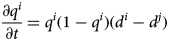
The stylized model, first outlined in Cavalli-Sforza and Feldman (Reference Cavalli and Feldman1981), gives the probability of a child fully adopting its parents’ dichotomous trait i as:
 $$P^{ii} = d^i + (1 - d^i)q^i,$$
where 0 ≤ d i ≤ 1 is the probability of successful vertical socialization and 0 ≤ q i ≤ 1 is the fraction of population with trait i. In that respect, the likelihood of full socialization to the parents’ trait is determined by a convex combination of parental and social influences. Alternatively, the probability of a child adopting trait j ≠ i is given by:
 $$P^{ij} = (1 - d^i)(1 - q^i).$$
Assuming society is not culturally monolithic (1−q i > 0), equation (2) describes the process of generational cultural divergence i → j as the function of the exogenously determined success of vertical transmission and the fraction of the population with trait j (from which a role model is selected at random).Footnote 10 Taken together, the above equations imply that without any exposure to the rest of society (equivalent to 1 − q i = 0), parents transfer their traits to children with probability 1, resulting in no cultural change within the population.
In line with the above equations, cultural values of individuals may be represented by:
 $$HOFSTEDE_d^{CHILD} \equiv HOFSTEDE_d^{PARENT} + f\,(EXTERNAL) + \varepsilon, $$
where HOFSTEDE represents the Hofstede dimension of interest d, f(EXTERNAL) with f(0) = 0 is a function that captures external (non-familial) influences on cultural formation, and ε is a random personality attribute. In line with theoretical considerations, equation (3) implies that absent external experiences, the cultural values of all parents and their children within a country would be, on average, identical.
In the context of the present study, the approximately single-generation age gap between the cohorts in question bolsters the argument that individuals in the 1971 cohort are likely to be, on the aggregate, immediate descendants of the 1941 cohort. To focus specifically on the change in culture within countries, equation (3) can be econometrically re-specified as:Footnote 11
 $$\Delta HOFSTEDE_{d,i} \equiv HOFSTEDE_{d,i}^{1971} - HOFSTEDE_{d,i}^{1941} = {\bf X}^{{\prime}} \theta + \alpha + {\varepsilon}_i,$$
where i indexes country, α is a constant term, and ΔHOFSTEDE d,i represents cultural distance between younger and older generations and, implicitly, cultural change over the long-run and after generational replacement.
Abstracting from familial influences, equation (4) expresses cultural change as the function of only the non-familial factors in X that induce cultural divergence between “child” and “parent” cohorts. In later econometric analysis, horizontal cultural influences stemming from the non-parental population are implicitly controlled for by countries’ population size, religion, and ethnic, religious, and linguistic heterogeneity. Any residual deviation in cultural values between parents and children is then related to country-specific changes in economic conditions, set during the period of adulthood of the 1941 cohort, and youth and personality development of the 1971 cohort.
Operationalizing cultural change in this way allows for two key assumptions to be made for empirical analysis. First, as the cultural values of youth are significantly more malleable to external influences, divergence in generational values will be primarily driven by the cultural formation of the 1971 cohort. In that respect, the values of the 1941 cohort are taken as given, since belief formation tends to slow down significantly during adulthood (Inglehart, Reference Inglehart2008). Second, because a large fraction of the 1971 cohort only came of age between 1970 and the 2000s, economic changes since about 1970 are assumed to come as mostly exogenous to this generation's cultural formation, depending on the chosen end period. In other words, the cultural formation of children and adolescents is unlikely to feed back into society-wide economic changes. These assumptions are in line with the socialization hypothesis of generational value change (Inglehart, Reference Inglehart2008), which states that adults’ cultural values are determined by socio-economic conditions during one's early years.
Based on the above, we begin with OLS estimation of the following specification:
 $$ \Delta HOFSTEDE_{d,i} = \beta \log \left( {\displaystyle{{GDPpc_t} \over {GDPpc_{1970}}}} \right)_{\! i} \, + \, \phi \log (GDPpc_{{\rm 1970}})_i + {\bf X}{\rm ^{\prime}}\theta + \alpha + \varepsilon _i, $$
where GDPpc is real GDP per capita and (natural) log(GDPpc t/GDPpc 1970) is the “long difference” between per capita income in year t >1971 and 1971, the year of birth of the average member of the younger cohort. The unit of analysis is a country indexed by i.
The parameter of interest β captures the effect of widening of the per capita real income gap between 1970 and t by a factor of e ≈ 2.71, or by 171%, on the cultural distancing of the younger cohort, holding constant for the initial levels of wealth into which the younger cohort was born.Footnote 12 The idea is that if economic change up to year t is at all causally related to generational cultural cleavages, then more extensive development should be consistent with more pronounced cultural deviations between cohorts. Two years in t are selected as thresholds of interest: 2010 in benchmark models, and 1990 in more “restrictive” models. The year 2010 gives the broadest possible view of the impact of development, but it also allows for grown members of the 1971 cohort to take part in economic activity, potentially confounding the results. To address this concern, 1990 is likewise chosen as another threshold year below which the average member of the 1971 cohort is likely to be either in school or too young to significantly take part in economic activity.
To isolate cultural change from changes in population dynamics and composition, all specifications hold constant for (log) population size averaged over all years between 1970 and t, as well as the time-invariant index of average fractionalization that increases the level of ethnic, linguistic, and religious heterogeneity within countries.Footnote 13 Other time-invariant control variables for geographic, religious, and institutional legacies capture the enduring effect of traditional value systems and collective memories on cultural change. These legacies influence the path dependency (“stickiness”) of culture and the strength of family ties, and thus moderate the impact of different processes on the extent of transmission of cultural values across generations. This line of reasoning is consistent with the idea that national cultures follow parallel trajectories rather than converging over time (Inglehart and Baker, Reference Inglehart and Baker2000), as well as with the finding of stable cultural distances between countries (Beugelsdijk et al., Reference Beugelsdijk, Maseland and Van Hoorn2015).
For example, Protestantism is associated with greater secularism and interpersonal trust (Guiso et al., Reference Guiso, Sapienza and Zingales2006; Inglehart and Baker, Reference Inglehart and Baker2000), which allows individuals to more readily interact with members of the out-group and facilitate the move away from collectivism. In a similar vein, the common law system allows for greater freedom to enter contracts and ease of development of stronger out-group relationships. Geography determines exposure to foreign populations and ideas, as well as migration costs away from family and social groups, reinforcing or hindering generational cultural transmission. Climate determines nature's hostility or abundance, and establishes an enduring sense of dependency on the self versus others (Hofstede et al., Reference Hofstede, Hofstede and Minkov2010: 85). The legacies of great ancient empires (i.e. Chinese and Roman) reverberated through time in the form of cultural ideas about the nature of relationships between parents and children (via inheritance laws and the power of the father in the family), and people and authority (via regard for codified universal laws versus broad principles) (Hofstede, Reference Hofstede2001: 119–121; Hofstede et al., Reference Hofstede, Hofstede and Minkov2010: 84, 232).
5. Hypotheses
According to the World Bank, world real GDP per capita between 1971 and 2010 nearly doubled from $5,280 to $9,516. In line with the modernization hypothesis (Inglehart and Baker, Reference Inglehart and Baker2000), economic progress led societies to adopt values that are “rational, tolerant, trusting, and participatory.” The early stages of economic development during the industrialization stage coincided with mass migration to cities, occupational specialization, transformed gender roles, a better educated public, and broader political participation (Inglehart and Baker, Reference Inglehart and Baker2000: 21). These processes induced early industrializing societies to adopt more materialistic and secular–rational worldviews according to which individuals are to be the masters of their own fate and no longer at the mercy of nature's capriciousness.
Once a sufficiently high standard of living is attained, additional improvements in economic circumstances give rise to post-materialist values, which emphasize “quality of life, environmental protection, and self-expression” over existential and material survival (Inglehart and Baker, Reference Inglehart and Baker2000: 21). Consequently, citizens of more affluent countries began spending less effort on producing material wealth and more on creating living environments in which freedom of expression and individual judgement were becoming increasingly relevant (Inglehart and Baker, Reference Inglehart and Baker2000: 22).
How did economic progress affect the change in Hofstede dimensions? In individualistic societies, people tend to be responsible primarily to self and closest kin, valuing “individual freedom, opportunity, achievement, advancement, and recognition” (Gorodnichenko and Roland, Reference Gorodnichenko and Roland2011: 492). The rapid industrialization and the subsequent move toward the post-industrial society in the latter half of the 20th century saw the younger generations growing up in an increasingly affluent world, leading to economic and personal empowerment and enabling individuals to pursue own avenues for life's fulfilment. Hence, the prior expectation is that development gives rise to personal autonomy and individualism.
Power distance represents the degree to which inherently unequal distribution of power is expected, accepted, and even desired by the less powerful members of society. In high power distance countries, strict hierarchies of power at work (boss–subordinate), school (teacher–student), and family (parent–child), as well as one's status in life are taken as largely given and immutable. In these societies, superiors can exercise considerable influence over the behavior of subordinates, who accept such a state of affairs and view their need for security and dependence on authority as the very basis of social order (Hofstede, Reference Hofstede2001: 97).
Improvements in living standards can play a multifaceted role in the change in this dimension. Greater wealth and economic opportunity diminish concerns over existential security and increase the bargaining power of subordinates, dismantling the notion of immutability of one's station in life and diluting de facto existential inequalities in hierarchical labor relationships. Parents can afford more and better education for their children, who are taught to associate skills with wealth, and wealth with power. Youth maturing in faster-growing economies observe realizations of independence among adults with higher frequency and clarity, which stimulates determination and imagination about their future, and ultimately the desire for assertiveness and “power striving,” reducing tolerance of rigid hierarchies (Hofstede, Reference Hofstede2001: 83, 98).
A related argument suggests that economic growth translates not just to higher purchasing power, but also greater de facto political power (Acemoglu and Robinson, Reference Acemoglu and Robinson2000; Acemoglu et al., Reference Acemoglu, Johnson, Robinson, Aghion and Durlauf2005). As individuals command a greater share of economic resources, they become better able to influence political institutions and to themselves determine the allocation of political power and authority. Therefore, the expectation is that economic progress leads individuals to be more cognizant of their potential for political and social mobility, leading to increases in egalitarian sentiments and a fall in power distance.
The uncertainty avoidance dimension gauges countries’ level of tolerance for ambiguity in life. Societies ranking high on this dimension generally feel powerless when facing unknown or unstructured situations, and react to such uncertainty with greater anxiety, stress, and demand for greater structure or regulation at work, institutions, and relationships. The observed change in this dimension across generations, however, has been small. One reason for this may be that the desire to escape ambiguity is a basic fact of human nature (Hofstede, Reference Hofstede2001: 148).
Modernization can have a disparate impact on the change in this dimension. On the one hand, economic development leads to diminished concerns about personal livelihood and greater liberation of individuals from the stresses of economic insecurity. Youth growing up in rapidly developing economies may note that “the future is bright,” and that satisfaction, security, and stability are more often derived from personal ability and achievement than from unquestioning adherence to superiors, well-structured relationships, or “Truths with a capital T” (Hofstede, Reference Hofstede2001: 162).
Although improvements in living standards and the adoption of new technologies a provide means to guard against uncertainty, they also bring new risks and challenges (Hofstede, Reference Hofstede2001: 148). Faster development over a fixed time period also implies a more rapidly changing economic landscape and arguably higher stress levels. Some processes commonly associated with economic development, such as mass privatization, exposure to international goods and factor flows, and a shifting industry structure can incite a reaction against instability and greater demand for structure.
Long- versus short-term orientation refers to the variation in goal-oriented mentality with a focus on the future. Long-term oriented societies broadly value patience, hard work and thrift, and small socio-economic differences, while short-term orientation values leisure, personal autonomy and achievement, and a meritocratic reward system (Hofstede et al., Reference Hofstede, Hofstede and Minkov2010: 251). Modernization may likewise impact the change in long-term orientation in differing ways. On the one hand, economic enrichment decreases immediate physiological needs and increases life expectancy, which may foster a longer-term view of life and of pursuit of gratification (Hofstede et al., Reference Hofstede, Hofstede and Minkov2010: 240). Moreover, longevity may induce pro-saving behavior to finance retirement spending (Tang and Koveos, Reference Tang and Koveos2008: 1051), while higher wages increase the opportunity cost of leisure and therefore raise the value of hard work (although on net, this is subject to the strength of the income effect). On the other hand, economic opportunity often requires urgency and competitiveness in order to be seized and the drive to spend (and save less) is more pronounced in societies anticipating higher growth. The latter argument is similarly raised in Tang and Koveos (Reference Tang and Koveos2008: 1051).
The last dimension considered is indulgence versus restraint. Though conceptually distinct, this dimension exhibits strong negative correlation with long-term orientation: more indulgent societies allow themselves higher gratification and leisure. They also report higher levels of subjective well-being, extraversion, optimism, and looser social norms (Hofstede et al., Reference Hofstede, Hofstede and Minkov2010: 291). To the extent that pleasure-inducing activities and happiness are normal goods, economic prosperity endows individuals with both the means and the leverage to consume a larger quantity and variety of goods in accordance with individual preferences and sometimes in opposition to social norms. As people prosper, such indulgent behaviors are more likely to become accepted by the broader society. An alternative argument is that development and transition to a service-based economy liberates individuals from the stresses of intensive agriculture and the cynical beliefs that starvation, epidemics, and territorial wars are a regularity of life (Hofstede et al., Reference Hofstede, Hofstede and Minkov2010: 297).
6. Results
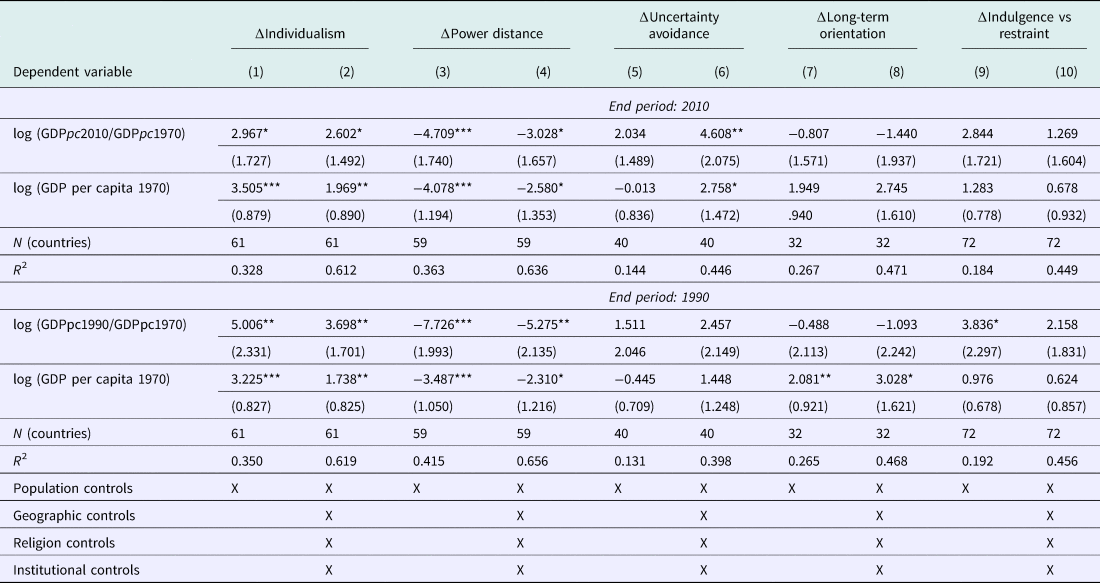
Table 2 reports parameter estimates for initial levels and “long difference” in per capita income between 1970 and 2010, and 1970 and 1990, respectively. Odd-numbered specifications include population variables described in the above, and even-numbered specifications include the full set of population, geographic, religion, and institutional controls. In individualism specifications with the end year t = 2010, a unit increase in the log difference of GDP per capita is associated with 2.97 and 2.60 point increases in cultural distance between young and old cohorts in baseline and full control models, respectively. These estimates are both statistically (at the 10% level) and economically significant, amounting to 34% of the regression sample standard deviation of ∆IND. The specifications with the end year t = 1990 restrict the sample to the period of childhood and adolescence of the average member of the 1971 cohort. Statistical and economic significance is even greater in these models: a unit increase in log difference in GDP per capita income between 1970 and 1990 is associated, at the 5% level, with a 3.7-point increase (about half of standard deviation of ∆IND) in individualism distance between younger and older generations in the full control specification.
Cultural change and economic development, 1970–1990 and 1970–2010, OLS estimates.

Notes: Robust standard errors in parentheses. Population controls include the natural log of population averaged over all years between 1970 and t = {1990, 2010}, and the average of ethnic, linguistic, and religious fractionalization. Geographic controls include latitude and the landlocked dummy. Religion controls include dummies for predominantly Protestant, Catholic or Muslim populations. Institutional controls include a dummy when Romance or Chinese languages are either dominant or widely spoken (PDI specifications only) and British legal origins (UA specifications only).
* p < 0.1, ** p < 0.05, *** p < 0.01.
In power distance specifications, the impact of development is statistically significant and in line with the priors. In full control specifications, a unit increase in the log difference in GDP per capita between 1970 and 2010 is associated with the move away from power distant to more egalitarian attitudes in younger generations by 3.03 points, and by 5.30 points between 1970 and 1990. The effect of development is sizeable, amounting to 66% of the in-sample standard deviation of ∆PDI in full control specification with t = 1990.
Results from uncertainty avoidance specifications show mixed results. In the specification with 2010 as the end year, economic progress is associated with an increase in uncertainty avoidance among younger generations. However, the significance of the effect disappears in the restricted 1970–1990 sample. Similarly, no significant results are found for indulgence versus restraint and long-term orientation dimensions, although coefficients on growth show negative association with long-term orientation, and positive with indulgence (for this dimension, simple correlation equals + 0.37 for 1970–1990).Footnote 14 Thus far, the findings in Table 2 suggest a robust effect of economic growth on cultural change in two dimensions, individualism and power distance.
To further control for the confounding influence of the influx of younger generations into economic activity, we consider only the 1970–1990 growth in GDP per engaged person (aged 15 and above), defined as individuals who performed any work during the reference period (data drawn from Penn World Tables 9.0). To this end, real GDP per capita is decomposed into two components according to the formula:
 $$GDPpc = \left( {\displaystyle{{GDP} \over {Population}}} \right) \times \left( {\displaystyle{{Workers} \over {Workers}}} \right) = \left( {\displaystyle{{GDP} \over {Workers}}} \right) \times \left( {\displaystyle{{Workers} \over {Population}}} \right).$$
The corresponding growth rate in real GDP per capita equals the sum of growths of real GDP per worker and fraction of working age population. We then estimate the following equation:
 $$\eqalign{\Delta HOFSTEDE_{d,i} =\; &\beta \log \left( {\displaystyle{{GDPpw_{{\rm 1990}}} \over {GDPpw_{1970}}}} \right)_{\! i} \,+\, \phi \log (GDPpw_{{\rm 1970}})\; \cr & + \varphi \log \left( {\displaystyle{{{{\rm [}Workers/Population{\rm ]}}_{{\rm 1990}}} \over {{{\rm [}Workers/Population{\rm ]}}_{{\rm 1970}}}}} \right)_{\! i} \,+\, {\bf X}^{\prime}\theta + \alpha + \varepsilon _i,} $$
where GDPpw is GDP per engaged person (worker).Footnote 15
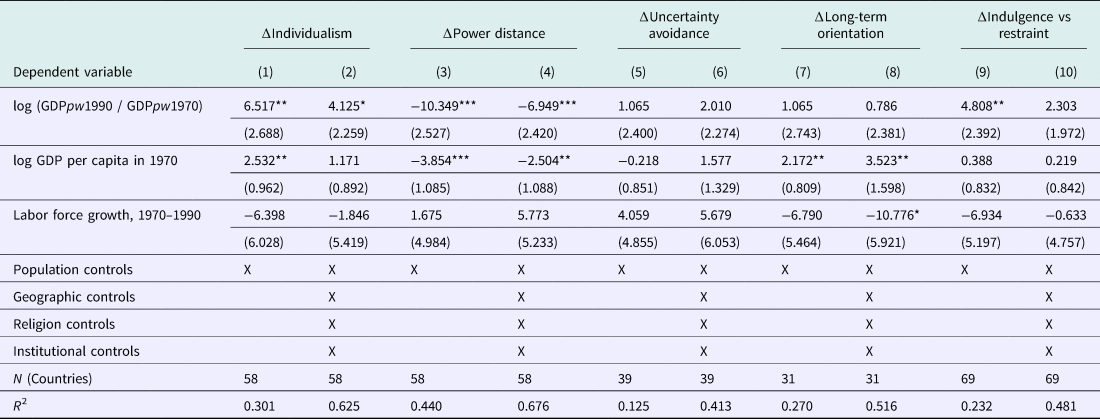
Table 3 reports results for equation (7). The magnitude and statistical significance of estimates is mostly retained for individualism and power distance: a unit increase in the log difference in GDP per worker is associated with the increase by 4.12 points (54% of standard deviation of ∆IND) in individualism and with a reduction of about 7 points (85% of standard deviation of ∆PDI) in power distance among younger generations in full control specifications.
Cultural change and worker productivity, 1970–1990, OLS estimates.

Notes: robust standard errors in parentheses. Population controls include the natural log of population averaged over all years between 1970 and t, and the average of ethnic, linguistic, and religious fractionalization. Geographic controls include latitude and the landlocked dummy. Religion controls include dummies for predominantly Protestant, Catholic or Muslim populations. Institutional controls include a dummy when Romance or Chinese languages are either dominant or widely spoken (PDI specifications only) and British legal origins (UA specifications only).
* p < 0.1, ** p < 0.05, *** p < 0.01.
As with baseline results, no robust significant effect is found for uncertainty avoidance, long-term orientation, or indulgence dimensions.Footnote 16 These null results may be due to the diverging impact of development on these dimensions as outlined previously, or to non-linear dynamics in the process of development as argued in Tang and Koveos (Reference Tang and Koveos2008). It is also suggested that these cultural orientations were largely determined by deep historical factors, which explains their relative constancy (Hofstede et al., Reference Hofstede, Hofstede and Minkov2010). Moreover, it is possible that non-economic factors play a major role in the change along these dimensions. For example, uncertainty avoidance significantly increases with age (Hofstede, Reference Hofstede2001: 185), showing that for each year increase in each country's average age, uncertainty avoidance score increases by 7 points. Overall, the empirical results report that in faster-growing economies, the rise of individualistic and (politically) egalitarian attitudes among younger generations is significantly more pronounced, independently of different socio-economic controls, time frames considered, and an alternate measure for economic growth.
7. Conclusion
This paper empirically investigates the consequences of long-run economic development on intergenerational cultural change in up to 72 countries. Using country-level data on generational cleavages in five replicated Hofstede (Reference Hofstede1980, Reference Hofstede2001) cultural dimensions across two non-overlapping age cohorts, we present evidence that increases in real GDP per capita during the coming-of-age period of the younger cohort are associated, at statistically and economically significant levels, with the observed generational value shifts toward greater individualism and egalitarianism (less power distance) around the world. The results are robust to a number of historical, geographic, and institutional controls, different periods under consideration, and an alternate measure of economic growth.
The findings of this paper are consistent with a small but growing literature on the effects of economic on cultural change. Existing research supports the notion that greater economic prosperity and equality, in the long run, gives rise to more tolerant, egalitarian, autonomous, and trusting norms across countries (Inglehart and Baker, Reference Inglehart and Baker2000; Kyriacou and Lópes Velásquez, Reference Kyriacou and López Velásquez2015; Tang and Koveos, Reference Tang and Koveos2008). This paper complements the above studies by focusing the analysis on its impact on cultural change within countries. In that respect, one central contribution of this paper has been to exploit the temporal dimension of cross-generational value orientations, and thus provide supportive arguments in favor of a causal relationship between development and cultural change. In doing so, we found suggestive evidence of a self-perpetuating cycle in which development promotes the rise of certain “pro-development” cultural values.
Some caveats apply. One limitation of the study's data is that the cohort-based view of cultural change does not preclude the possibility that younger cohorts adopt similar cultural values to those of their elders as they age (see e.g. Beugelsdijk et al., Reference Beugelsdijk, Maseland and Van Hoorn2015: 237). In that regard, a greater number of generational cohorts must be observed longitudinally to clarify the impact on cultural change. Furthermore, the speed and magnitude of actual cultural change within a country is difficult to quantify without accounting for the relative changes in the age structure of the population over time, as well as fertility and mortality rates. Also, since different mental models cannot be considered in isolation, the direction of overall cultural change is impossible to characterize by focusing on individual cultural dimensions.
Finally, it is important not to interpret the results in a normative way. There is no one set of “best” cultural values that economic development “should” promote. Although improvements in living standards exhibit a two-way relationship with individualism and low power distance, the rise of these value norms due to development could entail hidden costs to social and political structures. Cultural change in the form of generational distancing can increase fractionalization and raise tensions within a society. Moreover, short-run economic trade-offs can occur: while the move away from collectivism to individualism promotes long-run growth, it also discourages collective action owing to self-interested pursuits (Gorodnichenko and Roland, Reference Gorodnichenko and Roland2017: 402). Future research may examine more closely the socio-economic consequences of generational cultural divergence, as well as the non-economic drivers of cultural change across countries.
Acknowledgments
I am grateful to the editors and the anonymous referees for their helpful comments. All remaining errors are my own.
Appendix
Countries used in regressions.