Introduction
The published literature suggests that quality improvement initiatives can improve tracheostomy care.Reference McGrath, Lynch, Bonvento, Wallace, Poole and Farrell1 Despite this, work describing patient and family outcomes after tracheostomy indicates that patients still do not feel prepared at the time of discharge. Key areas in which to target improvement are the pre-operative, immediate post-operative and discharge phases.Reference McCormick, Ward, Roberson, Shah, Stachler and Brenner2
There is growing recognition of patients' contributions to setting objectives for: their own care, improving health outcomes and evaluating care. Limited evidence suggests that there is minimal patient involvement in the process of improving tracheostomy healthcare provision. Hence, this work aimed to evaluate, on an international level, the current status of tracheostomy care, focusing on those issues identified as important to patients.
The aim was two-fold: (1) to conduct a needs assessment regarding the current provision of tracheostomy care within hospitals in the global community, focusing upon areas identified as important by patients and family members;Reference McCormick, Ward, Roberson, Shah, Stachler and Brenner2 and (2) to champion patient engagement via an educational intervention for healthcare professionals.
Materials and methods
Needs assessment
The initial survey employed a multicentre cross-sectional design. Tracheostomy healthcare professionals were contacted using a mailing list held by the Global Tracheostomy Collaborative. A survey was created through a collaboration of multiple professionals (ENT surgeon, specialist nurse, speech and language therapists, and family champion) to assess current provision of tracheostomy care. Topics were selected based on aspects of the tracheostomy pathway, including pre-operative preparation, post-operative education, home nursing, discharge delays and quality improvement measures.Reference Arora, Hettige, Ifeacho and Narula3 Confidence in involvement in tracheostomy quality improvement initiatives was assessed using a five-point Likert scale (5 = very confident; 1 = not very confident).
Educational intervention
Following completion of the initial survey, participants were invited to partake in two online webinars, which focused upon involving patients and families in healthcare provision and quality improvement tracheostomy projects. Results from respondents caring for both adult and child patients were analysed. Global experts (ENT surgeons, specialist nurses, respiratory therapist, speech and language therapists, and patient and family champions) were invited to deliver the webinars. Following completion, participants were asked to complete a follow-up survey.
Statistical analysis
Participant confidence was compared before and after the webinar using the Mann–Whitney U test.
Ethical considerations
As per Health Research Authority guidance, this service evaluation did not require National Health Service Research Ethics Committee approval. As per institutional guidance, this project did not require further ethical approval.
Results
Participant demographics
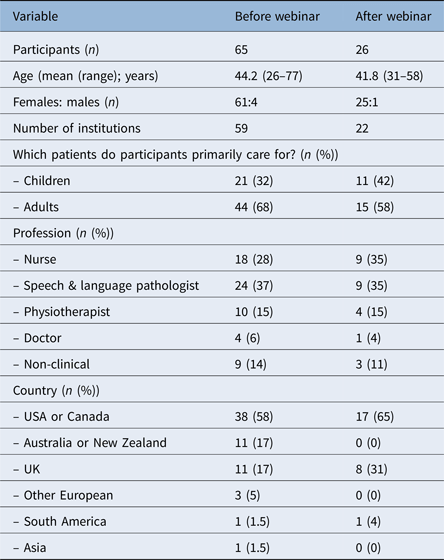
Sixty-five healthcare professionals completed the survey before the webinar and 26 completed it afterwards. The majority of participants were nursing or speech or language staff. Table 1 illustrates the spread of participants from 10 different countries.
Demographic details of participants

Pre- and post-operative patient preparation
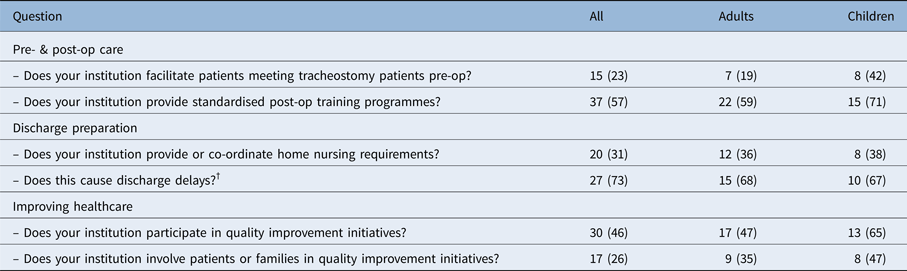
Table 2 demonstrates participants’ responses regarding patient preparation in the pre- and post-operative phases. Only 23 per cent (n = 15) of the participants’ institutions routinely offered patients the ability to meet people with a tracheostomy pre-operatively. The reported proportion that consistently offered a standardised tracheostomy training programme for patients or family members was 57 per cent (n = 37). When analysed by patient cohort, paediatric practitioners were more likely than adult healthcare providers to organise pre-operative meetings (42 per cent vs 19 per cent) and training programmes (71 per cent vs 59 per cent).
Participants’ responses regarding their institutional experiences of patient preparation at different phases*

Data represent numbers (and percentages) of ‘yes’ responses. *Specifically, in the pre- and post-operative phases, during discharge preparation, and regarding healthcare improvement measures. †In institutions that prepare patients for discharge: n = 37, n = 22, n = 15, respectively. Post-op = post-operative; pre-op = pre-operative(ly)
Discharge preparation
Table 2 demonstrates participants’ responses regarding preparation for discharge. Not all institutions provided or co-ordinated the provision of full nursing requirements on discharge. Only 31 per cent (n = 20) provided this service. Of the institutions that prepared patients for discharge (n = 37), most (73 per cent, n = 27) reported associated discharge delays whilst waiting for the package of care to start, with the result that patients remained in hospital longer. Discharge preparation delays were similar for adults and children.
Quality improvement measures
Table 2 demonstrates the involvement of institutions and patients or family members in quality improvement initiatives. The needs assessment illustrated that 46 per cent of participants (n = 30) regularly participated in quality improvement tracheostomy initiatives. However, only 26 per cent (n = 17) always involved patients or family members. Regarding quality improvement measures, paediatric practitioners were more likely than adult healthcare providers to participate and involve patients or family members; there are, however, further improvements to make.
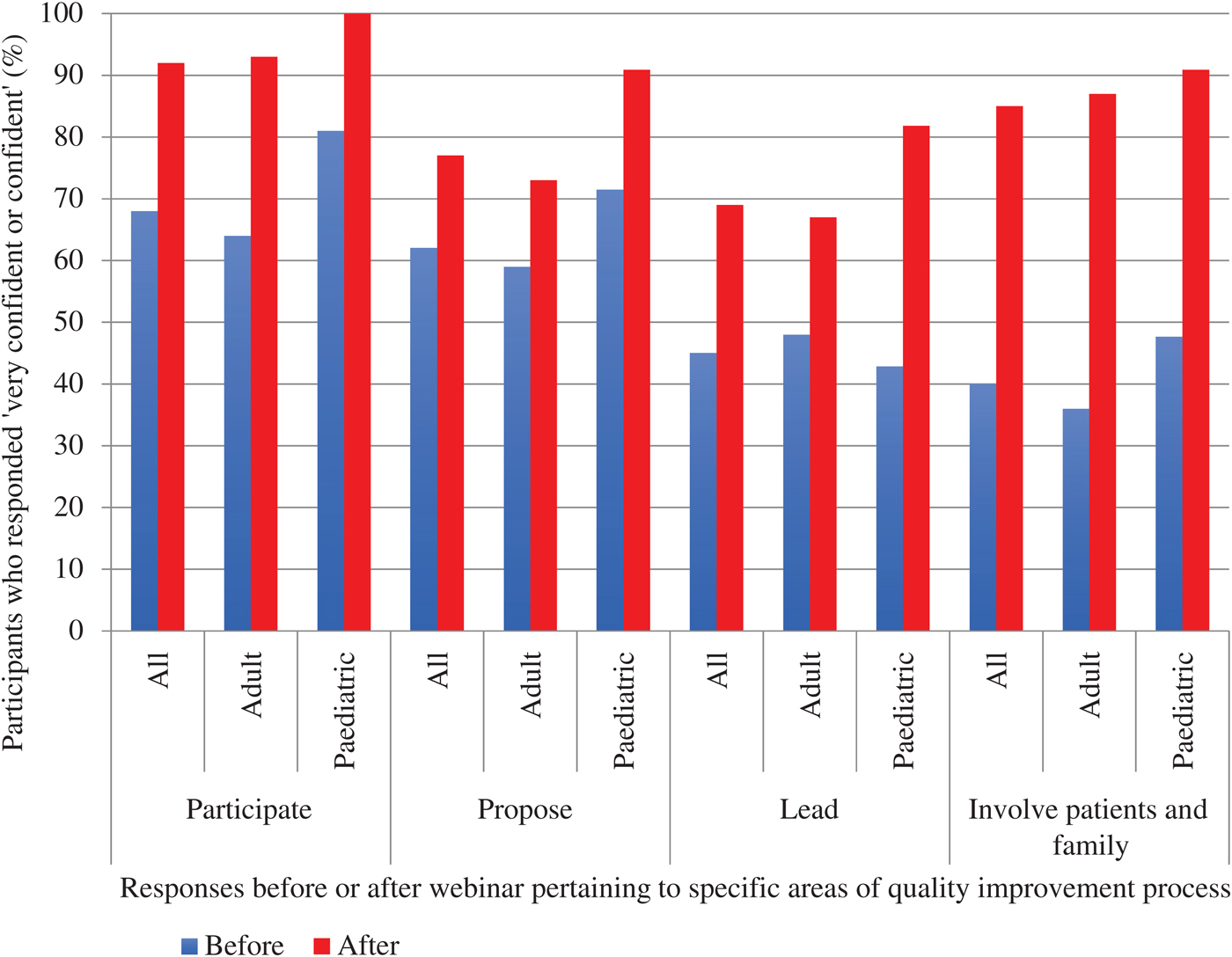
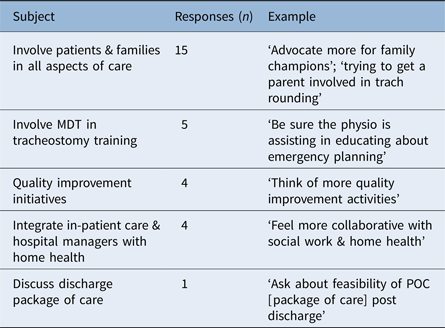
Figure 1 demonstrates the effect of the educational webinars on participant confidence of involvement in quality improvement tracheostomy initiatives. The majority of participants were very confident or confident to participate in initiatives both before (68 per cent, n = 44) and after (92 per cent, n = 24; p = 0.105) the webinars. Following the webinar, participants were very confident or confident to: propose or develop new quality improvement projects (p = 0.009, compared with pre-webinar responses), become the hospital quality improvement tracheostomy lead (p = 0.007), and involve patients or family members (p < 0.0001). The percentage improvement was greatest in paediatric healthcare providers (Figure 1). Table 3 summarises the themes observed in participants’ open or free responses.
The effect of webinars on confidence in involvement in quality improvement tracheostomy initiatives in practitioners who primarily cared for adults or children.

Open-ended and free responses after webinars

MDT = multidisciplinary team
Discussion
Our results indicated that we were not sufficiently addressing previously highlighted concerns from patients and their families, and that patients were rarely involved in implementing measures to improve tracheostomy healthcare. Interestingly, this figure might be relatively inflated compared to the general medical population, as the responses were from providers who chose to participate in the patient and family involvement webinars, possibly indicating an area of interest for them. An important learning point was the disparity between care offered by practitioners who primarily cared for children or adults; in general, those who tended to children were more engaged with preparatory care for patients and showed a greater improvement in confidence following the educational webinar.
In addition to the disparity between responses of adult versus child healthcare practitioners, pre- and post-operative training and education were poorly standardised within healthcare institutions. The lack of pre-operative exposure of patients, or their family members, to tracheostomy patients represented an area for improvement. Clinical consensus guidelines published by the American Academy of Otolaryngology – Head and Neck Surgery in 2013 on tracheostomy care advocates patient education prior to elective tracheostomy surgery.Reference Mitchell, Hussey, Setzen, Jacobs, Nussenbaum and Dawson4 Post-tracheostomy care also required improvement, particularly in terms of the low levels of home nursing provision. Often high levels of responsibility must be taken on by family members and the patient themselves. This highlights the ongoing need to improve and standardise the co-ordination of discharge planning, to enable a smooth transition from hospital to home.Reference McCormick, Ward, Roberson, Shah, Stachler and Brenner2, Reference Mitchell, Hussey, Setzen, Jacobs, Nussenbaum and Dawson4 Family members often act as the primary carers for relatives with tracheostomies, and play an added role in informing healthcare providers of the patient's needs.Reference Loerzel, Crosby, Reising and Sole5 They are ideal candidates for advocating the improvement of healthcare systems’ provision.
Despite the improvements required, only a few of the participating institutions involved patients in quality improvement initiatives. Placing value on the patient's experience and what is important to them is fundamental to delivering optimal care. Patients represent an invaluable resource for improving healthcare services, as they have a unique understanding and specific expectations of their healthcare system.Reference Robert, Cornwell, Locock, Purushotham, Sturmey and Gager6 However, there seems to be a gap in implementing quality improvement initiatives.Reference Lord and Gale7 Changes can start to be realised via simple interventions, such as interactive webinars. Similar educational initiatives can be effectively achieved in a globally co-ordinated effort. This is by no means the single change required to evolve the processes involved in quality improvement measures, but it is an effective place to start.
• Previous work indicates that patients with new tracheostomies and their families do not feel prepared at time of discharge
• Patients and families are rarely asked how they feel services should be improved
• Pre- and post-operative training and education remains poorly standardised in healthcare institutions, and is an area for improvement
The Global Tracheostomy Collaborative was established in 2012 to standardise best practice tracheostomy care worldwide. It represents a unique opportunity to gain insight into the current status of tracheostomy care, on a global scale. However, this also represents a limitation for our study, as this work principally reflects trends in North America, Australasia and Europe. A survey of tracheostomy care in developing nations would be a useful future exercise.
This study involved a pilot survey, which will form the basis for a further, more extensive project. The survey, which utilised a five-point Likert scale, was designed by multiple professionals.Reference Streiner, Norman and Cairney8 There was an uneven sample size before and after the webinar. This was probably because survey completion was not compulsory. This reflects the difficulty in performing educational research and weakens the conclusions we can draw beyond general trends. Long-term evaluation of the impact of this study posed logistical problems, particularly in the context of a global multicentre study.
Conclusion
The provision of tracheostomy care in hospital and at discharge can be improved. Correspondingly, the relatively low proportion of healthcare professionals who participate, develop and lead tracheostomy quality improvement initiatives must increase. Paediatric practitioners were slightly ahead of the curve compared to adult healthcare providers, but there were still improvements to be made. The current practice of healthcare professional led audit is becoming less viable; future initiatives should focus upon patient-centred and patient-led outcomes to ensure excellence in healthcare delivery. The healthcare system of the future must evolve to align patient and healthcare leaders, in order to deliver better patient outcomes.
Competing interests
AA is a founding member of the Global Tracheostomy Collaborative; CS and EW are committee members.