Introduction
Nutrition is an interaction between physiological processes and ecology, so it is directly associated with natural selection as well as the competition for food (Sheikher et al., Reference Sheikher, Sharma and Sharma2001; Zhu et al., Reference Zhu, Zhang and Ren2005; Xue et al., Reference Xue, Pang, Wang, Li and Liu2010). In many studies of the relationships between insects and plants, attempts have been made to quantify the efficiency with which insects exploit their food plants (David & Gardiner, Reference David and Gardiner1962; Sheikher et al., Reference Sheikher, Sharma and Sharma2001; Xue et al., Reference Xue, Pang, Wang, Li and Liu2010). Together with data on the rate of food ingestion and growth, food utilization efficiency is an important component of herbivore performance (Slansky & Scriber, Reference Slansky, Scriber, Kerkut and Gilbert1985). From a nutritional point of view, utilization efficiency reflects the quality of food. Since it became clear from classical nutritional studies that the qualitative requirements of insects do not differ fundamentally among species (Dadd, Reference Dadd, Kerkut and Gilbert1985) and that green plants generally contain all nutritionally essential elements required by insects (Fraenkel, Reference Fraenkel1959; Fourche et al., Reference Fourche, Guillet, Calvez and Bosquet1977), a quantitative nutritional approach had become indispensable to achieve a better understanding of the tropic relationships between herbivores and plants (Scriber, Reference Scriber1981; Slansky, Reference Slansky1982). Differences in the efficiencies of digestion and conversion of food may contribute to observed patterns in the specificity of insect-plant interaction.
A great deal is known concerning the qualitative nutritional requirements of insects. The quantitative aspects of insect nutrition have, however, received more attention, and there have been a number of studies on the rates of intakes and the efficiency of food utilization (David & Gardiner, Reference David and Gardiner1962; Scriber, Reference Scriber1981; Slansky, Reference Slansky1982; Sheikher et al., Reference Sheikher, Sharma and Sharma2001; Massey & Hartley, Reference Massey and Hartley2009; Xue et al., Reference Xue, Pang, Wang, Li and Liu2010). In particular, relatively little is known concerning the intake, digestibility and efficiency of conversion of defined diets. Quantitative work with artificial diets has usually involved only measurements of the amount of a particular nutrient required per unit of diet (House, Reference House1959, Reference House1962, Reference House and Rockstein1965a, Reference Houseb). This defines the relationship between the requirements for particular nutrients (Sang, Reference Sang1956, Reference Sang1959) but says nothing of food intake, absolute requirements or the efficiency of food utilization.
Data on the amount of food consumed and its utilization are useful for easy comparisons across different foods, different instar stages or environmental factors (temperature, crowding, etc.). The measurement of consumption is achieved by measuring intake and growth. Most measurements of intake and utilization have been made with insects feeding on natural foods, and the information available in this area is useful. Insects, as a group, feed upon a remarkably diverse list of organic substances. At the same time, most species show a high degree of specificity in their choice of food. Gordon (Reference Gordon1959) hypothesized: “Competition and natural selection gradually drive and bind each species to a specialized food supply that it can utilize more efficiently than any of its competitors.” Nevertheless, the qualitative nutritional requirements of growing insects seem to be relatively uniform (Fraenkel, Reference Fraenkel1953, Reference Fraenkel1959; House, Reference House1962). It seems apparent that adaptive nutritional differences must be sought on a quantitative level and that a meaningful comparative nutrition of insects will not emerge until quantitative studies are emphasized. The determination of absolute requirements for dietary constituents depends upon the measurement of intake. Differences in food efficiency can be demonstrated only by measuring intake and growth. Digestibility should also be measured since it can be expected to vary widely with different foods. The efficiency with which digested food is used for growth will vary not only with the maintenance requirement for energy but also with the balance of nutrients (Gordon, Reference Gordon1959). Measures of intake and utilization have played little part in the classical studies of insect nutrition although their usefulness in this connection is obvious. For example, instances of poor growth may not be due to the nutritional inadequacy of the diet but to a low rate of intake due to the absence of a non-nutrient phagostimulant. Conversely, the addition of a nutrient with phagostimulatory activity might lead to increased growth although the nutrient is neither required nor utilized (Dadd, Reference Dadd1960). Measures of intake and utilization can give an indication of this, since patterns of utilization may be different although diets are similar in their ability to support growth. For instance, low intake might be offset by high digestibility or a high utilization of digested food for growth or vice versa. An overall understanding of the utilization of a food requires answers to the following questions: At what rate is the food eaten? How much of the eaten food is actually digested? What part of the food is incorporated as body substance? These questions cannot be answered without a reliable and accurate method for determining the weight of the food ingested, the weight of the faeces which correspond to the ingested food and the weight gained by the insect during the experiment. These three measurements are basic and necessary for the calculation of the rate of feeding, the digestibility and the efficiency of conversion of food to body substance. This is true whether the question is the utilization of whole food (fresh weight), dry matter, energy, carbohydrates, nitrogen or other nutrient constituents of the food. Utilization data are most useful if they are reduced to terms which allow one to compare, for example, the utilization of different foods, utilization from instar to instar or the effects of environmental factors on utilization. Studies on the consumption and utilization of food in insects facilitate the understanding of the adaptability of insects. In insects, the females have generally lower consumption and higher conversion of food into body matter. Study of insect nutrition assumes significance as it provides necessary information for the economic exploitation and the management of the insects and also elucidates the energy relationship among the communities. Considering the importance of the insect nutrition, its various aspects have been studied on Pieris brassicae (Linn.).
Pieris brassicae is one of the most destructive pests, causing damage at all growth stages of host plant (Lal & Ram, Reference Lal and Ram2004; Younas et al., Reference Younas, Naeem, Raquib and Masud2004; Hasan, Reference Hasan2008). It is an oligophagous pest with a wide host range and is known to infest 83 species of food plants belonging to Cruciferae (Bhandari et al., Reference Bhandari, Sood, Mehta, Choudhary and Prabhakar2009). It has a Palearctic distribution from North Africa across Europe and Asia to the Himalayan Mountains (Jainulabdeen & Prasad, Reference Jainulabdeen and Prasad2004). In India, it passes winter in the plains and migrates to hilly regions during summer (Gupta, Reference Gupta1984). The young caterpillars feed gregariously on host plants’ leaves (Jainulabdeen & Prasad, Reference Jainulabdeen and Prasad2004; Younas et al., Reference Younas, Naeem, Raquib and Masud2004; Hasan, Reference Hasan2008; Bhandari et al., Reference Bhandari, Sood, Mehta, Choudhary and Prabhakar2009). On cabbage and cauliflower, the caterpillar sometime bores into the heads, causing extensive damage and yield loss. During development, one single larva of P. brassicae consumes 74–80 cm2 leaf area (Younas et al., Reference Younas, Naeem, Raquib and Masud2004; Hasan & Ansari, Reference Hasan and Ansari2010a,Reference Hasan and Ansarib, Reference Hasan and Ansari2011a,Reference Hasan and Ansarib,Reference Hasan and Ansaric).
The objectives of this study were to determine (i) food utilization by the larvae of P. brassicae on five brassicaceous host plants, (ii) effects of food plant on duration of larval development and (iii) effects of food plant on the duration and weight of the pupal instar.
Materials and methods
Host plants
Five host plants were used in this study, including cabbage (Brassica oleracea var. capitata), cauliflower (Brassica oleracea var. botrytis), radish (Raphanus sativus), broccoli (Brassica oleracea var. italica) and mustard (Brassica campestris). These plants were selected because they are the most important economic crops in India and are primary host plants of P. brassicae. The five species of host plants were singly planted in plastic pots (20 cm in diameter and 15 cm in depth) in the Department of Plant Protection, Faculty of Agricultural Sciences, AMU, Aligarh India and were maintained insecticide-free. The plants were used when they had 4–5 true leaves.
Insect
Pieris brassicae larvae were originally collected from cabbage fields (Brassica oleracea var. capitata L.) and were subsequently reared on all host plants, i.e. cabbage, cauliflower, mustard, radish and broccoli. Before starting the experiments, larvae were reared separately on the above-mentioned host plants for two successive generations to eliminate the effects of previously ingested food. The stock culture was maintained in laboratory in a BOD incubator at 26±2°C, 70% RH and 12:12 L:D. The eggs obtained from the second generation adults were used in the following experiments.
Food consumption and utilization
Newly hatched first instar larvae were taken from the established laboratory cultures of P. brassicae and kept in groups of 20 each (five replicates) in a jar of 100 ml. These were provided with fresh leaves of the respective food plant on a daily basis until pupation. Daily records of the weight of the larvae, food given, food left uneaten and faecal matter produced were maintained. Concomitantly, a control was run daily throughout the study by keeping weighted leaf in a Petri dish and reweighing it after 24 h to assess loss of water/moisture from the food for the purpose of compensation of similar loss from the food offered to the larvae. Food utilization rates were then calculated based on the following formulas of Waldbauer (Reference Waldbauer1968):
Consumption index (CI)
Consumption index can be made on the basis of the rate of intake relative to the mean weight of the larva during the feeding period. It can be calculated with the help of following formula:

- F=
fresh weight of food eaten
- T=
duration of feeding period (days)
- A=
mean fresh weight of larva during feeding period
Relative growth rate (RGR)
It can be calculated as:

- G=
fresh weight gain of larva during feeding period
- T=
duration of feeding period (days)
- A=
mean fresh weight of larva during feeding period
Efficiency of conversion of ingested food (ECI)
The efficiency of conversion of ingested food to body substance is calculated as:

- WG=
weight gained
- FI=
weight of food ingested
Approximate digestibility (AD)
The approximate digestibility is calculated as:

- FI=
weight of food ingested
- WF=
weight of faeces
Efficiency of conversion of digested food (ECD)
The efficiency with which digested food is converted to body substance is calculated as:

- WG=
weight gained
- FI=
weight of food ingested
- WF=
weight of faeces
Duration of larval development
Duration of larval development was recorded on all five food types. Leaves of respective food plants containing five newly hatched larvae each in 20 replications and were placed in jars with a wet filter paper and incubated at 26±2°C, 70% RH and 12:12 L:D. These conditions maintained throughout larval development.
Pupal duration and weight
One-day-old pupae were collected from the walls of the rearing cages of all respective host plants and were sexed as suggested by Chandra & Lal (Reference Chandra and Lal1975). After sexing, healthy male and female pupae were selected and reared separately in batches of ten. For each host plant, the duration of pupal development to adult emergence was noted for each sex. Weight of pupae was measured using an electronic balance. This experiment was repeated in the same way for all host plants.
Statistical analysis
Data obtained for the duration of larval development were subjected to one-way analysis of variance (ANOVA). Mean values were compared using Tukey's HSD post-hoc test. A nonparametric Kruskal-Wallis one way analysis of variance was performed to access differences in the duration and weight of pupae reared on different host plants. Student's t-test was used to analyze the differences in the duration and weight of male and female pupae reared on different plant species. All statistical analysis was done using the language program R development core Team R 2.10.1 (2010) unless stated otherwise.
Results
Food consumption and utilization
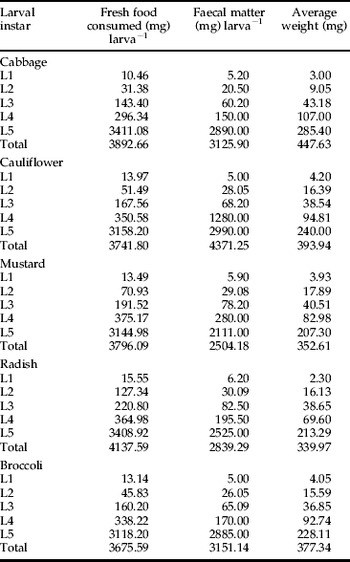
The rate of food consumption generally increased with the age of larvae. Consumption was highest on radish (4137.6 mg) and lowest on broccoli (3675.6 mg), which was similar to cauliflower (3741.8 mg) (table 1). It was observed that consumption was lowest during the initial day of larval development, and it gradually increased with the advancing of larval age. The consumption of first instar was lowest on cabbage (10.46 mg) and highest (15.55 mg) on radish. However, consumption of fifth instars was highest on cabbage (3411 mg) and lowest on mustard (3145 mg) (table 1). More faeces were produced by later instars than in the early ones. The weight of faecal matter produced over the entire larval development period was highest on cauliflower (4371 mg) and lowest on radish (2839 mg).
Food consumption and weight gain by different larval instars of P. brassicae.

It was observed that larvae gained most weight in the fifth instar on all host plants. The highest weight gain of fifth instars was evident on cabbage (284 mg), followed by cauliflower (240 mg), broccoli (228 mg), radish (213 mg) and mustard (207 mg) (table 1).
The consumption index (CI) was also greatest in the fifth larval instar on all host plants (table 2). A significantly higher CI was recorded on cabbage, as compared to other tested host plant (F=191.66; df=4, 24; P>0.05). Approximate digestibility (AD) was maximum in the first instar and minimum in the fifth instar on all host plants tested. The overall AD, of larval stages combined, was significantly greater on radish and least on cabbage (F=79.38; df=4, 24; P>0.05) (table 2).
Comparative summary of nutritional indices for P. brassicae on tested host plants.

Within column, means followed by different letters are significantly different from each other according to Tukey's HSD post-hoc test (P<0.01).
Efficiency of conversion of ingested food (ECI) was lowest in fifth instar on all host plants. However, overall percent of ECI was significantly higher on cabbage and lower on radish (F=77.40; df=4, 24; P>0.05) (table 2).
The mean efficiency of conversion of digested food (ECD) was highest on cabbage (64.6%) and lowest on radish (26.9%). These values were significantly different (F=394.19; df=4, 24; P>0.05) (table 2). Mean relative growth was significantly greater on cabbage (F=48.49; df=4, 24; P>0.05), in comparison to other tested host plants, and was lowest on radish.
Duration of larval development
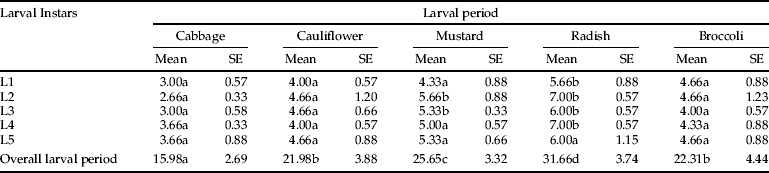
Host plants strongly affected developmental time. On all host plants, the overall mean larval period of P. brassicae varied from 15.89 to 31.66 days. The total duration of larval development was significantly longer on cabbage compared with other host plants tested (F=10.25; df=4, 99; P=0.001) (table 3).
Larval period of P. brassicae on tested host plants.
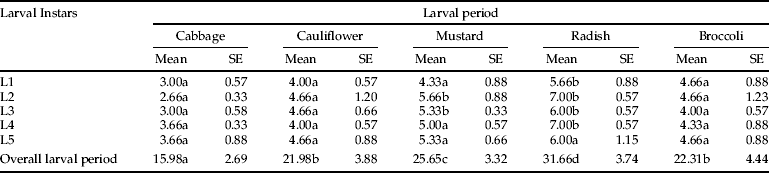
Within rows, means followed by different letters are significantly different according to Tukey's HSD post-hoc test (P<0.01). L1, L2, L3, L4 and L5 represents the first, second, third, fourth and fifth instar stages of P. brassicae, respectively.
Pupal duration and weight
On all host plants, the average time taken by female pupae to develop into adults was significantly prolonged (H= 40.06; df=4; P>0.001) as compared to male pupae (H=39.80; df=4; P>0.001). However, the duration of both male and female pupa was shortest on cabbage (t=−3.34; df=18; P=0.003) and longest on radish (t=−0.62; df=18; P=0.53) (fig. 1).
Duration (days) of male and female pupae of P. brassicae on different host plants. Box plot with similar letters are not significantly different (P>0.05).

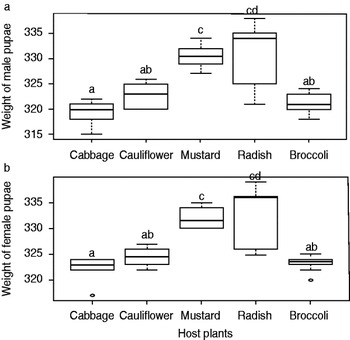
Similarly, the average weight of female pupae on all host plants was significantly heavier (H=35.39; df=4; P>0.001) in comparison to male pupae (H=33.90; df=4; P>0.001). However, the weight of both male and female pupae was least on cabbage (t=2.88; df=18; P=0.009) and greatest on radish (t=−0.616; df=18; P=0.54) (fig. 2).
Weight (mg) of male and female pupae of P. brassicae on different host plants. Box plot with similar letters are not significantly different (P>0.05).

Discussion
Aspects of host plant quality relevant to herbivore fitness may include physical attributes, allelochemicals and/or nutritional composition (Hasan & Ansari, Reference Hasan and Ansari2011a). The composition of food includes both absolute and relative amounts of proteins, amino acids, lipids, fatty acids, carbohydrates, water, minerals and vitamins. In order to attain the ideal growth, developmental and reproductive performance, herbivores must obtain adequate amounts of the necessary nutrients in a suitable host plant. Among the above contents, host plant nitrogen content is considered to be the most important and limiting factor for herbivores (Zhong-xian et al., Reference Zhong-xian, Xiao-ping, Heong and Cui2007).
It is necessary for herbivores to obtain and utilize the nutritional foods for growth, development and reproduction. The amount and quality of food consumed by immature herbivores influence their fitness, growth rates, developmental duration, final body weights, dispersal abilities and probabilities of survival (Hasan & Ansari, Reference Hasan and Ansari2011a,Reference Hasan and Ansarib). Similarly, the amount and quality of food consumed by adults influence their performance in mating success, as well as timing and extent of reproduction and disposal ability (Slansky & Scriber, Reference Slansky, Scriber, Kerkut and Gilbert1985). Earlier, David & Gardiner (Reference David and Gardiner1962) had reported a consumption of 3103 to 3695 mg (average 3399 mg) and Chandra & Lal (Reference Chandra and Lal1975) recorded a still wider range, i.e. 1823 to 4373 mg per P. brassicae larva. However, Murugesan (Reference Murugesan2001) studied the consumption and utilization of different cole crops by P. xylostella and observed that higher quantity of food consumed, lower CI, higher RGR, AD and ECI on cauliflower made it more suitable for the larval development. Furthermore, Sandhu & Sandhu (Reference Sandhu and Sandhu2011) worked on consumption and indices of growth of P. xylostella on different cultivars of cabbage, and found that maximum food consumption was recorded on the cv. Pusa Mukta and least on cv. Pride of India. High CI, lowest RGR, AD, ECI and higher leaf area damage was found on cvs. Pusa Mukta and Golden Acre. Thus, Pusa Mukta and Golden Acre were considered to be the most suitable and Pride of India the least suitable hosts for the development of P. xylostella.
The present results indicated that food consumption increased in successive instars, yet the consumption per gram body weight was disproportionately high in the final, fifth instar, as compared to all earlier instars; perhaps this reflected the markedly larger mouth parts in fifth instar larvae, enabling plant leaves to be eaten more easily (Hasan & Ansari, Reference Hasan and Ansari2010a,Reference Hasan and Ansarib, Reference Hasan and Ansari2011a,Reference Hasan and Ansarib). Hammond et al. (Reference Hammond, Pedigo and Poston1979) had earlier reported that the feeding by the last instar was of critical importance for the growth of the insect, and the present studies point towards such a correlation. The present investigation, however, revealed that the growth rate in all instars was constant though the consumption of food and growth (as measured by increase in larval weight) were maximum in the last instar. Growth rates were significantly reduced on radish, which may be due to harder tissue texture and the presence of spine like trichomes on leaves (Ahmad et al., Reference Ahmad, Monobrullah, Kaul and Singh2007). Higher RGR, ECI and ECD on cabbage may result from its softer tissue texture (Sheikher et al., Reference Sheikher, Sharma and Sharma2001). This reinforces the suggestion that cabbage is a more suitable host for P. brassicae than the other host plants tested.
Shorter larval periods and lower larval mortality rates may indicate greater host suitability (Awmack & Leather, Reference Awmack and Leather2002). In the present study, the overall duration of larval development in P. brassicae varied on different hosts. For example, it was longest on radish and significantly shortest on cabbage. This difference probably reflected the different nutritional status of tested plant species (Hasan & Ansari, Reference Hasan and Ansari2011a,Reference Hasan and Ansarib). Low pupal body weights in both sexes on cabbage were associated with a more rapid developmental time. However, female pupae were heavier than the male pupae on all tested host plants. A possible reason for this may be the need for greater fat body development in female pupae compared with males to facilitate egg production (Evans, Reference Evans1982; Thornhill & Alcock, Reference Thornhill and Alcock1983; Gilbert, Reference Gilbert1984; Tammaru et al., Reference Tammaru, Kaitaniemi and Ruohomaki1996; Cloutier et al., Reference Cloutier, Duperron, Tertuliano and McNeil2000). Increased food consumption by female larvae has also been reported in several other studies (Agarwala et al., Reference Agarwala, Bardhanro, Yasuda and Takizawa2001; Telang et al., Reference Telang, Booton, Chapman and Wheeler2001; Moeser & Vidal, Reference Moeser and Vidal2005).
Relatively, knowledge has been published on insect nutrition, particularly as affected by different host plants. Knowledge of how host plant quality influences the consumption and utilization of food by P. brassicae can help one to understand the ecology/adaptability and to select for the proper measures in management of this pest.
Acknowledgement
Financial assistance from UGC, New Delhi, India during this research program is gratefully acknowledged. We are thankful to two anonymous reviewers for reviewing the early version of this manuscript. We are also grateful to the subject editor of BER for his critical comments during the review process.