


1. Introduction
Lamproitic rocks have been the subject of intense interest because they are commonly emplaced in different tectonic environments from within-plate to destructive plate boundaries. Lamproites facilitate understanding and evaluation of complex magmatic processes, including partial melting, fractional crystallization, mantle metasomatism, and crustal contamination processes for K-rich magmas (e.g. Foley, Reference Foley1992a, b; Ellam et al. Reference Ellam, Hawkesworth, Menzies and Rogers1989; Conticelli, Reference Conticelli1998; Duggen et al. Reference Duggen, Hoernle, Van Den Bogaard and Garbe-Schonberg2005). However, the location, nature and ultimate origin of ultrapotassic reservoirs is a matter of debate (e.g. Peccerillo, Reference Peccerillo1992; Murphy, Collerson & Kamber, Reference Murphy, Collerson and Kamber2002).
Si-rich Mediterranean lamproites present extreme isotopic compositions, approaching the signatures of upper crust rocks (Nelson, McCulloch & Sun, Reference Nelson, McCulloch and Sun1986; Nelson, Reference Nelson1992). Earlier workers explored the possibility that the extremely depleted component of the mantle source of Tertiary Mediterranean lamproites is derived from an island-arc oceanic lithosphere accreted during Mesozoic subduction–Alpine collision processes (Prelević, Foley & Cvetković, Reference Prelević, Foley, Cvetković, Beccaluva, Banchini and Wilson2007; Prelević et al. Reference Prelević, Foley, Romer, Cvetković and Downes2005).
The Kırka–Afyon–Isparta alkaline volcanic area is a Neogene–Quaternary potassic to ultrapotassic volcanic area (e.g. Alıcı et al. Reference Alici, Temel, Gourgaud, Kieffer and Gündoğdu1998; Francalanci et al. Reference Francalanci, Civetta, Innocenti, Manetti, Savaşçın and Eronat1990, Reference Francalanci, Innocenti, Manetti and Savaşçin2000; Çoban & Flower, Reference Çoban and Flower2006) related to subduction and collision resulting from the convergence of Africa and Eurasia. Since the pioneering work of Keller & Villari (Reference Keller and Villari1972) and Keller (Reference Keller1983), it has been the most investigated alkaline province in the Kırka–Afyon–Isparta region. Recent volcanological and petrographic papers have attempted to clarify the genesis and peculiar mineralogy and geochemistry of potassic–ultrapotassic rocks in the area (e.g. Savaşçın & Oyman, Reference Savaşçin and Oyman1998; Francalanci et al. Reference Francalanci, Civetta, Innocenti, Manetti, Savaşçın and Eronat1990, Reference Francalanci, Innocenti, Manetti and Savaşçin2000; Doglioni et al. Reference Doglioni, Agostini, Crespi, Innocenti, Manetti, Riguzzi and Savaşçin2002; Akal, Reference Akal2003; Innocenti et al. Reference Innocenti, Agostini, Di Vincenzo, Doglioni, Manetti, Savaşçin and Tonarini2005; Çoban & Flower, Reference Çoban and Flower2006). Limited age determinations imply that volcanism in the Kırka–Afyon–Isparta area becomes young to the south from Afyon to the Isparta locations. In the Afyon region, the ages of volcanism are scattered between 14.8±0.3 and 8.6±0.2Ma (Besang et al. Reference Besang, Eckhardt, Harre, Kreuzer and Müller1977), whereas in the Isparta region they are between 4.7±0.5 and 4.07±0.2 Ma (Lefevre, Bellon & Poisson, Reference Lefevre, Bellon and Poisson1983).
Previous studies (e.g. Keller & Villari, Reference Keller and Villari1972; Keller, Reference Keller1983; Savaşçın & Oyman, Reference Savaşçin and Oyman1998; Francalanci et al. Reference Francalanci, Civetta, Innocenti, Manetti, Savaşçın and Eronat1990, Reference Francalanci, Innocenti, Manetti and Savaşçin2000) mainly focused on the potassic–ultrapotassic rock suites in the Kırka–Afyon–Isparta volcanic area. This paper reports new whole-rock major elements, trace elements, Sr–Nd isotopic data and mineralogical compositions of lamproites in the Afyon volcanic province, to determine relationships with Mediterranean lamproites.
2. Geological setting of potassic–ultrapotassic rocks around Şuhut/Afyon
The products of Middle Miocene potassic–ultrapotassic volcanic activity overlie and intrude the sedimentary formations of the northeastern part of the western Taurides around the Şuhut/Afyon region. Based on their stratigraphic positions, the volcanic products can be divided into three groups. Melilite leucitite, tephriphonolite and voluminously small trachyandesite lavas, which had covered and intruded the sedimentary rocks of the Tauride belt, form the first group. They are mainly covered by leucitite blocks and clast-rich volcaniclastic successions and partly by lamproitic lava flows.
The second group of volcanic products is characterized by lamproitic lavas and widespread and thick trachyandesitic lavas and pyroclastic successions. Lacustrine sedimentary rocks, which are gradationally interfingered with the volcanosedimentary rocks and phonotephritic tuff, overlie both the latitic pyroclastic succession and leucitite blocks and clast-rich volcaniclastic succession. The third and last volcanic activity in the area is represented by phonotephritic lavas.
Four lamproite outcrops have been recognized near the Balçıkhisar and İlyaslı/Şuhut locations (Fig. 1). The near-surface emplacement and relatively quiescent subaerial eruptions of lamproite magma produced different emplacement forms such as lava flows and dyke-like and dome-like shapes.
(a) Location map showing tectonic lines in the Western Anatolia modified from 1:500000 scale geological map of Mineral Research and Exploration (MTA). (b) Geological map of the studied area located at the southern part of Afyon Volcanic Province. For legend see Figure 2.

Simplified stratigraphy of the studied area.

2.a. İlyaslı lamproite
The İlyaslı lamproite resulted from the intrusion of a small volume of lamproitic magma into flysch facies rocks and the earlier products of trachyandesitic volcanism, such as ignimbrite and debris flows. It crystallized near the surface and/or in the subaerial environment. The outcrop is mainly covered by a latitic pyroclastic sequence.
The dome/plug-shaped lamproite body is intensely eroded and its inner structure of five concentric zones can be observed. The central part consists of a dark grey-green coarse-grained section that corresponds to the deeper facies. The middle part is composed of medium- to fine-grained grey to brownish grey rocks. The upper part presents volcanic facies characterized by reddish brown flow lamination and vesicular texture. The top of the body has an oxidized and silicified red zone.
Sanidine phenocrysts about 1 × 1 cm in diameter occur in the groundmass of the coarse-grained lavas. In the fine- to medium-grained lava, platy phlogopite phenocrysts (up to 5 mm) and olivine crystals (2–3 mm) are distinguished. Samples from the upper part of the body are rich in vesicles filled by chalcedony. In these samples, flow structure is distinguished by the presence of oriented phlogopite phenocrysts and different coloured thin flow bands.
2.b. Mursalini Lamproite
Lamproitic volcanism at the Mursalini location produced minor amounts of pyroclastic rocks followed by the emplacement of lava flows. These products overlie a trachyandesitic ignimbrite, and latitic pyroclastic successions also cover all products of lamproitic activity. The yellowish-white pyroclastic rocks, which exceed 15 m in thickness, consist of laminated and massive crystal lithic lapilli tuff.
The tuffs are composed of up to 10–20% juvenile lamproite lapilli with accidental rock fragments and angular grains of phlogopite, sanidine, plagioclase, richterite and quartz xenocrysts set in very finely comminuted lamproite ash. The angular rock fragments (2–5 mm in size) and quartz crystals are derived from disaggregated country rocks such as quartzite, siltstone, sandstone and volcanic lithics. Most of the lapilli grains show different degrees of alteration.
The lava flow ranges in thickness from 2 to 20 m and covers an area of about 0.03 km2. Medium- to coarse-grained and flow-banded coherent lavas are located in the lava breccias. The top of the lava breccia has a vesicular texture with the vesicles elongated parallel to flow direction.
2.c. Bahçegüney lamproite
The dyke-like intrusion with the limited lava flow of lamproite is about 1 km long and 60 m in width and oriented approximately N–S. Lamproite intrudes the sedimentary formations of the Tauride Belt, including pebblestone, sandstone and siltstone alternations and latitic volcanic breccia. The lava flows are underlain by latitic volcanic breccia and overlain by thin pyroclastic deposits and lava breccia of the second phase latitic volcanic activity.
The massive and medium- to fine-grained lavas display well-developed thick lamination flow and elongated vesicles (reaching up to 4 cm). Along the contact of the massive lava flow, a baked zone approximately 50 cm thick is recognized by its red colour on the latitic volcanic breccia. Relatively fresh and coarse-grained massive lavas are observed in a deeply eroded small creek. Coarse sanidine phenocrysts reach up to 0.7 cm in size.
2.d. Göktepe lamproite
Subaerial lamproitic lava flows mainly cover sedimentary rocks of the Tauride belt and partly overlie the tephriphonolitic lava flow. Latitic pyroclastics, leucitite block and clast-rich volcaniclastic deposits and lacustrine sedimentary rocks mainly overlie lamproitic lavas. Flow types are variable, massive and vesicular with flow lamination, flow breccias and fine-grained coherent lava flows commonly present.
Flow alignment of platy phlogopite phenocrysts (up to 4 mm long) is a characteristic feature of massive and vesicular lavas. A wide range of vesicle morphologies is exhibited in the lavas and clasts. Red oxidized flow tops are observed at the top of the grey–light brownish grey lavas. Lava flows generally present medium- to fine-grained holocrystalline textures. The phenocrysts are elongated phlogopite and altered olivines.
3. Analytical methods
Quantitative analyses of mineral compositions were obtained at the Universite Pierre et Marie Curie (Laboratoire de Petrologie-Mineralogique), Paris, using an MS-46 CAMECA electron microprobe and CAMEBAX automated electron microprobe. Natural and synthetic minerals were used as standards. Counting time was 30 s; accelerating voltage was 15 kV; beam current was 20–30 nA; beam diameter was 5 μm. Whole-rock major, trace and rare earth element analyses were conducted by ICP-Emission Spectrometry (Jarrel Ash AtomComp Model 975/Spectro Ciros Vision) and ICP-Mass Spectrometry (Perkin-Elmer Elan 6000 or 9000) at ACME Analytical Laboratories, Vancouver, British Columbia (Canada).
Whole-rock Sr and Nd isotopic compositions were determined at the Institute of Geology and Geophysics, Chinese Academy of Sciences/Beijing, China. For Nd–Sr isotope analyses, Rb–Sr and light rare-earth elements were isolated on quartz columns by conventional ion exchange chromatography with a 5 ml resin bed of AG 50W-X12 (200–400 mesh). Nd and Sm were separated from other rare-earth elements on quartz columns using 1.7 ml of Teflon powder coated with HDEHP, di (2-ethylhexyl)-orthophosphoric acid, as the cation exchange medium. Sr was loaded with a Ta-HF activator on pre-conditioned W filaments and was measured in single-filament mode. Nd was loaded as phosphate on pre-conditioned Re filaments and measurements were performed in a Re double filament configuration. The 87Sr/86Sr and 143Nd/144Nd ratios are normalized to 86Sr/88Sr = 0.1194 and 146Nd/144Nd = 0.7219, respectively. In the Laboratory for Radiogenic Isotope Geochemistry of the IGG CAS, repeated measurements of Ames metal and the NBS987 Sr standard in year 2004/2005 gave mean values of 0.512149 ± 0.000003 (n = 98) for the 143Nd/144Nd ratio and 0.710244 ±0.000004 (n = 100) for the 87Sr/86Sr ratio. The external precision is a 2σ uncertainty based on replicate measurements on these standard solutions over one year. Total procedural blanks were <300 pg for Sr and <50 pg for Nd.
4. Mineralogy
As seen in Figure 3, the lava flows and medium- to coarse-grained dyke and dome-shaped lamproite samples display fine-grained to coarse-grained holocrystalline textures, respectively. Their mineralogical compositions consist of sanidine, olivine, phlogopite, K-richterite, clinopyroxene, apatite, calcite and opaque minerals. They have phenocrysts of olivine, phlogopite, clinopyroxene and K-richterite.
Photomicrographs of the massive lamproite lavas from İlyaslı lamproite (a), Mursalini lamproite (b), Bahçegüney lamproite (c), and lava flows of Göktepe lamproite outcrops (d).

Poikilitic and equant sanidine crystals constitute about 60 vol. % of the rock, and are found as clear and unaltered groundmass crystals (Fig. 3). Twinning is typically absent, but rare Carlsbad-twins have been noted. Generally, the crystal sizes range from 500 μm to 2 mm, but in the İlyasli lamproite they exceed 1 cm. In the fine-grained lamproite samples, sanidine crystals are less than 500 μm in size. Usually they contain inclusions of euhedral/subhedral phlogopite, clinopyroxene, apatite and opaque. Euhedral crystals are observed in the vugs, which coexist with calcite (Fig. 4a). Sanidines (Or83–90) contain a relatively high abundance of Na2O (1.11–1.69 wt%) and total FeO (1.35–1.61 wt%) and less than 0.03 wt% CaO. The concentrations of TiO2 (0.11–0.28 wt%) and Al2O3 (17 wt%) are comparable to those of typical sanidines from lamproites worldwide (Mitchell & Bergman, Reference Mitchell and Bergman1991) (Table 1).
(a) Euhedral sanidine crystals in vugs. (b) Optically zoned euhedral clinopyroxene microcrysts showing simple twinning in cross-polars and plane polarized light. Anhedral richterite microphenocrysts and phenocrysts are easily distinguished by their reverse pleochroism colours. (c) Optically continuous poikilitic allotriomorphic richterite plates and euhedal richterite. (d) Interstitial anhedral richterite. Mineral symbols have been given according to Kretz (Reference Kretz1983).

Representative mineral analyses of Afyon lamproites

FeO* – total iron as FeO; Fe2+ and Fe3+ have been recalculated after Morimoto (Reference Morimoto1989); bld – below detection limit. > is transition area from core to rim. An – albite; An – anorthite; Or – orthoclase; Ann – annite; Phl – phlogopite; Fo – forsterite; Fa – fayalite; Wo – wollastonite; En – enstatite; Fs – ferrosilite.
Strongly pleochroic phlogopite phenocrysts and microphenocrysts form lath-shaped and poikilitic plates containing euhedral apatite and stubby microcrystal pyroxene inclusions. Representative microprobe analyses of phlogopite phenocrysts are given in Table 1. The phlogopites in the İlyaslı lamproite contain high titanium (up to 8.1 wt% TiO2), low alumina (up to 11.6 wt% Al2O3), barium (up to 2.2 wt%), and low total iron (up to 11 wt% total FeO) contents. In Figure 5, phlogopites follow the typical lamproite trend (Mitchell & Bergman, Reference Mitchell and Bergman1991).
TiO2 v. Al2O3 (wt%) diagram for phlogopite from Afyon lamproites. Data fields from Mitchell & Bergman (Reference Mitchell and Bergman1991). Field for Serbian lamproites is from Prelević et al. (Reference Prelević, Foley, Romer, Cvetković and Downes2005). Field for Gaussberg lamproite is from Sheraton & Cundari (Reference Sheraton and Cundari1980).

Richterite-type amphiboles, distinguished by their distinctive pink to brownish-yellow pleochroism, are one of the typical minerals for lamproites (Fig. 4c, d). The richterite inclusions are unusual in the poikilitic sanidine crystals. Euhedral prisms (<160 μm) are rare and generally observed as microcrysts at the contacts of sanidines or in the vugs of the lava. They crystallized contemporaneously with and/or after sanidine. In the coarse-grained part of İlyaslı lamproite, richterite crystals are found as optically continuous poikilitic allotriomorphic plates, euhedral phenocrysts (Fig. 4c) and interstitial anhedral grains (Fig. 4d). Richterites belong to the sodic–calcic amphibole group of Leake (Reference Leake1978), and their general formula is (Na, K)NaCa(Mg, Fe2+),Si8O22(OH)2. Representative compositions of amphibole from İlyaslı lamproite (Table 1) show that they contain <3 wt% TiO2, 0.5–0.6 wt% Al2O3 and Mg/(Mg+Fetot) ratios of 0.8. The compositions of the amphibole are very close to the theoretical richterite composition of Wagner & Velde (Reference Wagner and Velde1986).
Subhedral to euhedral olivine phenocrysts and microphenocrysts (reaching up to 2.5 mm in size) in various proportions are common constituents of lamproites (Fig. 3a, b, d). They do not show any kink bands and are interpreted to be of purely magmatic and not of xenocrystic origin. Olivine compositions range in Mg number from 76.6 to 80.7. They are magnesium- and manganese-poor (38–41 wt% MgO; 0.38–0.75 wt% MnO) relative to other Mediterranean lamproites. Calcium is usually low (<0.25 wt% CaO), as are chromium (<0.06 wt% Cr2O3) and nickel (<0.12 wt% NiO) (Table 1). Olivine phenocrysts from Mediterranean lamproites are plotted in Figure 6 to compare with Afyon lamproites (dataset for Mediterranean lamproites is from Prelević & Foley, Reference Prelević and Foley2007). Olivine phenocrysts from Afyon lamproites have low CaO and Fo contents in respect to olivine phenocrysts of Mediterranean lamproites.
Plot of Fo v. CaO for olivines from samples of Afyon lamproites (black stars). Comparison dataset for primitive Mediterranean lamproites is from Prelević & Foley (Reference Prelević and Foley2007).

Clinopyroxene is generally present as slender or stubby lath-shaped microphenocrysts and groundmass microcrysts (100 μm to 200 μm in size). Microphenocrysts, reaching up to 750 μm in size, have subhedral stubby and partly rounded crystal forms. They are colourless to very pale green and weakly pleochroic. They occur as single and optically zoned crystals (Fig. 4b). Twinning is rare, but when present, it occurs as a simple twin with a composition plane parallel to (010). Microphenocrysts have Mg number 83–87 and very low amounts of Ti and Al (Table 1) This is a peculiar feature of clinopyroxene from lamproitic rocks (Mitchell, Reference Mitchell1985). They are diopside–En-diopside (En47–49Fs7–9Wo44–46) similar to clinopyroxenes from West Kimberley, Leucite Hill and Serbian lamproites (e.g. Mitchell & Bergman, Reference Mitchell and Bergman1991; Carlier & Lorand, Reference Carlier and Lorand2003; Prelević et al. Reference Prelević, Foley, Romer, Cvetković and Downes2005) (Fig. 7).
Clinopyroxene compositions of the İlyaslı lamproite plotted in the conventional Ca–Mg–Fe+Mn quadrilateral diagram. Data fields for Leucite Hill, West Kimberley and Italian lamproitic clinopyroxenes are from Mitchell & Bergman (Reference Mitchell and Bergman1991) and Carlier & Lorand (Reference Carlier and Lorand2003), respectively.

Apatites are mainly colourless euhedral acicular hexagonal prisms (up to 80 μm × 200 μm) and include minute fluid inclusions. The groundmass apatite crystals reach up to 40 μm × 100 μm in diameter. Subhedral/anhedral apatite xenocrysts are rich in fluid inclusions. Carbonate and barite crystals occur as vug fillings in the medium–coarse-grained lamproites.
5. Bulk-rock geochemistry
The bulk-rock major and trace element compositions of representative coarse-grained lamproite samples are given in Table 2. Their major element contents have relatively high SiO2(50–51 wt%), low Al2O3 (9–10 wt%), MgO > 3%, K2O > 3%, K2O/Na2O > 3, and mostly plot in Group I (lamproite field) and Group III (Roman type) in the ultrapotassic rock classification diagram (Al2O3 v. CaO) of Foley et al. (Reference Foley, Venturelli, Green and Toscani1987) and Foley (Reference Foley1992a, Reference Foley1994) (Fig. 8a). In the CaO/SiO2 and CaO/MgO diagrams (Fig. 8b, c) they plot partly in the Roman province field, and overlap the potassium series, transitional rock and high-potassium series rocks of the Italian province (e.g. Conticelli & Peccerillo, Reference Conticelli and Peccerillo1992; Peccerillo, Reference Peccerillo1995, Reference Peccerillo2003; Conticelli et al. Reference Conticelli, D'Antonio, Pinarelli and Civetta2002). Mg number ranges from 49.3 to 72.7, and they show low Ni contents, below 258 ppm. TiO2 contents of the samples are <1.5 wt%, which is a characteristic of orogenic alkaline rocks, as proposed by Thompson (Reference Thompson1997) and Rogers (Reference Rogers1992). Based on P2O5/TiO2 v. TiO2 ratios to describe the geological setting of ultrapotassic rocks (Foley et al. Reference Foley, Venturelli, Green and Toscani1987), Afyon lamproites reflect an active orogenic area with low TiO2 contents (1–2 wt%) relative to the stable continental area (Fig. 8d). The incompatible trace elements show extreme enrichment in large ion lithophile elements (LILE; Cs, Rb, Ba, Th and U), 200 to 8000 times primitive mantle of Sun & McDonough (Reference Sun, McDonough, Saunders and Norry1989). Samples display high abundances of Cs, Rb, Ba, Th, Pb and Sr. Primitive mantle-normalized element patterns of Afyon lamproites show characteristic Pb and K peaks, but they do not exhibit Ba, Sr and P troughs, as are observed in all the other Mediterranean lamproites (Fig. 9). Afyon lamproites are depleted in high field strength elements (HFSE) but show positive Sr and negative Nd anomalies with respect to those of the lamproitic rocks of Spain, Italy and Serbia. Afyon samples also display high LILE/HFSE and LILE/REE values, characteristic of magmas related to an orogenic environment (Conticelli et al. Reference Conticelli, D'Antonio, Pinarelli and Civetta2002). Chondrite-normalized (Sun & McDonough, Reference Sun, McDonough, Saunders and Norry1989) rare earth element (REE) patterns (Fig. 10) of Mediterranean lamproites display a pronounced enrichment of LREE over HREE with (La/Yb)cn values ranging from 15.2 to 17.0 and negative Eu anomalies (Eu/Eu* = 0.73–0.77). Afyon lamproites show similarities with REE patterns and Eu anomalies; however, they are less fractionated than Italian, Spanish and Serbian lamproites ((La/Yb)cn = 21–112).
Major (%) and trace element (ppm) and Sr and Nd isotopes of Afyon lamproite samples

IL – İlyaslı Lamproite; MR – Mursalini Lamproite; BH – Bahçegüney Lamproite. Total iron as Fe2O3. Mg number = atomic 100Mg/(Mg+0.9FeT); 2 sigma for isotopic analyses is between 0.000001 and 0.000005 for Nd isotopic measurements, and between 0.000001 and 0.000005 for Sr isotopic measurements.
Plots of Afyon lamproites on ultrapotassic rock classification diagrams of Foley et al. (Reference Foley, Venturelli, Green and Toscani1987) and Foley (Reference Foley1992a, Reference Foley1994). Field for Italian lamproites is from Peccerillo, Poli & Serri (Reference Peccerillo, Poli and Serri1988); Conticelli (Reference Conticelli1998); Conticelli, Manetti & Menichetti (Reference Conticelli, Manetti and Menichetti1992) and Conticelli et al. (Reference Conticelli, D'Antonio, Pinarelli and Civetta2002). Fields for Spanish and Serbian lamproites are from Duggen et al. (Reference Duggen, Hoernle, Van Den Bogaard and Garbe-Schonberg2005) and Prelević et al. (Reference Prelević, Foley, Romer, Cvetković and Downes2005), respectively.

Primitive-mantle normalized incompatible element patterns of Afyon lamproites. Normalized values are after Sun & McDonough (Reference Sun, McDonough, Saunders and Norry1989). Field for Italian lamproites is from Peccerillo, Poli & Serri (Reference Peccerillo, Poli and Serri1988); Conticelli (Reference Conticelli1998); Conticelli, Manetti & Menichetti (Reference Conticelli, Manetti and Menichetti1992) and Conticelli et al. (Reference Conticelli, D'Antonio, Pinarelli and Civetta2002). Fields for Spanish and Serbian lamproites are from Duggen et al. (Reference Duggen, Hoernle, Van Den Bogaard and Garbe-Schonberg2005) and Prelević et al. (Reference Prelević, Foley, Romer, Cvetković and Downes2005), respectively.

C1 Chondrite-normalized REE patterns of Afyon lamproites. Normalized values are after Sun & McDonough (Reference Sun, McDonough, Saunders and Norry1989). Field for Italian lamproites is from Conticelli (Reference Conticelli1998); Conticelli, Manetti & Menichetti (Reference Conticelli, Manetti and Menichetti1992) and Conticelli et al. (Reference Conticelli, D'Antonio, Pinarelli and Civetta2002). Fields for Spanish and Serbian lamproites are from Duggen et al. (Reference Duggen, Hoernle, Van Den Bogaard and Garbe-Schonberg2005) and Prelević et al. (Reference Prelević, Foley, Romer, Cvetković and Downes2005), respectively.

5.a. Nd–Sr isotopes
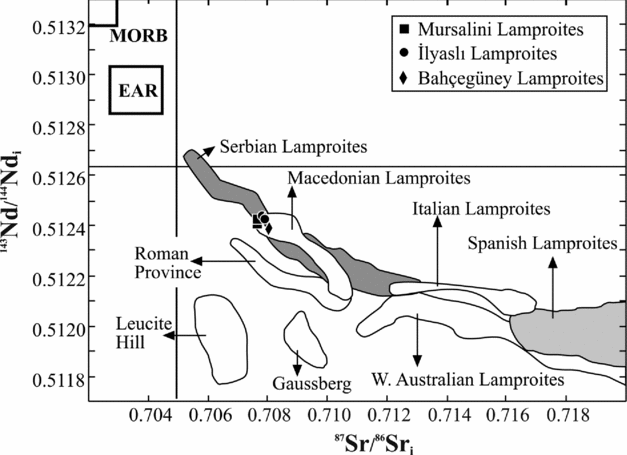
The Nd and Sr isotopic ratios of Afyon lamproites are reported in Table 2. They yield a range of high initial 87Sr/86Sr ratios (0.707703–0.708073) and low 143Nd/144Nd ratios (0.512380–0.512438). The samples plot in the enriched quadrant below bulk earth values and approach upper continental crustal values, which are typical for ultrapotassic rocks derived from either an enriched mantle or a mantle source contaminated by crustal material (Mitchell & Bergman, Reference Mitchell and Bergman1991). Afyon lamproites show similarity to other lamproitic rocks in Eastern Mediterranean ultrapotassic provinces. Their isotopic compositions overlap with lamproites from Macedonia and Serbia and have higher Nd and lower Sr isotopic ratios than Italian and Spanish lamproites and Roman Province ultrapotassic rocks (Fig. 11).
Nd–Sr isotope diagram (initial values) for Afyon lamproites. Also shown for comparison are fields for Serbian lamproites (Altherr et al. Reference Altherr, Meyer, Holl, Volker, Alibert, McCulloch and Majer2004; Prelević et al. Reference Prelević, Foley, Romer, Cvetković and Downes2005); Gaussberg (Murphy, Collerson & Kamber, Reference Murphy, Collerson and Kamber2002); Leucite Hills lamproites (Nelson, McCulloch & Sun, Reference Nelson, McCulloch and Sun1986); Italian lamproites and Roman Province (Conticelli et al. Reference Conticelli, D'Antonio, Pinarelli and Civetta2002); Spanish lamproites (Duggen et al. Reference Duggen, Hoernle, Van Den Bogaard and Garbe-Schonberg2005); West Australian lamproites (Fraser et al. Reference Fraser, Hawkesworth, Erlank, Mitchell and Scott-Smith1985); Macedonian lamproites (Altherr et al. Reference Altherr, Meyer, Holl, Volker, Alibert, McCulloch and Majer2004); MORB (Zindler & Hart, Reference Zindler and Hart1986); EAR – European asthenospheric reservoir (Cebria & Wilson, Reference Cebria and Wilson1995).
6. Discussion and conclusions
Lamproites within the Mediterranean region are part of the Alpine–Himalayan orogenic belt. They are common in the Mediterranean and are located in four regions: Italy (e.g. Venturelli et al. Reference Venturelli, Thorpe, Dal Piaz, Del Moro and Potts1984b; Peccerillo, Poli & Serri, Reference Peccerillo, Poli and Serri1988; Conticelli et al. Reference Conticelli, Carlos, Widom, Serri, Beccaluva, Banchini and Wilson2007), Spain (e.g. Venturelli et al. Reference Venturelli, Capedri, Di Battistini, Crawford, Kogarko and Celestini1984a; Benito et al. Reference Benito, Lopez-Ruiz, Cebria, Hertogen, Doblas, Oyarzun and Demaiffe1999; Duggen et al. Reference Duggen, Hoernle, Van Den Bogaard and Garbe-Schonberg2005), Serbia and Macedonia (Prelević et al. Reference Prelević, Foley, Romer, Cvetković and Downes2005; Altherr et al. Reference Altherr, Meyer, Holl, Volker, Alibert, McCulloch and Majer2004) and Turkey (e.g. Savaşçın & Oyman, Reference Savaşçin and Oyman1998; Francalanci et al. Reference Francalanci, Innocenti, Manetti and Savaşçin2000; Çoban & Flower, Reference Çoban and Flower2006).
Lamproitic rocks of the Mediterranean region are mainly related to subduction and collisional orogenic processes and/or are followed by an extensional regime resulting after the convergence of Africa and Eurasia. During subduction processes, the depleted lithospheric mantle source was affected by subduction-derived metasomatising agents (e.g. Nelson, McCulloch & Sun, Reference Nelson, McCulloch and Sun1986; Ellam et al. Reference Ellam, Hawkesworth, Menzies and Rogers1989; Peccerillo, Reference Peccerillo1992). The occurrences of lamproitic melts are explained either by partial melting of previously depleted lithospheric mantle metasomatically enriched by fluids or melts from earlier subduction processes or source contamination by subducted continental crustal material (e.g. Peccerillo, Reference Peccerillo1985, Reference Peccerillo1999, Reference Peccerillo2003; Rogers et al. Reference Rogers, Parker, Hawkesworth and Marsh1985; Beccaluva, Di Girolamo & Serri, Reference Beccaluva, Di Girolamo and Serri1991; Conticelli, Reference Conticelli1998, Conticelli et al. Reference Conticelli, D'Antonio, Pinarelli and Civetta2002, Reference Conticelli, Melluso, Perini, Avanzinelli and Boari2004; Altherr et al. Reference Altherr, Meyer, Holl, Volker, Alibert, McCulloch and Majer2004; Duggen et al. Reference Duggen, Hoernle, Van Den Bogaard and Garbe-Schonberg2005).
In the geodynamic history of the Aegean Sea and western Anatolia, the continental subduction–collision of the African Plate under the southern Eurasia Plate along the Hellenic and Cyprus arcs occurred during Middle–Late Miocene times (Fytikas et al. Reference Fytikas, Giuliani, Innocenti, Marinelli and Mazzuoli1976; Doglioni et al. Reference Doglioni, Agostini, Crespi, Innocenti, Manetti, Riguzzi and Savaşçin2002; Agostini et al. Reference Agostini, Doglioni, Innocenti, Manetti, Tonarini, Savaşçin, Beccaluva, Banchini and Wilson2007). This collisional phase was followed by an extensional tectonic regime which commenced during Late Miocene–Early Pliocene times in western Anatolia (Koçyiğit, Reference Koçyiğit1984; Dewey & Şengör, Reference Dewey and Şengör1979). Koçyiğit (Reference Koçyiğit1984) indicated that several NE–SW- and NW–SE-trending cross-graben and horst structures bounded by active normal faults dominate the area between Afyon and the Isparta Angle (Fig. 1). This period is also interpreted as the beginning of intra-plate rifting. Francalanci et al. (Reference Francalanci, Innocenti, Manetti and Savaşçin2000) argued that the alkaline magmatism was associated with an extensional tectonic phase and occurred along a N–S-trending tectonic line between Afyon to Isparta (Antalya fault zone).
The Afyon lamproites as defined by Foley et al. (Reference Foley, Venturelli, Green and Toscani1987) display many characteristics that are consistent with contamination of their mantle source by a subducted component. This indicates a role for subduction-related processes and modification of the mantle source by metasomatism. Afyon lamproites have relatively low Ti and Nb concentrations, and show strong enrichments of fluid-mobile elements (Rb, U, K, and Pb) relative to fluid-immobile, incompatible elements (Nb, Ta, Zr, Hf, REE) characteristic of magma generated in a subduction-related orogenic environment. This trace-element pattern indicates a crustal signature for Afyon lamproites. The negative Ti anomalies in the patterns suggest a Ti-rich accessory phase in their melting residues. Sr and Nd isotopic values plot in the enriched quadrant and overlap with lamproitic rocks from Serbia and Macedonia, suggesting a high amount of contamination by crustal components from a subducted slab in their source.
Serbian lamproites defined by the recent study of Prelević, Foley & Cvetković (Reference Prelević and Foley2007) are not contemporaneous with any subduction tectonics as Italian and Spanish lamproites are. According to these authors, the past subduction episodes have played a major role in conveyance of metasomatic inputs to the lithospheric mantle during collision. The alkaline melts of Serbian lamproites were produced by mantle mixing between the Serbian enriched mantle end-member (vein-material) and MORB-like end member (peridotite mantle) (Prelević, Foley & Cvetković, Reference Prelević, Foley, Cvetković, Beccaluva, Banchini and Wilson2007) (Fig. 12). According to this model, which is consistent with vein + wall-rock melting (Foley, Reference Foley1992b; Mitchell, Reference Mitchell1995), Afyon lamproites indicate consistency with end-member mixing models of Serbian lamproites which are located on mixing curves of the crustal end-member Sr and Nd isotopic variations for Serbian lamproites. Hence, such a situation may be interpreted to generate alkaline melts by a crustal end-member mixing model for Afyon lamproites during the post-collisional tectonic regime in western Anatolia.
Placement of Afyon lamproites on the 143Nd/144Nd v. La/Yb and 87Sr/86Sr v. Nb (ppm) diagrams of primitive samples of Serbian lamproitic rocks showing possible end-members to explain the isotopic variation in their source (Prelević et al. Reference Prelević, Foley, Romer, Cvetković and Downes2005).

In general, Mediterranean lamproites have the same mineralogical composition consisting of olivine + clinopyroxene ± orthopyroxene + K-richterite + phlogopite + sanidine ± leucite + apatite ± dalyite ± Cr/Zr-armacolite + ilmenite + rutile + magnetite + hematite + spinel (e.g. Altherr et al. Reference Altherr, Meyer, Holl, Volker, Alibert, McCulloch and Majer2004; Conticelli et al. Reference Conticelli, Carlos, Widom, Serri, Beccaluva, Banchini and Wilson2007; Prelević et al. Reference Prelević, Foley, Romer, Cvetković and Downes2005). The mineralogy of Afyon lamproites is characteristically similar to Mediterranean lamproites. Olivine is the main component of the Mediterranean lamproites. In olivines from Spanish and Italian lamproites, Fo contents are extremely high (82–94% and 85–94%, respectively). In Serbian lamproites, Fo content is widely variable (72–89%). The olivine phenocrysts from Afyon lamproites have low Fo and CaO contents (76–81% Fo). The very low calcium contents in olivine reflect the low level of CaO in the melt during magmatic differentiation or changes in melt composition during olivine crystallization (Libourel, Reference Libourel1999). Liquid experiments on Si-rich lamproites (e.g. Foley, Reference Foley1992a; Mitchell & Edgar, Reference Mitchell and Edgar2002) show that olivine is notably absent as a liquidus phase at pressures in excess of 10 kbar. The presence of olivine has been reported only at low pressures, to somewhere between 2 and 3.0 Gpa, according to Edgar & Mitchell (Reference Edgar and Mitchell1997), or 1.0 GPa according to Foley (Reference Foley1990). Foley (Reference Foley1992a) suggested that primary lamproitic magmas from leucite lamproite to olivine lamproite can be derived by partial melting of phlogopite harzburgite as a function of pressure between <15 and 60 kbar. Prelević, Foley & Cvetković (Reference Prelević, Foley, Cvetković, Beccaluva, Banchini and Wilson2007) explain that the extraction depth of Mediterranean lamproites from the mantle source is less than 60 km.
In conclusion, Afyon lamproites display many features of Mediterranean-type lamproites at post-collision–extension areas related to subduction processes controlled by low-pressure fractionation. Afyon lamproites require crustal and mantle components and modification by metasomatism for their origin. Mantle mixing between an enriched mantle end-member (vein-material) and MORB-like end member (peridotite mantle) seems the most likely model for the alkaline melt of Afyon lamproites during extension processes.
Acknowledgements
I wish to thank Dr Dejan Prelević for his stimulating discussions and suggestions. I thank Hilary Downes and Sandro Conticelli for constructive reviews that significantly improved the paper. Editorial handling by David Pyle was very helpful. Special thanks are due to Philippe D'Arco for microprobe analyses carried out in the Université Pierre et Marie Curie (Laboratoire de Petrologie-Mineralogique), Paris. Thanks also to Hubert Remy for organizing and providing the electron-microprobe analyses.



