I. INTRODUCTION
Wireless power supply (WPS) is motivated by the simple and comfortable use of many small electric appliances with a small power input in everyday life. WPS is being solved through a reduction of power consumption of appliances on the one hand and through an increase in efficiency in WPS systems on the other hand. Nowadays, the conventional means for power supply is by interconnecting an appliance with a power grid socket, either for permanent power supply or for accumulator charging. Both can be unsuitable or impractical in some cases. The cable connection restricts the movement of the appliance, whereas the external charger, which differs for various appliances, is usually necessary for accumulator charging. The main idea of WPS is delivering small electrical appliances with a power input up to several W from such restrictions, the implementation of a means for power supply as a standard equipment of future buildings and the wireless power transmission (WPT) to appliances for distances up to several meters.
The wireless power supply system (WPSS) chain consists of a power source, a “wireless” transmission medium, an appliance, and adaptors on both medium sites for securing efficient transmission, see Fig. 1. The adaptors usually include frequency converters as the frequency used for the transmission medium is different from the frequencies that are proper for the power source and the appliance.
WPS chain.

II. PRINCIPLES
The basic principles suitable for WPS are electromagnetic induction (EMI) and electromagnetic wave (EMW). The technology of WPT, which adheres to the principles of WPS, began to develop at the end of the 19th century. At the time, Nikola Tesla tried to transmit a significant amount of power with the help of the earth currents [Reference Tesla1]. In the following decades, different principles of WPT that differed in the amount of transmitted power and the distance of transmission were developed. A more important progress was made in the 1960s: EMW of several GHz frequency was proposed as a means of WPT [Reference Brown2] and demonstrated by powering a small pilotless helicopter from an earthbound base [Reference Brown3]. Subsequently, the same principle was suggested for the WPT from a solar collector on the earth's orbit to the earthbound base [Reference Glaser4]. These concepts were followed by the development of a special antenna with an integrated rectifier, which is called rectenna (rectifying antenna) [Reference Brown5]. In the 1960s, the concept of WPT by EMI at a frequency of several kHz for the powering of artificial hearts was introduced as well [Reference Fuller6]. This concept is conjoint with the advancement in high-efficiency switched sources [Reference Mohan, Undeland and Robbins7]. At the beginning of the 21st century, the solving of WPT through free space for the powering of appliances with a small power input in rooms was started [Reference Scheible, Schutz and Apneseth8, 9].
The use of the introduced principles will be explained further with examples. There are two main categories of WPSS that are suitable for the powering of appliances with a small power input in rooms. Two-dimensional (2D) and three-dimensional (3D) systems can be differentiated. The former allows the appliance to move along any surface that has different properties in comparison to free space, while the latter allows the appliance to move in free space. Both the surface and space serve as a transmission medium.
A) The printed circuit board (PCB) transformer with mobile secondary
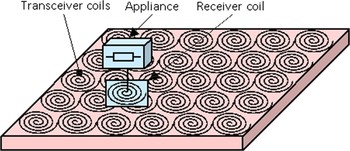
The PCB transformer with mobile secondary is a 2D system with the basic principle of EMI [Reference Jian and Yu10]. The working frequency of this system is about hundreds of kHz and the transmitted power ranges up to tens of W. The coupling surface, which serves as a transmission medium, consists of multilayer PCB arrays of transceiver coils connected to the power source. The appliance's receiver coil is connected to the load and the appliance can be placed on the surface at an arbitrary point, see Fig. 2. The system is based on an air gap coreless transformer, which is, for better transmission efficiency, tuned in resonance with the help of reactances connected to the transceiver and the receiver coil.
Scheme of PCB transformer with mobile secondary.

The 2D concept of WPS by EMI is apparently the most developed and is used in different types of chargers. The implementation differs in the arrangement of the transceiver and receiver coils system [Reference Hui and Ho11, Reference Casanova, Low and Lin12]. The purpose is to create a relatively homogeneous magnetic field in the area of the transceiver coils and thus to decrease the dependence on the mutual position of the transceiver and receiver coils. Mostly, flat single or multilayer coils with different conductor levies are used. The transceiver coils create a small facet or a whole surface and are mostly bigger than the receiver coil. There exist a lot of commercially available WPSS using this concept [13, 14].
B) Two-dimensional transmission (2DT) sheet
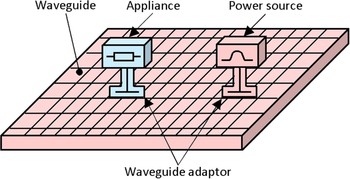
The 2DT sheet is a 2D system with the basic principle of EMW [Reference Shinoda, Makino, Yamahira and Itai15]. The working frequency of this system is about several GHz and the transmitted power goes up to a few W (the power delivered to the appliance is up to several mW). The coupling surface, serving as a transmission medium, is created by a dielectric slab waveguide with an all-metal bottom wall, while the top wall is represented by a metal grid, see Fig. 3. The power is coupled into the waveguide, propagates through the waveguide, and can be extracted at an arbitrary point by the appliance with the help of a resonant adaptor that violates the condition for power withholding in the waveguide. The same adaptor can also be used for waveguide excitation.
Scheme of 2DT sheet.

This concept is now in the stage of basic research. Besides excitation of the waveguide by the adaptor enclosed on its top wall, the waveguide can be excited by a connector on its edge [Reference Yamahira, Makino, Itai and Shinoda16]. The influence of the reflection or radiation at the end of a waveguide structure and homogeneity of the electromagnetic field has not been solved yet. Thus the received power depends on the position of the appliance.
C) WiTricity
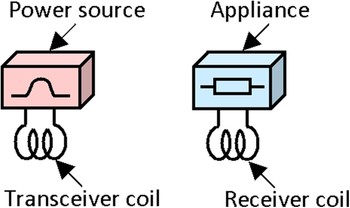
WiTricity, meaning wireless transmission of electricity, is a 3D system with the basic principle of strong coupled electromagnetic resonators with the help of EMI [Reference Kurs, Karalis, Moffatt, Joannopoulos, Fisher and Soljacic17]. The working frequency of this system is about several MHz and the transmitted power goes up to tens of W. The power is coupled through free space with the help of magnetic flux. The flux, which is emitted by the transceiver coil, goes through the receiver coil. The transceiver and receiver resonant circuits are represented by coils themselves and by their parasitic capacities (Fig. 4).
Scheme of WiTricity.

This concept of WPT by self-resonant coils is now in the stage of basic research. A similar commercially available system is based on a pair of orthogonal transceiver Helmholtz coils with a relatively homogeneous rotating magnetic field, which surrounds the determined space [Reference Scheible, Schutz and Apneseth8, 18]. The receiver coil, which is considerably smaller than the transceiver coil, is created by three orthogonal loops, which together with the homogeneity of the field decrease the dependence on the mutual position of the transceiver and receiver coils.
D) Rectenna
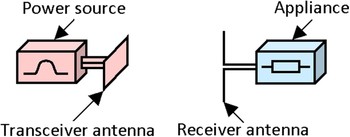
A system that uses a rectenna is a 3D system with the basic principles of EMW [Reference Brown3] (Fig. 5). The working frequency of this system is about several GHz and the transmitted power ranges up to several W (the power delivered to the appliance is up to hundreds of µW). Power is delivered through free space between the transceiver and receiver antennas in the form of waves in a similar manner to radio communication transmission (Fig. 5). The space is covered by the transceiver antenna with a certain level of power density. The receiver antenna is designed to harvest the maximum energy at the point where it is placed [Reference McSpadden, Fan and Chang19]. The receiver antenna is usually connected directly to the rectifying circuit, which converts RF power to DC power.
Scheme of system that uses rectenna.

The research in the field of rectenna is mostly aimed at the construction of a receiver antenna with a high-efficiency integrated rectifier. The receiver antenna is usually any modification of dipole in planar structure, and in some cases it is designed as a dual band including the rectifier [Reference Suh and Chang20]. The rectennas are connected in an array for high power level reception [Reference Ren and Chang21]. However, this is not practical with respect to the increasing dimension of the receiver antenna. The problem of the transceiver antenna has not been fully solved. There is only an assumption that the transceiver antenna covers the determined space with a certain level of power density. The dependence of the received power on the mutual arrangement of the transceiver and the receiver antenna is not discussed either. Commercially available systems using this concept already exist [9].
III. COMPARISON
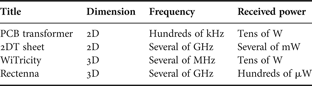
The frequency and the power properties of the mentioned systems are summarized in Table 1. It is hard to estimate the exact value of efficiency as it depends in particular on the distance between the power source and the appliance, on the frequency, and also on other objects in the considered area. From the transmission efficiency point of view, the systems can be qualitatively compared as follows. The PCB transformer has the best efficiency because power is collected in the surroundings of the coupling surface and because of the EMI principle with real power flow existing only if the appliance is presented. WiTricity has the second best efficiency because there is again real power flow only if the appliance is presented, but power is scattered in space and the coupling can be weaker in the case of longer distances. Thus with respect to efficiency, the 2DT sheet follows next. In the case of the 2DT sheet, there is collected power in its surroundings but real power flow exists even if the appliance is not presented because of the guided wave. Finally, rectenna has the worst efficiency because there is real power flow even if the appliance is not presented, power is scattered in space by radiated wave, and only a small portion of power is delivered to the appliance. On the other hand, rectenna can be a suitable choice when the electromagnetic power is to be harvested from the space where it is presented as a waste product (from the rectenna point of view) of any electromagnetic phenomena, i.e. radio communication transmission.
Comparison of WPS systems.

The main reason for the decrease in efficiency, which is directly conjoined with the principle of WPT through EMI and EMW, respectively, is ohmic losses in the conductors of the transceiver and receiver coils [Reference Waffenschmidt and Staring22] and losses due to the scattering of power [Reference Ahmed, Yeong and Ahmad23]. Ohmic losses are issues of cross section, length and material of coils conductor, and frequency. They can be decreased up to a certain level by a suitable choice of the mentioned parameters without changing the shape of the coils' magnetic field. The losses due to the scattering of power are caused by an increase of the wave front with growing distance from a source. They can be decreased by restriction of the angle in which the power is directed but the shape of the electromagnetic field is changed and this is in contradiction with the decrease of dependence on the mutual position of the source and appliance.
The frequency band for WPT adheres to the conservation of electromagnetic field character with respect to the dimensions of particular elements in the transmission chain. This means for WPT by EMI/EMW, the wavelength has to be considerably bigger than/comparable with the elements of the transmission chain. In the case of EMI, efficiency decreases for very low frequency or very high frequency as a result of ohmic losses or losses due to radiation. Thus as a compromise, a suitable frequency band is from to hundreds of kHz to several MHz [Reference Scheible, Schutz and Apneseth8, Reference Kurs, Karalis, Moffatt, Joannopoulos, Fisher and Soljacic17]. In the case of EMW, very low frequency leads to an excessively big and impractical dimension of elements in the transmission chain and low radiation efficiency of the wave. On the other hand, very high frequency leads to significantly small demanding production dimension, an increase in losses due to scattering of power, and problems with the implementation of the power generator. Hence as a compromise, a suitable frequency band responds to several GHz [Reference Shinoda, Makino, Yamahira and Itai15, Reference McSpadden, Fan and Chang19].
From the point of view of a shading transmission path between a source and an appliance and the influence of extraneous objects to transmission, WPT by EMI is more resistant than WPT by EMW [Reference Karalis, Joannopoulos and Soljacic24]. Most objects in the room have a dielectric character. In the case of EMI, magnetic field distribution can be influenced by metal and ferromagnetic objects in which eddy currents are excited and which bend the magnetic field, respectively. In the case of EMW, all objects in the transmission path cause scattering and diffraction of the wave. From the system dimension point of view, WPT for 2D systems where the electromagnetic field is concentrated in the proximity of the surface is less influenced. Generally, it can be said that the extraneous objects rather cause scattering and refraction of the electromagnetic field than its absorption because power reception in all systems is based on the resonant principle.
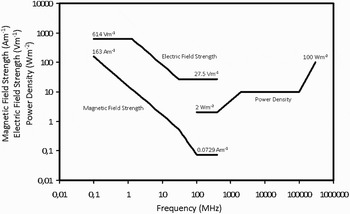
The systems developed by the academic community, which are in the stage of basic research, do not take safety and electromagnetic compatibility standards much into account. More critical for standards fulfillment are 3D systems where WPT is accomplished in the free space. Commercially available systems that use EMI [Reference Scheible, Schutz and Apneseth8] or EMW [9] feature values of magnetic field strength 6 A/m at 120 kHz or power density 1 W/m2 at 915 MHz, which are in accordance with the IEEE standard for safety levels [25], see Fig. 6. From the electromagnetic compatibility standards point of view, the WPSS through EMI and EMW are mostly designed for free usable frequencies from ISM bands [Reference Scheible, Schutz and Apneseth8–Reference Jian and Yu10, Reference Shinoda, Makino, Yamahira and Itai15].
IEEE standard for safety levels with respect to human exposure to radio frequency electromagnetic fields.

Ready to use implementation for wholesale manufacturing and integration into small electric appliances are known for receiving parts of different WPSS. In the case of 2D systems using EMI, the receiver coils can be made as PCB [Reference Jian and Yu10]. In the case of 3D systems using EMI and EMW, are they commercially available as a block which can be connected additionally to the appliance [9, 18]. The cost of such an appliance is discussible. The chargers using EMI should have costs similar to conventional chargers with respect to the competitive advantage [26]. The 3D systems using EMI and EMW, which are able to transmit a small amount of power, are aimed at sensor networks with small power consumption at this moment. They can be profitable in case of powering many sensors, where accumulators, their replacement or cable connection, are not economical [Reference Scheible, Schutz and Apneseth8].
IV. CONCLUSION
Different types of WPSS were introduced for an explanation of the basic principles suitable for WPS of devices with a small power input in rooms. The next development will depend on safety limits for the electromagnetic field and the power needed for these appliances.
The goal is to create either a system with high efficiency, where electromagnetic energy is directed predominantly from the power source only to the appliance and only if the appliance is presented, or a system that can harvest the maximum electromagnetic energy from the point where it is placed. Important issues are the increase of the transmission distance and the transmitted power levels.
The research performed by us is aimed at the two systems based on the induction principle and the wave principle. Apart from the transmission efficiency, two important problems are investigated, namely the development of a smaller and simpler construction of a wireless power receiver for better integration into electronic appliances and the proposal of such a system concept in which power received by the appliances is only minimally dependent on the appliance position with respect to the power source.
ACKNOWLEDGEMENTS
This work was supported by the Czech Ministry of Education, Youth, and Sports within the framework of the project OC09075 Novel Emerging Wireless Systems (NEWS) (in the frame of COST IC0803 RF/Microwave Communication Subsystems for Emerging Wireless Technologies – RFCSET) and by the Grant Agency of the Czech Republic (doctoral grant 102/08/H018, Modeling and Simulation of Fields).
 Jan Kracek was born in Slany, Czech Republic, in 1984. He received his M.Sc. from the Czech Technical University in Prague in 2008. He is a member of the IEEE and the Radioengineering Society. His research interests include wireless power transmission and antennas.
 Milos Mazanek was born in Tanvald, Czech Republic, in 1950. He received his M.Sc. and Ph.D. from Czech Technical University in Prague in 1974 and 1980, respectively. Since 2000, he has been a full professor at Department of Electromagnetic Field of Czech Technical University in Prague. He has been the head of the department since 1997, a senior member of the IEEE, the head of the Radioengineering Society and the National Czech URSI Committee. His research interests include antennas, propagation, radiometry, and electromagnetic compatibility.