Decades of research have focused on the intergenerational transmission of stress and adversity from parents to children, elucidating risk factors that propagate the cycle of maltreatment, violence, and other forms of trauma within families (Ertem, Leventhal, & Dobbs, Reference Ertem, Leventhal and Dobbs2000; Sroufe, Egeland, Carlson, & Collins, Reference Sroufe, Egeland, Carlson and Collins2005; Widom & Wilson, Reference Widom, Wilson, Lindert and Levav2015). There is much less research on protective factors that buffer against the transmission of trauma from the childhoods of parents to the childhoods of their offspring. Research on protective factors that alleviate parenting disturbances and break the cycle of abuse mostly focuses on parents’ interpersonal resources, such as support from their romantic partners and therapeutic interventions that promote “meaning-making” of past abuse and foster positive parent–child relationships (Egeland & Eriksen, Reference Egeland, Erickson, Sameroff, McDonough and Rosenblum2004; Egeland, Jacobvitz, & Sroufe, Reference Egeland, Jacobvitz and Sroufe1988; Geeraert, van den Noortgate, Grietens, & Onghena, Reference Geeraert, van den Noortgate, Grietens and Onghena2004; Lieberman & Van Horn, Reference Lieberman and Van Horn2008; Raby, Steele, Carlson, & Sroufe, Reference Raby, Steele, Carlson and Sroufe2015; Roisman, Padrón, Sroufe, & Egeland, Reference Roisman, Padrón, Sroufe and Egeland2002).
Very little research has identified protective factors within the parent that are not contingent exclusively on the contributions of others. This study focuses on “angels in the nursery,” defined as individuals’ capacity to recall memories of loving moments with their caregivers. Although angel memories may stem at least in part from actual interpersonal experiences, the qualities that characterize how they are recalled (e.g., the clarity, coherence, richness, and specificity of the descriptions) are believed to vary as a function of individual differences and the unique meaning and salience of the memories for the specific individual. Individuals who can hold onto benevolent childhood memories when they become parents may be able to draw internal resources from these memories and re-create positive caregiving moments with their offspring as buffers against the intergenerational transmission of adversity (Lieberman, Padrón, Van Horn, & Harris, Reference Lieberman, Padrón, Van Horn and Harris2005). The theoretical basis for these premises is rooted in the literature on psychological defenses elaborated by psychoanalytic infant mental health contributions (Fraiberg, Reference Fraiberg1980) and attachment theory (Bowlby, Reference Bowlby1980).
Background of Angels in the Nursery
The concept of “angels in the nursery” emerged as a counterpart to the metaphor of “ghosts in the nursery” (Fraiberg, Adelson, & Shapiro, Reference Fraiberg, Adelson and Shapiro1975), which describes the conflicted affects stemming from a parent's unresolved childhood experiences of impaired caregiving that are suppressed and later reenacted with the parent's offspring. These “ghosts in the nursery” are often elicited by the young offspring's displays of distress, fear, anger, or other negative affects that trigger the parents’ often unconscious recollections of their suppressed or compartmentalized early affective experiences. Alternatively, the term “angels in the nursery” describes a parent's memories of loving childhood experiences with a caregiver that may serve as guiding models for nurturing the parent's offspring (Lieberman et al., Reference Lieberman, Padrón, Van Horn and Harris2005). These benevolent memories may coexist with memories of fear and distress in relation to childhood caregivers and may persist into adulthood in spite of childhood adversities and unresolved trauma.
The first evidence of “angels in the nursery” originated in clinical self-descriptions of mothers receiving child–parent psychotherapy (CPP) with their young children following experiences of intimate partner violence. Several of the mothers reported that they were able to maintain positive parenting because they remembered childhood experiences of love and support that sustained them despite simultaneous or subsequent experiences of violence and victimization (Lieberman et al., Reference Lieberman, Padrón, Van Horn and Harris2005; Lieberman & Van Horn, Reference Lieberman and Van Horn2008). Clinical case studies also illustrate that remembering angel memories enables traumatized parents to bring moments of love, compassion, and safety to their children, resulting in therapeutic benefits (Narayan, Oliver Bucio, Rivera, & Lieberman, Reference Narayan, Oliver Bucio, Rivera and Lieberman2016).
“Angel memories” are assessed using the Angels in the Nursery Interview (abbreviated here to “Angels Interview”), which prompts respondents to “think of a memory of a time when you were little when you felt especially loved, understood, or safe” (Van Horn, Lieberman, & Harris, Reference Van Horn, Lieberman and Harris2008; Narayan, Ghosh Ippen, Harris, & Lieberman, Reference Narayan, Ghosh Ippen, Harris and Lieberman2017). Memory narratives are audio-recorded, transcribed, and later coded by trained raters for positive valence, elaboration, richness, and specificity (Ghosh Ippen, Narayan, Van Horn, & Lieberman, Reference Ghosh Ippen, Narayan, Van Horn and Lieberman2015). An example of a positive and elaborated angel memory (i.e., one that is specific and richly detailed) receiving a high score of 4 out of 5 is “My grandfather always made me feel understood because he was so patient. I had a lot of imaginary friends, and he humored me. One time when we were driving, I was worried about my imaginary friend, and I said, ‘Joey forgot his shoe.’ My grandfather turned the car right around to retrieve the lost imaginary shoe.” A slightly lower score of 3, which is the most frequent score, reflects memories of generally feeling loved without providing specific examples, such as, “I always felt loved when I was little. I don't have an exact memory because the feeling was always there.”
Angel memories are conceptualized as independent but related constructs to other well-validated assessments of positive early life experiences. For instance, the Adult Attachment Interview (Main & Goldwyn, Reference Main and Goldwyn1984a, Reference Main and Goldwyn1984b) assesses internalized representations of attachment security or insecurity with childhood caregivers. Rather than internal working models of attachment that shape relational expectations, however, angel memories are specific recollections of concrete moments characterized by love, tenderness, and protection. For instance, although the generalized feeling of being loved in the latter example above may be considered as dismissive or idealized on the Adult Attachment Interview because it lacks supporting details, it is given a score in the moderate range on the Angels Interview because it denotes an internal state where defenses against affect do not interfere with an organized state of mind that involves feeling loved (Bowlby, Reference Bowlby1988).
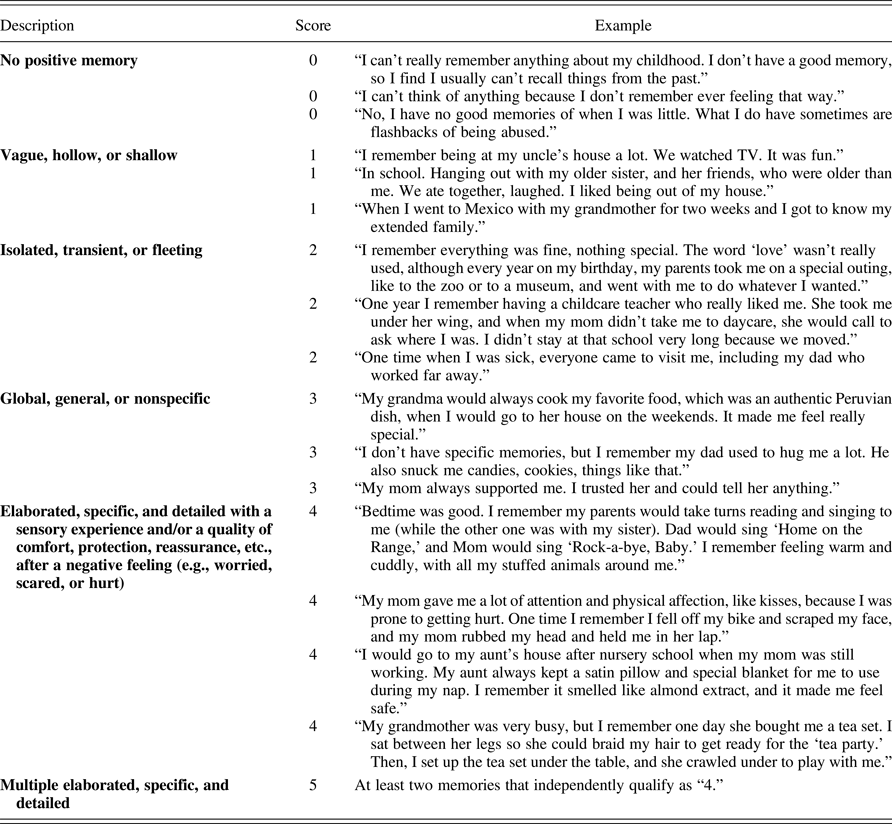
While many parents are readily able to recall angel memories following the opening Angels Interview prompt, some parents who experienced childhood adversity are not able to recall any memory of feeling loved with a caregiver. Pilot findings (Narayan et al., Reference Narayan, Ghosh Ippen, Harris and Lieberman2017) showed that in a sample of 54 mothers reared in foster care, approximately 15% were unable to recall any angel memories and received scores of 0 for angel memory quality (see Table 1 for examples of all possible scores). Of note, angel memory scores were not associated with the severity of childhood maltreatment in that sample, suggesting that access to more positive, elaborated angel memories is not merely a function of having experienced less severe childhood maltreatment.
Examples of angel memories ranging in scores from 0 to 5

Although it is likely that having frequent and consistent childhood experiences of positive caregiving may provide a respondent with a greater reservoir of angel memories to draw from, it is often the case that respondents describe richly elaborated angel memories despite also reporting childhoods characterized by predominantly chronic and severe adversity. The role of psychic defenses in how individuals organize their experience of reality has been extensively discussed in psychoanalytic theory and attachment theory, both of which share a common root in acknowledging the ubiquity of psychological conflict as the result of incompatibilities between competing motivations and resulting thoughts and affects (Fonagy, Gergely, & Target, Reference Fonagy, Gergely, Target, Cassidy and Shaver2008). It is possible that some individuals are able to derive great comfort and long-term benefit from even fleeting or inconsistent experiences of feeling loved and protected, whereas other individuals fend off positive memories because their sense of self and their perception of their caregivers are organized around their experiences of stressful and traumatic interpersonal events.
Memory is fluid, and angel memories that are initially inaccessible due to defensive processes may emerge in the course of therapeutic work that supports an exploration of the emotional impact of adversity and trauma. CPP has been helpful in facilitating recall of positive and elaborated angel memories in mothers who were not able to recall any angel memories during the initial assessment before starting psychotherapy (Narayan et al., Reference Narayan, Oliver Bucio, Rivera and Lieberman2016). Resolving and healing from childhood adversity during the course of CPP or other trauma-informed interventions may provide access to angel memories by unblocking defensive processes such as deactivating (dismissing or avoidant) attachment strategies and by segregating mental systems to exclude painful affective memories from consciousness (Bowlby, Reference Bowlby1980).
The Current Study
The present study aimed to replicate and extend pilot evidence from a study that empirically tested angels in the nursery as protective factors that buffer against the intergenerational transmission of trauma in high-risk families (Narayan et al., Reference Narayan, Ghosh Ippen, Harris and Lieberman2017). In the pilot study of 54 mothers reared in childhood foster care, more positive and elaborated angel memories were buffers against the association between mothers’ childhood maltreatment and their adulthood posttraumatic stress disorder (PTSD) symptoms. The first aim of the present study was to determine whether angel memories also buffered against the association between mothers’ childhood maltreatment and their current PTSD symptoms in a larger, multiethnic, multilingual sample. We hypothesized that mothers’ angel memories would moderate the association between their childhood maltreatment and their total PTSD symptoms, consistent with protective effects.
The second aim was to examine whether angel memories also buffered against the association between childhood maltreatment and other forms of adulthood psychopathology because childhood trauma is typically associated with psychiatric comorbidities (Putnam, Harris, & Putnam, Reference Putnam, Harris and Putnam2013). We examined additional forms of psychopathology, including depression symptoms and comorbid psychopathology (defined as clinical levels of PTSD and depression symptoms). We expected that more positive and elaborated angel memories would also buffer against the association between mothers’ childhood maltreatment and their depression symptoms and comorbid psychopathology.
The third aim was to examine the protective effects of angel memories in the link between mothers’ childhood maltreatment and their children's trauma exposure. The pilot study did not include the participants’ children, precluding the ability to ascertain the intergenerational protective effects of angel memories on the parents’ offspring. In the current study, we hypothesized that mothers’ more positive and elaborated angel memories would moderate the association between their childhood maltreatment and their children's exposure to traumatic events, again reflecting protective effects.
The fourth and final exploratory aim was to examine whether significant moderation of mothers’ angel memories in the link between their childhood maltreatment and their children's trauma exposure differed by the child's sex. Previous research indicates that there are sex differences in the types of trauma transmitted to male versus female offspring of parents who were maltreated as children. For instance, the intergenerational transmission of childhood sexual abuse is particularly apparent from mothers to daughters (McCloskey & Bailey, Reference McCloskey and Bailey2000). Mothers who were maltreated as children also show sex-specific abusive and punitive parenting of their offspring, such that mother–son relationships tend to include higher levels of boundary violations in physical intimacy, whereas mother–daughter relationships often include higher levels of derisiveness and belittling (Shaffer & Sroufe, Reference Shaffer and Sroufe2005). Despite these sex-specific patterns of risk transmission, it is not known whether sex-specific patterns of protection also exist. Exploring sex differences was included as a goal of the study because of the dearth of research on this aspect of intergenerational resilience.
Method
Participants
The study participants were 185 biological mothers (M age = 30.67 years, SD = 6.44, range = 17–46 years) who self-identified as Latina (54.6%), White (17.8%), African American (10.3%), biracial/multiracial (9.2%), Asian (5.4%) or other (2.7%). Almost one quarter of the mothers (23.8%) were monolingual Spanish speaking. Mothers reported an average educational attainment of less than a high school degree (M = 11.28 years, SD = 2.70, range = 1–13 years) and predominantly low-income status (M average monthly income = $1,873.30, SD = $2,192.19, range = $0–$16,000), with 75% of the sample reporting an average income of ≤$2,000 per month. Mothers were referred for clinical services (CPP) at a university-affiliated clinical research program at an urban public hospital following their young children's (ages 0–6 years) exposure to a traumatic event (e.g., exposure to family or community violence, direct child maltreatment, serious illness, incarceration of a family member, death of someone close, etc.). The child for whom the mother was seeking services was the target child in this study (51.4% male, M = 42.51 months, SD = 15.95, range = 3–72 months; 50.8% Latina, 18.9% biracial/multiracial, 14.1% White, 10.3% African American, 4.3% Asian, 1.6% other). Families were referred to the study by sources including but not limited to mental health service providers, case managers, child welfare workers, primary care providers, other clients, and self-referrals.
Prior to receiving CPP, mothers and children participated in an extensive pretreatment assessment, which served as the source of data for the current study. Mothers completed standardized instruments on life events, including their childhood maltreatment, current psychopathology symptoms (i.e., PTSD and depression), their children's lifetime exposure to traumatic events, demographic and contextual information for covariate variables, and the Angels Interview, which was audio-recorded and later coded by trained raters. Trained master's- or doctoral-level clinical researchers conducted all assessments in mothers’ preferred language of English or Spanish. The institutional review board at the University of California, San Francisco, approved all study procedures, and mothers provided informed consent for themselves and their children prior to enrolling. Mothers received honoraria to compensate them for completing the assessment, and children received small toys.
Measures: Primary variables
Angel memories
Mothers completed the Angels in the Nursery Interview, which consists of seven standardized questions that ask participants to think of “a memory of a time when you were little when you felt especially loved, understood, or safe.” Follow-up prompts probe about the age of the memory, sensory details (e.g., smells, sights, sounds, or other sensations connected with the memory), and additional memories with the same or different childhood caregivers or attachment figures that also elicit feelings of being loved, understood, or safe (Narayan et al., Reference Narayan, Ghosh Ippen, Harris and Lieberman2017; Van Horn et al., Reference Van Horn, Lieberman and Harris2008). Thus, respondents are given several opportunities to generate memories, and their final angel memory score reflects the memory that is the most positive and elaborated. For example, a mother who described two memories, one qualifying as a “3” and one qualifying as a “4,” would receive a final score of 4.
The Angels Interview typically requires 10–15 min to administer and comparable time to code, following approximately 8 hr of training. Trained coders, one of whom was bilingual and a native Spanish speaker, reviewed the memory narratives and assigned scores on a 6-point scale for total memory quality. According to the coding manual (Ghosh Ippen et al., Reference Ghosh Ippen, Narayan, Van Horn and Lieberman2015), higher scores prototypically reflect angel memories that are more positive, specific, elaborated, and detailed, and include the presence of either (a) a sensory experience that adds to the quality of the memory (e.g., being hugged or held, smelling a scent such as perfume or food associated with a loving caregiver), or (b) reassuring feelings, such as comfort or protection, in the context of feeling sad, lost, threatened, or some other negative emotion. (See Table 1 for descriptions of angel memories and examples of responses receiving each score.) Interrater reliability for angel memories was excellent (intraclass correlation coefficient = .92).
Mothers’ childhood maltreatment
Mothers completed the Life Stressors Checklist—Revised (Wolfe, Kimerling, Brown, Chrestman, & Levin, Reference Wolfe, Kimerling, Brown, Chrestman, Levin and Stamm1996), composed of 30 adversities, such as childhood maltreatment, as well as noninterpersonal stressors (e.g., experiences of natural disasters, car accidents, physical illness, etc.). The present study relied on maternal endorsement of five maltreatment subtypes occurring between ages 0 and 17: emotional abuse/neglect (being “frequently shamed, embarrassed, ignored, or repeatedly told you were ‘no good’”; n = 83, 44.9%); physical neglect (being “not fed, properly clothed, or left to take care of oneself when too young or ill”; n = 46, 24.9%); exposure to interparental violence, often considered a form of emotional abuse (Holt, Buckley, & Whelan, Reference Holt, Buckley and Whelan2008; seeing “violence between family members, e.g., hitting, kicking, slapping, and punching”; n = 102, 55.1%); physical abuse (being abused or physically attacked, e.g., hit, slapped, choked, burned, or beat up”; n = 86, 46.5%); or sexual abuse (having ever been “touched or made to touch someone else in a sexual way because he/she forced you in some way or threatened to harm you if you didn't” or had “sex [oral, anal, genital] when you didn't want to because someone forced you in some way or threatened to harm you if you didn't”; n = 99, 53.5%). Scores on maternal maltreatment ranged from 0 to 5 (M = 2.27, SD = 1.68). For analyses, these five items were summed for total experiences of childhood maltreatment.
Mothers’ PTSD symptoms
Mothers completed the Davidson Trauma Scale (DTS; Davidson et al., Reference Davidson, Book, Colket, Tupler, Roth, David and Feldman1997), a standardized instrument that assesses 17 self-reported PTSD symptoms in the past week. Items are rated on 0- to 4-point frequency scales ranging from not at all to every day (total frequency scores range from 0 to 68) and severity scales from not at all distressing to extremely distressing (total severity scores range from 0 to 68). According to standard procedures, frequency and severity scales are combined to yield a total raw score ranging from 0 to 136 for total PTSD symptoms (M = 47.89, SD = 29.94; range = 0–125; α = 0.94).
Maternal depression symptoms
Mothers completed the Beck Depression Inventory, Second Edition (BDI-2; Beck, Steer, & Brown, Reference Beck, Steer and Brown1996), which assesses 21 self-reported depression symptoms in the past 2 weeks on 0- to 3-point frequency scales. Total scores range from 0 to 63. Analyses used the raw score for total depression symptoms (M = 17.17, SD = 11.45, range = 0–50; α = 0.92).
Maternal comorbid psychopathology
A comorbid psychopathology score was calculated by determining whether mothers met criteria for clinical levels of PTSD and depression diagnoses according to the DTS and the BDI-2, respectively. For clinical PTSD, DTS scores were dichotomized at ≥40 to reflect the “efficiency cutoff” recommended by the developers (Davidson et al., Reference Davidson, Book, Colket, Tupler, Roth, David and Feldman1997). This score of ≥40 corresponds to the score at which participants in the original validity study were diagnosed with PTSD based on the Structured Clinical Interview for the DSM-III-R (Spitzer, Williams, Gibbon, & First, Reference Spitzer, Williams, Gibbon and First1990). For clinical depression, BDI-2 scores were dichotomized at ≥10 to reflect at least mild to moderate depression, based on recommendations from developers (Beck, Steer, & Carbin, Reference Beck, Steer and Carbin1988). Dichotomized clinical-level PTSD and depression scores were added, yielding a comorbid psychopathology score: 0 (neither clinical PTSD nor depression, n = 35; 18.9%), 1 (either clinical PTSD or depression, n = 49; 26.5%), or 2 (both, n = 77; 41.6%).
Children's exposure to traumatic events
Mothers completed the Traumatic Events Screening Inventory—Parent Form, Revised (Ghosh Ippen et al., Reference Ghosh Ippen, Ford, Racusin, Acker, Bosquet, Rogers and Edwards2002), which assesses child exposure to 23 different lifetime traumatic events including child maltreatment, exposure to family and community violence, accidental injury, incarceration or loss/separation from caregivers, and other adversities. A sum of total traumatic event exposure was computed (M = 5.71, SD = 2.61, range = 0–15).
Measures: Covariates
Demographics
Several demographic covariates were gathered from the maternal assessment and used in the analyses, including mothers’ preferred language (English or Spanish), maternal age, average monthly income, and educational attainment; and child age and sex. There was a wide distribution of maternal educational attainment from first grade through postsecondary education. Given the skewness in this variable, educational attainment was trichotomized into three groups: less than a high school education (n = 51; 27.6%), high school degree or equivalent (n = 42; 22.7%), and at least some college (n = 84; 47.6%).
Maternal stress
Given that mothers were the primary informants on all variables except for coder-rated angel memories, maternal stress at the time of the assessment was controlled using the parental distress subscale of the 36-item Parenting Stress Index, Short Form, Version 3 (Abidin, Reference Abidin1990). This subscale assesses general parental stress in the parenting role on 0- to 5-point scales from strongly agree to strongly disagree (M = 31.18, SD = 10.19, range = 12–60; α = 0.89). Raw scores were used as covariates. (Of note, raw scores ≥31 correspond to ≥85th percentile according to the developers and reflect substantially elevated parental stress, which was present in 42.7% [n = 79] of this sample.)
Data analytic plan
All hypotheses were tested using hierarchical linear regressions with interaction terms, yielding four total regressions: maternal PTSD symptoms, depression symptoms, and comorbid psychopathology; and children's exposure to traumatic events. Spanish language was considered a theoretical covariate and included as a control variable in all analyses because this is the first empirical study to examine the protective effects of angel memories in multilingual families. Thus, it was important to examine whether protective effects held after accounting for potential associations between maternal language and maternal/child outcomes. Maternal stress was also considered a theoretical covariate and was included in all regressions to observe whether findings held after accounting for mothers’ stress levels because they provided reports on all of the other variables. Given the overlap between maternal stress and the three psychopathology outcomes (particularly depression symptoms), all analyses were conducted with and without maternal stress as a covariate, and all results remained the same regardless. The results below are presented with maternal stress included.
Additional covariates (e.g., maternal age, educational attainment, and average monthly income; and child age and sex) were considered to be empirical covariates (i.e., potentially sample-specific and not conceptually presumed to necessarily relate to outcomes). These covariates were included in analyses when they were significantly associated with any of the maternal or child outcomes at the bivariate level. For each regression, significant covariates were entered in the first step, main effects (i.e., maternal childhood maltreatment and angel memories, z-scored) were entered in the second step, and the interaction of maternal maltreatment and angel memories was entered in the third step. All regression results were examined for any influential cases according to Cook's d ≥ 4/n (Cook & Weisberg, Reference Cook and Weisberg1982; Rawlings, Reference Rawlings1988). No influential cases significantly affected any of the results reported below. Significant interactions were probed with the Johnson–Neyman technique (Hayes & Mattes, Reference Hayes and Matthes2009) to examine significant simple slopes of the outcome on maternal childhood maltreatment at different values of the moderator, angel memories.
Missing data
Missing data were minimal and ranged from 0% on most demographic covariates, angel memories, and children's trauma exposure; to approximately 2%–4% on maternal stress, average monthly income, and educational attainment; to 13.0% on certain maternal outcomes (e.g., comorbid psychopathology). The total percentage of missing data across the entire data set was only 3.6%. Data were assumed to be missing at random. Twenty data sets were imputed with fully conditional specification in SPSS Version 24.0 (Rubin, Reference Rubin1987; Schafer & Graham, Reference Schafer and Graham2002), and all regression analyses were reconducted using results pooled across the 20 imputed data sets. All raw and imputed results were compared, and no differences in the pattern of findings were noted; thus, all of the results reported below reflect the raw data.
Results
Descriptive statistics
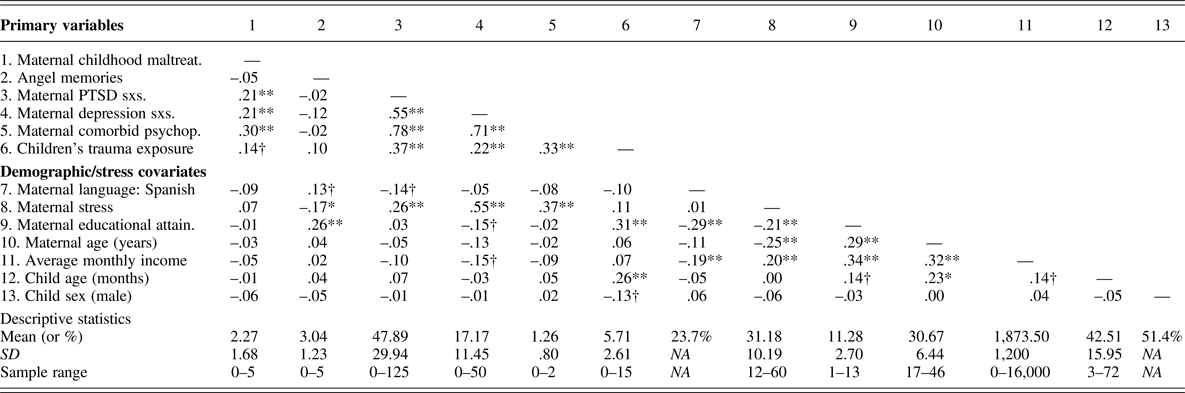
Rates of mothers’ childhood maltreatment were high, with 149 mothers (80.5%) reporting at least one subtype of childhood maltreatment, and 24 mothers (13.0%) reporting all five subtypes. Table 2 presents bivariate correlations, means, standard deviations (SD), and sample ranges for all study variables. Higher levels of maternal childhood maltreatment were significantly associated with higher levels of PTSD symptoms, (r = .21, p < .01), depression symptoms (r = .21, p < .01), and comorbid psychopathology (r = .30, p < .01), and were marginally significantly associated with higher levels of children's trauma exposure (r = .14, p < .10). However, higher levels of childhood maltreatment were not significantly associated with less positive angel memories (r = –.05, p = ns).
Bivariate correlations and descriptive statistics for all study variables

Note: Maltreat., maltreatment. Sxs., symptoms. Psychop., psychopathology. Attain., attainment. *p < .05. **p < .01. †p < .10.
In terms of empirical covariates, higher maternal educational attainment was marginally significantly associated with lower maternal depression symptoms (r = –.15, p < .10) and significantly associated with higher offspring trauma exposure (r = .31, p < .01), so educational attainment was included in regressions predicting to those outcomes. Higher maternal average monthly income was marginally significantly associated with lower maternal depression symptoms (r = –.15, p < .10), so income was also included in the regression predicting to depression symptoms. Maternal age was not significantly associated with any outcome, so it was not included in the regression analyses. Older child age was significantly positively correlated with greater child trauma exposure (r = .26, p < .01), and child male sex was marginally negatively associated with child trauma exposure (r = –.13, p < .10), so both variables were included in that regression.
Regression analyses
Maternal PTSD symptoms
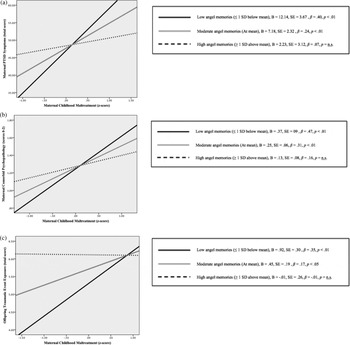
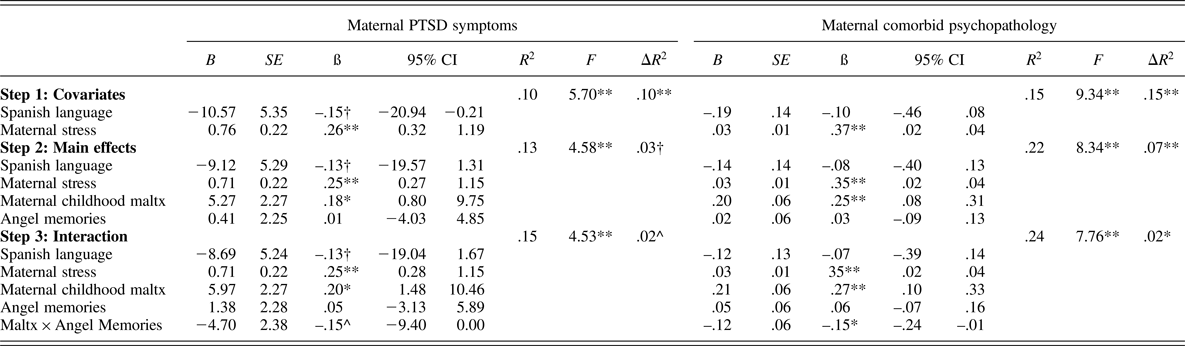
Higher levels of maternal childhood maltreatment significantly predicted higher levels of mothers’ PTSD symptoms, revealing a main effect of maltreatment (β = .20, p < .05). There was a significant interaction of Maltreatment × Angel Memories (β = –.15, p = .05) in predicting PTSD symptoms (Table 3). (The p value for this interaction dropped below .05 according to the imputed results, the results without influential cases, and the results without maternal stress controlled). The interaction of Maltreatment × Angel Memories independently added a small but significant amount of variance in the final step of the model, ΔR 2 = .02, p = .05. In terms of covariates, Spanish language marginally predicted lower PTSD symptoms (β = –.13, p < .10), and higher levels of maternal stress significantly predicted higher levels of PTSD symptoms (β = .25, p < .01). The final model predicted approximately 15% of the variance in maternal PTSD symptoms. Probing the significant interaction (Figure 1a) revealed that the simple slopes of maternal maltreatment and PTSD symptoms were significant at 1 SD below the mean on angel memories through approximately the mean on angel memories (z scores <.48), corresponding to angel memory scores ≤3, but not at ≥.48 SD above the mean on angel memories (corresponding to scores of 4 or 5). In other words, childhood maltreatment significantly predicted adulthood PTSD symptoms only for mothers with less positive, elaborated angel memories (who received scores ≤3).
Angel memories buffer effects of maternal childhood maltreatment on (a) adulthood PTSD symptoms, (b) adulthood comorbid psychopathology, and (c) children's trauma exposure. Angel memories were tested as a continuous moderator, as described in text, but are graphically presented at three levels of the moderator here for simplicity.

Hierarchical regression for maternal PTSD symptoms and comorbid psychopathology

Note: Maltx, maltreatment. *p < .05. **p < .01. ^p = .05. †p < .10.
Maternal depression symptoms
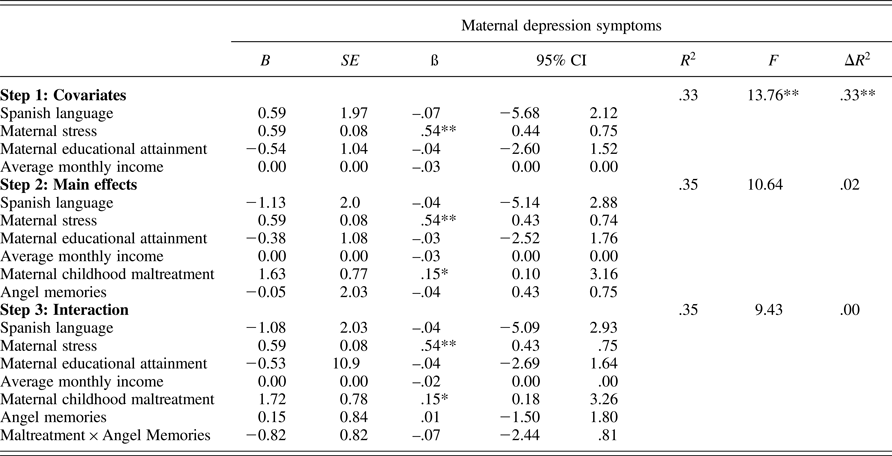
Higher levels of maternal childhood maltreatment significantly predicted higher levels of mothers’ depression symptoms, revealing a main effect of maltreatment (β = .15, p < .05), but the interaction of Maltreatment × Angel Memories was not significant (Table 4). Higher maternal stress significantly predicted higher levels of maternal depression symptoms (β = .55, p < .01). Together, the final model predicted approximately 35% of the variance in maternal depression symptoms. Given the nonsignificant interaction, no further analyses were conducted.
Hierarchical regression for maternal depression symptoms

Note: *p < .05. **p < .01.
Maternal comorbid psychopathology
Similar to the regression for maternal PTSD symptoms, higher levels of maternal childhood maltreatment significantly predicted higher levels of mothers’ comorbid psychopathology (β = .27, p < .01), revealing a main effect of maltreatment. There was a significant interaction of Maltreatment × Angel Memories (β = –.15, p < .05) in predicting comorbid psychopathology (Table 3). This interaction also predicted a small but significant amount of variance in comorbid psychopathology as an independent step, ΔR 2 = .02, p < .05. In terms of covariates, higher levels of maternal stress also predicted higher risk for comorbid psychopathology (β = .35, p < .01). The final model predicted approximately 24% of the variance in comorbid psychopathology. Probing the interaction (Figure 1b) showed that the simple slopes of maternal maltreatment on comorbid psychopathology were significant at 1 SD below the mean, through slightly above the mean (z scores <.85), corresponding to angel memory scores ≤4, but not at ≥.85 SD above the mean on angel memories (corresponding to scores of 5 on angel memories). In other words, childhood maltreatment significantly predicted adulthood comorbid psychopathology unless mothers received the highest possible score on angel memories.
Children's traumatic event exposure
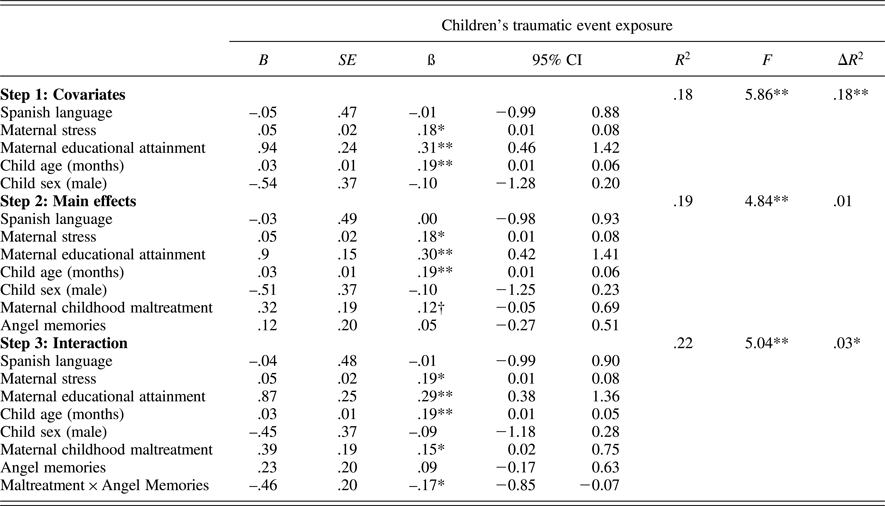
The regression for children's exposure to traumatic events revealed similar patterns as maternal PTSD symptoms and comorbid psychopathology: higher levels of maternal childhood maltreatment significantly predicted higher levels of their children's trauma exposure (β = .15, p < .05). Furthermore, the interaction between Maltreatment × Angel Memories (β = –.17, p < .05) was also significant in predicting children's trauma exposure (Table 5). This interaction effect independently contributed a small but significant amount of variance to children's trauma exposure, ΔR 2 = .03, p < .05. Significant covariates included higher levels of maternal stress (β = .19, p < .05) and maternal educational attainment (β = .29, p < .01), and older child age (β = .19, p < .01). The final model predicted approximately 22% of the variance in children's trauma exposure. Probing the interaction (Figure 1c) revealed that similar to maternal PTSD symptoms, the simple slopes of maternal childhood maltreatment on their children's trauma exposure were significant at 1 SD below the mean, through approximately the mean on angel memories (z scores ≤ –.03), corresponding to scores on angel memories ≤3, but not at >.–03 SD above the mean on angel memories (corresponding to scores of 4 or 5 on angel memories). Following a similar pattern as PTSD symptoms, mothers’ childhood maltreatment significantly predicted their children's exposure to more traumatic events only when mothers recalled less positive and elaborated angel memories (and received scores ≤3).
Hierarchical regression for offspring exposure to traumatic events

Note: *p < .05. **p < .01. †p < .10.
Post hoc analyses for child sex differences
Exploratory regression analyses were conducted with the total sample split by child sex to understand whether protective effects of maternal angel memories replicated in buffering sons’ versus daughters’ exposure to greater numbers of traumatic events. The regression predicting children's trauma exposure was reconducted separately for male versus female children. Results showed that for males/sons, higher levels of maternal childhood maltreatment did not significantly predict higher levels of their trauma exposure. The interaction of Maltreatment × Angel Memories in predicting male children's trauma exposure was also not significant.
For girls/daughters, higher levels of maternal childhood maltreatment predicted higher levels of their trauma exposure (β = .26, p < .01). The interaction of Maltreatment × Angel Memories was also significant (β = –.24, p < .05), and it independently contributed a small but significant amount of variance in the final step of the model, ΔR 2 = .05, p < .05. Higher maternal stress was also a significant predictor of daughters’ higher levels of trauma exposure (β = .28, p < .01), as was older child age (β = .24, p < .01). Mothers’ higher educational attainment was a marginally significant predictor of daughters’ higher levels of trauma exposure. (β = .23, p < .10). The final model predicted approximately 29% of the overall variance in girls’/daughters’ traumatic event exposure. Probing the interaction revealed a similar cutpoint for angel memories as effective buffers against daughters’ trauma exposure as the regression did with both sexes together. The simple slopes of maternal childhood maltreatment on daughters’ trauma exposure were significant at 1 SD below the mean, through approximately the mean on angel memories (z scores <.09), corresponding to scores on angel memories ≤3, but not at ≥.09 SD above the mean on angel memories (corresponding to scores of 4 or 5 on angel memories). That is, higher levels of mothers’ childhood maltreatment significantly predicted daughters’ exposure to more traumatic events when mothers’ angel memories were less positive and elaborated (and received scores ≤3).
Discussion
This study replicates and extends published pilot findings showing the protective role of benevolent childhood memories with caregivers (“angel memories”) against lifespan and intergenerational trauma. Findings from the pilot study (Narayan et al., Reference Narayan, Ghosh Ippen, Harris and Lieberman2017) revealed that for mothers who had more positive and elaborated angel memories, the association between their childhood maltreatment and adult PTSD symptoms was not significant, consistent with protective effects. The present study replicated these findings. For mothers with less positive and elaborated angel memories, childhood maltreatment significantly predicted PTSD symptoms. Alternatively, for mothers with more positive and elaborated angel memories, higher levels of their childhood maltreatment did not predict higher levels of their PTSD symptoms, suggesting that their angel memories protected them from trauma-related psychopathology in adulthood.
Replication and extension of angel memories as protective factors
The replicability of angel memories as protective factors that buffer against the effects of mothers’ childhood maltreatment on their adult PTSD symptoms has now been established in two different samples with unique ethnic, cultural, and linguistic differences, and with method variance. In the pilot sample, mothers were primarily African American, all were native English speakers, all had been reared for at least part of their childhoods in foster care, and many had experienced very severe childhood maltreatment (Narayan et al., Reference Narayan, Ghosh Ippen, Harris and Lieberman2017). In the present study, the sample was more than three times as large and consisted of predominantly Latina mothers, with approximately one-quarter of mothers identifying as monolingual Spanish speakers. In addition, the pilot study and the current study utilized different instruments to assess the same independent and dependent variables, further generalizing replicability across methods. The pilot study used the Childhood Trauma Questionnaire (Bernstein et al., Reference Bernstein, Stein, Newcomb, Walker, Pogge, Ahluvalia and Zule2003) for mothers’ childhood maltreatment and the Trauma Symptom Inventory, Second Edition (Briere, Elliott, Harris, & Cottman, Reference Briere, Elliott, Harris and Cottman1995) for maternal PTSD symptoms, whereas the current study utilized the Life Stressors Checklist—Revised for maternal childhood maltreatment (Wolfe et al., Reference Wolfe, Kimerling, Brown, Chrestman, Levin and Stamm1996) and the Davidson Trauma Scale for PTSD symptoms (Davidson et al., Reference Davidson, Book, Colket, Tupler, Roth, David and Feldman1997). Together, these findings provide strong and replicable evidence that more positive and elaborated angel memories can buffer maltreated mothers from PTSD symptoms in adulthood.
The present study also investigated the protective effects of maternal angel memories on additional aspects of maternal and child well-being. Findings showed that more positive and elaborated angel memories buffered maltreated mothers from experiencing comorbid psychopathology in adulthood (operationalized as clinical levels of PTSD and depression symptoms) and also buffered their offspring from being exposed to higher numbers of traumatic events. Of note, however, protective effects of angel memories were not significant for maternal depression symptoms. These findings indicate that the protective effects of angel memories may be specific to psychological outcomes reflecting traumatic stress (e.g., PTSD symptoms and offspring trauma exposure) rather than to more general psychological outcomes. Furthermore, individuals with childhood maltreatment, especially that which is chronic or co-occurring across subtypes, are often likely to have comorbid or co-occurring psychological disorders or symptoms (Putnam et al., Reference Putnam, Harris and Putnam2013). Of the 149 mothers in this sample who experienced at least one subtype of childhood maltreatment, 75.8% experienced more than one subtype. There may be something about angel memories that is particularly helpful in protecting parents who have experienced extensive or complex childhood trauma, such as multiple maltreatment subtypes, against outcomes pertaining to traumatic stress or psychiatric comorbidities. This tentative explanation warrants replication in other samples.
Another possibility for the lack of significant buffering effects of angel memories for mothers’ depression symptoms may be that depression symptoms may, at least in this sample, be characterized by a higher degree of equifinality (i.e., stemming from multiple, transactional origins; Cicchetti & Rogosch, Reference Cicchetti and Rogosch1996; Harrington, Rutter, & Fombonne, Reference Harrington, Rutter and Fombonne1996). In the present sample, it is possible that other factors, such as contemporaneous contextual stress or negative relationships, were more proximal predictors of depression symptoms. In support of this possibility, mothers’ stress, operationalized as general distress in the parenting role, was very strongly associated with their depression symptoms. Although maternal stress did not influence whether or not angel memories moderated the association between childhood maltreatment and maternal depression symptoms (moderation was nonsignificant with or without maternal stress included in the regression model for depression), it is possible that contemporaneous stressors, rather than childhood adversity or angel memories, were among the strongest influences on depression symptoms in this group of mothers.
Furthermore, it is also possible that memories of positive childhood experiences are stronger buffers against PTSD symptoms than depression symptoms in samples of maltreated mothers. A similar pattern was observed in a separate sample of low-income pregnant women with high levels of childhood adversity: higher benevolent childhood experiences (BCEs; Narayan, Rivera, Bernstein, Harris, & Lieberman, Reference Narayan, Rivera, Bernstein, Harris and Lieberman2018), which index the overall availability of childhood supports and resources rather than memories of them, significantly predicted lower PTSD but not depression symptoms after accounting for women's childhood adversity (Narayan et al., Reference Narayan, Rivera, Bernstein, Harris and Lieberman2018). However, whether and to what extent higher levels of angel memories are effective protective factors against depression symptoms, as well as other sequelae following childhood adversity, should continue to be examined in other samples.
This is the first empirical study to document that mothers’ angel memories buffer against the intergenerational transmission of trauma from mothers to children. We found that for mothers with more positive and elaborated angel memories, the association between maternal childhood maltreatment and their children's exposure to traumatic events was nonsignificant, reflecting a protective effect. Alternatively, for mothers with less positive and elaborated angel memories, higher levels of mothers’ childhood maltreatment predicted their children's higher trauma exposure. One possible pathway may involve the negative impact of mothers’ childhood trauma exposure on their ability to appraise danger accurately (Pynoos, Steinberg, & Piacentini, Reference Pynoos, Steinberg and Piacentini1999). It is also possible that mothers who are able to retain memories of feeling safe, protected, and loved within an overall context of adversity have less psychological need for rigidly segregated mental systems (Bowlby, Reference Bowlby1980). Mothers with greater access to more positive and elaborated angel memories may also retain a greater ability to protect their children from their own angry impulses, to detect potential danger from the environment, and to shield their children from these threats.
This general finding that more positive and elaborated angel memories deter the transmission of trauma from mothers to children is aligned with other studies that have also documented parental characteristics as intergenerational protective factors for children's well-being. For example, maternal reflective functioning (RF), defined as parents’ capacity to reflect on their own and their children's mental states, was found to mediate associations between adult attachment representations and parental attachment to infants (Slade, Grienenberger, Bernbach, Levy, & Locker, Reference Slade, Grienenberger, Bernbach, Levy and Locker2005). While associations between angel memories and adult attachment or RF have not yet been established, it is likely that these protective constructs are interrelated. Parents who have more secure and positive memories of their childhood experiences with caregivers may be more likely to reflect on their mental states and relationships with their children, evincing stronger RF, and to respond to children with higher levels of sensitivity and protection.
Sex-specific protective effects of angel memories
The buffering effect of mothers’ angel memories for lower offspring trauma exposure was significant for daughters but not sons. Although the specific mechanisms underlying this protective process are still unknown, it is possible that mothers may view their daughters as more vulnerable and act more protectively toward them, partly because of their gender-based identification and partly due to prevailing social perceptions of gender differences. It is also possible that mothers may be more likely to engage in negative attributions of their sons based on their violent or otherwise acrimonious experiences with the child's father, a pattern that has been clinically associated with less protective behavior toward sons (Lieberman, Reference Lieberman, Atkinson and Zucker1997, Reference Lieberman1999). Although the mechanisms at work cannot be gleaned from the present data, previous research also suggests that “matched trauma” (i.e., a child's experience of the same trauma type that the parent experienced as a child) has unique effects on the parents’ perceptions and views of the child's well-being compared to circumstances where the parent's and child's trauma are not “matched” (Cohodes, Hagan, Narayan, & Lieberman, Reference Cohodes, Hagan, Narayan and Lieberman2015). Although tentative and warranting replication, the finding that daughters are more strongly buffered by angel memories suggest that there may be sex-specific intergenerational pathways of resilience. The mechanisms underlying them are a viable area to pursue in future studies.
Thresholds for protective effects of angel memories
The interaction analyses provided information on cutpoints of angel memories scores that buffered the effects of mothers’ childhood maltreatment on their own and their children's well-being. While angel memories receiving scores of either 4 or 5 were effective protective factors that buffered the effects of maltreatment on maternal PTSD symptoms and children's trauma exposure, angel memories needed to receive the highest possible score of 5 to be effective buffers against maternal comorbid psychopathology. These observations suggest that angel memories may need to be particularly strong to buffer the effects of childhood maltreatment on psychological comorbidities. Specifically in this sample, angel memories needed to be rich in emotional content, reflected by a memory with vivid sensory details, and/or a memory that connected specific moments to feelings of love, comfort, protection, or reassurance. Scores of 3 or below, characterized by vague or transient responses where the affect was not directly or specifically connected to specific moments that were enduring, were not effective buffers against maladaptation. The presence of these thresholds echoes Selma Fraiberg's observations that traumatized individuals who are able to connect affect to experience are less likely to perpetrate trauma across generations (Fraiberg et al., Reference Fraiberg, Adelson and Shapiro1975). In addition, the findings help expand her insights by showing that it may be just as important to connect positive affect to positive memories as it is to have integrated emotional narratives of traumatic experiences.
The thresholds for protective effects observed in this study are different from those in the pilot sample. There, angel memories receiving scores ≥2 were effective buffers against the association between maternal maltreatment and PTSD symptoms, suggesting that even transient, isolated, or fleeting positive childhood memories were protective factors for mothers reared in foster care (Narayan et al., Reference Narayan, Ghosh Ippen, Harris and Lieberman2017). Taken together, findings across the two studies indicate that thresholds for angel memories to be effective protective factors may vary depending on the characteristics of the sample, the type of childhood adversity, and the outcomes of interest.
There could be several explanations for these shifting thresholds. For adults whose childhood traumatic experiences significantly outweighed the positive and loving childhood moments, lower scores on angel memories may carry more weight as protective factors. The pilot sample consisted of a particularly high-risk group of mothers, all of whom had been in childhood foster care and many of whom reported experiencing very severe and chronic childhood maltreatment. It is possible that for those women, having some trace of a loving memory, even if isolated or fleeting, served as a ray of hope that sustained their self-worth and offered some protection from trauma-related impairment. The issue of how angel memories differ in their protective strength across samples with varying levels of adversity is a compelling area to pursue. An additional consideration apparent in both studies is that very high levels of unresolved childhood trauma might block access to any angel memories, resulting in scores of 0 on angel memories, which were present in a small group of mothers in each sample. This raises the possibility that the status of childhood trauma as resolved versus unresolved might also be an important consideration for future studies.
In addition, it is important to note that although protective effects of angel memories for several trauma-related outcomes were established, all protective effects in the current study were modest. The interaction of maternal maltreatment and angel memories added only a small although significant amount of variance to models predicting maternal PTSD symptoms, comorbid psychopathology, and children's trauma exposure. While statistical effects are small, it may be practically meaningful to consider the above thresholds when evaluating whether effects of angel memories are clinically significant buffers against outcomes of interest.
It is also noteworthy that angel memories did not seem to be directly compromised by levels of psychopathology symptoms. The correlations between maternal PTSD, depression, and comorbid psychopathology with angel memories were all nonsignificant, indicating that higher levels of psychopathology do not seem to directly impair the recollection of angel memories. Furthermore, the association between mothers’ childhood maltreatment and their angel memories was also nonsignificant, similar to the pilot sample (Narayan et al., Reference Narayan, Ghosh Ippen, Harris and Lieberman2017). This suggests that level of overall maltreatment also does not seem to directly compromise angel memory quality. However, higher levels of maternal stress, a covariate to account for potential maternal reporting biases, were significantly but modestly associated with lower angel memories, suggesting that general stress levels may slightly hinder the recall of higher quality angel memories. Future studies should directly examine associations between mothers’ angel memories and other distal and proximal factors, such as objective levels of positive early caregiving and other factors that may be associated with angel memories, including adult attachment representations, reflective functioning, or presence of unresolved trauma.
Strengths, limitations, and future directions
This is the first study to show that angel memories provide protective effects across numerous maternal and child outcomes in a sample of ethnically, culturally, and linguistically diverse families. A key strength of the study is that it illustrates the utility of an instrument that is brief to administer and code, yet assesses a replicable protective factor against lifespan and intergenerational transmission of trauma. Additional strengths include a relatively large sample, the ability to control for mothers’ stress levels given that they were the primary informants on all variables, and replicability of findings in this sample despite utilization of different instruments than the pilot sample.
There were also several limitations. The replicability of findings involves primarily Latina mothers, a quarter of whom were monolingual Spanish speaking. While this is an important first step in documenting the cross-cultural utility of angel memories as protective factors when compared with the pilot sample of primarily African American mothers, future studies should examine angel memories in families of additional racial and ethnic backgrounds. In addition, this sample was clinically referred and characterized by high levels of contemporaneous maternal stress (the sample mean on maternal stress corresponded to the 85th percentile of the Parenting Stress Index, Short Form, Version 3, according to developers). While it is likely important to utilize samples with high levels of, and high variation in, childhood adversity and ongoing stress in order to examine protective factors that deter maladaptation, it is unknown whether angel memories would exert similar protective effects in lower stress, non-clinically referred samples.
This study did not take into account additional factors that may have buffered the transmission of trauma from mothers to children and that may have also been related to stronger recollection of angel memories. For instance, studies have found that having a supportive partner or coparent and making meaning of trauma through therapeutic support may deter the intergenerational transmission of maltreatment to children (Egeland & Erickson, Reference Egeland, Erickson, Sameroff, McDonough and Rosenblum2004; Egeland et al., Reference Egeland, Jacobvitz and Sroufe1988). Although the present mothers were about to enter therapy, we did not assess whether mothers had previously participated in therapy or if they had supportive partners. Several additional unmeasured constructs, such as reflective functioning, other cognitive capacities, and general emotional awareness, might have also helped account for the buffering effects. Future studies should investigate the additive contribution of these capacities in conjunction with angel memories in mitigating the intergenerational transmission of childhood trauma.
Future studies also need to examine more nuanced dimensions of angel memories, such as whether their protective effects are weakened if the source of the angel memory is the same individual who perpetrated maltreatment. In this study, we did not have enough information about who perpetrated maltreatment during the mothers’ childhoods. We are currently working to differentiate, in subsequent samples, protective effects of angel memories that are characterized by protection in the context of harm (e.g., when one caregiver shields or protects the respondent from another caregiver's abuse), versus rupture in the protective shield (e.g., when the source of the angel memory is the same person who also perpetrated harm). It is likely that these two circumstances would result in different forms of psychological adaptation. Psychological maladaptation may be especially likely if the respondent is still haunted by a caregiver's contradictory behavior. Alternatively, better psychological adaptation would likely follow from angel memories that are characterized by recollections of positive, loving moments that do not contain elements of maltreatment or references to traumatic experiences at all.
Conclusions
The present study provides support for the concept that angels in the nursery are effective protective factors that buffer against the intergenerational transmission of trauma in a group of predominantly low-income, ethnically diverse mothers and young children. These protective effects have now been replicated across two independent samples with variance in methods; ethnic, cultural, and linguistic diversity; and types of childhood adversity and psychopathology. Angels in the nursery are particularly advantageous because they can be identified and coded briefly with minimal training and low burden to participants and researchers. They offer parents who have experienced trauma an opportunity to reflect on moments of childhood love, happiness, and protection. Mothers administered the Angels Interview often comment afterward, “I've never really thought about a positive memory,” “No one has ever asked me about this before,” and “That was very helpful, thank you.” Future research is needed to continue to investigate angels in the nursery as protective factors that buffer against the effects of punitive or abusive caregiving on lifespan and intergenerational maladaptation and whether angel memories can be systematically nurtured and strengthened with evidence-based, trauma-informed interventions.