

Introduction
Climate change affects livestock production in multiple ways (Gauly et al., Reference Gauly, Bollwein, Breves, Brügemann, Dänicke, Daş, Demeler, Hansen, Isselstein, König, Lohölter, Martinsohn, Meyer, Potthoff, Sanker, Schröder, Wrage, Meibaum, von Samson-Himmelstjerna, Stinshoff and Wrenzycki2013). One direct impact is heat stress due to elevated temperature and humidity. Both of these parameters can be linked to empirical data on physical livestock yields (e.g. Fuhrer and Calanca, Reference Fuhrer and Calanca2012) and are incorporated in the temperature humidity index (THI). In order to understand the economic consequences of the impact of climate-related changes in THI, methods are required that combine bio-physical and economic models (Kipling et al., Reference Kipling, Bannink, Bellocchi, Dalgaard, Fox, Hutchings, Kjeldsen, Lacetera, Sinabell, Topp, van Oijen, Virkajärvi and Scollan2016). Here, a THI model was linked to an integrated modelling framework (IMF) at farm level. The THI model and associated parameters are used to consider economic climate change impacts on dairy and suckler cow yields, using Austrian farms as a case study.
Material and methods
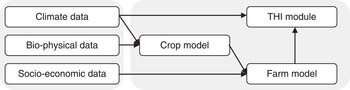
The IMF is delineated in Figure 1. Data include climate data, bio-physical data (e.g. soil characteristics, altitude, field sizes) and socio-economic data (e.g. input and output prices, farm endowments). The bio-physical process model EPIC (e.g. Williams, Reference Williams1995) calculates crop yields at field scale for a bundle of management alternatives and climates. It provides inputs to the bio-economic farm optimization model FAMOS[space], which maximizes farm gross margins subject to farm-specific constraints such as land endowments or livestock housing capacities (see Schönhart et al. (Reference Schönhart, Schauppenlehner, Kuttner, Kirchner and Schmid2016) for further information on this IMF version). Here we present the integration of the THI module as a novel feature of the IMF. The THI module values heat stress impacts of dairy and suckler cows monetarily based on farm-specific livestock endowments, which result from optimized farm management in FAMOS[space].
Overview of the integrated modelling framework including a temperature humidity index (THI) module.

Schönhart and Nadeem (Reference Schönhart and Nadeem2015) estimated heat stress impacts for all Austrian NUTS-3 regions, covering uncertainty by combining different THI models and three scenarios. We select three out of these THI models named NRC, Youssef and Mader (models are cited in Walter and Löpmeier, Reference Walter and Löpmeier2010; see Schönhart and Nadeem, Reference Schönhart and Nadeem2015), and estimate a daily THI value at farm level. Yield losses are assumed to occur above a critical THI threshold (THIct). Each additional THI point above THIct is valued economically by a milk yield loss coefficient per cow (mylc) (Kolb, Reference Kolb2012), the milk price (mp) and the farm’s herd size. Parameter mp is exogenous and part of the IMF scenario settings. To take yield losses of suckler cows into account, we assume physical milk yield losses as for dairy cows but value losses by a reduced milk price.
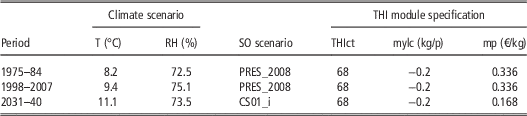
The IMF is applied to three time periods, characterized by three different scenario sets, that is, climate scenarios, socio-economic scenarios and THI parameter specifications (Table 1). Climate change scenarios result from a statistical model at 1 km2 spatial resolution (i.e. Scenario 1 in Strauss et al., Reference Strauss, Formayer and Schmid2013, 436). We correct the average temperature at grid resolution according to the difference between farm-specific altitude and average grid altitude (−0.75°C/+100 m). The socio-economic scenarios describe the framework conditions for farmers, for example, with respect to agricultural policies or market price developments in FAMOS[space]. PRES_2008 represents the current situation, whereas CS01_i frames a climate change impact scenario. It takes autonomous adaptation into account, for example, crop rotation choices, irrigation, fertilization and land cover change. Livestock diets and herd sizes can be adapted, for example, due to changing quantities in feed supply. For further explanations on CS01_i specifications, see Schönhart et al. (Reference Schönhart, Schauppenlehner, Kuttner, Kirchner and Schmid2016). The third set of scenarios (see Table 1) are THI module specifications. Here, they represent average values (compare with BASE scenario in Schönhart and Nadeem (Reference Schönhart and Nadeem2015)).
Scenario parameter description

THI=temperature humidity index; °C=average temperature among all farms; RH=relative humidity; SO=socio-economic scenario; THIct=THI critical threshold value; mylc=milk yield loss coefficient; mp=milk price in real terms.
We apply the IMF to a case study landscape in the Austrian Mostviertel region with about 3000 ha of agricultural land dominated by permanent grassland. From 118 case study farms in total, we consider 115 by farm location. About 91 of these raise cattle for dairy or beef production with an initial endowment of 1251 cows.
Results
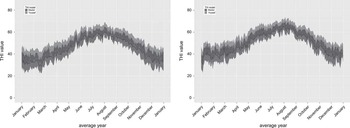
Figure 2 presents average daily THI values for two of the three periods. Average values for NRC are between the THI models Mader and Youssef, but variability between years and farms is slightly larger in NRC. For the period 1975–84, the maximum average THI value is at 65 while it increases to 69 in the period 2031–40. THI values from model Mader are about 5 points below those from Youssef, whereas variability is rather similar between both models.
Average temperature humidity index (THI) values over all farms for an average year in the period 1975–84 (left) and 2031–40 (right) for two THI models. The shaded areas indicate the standard deviation of THI values for days and farms (n=115 farms and 10 years).

Average THI values reveal differences between models as well as variability among farms and years. However, impacts on livestock productivity result from daily THI values passing certain thresholds. Table 2 presents average economic impacts from THI on cattle productivity. Depending on the THI model, the annual number of days with THI values above THIct increases on average among all farms from 1 to 7 days in the period 1975–84 to 9 to 37 days in the period 2031–40. An increasing SD from 0 to 3 points between 1975 and 1984 to 3 to 8 points between 2031 and 2040 indicates increased variability in livestock performance from climate change. However, total economic losses are small compared with total farm gross margins in each period. Economic losses result from physical milk yield losses per cow, endogenous farm livestock numbers and exogenously assumed milk prices. Model results for the present situation, that is, period 1998–2007, indicate an average loss of 0.0% to 0.1% compared with a situation without THI impacts on cattle. Increasing temperatures until 2031–40 increase days with THI values above THIct, and along with a slightly higher number of cows this drives physical milk yield loss on the farms. However, a substantially lower real milk price in the period 2031–40 reduces these losses to a level similar to the present. Consequently, the economic net climate change impact, that is, the difference between economic yield losses from THI levels in period 2031–40 compared with the present situation is around 0.
Average annual number of days above the temperature humidity index critical threshold (THIct) and annual economic yield loss as relative share of the farm gross margin without THI impact

Discussion
Schönhart and Nadeem (Reference Schönhart and Nadeem2015) estimated milk yield loss impacts from climate change between 0% and 3% for Austria in the period 2071–2100 compared with the present. This uncertainty range is due to different assumptions on parameter values and choices of THI models. Based on these experiences we applied three rather conservative THI models. Results indicate a minor importance of heat stress in the coming decades for the modelled case study. Lower temperature increases until mid-century, higher elevation of the farm locations, conservative THI models, average parameter value assumptions as well as the consideration of real milk prices explain the low impacts compared with previous studies (for a review see Schönhart and Nadeem, Reference Schönhart and Nadeem2015). The assumed temperature trend appears rather robust for Austria (Austrian Panel on Climate Change, 2014) and justifies the consideration of only one climate scenario. Furthermore, the focus of this article was on variability from farm location, which matters for THI impacts even within a small landscape. However, major assumptions have to be considered when interpreting the results. THI impact estimates are calculated ex post to farm optimization. It is unlikely that the small impacts trigger management decisions, but this may not be the case for any location or scenario. We considered dairy and suckler cows only and focussed on changes in milk yields. Other heat stress impacts, for example, on animal welfare or fertility, other livestock categories and species and other climate change impacts, such as changes in vector-borne disease risk (e.g. Gauly et al., Reference Gauly, Bollwein, Breves, Brügemann, Dänicke, Daş, Demeler, Hansen, Isselstein, König, Lohölter, Martinsohn, Meyer, Potthoff, Sanker, Schröder, Wrage, Meibaum, von Samson-Himmelstjerna, Stinshoff and Wrenzycki2013), can be considered as well and likely increase costs from climate change in livestock production.
Conclusions
This article proposes a method to analyse direct climate change impacts by integrating economic losses from heat stress on dairy and suckler cows into an IMF ex post to the optimization routine. The approach demands standard IMF output, such as cow numbers, farm gross margins or milk prices. Results on a case study of 115 Austrian farms show minor impacts from heat stress for the coming decades. Nevertheless, such results can be important as they highlight adaptation priorities. According to the results and compared with other studies in the same region (e.g. Mitter et al., Reference Mitter, Kirchner, Schmid and Schönhart2014), adaptation maybe is more important for crop production.
Acknowledgements
Research has been supported by CATMILK (Adaptation in Austrian cattle and milk production; Austrian Climate Research Programme, ACRP) and by the Federal Ministry of Agriculture, Forestry, Environment and Water Management of Austria within the FACCE-JPI Knowledge Hub MACSUR. Ulrich Morawetz and Richard Kippling gave feedback on a draft version.