Introduction
According to the Developmental Origins of Health and Disease (DOHaD) hypothesis non-optimal growth during prenatal life can have long-term health consequences later in life.Reference Barker 1 Low birth weight (LBW) has been associated with all-cause mortality as well as an increased risk of developing type 2 diabetes and coronary heart disease later in life.Reference Eriksson, Osmond, Kajantie, Forsen and Barker 2 – Reference Baker, Olsen and Sorensen 7 LBW has also been linked with altered skeletal muscle fiber compositionReference Jensen, Storgaard, Madsbad, Richter and Vaag 8 and decreased muscle strength in adult life.Reference Dodds, Denison and Ntani 9 – Reference Yliharsila, Kajantie and Osmond 11 These conditions are risk factors for decreased physical functioning in old ageReference Rantanen, Guralnik and Foley 12 and one study has shown positive association between LBW and lower general health-related physical functioning at older age.Reference von Bonsdorff, Rantanen and Sipila 13 However, there are also studies that have shown inconsistent evidence on LBW and measures of physical performance in adulthood.Reference Kuh, Hardy and Butterworth 14 , Reference Martin, Syddall, Dennison, Cooper and Sayer 15 Although LBW has been shown to be associated with lower leisure time physical activity (LTPA),Reference Elhakeem, Cooper, Bann, Kuh and Hardy 16 , Reference Andersen, Angquist and Gamborg 17 there are also studies which have not observed an association of LBW and inactivity.Reference Pinto Pereira, Li and Power 18 , Reference Ridgway, Brage and Sharp 19 Andersen et al. also showed that the association between birth weight and LTPA is U-shaped, both low and high birth weight being associated with lower probability of undertaking LTPA.Reference Andersen, Angquist and Gamborg 17 Physical activity (PA) is important in maintaining physical performanceReference Fried and Guralnik 20 , Reference Paterson and Warburton 21 as well as in preventing several chronic non-communicable diseases.Reference Lee, Shiroma and Lobelo 22 As the life expectancy increases as well as the number of people surviving to very old age, preserving adequate physical functioning is becoming an important global health issue. Further, it is crucial in preserving independency and coping with daily tasks.Reference Vaughan, Leng and La Monte 23
We have previously shown in a Finnish birth cohort, the Helsinki Birth Cohort Study (HBCS) that the volume of objectively measured PA among older people was positively associated with their physical performance measured with a validated fitness test battery [Senior Fitness Test (SFT)].Reference Jantunen, Wasenius and Salonen 24 To our knowledge no previous study has explored the interaction between body size at birth and PA on physical performance in old age. By identifying those who benefit the most from PA in preserving physical performance, it helps us in targeting the promotion of PA. The aim of this study was to assess whether birth weight modifies the effect size of the association between PA and physical performance.
Methods
Study population and measures
The subjects in this study belong to the HBCS including 13,345 individuals born in Helsinki between 1934 and 1944. In the year 2000, a random sample of subjects from the HBCS was invited to participate in a clinical examination conducted between the years 2001 and 2004.Reference Yliharsila, Kajantie and Osmond 11 From the first clinical study cohort (n=2003) 142 of the participants had died by 2011. People who were alive and living within 100 km distance from the study clinic in Helsinki (n=1404) were invited to participate in a new clinical examination. In total, 1094 participants attended the second clinical examination between 2011 and 2013Reference Perala, von Bonsdorff and Mannisto 25 ; 1078 of these completed the SFT and 714 of these also were willing to participate in the PA measurement. In total, 19 participants did not have information on educational attainment. Therefore 695 individuals (316 men and 379 women) were included in the study.Reference Jantunen, Wasenius and Salonen 24
PA was objectively measured between 2012 and 2013 using the SenseWear Pro 3 Armband (SWA) (BodyMedia, Inc., Pittsburg, PA, USA). The SWA has been shown to be valid for assessing energy expenditure in free-living conditionsReference St-Onge, Mignault, Allison and Rabasa-Lhoret 26 and the energy expenditure estimated by the SWA correlates strongly with estimates from doubly labeled water and indirect calorimetry also in elderly people (r 0.48, P<0.01).Reference Colbert, Matthews, Havighurst, Kim and Schoeller 27 The SWA is a multisensory body monitor that is worn on the triceps of the right arm and it combines information from a biaxial accelerometer and several physiological parameters such as skin temperature, near-body temperature, heat flux and galvanic skin response. This information is integrated with the individual’s demographic characteristics and processed by a software to provide minute-by-minute estimates of energy expenditure. We used the Innerview SenseWear Professional Software (version 6.1) for analyses. SWA based PA was expressed as the metabolic equivalents of task (MET) and MET values were multiplied with time (hours) to calculate MET-h. The study population was instructed to wear the SWA for 10 consecutive days, also when sleeping and to take off the SWA only when showering, bathing or swimming. Participants with valid data from at least 4 weekdays and 1 weekend day were included in the study. A valid day consisted of day with at last 1296 min data (90% of 24-h period). The volume of physical activity was expressed as average MET-h/day.
At the clinical examination physical performance was assessed by using the validated SFTReference Rikli and Jones 28 between 2011 and 2013. We used a modified test battery consisting of five components of the SFT; number of chair stands in 30 s to assess lower-body strength; number of bicep curls in 30 s while holding a hand weight to assess upper-body strength; chair sit and reach to assess the lower-body flexibility; number of meters walked in 6 min to measure aerobic endurance and back scratch to assess upper-body flexibility. The result of each test was expressed as age (for each 5-year group) and sex standardized percentile scores and an overall test score was calculated by summarizing the normalized scores of the five SFT components.
Measurements of weight and height at birth and information on gestational age (last menstrual period of mother) were retrieved from hospital birth records. The participants were measured for weight and height at the clinical examination. Body mass index (BMI) was calculated as weight in kilograms divided by square of height in meters (kg/m2). Lean body mass (LBM) and body fat was assessed with bioelectrical impedance by using the InBody 3.0 eight-polar tactile electrode system (Biospace Co., Ltd., Seoul, Korea). Participants’ smoking habits were assessed by questionnaires and smoking status was expressed as years of smoking. Individually linked data on educational attainment (years of studying) was obtained from Statistics Finland.
Statistical analyses
Analyses were conducted separately for men and women as the developmental programming has shown to be different in men and women.Reference Aiken and Ozanne 29 We divided the study population in three categories according to their birth weight, <3000 g, 3000–3499 g and ⩾3500 g. Statistical comparisons between birth weight groups were conducted by using ANOVA and between men and women in different birth weight groups with Student’s t-test. Linear regression analyses were used to identify the appropriate predictors of the physical performance using unadjusted and adjusted (age, gestational age, educational attainment and smoking) standardized regression coefficients β. The β value is a measure of how strongly each predictor variable influences the criterion (dependent) variable. The β is measured in units of standard deviation. Cohen’s standard for β values above 0.10, 0.30 and 0.50 represent small, moderate and large relationships, respectively.Reference Cohen 30 A possible non-linear relationship between MET-h and the SFT were assessed by quadratic regression models. The significance level was set at P<0.05. We also undertook sensitivity analyses to test the associations between the volume of physical activity with different components of SFT (chair stand, arm curl, chair sit and reach, 6-min walk and back scratch tests). The analyses were adjusted for age, gestational age, educational attainment and smoking. The analyses were carried out with Stata 14.1, StataCorp LP (College Station, TX, USA) statistical package.
Results
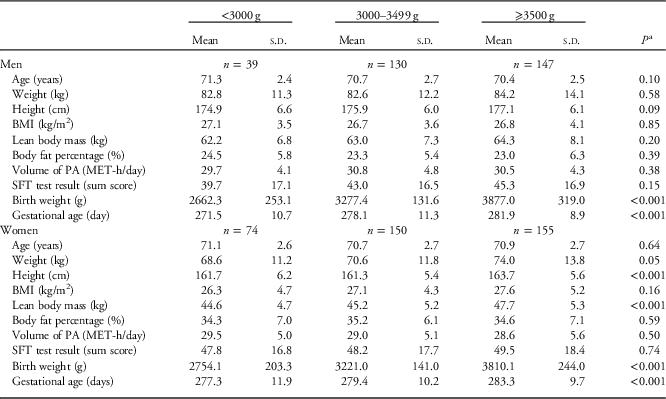
Table 1 shows descriptive characteristics of the study population according to birth weight separately for men and women. Mean age of the participants was 70.7 years. Women whose birth weight was ⩾3500 g were significantly taller (P<0.001) in adulthood and their LBM was significantly higher (P<0.001) than for women with birth weight was <3500 g. Otherwise weight, height, BMI, LBM or body fat percentage in adulthood did not differ significantly between the birth weight groups.
Characteristics of the study population

BMI, body mass index; PA, physical activity; MET, metabolic equivalents of task; SFT, Senior Fitness Test.
a Difference between birth weight groups.
The volume of PA in older age did not differ statistically significantly between birth weight groups. In men, the mean SFT score was higher in the higher birth weight groups, but these associations were not statistically significant (P=0.15 in men and P=0.74 in women). In each birth weight group women performed better in SFT compared with men (P=0.002–0.039). On the contrary men had greater volume of PA in the 3000–3499 g (P=0.002) and ⩾3500 g (P=0.039) birth weight groups compared with women. The difference was not significant in those with a birth weight <3000 g (P=0.873).
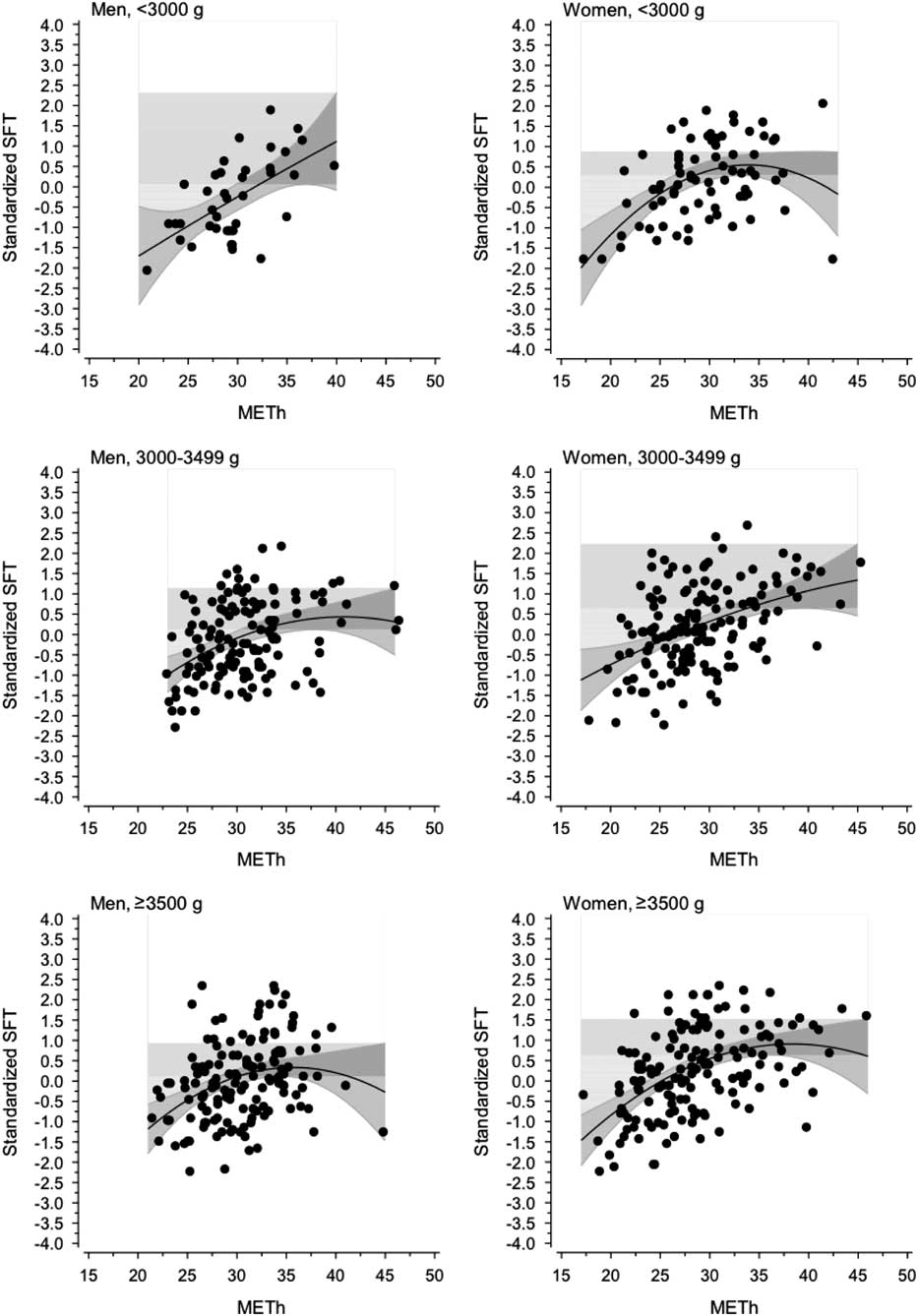
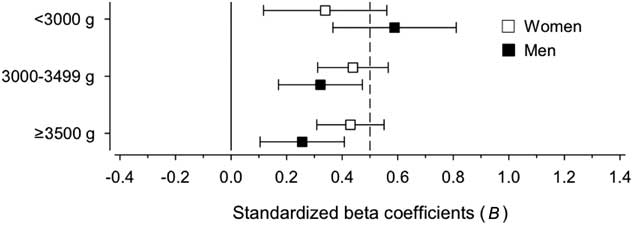
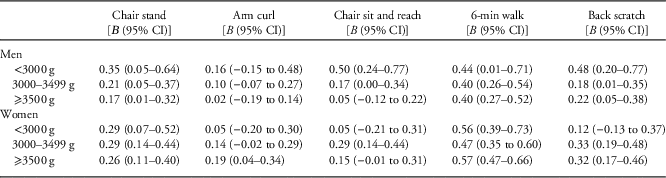
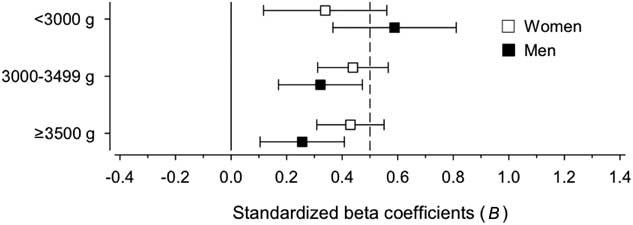
Figure 1 shows the associations between the volume of PA and the SFT score in the three birth weight groups separately for men and women. Figure 2 presents the associations between the volume of PA and the SFT score adjusted for age, gestational age, educational attainment and smoking years. The volume of PA was significantly associated with the SFT score both in men and women in each of the three birth weight groups. However, only in men whose birth weight was <3000 g the association was large based on Cohen’s standard (β 0.59; 95% confidence interval 0.37–0.81, P<0.001). In Table 2, the associations between physical activity and the different components of SFT in different birth weight groups are shown in men and women separately. In men belonging to the birth weight group <3000 g, the association was constantly stronger in chair stand, arm curl, chair sit and reach, and back scratch test. In the 6 min walk test there were no difference between birth weight groups in men or in women. In the other test components in women there were not a consistency in the strength of associations between birth weight groups.
The associations (quadric polynomial regression fit) between physical activity [metabolic equivalents of task (MET-h)] and physical performance [standardized Senior Fitness Test (SFT)] in different birth weight groups men and women separately. The gray area gives 95% confidence intervals.

The associations between physical activity and Senior Fitness Test (SFT) result adjusted for age, gestational age, educational attainment and smoking in different birth weight groups men and women separately (β-values with 95% confidence intervals). The dash line shows suggested threshold for large effect size. The interaction between metabolic equivalents of task-hour (MET-h) and birth weight groups was in men 0.13 and in women 0.48.
The associations between physical activity and the different components of Senior Fitness Test (SFT) adjusted with age, gestational age, educational attainment and smoking in different birth weight groups men and women separately

B, standardized beta coefficient; CI, confidence interval.
Discussion
We observed that the effect size of the association between PA and physical performance in later life is modified by body size at birth. We stratified the study group by birth weight and in both genders and in each birth weight group the volume of PA was associated with the physical performance in older age. However, only in men belonging to the lowest birth weight group the association was large. The interpretation of our findings suggests that men with LBW might benefit most from engaging in PA in order to maintain a better physical performance.
In this study the volume of PA did not differ significantly between birth weight groups. However, when comparing men and women in the two heaviest birth weight groups men had significantly greater total volume of PA than women. The mean SFT score was higher in the higher birth weight groups, but the differences between the groups were not statistically significant. These results are in line with a previous study in the same cohort showing that lower weight at birth predicted lower general health-related physical functioning 10 years earlier at a mean age 62 years.Reference von Bonsdorff, Rantanen and Sipila 13 , Reference Eriksson, Osmond and Perala 31 Women had better physical performance scores in every birth weight group compared with men.
When testing different test components of SFT, we found that the results were in accordance with the overall SFT with all other test components than 6-min walk test. In chair stand, arm curl, chair sit and reach, and back scratch tests the association between volume of PA with these SFT components was constantly stronger in men with birth weight <3000 g. In women there was not such a consistency of the strength of the associations between different birth weight groups. In line with a previous studyReference Salonen, Kajantie and Osmond 32 in the same birth cohort reporting no significant association between size at birth and cardiorespiratory fitness (UKK 2-km walk test) there were no difference in the strength of associations of volume of PA and 6 min walk test results between birth weight groups in men or in women. Effect size being larger in the overall SFT result than in the test components of it supports focusing on the overall SFT result.
The DOHaD hypothesis proposes that the prenatal period largely influences the health and wellbeing of an individual.Reference Barker 33 In utero malnutrition results in physiological adaptations in structure, metabolism and endocrine functions and increases the susceptibility to adult diseases. When the nutrients provided to a fetus are limited, the fetus tries to conserve energy to the growth of key organs, such as the brains, at the expense of other tissues. Birth size serves as a marker of the intrauterine environment. LBW can, however, be a result of preterm birth or slow growth in utero. Because of this and since we wanted to focus on the effects of slow prenatal growth, we adjusted the analyses for gestational age.
LBW is associated with lower LBM,Reference Yliharsila, Kajantie and Osmond 11 lower muscle mass and altered skeletal muscle fiber compositionReference Jensen, Storgaard, Madsbad, Richter and Vaag 8 and with decreased muscle strength across the life course.Reference Dodds, Denison and Ntani 9 Prenatal undernutrition may result in permanent reduction in both the size and number of muscle fibers.Reference Maltin, Delday, Sinclair, Steven and Sneddon 34 As the number of muscle fibers decreases with age a deficit in the muscle fibers reserve established at birth may predispose to premature decline in physical performance. Muscle weakness in midlife has been shown to predict functional limitations and disability 25 years later.Reference Rantanen, Guralnik and Foley 12 On the other hand a study has demonstrated that weight gain in childhood was beneficial for midlife physical performance suggesting that the interventions to increase muscle mass in early life may have beneficial effects on physical performance in adulthood.Reference Kuh, Hardy and Butterworth 14 LBW has been linked to obesityReference Yliharsila, Kajantie and Osmond 11 and reduced cardiopulmonary capacity.Reference Lawlor, Cooper and Bain 35 These features can reduce the willingness to engage in PA and are risk factors for lower physical performance. LBW has also been associated with other poor health outcomes,Reference Barker 1 which can be linked with limited physical performance. In addition, there is evidence that personality factors may also be determined in utero Reference Raikkonen and Pesonen 36 and can thus have an influence on the relationship between birth weight and adult health outcomes.
The strengths of our study include a well-characterized birth cohort with birth data obtained from reliable hospital records. Further strengths are objectively measured PA and assessment of physical performance was done using a validated physical performance test battery.
The limitations of HBCS have been previously discussed.Reference Barker, Osmond, Forsen, Kajantie and Eriksson 4 The participants of the study were both born and attended child-welfare clinics in the city of Helsinki. As the attendance to the clinics was voluntary, the study population may not be representative of all people living in Helsinki. As some of the individuals included in this cohort were born during the Second World War, families might have suffered from food shortages. These results might have been affected also by a survival effect among those with better physical performance. Individuals who participated in the clinical examination in 2011–2013 were younger, thinner, more educated had a healthier diet in 2001–2004 than those who did not participate in the follow-up. There might have been also a selection bias as the participation in the SFT requires a certain level of physical fitness and those with severe functional limitations excluded from the study. Those who participated in the PA measurement had significantly better overall SFT result and also succeeded better in other test components than chair sit and reach and back scratch. Because the setting of the study was cross-sectional the direction of causality remains uncertain. But since there is a large body of evidence on the importance of PA in maintaining good physical performance it supports our interpretation of the result.
In conclusion, our study suggests that influences during prenatal life can have long-term effects on health that can be partly predicted by the size of a newborn. In our study the association between PA and physical performance in old age was most obvious among men with LBW. Individuals who are small at birth might especially benefit from PA in preserving their physical performance in later life. As birth weight is not easily modifiable, more focus should be put on enhancing active lifestyles among aging people in order to preserve good physical performance, independency and quality of life as long as possible. Even more important is taking care of pregnant women’s adequate health and nutrition status. In addition, as the function of the placenta has a significant impact on birth weight, we should also try to diminish the risk of placental insufficiency.
Acknowledgments
The authors thank the volunteers for taking the time to participate in the clinical study and the research nurses for carrying out the clinical examinations.
Financial Support
HBCS was supported by grants from British Heart Foundation; Finska Läkaresällskapet; Samfundet Folkhälsan; Juho Vainio Foundation; Signe and Ane Gyllenberg Foundation; The Diabetes Research Foundation; Finnish Foundation for Cardiovascular Research and EU H2020-PHC-2014-DynaHealth (grant no. 633595). The Academy of Finland supported M.B.v.B. (grant no. 257239) and J.G.E. (grant nos. 129369, 129907, 135072, 129255 and 126775). The funding sources had no role in the study design, collection, analysis or interpretation of the data or writing of the report.
Conflicts of Interest
None.
Ethical Standards
The clinical study protocol was approved by the Ethics Committee of Epidemiology and Public Health of the Hospital District of Helsinki and Uusimaa. Written informed consent was obtained from each participant before any study procedure was initiated.