Coarctation of the aorta accounts for 6–8% of all congenital heart defects. Though surgery remains the mainstay of treatment for native coarctation in infants, balloon angioplasty and stent implantation are commonly performed in cases of re-coarctation and native coarctation diagnosed later in childhood. Both percutaneous procedures have proven to be safe and effective in reducing coarctation gradients.Reference Moore, Vincent and Beekman 1 – Reference Meadows, Minahan, McElhinney, McEnaney and Ringel 5 Current American Heart Association guidelines for intervention include a peak-to-peak gradient >20 mmHg or a peak-to-peak gradient <20 mmHg in the presence of significant collateral vessels, ventricular dysfunction, a single-ventricle heart, or systemic hypertension.Reference Feltes, Bacha and Beekman 6
Several studies have shown that patients with coarctation who were treated with surgery or percutaneous intervention and have minimal gradients at rest develop significant gradients with exercise.Reference Günthard, Buser, Miettunen, Hagmann and Wyler 7 – Reference Markel, Rocchini and Beekman 13 Furthermore, patients with a significant gradient when awake may have a markedly lower gradient when measured in the catheterisation lab under general anaesthesia. We use isoproterenol, a β1- and β2-adrenoreceptor agonist, to simulate a more active, high cardiac output state, particularly in patients found to have borderline or low coarctation gradients in the catheterisation lab. Isoproterenol increases heart rate and cardiac output while decreasing systemic vascular resistance.Reference Nathan, Ongley and Rahimtoola 14 It has been used safely in the catheterisation lab to assess various obstructive lesions and to guide decision-making regarding myomectomies in patients with hypertrophic cardiomyopathy.Reference Elesber, Nishimura, Rihal, Ommen, Schaff and Holmes 15 The use of isoproterenol in patients with coarctation has been described in small groups of patients, but these studies do not correlate the invasive haemodynamic findings with non-invasive methods, characterise the blood pressure changes in the ascending and descending aorta in response to isoproterenol, or describe how intervention affects these gradients.Reference Weber, Cyran, Grzeszczak, Myers, Gleason and Baylen 10 , Reference Markel, Rocchini and Beekman 13 , Reference Kim, Eryu, Asakai, Hayashi, Kaneko and Kato 16
We aimed to describe the haemodynamic effects of isoproterenol in patients undergoing cardiac catheterisation for coarctation, and correlate the invasive data with non-invasive data – e.g., upper- to lower-extremity gradient by blood pressure cuff, Doppler. We also sought to assess and describe the impact percutaneous intervention has on the gradient elicited by isoproterenol.
Materials and methods
A retrospective chart review was performed of patients with two-ventricle physiology who underwent cardiac catheterisation for coarctation and received an isoproterenol challenge at our centre. The Institutional Review Board approved the study. The Xper Information Management System (Philips, Best, the Netherlands) was queried to identify patients who met these criteria and underwent cardiac catheterisation from 1 July, 2012 to 31 July, 2015. We collected demographic and clinical data including cardiac diagnoses and prior, current, and subsequent interventions. Blood pressures, including gradients between the upper and lower extremity, were collected when available using the highest of the upper and lower extremity blood pressures. The measurements were taken from the most recent pre- and post-catheterisation clinic visits. If they were not obtained at the post-catheterisation clinic visit, they were collected from the post-catheterisation hospitalisation if performed. The presence of hypertension was documented as well and was based on the recent American Academy of Pediatrics Guidelines.Reference Flynn, Kaelber and Baker-Smith 17
Catheterisation data collected included minimum coarctation diameter before and after intervention; diameter of the descending aorta at the level of the diaphragm; heart rate with and without isoproterenol; and pressures proximal and distal to the coarctation, with and without isoproterenol, and before and after intervention. Peak-to-peak pressure gradient measurements were obtained either by pullback of a pigtail catheter across the coarctation or simultaneously when a second femoral arterial line was placed. A 3- to 5-ug dose of isoproterenol was administered as a bolus, and pressure measurements proximal and distal to the coarctation were repeated at peak heart rate. Angiography was performed and the minimum coarctation diameter and the diameter of the normal segment adjacent to the coarctation were measured. A decision was made regarding the need for intervention based on haemodynamics and imaging. Balloon or stent sizing was performed according to standard practice. The balloon or stent size did not exceed the diameter of the adjacent normal aorta by more than 120% and the narrowing by more than 300%. Gradients were measured with and without isoproterenol after intervention in a similar manner as described above. Complications were collected from the catheterisation report.
Echocardiographic data collected include the estimated peak instantaneous and mean gradients at the site of coarctation. These data were collected from echocardiograms performed on the most recent pre- and post-catheterisation clinic visits or from the post-catheterisation hospital stay. In eight studies belonging to outside groups, an estimated mean gradient was not available; therefore, we substituted this value with one-half of the estimated peak instantaneous gradient.
Statistical analysis was performed using JMP Pro 12 statistical software (SAS institute Inc., Cary, North Carolina, United States of America). Initial analysis was performed on all patients with borderline gradients – with a baseline gradient ⩽20 mmHg – at catheterisation to assess for factors associated with a gradient >20 mmHg with an isoproterenol challenge. Patients who did not have an intervention or had incomplete catheterisation data were excluded from further analysis. Descriptive statistics of continuous variables are presented as mean±standard deviation for normally distributed data, and median (range) for the remaining data. Two-sample and paired t-tests were performed for comparisons of normally distributed variables, and Wilcoxon’s signed-rank test was used for the remaining variables. Pearson’s correlation was performed to assess for a correlation between non-invasive and invasive measures of the coarctation gradient. Fisher’s Exact test was used for comparisons of categorical variables. Statistical significance was set at a p-value <0.05.
Results
Patient profile
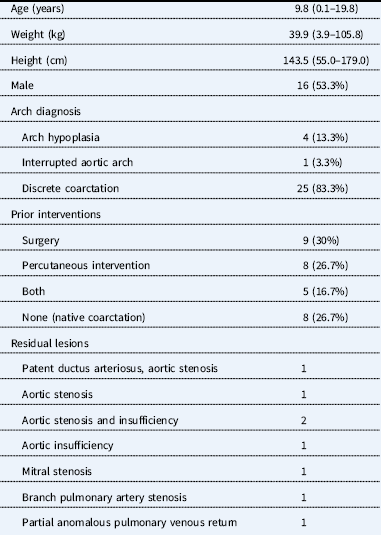
In all, 30 patients underwent isoproterenol challenge with a median age of 9.8 (0.1–19.8) years and weight of 39.9 (3.9–105.8) kg. A total of 16 patients were male (53.3%). The primary arch diagnosis was discrete coarctation in 25 patients, arch hypoplasia in four patients, and interrupted aortic arch in one patient. Nine patients had prior surgical intervention, eight had prior percutaneous intervention, five had both prior surgical and percutaneous interventions, and eight had native coarctation. Of the patients with percutaneous intervention, six patients had prior stent placement. Eight patients had other residual cardiac lesions (Table 1). The indication for catheterisation was at the discretion of the primary cardiologist and was typically based on the patient’s gradient by echocardiography or blood pressure cuff. In one patient, who previously had a stent placed, the intervention was performed to accommodate somatic growth of the aorta.
Patient profile (n=30).

Values are median (range) or n (%)
Isoproterenol challenge
Of the 30 patients who underwent isoproterenol challenge, 22 patients had a baseline gradient ⩽20 mmHg. There was a significant correlation between the ratio of the coarctation to descending aorta diameter (angiographic severity) and the absolute increase in the gradient with isoproterenol (R2=0.20, p=0.0361). A total of 16 (72.3%) of these patients developed a gradient >20 mmHg with isoproterenol. These 16 patients were compared with the six patients who did not develop a gradient >20 mmHg with isoproterenol, and the difference in the coarctation to descending aorta diameter ratio approached statistical significance (0.61±0.15 versus 0.74±0.15, p=0.0870). In all, 19 of the 22 patients with a baseline gradient ⩽20 mmHg had blood pressure readings. The presence of hypertension was not associated with a gradient >20 mmHg with isoproterenol challenge (p=1).
Intervention
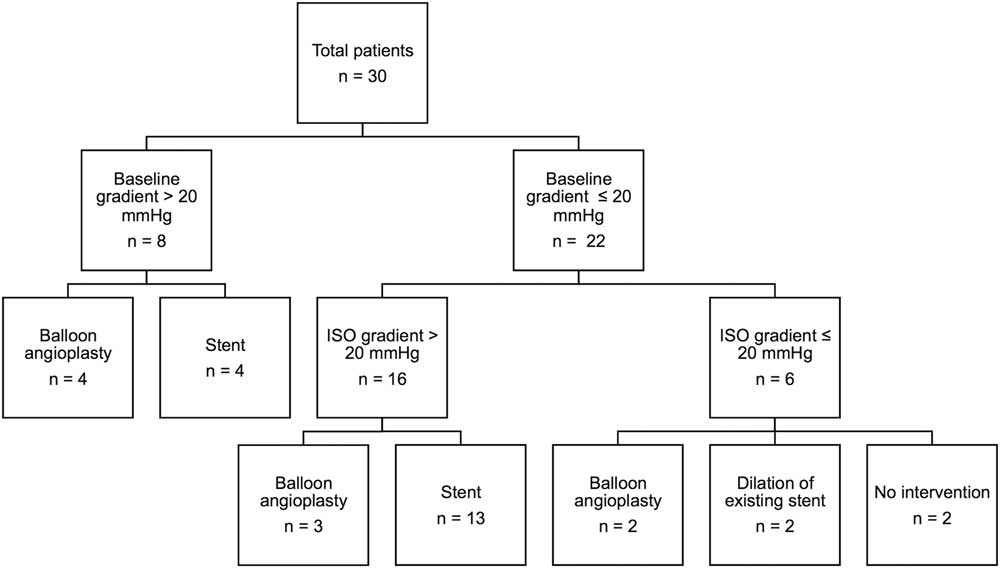
A total of 28 patients underwent intervention with stent placement (17), balloon angioplasty (9), and further dilation of a previously implanted stent (2) (Fig 1). Three of these patients did not have a complete set of haemodynamic data from the catheterisation data. The remaining 25 patients are included in the analysis described below.
Flow chart of all patients demonstrating categorisation by their baseline gradient and subsequent interventions. ISO=isoproterenol.

Pre-intervention catheterisation data
The baseline heart rate increased by a mean of 55.5±19.3% with isoproterenol challenge. Proximal to the coarctation, the mean systolic blood pressure increased slightly from 94.9±14.5 to 98.7±17.5 mmHg (p=0.1336); the mean diastolic blood pressure decreased from 55.2±11.9 to 44.2±12.8 mmHg (p=0.0015); and the average mean arterial pressure decreased from 72.8±12.8 to 65.5±12.7 mmHg (p=0.0065). Distal to the coarctation, the mean systolic blood pressure decreased from 77.7±14.2 to 64.0±13.0 mmHg (p<0.0001); the mean diastolic blood pressure decreased from 52.7±11.7 to 37.6±7.9 mmHg (p<0.0001); and the average mean arterial pressure decreased from 63.8±11.6 mmHg to 48.5±10.0 (p<0.0001).
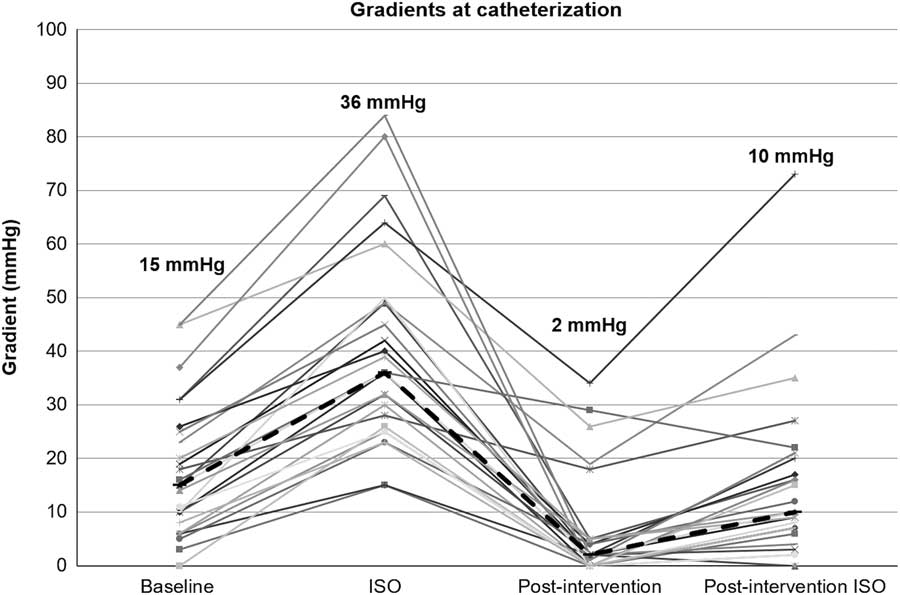
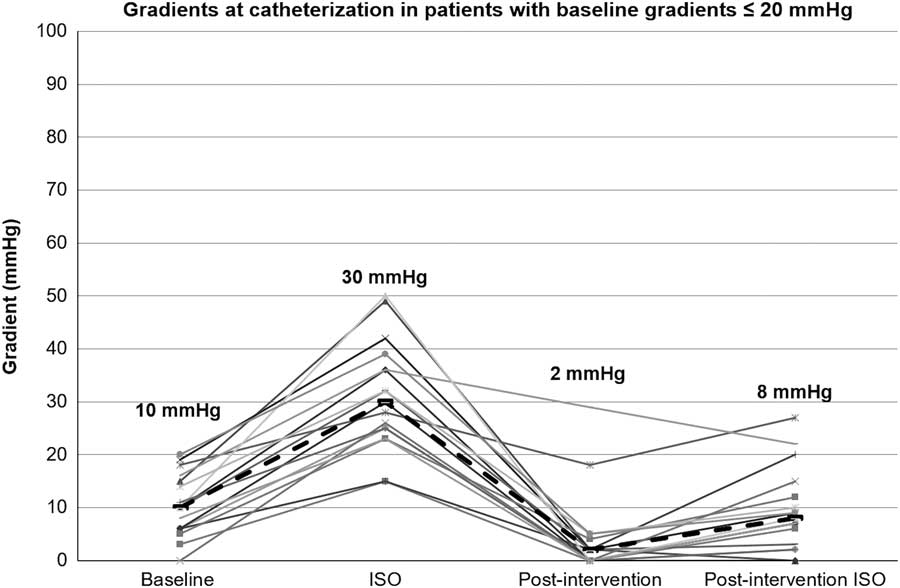
The median gradient increased from 15 (0–45) mmHg at baseline to 36 (15–84) mmHg (p<0.0001) with isoproterenol challenge (Fig 2). In the subgroup of patients with a baseline gradient ⩽20 mmHg (n=17), the median gradient increased from 10 (0–20) to 30 (15–50) mmHg (p<0.0001) with isoproterenol challenge. In all, 15 of 17 patients (88%) developed a gradient >20 mmHg (Fig 3).
Coarctation gradients at catheterisation for all patients (n=25). For each patient with gradients measured before and after intervention and with and without isoproterenol (ISO), catheter-derived gradients are shown. There is a significant increase from the baseline with ISO administration (p<0.0001). After intervention there is a significant reduction in the gradient both without and with ISO when compared with their respective states before intervention (p<0.0001). Dashed line represents median values.

Coarctation gradients at catheterisation in patients with a gradient ⩽20 mmHg at baseline (n=17). There is a significant increase from the baseline with isoproterenol (ISO) administration (p<0.0001). In all, 15 patients (88%) developed gradients >20 mmHg. After intervention there is a significant reduction in the gradient both without and with ISO when compared with their respective states before intervention (p<0.0001). Dashed line represents median values.

Post-intervention catheterisation data
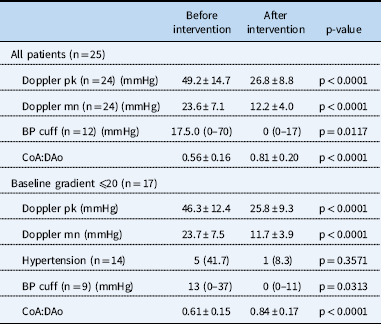
After intervention, the heart rate increased by a mean of 48.9±16.5% with isoproterenol, which did not differ significantly from that before intervention (p=0.0744). The median gradient decreased to 2 (0–34) mmHg, versus baseline pre-intervention, p<0.0001. The median gradient post-intervention with isoproterenol was 10 (0–73) mmHg, versus pre-intervention isoproterenol, p<0.0001, and was ⩽20 mmHg in 19 patients (76%) (Fig 2). The mean ratio of the coarctation to descending aorta diameter improved from 0.56±0.16 to 0.81±0.20 (p<0.0001) (Table 2).
Changes in non-invasive data and coarctation site to descending aorta diameter ratio (CoA:Dao).

BP cuff=blood pressure cuff gradient; Doppler mn=estimated mean gradient; Doppler pk=estimated peak instantaneous gradient
Values are mean±SD, median (range), or n(%)
In the subgroup of patients with a baseline gradient ⩽20 mmHg, the median gradient post-intervention improved to 2 (0–29) mmHg, versus baseline pre-intervention, p=0.005, and with isoproterenol it improved to 8 (0–27) mmHg, versus pre-intervention isoproterenol, p<0.0001. When comparing isoproterenol gradients, of the 15 patients with a gradient >20 mmHg before intervention, 13 (87%) were found to have a gradient ⩽20 mmHg after intervention (Fig 3). The mean coarctation to descending aorta diameter ratio improved from 0.61±0.15 to 0.84±0.17 (p<0.0001) (Table 2).
Non-invasive data
In all, 24 patients had echocardiograms performed before and after intervention. Before intervention, the mean estimated peak instantaneous and mean gradients by Doppler were 49.2±14.7 mmHg and 23.6±7.1 mmHg, respectively. After intervention, they improved to 26.8±8.8 (p<0.0001) and 12.2±4.0 mmHg (p<0.0001), respectively. A total of 12 patients had gradients measured by blood pressure cuff both before and after catheterisation. The median gradient improved from 17.5 (0–70) mmHg to 0 (0–17) mmHg (p=0.0117).
In the subgroup of patients with a baseline gradient ⩽20 mmHg, before intervention, the mean estimated peak instantaneous and mean gradients by Doppler were 46.3±12.4 and 23.7±7.5 mmHg, respectively. They improved to 25.8±9.3 (p<0.0001) and 11.7±3.9 mmHg (p<0.0001), respectively, after intervention. Blood pressures were measured in 14 patients before and after intervention. Five of these patients had hypertension before intervention, and only one had hypertension after intervention (p=0.3571). The gradients by blood pressure cuff were measured in nine patients, and the median gradient improved from 13 (0–37) to 0 (0–11) mmHg (p=0.0313) (Table 2).
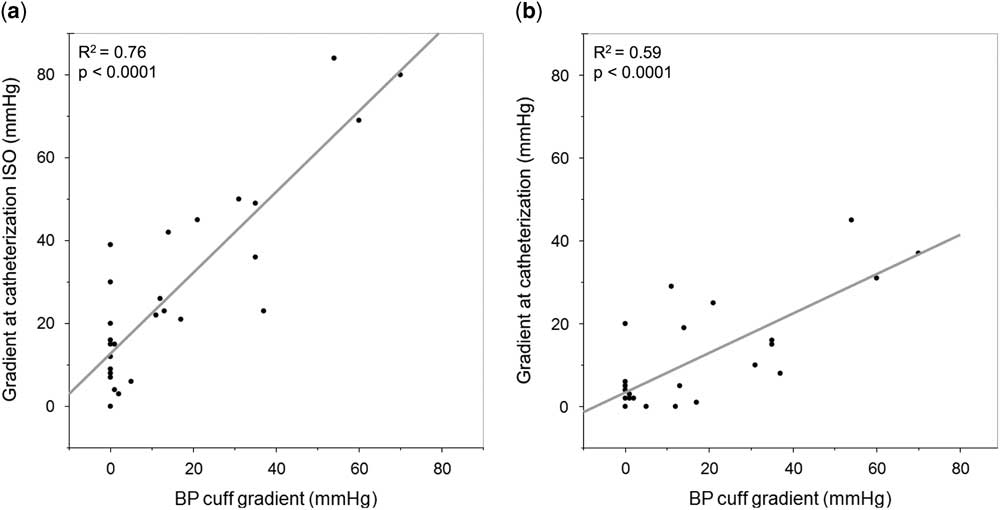
When assessing the degree of correlation between the catheterisation gradients and non-invasive measures, the strongest correlation occurred between the gradients at catheterisation with isoproterenol and blood pressure cuff gradients (R2=0.76, p<0.0001) (Fig 4). The gradients on isoproterenol correlated best with the estimated peak and mean Doppler gradients, when compared with the catheter-derived gradients without isoproterenol.
Correlations between gradients at catheterisation and gradients by blood pressure (BP) cuff. ( a ) The gradients on isoproterenol (ISO) correlated more closely than the ( b ) gradients without ISO.

Complications and follow-up
There were no acute complications related to the procedure or isoproterenol administration. Five patients required aortic arch surgery or catheter-based intervention at a mean follow-up of 1.98±0.85 years. Three had surgical repair of native coarctation that was intervened on at an age range of 0.1–1.7 years, one had placement of a covered stent for pseudoaneurysm formation, and one underwent further dilation of a stent.
Discussion
The use of isoproterenol as a method to increase cardiac output and mimic a more physiologically active state during catheterisation of patients with coarctation has been described previously.Reference Weber, Cyran, Grzeszczak, Myers, Gleason and Baylen 10 , Reference Markel, Rocchini and Beekman 13 , Reference Kim, Eryu, Asakai, Hayashi, Kaneko and Kato 16 Weber et al described the use of isoproterenol in eight patients with “adequate” coarctation repairs and low blood pressure cuff gradients who developed hypertension during exercise testing. With administration of isoproterenol during catheterisation, they had a significant increase in both cardiac index and the peak-to-peak coarctation gradient. Kim et alReference Kim, Eryu, Asakai, Hayashi, Kaneko and Kato 16 described similar findings in 13 children suspected of having coarctation, who had gradients ⩽20 mmHg at cardiac catheterisation. Isoproterenol has been used similarly to mimic an exercise state in patients with other obstructive heart lesions, including aortic and pulmonary valve stenosis and hypertrophic cardiomyopathy.Reference Elesber, Nishimura, Rihal, Ommen, Schaff and Holmes 15 , Reference Truccone, Steeg, Dell and Gersony 18 , Reference Neal, Lucas, Rao and Moller 19
Our data are consistent with prior studies in that isoproterenol challenge resulted in a significant increase in coarctation gradients. This increase was, at least in part, secondary to the severity of the coarctation. There was a significant correlation between the absolute increase in the gradient with isoproterenol and the angiographic severity of coarctation. When comparing patients who had a gradient >20 mmHg with isoproterenol with those who did not, the difference in the degree of angiographic narrowing approached statistical significance. Furthermore, the majority of our patients (72.3%) with a resting gradient ⩽20 mmHg at the time of catheterisation developed gradients >20 mmHg after isoproterenol administration. This finding probably influenced the decision of whether to intervene in these patients and, more importantly, we demonstrated that the isoproterenol-induced gradients could be reduced effectively with an intervention. In 87% of our patients with low or borderline gradients at baseline, which increased to >20 mmHg with isoproterenol, intervention resulted in isoproterenol-induced gradient <20 mmHg. Patients who underwent intervention also demonstrated a significant improvement in Doppler and blood pressure cuff gradients.
Exercise testing may be useful in unmasking clinically significant coarctation,Reference Das, Raj and Shoemaker 20 , Reference Kappetein, Guit and Bogers 21 but it cannot be performed in infants, younger children, or in developmentally delayed patients. In patients suspected of having a significant coarctation, the gradient under anaesthesia may not accurately represent the physiologic state the patient is in much of the time. Isoproterenol challenge, as our data suggest, provides another modality for unmasking of haemodynamically significant coarctation gradients; however, it is not a perfect surrogate for exercise testing. Isoproterenol administration increases cardiac output and lowers systemic vascular resistance, which is physiologically similar to exercise.Reference Nathan, Ongley and Rahimtoola 14 , Reference Dexter, Whittenberger, Haynes, Goodale, Gorlin and Sawyer 22 In exercise, the diastolic blood pressure is typically unchanged or has a minimal increase and the mean arterial pressure typically increases, whereas a decrease is seen in both of these values in patients given isoproterenol.Reference Kuramoto, Matsushita, Kuwajima, Iwasaki and Murakami 23 , Reference Wolthuis, Froelicher, Fischer and Triebwasser 24 We similarly observed significant decreases in diastolic blood pressure and mean arterial pressure proximal and distal to the coarctation in response to isoproterenol. Although exercise typically results in an exaggerated increase in systolic blood pressure in patients with coarctation and even some patients after adequate coarctation repair,Reference Pelech, Kartodihardjo, Balfe, Balfe, Olley and Leenen 25 , Reference De Caro, Spadoni and Crepaz 26 in our cohort, a small bolus of isoproterenol did not significantly raise the systolic blood pressure proximal to the coarctation. This observation may be explained by the low doses administered to our patients, as isoproterenol may raise systolic blood pressure at higher doses.Reference Kuramoto, Matsushita, Kuwajima, Iwasaki and Murakami 23 In contrast to the blood pressure response to exercise in coarctation, where the increase in the upper extremity systolic blood pressure significantly contributes to the increased coarctation gradient, the increased gradients observed in our cohort were primarily owing to a significant decrease in the systolic blood pressure distal to the coarctation.
Others have noted that isoproterenol administration is an imperfect surrogate for exercise in children with congenital heart disease.Reference Truccone, Steeg, Dell and Gersony 18 , Reference Neal, Lucas, Rao and Moller 19 At similar heart rates, isoproterenol has a more potent vasodilatory effect when compared with exercise, but does not augment cardiac output to the same degree.Reference Truccone, Steeg, Dell and Gersony 18 Estimated gradients by Doppler in patients with surgically repaired coarctation during exercise have been shown to correlate with those on dobutamine.Reference Banaszak, Szkutnik, Kusa, Banaszak and Białkowski 27 However, exercise is a more potent vasodilator, and may differ with regard to cardiac output as well.Reference Cnota, Mays and Knecht 28
The types of activity and exercise children engage in often use the lower extremities to a greater degree than the upper extremities. Interestingly, Markel et alReference Markel, Rocchini and Beekman 13 demonstrated that in children with coarctation leg exercises resulted in higher upper-extremity systolic blood pressures and higher blood pressure cuff gradients compared with arm exercises, presumably, owing to the greater demand for descending aorta flow during leg exercises and differential vasodilation. In this sense, giving isoproterenol to children with coarctation under anaesthesia may actually underestimate the upper extremity systolic blood pressure response and coarctation gradient with exercise. Although there are some physiologic inconsistencies between exercise and isoproterenol administration, it is still likely that isoproterenol testing is more representative of a patient’s awake and active physiologic state, and clinically significant isoproterenol-induced gradients should be addressed. Interestingly, our data show that gradients with isoproterenol correlated more closely with patients’ blood pressure cuff gradients while awake than the baseline gradients at catheterisation.
Clarifying the haemodynamic significance of a borderline coarctation in a higher cardiac output state may be important in long-term preservation of myocardial function in this group of patients. Evidence suggests that even patients with adequate coarctation repairs have increased left ventricular mass and impairments in systolic global area strain.Reference Kowalik, Kowalski, Klisiewicz and Hoffman 29 Furthermore, patients who have undergone successful stent treatment for coarctation have relatively reduced systolic and diastolic function at rest, which is further discrepant during exercise.Reference Chen, Cifra and Morgan 9 For these same reasons, it is equally important to demonstrate that after an intervention significant obstruction in the awake or active state is eliminated. As we demonstrated, it is possible to achieve a gradient ⩽20 mmHg in most patients with borderline coarctation while on isoproterenol.
There were several limitations to our study. This was a retrospective study and we had incomplete echocardiographic and haemodynamic data. Additionally, the dose of isoproterenol used was inconsistent and not based on the weight of the patient, and therefore its effects may be variable. However, the same dose was given before and after intervention, and thus the comparison with each patient acting as his/her own control is reasonable. We did not measure the cardiac output on isoproterenol, which would have been useful to allow us to better frame the significance of the increased gradients. Ideally, it would have been beneficial to have exercise data before and after intervention to determine whether there was an improvement in the coarctation gradient with exertion.
Isoproterenol can be used safely in the catheterisation laboratory for patients with coarctation to simulate a more active physiologic state. Its administration resulted in a significant increase in coarctation gradients, which had a better correlation with the blood pressure cuff gradients in the awake state. Intervention with stent placement or balloon angioplasty resulted in a significant improvement in the gradients with and without isoproterenol. Further studies using exercise data and long-term ventricular function would be beneficial to further assess the effectiveness of intervention in these patients.
Financial Support
This work was supported by the Children’s Hospital Los Angeles Heart Ambassadors and the Hearst Foundation.
Conflicts of Interest
None.
Ethical Standards
The authors assert that all procedures contributing to this work comply with the ethical standards of the Belmont Report and with the Helsinki Declaration of 1975, as revised in 2008, and has been approved by the CHLA Institutional Review Board.
Acknowledgements
This work was supported by the Children’s Hospital Los Angeles Heart Ambassadors and the Hearst Foundation.