During the initial surge of the COVID-19 pandemic in the spring and summer of 2020, paediatric heart centres were forced to rapidly alter the way they provided care for their patients. Reference Morray, Gordon and Crystal1–Reference Horn, Chakinala, Oudiz, Joseloff and Rosenzweig4 Centres had to make difficult practice decisions in order to optimise data collection and patient care while minimising exposure to the SARS-CoV-2 virus. To address these issues, professional societies and institutions created new protocols to address procedures, echocardiography, consults and nearly every other element of practice that included canceling elective procedures, increasing utilisation of telemedicine technology and reducing direct patient contact when not essential. Reference Fremed, Lytrivi and Liberman5–Reference Chowdhury, Hope and Arthur10 In this study, we used a survey-based approach to characterise the changes in paediatric cardiology practices across the country during initial peak of the COVID-19 pandemic as well as the earliest stages of re-opening. A thorough understanding of how different institutions and practices rapidly adapted to these difficult circumstances may aid in timely and effective responses to future global health emergencies.
Materials and methods
A survey-based descriptive study was performed to assess how changes to the practice of paediatric cardiology were implemented in response to the COVID-19 pandemic across different practice settings and geographic regions. An online questionnaire (SurveyMonkey, Momentive Inc., San Mateo, CA) was created to collect data on practice changes and decision making during this period. Responses remained anonymous and no protected health information was collected. This 40-item survey (Supplement Material) was emailed to 836 American Academy of Pediatrics Section on Cardiology and Cardiothoracic Surgery members. Recipients of the survey included paediatric cardiologists, cardiothoracic surgeons and fellows-in-training. The questionnaire was initially distributed in June, 2020 and responses were received prior to September 1, 2020. Responses were stored in a database and analysed using Microsoft Office Excel (Version 2016). Reminder emails with the digital survey link and request to complete the questionnaire were sent twice. Percentages reported were based on the total number of responses for each individual survey item as not all participants completed every survey item.
Results
Survey distribution and participants
Surveys were completed by 84/836 potential participants (10%) representing 28 states. In five cases, responses were excluded as they only provided responses to the first question, leaving 79 responses from 28 states and yielding a final response rate of 9.5%. When asked to identify their practice areas within paediatric cardiology (multiple responses allowed), 55/79 (70%) identified as general cardiologists and 32/79 (41%) as non-invasive imagers. The remaining responses were distributed among electrophysiology, heart failure/transplant, interventional cardiology, adults congenital heart disease, pulmonary hypertension and fellows-in-training. Multiple roles were selected by 27/79 (34%) participants. The median duration of time in practice was 17 years (IQR 10–20). Most participants (79%) practiced at hospital-based academic/teaching institutions. More than half (53%) reported five or fewer COVID-19 patients at their institution at the time of survey completion, 30% reported between 6 and 20 cases and 16% reported greater than 20 cases. Multi-system inflammatory syndrome cases were treated by 36/79 participants (45%), with 2/7 (3%) “unsure” and 41/79 (52%) failing to provide a response to that question. At the time of survey completion, 63/79 (80%) participants indicated that their institutions/practices had begun the process of reopening or expanding patient care and 16/79 (20%) did not respond.
Areas of change
Changes to one or more areas of practice were reported by 78/79 (99%) of participants. Outpatient encounters were the most affected area (72/79, 91%), and physician call schedules (34/79, 43%) and frequency of electrocardiogram (34/79, 43%) were the least reported area of change. Out of 63 participants who responded to the question “have you been redeployed”, 4 (6%) indicated they had been reassigned to roles other than pediatric cardiology including one to adult medicine and two to “non-physician” roles including telephone support. Of these four, two practiced in the Northeast and two practiced in the Midwest.
Safety precautions
Most participants reported limitations to numbers of patient visitors, most commonly restricting to one person accompanying the patients in both in and outpatient settings. Screening questionnaires and temperature monitoring were reported by 80 and 78% of respondents, respectively. Patients were tested for COVID-19 prior to procedures in 93% of cases and most sites required testing within 2–3 days of the procedure. Universal testing of expectant mothers admitted to Labor and Delivery units occurred in 62% of cases. Elective postponement of procedures by patients “very frequently” or “frequently” was reported by 32/68 (47%) participants.
Telemedicine
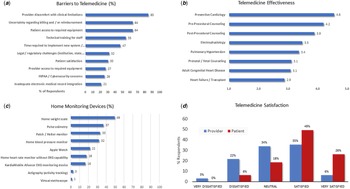
Alternative methods for patient encounters were utilised during the peak of the pandemic by 74/79 (11%) of participants. These mainly included video visits but other modalities such as audio only and electronic messaging were utilised as well. The most common platforms were those embedded within the user’s electronic medical record system or Zoom. Other platforms such as VidyoConnect (Vidyo, Hackensack, NJ), Doximity Dialer (Doximity, San Francisco, CA), FaceTime (Apple Inc., Cupertino, CA), and WhatsApp (WhatsApp LLC, Facebook, Inc. Menlo Park, CA) were utilised less frequently. The most common barriers to implementation of telehealth were provider discomfort with the clinical limitations of telehealth encounters (85%) as well as billing concerns (65%) and perceived patient access to necessary equipment (65%) (Fig 1a). The perceived effectiveness of telehealth encounters was also assessed for specific situations and was felt to be most effective for preventive cardiology visits. Telehealth was considered least effective for heart failure/transplant encounters (Fig 1b). When asked about satisfaction with telemedicine encounters, 36/65 (55%) providers who utilised telemedicine were overall neutral or satisfied with the experience. However, when asked about how their patients felt about the encounters, 49/65 (75%) indicated that the patients were either satisfied or very satisfied (Fig 1c). Various home monitoring devices were also utilised, most commonly a traditional scale for weight assessment (39/79, 49%), pulse oximeter (29/79, 37%), ambulatory cardiac rhythm monitors such as Holters or patch devices (26/79, 33%) and home blood pressure monitors (25/79, 32%). Apple watches (17/79, 22%) and the AliveCor KardiaMobile™ device (13/79, 16%) were occasionally utilised. Other devices such as home actigraphy (2/79, 3%) or virtual stethoscopes (1/79, 1%) and were less utilised (Fig 1d). Telemedicine was utilised in fetal cardiology encounters by nearly one-third of participants in situations such as normal first-time fetal encounters (55%), follow-up fetal echo (55%), new consult for congenital heart disease (45%) and new fetal arrhythmia consult (35%).
Experience with telemedicine. ( a ) Barriers to implementing telemedicine. ( b ) Provider rated effectiveness of telemedicine. ( c ) Home monitoring devices used as part of telemedicine program. ( d ) Provider satisfaction versus perceived patient satisfaction with telemedicine encounters.

Echocardiography
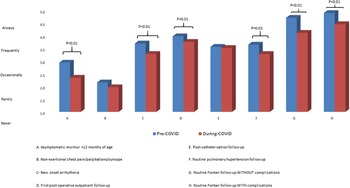
Changes in echocardiography frequency were reported by 61/79 (77%) participants with 46/79 (58%) reporting a substantial decrease in the numbers of echocardiograms performed. They were also less likely to perform echocardiograms in nearly all specific clinical scenarios that were asked about. Exceptions included non-exertional chest pain/palpitations/syncope, for which echocardiography was performed rarely both before and during the initial stage of the COVID-19 pandemic, and post-catheterization follow-up, for which echocardiography was performed occasionally to frequently both before and during COVID-19 (Fig 2). Among those who performed fetal echocardiography, 16/36 (44%) reported that their indications for performing fetal echocardiogram changed in response to the pandemic.
Likelihood of performing echocardiography prior to and during COVID-19 pandemic. Participants were asked to rate the likelihood for each scenario as always, frequently, occasionallysurvey was administered survey was administered or never. Responses were converted to a 5-point scale. Pre- and post-responses were analysed using Wilcoxon signed-rank test. Significant decreases in likelihood of echocardiography were found in nearly all situations.

Financial and personal concerns
Out of 63 participants who responded to questions regarding career, finance and safety concerns, 56% of participants expressed concern about job security or prospects for career advancement and 51% half reported concern over personal finances and/or practice viability. Lay-offs and/or furloughs related to the pandemic were reported by 52% of participants. Despite this, only 3% of participants reported taking out a personal protection loan. When asked about safety concerns, 30% reported “never” having concerns about physical safety or access to PPE while 13% reported “always” having these concerns.
Discussion
The COVID-19 pandemic impacted paediatric centers and practices across the country. A recent AAP survey measuring practice impacts Reference Korioth11,12 showed rapid adaptations in practice in order to maximise safety of patients and providers while still providing necessary care. As a heavily procedural specialty, paediatric cardiology was significantly impacted requiring changes to nearly every aspect of practice. In this study, we demonstrate the magnitude of change that occurred within paediatric cardiology practices during the peak of the COVID-19 pandemic and describe provider attitudes towards these shifts in care.
Although the majority of practices saw relatively few cases of COVID-19 at the time of survey completion, virtually all shut down significantly during the peak of the pandemic, with many cancelling elective procedures, allowing only those that were urgent or emergent, Reference Stephens, Dearani and Guleserian3 and nearly all limiting visitation. Echocardiography volume was also reduced substantially reduced and providers were more reserved in obtaining echocardiograms for patients during COVID-19 across a variety of clinical situations including asymptomatic murmur in patient older than 1-year, new onset arrhythmia, routine pulmonary hypertension follow up, and routine Fontan follow ups for both symptomatic and asymptomatic patients. This is most likely related to an effort to minimise contact between technician and patient to avoid potential viral exposure in patients who are deemed stable from an appropriate history and physical exam. It is also possible that these encounters were more likely to have been conducted remotely via telemedicine platforms, precluding them from obtaining echocardiography. Notably, the two scenarios where the likelihood of performing an echocardiogram did not significantly change were the first post-operative outpatient follow up visit and post-catheterization follow up. In both these cases, echocardiogram is typically required to rule out development of pericardial effusion or other complications related to the procedure that was done. As a result, these encounters are less likely to have been conducted remotely. The need to minimise exposure challenged and prompted both paediatric cardiologists and referring providers to consider the appropriate utilisation of echocardiograms and triage based on the indications and their urgency. The American Society of Echocardiography (ASE) initially released a statement on modified recommendations for performing echocardiography and advanced imaging during the pandemic. Reference Barker, Lewin and Donofrio6 In the setting of increased vaccination rates and decreased caseloads, they subsequently released a follow-up statement with recommendations for re-expansion of imaging programs with an emphasis on safety precautions. They also encourage the use of telemedicine in fetal encounters involving images being performed at obstetric visits to be reviewed remotely by the cardiologist. Finally, they encourage trainee involvement in imaging procedures. Reference Altman, Donofrio and Arya9 Whether this pandemic and these modifications in practice will change the future patterns of how these tests are being ordered is yet to be determined.
During the pandemic, telemedicine was rapidly integrated into clinical practices throughout the country including video encounters and utilisation of ambulatory devices. 13 In our survey, it was generally felt to be effective for encounters that were less likely to require echocardiography such as preventive cardiology visits. It was interesting to note that the perceived satisfaction of patients was higher than the personal satisfaction of the providers with these visits, which may reflect provider optimism and confidence in their ability to develop care in any platform or the convenience that telemedicine provides for the patient. This discrepancy would be worth exploring further in future studies. Various surveys across different specialties have demonstrated high patient satisfaction with telemedicine visits. Reference Singh, Mountjoy and McElroy14 Over time provider satisfaction will likely continue to improve as shown in various recent surveys after providers have the chance to familiarise with the telemedicine technology. Reference Nguyen, Waller, Pandya and Portnoy15,16 This technology has also useful in heavy imaging disciplines such as fetal cardiology. Reference Schwartz, Klein and Barbosa17 Finally, the financial impact of COVID-19 was significant with roughly half of participants reporting concerns related to personal finances or practice viability and job losses at their respective institutions and practices. These findings parallel a recent AAP survey of paediatric practices which showed substantial shifts from in office encounters to telemedicine with 70% reduction in preventive care visits and 83% reduction in sick visits. 18
This study was limited by its survey-based nature and the inherent recall bias associated with this methodology in addition to a low response rate. Though the overall sample size was small, it represented a geographically and clinically diverse population of paediatric cardiologists. Finally, as the pandemic peaked at different times depending on region of the country, survey responses only reflected practice changes implemented up to the point of survey completion and practice may have been different after completion of the survey.
Paediatric cardiology practice across the country was heavily impacted by COVID-19 and required many adaptations including minimising non-essential procedures, increasing use of telemedicine. Providers were generally satisfied with telemedicine and utilised several platforms. Financial concerns were common; however, most participants were not frequently concerned about personal safety. The provider experience during the peak of the COVID-19 pandemic has shown that more judicious use of echocardiography as well as utilisation of telemedicine for certain encounter types may be a practical option in paediatric cardiology practice and should be strongly considered going forward. Though this data was not available at the time, the survey was administered that it would be worthwhile to reassess echocardiography and telehealth utilisation as well as provider opinions and practices at 1 year following initial survey completion. Finally, inter-institutional collaboration would be useful in creating standardised protocols based on shared experiences that could be rapidly implemented in future public health crises.
Supplementary material
To view supplementary material for this article, please visit https://doi.org/10.1017/S1047951121004364
Acknowledgements
The authors would like to recognise the contributions of Dr. John S. Hokanson for his input on survey design.
Financial support
This research received no specific grant from any funding agency, commercial or not-for-profit sectors.
Conflicts of interest
None.
Ethical standards
The authors assert that all procedures contributing to this work comply with the ethical standards of the relevant national guidelines on human experimentation and with the Helsinki Declaration of 1975, as revised in 2008, and has been approved by the Columbia University Irving Medical Center Institutional Review Board.