Introduction
To date, five Paragonimus species have been found, mostly in northern Vietnam, where local people suffer from Paragonimus infection (Kino et al., Reference Kino, De, Vien, Chuyen and Sano1995; Doanh et al., Reference Doanh, Shinohara, Horii, Habe, Nawa, The and Le2007a, Reference Doanh, Shinohara, Horii, Habe, Nawa and Leb, Reference Doanh, Shinohara, Horii, Habe, Nawa and Le2008, Reference Doanh, Shinohara, Horii, Habe and Nawa2009a, Reference Doanh, Shinohara, Horii, Yahiro, Habe, Vannavong, Strobel, Nakamura and Nawab). Of these, Paragonimus proliferus Hsia & Chen, Reference Hsia and Chen1964 is a rare and mysterious species because of its evenly large, excysted metacercariae in crab hosts, and its limited distribution in Yunnan province, China (Hsia & Chen, Reference Hsia and Chen1964; Zhou, Reference Zhou2004; Yang et al., Reference Yang, Zhou, Li, Bai, Wu and Xiu2007) and in Lai Chau province, Vietnam (Doanh et al., Reference Doanh, Shinohara, Horii, Habe, Nawa and Le2008). Because these two provinces are geographically adjacent to each other, it is reasonable that no genetic variance was observed in the nuclear ribosomal second internal transcribed spacer region (ITS2) and partial mitochondrial cytochrome oxidase subunit 1 gene (CO1) of P. proliferus from Yunnan, China and from Lai Chau, Vietnam (Doanh et al., Reference Doanh, Shinohara, Horii, Habe, Nawa and Le2008; Zhou et al., Reference Zhou, Yang, Doanh, Yang, Xiang, Li, Shinohara, Horii and Nawa2008). Since several Paragonimus species, such as P. westermani and P. skrjabini, are widely distributed with significant genetic variance among geographically separated populations (Blair et al., Reference Blair, Agatsuma, Watanobe, Okamoto and Ito1997, Reference Blair, Chang, Chen, Cui, Wu, Agatsuma, Iwagami, Corrlis, Fu and Zhan2005), it was of interest to see that the distribution of P. proliferus in the China–Vietnam border region is limited, without genetic variance, and is almost always present in crab hosts as the large excysted metacercariae without variation in size. While we conducted surveys in central Vietnam far away from the previously reported area of distribution of P. proliferus, we collected excysted metacercariae of P. proliferus together with other Paragonimus species in crabs, Potamiscus tannanti, in Quang Binh province. Molecular analyses revealed that all ITS2 sequences of P. proliferus of the Quang Binh population were completely identical with each other and also with those of previously reported populations in the China–Vietnam border region. On the other hand, CO1 sequences of the Quang Binh population were significantly different from those of China and of northern Vietnam, showing the presence of genetic variance of different geographical populations among P. proliferus species.
Materials and methods
Collection of metacercariae
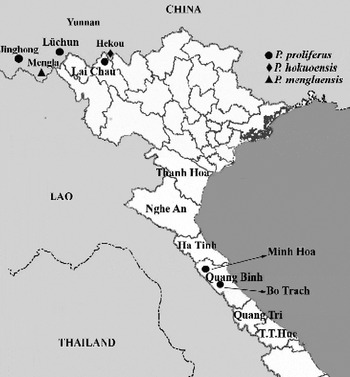
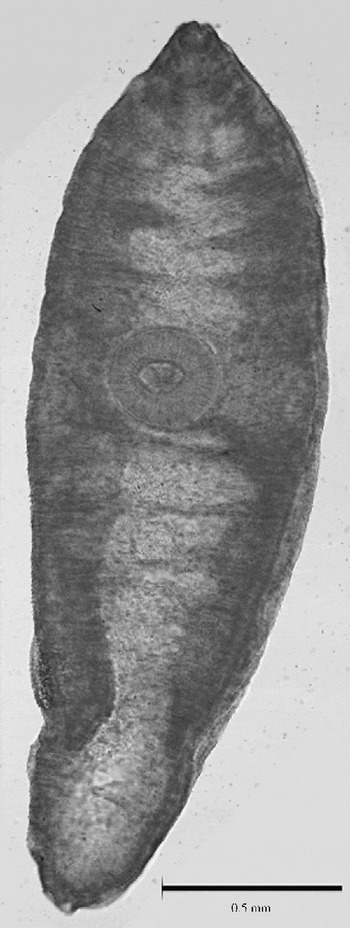
Mountainous crabs were caught in six provinces of central Vietnam, including Thanh Hoa, Nghe An, Ha Tinh, Quang Binh, Quang Tri and Thua Thien Hue (fig. 1). They were examined for the presence of Paragonimus metacercariae by the method described previously (Doanh et al., Reference Doanh, Shinohara, Horii, Habe, Nawa, The and Le2007a). Excysted metacercariae of P. proliferus (fig. 2) were collected and used for morphological observation and preserved in 100% ethanol for molecular study.
A map showing study sites and geographical distribution of Paragonimus proliferus and its synonyms.

Excysted metacercaria of Paragonimus proliferus collected from the crab, Potamiscus tannanti, from Quang Binh province, Vietnam.

Molecular analyses
For molecular analyses, we amplified and sequenced the ITS2 region and CO1 gene of five excysted metacercariae of P. proliferus, including three samples from Minh Hoa district (with code: MC10, MC11, MC12) and two from Bo Trach district (with code: MC46, MC47). The methods for molecular study were as reported in our previous publication (Doanh et al., Reference Doanh, Shinohara, Horii, Habe, Nawa, The and Le2007a). In brief, genomic DNA from individual metacercariae was extracted by proteinase K digestion and phenol/chloroform/isoamyl alcohol extraction procedures, followed by ethanol precipitation for purifying extracted DNA. ITS2 was amplified using the primer pair 3S and A28 (Bowles et al., Reference Bowles, Blair and McManus1995) and CO1 was obtained using primer pair CO1-1 and CO1-2 (Thaenkham & Waikagul, Reference Thaenkham and Waikagul2008). The polymerase chain reaction (PCR) products were purified using Qiaquick PCR purification Kit (Qiagen Inc., Tokyo, Japan), then were primed using Big-Dye terminator cycle sequencing kit v3.1 (Applied Biosystems Japan Ltd, Tokyo, Japan) and both strands directly sequenced (Genetic Analyzer 3130, Applied Biosystems). These sequences were deposited in the DNA Data Bank of Japan with accession numbers AB663672–AB663681. To analyse phylogenetic relationships, all sequences of P. proliferus from northern Vietnam and Yunnan, China, including P. hokuoensis which was a synonym of P. proliferus, were also obtained from GenBank. In addition, ITS2 and CO1 sequences of some other Paragonimus species were also used to set up two sequence data sets, ITS2 and CO1, for reconstructing the phylogenetic trees. They were aligned using Clustal-W (Thompson et al., Reference Thompson, Higgins and Gibson1994) with default options. Evolutionary analyses were conducted in MEGA5 (Tamura et al., Reference Tamura, Peterson, Peterson, Stecher, Nei and Kumar2011). The best model of nucleotide substitution was tested and a maximum likelihood tree was subsequently reconstructed using the best model. The statistical confidence of branching patterns was evaluated by the bootstrap test.
Results
Morphology and prevalence of P. proliferus metacercariae in crab hosts
We examined the presence of Paragonimus metacercariae in crab hosts in six provinces of central Vietnam. Large excysted metacercariae of P. proliferus (fig. 2) were found from crabs, P. tannanti, in two locations: Phuc Trach commune of Bo Trach district and Thuong Hoa commune of Minh Hoa district, in Quang Binh province (fig. 1). The bodies of excysted metacercariae are lancet in shape, measuring 2.45 ± 0.21 mm in length and 0.70 ± 0.05 mm in width (based on 22 specimens). The oral sucker is 100 ± 10 × 110 ± 10 μm, and the ventral sucker is 240 ± 2.3 μm in diameter, located at about one-third along the body from the anterior end. The excretory bladder winds from the oesophagus to the level of the ventral sucker but is straight thereafter to the posterior end. The intestine bifurcates just beneath the pharynx and each branch extends to near the posterior end. The body surface is covered with chisel-shaped single spines. These features are completely identical with those of P. proliferus reported previously (Hsia & Chen, Reference Hsia and Chen1964; Zhou, Reference Zhou2004; Doanh et al., Reference Doanh, Shinohara, Horii, Habe, Nawa and Le2008).
Among 100 crabs examined in Phuc Trach commune, P. proliferus metacercariae were found in three (3.0%) crabs, with 3, 4 and 10 metacercariae per crab. In Thuong Hoa commune, Minh Hoa district, P. proliferus metacercariae were found in four (4.0%) out of 100 crabs examined, with 2, 8, 10 and 20 metacercariae per crab. In this area, metacercariae of other Paragonimus species, including P. westermani, P. bangkokensis and P. harinasutai, were also found (data not shown). Of these, P. westermani was the most abundant, followed by P. bangkokensis; P. harinasutai and P. proliferus were rather rare species.
Molecular phylogenetic analyses
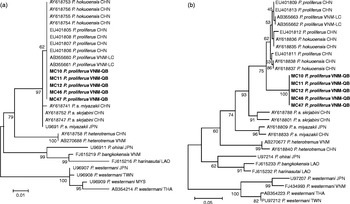
A total of five sequences of both ITS2 and CO1 were obtained successfully from five excysted metacercariae of P. proliferus collected from two locations in Quang Binh province. All of the sequences of each of the genes obtained from those samples were completely identical. These sequences were aligned with those of P. proliferus from Lai Chau province of northern Vietnam and from Yunnan province, China, and other species within the genus Paragonimus obtained from the DNA database to reconstruct two maximum likelihood trees of ITS2 (fig. 3a) and CO1 (fig. 3b) genes. The results showed that ITS2 sequences of P. proliferus from Quang Binh province (central Vietnam) were completely identical with those of Lai Chau province (northern Vietnam) and of Yunnan province (China), as well as of P. hokuoensis of China. They were all clustered in a single clade in the ITS2 tree (fig. 3a). In contrast, two separate groups of P. proliferus were recognized in the CO1 tree (fig. 3b). All CO1 sequences of Quang Binh samples made a single group, distinct from all other isolates of P. proliferus from northern Vietnam and Yunnan, China. The samples from the latter locations were almost completely identical (99.3% similarity) with each other, making a group. These two groups, northern Vietnam and Yunnan, China group and central Vietnam group, were 5.6% different from each other on average and clustered with each other at the bootstrap value of 75%.
The maximum likelihood trees reconstructed from (a) ITS2 and (b) CO1 gene sequences. Bootstrap scores (percentages of 1000 replications) are presented for each node. Nucleotide sequences obtained in this study are represented in bold with sample code. Locations of collecting samples in Vietnam are abbreviated (QB for Quang Binh, and LC for Lai Chau province). Other sequences from the DNA database are shown with accession number, species name and country code.

Discussion
Among the genus Paragonimus, P. proliferus is different from other species in the distinct form of metacercariae in the second intermediate host crabs. Metacercariae of all Paragonimus species other than P. proliferus usually appear as the encysted form. In contrast, P. proliferus metacercariae typically appear as enormously large, excysted forms covered with chisel-shaped single spines and have intestines reaching to one-sixth of the body length from the posterior end (Hsia & Chen, Reference Hsia and Chen1964; Zhou, Reference Zhou2004; Doanh et al., Reference Doanh, Shinohara, Horii, Habe, Nawa and Le2008). These unique characteristics make them easily identified as P. proliferus metacercariae in the second intermediate hosts. Only a few encysted metacercariae of P. proliferus with whole cyst walls of over 1.0 mm in size, which are fragile and easily ruptured during triturating, were reported by Zhou (Reference Zhou2004). In Vietnam, however, we have never seen such an encysted form. Although P. proliferus excysted metacercariae are extremely large, like juvenile worms, they are quite even in size with very small variance. The development of P. proliferus in the second intermediate hosts, therefore, would be an interesting issue to explore.
Paragonimus proliferus was discovered first in Jinghong, Yunnan province, China in 1964 (Hsia & Chen, Reference Hsia and Chen1964). In the same year, two other species, P. menglaensis Chung, Ho, Chang and Tsao, 1964 (Chung et al., Reference Chung, Ho, Cheng and Tsao1964) and P. hokuoensis Ho et al., Reference Ho, Chung, Chou Tsao, Zheng and Yang1964 (Ho et al., Reference Ho, Chung, Chou Tsao, Zheng and Yang1964), were also discovered in Mengla and Hekou, respectively, of Yunnan province, China. Then, both these two species were proved to be synonyms of P. proliferus (Blair et al., Reference Blair, Xu and Agatsuma1999; Zhou, Reference Zhou2004; Doanh et al., Reference Doanh, Shinohara, Horii, Habe, Nawa and Le2008; Zhou et al., Reference Zhou, Yang, Doanh, Yang, Xiang, Li, Shinohara, Horii and Nawa2008). Thus, P. proliferus had been reported only in a limited area of Yunnan province, China until 2008 when we collected excysted metacercariae of this species in Lai Chau province, northern Vietnam (Doanh et al., Reference Doanh, Shinohara, Horii, Habe, Nawa and Le2008). In the present study, we collected excysted metacercariae of P. proliferus in Quang Binh province, central Vietnam, about 1000 km from Lai Chau province (fig. 1). Together with the intra-species genetic variance in CO1 sequences among P. proliferus populations from central Vietnam and from the Vietnam–China border region found in this study, more genetic variants of P. proliferus are likely to exist in and around the Indochina peninsula to the south-western part of China.
With regard to second intermediate hosts, P. proliferus exploits crab species of the family Potamidae. The prevalence of P. proliferus metacercariae in the crab hosts was variable among locations, but generally low. In Yunnan province of China, P. proliferus metacercariae were found in 27.6% of crabs, Potamon chinghungense, with an average incidence of 2.25 metacercariae/crab (Yang et al., Reference Yang, Zhou, Li, Bai, Wu and Xiu2007). In Lai Chau province, northern Vietnam, the prevalence of P. proliferus in crabs, Potamiscus mieni, was 17.7–32.0%, with 1–8 metacercariae/crab (Doanh et al., Reference Doanh, Shinohara, Horii, Habe, Nawa and Le2008). In the present study, in Quang Binh province, in central Vietnam, 3.0–4.0% of crabs, P. tannanti, were infected, with 2–20 metacercariae/crab. Such a low density of infection raises some questions as to whether the definitive hosts of P. proliferus are restricted to a special species of animal(s) and the number of infected animals are limited. To date, the infectivity/pathogenicity of P. proliferus to humans remains unknown. By experimental infection, Zhou (Reference Zhou2004) successfully obtained adult worms from rats by both oral administration and peritoneal injection with P. proliferus metacercariae, but failed to infect cats, dogs or monkeys by oral infection. Doanh et al. (Reference Doanh, Shinohara, Horii, Habe, Nawa and Le2008) also failed to infect dogs and cats orally with P. proliferus metacercariae, but successfully obtained adult worms from a cat by intraperitoneal injection. Thus, although the natural definitive hosts of P. proliferus have never been proven, wild rodents seem to be the natural hosts of P. proliferus. More extensive epidemiological surveys on the intermediate and the final hosts are necessary to elucidate the natural life cycle and genetic diversity of P. proliferus.
Acknowledgements
P.N.D. received a postdoctoral fellowship (no. P10111) from the Japanese Society for Promotion of Science (JSPS). This study was also supported by Vietnam's National Foundation for Science and Technology Development (no.106.12.53.09).