



Introduction
Reactive oxygen species (ROS) are known to play a crucial physiological role as functional signalling molecules, such as mediating the effect of growth and inflammatory factors (Thannickal and Fanburg Reference Thannickal and Fanburg2000). However, when ROS overwhelm antioxidant systems, this imbalance leads to oxidative stress, which in turn damages cellular components such as proteins, carbohydrates, nucleic acids, and lipids, thereby compromising cell viability and function (Rani et al. Reference Rani, Deep, Singh, Palle and Yadav2016). Spermatozoa are particularly vulnerable to ROS due to the high concentration of polyunsaturated fatty acids (PUFAs) in their plasma membrane (O’Flaherty and Scarlata Reference O’Flaherty and Scarlata2022). Excessive ROS levels can result in mitochondrial dysfunction, DNA double-strand breaks, and apoptosis (Nowicka-Bauer and Nixon Reference Nowicka-Bauer and Nixon2020). However, despite their detrimental potential, ROS also play a dual role in spermatozoa. Physiological levels of ROS are essential for normal sperm functions, including capacitation, hyperactivation and sperm-egg fusion (Martin-Hidalgo et al. Reference Martin-Hidalgo, Bragado, Batista, Oliveira and Alves2019; O’Flaherty and Matsushita-Fournier Reference O’Flaherty and Matsushita-Fournier2017). Finally, the oxidative damage induced by ROS in spermatozoa leads to reduced motility and viability, increased DNA fragmentation and impaired fertilization and embryo development (Nowicka-Bauer and Nixon Reference Nowicka-Bauer and Nixon2020).
Seminal plasma is rich in antioxidants, but these are removed during sperm preparation for assisted reproductive technology (ART). Moreover, washing sperm through centrifugation can generate additional ROS (Shekarriz et al. Reference Shekarriz, Thomas and Agarwal1995). The reduction of antioxidants in seminal plasma, combined with increased ROS production, disrupts the oxidative balance, making it crucial to prevent oxidative damage during sperm preparation for in vitro fertilization (IVF). Various antioxidants, such as melatonin (Zhao et al. Reference Zhao, Whiting, Lambourne, Aitken and Sun2021), date seed oil (Fatma et al. Reference Fatma, Nozha, Ines, Hamadi, Basma and Leila2009), ascorbic acid (Ahmad et al. Reference Ahmad, Agarwal, Esteves, Sharma, Almasry, Al-Gonaim, AlHayaza, Singh, Al Kattan, Sannaa and Sabanegh2017), and Vitamin E (Ghafarizadeh et al. Reference Ghafarizadeh, Malmir, Naderi Noreini, Faraji and Ebrahimi2021), have been studied for their potential to alleviate oxidative stress in spermatozoa. However, there is still a need for antioxidants with proven clinical efficacy to prevent oxidative damage to human spermatozoa.
H2S, as a gas molecule, has been demonstrated to play an important role in inflammatory and oxidative stress processes (Cirino et al. Reference Cirino, Szabo and Papapetropoulos2023). A previous study demonstrated treatment with H2S donor GYY4137 ameliorated lung injury and suppressed inflammatory state and oxidative stress in lung tissues of H2S-deficient mice (Huang et al. Reference Huang, Wang, Zhou, Tang, Zhang, Zhu and Ni2021). In the male reproductive system, the expression of H2S-generating enzymes, including cystathionine γ-lyase (CSE), cystathionine β-synthase (CBS) and 3-mercaptopyruvate sulphurtransferase (3-MST), had been identified in testis, epididymis and spermatozoa (Wang et al. Reference Wang, Wang, Li, Han, Zhang, Meng, Xiao, Xie, Wang, Sha, Chen, Moore, Wang, Xiang and Ji2018). And H2S levels had been tested in human seminal plasma (Wang et al. Reference Wang, Wang, Li, Han, Zhang, Meng, Xiao, Xie, Wang, Sha, Chen, Moore, Wang, Xiang and Ji2018). These results suggest this gasotransmitter is involved in sperm physiology. H2S had been demonstrated to protect against testicular and epididymal injury (Lorian et al. Reference Lorian, Kadkhodaee, Kianian, Abdi, Ranjbaran, Ashabi and Seifi2020; Wang et al. Reference Wang, Wang, Li, Han, Zhang, Meng, Xiao, Xie, Wang, Sha, Chen, Moore, Wang, Xiang and Ji2018; Xia et al. Reference Xia, Ning, Cheng, Yu, Rao, Ruan, Yuan and Du2019; Yuksel et al. Reference Yuksel, Erginel, Bingul, Ozluk, Karatay, Aydın and Keskin2022). However, the role of H2S in sperm preparation for ART is less understood. This study was conducted to evaluate the antioxidant effects of H2S on sperm motility, viability, lipid peroxidation and caspase-3 activity in human spermatozoa subjected to H2O2-mediated oxidative damage.
Materials and methods
Ethics statement and study population
The study was approved by the Ethics Committees of General Hospital of Southern Theatre Command (reference number: NZLLKZ2024017). Before the study, all subjects signed informed consent.
A total of 33 healthy men who attended the Reproductive Medicine Center of the General Hospital of Southern Theatre Command between June 2022 and July 2023 were assessed. All participants had normal semen parameters based on sperm evaluation and had no history of infertility or identifiable risk factors for male infertility. Participants with abnormal sperm parameters, recent fevers, inflammatory or immune diseases, smoking, or alcohol intake were excluded. Sperm samples from 8 men were used for preliminary analysis to determine the appropriate concentration of H2O2 for inducing sperm damage. Sperm samples from 25 men were subsequently used to assess the protective effect of H2S donor GYY4137 on sperm damage induced by H2O2. The mean age of participants was 32 ± 5 years.
Sperm processing
Semen samples were obtained through masturbation after 2–7 days of sexual abstinence, collected in sterile containers, and incubated at 37°C for at least 30 min to allow liquefaction. The semen samples were evaluated for sperm parameters, including concentration, motility, morphology, and viability following the procedures recommended by World Health Organization (WHO 2021). Semen samples with normal sperm parameters were prepared using the density gradient centrifugation method with 45% and 95% SpermGrad™ (Vitrolife, Gothenburg, Sweden) and G-IVFTM plus medium (Vitrolife, Gothenburg, Sweden). The sperm separation density gradient was produced by layering 1.5 mL of 45% SpermGrad over 1.5 mL of the 90% SpermGrad, with 1.5 mL of semen sample added over the upper layer. After centrifugation at 500 × g for 15 min, the supernatant was gently removed, and the pellet was transferred into G-IVFTM plus medium for washing. Centrifugation was then repeated at 150 × g for 5min, after which the supernatant was removed and the pellet was resuspended in G-IVFTM plus medium.
Induction of oxidative stress
Oxidative stress was induced by exposuring sperm to H2O2. A 30% stock solution of H2O2 was diluted to 10 mM using G-IVFTM plus medium. Sperm was then cultured in the presence of different concentrations of H2O2, ranging from 2 to 100 μM, for 15min at 37 °C to determine suitable H2O2 concentration.
Sperm treatment
To evaluate the effect of H2S on sperm parameters, GYY4137 (Sigma-Aldrich), a slow H2S releasing compound, was used to treat sperm exposed to H2O2. Briefly, sperm from participant was seeded into 24-well plate and treated with H2O2 for 15min, followed by the addition of different concentrations of GYY4137 (0.625–2.5μM) to the culture medium. After 24 h of incubation at 37 °C, sperm parameters were assessed.
Sperm motility analysis
A 10 μL sperm sample was placed in a haemocytometer counting chamber, and sperm motility was assessed under light microscopy at 40× magnification by counting 200 sperm cells, following WHO 2010 criteria. Each sample was evaluated by two technicians in duplicate, and the results were averaged after calculating the error.
Sperm viability analysis
Sperm viability was determined using the eosin-nigrosin staining technique, according to WHO recommendations. Briefly, 20 μL of the sperm sample was mixed with 20 μL of staining solution, and the mixture was placed on a glass slide. The sample was observed under light microscopy at 40 × magnification. Viable sperm cells were remained colourless, while dead sperm cells were stained red. At least 200 sperms were examined, and the percent of stained sperms was calculated.
Sperm samples for oxidative stress detection
Following sperm motility and viability analyses, the remaining sperm samples were divided into several aliquots based on the sperm count, centrifuged at 120 × g for 5 min, and the supernatant was removed. The pellet was collected and stored in liquid nitrogen for oxidative stress detection.
Lipid peroxidation (LPO) analysis
Lipid peroxidation levels were estimated by measuring malondialdehyde (MDA) and 4-hydroxynonenal (4HNE) production using commercial assay kits. For MDA analysis, sperm samples were thawed from liquid nitrogen, lysed in RIPA lysis buffer at 4°C for 10 min, and centrifuged at 12,000 × g for 10 min at 4°C to collect the supernatant. Protein concentration was determined using a commercial assay kit (Beyotime, Haimen, China). MDA concentration was measured using the thiobarbituric acid (TBA) reaction with a commercial assay kit (Jiancheng Bioengineering Institute, Nanjing, China). The supernatant was incubated with TBA in a boiling water bath for 40 min, then cooled and centrifuged at 4,000 rpm for 10 min. The supernatant was collected and measured with a spectrophotometer at 530 nm. For 4HNE analysis, sperm samples were thawed, repeatedly frozen, and thawed, then centrifuged at 12,000 × g for 10 min to collect the supernatant. After determining protein concentrations, the supernatant was analyzed using a commercial ELISA kit (Cusabio, Wuhan, China) according to the manufacturer’s instructions.
Measurement of caspase-3 activity
The protein from the sperm samples used in the MDA test was employed to measure caspase-3 activity. Caspase-3 activity was assessed using the Ac-DEVD-pNA reaction with a commercial assay kit (Beyotime, Haimen, China). Briefly, 40 μL of the sperm sample was mixed with 60 μL of reaction buffer containing 10 μL of the 2 mM Ac-DEVD-pNA substrate. After incubation at 37°C for 120 min, the samples were measured with a spectrophotometer at 405 nm.
GSH measurement
GSH levels were measured using a commercial assay kit (Beyotime, Haimen, China). Briefly, sperm samples were thawed from liquid nitrogen, repeatedly frozen and thawed, then centrifuged at 12,000 × g for 10 min to collect the supernatant. Detection reagents were mixed with the supernatant, and GSH levels were measured using a microplate analyzer at an absorbance of 412 nm.
Statistical analysis
The Kolmogorov-Smirnov test was performed to ensure normal distribution and parametric statistics were used. The repeated measure ANOVA was applied to compare the means of more than two groups; comparison between two group were conducted by paired t-test. P < 0.05 was considered as statistically significant. All analyses were performed using SPPS 21 Software (IBM SPSS Statistics for Windows).
Results
H2O2 was used to induce oxidative stress in human sperm samples. The effect of 0–100 μM H2O2 on sperm motility and viability are shown in Figure1. A kinetic dose-response study was used to determine the optimal concentration of H2O2 for inducing sperm damage. As shown in Figure 1A&B, sperm incubated with ≥ 25 μM H2O2 showed a significant decrease in viability, with the majority of spermatozoa dying after 15 min of exposure. Consequently, 10 μM H2O2 was selected as the optimal concentration for subsequent experiments.
Effect of H2O2 on human sperm motility (A) and viability (B). Sperm samples (n = 8) were exposed to varying concentrations of H2O2 (0–100 μM) for 15 min at 37°C. Sperm parameters were evaluated. Data are presented as mean ± SD. **p < 0.01, ***p < 0.001 versus the control group.

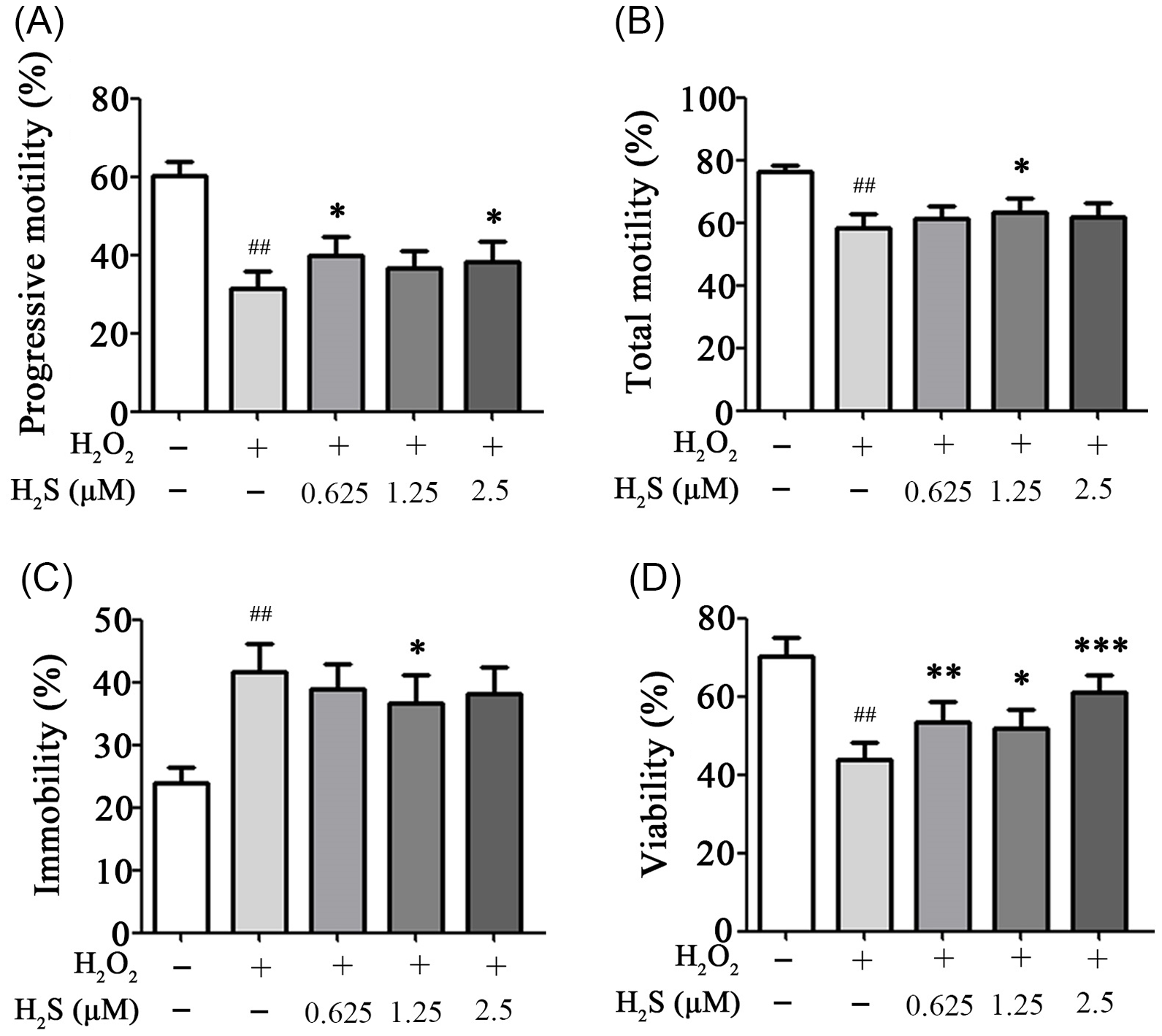
Exposure of 10 μM H2O2 adversely affected sperm motility, including reduced progressive motility (PR) and total motility (progressive + non-progressive motility, PR + NP), and an increase in immobility (MI). Treatment with GYY4137 partially mitigated the motility reduction induced by H2O2 (Figure 2A, B&C). Moreover, GYY4137 significantly improved H2O2-induced reductions in viability in a dose-dependent manner (Figure 2D).
Impact of H2S donor GYY4137 on sperm motility (A–C) and viability (D) under oxidative stress. Spermatozoa from 25 healthy men were incubated for 15 min with or without 10 μM H2O2, followed by co-culture with increasing concentrations of GYY4137 for 24 h. Sperm parameters were then assessed. Data are shown as mean ± SD. ## p < 0.01 versus the control group; *p < 0.05, **p < 0.01, ***p < 0.001 versus the H2O2 group.
Lipid peroxidation (LPO) is known to have detrimental effects on sperm function, leading to dramatic remodelling of the composition and biophysical properties of sperm membranes. MDA and 4HNE, highly reactive lipid aldehydes generated from LPO, serve as important biomarkers of lipid peroxidation (O’Flaherty and Scarlata Reference O’Flaherty and Scarlata2022). Compared to the control group, the levels of 4HNE and MDA were significantly elevated following exposure of spermatozoa to H2O2. Incubation with GYY4137 significantly reduced the levels of 4HNE and MDA induced by H2O2 in a dose-dependent manner (Figure 3).
Influence of H2S donor GYY4137 on lipid peroxidation in spermatozoa treated with H2O2. Spermatozoa from 12 healthy men were incubated for 15 min with or without 10 μM H2O2 and then co-cultured with varying concentrations of GYY4137 for 24 h. MDA (A) and 4HNE (B) levels were measured. Data are expressed as mean ± SD. # p < 0.05, ## p < 0.01 versus the control group; *p < 0.05 versus the H2O2 group.

Excessive ROS have been shown to promote both caspase activation and apoptosis, leading to cell death and reduced sperm count (Mahfouz et al. Reference Mahfouz, du Plessis, Aziz, Sharma, Sabanegh and Agarwal2010). In this study, the activity of caspase-3, a key enzyme in the apoptosis pathway, was markedly increased following exposure to H2O2. Incubation of spermatozoa with GYY4137 significantly attenuated H2O2-induced caspase-3 activity in a dose-dependent manner (Figure 4).
Effect of H2S donor GYY4137 on caspase 3 activity in spermatozoa treated with H2O2. Spermatozoa from 12 healthy men were incubated for 15 min with or without 10 μM H2O2 and subsequently co-cultured with increasing concentrations of GYY4137 for 24 h. Sperm parameters were then measured. Data are represented as mean ± SD. ##p < 0.01 versus the control group; *p < 0.05 versus the H2O2 group.

Furthermore, hydrogen sulfide (H2S) has been demonstrated to enhance the production of glutathione (GSH) by stimulating cystine/cysteine transporters and redistributing GSH to mitochondria (Tabassum and Jeong Reference Tabassum and Jeong2019). The level of GSH in spermatozoa was decreased after the exposure to H2O2. However, incubation with GYY4137 significantly elevated GSH levels (Figure 5).
Effect of H2S donor GYY4137 on GSH levels in spermatozoa exposed to H2O2. Spermatozoa from 12 healthy men were incubated for 15 min with or without 10 μM H2O2, followed by co-culture with increasing concentrations of GYY4137 for 24 h. Sperm parameters were assessed. Data are depicted as mean ± SD. # p < 0.05 versus the control group; *p < 0.05 versus the H2O2 group.

Discussion
In the male reproductive system, the expression of H2S-generating enzymes had been detected in spermatozoa (Martínez-Heredia et al. Reference Martínez-Heredia, de Mateo, Vidal-Taboada, Ballescà and Oliva2008; Wang et al. Reference Wang, Wang, Li, Han, Zhang, Meng, Xiao, Xie, Wang, Sha, Chen, Moore, Wang, Xiang and Ji2018), and H2S levels had been measured in seminal plasma (Wang et al. Reference Wang, Wang, Li, Han, Zhang, Meng, Xiao, Xie, Wang, Sha, Chen, Moore, Wang, Xiang and Ji2018). These results suggest that H2S may be involved in sperm physiology to some extent. Numerous studies have highlighted the importance of H2S in combating oxidative stress (Cirino et al. Reference Cirino, Szabo and Papapetropoulos2023). Oxidative stress is a key factor contributing to sperm damage both in vivo and in vitro. The goal of this study was to examine the protective effect of H2S donor GYY4137 on sperm damage induced by H2O2 in vitro. We found that H2S could alleviate the oxidative damage to spermatozoa caused by H2O2, including improvements in motility and viability, as well as reductions in lipid peroxidation and caspase-3 activity.
The in vitro model of H2O2-mediated oxidative damage in spermatozoa had been demonstrated in several of studies (Bader et al. Reference Bader, Ibrahim, Moussa, Mourad, Azoury, Azoury and Alaaeddine2020; Chan et al. Reference Chan, Alqawasmeh, Zhao, Chan, Leung, Chow, Agarwal, Mak, Wang, Pang, Li and Chu2021; Fatma et al. Reference Fatma, Nozha, Ines, Hamadi, Basma and Leila2009; Nenkova et al. Reference Nenkova, Stefanov, Chervenkov and Alexandrova2016). Wang et al. demonstrated that the physiological concentration of H2O2 in seminal plasma is approximately 20 μM, significantly increasing to 40 μM in patients with spermatocystitis (Wang et al. Reference Wang, Liu, Zhou, Wang, Zhang and Cheng2023). Therefore, the effects of 0–100 μM H2O2 on sperm motility and viability were assessed. Sperm motility and viability decreased in a dose-dependent manner, with 10 μM being selected as the optimal concentration for the subsequent study. Indeed, exposure to 10 μM H2O2 induced a significant reduction in sperm viability and motility.
According to the releasing mechanism, H2S donors include two categories: fast- and low releasing agents. GYY4137, a phosphorodithioate derivative, releases H2S slowly and continuously, mimicking physiological conditions. In contrast, inorganic salts like sodium hydrosulphide (NaHS) and sodium sulfide (Na2S) release H2S rapidly when dissolved in an aqueous solution. Previous studies have reported divergent effects of fast- and slow-releasing H2S donors on boar and human spermatozoa (Pintus et al. Reference Pintus, Jovičić, Kadlec and Ros-Santaella2020; Wang et al. Reference Wang, Wang, Li, Han, Zhang, Meng, Xiao, Xie, Wang, Sha, Chen, Moore, Wang, Xiang and Ji2018), with high concentration of Na2S (>25 μM) shown to be detrimental to sperm motility (Zhao et al. Reference Zhao, Zhang, Liu, Zhang, Hao, Li, Chen, Shen, Tang, Min, Meng, Wang, Yi and Zhang2016). These findings suggest that the rapid release of high concentrations of H2S can impair sperm fertilization capacity. In our study, GYY4137 was used at concentrations between 0.625–2.5 μM, lower than those used on boar spermatozoa (Pintus et al. Reference Pintus, Jovičić, Kadlec and Ros-Santaella2020), but comparable to those used in asthenospermic human semen samples with reduced H2S concentrations in seminal plasma (Wang et al. Reference Wang, Wang, Li, Han, Zhang, Meng, Xiao, Xie, Wang, Sha, Chen, Moore, Wang, Xiang and Ji2018).
As a slow-releasing H2S donor, GYY4137 shows a great potential as an antioxidant additive in sperm medium during in vitro sperm preparation of artificial reproductive technology. H2S had been tested in human seminal plasma and was associated with sperm motility (Wang et al. Reference Wang, Wang, Li, Han, Zhang, Meng, Xiao, Xie, Wang, Sha, Chen, Moore, Wang, Xiang and Ji2018). Supplementation with GYY4137 has been shown to improve sperm motility in asthenospermic patients. The protective effect of GYY4137 against H2O2-induced oxidative stress in boar sperm has been previously demonstrated (Pintus et al. Reference Pintus, Jovičić, Kadlec and Ros-Santaella2020). Additionally, treatment with GYY4137 has been shown to mitigate ipsilateral epididymis injury in experimentally varicocele-induced rats (Xia et al. Reference Xia, Ning, Cheng, Yu, Rao, Ruan, Yuan and Du2019).
Excessive ROS is known to promote lipid peroxidation and caspase activation (Mahfouz et al. Reference Mahfouz, du Plessis, Aziz, Sharma, Sabanegh and Agarwal2010). LPO has detrimental effects on sperm function, leading to dramatic remodelling of the composition and biophysical properties of sperm membranes. MDA and 4HNE are highly reactive lipid aldehydes from the breakdown of LPO (O’Flaherty and Scarlata Reference O’Flaherty and Scarlata2022). The activity of caspase-3 was significantly increased after the exposure of spermatozoa to H2O2. Our results showed that GYY4137 could reduce sperm apoptosis induced by H2O2 through its antioxidative properties.
Conclusions
In summary, to our best knowledge, this is the first study to explore the protective role of H2S donor GYY4137 on human spermatozoa exposed to H2O2-induced oxidative stress in vitro. We found that GYY4137 effectively mitigates multiple aspects of H2O2-induced oxidative stress in human spermatozoa. Further studies assessing additional parameters on a larger-scale trial may provide a better understanding of the biological role of H2S donor GYY4137 in male infertility. Further investigations exploring the mechanism of GYY4137 on human spermatozoa should be performed.
Data availability
The data that support the findings of this study are available from the corresponding author (X.G), upon reasonable request.
Acknowledgements
We are grateful to all of our clinical staff of the reproduction team for their support.
Author contributions
X.G and Y.H developed the concept and designed the study. Y.H, Y.C and M.Z performed the measurement. D.L and R.G analyzed the data and interpreted the results. X.G and Y.H drafted the manuscript. All authors critically reviewed the manuscript and approved the final version of the manuscript.
Funding
We are grateful for the financial support from the Project of Guangzhou Science and Technology Plan (202102021271) and Yu Cai Project of the General Hospital of Southern Theater Command (2022NZC005).
Competing interests
The authors declared that they have no conflicts of interest.



