Introduction
Oral health is an essential component of healthy ageing. Common oral health problems for older people, such as dry mouth syndrome, poor sense of taste and difficulty in chewing and speaking due to tooth loss, can lead to poor quality of life (Gerdin et al. Reference Gerdin, Einarson, Jonsson, Aronsson and Johansson2005; Locker, Clarke and Payne Reference Locker, Clarke and Payne2000). The most important problems are multiple tooth loss and poor ability to chew food, which can result in limited food choices, especially for fruits and vegetables (Ervin and Dye Reference Ervin and Dye2009; Savoca et al. Reference Savoca, Arcury, Leng, Chen, Bell, Anderson, Kohrman, Frazier, Gilbert and Quandi2009; Walls et al. Reference Walls, Steele, Sheiham, Marcenes and Moynihan2000).
The oral health status of an older person is the outcome of multiple exposures to risk and protective factors through a period of 60 years or longer. Socio-economic position (SEP) as indicated by educational level, occupation and income affects the exposure to risk and protective factors at the individual level throughout the lifecourse (George Reference George2005; Jung et al. Reference Jung, Tsakos, Sheiham, Ryn and Watt2010; Sisson Reference Sisson2007). Therefore, SEP at various stages in life can be used as a proxy for the exposure to risk and protective factors over the lifecourse (Braveman and Barclay Reference Braveman and Barclay2009).
Older persons born at different times have lived in different social contexts; therefore, birth cohort reflects critical periods in relation to the history of socio-political policy. Cohort membership reflects living and working conditions, access to education and the dental care that was available, as well as awareness about dental hygiene in the population. For example, cohorts born before 1920 were not able to take advantage of the school dental programme initiated in 1938 in Sweden (Pedersen et al. Reference Pedersen, Vigild, Nitschke and Berkey2005). Swedish national dental insurance, which reduces inequity in access and utilisation of dental care, was introduced in 1974. Recent birth cohorts have benefited more than earlier cohorts from advances in dental knowledge and technology as well as improved access to dental services to prevent tooth loss. Dental treatments before the introduction of national insurance and dental hygienist programmes were more often extraction than restoration. Therefore, the study of determinants of oral health of older persons has to take birth cohort into consideration.
Gender differences in oral health can be the result of biological factors, such as reduced salivation in women after menopause, or social factors, such as opportunities for education. While higher proportions of women in more recent birth cohorts have maintained their teeth into late life, a Swedish study showed differences among women depending on education level (Österberg et al. Reference Österberg, Johanson, Sundh, Steen and Birkhed2006). Thus, gender influences the association between SEP and oral health in late life throughout the lifecourse.
The lifecourse perspective considers risk and protective factors at critical periods as well as the accumulative effects of those factors throughout life (Braveman and Barclay Reference Braveman and Barclay2009). Childhood can be considered a critical period for oral health outcomes at old age since it is during childhood that teeth, and oral hygiene habits, are formed. Several studies have reported the effect of childhood socio-economic conditions on dental status in early adulthood (Lu et al. Reference Lu, Wong, Lo and McGrath2011; Thomson et al. Reference Thomson, Poulton, Milne, Caspi, Broughton and Ayers2004). Few data sets are able to follow individuals from childhood into mid- and late life. This study is based on data from persons born between 1903 and 1925 interviewed in middle age and again in old age. The interview in 1968 included retrospective questions about childhood SEP. The study aims to identify childhood and mid-life socio-economic determinants of tooth loss and chewing problems among persons aged 77 years and older, as well as to determine whether birth cohort and gender influence the association between SEP and oral health outcomes.
Methods
This study analyses data from two Swedish national surveys, the Swedish Level of Living Survey (LNU) and the Swedish Panel Study of the Living Conditions of the Oldest Old (SWEOLD) that followed the same individuals from 1968 until 2002. The first LNU was carried out by interviewing a random sample of 1:1,000 of the Swedish population aged 15–75 years in 1968. The sample was randomly selected from registration numbers. Subsequent LNU surveys were carried out in 1974, 1981, 1991 and 2000, maintaining the age ceiling of 75. SWEOLD was carried out in 1992 and 2002 to follow up the former LNU respondents who were older than 75 years. The survey included people living at home and in institutions. SWEOLD used most of the items in the LNU survey as well as some additional questions particularly important to persons older than 75 years. For example, SWEOLD added a question about the ability to chew hard food. This study uses the 1968 LNU wave as baseline and the 2002 SWEOLD as follow-up. Both surveys had high response rates (LNU 1968, 90.8%; SWEOLD 2002, 88.5%) and were representative of the intended age groups at that time.
Material
Study persons were those aged 43–75 years in 1968 who survived to late life (aged 77+) and were included in SWEOLD 2002. In 1968, 3,340 persons aged 43–75 were interviewed. Of these, 2,615 had died, 43 had emigrated and 112 were non-respondents in 2002, leaving 570 interviewees in 2002. All persons born before 1902 died before 2002; thus, the persons included in the analysis were those born 1903–1925.
Variables
The outcome variables are multiple tooth loss in mid-life obtained from LNU in 1968, and multiple tooth loss and chewing problems in late life obtained from SWEOLD 2002. In both waves, participants were asked to choose a statement that best described the condition of their teeth. The answers were dichotomised into two groups, having natural teeth or multiple tooth loss. The former includes ‘own teeth in good shape, few fillings’ and ‘own teeth, many crowns, fillings, bridge’, while multiple tooth loss includes ‘own teeth but in poor shape, that is, many missing’, ‘complete dentures or partial dentures’ and ‘no teeth or only a few’.
Participants were asked, ‘Can you chew hard food such as hard bread or apples?’ and given three alternative answers. The answer ‘Yes, without difficulty’ was classified as not having chewing difficulty. The answers ‘Yes, but I must be careful’ and ‘No, not at all’ were classified as having chewing difficulty.
The independent variables include birth cohort, gender, childhood SEP and mid-life SEP. Indicators of SEP were education level and occupation. Childhood SEP was measured by father's occupation and father's educational level, which were obtained from LNU 1968. Fathers' occupations and educational levels were selected because variation among women was low in the 1920s.
Mid-life SEP was obtained from SWEOLD 2002 and measured by personal education level and social class according to family-based occupation. Family-based occupation was constructed by comparing personal occupation with spouse's occupation (if any) and selecting the higher in the social class stratum. This has been shown to be a more appropriate reflection of access to resources, especially for women (Galobardes et al. Reference Galobardes, Shaw, Lawlor, Lynch and Smith2006).
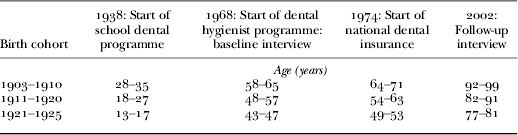
Age is an important confounding factor and can be grouped to reflect birth cohort membership. This study took birth cohort as a confounder into the analysis rather than age to reflect socio-political influence on oral health status. In addition, studies that analysed both age and cohort effect on edentulousness in the same Swedish elderly population (Ahacic, Parker and Thorslund Reference Ahacic, Parker and Thorslund2007; Ahacic and Thorslund Reference Ahacic and Thorslund2008; Holst and Schuller Reference Holst and Schuller2000) and an adult Norwegian population (Holst and Schuller Reference Holst and Schuller2000) showed cohort effect to be more prominent than age. In this study, samples were divided into three birth cohorts, 1903–1910, 1911–1920 and 1921–1925, which corresponded to persons aged 77–81, 82–91 and 92+ years old. Table 1 shows the ages of each cohort when the school dental programme began (1938), when the dental hygienist programme began (1968) and when national dental insurance was initiated (1974).
Birth cohorts' ages at important dates in Swedish dental care history

Statistical analyses
Only complete cases were selected for the analysis. The percentage of missing data for each variable ranged from 0.2 to 1.1 per cent, and bias from missing data was expected to be minimal. This corresponds to 556 out of 570 interviewed persons. The bivariate associations between confounding variables, all childhood and mid-life SEP and all outcome variables were analysed with Pearson's chi-square test or Fisher's exact test. Multiple logistic regressions were used to determine odds ratios of having multiple tooth loss in mid-life (in 1968) and in late life as well as having difficulty chewing hard food in late life, using the statistical software package SPSS 17.0. Multicollinearity among childhood SEP indicators, mid-life SEP indicators, gender and birth cohort were checked. All variance inflation factors were less than 2.5, and tolerances were higher than 0.4. Therefore, despite that they are significantly intercorrelated, these variables were not expected to affect the logistic regression (Anderson and Black Reference Anderson and Black1984). The regression analysis for chewing difficulty in late life was adjusted with multiple tooth loss in late life. All logistic regression analyses were also repeated using age instead of birth cohort as a confounding variable. Each regression model was checked for model fit by examining goodness of fit in terms of the Hosmer–Lemeshow test and outliers outside three standard deviations.
Results
The mean age of the persons who died before the follow-up year in 2002 was significantly higher than the survivors (59.9±8.8 versus 49.3±5.0 years old in 1968, p<0.000) and there were more women (59.6% versus 47.8%, p<0.000). A significantly higher proportion of those who died had fathers with basic education (87.3% versus 84.3%, p<0.05) but the distribution of fathers' occupations was not significantly different (p>0.05). Persons who died also had a higher prevalence of multiple tooth loss at baseline (1968) (67.0% versus 41.0%, p<0.001), but the baseline prevalence among those interviewed and among those who were alive but not interviewed at follow-up (2002) was not significantly different (41.2% versus 33.8%, p>0.05).
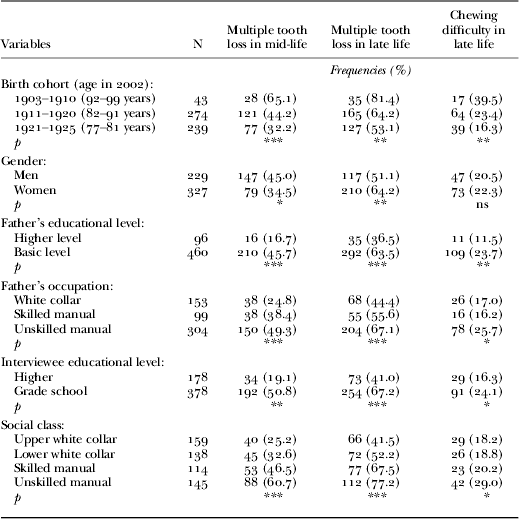
The mean age in the 2002 sample was 83.4±4.9 years old with an age range of 77–99 years. Table 2 shows that birth cohort and all indicators of SEP in childhood and mid-life were significantly associated with multiple tooth loss in mid- and late life, and chewing difficulty in late life. Gender was significantly associated with multiple tooth loss in mid- and late life, but not with chewing difficulty in late life. Childhood SEP, as indicated by father's education and occupation, was significantly correlated with the interviewee's own educational level and social class (data not shown).
Prevalence of multiple tooth loss in mid-life (43–65 years of age) and in late life (77+ years of age) and chewing difficulty in late life by demographic and social position

Note: N=556.
Significance levels: * p<0.05, ** p<0.01, *** p<0.001, ns: not significant (Pearson's chi-square or Fisher's exact test).
Multiple tooth loss in mid- and late life
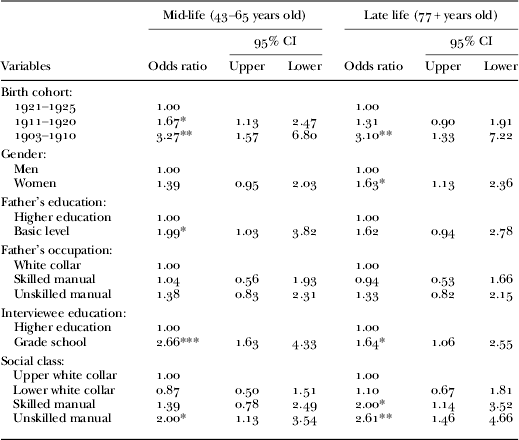
Table 3 shows the logistic regression models with the odds of having multiple tooth loss in mid- and late life. When childhood and mid-life SEP indicators were entered together into the regression model for multiple tooth loss in mid-life, people whose fathers had low education and who had low education themselves exhibited higher odds ratio (OR) of multiple tooth loss (OR=1.99 and 2.66, p<0.05 and <0.001). While father's occupation was not significant for multiple tooth loss in mid-life, persons who were unskilled manual workers in mid-life had lower odds compared to upper white-collar workers (OR=2.00, p<0.05). The two earlier birth cohorts had significantly higher odds of having multiple tooth loss (OR=1.67 and 3.27, p<0.05 and <0.01) but the gender difference was not significant (p>0.05).
Multiple tooth loss in mid- and late life

Notes: N=556. CI: confidence interval.
Significance levels: * p<0.05, ** p<0.01, *** p<0.001.
Multiple tooth loss in late life, although not significantly associated with childhood SEP, was more likely among persons who had lower education (OR=1.64, p<0.05) and among the skilled and unskilled manual workers than the upper white-collar workers (OR=2.00 and 2.61, p<0.05 and <0.01). The 1903–1910 birth cohort was also more likely to have multiple tooth loss than the 1921–1925 birth cohort (OR=3.10, p<0.01), and gender difference was significant. In late life, women were more likely to have multiple tooth loss than men (OR=1.63, p<0.05).
Chewing difficulty in late life
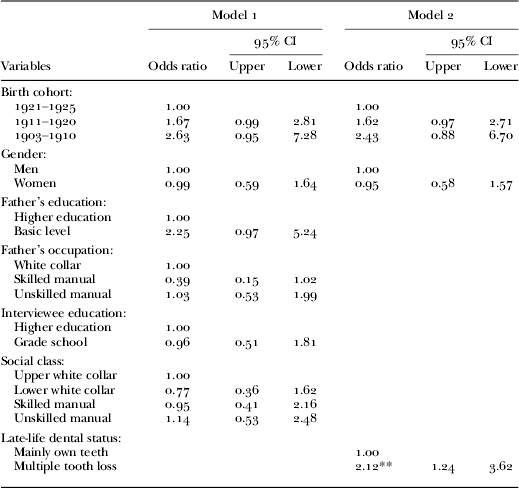
Prevalence of chewing difficulty in late life was 22 per cent. Table 4 shows logistic regression models for difficulty chewing hard food in late life. When controlled for birth cohort and gender, neither childhood nor mid-life SEP had significant odds for chewing difficulty in late life. Only multiple tooth loss in mid-life was significantly associated with chewing difficulty in late life (OR=2.12, p<0.01).
Chewing difficulty in mid- and late life

Notes: N=556. CI: confidence interval.
Significance level: ** p<0.01.
When logistic regressions controlled for age in years instead of birth cohort, the models for both mid- and late life multiple tooth loss and chewing difficulty in late life gave similar results (data not shown).
Discussion
This study analyses the associations between childhood and mid-life SEP with multiple tooth loss and chewing difficulty in a Swedish population aged 77 years or older using national population survey data. Based on a conceptual model of socio-behavioural risk factors of oral health by Petersen (Reference Petersen2005), we assumed that SEP in childhood and mid-life reflects exposure to risk and protective factors concerning dental health.
Taking childhood living conditions as a critical period in the lifecourse perspective, numerous studies have shown associations between childhood socio-economic status and coronary heart disease, lung diseases and quality of life in old age (Blackwell, Hayward and Crimmins Reference Blackwell, Hayward and Crimmins2001; Bowen and Gonzalez Reference Bowen and Gonzalez2010; Braveman and Barclay Reference Braveman and Barclay2009; Fors, Lennartsson and Lundberg Reference Fors, Lennartsson and Lundberg2009; Rigidor et al. Reference Rigidor, Banegas, Gutierrez-Fisac, Dominguez and Rodriguez-Artalejo2004). An English longitudinal study reported a significant association between parental occupation and edentulousness at age 50+ (Tsakos et al. Reference Tsakos, Demakakos, Breeze and Watt2011). Our study also shows significant associations between childhood SEP and multiple tooth loss at age 77+. However, the association became non-significant when mid-life SEP was taken into the analysis. Since childhood SEP significantly associates with mid-life SEP, which, in turn, associates with multiple tooth loss late in life, the results suggest that childhood SEP has an indirect effect on dental status in late life for this older population.
While childhood and mid-life SEP was significantly associated with difficulty chewing hard food in late life in a bivariate analysis, the association became non-significant when birth cohorts were added to the analyses. However, chewing difficulty had a significant association with dental status even when controlled for birth cohort. Since one aim of the national dental insurance of 1974 was to decrease SEP inequity in access to dental care, it might be postulated that the general improvement in access to care, in particular access to dental prostheses, may have weakened the association between chewing difficulty and mid-life SEP in the older population in 2002. A study of older persons in Gothenburg, Sweden, showed a general increase in the utilisation of dental care between 1971 and 2000 (Österberg et al. Reference Österberg, Johanson, Sundh, Steen and Birkhed2006). A nationwide study from 1988/89, on the contrary, showed SEP inequities in dental care among older people (Österberg et al. Reference Österberg, Lundgren, Emilson, Sundh, Birkhed and Steen1998). While it is clear that utilisation has increased, the access to dental care during the beginning years of the insurance programme was more likely to be available only in major cities such as Gothenburg. Thus, the effect of national insurance in the beginning years might not be able to prevent social differences in tooth loss but the increasing access to dental care in the later years of the insurance might decrease social differences in tooth replacement.
Although the findings from our study cannot clearly show the interaction between socio-political contexts and SEP that influences oral health outcome in late life, some explanations to the differences among the three birth cohorts can be postulated. The preventive benefits of the school dental programme, the dental hygienist programme and national dental insurance might contribute to the significantly higher odds of multiple tooth loss late in life in the 1903–1910 birth cohort compared to the 1921–1925 birth cohort. Members of the 1921–1925 birth cohort may have benefited from various dental services at more appropriate ages than members of the other two birth cohorts. For example, the school dental programme started in 1938. At that time, members of the 1921–1925 birth cohort were aged 13–17 years while members of the other two birth cohorts were well above school age. Members of the 1921–1925 birth cohort may have received preventive care from the dental hygienist programme (initiated in 1968) and the dental insurance scheme (initiated in 1974) at a younger age than the earlier birth cohorts. However, socio-political context differences among the three birth cohorts were not distinct, and there were regional differences in the implementation of dental programmes.
Studies examining gender differences in oral health have shown mixed results. For example, an Italian study of an older population aged 65+ reported higher prevalence of edentulousness among women (Musacchio et al. Reference Musacchio, Perissinotto, Binotto, Sartori, Silva-Netto, Zambon, Manzato, Corti, Baggio and Crepaldi2007). The first National Health and Nutrition Examination Survey (NHANES I) in 1971–1975 in the United States reported no gender difference in edentulousness in persons aged 60–74 years (Eklund and Burt Reference Eklund and Burt1994). A 15-year longitudinal study of tooth loss in people born in 1942 in Örebro, Sweden, showed no gender difference in tooth loss between ages 50 and 65 years (Åstrøm et al. Reference Åstrøm, Ekback, Ordell and Unell2011). These studies did not compare rates of tooth loss in men and women throughout the lifecourse. Our study shows gender differences in the progression of multiple tooth loss from mid- to late life. The gender difference in multiple tooth loss in mid-life was non-significant when adjusted for birth cohort and SEP. But in late life, the percentage of women with multiple tooth loss was higher than that of men, regardless of birth cohort, education and social class.
The biological aspects of gender, especially after mid-life, may explain some of the results. The Progetto Veneto Anziani study found that tooth loss was significantly related to pregnancy and menopause (Musacchio et al. Reference Musacchio, Perissinotto, Binotto, Sartori, Silva-Netto, Zambon, Manzato, Corti, Baggio and Crepaldi2007). After menopause, women experience hyposalivation due to the decrease in oestrogen hormone levels (Friedlander Reference Friedlander2002). Both hyposalivation and decreases in oestrogen are risk factors for root caries and periodontal diseases that can lead to tooth loss (Friedlander Reference Friedlander2002). Therefore, mid-life seems to be a critical period for women in regard to dental health.
It is difficult to disentangle biological factors from social disadvantage. More recent cohorts of women in Sweden have had better access to education. An additional analysis of our database showed the proportion of women with higher education increased from 14.3 per cent in the oldest birth cohort, to 28.8 and 33.3 per cent in the youngest birth cohorts. Further study should assess gender patterns in other socio-economic factors, health behaviour and care utilisation.
Our results are limited by attrition due to death during the 34-year evaluation time, as expected with such long-term follow-up. Since those who died before follow-up were significantly older, had a higher prevalence of multiple tooth loss at baseline (1968) and had lower childhood SEP than the survivors, the selective survival bias limits generalisation of the findings to the whole population in 2002. Thus, the significant variables found in this study may not be appropriate for predicting multiple tooth loss in old age for the whole population. Rather, we have identified determinants of oral health problems in the population surviving to the evaluation year. In addition, there was some attrition due to non-response. However, the prevalence rates of multiple tooth loss at baseline (1968) among those interviewed and among those who were alive but not interviewed in the follow-up year (2002) were not significantly different. Therefore, the bias from non-responders may not be substantial.
As with other national population surveys, the assessment of dental status was self-reported. Although the self-reported number of teeth in persons aged 70+ years has been validated (Douglass, Berlin and Tennstedt Reference Douglass, Berlin and Tennstedt1991), we could not test the reliability of self-reported dental status in this study. However, an estimation of self-misclassification in this study, that is, multiple tooth loss reported at baseline but reversed to having mainly one's own teeth in good condition in the evaluation year, was not large (1.97%), and there may be some individuals who had teeth restored or replaced with prosthetics between 1968 and 2002. The findings should, therefore, be interpreted with caution.
Finally, improved access to and quality of dental care (Österberg et al. Reference Österberg, Sundh, Gustafsson and Grondahl1995), combined with generally better living conditions, have resulted in lower prevalence rates of tooth loss among Swedish older people (Ekman Reference Ekman2006; Johanson et al. Reference Johanson, Österberg, Steen and Birkhed2009; Österberg, Carlsson and Sundh Reference Österberg, Carlsson and Sundh2000). Therefore, the patterns of determinants found in this study may differ in future birth cohorts.
In conclusion, this study presents evidence that childhood conditions may contribute to multiple tooth loss in mid-life, which subsequently contributes to multiple tooth loss in late life. Tooth loss in late life is strongly associated with difficulty chewing hard food. The prevalence of multiple tooth loss is higher in women than in men in late life but not in mid-life. Therefore, prevention and other dental interventions should be delivered at the appropriate time during the lifecourse and special attention given to tooth-loss prevention for women in mid- to late life.
Acknowledgements
We are grateful for financial support from the National Society for Research on Ageing (RÅF), the Swedish Council for Working Life and Social Research (FAS) and the Swedish Research Council (VR). The Karolinska Institute Regional Ethics Committee reviewed and approved the SWEOLD 2002 project (KI Dnr 03-413), and permission to use the data was obtained from the Aging Research Center.