Infant vocalizations start as immature sounds but quickly transition to speech-like sounds, which contain vowels and eventually consonant–vowel syllables. Although vocal milestones are well documented (Nathani, Ertmer, & Stark, Reference Nathani, Ertmer and Stark2006; Oller, Reference Oller2000), the mechanisms that drive developmental change are not well understood. Researchers have suggested that social interactions are important for speech and language development; prelinguistic sounds, in addition to social interactions that accompany vocal production, could elicit proximate responses from parents that influence communicative development (Locke, Reference Locke1996; see also Bates, Benigni, Bretherton, Camaioni, & Volterra, Reference Bates, Benigni, Bretherton, Camaioni and Volterra1979). A number of studies have shown that parent responses to prelinguistic sounds influence language development (Nicely, Tamis-LeMonda, & Bornstein, Reference Nicely, Tamis-LeMonda and Bornstein1999; Rollins, Reference Rollins2003; Tamis-LeMonda, Bornstein, & Baumwell, Reference Tamis-LeMonda, Bornstein and Baumwell2001), but few studies have explored the role that parent responses play in early vocal and speech development.
A seminal experimental study identified a potential social shaping mechanism for speech development. Infants who received contingent non-vocal responses to their vocalizations produced more developmentally advanced speech-like sounds containing consonant–vowel pairs compared to infants who did not receive contingent responses (Goldstein, King, & West Reference Goldstein, King and West2003). Further experimental studies have shown that contingent vocal responses also result in an increase in consonant–vowel vocalizations (Goldstein & Schwade, Reference Goldstein and Schwade2008; Miller & Gros-Louis, Reference Miller and Gros-Louis2013). In addition, infants who received more contingent responses to their vocalizations between 8 and 14 months of age showed a larger increase in consonant–vowel vocalizations in their repertoire between 8 and 14 months of age (Gros-Louis, West, & King, Reference Gros-Louis, West and King2014). Together, these studies suggest that contingent feedback could serve as a mechanism for vocal development, but it is unclear how contingent responses drive change.
A recent study of naturally occurring parent–infant vocal interaction provides an important key finding to explain how contingent responses can serve as a social mechanism for speech development. The likelihood of infants producing a speech-related (i.e., non-cry) vocalization increases after receiving a contingent response to a prior speech-related vocalization. Furthermore, adults were more likely to respond to speech-related vocalizations compared to other vocalizations (Warlaumont, Richards, Gilkerson, & Oller, Reference Warlaumont, Richards, Gilkerson and Oller2014). This demonstrates how the bi-directional interactions of infants and parents can facilitate vocal development. If infants receive contingent responses, they are more likely to produce speech-related vocalizations, which are more likely to receive contingent responses, creating a positive feedback loop for increasing infants’ production of speech vocalizations.
Warlaumont and colleagues (Reference Warlaumont, Richards, Gilkerson and Oller2014) examined interactions between adults and infants throughout the day with LENA devices. This has the advantage of amassing a large amount of data from parent–infant interactions; however, the automated coding of child speech-related sounds that was used included all sounds that were non-vegetative and non-reflexive. Thus, the coding missed an important distinction between early speech-like sounds, vowel-like (V), and consonant–vowel (CV) vocalizations. Vowel-like vocalizations emerge around 3 months of age and are eventually accompanied by consonants around 7 months of age. Consonant–vowel vocalizations are syllable-like and are the precursors to words (Nathani et al., Reference Nathani, Ertmer and Stark2006). The difference between V and CV vocalizations is salient to parents (Oller, Eilers, & Basinger, Reference Oller, Eilers and Basinger2001) and they elicit different responses (Gros-Louis, West, Goldstein, & King, Reference Gros-Louis, West, Goldstein and King2006). Furthermore, CV production and CV variability are associated with language outcomes (Stoel-Gammon, Reference Stoel-Gammon2011).
The goal of the current study was to bring together what is known from experimental studies with the proposed social feedback loop (Warlaumont et al., Reference Warlaumont, Richards, Gilkerson and Oller2014). Experiments have shown that contingent parent responding results in an increase in infants’ production of more developmentally advanced, speech-like consonant–vowel vocalizations (e.g., Goldstein & Schwade, Reference Goldstein and Schwade2008). By contrast, Warlaumont et al. (Reference Warlaumont, Richards, Gilkerson and Oller2014) demonstrated effects of contingent responding on the production of any speech-like vocalization. Therefore, all prelinguistic vocalizations were lumped together. However, as noted above, it is important to consider the distinction between V and CV vocalizations given their foundational importance in vocal and language development. Thus, the current study examined parent responses to vowel-like vocalizations (V) compared to consonant–vowel vocalizations (CV), and whether these responses increased the likelihood that infants would produce subsequent V and CV vocalizations.
We observed infants in everyday play interactions at two ages of developmental transition: at 10 months of age, just after they acquire canonical babbling, and at 12 months of age, when they are starting to produce their first words (Fenson, Dale, Reznick, Bates, Thal, & Pethick, Reference Fenson, Dale, Reznick, Bates, Thal and Pethick1994; Nathani et al., Reference Nathani, Ertmer and Stark2006). We examined two related questions: (1) Did parents’ contingent responsiveness to vowel-like and consonant–vowel vocalizations differ; and (2) Were parents’ contingent responses to vowel-like and consonant–vowel vocalizations equally likely to elicit subsequent vowel-like or consonant–vowel vocalizations from infants. Prior studies have found mixed results regarding parent responses to vocal types; one study found no differences in parent responses to 12-month-old vocal types, except in the context of book reading (Gros-Louis, West, & King, Reference Gros-Louis, West and King2016), whereas another study found that during play interactions parents respond more to 9-month-old consonant–vowel vocalizations compared to vowel-like vocalizations (Gros-Louis et al., Reference Gros-Louis, West, Goldstein and King2006). We predicted that parents would respond with equal frequency to all types of vocalizations. We did not have a specific hypothesis for the likelihood of contingent responses to V or CV vocalizations eliciting subsequent vowel or consonant–vowel vocalizations because prior studies have shown that responses to any vocalizations increase the production of more developmentally advanced CV vocalizations (e.g., Goldstein & Schwade, Reference Goldstein and Schwade2008).
Method
Participants
Twenty-one 10-month-old infants (M = 308.4 days, SD = 7.0 days; range: 298–321; 11 females) and twenty-nine 12-month-old infants (M = 368.0 days, SD = 10.6 days; range: 351–392; 11 females) and their mothers and fathers comprised the sample for the current study. Participants were part of a larger study on parent–infant interaction. These participants were selected based on their completing all components of the larger study; other participants dropped out or infants were fussy during the play sessions (n = 10). Power analyses indicated that this sample provided 80% power to detect a large effect size (d = 0.8). Participants were recruited from county birth records in Johnson and Linn Counties, Iowa, and from a database of infants whose parents had agreed to participate in studies of infant development. Participants were primarily Caucasian (two Chinese), middle socioeconomic status, and all but one mother and one father had completed at least some college (84% of mothers and 82% of fathers had a bachelor or higher degree). Mothers and fathers were roughly the same age (mothers: M = 32.2, range = 24–43; fathers: M = 34.4, range = 24–56). All but two infants were monolingual (two were raised speaking Chinese and English), full-term with no developmental delays, and had normal hearing based on hearing screenings done at birth.
Procedure
Infants engaged in two 30-minute naturalistic free play interactions with their mothers and fathers separately in a playroom that contained a variety of age-appropriate toys. Parents were instructed to play as they would at home. Three wall-mounted video cameras (Sony EVI-D 100) recorded interactions. Video-feed was routed through an audio-video mixer (Datavideo SE-800AVK) to allow for selection of the best camera angle or picture-in-picture recording to observe parent–infant interactions. Audio-recordings were made using a wireless microphone (Sennheiser ew112G2) sewn into overalls worn by the infant (Goldstein et al., Reference Goldstein, King and West2003; Gros-Louis et al., Reference Gros-Louis, West and King2014). The order of parent visit was counterbalanced. Infants received a small prize for their participation (book, stuffed animal, or toy) and parents received a $5 merchant gift card.
Coding
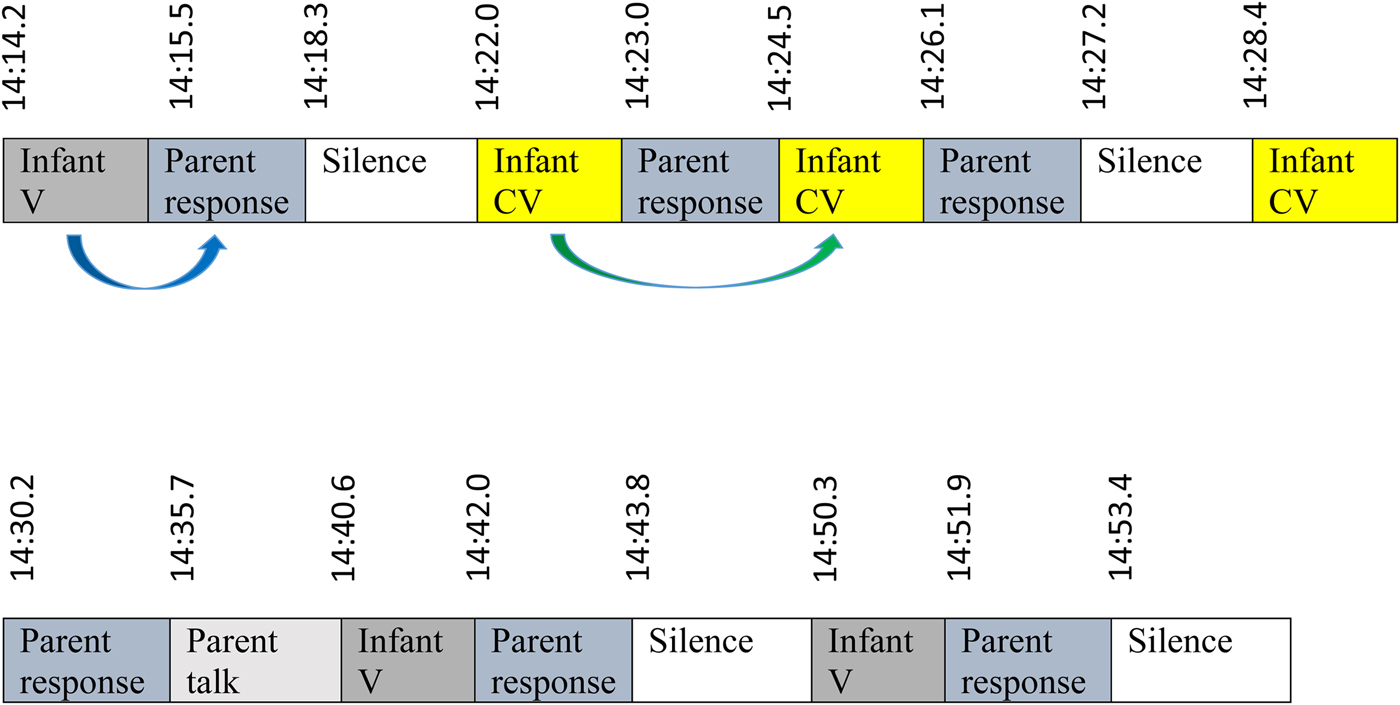
All coding was done using ELAN (EUDICO Linguistic Annotator-Max Planck Institute for Psycholinguistics, Nijmegen, the Netherlands; online < http://www.lat-mpi.eu/tools/elan/>; Lausberg & Sloetjes, Reference Lausberg and Sloetjes2009). The coding focused on three aspects of the interaction to assess the social feedback loop hypothesis as proposed by Warlaumont et al. (Reference Warlaumont, Richards, Gilkerson and Oller2014): (1) infants’ vocalizations; (2) parents’ contingent responses to infants’ vocalizations; (3) infants’ production of vocalizations following parents’ contingent responses and following vocalizations that did not receive contingent responses. See Figure 1 for a visual illustration of the coding.
Schematic of manual coding of infant vocalizations, parents’ responses, and subsequent infant vocalizations. Diagram illustrates the relationship among infant vocalizations, contingent responses of parents, and dependence of infant subsequent vocalizations on adult responses. Infant CV = infant consonant–vowel vocalization; Infant V = infant vowel-like vocalization; Parent response = parent contingent response (i.e., occurring within 2 seconds of infants’ vocalization); Parent talk = parent talking, not contingent response; Silence = no infant or parent vocalizing. The left arrow represents a contingent response by parent. The right arrow represents when the subsequent vocalization by an infant follows a parent contingent response to a previous infant vocalization.

Infant vocalizations included any sound that infants produced except distress vocalizations (e.g., fusses and cries, which includes vocalizations at the beginning of a crying bout accompanied by negative facial expression and full crying bouts) and vegetative sounds (e.g., hiccups, burps). Vocalizations were coded for broad phonological structure to distinguish syllable-like vocalizations, i.e., more developmentally advanced, from those that lacked a consonantal component (Gros-Louis et al., Reference Gros-Louis, West, Goldstein and King2006). Vocalizations that contained a consonant and vowel sound were coded as ‘CV’ (consonant–vowel), regardless of the order in which the consonant and vowel occur (‘VC’ and ‘VCV’ are also coded as ‘CV’ vocalizations), whereas vocalizations that contained no consonant sound were coded as ‘V’ (vowel-like).
Parents’ contingent responses were defined as a change in behavior that occurred during or within 2 seconds of the offset of infants’ vocalizations; that is, if parents started to respond as infants were still vocalizing, though this was infrequent, it was counted as a response. In addition, responses could be vocal and/or non-vocal (Goldstein & Schwade, Reference Goldstein and Schwade2008; Gros-Louis et al., Reference Gros-Louis, West, Goldstein and King2006). We included non-vocal behaviors, in addition to vocal behaviors, as non-vocal behaviors have been shown to experimentally increase infants’ production of developmentally advanced vocalizations (Goldstein & Schwade, Reference Goldstein and Schwade2008). Eight assistants coded infants’ vocalizations and parent responses. To accommodate multiple coders of the data, we calculated Krippendorf's alpha for reliability for 20% of the sample. We used the ‘bootstrapping’ method to obtain a 95% confidence interval for alpha (Hayes & Krippendorff, Reference Hayes and Krippendorff2007). Krippendorff's alpha for agreement among eight coders was 0.7247, and the 95% bootstrapping confidence interval for the true alpha coefficient was [0.6841, 0.7648].
Data analysis
Shapiro–Wilk's tests rejected the hypothesis that the data of mean frequency of different types of vocalizations (CV, V) were drawn from a normal distribution [ps < .01]. Square root transformations resulted in normal distributions [ps > 0.1]. Repeated measures ANOVAs were used to examine variation in infant vocal production with mothers and fathers and contingent responses to infants’ vocalizations. Where appropriate, Mauchly's W was used to assess if violations of sphericity occurred. In these cases, Greenhouse–Geisser corrections were used to adjust degrees of freedom. Also, Levene's test was used to confirm that the data met the assumption of homogeneity of variance. Post-hoc analyses using SPSS Bonferroni adjusted p-values, or t-tests with p-values adjusted for multiple comparisons, were used to examine significant pairwise differences. All analyses were done using IBM Statistics 21 software (Armonk, NY: IBM Corp.).
The proportions of parent responses were used in analyses of parent responsiveness because parents’ opportunities to respond are related to the number of infant vocalizations produced (see also Olson & Masur, Reference Olson and Masur2013), which varied across infants. Frequencies of parent responses were converted to proportions using the total number of infant vocalizations as the denominator. Shapiro–Wilk's tests confirmed that the proportional responses were drawn from a normal distribution [ps > .05].
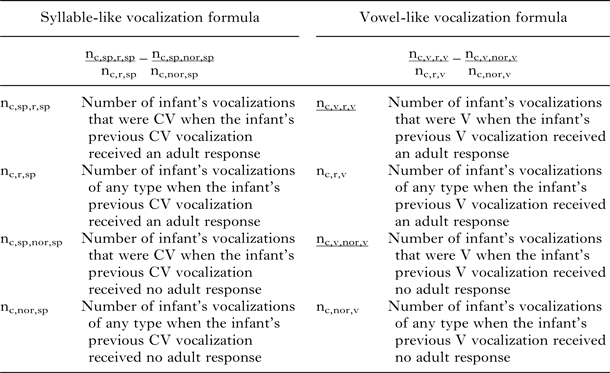
To assess infants’ vocal production following parents’ contingent responses, we first examined if infants were more likely to produce CV vocalizations or more likely to produce V vocalizations following parents’ contingent responses. Next, to explore whether there is evidence of a social feedback loop, we employed the formula provided by Warlaumont et al. (Reference Warlaumont, Richards, Gilkerson and Oller2014), which takes the base rate of infants’ V and CV vocalizations following no parental responses into consideration. Thus, we examined the difference of the probability of an infant's consonant–vowel (CV) vocalization following an adult's previous contingent response to a CV (total CV following response to CV / total vocalizations following response to CV) and an infant's CV vocalization following no contingent response to a CV vocalization (total CV following no response to CV / total vocalizations following no response to CV). We also computed this for vowel-like (V) vocalizations to assess the probability of an infant's V vocalization following an adult's previous contingent response to a V vocalization as compared to an infant's V vocalization following no contingent response to a V vocalization. Last, we examined whether the probability of CV vocalizations is higher following adult contingent responses to a prior V vocalization compared with when the adult does not respond to a prior V vocalization (based on prior findings of Goldstein et al., Reference Goldstein, King and West2003). See Table 1 for the formula (see also Warlaumont et al., Reference Warlaumont, Richards, Gilkerson and Oller2014, for additional information).
Formulas used to assess infants’ production of subsequent CV or V vocalization following a contingent response to a CV or V vocalization. Not outlined in the table: syllable-like vocalization (CV) after contingent response to (V). The same as for vowel-like vocalization calculations, except that the number of subsequent CV was assessed when the infant's previous V vocalization received a contingent response

Results
Preliminary data analysis did not find any significant gender differences in vocal production for 10- or 12-month-olds (overall number of vocalizations, type of vocalization – V or CV). Therefore, we collapsed data across male and female infants. We first report infants’ vocal behavior with mothers and fathers, comparing what type of vocalizations 10- and 12-month-olds produce when playing with mothers and fathers. Next, we present analyses of parents’ responsiveness to infants’ vocalizations to examine if parents respond more to V or CV vocalizations and whether this differs in 10- and 12-month-olds. Last, we assess how parents’ responsiveness relates to infants’ subsequent vocal production within interactions at the level of individual vocalizations. We first examine whether parents’ contingent responsiveness to V and CV vocalizations is associated with infants’ production of subsequent V and CV vocalizations immediately following parents’ responses. Second, we examine the likelihood of infants producing a V or CV following parents’ contingent response to V or CV, taking into account infants’ production of V or CV after a vocalization that did not receive a contingent response.
Infant vocal production
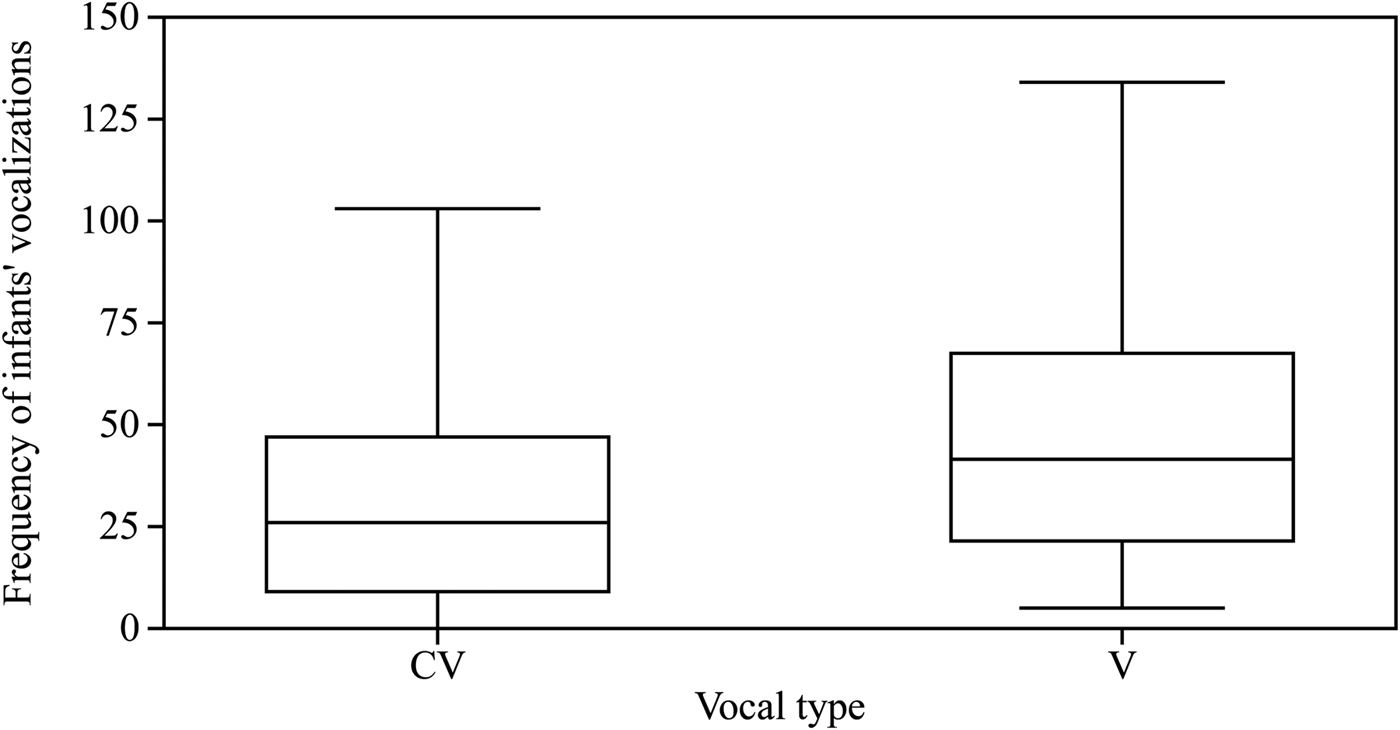
A 2 (vocal type: CV, V) × 2 (parent: mom, dad) × 2 (age: 10, 12) mixed design repeated measures ANOVA with number of vocalizations as the dependent variable found a significant main effect of vocal type [F(1,48) = 9.588, p = .003, η p2 = .166, observed power = .824], but not a main effect of parent [F(1,48) = 0.233, p > .6] or age [F(1,48) = 2.180, p = .146]. Post-hoc analysis showed that infants produced significantly more V vocalizations than CV vocalizations [t(49) = 2.198, p < .04, d = 0.63] (Figure 2). There was no interactive effect of vocal type and parent [F(1,48) = 0.566, p > .4], parent and age [F(1,48) = 1.831, p > .182], or vocal type and age [F(1,48) = 0.100, p > .7]. Last, there was no three-way interaction between vocal type, parent, and age [F(1,48) = 2.094, p > .2].
Box plots (minimum, first quartile, median, third quartile, maximum) of the average number of vowel-like (V) and consonant–vowel (CV) vocalizations produced by infants during two 30-minute free play sessions with parents.

Parent responsiveness
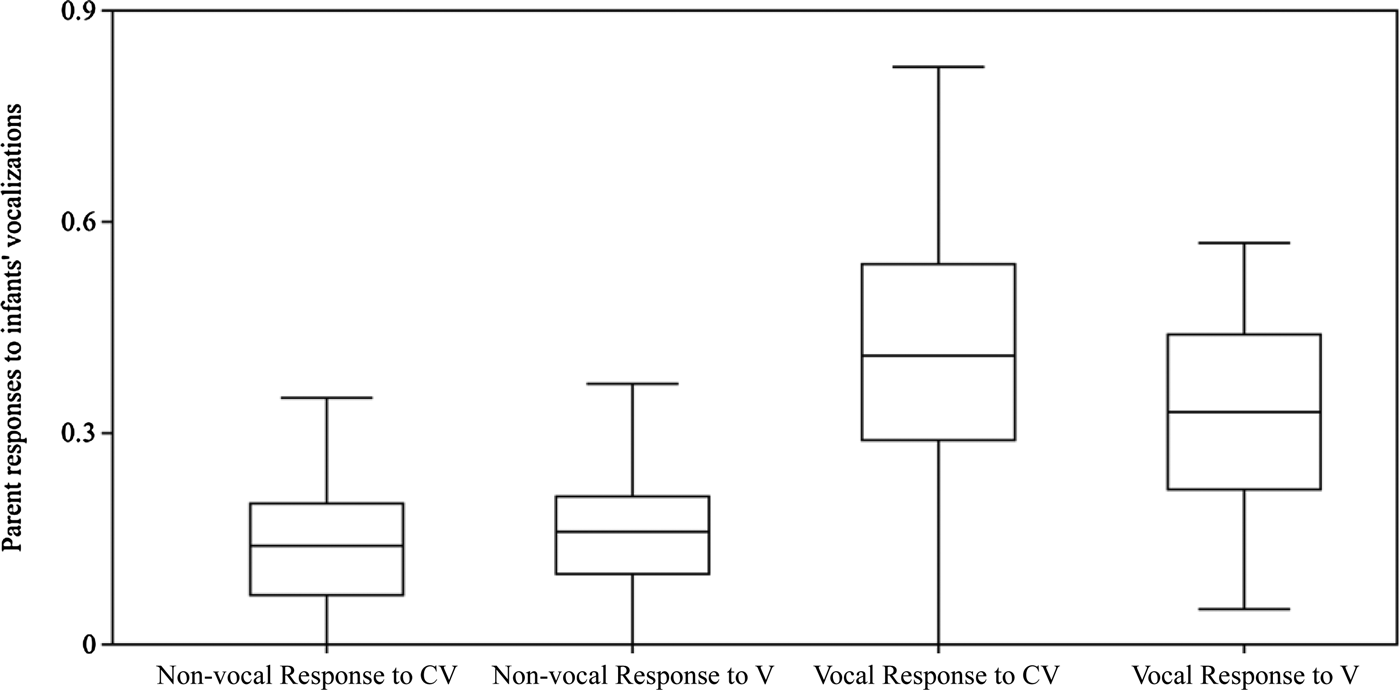
Preliminary analyses found no differences between mothers’ and fathers’ overall levels of responsiveness, thus we combined mothers’ and fathers’ data to explore responses to CV and V vocalizations. A 2 (response type: vocal, non-vocal) × 2 (vocal type: CV, V) × 2 (age: 10, 12) mixed design repeated measures ANOVA revealed a main effect of response type [F(1,47) = 50.19, p < .001, η p2 = .516, observed power = 1.000]. Parents responded with vocal responses significantly more than non-vocal responses [p < .001, d = 2.31]. There was also a significant main effect of vocal type [F(1,47) = 9.679, p = .003, η p2 = .171, observed power = .861] and an interactive effect of response type and vocal type [F(1,47) = 13.767, p = .001, η p2 = .227, observed power = .953]. Parents responded significantly more to CV than to V vocalizations [p = .003, d = 0.38], and parents responded with more vocal responses to CV than to V vocalizations [p < .001. d = 1.69] (Figure 3).
Box plot (minimum, first quartile, median, third quartile, maximum) of the proportion of consonant–vowel and vowel-like vocalizations that received vocal and non-vocal responses.

Infant vocal production following parent responses
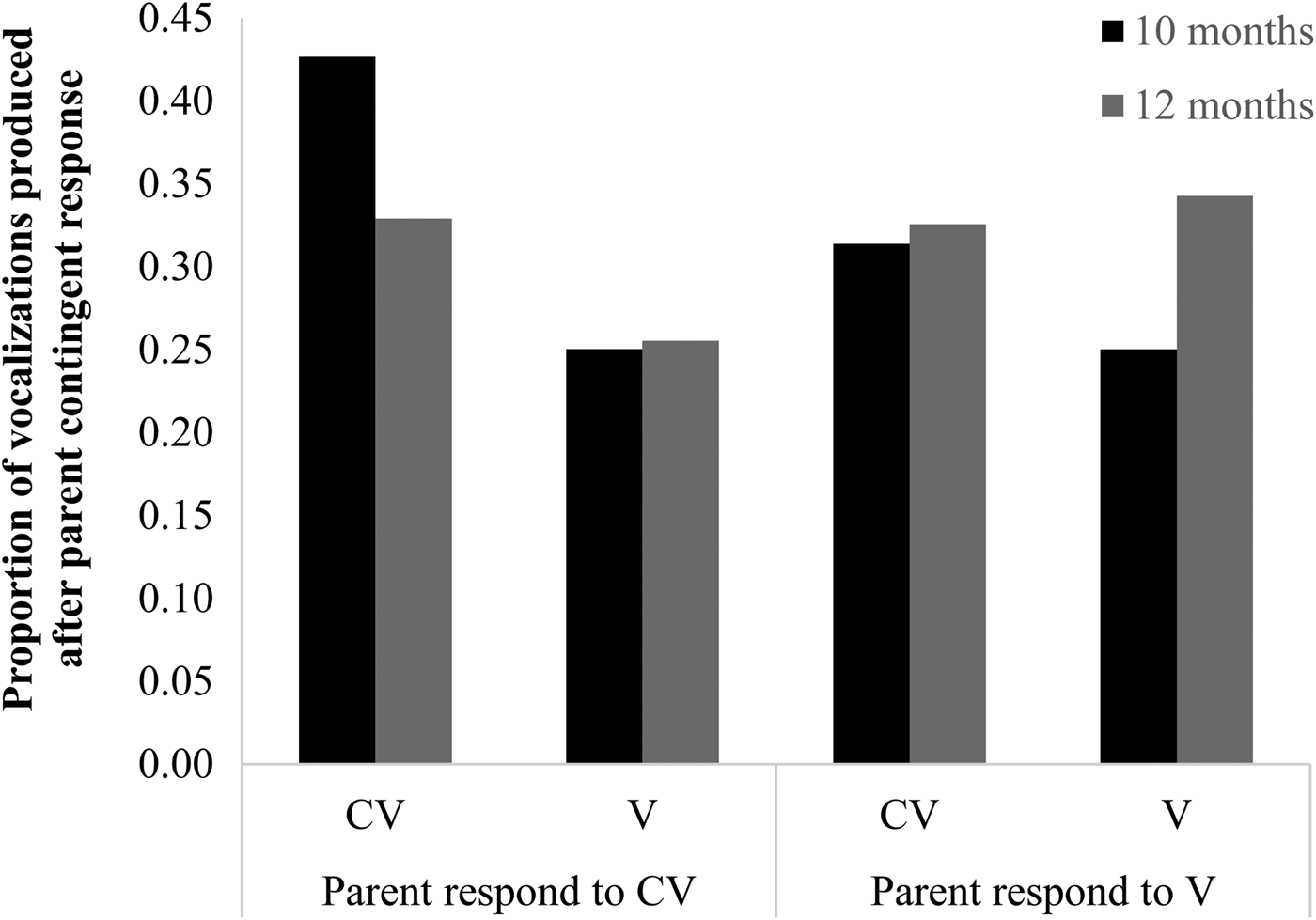
To assess infant vocal production following a parent response to CV and V vocalizations, we conducted a 2 (vocal type that parent responded to: CV, V) × 2 (vocal type infant produced after parent response: CV, V) × 2 (age: 10, 12) mixed design repeated measures ANOVA. Results showed a significant main effect of vocal type produced after parent contingent responses [F(1,48) = 4.026, p = .05, η p2 = .077] and a significant interaction between the vocal type that parents responded to and age [F(1,48) = 4.228, p < .05, η p2 = .081]. Bonferroni corrected post-hoc analyses showed that infants produced more CV than V vocalizations following a contingent response to any vocalization [M CV = .36, SD = 0.18; M V = .28, SD = 0.15; p < .03; see Figure 4].
Overall proportion of consonant–vowel and vocal-like vocalizations that followed contingent responses to consonant–vowel and vowel-like vocalizations.

Although 10- and 12-month-olds produced more CV vocalizations after contingent responses to prior vocalizations (V or CV), this did not take into account production of CV following no contingent response to the prior vocalization (V or CV). Thus, it is unclear if infants’ production of speech-like sounds was contingent on receiving a response to their prior vocalization. Therefore, we examined whether the likelihood of an infant producing a CV increased after receiving a contingent response to their prior CV vocalization compared to after they did not receive a contingent response to their prior CV. In addition, we examined if the likelihood of producing a CV increased after receiving a contingent response to their prior V vocalization. As an additional control, we assessed infants’ likelihood of producing a V after receiving a response to their prior V vocalization.
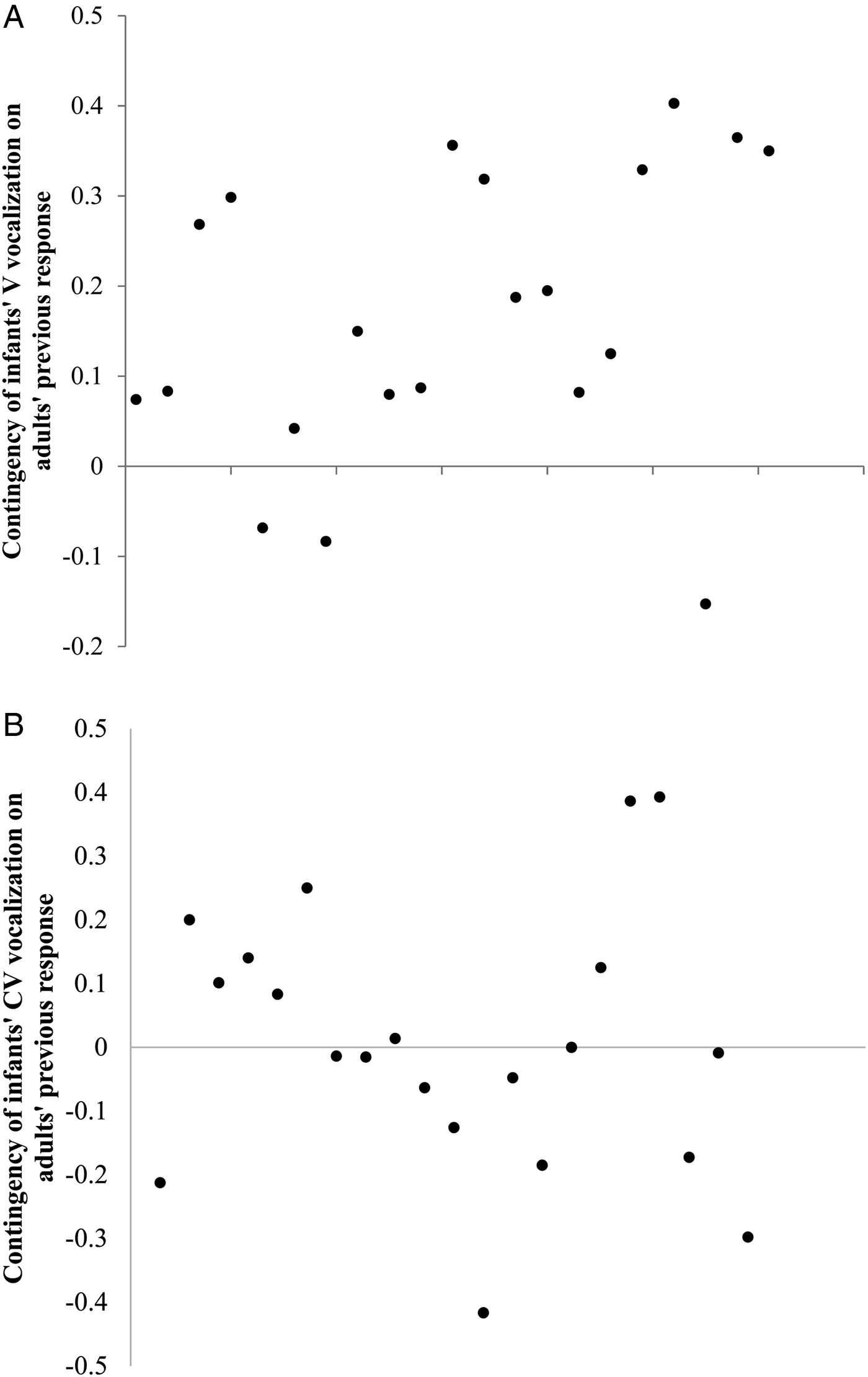
We found that 10-month-olds were more likely to produce a subsequent V vocalization following a contingent response to a V vocalization compared to when their prior V vocalization did not receive a response. The mean difference between the proportion of 10-month-olds’ vocalizations that were vowel-like when the preceding V vocalization received a contingent response, and the proportion when the preceding V vocalization did not receive a contingent response, was 0.17, and this difference is significantly different from zero [t(28) = 4.737, p = .0001, d = 1.03; Figure 5a]. By contrast, the mean difference for the proportion of CV vocalizations following a contingent response to CV and the proportion of CV when the preceding CV did not receive a contingent response was 0.006, which was not significantly different from zero [t(20) = 0.148, p > .8; Figure 5b]. Furthermore, the mean difference for the proportion of CV vocalizations following a contingent response to V, and the proportion of CV when the preceding V did not receive a contingent response, was 0.001, which was not significantly different from zero [t(20) = 0.044, p > .9]. Thus, we found that 10-month-olds were only more likely to produce a subsequent V vocalization following a contingent response to a V vocalization.
Contingencies of 10-month-olds’ consonant–vowel vocalizations on previous adult contingent responses (calculated as the difference between the proportion of infants’ vocalizations that were CV when the previous CV had received a contingent response and the proportion of infants’ CV when the previous CV had not received a contingent response). Positive numbers indicate that infants produce an increase in vocalizations following a parent response; negative numbers indicate that infants produce a decrease in vocalizations following a parent response. Each dot represents a participant.

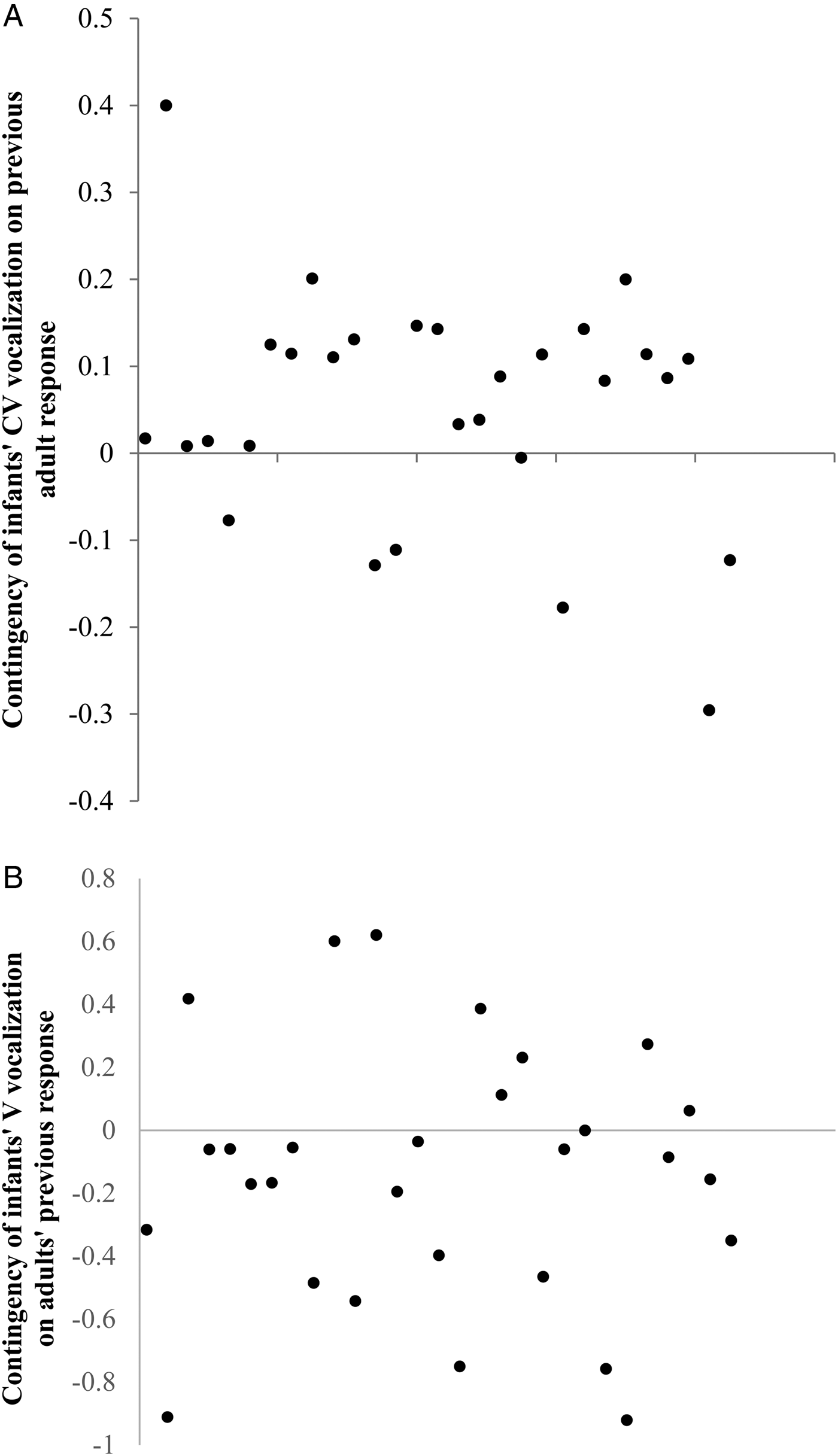
In contrast to the findings for 10-month-olds, we found that 12-month-olds were more likely to produce a subsequent CV vocalization following a contingent response to their prior CV vocalization compared to when they had not received a contingent response to their prior CV vocalization. The mean difference between the proportion of 12-month-olds’ vocalizations that were consonant–vowel when the preceding CV vocalization received a contingent response, and the proportion when the preceding CV vocalization did not receive a contingent response, was 0.0521, and this difference is significantly different from zero [t(28) = 2.070, p < .05, d = 0.38; Figure 6a]. By contrast, the mean difference between the proportion of vocalizations that were vowel-like when the preceding V vocalization received a contingent response, and the proportion when the preceding V vocalization did not receive a contingent response, was –0.146 [t(28) = 1.922, p < .07; Figure 6b]. This demonstrates that 12-month-olds show a trend to not produce a subsequent V vocalization after receiving a contingent response to a V vocalization. Last, similar to the findings for 10-month-olds, the mean difference between the proportion of vocalizations that were CV when the preceding V vocalization received a contingent response, and the proportion when the preceding V did not receive a contingent response, was 0.012, which was not significantly different from zero [t(28) = 0.519, p > .6].
Contingencies of 12-month-olds’ consonant–vowel vocalizations on previous adult contingent responses (calculated as the difference between the proportion of infants’ vocalizations that were CV when the previous CV had received a contingent response and the proportion of infants’ CV when the previous CV had not received a contingent response). Positive numbers indicate that infants produce an increase in vocalizations following a parent response; negative numbers indicate that infants produce a decrease in vocalizations following a parent response. Each dot represents a participant.

Last, we compared the contingencies in 10- and 12-month-olds of producing a CV following a contingent response to a CV and producing a V following a contingent response to a V. That is, we asked whether 10-month-olds or 12-month-olds were more likely to produce a subsequent V (or CV) following a response to a V (or CV). For this analysis, we used the mean difference between the proportion of infants’ vocalizations that were consonant–vowel when the preceding CV vocalization received a contingent response, and the proportion when the preceding CV vocalization did not receive a contingent response (and the same mean difference for V). A 2 (age: 10, 12) × 2 (mean difference of producing a certain vocal type after parent response: CV, V) mixed design repeated measures ANOVA showed a significant main effect of age [F(1,20) = 5.283, p = .032, η p2 = .209] and a significant interaction between age and vocal type [F(1,20) = 9.471, p = .006, η p2 = .833]. Bonferroni corrected post-hoc analyses showed that 10-month-olds were more likely than 12-month-olds to produce vocalizations that were contingent on parents’ contingent response to infants’ vocalizations [p = .032]. Also, 10-month-olds were significantly more likely than 12-month-olds to produce a V vocalization following a parent's contingent response to a V vocalization [t(20) = 2.994, p < .007, d = 1.34]. The likelihood of producing a CV following a parent's contingent response to a CV did not differ between 10- and 12-month-olds [t(20) = –1.148, p = .264].
Discussion
The current findings highlight the importance of examining contingencies in moment-to-moment interactions between infants and parents to uncover possible mechanisms of developmental change (see also de Barbaro, Johnson, Forster, & Deák Reference de Barbaro, Johnson, Forster and Deák2013; Spencer & Perone, Reference Spencer and Perone2008). Both 10- and 12-month-olds produced consonant–vowel vocalizations more than vowel-like vocalizations after they received contingent responses to vocalizations. This is consistent with findings from Goldstein and colleagues (2003) who found that contingent social responses to infants’ vocalizations resulted in an increase in more developmentally advanced consonant–vowel vocalizations (CV). However, the prior research by Goldstein and colleagues examined global changes in the number of developmentally advanced vocalizations in response to changes in contingent responses to vocalizations. We went beyond this to explore the contingency relationship at the level of individual vocalizations. That is, we determined whether infants were more likely to produce particular types of vocalizations immediately following parents’ contingent responses to vocalizations compared to following vocalizations that did not receive contingent responses.
Specifically, we found that 10-month-olds were more likely to produce a vowel-like vocalization after their prior vowel-like vocalization received a contingent response, compared to when their prior vowel-like vocalization did not receive a contingent response. By contrast, 12-month-old infants were more likely to produce a subsequent syllable-like CV vocalization after their prior CV vocalization received a contingent response, compared to when their prior CV vocalization did not receive a contingent response. Furthermore, neither 10- nor 12-month-olds showed an increase in the production of CV vocalizations following a contingent response to V vocalizations when taking into account production of CV vocalizations following no response to V vocalizations. Together with prior research that showed that mothers respond differentially to syllable-like and vowel-like sounds (Gros-Louis et al., Reference Gros-Louis, West, Goldstein and King2006; Gros-Louis et al., Reference Gros-Louis, West and King2016), and the current findings that show that parents respond with vocal responses to syllable-like sounds more than to vowel-like sounds, results indicate that the type of vocalization uttered in an interaction with parents creates a positive feedback loop that may influence development. Infants receive more vocal responses to speech-like vocalizations, and contingent responses to speech-like vocalizations increase the likelihood of infants producing consecutive speech-like vocalizations.
A second question that we addressed is whether the contingencies differ across the two age groups. That is, do 10-month-olds and 12-month-olds differ in their likelihood to produce a V or CV following a response to V or CV? Comparing across ages, 10-month-olds were more likely than 12-month-olds to produce a V vocalization following a contingent response to a V vocalization, but 10- and 12-month-olds did not differ in the likelihood of producing a CV following a contingent response to a CV. There is a trend suggesting that 12-month-olds may produce fewer V vocalizations following a contingent response to a V vocalization. Thus, 12-month-olds may decrease V following a contingent response to V, rather than 12-month-olds showing a large increase in production of CV following a contingent response to CV. Regardless, the relative difference within each age group that we found for contingent production of a V following a contingent response to a V (in 10-month-olds) and contingent production of a CV following a contingent response to a CV (in 12-month-olds) indicates that the ages differ in their contingencies of producing less and more developmentally advanced sounds. This addresses the question of how responses affect vocal production within individuals of a certain age, which suggests a possible mechanism of vocal development.
Previous findings on prelinguistic vocalizations suggest that the social feedback loop for vocal development has its origins in reciprocal exchanges early in infancy (Hsu & Fogel, Reference Hsu and Fogel2001; Locke, Reference Locke2001). Adults respond differentially to early prelinguistic sounds, and infants’ vocalizations are affected by contingent responses. During their infants’ first few months of life, parents respond differentially and with more verbalizations to ‘positive’ cooing vocalizations than to ‘negative’ vocalizations (Keller & Schölmerich, Reference Keller and Schölmerich1987). Then, as vowel-like vocalizations become more variable between 3 and 5 months of age, adults show a preference for fully voiced vocalizations (Bloom, D'Odorico, & Beaumont, Reference Bloom, D'Odorico and Beaumont1993) compared to vocalizations that are less melodically complex and have more nasal resonance (Hsu, Fogel, & Cooper, Reference Hsu, Fogel and Cooper2000; Masataka & Bloom, Reference Masataka and Bloom1994).
Effects of parents’ contingent responses on the quality of infant vocalizations is evident early in development. Three-month-old infants produced sounds that were more speech-like when they engaged in vocal turn-taking with adults who responded contingently (Bloom, Russell, & Wassenberg, Reference Bloom, Russell and Wassenberg1987). As infants start to develop more advanced sounds, parents’ responses elicit more syllable-like sounds in 8- and 9-month-olds (Goldstein et al., Reference Goldstein, King and West2003; Goldstein & Schwade, Reference Goldstein and Schwade2008). This suggests that there may be social influences on phonological change throughout the prelinguistic period. However, we only found an effect of parents’ contingent responses to syllable-like vocalizations in 12-month-olds. Consonant–vowel vocalizations are critical precursors to fully formed words (Nathani et al., Reference Nathani, Ertmer and Stark2006) and, as infants near their first birthday, they are learning first words (Fenson et al., Reference Fenson, Dale, Reznick, Bates, Thal and Pethick1994). Therefore, it may be that the effect of a social feedback loop emerges with infants’ vocal competence and as they begin to produce their first words. Future studies should examine infants’ vocal development longitudinally to track changes in the effects of a social feedback loop at transitional points in development.
Similar to the study by Warlaumont et al. (Reference Warlaumont, Richards, Gilkerson and Oller2014), the current study is correlational. Future research must demonstrate causal effects of parents’ response contingencies on infants’ production of subsequent syllable-like vocalizations. It is also important to consider how different social contingencies could impact vocal learning opportunities. A recent study showed that infants whose mothers typically responded at high rates showed an increase in overall vocalization rate and also produced more developmentally advanced, CV vocalizations, whereas infants whose mothers typically responded at low rates did not show a change in vocal production in response to different contingency patterns (Miller, Reference Miller2014). These findings reveal the causal effects of parents’ responsiveness on vocalizations and how familiar and novel contingencies interact to differentially affect infants’ vocal production. In addition, a recent study found that different interactive contexts elicit differential production of CV and V vocalizations and maternal responses to CV and V vocalizations (Gros-Louis et al., Reference Gros-Louis, West and King2016). Thus, different social environments offer variable opportunities for interactions with social partners (‘social gateway’; White, King, Cole, & West, Reference White, King, Cole and West2002). Thus, infants could be differentially impacted by the social feedback loop proposed in the present study, depending on their home environment.
One limitation of the current study is that the sample was homogeneous, thus we could not examine effects of socioeconomic status or culture. Studies have demonstrated effects of these factors on parent responsiveness, in addition to language and communicative development (e.g., Fenson et al., Reference Fenson, Dale, Reznick, Bates, Thal and Pethick1994; Hoff, Reference Hoff2006; Tamis-LeMonda, Song, Smith Leavell, Kahana-Kalman, & Yoshikawa, Reference Tamis-LeMonda, Song, Smith Leavell, Kahana-Kalman and Yoshikawa2012). Thus, an examination of social interactions in a more diverse sample is needed to assess if the current findings generalize in different populations that likely have variable contingencies. Data from a broader sample and across different interactive contexts could contribute to the formulation of a model of communicative development that captures the variability in contingencies present in different social environments.
Prior studies have shown the effects of contingent responses on production of more developmentally advanced vocalizations (Goldstein & Schwade, Reference Goldstein and Schwade2008). Furthermore, infants’ vocal production and vocal practice is important for developing a variable repertoire. The current study reveals effects of parent responses to infant vocalizations in moment-to-moment interactions. Therefore, this study demonstrates how the interaction between infants’ vocal production, and parents’ responses can move development forward via a positive feedback loop. However, identification of how the social feedback loop impacts vocal and linguistic development is an important next step. Therefore, future studies should focus in depth on periods of transition from prelinguistic to linguistic communication. This is particularly important, given that if infants begin babbling after 10–11 months, they will experience more problems in cognitive and linguistic development than those who babble earlier (e.g., Oller, Eilers, Neal, & Cobo-Lewis, Reference Oller, Eilers, Neal and Cobo-Lewis1998; Oller, Eilers, Neal, & Schwartz, Reference Oller, Eilers, Neal and Schwartz1999). By examining parent–infant interactions, we can link responsiveness not only to increased production of CV vocalizations, but also to the emergence of particular words in the children's lexicon that resemble the CV vocalizations that they are producing (cf. Stoel-Gammon, Reference Stoel-Gammon, Wetherby, Warren and Reichle1998). These results suggest that detailed investigations of mutual contingencies in dyadic interactions could reveal how the dynamics of parent–infant social interactions relate to vocal development and infant language outcomes.