INTRODUCTION
Many recent studies have shown that art therapy could improve self-consciousness and resilience to pressure for patients going through personal growth (McIntyre, Reference McIntyre1992; Hawkins, Reference Hawkins1993). Some of them even found that a person's life could become more meaningful and more active by engaging in art appreciation and creating artwork (Frampton, Reference Frampton1986; Kennett, Reference Kennett2000). Fine art is a collection of experience and memories; art is images deeply rooted in the mind. Psychologically, when art happens, images' content reflects subjects' bio-psycho-spiritual aspect. Images not only remind people of past experiences but also enable them to recall memories vividly.
Art therapy has been used to offer support to cancer patients at different stages of their illness and with a variety of interventions. Art therapy has shown its effectiveness with post-treatment cancer patients (Luzzatto et al., Reference Luzzatto, Sereno and Capps2003), with patients in isolation for bone marrow transplantation (Gabriel et al., Reference Gabriel, Bromberg and Vandenbovenkamp2001), with patients during radiotherapy treatment (Oster et al., Reference Oster, Svensk and Magnusson2006), and with those undergoing chemotherapy (Forzoni et al., Reference Forzoni, Perez and Martignetti2010).
Nevertheless, the specific therapeutic factors of art therapy with terminal cancer patients are still not well understood.
Terminal cancer patients who were receiving hospice and palliative care might have good control of physical discomfort, however, they also had to face various challenges from life; they need mental and spiritual care as well, because they experience various pressures (Ferrell, Reference Ferrell2005). By getting experience from Western countries, we know that art therapy, whether visual appreciation or performing (e.g., music, dance, painting, or drama) could bring more meaning to patients' end of life and thus enhance the therapeutic effects of symptom control (McIntyre, Reference McIntyre1992; Hawkins, Reference Hawkins1993; Mayo, Reference Mayo1996; Kennett, Reference Kennett2000; Michele, Reference Michele, Doyle, Hanks, Cherny and Calman2004). Art therapy has been developed in hospice care units for some time, to ease the emotional stress on bereaved children or family (McIntyre, Reference McIntyre1992; Hawkins, Reference Hawkins1993; Kaye, Reference Kaye, Kaye and Blee1997).
The purpose of this study was to explore the effectiveness of art therapy for terminal cancer patients who were receiving hospice palliative care in Taiwan.
METHOD
Selection of Patients
The program was conducted in the Hospice Palliative Care Unit in Taipei Veteran General Hospital from April 2001 to December 2004. The Taipei Veterans General Hospital is a tertiary teaching hospital with 2,866 inpatient beds, including 16 beds for hospice palliative care, and also provides hospice home care service (Lin et al., Reference Lin, Wu and Tsai2004). Six physicians, 16 nurses, 1 social worker, 1 clergy, 2 art therapists, and >50 volunteers comprise the hospice palliative care team. The subjects enrolled in this study were terminal cancer patients under hospice palliative care, ≥18 years of age, who were mentally alert and willing to go through art therapy. The basic background information collected from our subjects included: gender, age, marital status, education level, religion, occupation, and origin of cancer.
Approach Methods
First, to become familiar with the comprehensive needs of each patient, the therapists attended the daily group meeting at the hospice ward, the weekly conference of the hospice organizing team, and conducted interviews with patients. Art therapists led the process of evaluating the patient's comprehensive needs and artistic expression. Art therapists interviewed the patients with the following questions “do you paint regularly?” “are you particular about esthetics (sense of beauty and appearance)?” Art therapists also evaluated whether the patient could clearly express happy memories or not. The therapist coached each patient on a one-on-one basis to facilitate mutual sharing; if necessary, a family member (or main caregiver) of the patient could assist. Receiving permission from the patient and the family, the therapist recorded the process of art therapy. This program was approved by the Taipei Veterans General Hospital.
The process of the art therapy was first to give an introduction and describe the purpose of art therapy to the patients and make a preliminary survey. Second, patients shared their happy memories with the therapist. The therapist guided the patients to obtain more happy memories and touching feeling, the therapist tried to reinforce these positive feelings. Third, the therapist relaxed the patient with favorite images and drawings. While the therapist explained the meaning of provided images, the patient usually could concentrate and sense beauty from the images. Through the evaluation of patients' visual perception, we communicated with them so that they could have an esthetic experience. Fourth, the therapists checked the patient's physical and mental conditions from time to time and adjusted the therapy accordingly. Fifth, the therapists encouraged patients to paint, draw, write, sculpt, make crafts, or take photographs. The focus was not on techniques but on being creative using appropriate artistic media. We also explained the meaning of the artwork and built relationships with patients. Sixth, based on each patient's interests, mental and physical conditions, the therapists would confer with the medical team and adjust the therapy so that it was more suitable for the patients. Seventh, through art appreciation, creative artwork, and encouragement from the therapists, the patients could free associate. When relaxed, the patients would enjoy their own artwork and were encouraged to write down whatever they felt, as records of self-growth and self-consciousness stage by stage. Each therapeutic session lasted ~30 minutes; it could be adjusted according to individual conditions.
Art Supplies
In consideration of patients' physical conditions, often weak and bedridden, the therapists prepared light and easy-to-use art supplies, including images for art appreciation (pictures of the patient, hardcopies or digital image), painting albums, light drawing boards, 8 kai paper (c. 12 × 10 inches), color pencils, brushes, drawing paper, digital audio and video media (using digital cameras and voice recorders for keeping track of a patient's recounting of memories), and additional supplies needed for editing and printing patients' artwork and images, or laminating them.
Interviews and Evaluation
We evaluated the effects of the therapy, with consideration of ethics. After consulting with a group of specialists, we decided upon the contents of the evaluation and surveys. Then we interviewed the patients and their family members and recorded the results, including how many art therapeutic sessions the patient had gone through and how many works of art the patient had created. The interview included the following subjects:
1. Feelings (recounting feelings of concentration during art appreciation,
2. feelings of fun while painting, and feelings toward the artworks)
3. Cognition (including family involvement, feeling of faith and gratitude, feeling positive about the meaning of life and sharing thoughts on life and death)
4. Behavior (adopting an approach to art appreciation and creation without focusing on progress). Patients could choose subject matter for appreciation and type for creation: landscape (nature, mountains, water, forest, skies, and buildings), still life (portraiture, animals, plants, minerals, and utensils), illustrations (picture stories and religious paintings), and abstract art disassociated images)
5. Impact on illness (feeling of relief of emotional stress and ameliorating of medical condition during therapy). Frequency items of the evaluations were rated using a 5-point Likert scale.
We evaluated the artistic expression by interviews and observations; patients also filled out evaluation forms with the help of families and therapists. There were five items in the evaluation of the artistic expression, one point for each of the following items: perception of beauty, art appreciation, creativity, hands-on artwork, and creating artwork regularly (Kuo et al., Reference Kuo, Moh and Chen2002). Finally, we made a comparison of these scores before and after the therapy.
Statistics and Analysis
Data in the text and tables are expressed as mean (standard deviation [SD]). Comparisons of artistic expression before and after art therapy were performed by paired t test or Fisher exact test. Results were compared between groups using Student t test or Mann–Whitney U test. Statistical analyses were performed by SPSS software (SPSS version 12.0, SPSS Inc., Chicago, IL). For all tests, only the results with p values < 0.05 (two-tailed test) were considered to be statistically significant.
RESULTS
Demographic Data of Patients
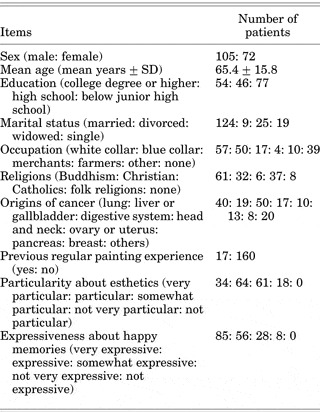
A total of 177 patients with terminal cancer, receiving hospice palliative care, were enrolled (105 males and 72 females). The mean age of all patients was 65.4 ± 15.8 years. Common origins of cancer were from lung, liver, gallbladder, digestive system, brain, neck, ovaries, uterus, pancreas, or breasts (Table 1). Eighty-nine percent of the patients were married, divorced, or widowed. Fifty-six percent of patients had education beyond senior high school. Buddhism was the most common religion in these patients. One hundred and sixty patients (90%) did not have regular painting experience. Ninty-eight patients (55%) were particular or very particular about esthetics. One hundred and forty-one patients (80%) gave description for their happy memories expressively or very expressively.
Demographic data of 177 terminal cancer patients who received art therapy

Evaluation of Art Therapy Interviews
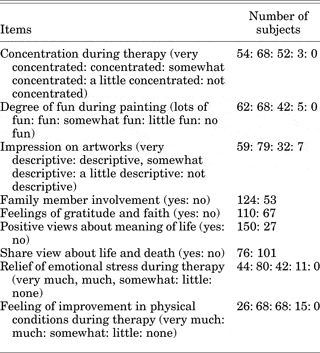
In evaluating the expression of feeling during the art therapy (Table 2), 122 patients (69%) appeared concentrated or very concentrated during art appreciation. One hundred and thirty patients (73%) had fun while painting and 138 patients (73%) gave description on art works well or very well. One hundred and fifty-four patients (87%) received the therapy with participating family members. One hundred and ten patients (62.1%) had feelings of gratitude and faith. One hundred and fifty patients (85%) had positive views about the meaning of life. Seventy-six patients (56%) were willing to share views about life and death. During the therapy, 124 patients (70%) felt relaxed in emotion, and 94 patients (53.1%) felt improvement in their physical condition.
Interviews and evaluation of art therapy in 177 terminal cancer patients

Each patient received a mean of 2.9 ± 2. sessions of the art therapy (range from 1 to 16 sessions). Eighty-one patients (46%) received more than two sessions of the art therapy. Each patient produced a mean of 1.8 ± 2.6 pieces of artwork (range from 0 to 29 pieces). Sixty-eight patients (38%) produced more than one piece of artwork. There was no significant difference regarding the sessions of art therapy received or the pieces of artwork created and the patients' age, gender, education level, marital status, religion, occupation, previous painting experience, degree of particularity about esthetics, and expressiveness about happy memories (data not shown).
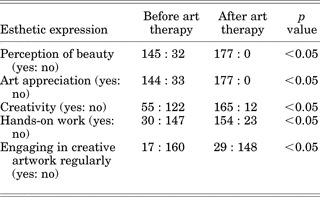
Before starting practical painting, patients attended art appreciation sessions and chose their subject matter (multiple choices). The percentages of their choices were: landscape (42%), still life (36%), illustration (27%), or abstract art (4%). After the art appreciation, when the patients began hands-on painting, the subjects shifted to: landscape (64%), still life (42%), illustration (35%), and abstract art (14%). The artistic expression before the therapy revealed 145 cases (82%) of perception of beauty, 144 cases (81%) of art appreciation, 55 cases (31%) of creativity, 10 cases (17%) of hands-on work, and 11 cases (6%) of engaging in creative artwork regularly. After therapy, the numbers of artistic expression changed to: 177 (100%), 177 (100%), 165 (93%), 154 (87%), and 29 (16%), in perception of beauty, art appreciation, creativity, hands-on work, and engaging in creative artwork regularly, respectively (Table 3) (p values all < 0.05 when compared to pretreatment values). The mean score of the five artistic expression items was 4.0 ± 0.7 after therapy; it was significantly higher than the score of 2.2 ± 1.4 before therapy (p < 0.001). Patients with an education level lower than junior high school had significantly greater improvement of artistic expression than those with higher education levels (2.3 ± 1.3 vs. 1.4 ± 1.3, p < 0.05). Patients without previous painting experience had significantly greater improvement in artistic expression than those experienced (1.9 ± 1.3 vs. 0.5 ± 1.2, p < 0.05). Patients who were expressive about happy memories had significantly greater improvement in artistic expression than their less expressive counterparts (2.3 ± 0.8 vs. 1.5 ± 0.6, p < 0.05). The improvement of artistic expression had no relationship to patients' age, gender, marital status, religion, or degree of particularity about esthetics (data not shown).
Comparisons of esthetic expression before and after art therapy in 177 terminal cancer patients

CASE ILLUSTRATION
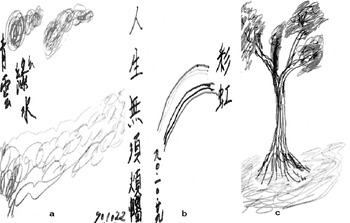
An 84-year-old man with terminal lung cancer had received five sessions of art therapy. Through the help of the art therapist, he recalled happy memories from his youth and talked about the scenery of his hometown. At first, he wanted to paint something to give to his grandson as a gift. He started meditating about fresh and clean air in his old hometown and came up with a painting of a blue mountain and green water (Fig. 1a). One week later when he talked about childhood events, he drew a picture of a rainbow after the art appreciation. He claimed that one should do his best and be appreciative of good fortune in life. One should not worry too much and fuss about unimportant matters. He then wrote “no need to worry about life” on his painting (Fig. 1b). Two weeks later, he talked about the old days when he was a child and also mentioned the beautiful scenery of his hometown. He drew some small trees standing on the grass (Fig. 1c). During the art therapy, his daughters were at his side, and they listened to his stories and enjoyed his paintings. They talked about their father very positively and also praised him.
An 84-year-old man with terminal lung cancer received five sessions of art therapy. Three works of art (a–c) were produced at 3 successive weeks after visual fine art appreciation and hands-on painting (see text for details).

The patient did not have any painting experience before this therapy. He was very focused during the art appreciation and practiced painting a lot. He was willing to share his life experience with others and tell stories a lot. He could describe his feelings clearly after he created a work of art. He showed enthusiasm toward life with a positive and optimistic attitude.
DISCUSSION
The purpose of hospice palliative care is to achieve the best quality of life for those terminal patients not responsive to curative treatment (Kennett, Reference Kennett2000). Terminal cancer patients usually have physical, psychological, social, and spiritual problems. Although patients' physical symptoms might be well controlled by medication, most terminal cancer patients still face great challenges in life when informed of the disease, the treatment procedures, and experience depression and lose control of emotions when informed that they are reaching the terminal stages, because of the pressure and fear of facing death. There is no doubt that these patients need mental and spiritual care. The art therapy, adopting visual art appreciation as a means to convey esthetic feelings and as a nonverbal means to communicate, could encourage patients to create artwork and enrich their life. The process of sharing artwork and the feeling of life is one kind of psycho-spiritual therapy for the patients, and could raise patients' confidence (Kaye, Reference Kaye, Kaye and Blee1997; Michele, Reference Michele, Doyle, Hanks, Cherny and Calman2004).
During the process of the art therapy in our study, it was important to emphasize the development of a therapeutic relationship among the therapists, the patients, and the art objects in order to help the patients express their emotion more. The therapist also tried to draw out the patients' happy memories. More than 80% of our patients could clearly describe such memories. If the patients had chosen images freely or through meditation, most of them could recall old incidents and images. By recalling the patient's happy memories, the therapist helped the patient to explore and find the meaning of life. The patient expressed hidden emotions through memories, and therefore the patient was more relaxed and had stable emotions. During the process of the therapy, the more clearly the patients could express themselves, the more concrete the subject matter that could be found in their artworks (McIntyre, Reference McIntyre1992; Hawkins, Reference Hawkins1993).
All patients were encouraged to practice painting or to create artworks freely after the visual art appreciation or meditation. Landscape was the most popular subject that patients chose for art appreciation and as their painting subject. Many works of art were about nature, the mountains, or water. Many people in Taiwan enjoy nature, and keeping in touch with nature becomes a way for them to achieve harmony and peaceful feelings. Leisure topics, photographs, and images from the art appreciation often affected patients' choosing topics to draw on. The experience helped relieve anxiety. Most patients sensed physical, emotional, and social needs through the art appreciation and the artwork they created. After the art appreciation, patients expressed their esthetic experience in many different ways, such as perception of beauty, appreciation, creativity, hands-on artwork, and engaging in creative artwork regularly. We have seen many cases in which patients began to paint after appreciating art. Many of the works or art were touching. We found that after the art therapy, most patients expressed esthetic experience more specifically, and became more motivated. Our results showed that patients with lower educational levels and without previous painting experience had greater improvement of artistic expression than those with higher educational levels. These may because the former cherished the opportunity of visual art appreciation and painting, which was something that they did not have before.
Most patients had family members or friends with them during the art therapy. When family members were involved in the art therapy, patients could interact with them and improve their creativity. Hands-on painting with family involvement could convey caring thoughts. A patient who was inspired or moved by beautiful images often felt a relief from anxiety and became more stable in emotion; the family members or caregivers could also feel the relief from sorrow (Hawkins, Reference Hawkins1993). With previous esthetic experience in life and sharing feelings with family, a patient can reaffirm positive attitude toward the meaning of life (Michele, Reference Michele, Doyle, Hanks, Cherny and Calman2004).
There were some other factors that would affect results of the art therapy for terminal cancer patients. Because of patients' different illness and different health conditions, the therapists could not set up scheduled sessions. Also, it was difficult to predict the life span of the patients; therefore patients completed different numbers of artwork and received different numbers of art therapy sessions. Some patients fell in and out of conscious from time to time, and others became weaker and weaker. These factors affected the therapy as well. When a patient was extremely weak or depressed, the therapeutic session simply could not proceed. A session could also be in jeopardy when a family member of the patient did not understand the purpose of the therapy. However, researchers could find more suitable patients for art therapy through the help of the medical team. Suitable patients included those who could communicate verbally, those who could not communicate verbally but who could communicate through writing or drawing, those who were depressed and worried but interested in arts or beautiful things, those who were willing to share life experiences, and those who wanted to improve relationships with family members (Kaye, Reference Kaye, Kaye and Blee1997; Tyler, Reference Tyler1998; Michele, Reference Michele, Doyle, Hanks, Cherny and Calman2004).
The terminal cancer patients who had different kinds of physical and psychological pressures usually became depressed (Ferrell, Reference Ferrell2005). In the process of the art therapy, we found that patients went from inactivity to actively creating artworks. Many of them picked the images they liked for the art appreciation and practiced drawing afterwards. These patients were able to overcome physical distress such as pain, and transformed the pain into creative artwork (McIntyre, Reference McIntyre1992; Hawkins, Reference Hawkins1993; Mayo, Reference Mayo1996; Kaye, Reference Kaye, Kaye and Blee1997; Kennett, Reference Kennett2000; Michele, Reference Michele, Doyle, Hanks, Cherny and Calman2004). From the description of the artwork they created, we could easily sense the spirit of the patients. These results were reinforced by the fact that most our patients were very focused during the art appreciation and enjoyed themselves while painting.
CONCLUSIONS
Through the art therapy, patients gained esthetic experience and inner support from the faith and thankfulness they had experienced. Through freestyle creativity and from all the kinds of artwork that they created, the patients were able to reexamine their lives and found the meaning in them. Our results showed that with care from a medical team and through art appreciation and hands-on painting, terminal cancer patients who were in deteriorating health conditions and facing death could have a chance to manage their emotional crisis. They were able to experience a sensation of nonverbal communication, and soothe the pressure and discomfort from illness (Kuo et al., Reference Kuo, Moh and Chen2002).
ACKNOWLEDGMENTS
This study was funded by the Foundation of the Development for Hospice and Palliative Care in Taipei Veterans General Hospital. We appreciate all colleagues who worked at the Hospice Palliative Care Unit during our research. We cherish each and every patient who was willing to share his or her passion for life, and we pay our sincere respects and best wishes to them.