Interrupted aortic arch is a complex CHD that is typically repaired surgically in the neonatal period. Maintaining patency of the ductus arteriosus is critically important in the preoperative management of infants with interrupted aortic arch, as systemic blood flow distal to the interruption is dependent on right-to-left shunting through the ductus arteriosus. Total correction with a single surgery is the preferred treatment courseReference Flint, Gentles and MacCormick 1 , Reference Tlaskal, Hucin and Hruda 2 though there are situations in which this is not possible.Reference Lin, Wang and Fu 3 , Reference Karimi, Farouk, Golden and Gilkeson 4 This case report details urgent hybrid palliation in a premature infant with ductal obstruction.
Case report
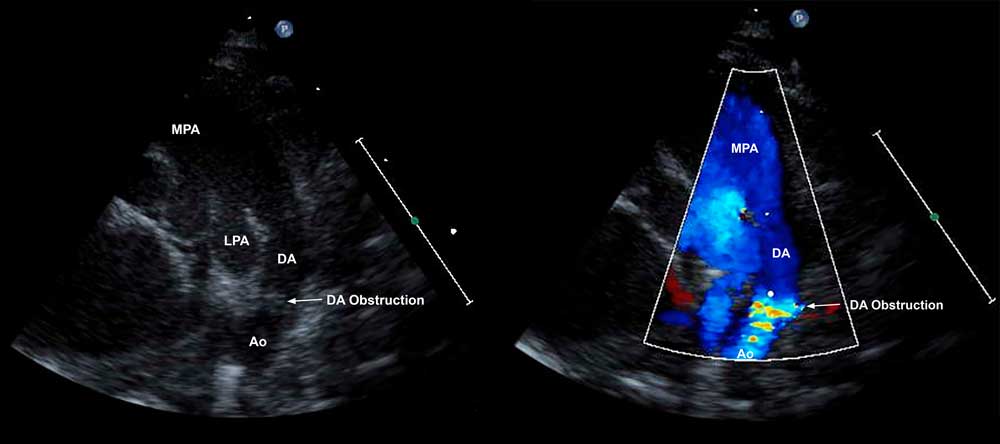
A female infant, without a previous diagnosis of CHD, was born at 28 6/7 weeks of gestation via Caesarean section for preterm labour with a birth weight of 1585 g. She required continuous positive airway pressure for ~30 minutes following birth but was subsequently weaned to room air. She did well for the first 2 days of life, not requiring respiratory or cardiovascular support and advancing on feeds. On day of life 3, her lower extremities were noted to be mottled. Upper- and lower-extremity blood pressures were measured using a cuff and showed a gradient of 50 mmHg. Echocardiography was performed and the echocardiogram showed an atrial septal defect, ventricular septal defect, concern for aortic coarctation, and severely depressed left ventricular systolic function. She was started on prostaglandin E1 and dopamine, intubated, and transferred to our facility. Upon arrival, echocardiography was performed and the echocardiogram showed a type-B interrupted aortic arch with a large posterior malalignment ventricular septal defect, large atrial septal defect, moderate-to-large ductus that was slightly narrowed at the pulmonary artery end, and an apparent membrane restricting flow at the aortic end (Fig 1). There was a mean gradient of 20 mmHg across the ductus arteriosus, and the abdominal aortic flow pattern on spectral Doppler was dampened, consistent with ductal obstruction. The aortic valve was bicuspid and moderately hypoplastic (annulus Z-score −3.3), and the left ventricular systolic function was moderately-to-severely depressed. Given the restriction of flow through the ductus arteriosus at the aortic end, which was unresponsive to prostaglandin E1, the decision was made to proceed with emergent intervention. She was deemed a high-risk candidate for cardiopulmonary bypass, given her prematurity, low birth weight, and ventricular dysfunction; therefore, the decision was made to perform an urgent hybrid stage-I procedure.
Two-dimensional and color doppler showing ductus arteriosus obstruction and flow acceleration at the level of obstruction.

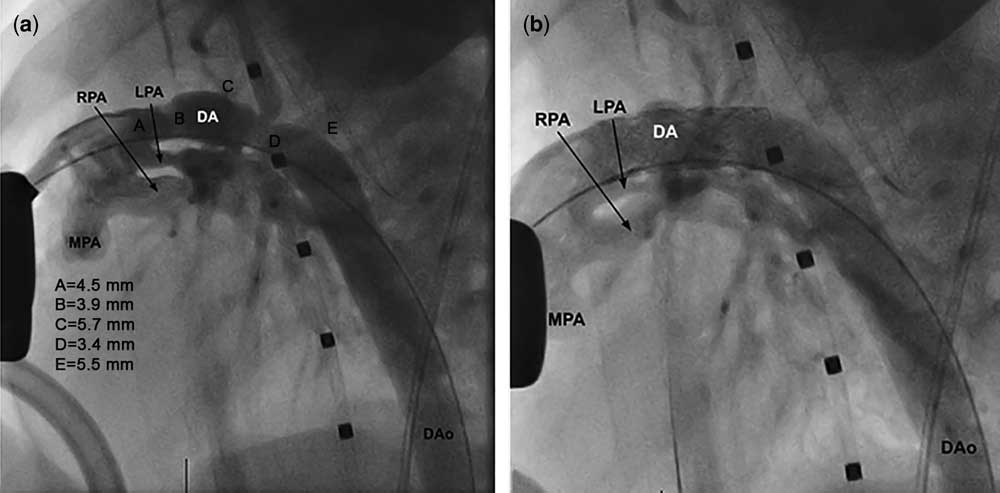
Angiogram showing the ductus arteriosus prior to intervention (a) and following stent implantation (b).

She was taken to the hybrid cardiac catheterisation laboratory. A hybrid stage-I palliation was performed using our standard institutional approach, with placement of bilateral pulmonary artery bands and ductus arteriosus stent.Reference Zampi, Hirsch, Goldstein and Armstrong 5 The pulmonary artery bands were adjusted until the mean pressures were 14 mmHg in the left pulmonary artery and 17 mmHg in the right. The anatomy of the ductus arteriosus is shown in Figure 2a. The ductus arteriosus measured 3.4 mm at the most narrow portion and the more proximal ductus arteriosus measured 5.7 mm. Because of the stenotic ductus arteriosus, a 16 mm long Formula 418 stent pre-mounted on a 6 mm balloon (Cook Medical, Bloomington, Indiana, United States of America) was chosen. Figure 2b shows the stented ductus arteriosus. Following the procedure, the patient was brought to the paediatric cardiac !after admission, the infant was confirmed to have DiGeorge syndrome. By day of life 7 – that is, at 4 days following her hybrid procedure – she had normal biventricular systolic function. Over the next several months, she did not require further intervention. There was no obstruction across the ductus arteriosus stent on echocardiography. She underwent complete surgical repair at 3 months of age at a weight of 3.8 kg. This repair included an end-to-end aortic anastomosis with pulmonary allograft patch augmentation of the aorta, ligation and division of the left subclavian artery, ventricular septal defect closure, atrial septal defect closure, bilateral branch pulmonary artery band removal, and ligation and division of the ductus arteriosus with removal of the stent. Her postoperative course was complicated by several failed extubation attempts. She subsequently required left hemi-diaphragm plication and was then weaned from all respiratory support. She was discharged home ~3 months after definitive repair.
Discussion
Interrupted aortic arch is a type of complex CHD that requires either definitive or staged repair in the neonatal period. Typically, prostaglandin E1 infusions are able to maintain ductal patency to ensure systemic blood flow distal to the interruption in infants awaiting surgical repair. The procedure of hybrid ductus arteriosus stenting and pulmonary artery band placement has been described in premature infants as a palliative procedure before definitive repair, as the risks from cardiopulmonary bypass are higher in this population. To our knowledge, this is the first reported case of urgent hybrid palliation needed for management of interrupted aortic arch. The obstruction to flow on the aortic side of the ductus arteriosus necessitated urgent intervention with a balloon-expandable stent to minimise ischaemic injury distal to the interruption. This allowed successful alleviation of the obstruction and ensured a stable circulation, simultaneously allowing for somatic growth before definitive repair.
Acknowledgements
The authors would like to acknowledge and thank our surgical colleague, Dr. Richard Ohye, who was also involved in this case.
Financial Support
This research received no specific grant from any funding agency, commercial or not-for-profit sectors.
Conflicts of Interest
None.