

Introduction
An acquired brain injury (ABI) is defined as a non-hereditary, post-birth injury to the brain resulting in neurological pathology and is categorized as traumatic or non-traumatic (Teasell et al., Reference Teasell, Bayona, Marshall, Cullen, Bayley, Chundamala and Tu2007). More than 3.6 million people sustain ABIs annually in the United States, with 2.8 million injuries specifically from a traumatic event (Taylor, Bell, Breiding & Xu, Reference Taylor, Bell, Breiding and Xu2017). ABI severity is determined by various factors and categorized as mild, moderate, or severe (O’Neil et al., Reference O’Neil, Carlson, Storzbach, Brenner, Freeman, Quiñones and Kansagara2013). Physical limitations, cognitive impairments and behavioral changes associated with all ABI severity levels can influence one’s ability and/or willingness to resume previous levels of activity within the home and community (Basford et al., Reference Basford, Chou, Kaufman, Brey, Walker, Malec and Brown2003). These changes can increase the risk of impaired functional independence, restricted community integration, and limited social interactions in individuals with ABI.
Community integration is a multi-faceted activity that can be integral to one’s overall quality of life (QOL). Increased community integration for individuals with ABI is associated with positive social outcomes including greater self-esteem, higher cognitive functioning, and better emotional and physical health (Cicerone, Mott, Azulay & Friel, Reference Cicerone, Mott, Azulay and Friel2004; Doninger et al., Reference Doninger, Heinemann, Bode, Sokol, Corrigan and Moore2003; Juengst, Arenth, Raina, McCue & Skidmore, Reference Juengst, Arenth, Raina, McCue and Skidmore2014). Community integration includes participation across multiple domains, beginning in the home and progressing to social settings and/or occupational environments (Parvaneh & Cocks, Reference Parvaneh and Cocks2012). Individuals with disabilities associate a sense of belonging within their community with owning a residence, accessing services and activities, and being comfortable in their own home (Sander, Pappadis, Clark & Struchen, Reference Sander, Pappadis, Clark and Struchen2011). Specifically, when community integration is restricted for external reasons, such as the COVID-19 pandemic, integration within the home environment is crucial for maintaining skills to reintegrate into larger community settings. Skills required for successful integration within the home and community domains can include cognitive, behavioral, physical, and psychological factors, all of which can be affected by ABI. While physical function, such as balance capacity, is often a straightforward factor assessed by clinicians, additional determinants play a role in community integration. Research suggests that interdisciplinary assessment and treatment for community integration should also include psychological components, such as balance confidence (Gerber, Gargaro & McMackin, Reference Gerber, Gargaro and McMackin2016).
Balance confidence is formed by self-efficacy and refers to an individual’s beliefs in their ability to perform balance-challenging activities (Torkia, Best, Miller & Eng, Reference Torkia, Best, Miller and Eng2016). Limitations in balance confidence often connect to a fear of falling, which can result in restricted activity participation in the home and community. This is due to the fact that individuals are often unwilling to attempt activities that they fear will result in a fall, despite having the physical ability to participate. Studies show that low balance confidence is a stronger predictor of falling than the Timed ‘Up & Go’ Test, the current gold standard for fall risk prediction (Landers, Oscar, Sasoaka & Vaughn, Reference Landers, Oscar, Sasoaka and Vaughn2015; Buisseret et al., Reference Buisseret, Catinus, Grenard, Jojczyk, Fievez, Barvaux and Dierick2020). Landers et al. (Reference Landers, Oscar, Sasoaka and Vaughn2015) further demonstrates that history of falls, pathology, and physical balance tests are less predictive of falls compared to psychological outcomes, therefore suggesting clinicians also use psychometric measurements when assessing fall risk. Current practice guidelines (McCulloch et al., Reference McCulloch, de Joya, Hays, Donnelly, Johnson, Nirider and Ward2016) focus on evaluation of physical mobility and balance, however, recommendations for assessment of balance confidence are not well-represented in the literature. One study (Holmberg & Lindmark, Reference Holmberg and Lindmark2008) found that clinicians consistently evaluate body function, activity and participation for patients with ABI, but do not consistently include an assessment of personal or environmental factors. They concluded that future research is indicated to explore methods and instruments which assess all aspects of the individuals’ needs for rehabilitation post-ABI. Assessing balance confidence as a personal factor, in addition to balance capacity and physical mobility may provide clinicians with a greater understanding of potential factors limiting community integration.
The objective of this study was to evaluate the correlation between balance confidence and community integration related to home management of community-dwelling adults with ABI. Home integration was highlighted secondary to current limitations in community access due to COVID-19 pandemic restrictions. The authors hypothesized that higher levels of balance confidence may be positively associated with greater levels of home integration for individuals with ABI.
Methods
Participants
Following approval from the Institutional Review Board of Kean University, participants voluntarily completed an online survey using Qualtrics Survey SoftwareXM between April and September 2020. Participants were recruited via email invitations sent to directors of outpatient ABI rehabilitation programs and ABI support groups throughout the United States, and via snowball sampling.
Inclusion criteria included adults over 18 years of age, that are community-dwelling (not in an inpatient facility), their own legal guardian, and have a history of ABI.
After providing informed consent via an electronic form, individuals answered demographic questions regarding sex, age, duration since initial injury, severity of injury and type of injury. The following definitions, as outlined in O’Neil et al. (Reference O’Neil, Carlson, Storzbach, Brenner, Freeman, Quiñones and Kansagara2013), were provided within the answer choices for severity of injury: (1) Mild ABI: No abnormal imaging (MRI, CT, etc); loss of consciousness for less than 30 min; confusion for less than 24 h; difficulty with memory for initial 24 h after injury, (2) Moderate ABI: Normal or abnormal imaging (MRI, CT, etc); loss of consciousness between 30 min and 24 h immediately after injury; difficulty with memory for 1–7 days after injury, (3) Severe ABI: Normal or abnormal imaging (MRI, CT, etc), loss of consciousness for more than 24 h after injury; difficulty with memory for more than 7 days after injury. The following explanations were provided for type of injury: (1) traumatic: due to an external force or impact (ie fall, car accident, etc) or (2) non-traumatic: due to internal damage to the brain (ie stroke, tumor, lack of oxygen, etc).
The exclusion criteria included individuals under 18 years of age, that reside within an inpatient facility, are not their own legal guardian, have no history of ABI and/or not able to either read or understand English.
Measures
The Activities-specific Balance Confidence Scale (ABC) together with the Community Integration Questionnaire (CIQ) reflect abilities, self-efficacy and participation in community-dwelling individuals (Inness et al., Reference Inness, Howe, Niechwiej-Szwedo, Jaglal, McIlroy and Verrier2011). Due to the deployment of the survey during the COVID-19 pandemic, the Home Integration Subscale of the CIQ (CIQ-H) was highlighted to focus on the home environment, which is central to QOL and the foundation for further community integration.
Activities-Specific Balance Confidence Scale (ABC)
The ABC is a self-reported fear of falling measure that examines balance confidence in progressively more challenging community activities such as reaching for an item, getting in/out of a car, and walking on icy sidewalks (Powell & Myers, Reference Powell and Myers1995). Participants score 16 components from 0-100%. A score of 0% indicates no confidence in their balance during that activity, denoting a greater fear of falling, and 100% indicates complete confidence with no fear of falling. Furthermore, each activity score can be divided into levels of functioning of the individual. A study by Myers, Fletcher, Myers & Sherk (Reference Myers, Fletcher, Myers and Sherk1998) determined that ABC scores lower than 50 were indicative of a low level of physical function, characteristic of elders receiving home care. ABC scores between 50 and 80 indicated a moderate level of functioning, which is characteristic of elders living in retirement homes or individuals with chronic health issues. ABC scores between 80 and 100 are indicative of a high level of function associated with physically active adults. The scale has high test–retest reliability, internal consistency and content validity in studies of various community-dwelling populations, including ABI. Multiple studies have identified significant positive correlations between the ABC and the Community Balance and Mobility Scale, a tool frequently used to measure physical balance performance after ABI (Inness et al., Reference Inness, Howe, Niechwiej-Szwedo, Jaglal, McIlroy and Verrier2011; Hays et al., Reference Hays, Tefertiller, Ketchum, Sevigny, O’Dell, Natale and Harrison-Felix2019). This demonstrates the ABC’s construct validity as a psychometric measure of balance confidence for the ABI population.
Community Integration Questionnaire – Home Integration subscale (CIQ-H)
The CIQ assesses the degree of community integration limitations experienced by individuals with ABI compared to those without ABI. This tool has high test–retest reliability, internal consistency, and construct validity (Hirsh, Braden, Craggs & Jensen, Reference Hirsh, Braden, Craggs and Jensen2011; Tomaszewski & Mitrushina, Reference Tomaszewski and Mitrushina2016; Willer, Rosenthal, Kreutzer, Gordon & Rempel, Reference Willer, Rosenthal, Kreutzer, Gordon and Rempel1993). Willer, Ottenbacher and Coad (Reference Willer, Ottenbacher and Coad1994) reported test–retest reliability coefficients of 0.91 for the overall CIQ, and coefficients ranging from 0.83 to 0.97 for the subscales for participants with ABI. Willer et al. (Reference Willer, Rosenthal, Kreutzer, Gordon and Rempel1993) found the internal consistency of the CIQ to be adequate with a coefficient alpha of 0.76 for the overall CIQ and 0.93 for the CIQ-H subscale. The CIQ produces a score on each of three subscales including Home Integration, Social Integration and Productive Activities. An overall total CIQ score is calculated by adding the three subscale scores with a higher score indicating a higher level of community integration (Geurtsen et al., Reference Geurtsen, van Heugten, Martina, Rietveld, Meijer and Geurts2011). Intercorrelations between the subscales and total score of the CIQ suggest that an accurate assessment of community integration can be made by solely completing the CIQ Home Integration (CIQ-H) subscale (Gontkovsky, Russum & Stokic, Reference Gontkovsky, Russum and Stokic2009). Some studies (Kratz, Chadd, Jensen, Kehn & Kroll, Reference Kratz, Chadd, Jensen, Kehn and Kroll2015; Tomaszewski & Mitrushina, Reference Tomaszewski and Mitrushina2016) have found that the CIQ-H has the most stability and internal reliability (α = 0.81) of the questionnaire’s three subscales, and the highest correlation (α = 0.844) to the CIQ total score. This study provided participants with the CIQ-H to measure the home management aspect of community integration. Within the CIQ-H, participants are asked to respond to each question by indicating who completes each activity, either, ‘Yourself alone (2), Yourself and someone else (1), or Someone else (0)’.
Procedure
Participants answered a series of demographic questions, followed by completion of the ABC and CIQ-H. The Home Integration subscale of the CIQ was utilized due to community restrictions imposed by the COVID-19 pandemic. Upon completing the survey, participants were debriefed and responses were anonymously recorded. If the participant was unable to physically complete the survey, a caregiver or research assistant read the questions aloud and clicked the participant’s verbally stated answer.
Statistical analysis
Data was transferred from Qualtrics to SPSS for analysis. Descriptive statistics including means and standard deviations (SD) were reported for participant demographics. A Mann–Whitney U test assessed differences in ABC total and CIQ-H total by injury type (traumatic vs non-traumatic). Kruskal-Wallis tests were used to determine if the total ABC or CIQ-H scores varied by level of injury severity and level of function. A Pearson Correlation (r) was used for quantifying the association between total ABC and CIQ-H scores due to the large sample size. A Spearman’s rho was used to evaluate the association between total ABC and CIQ-H scores when considering injury severity, level of function and type of injury. A p value of p < 0.05 was used to determine statistical significance and a power of 0.80 was used to determine if the sample size was adequate, using SPSS version 27 (IBM Corporation, Armonk, NY).
Results
Participant demographics
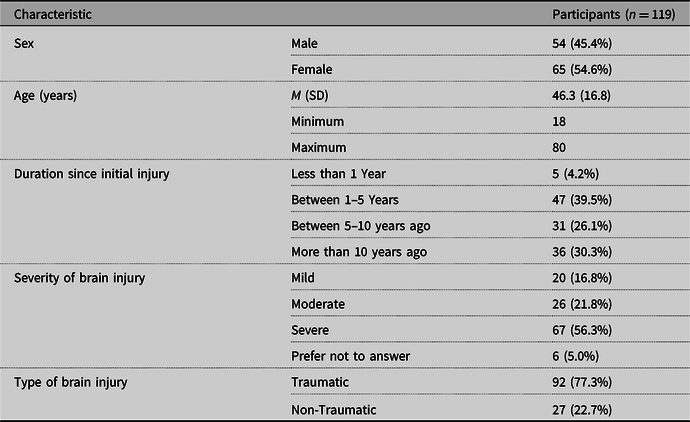
Of the 141 surveys collected, 22 were incomplete, yielding 119 completed surveys that were included in the analysis. Participant characteristics are summarized in Table 1. A power analysis indicated that the study was sufficiently powered (>0.80).
Participant Demographics

ABC and CIQ-H correlations
A Pearson’s correlation indicated there was a significant, but weak, positive correlation of 0.241 between ABC and CIQ-H total scores (p = 0.008). A Spearman’s rho analysis indicated no associations between severity of injury, type of injury or level of function (p > 0.05).
Total ABC and CIQ-H scores
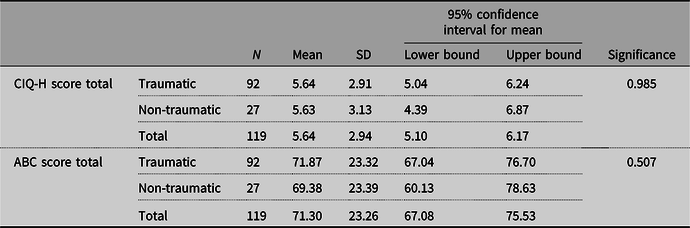
A Mann–Whitney U test revealed no significant difference between ABC total scores (p = 0.507) or CIQ-H total scores (p = 0.985) in individuals with a traumatic vs non-traumatic injury (p > 0.05). The ABC total and CIQ-H total scores are summarized by type of injury in Table 2.
CIQ-H and ABC Total Scores in Traumatic vs Non-traumatic Brain Injury

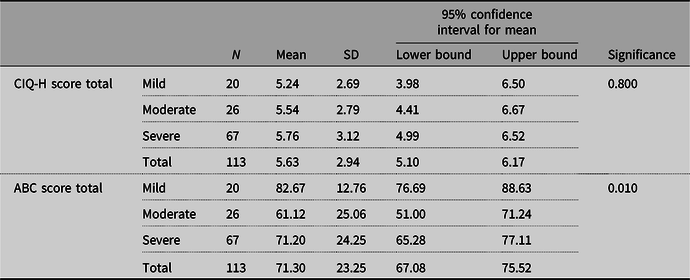
The six participants who chose ‘prefer not to answer’ regarding severity of injury were excluded from analysis. A Kruskal-Wallis Test of 113 participants determined that while there was no significant difference in the CIQ-H score based on injury severity, there was a significant difference in ABC score based on severity of injury. A Dunn’s post hoc test indicated a significant difference between the pair of mild-moderate (p < 0.008), and no significant difference between the pairs mild-severe and moderate-severe (p > 0.05). The ABC total and CIQ-H total scores are summarized by level of injury severity in Table 3.
CIQ-H and ABC Total Scores Based on Severity of Injury

Significance: p < 0.05.
ABC and CIQ-H scores by level of function
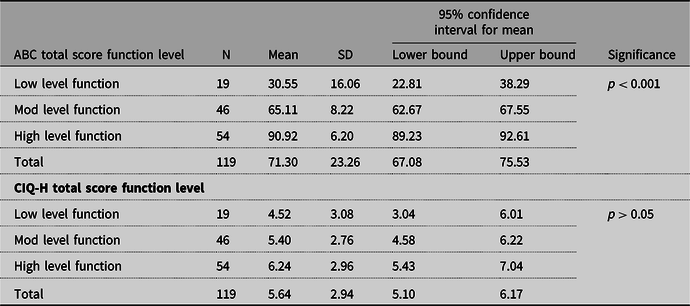
Table 4 summarizes the ABC total scores and CIQ-H scores by level of function. Mean total ABC scores for low, moderate and high level functioning individuals were 30.55/100 (SD = 16.06), 65.11/100 (SD = 8.22), and 90.92 (SD = 6.20), respectively. Mean CIQ-H scores for low, moderate and high level of functioning individuals were 4.52/10 (SD = 3.08), 5.40/10 (SD = 2.76), and 6.24/10 (SD = 2.96), respectively.
Mean ABC and CIQ-H Score Based on Level of Function

Significance: p < 0.01.
Discussion
This study found a statistically significant positive correlation between total ABC and CIQ-H scores. Thus, individuals who reported higher balance confidence tended to report higher community integration participation for home management, supporting the authors’ hypothesis. Likewise, individuals who reported lower balance confidence reported a lower level of participation in community integration for home management. The results of this study suggest that greater levels of balance confidence may be a contributing factor to community integration for home management in individuals with ABI.
No significant difference was identified between the ABC and CIQ-H correlations for individuals with traumatic vs non-traumatic ABIs. This lack of significance difference yields support that the relationship between balance confidence and home integration exists independently of injury type. There are limited studies on how the recovery of those with non-traumatic ABI differs from those with traumatic ABI, and future research is indicated to investigate the differential profiles of these two groups (Cullen, Park & Bayley, Reference Cullen, Park and Bayley2008; Colantonio et al., Reference Colantonio, Gerber, Bayley, Deber, Yin and Kim2011). Balance confidence may be important for clinicians to assess when determining community integration status, regardless of whether a patient incurs a traumatic vs non-traumatic ABI, however, this needs to be validated with larger-scale studies.
When comparing CIQ-H scores across levels of severity, no significant differences were found. Although only the home integration component of the CIQ was assessed, findings are consistent with current literature which reports that injury characteristics, including severity, has a negligible-weak relationship with community integration (Kersey, Terhorst, Wu & Skidmore, Reference Kersey, Terhorst, Wu and Skidmore2019). Community integration can be impacted in any individual with ABI, therefore future studies assessing community integration after ABI should assess all levels of severity.
Significant differences were found in total ABC scores based on injury severity, indicating that participants in this study with mild ABIs were more likely to exhibit higher levels of balance confidence, as compared to those with moderate or severe injuries. These results are supported by Myers et al. (Reference Myers, Fletcher, Myers and Sherk1998). However, while many studies utilize the ABC to assess balance confidence in individuals ranging from mild to severe ABI, there continues to be a lack of research comparing the three levels of severity (Hays et al., Reference Hays, Tefertiller, Ketchum, Sevigny, O’Dell, Natale and Harrison-Felix2019; Maskell, Chiarelli & Isles, Reference Maskell, Chiarelli and Isles2006; Thornton et al., Reference Thornton, Marshall, McComas, Finestone, McCormick and Sveistrup2005).
Analysis of the results indicates a significant difference in mean total ABC scores, where individuals with higher levels of balance confidence tend to have higher levels of physical functioning, a crucial component for integration into the home and community. This supports previous studies’ results which reported that individuals demonstrating higher degrees of balance confidence exhibit higher levels of balance capacity and mobility during activities of daily living both inside and outside the home (Inness et al., Reference Inness, Howe, Niechwiej-Szwedo, Jaglal, McIlroy and Verrier2011). This is further supported by the positive correlations found between the ABC and clinical measures of balance and mobility (Hays et al., Reference Hays, Tefertiller, Ketchum, Sevigny, O’Dell, Natale and Harrison-Felix2019). However, the lack of correlation between level of function and CIQ-H score indicates that the level of physical functioning is not the only determinant of successful integration in the home and community. Kersey et al. (Reference Kersey, Terhorst, Wu and Skidmore2019) determined that there are many possible predictors of community integration including mood, disability, social support, and social obstacles. The positive correlation between ABC scores and CIQ-H scores from this study suggest that balance capacity may be an additional determinant for clinicians to consider and should be explored in future studies.
The results of this study provide limited evidence to support the use of the ABC in conjunction with the CIQ-H when evaluating the home and community integration levels of individuals with ABI. Disciplines such as physical and occupational therapies may be able to incorporate the ABC as part of their assessment of community integration after ABI. However, as suggested by McCulloch (Reference McCulloch2007), other more specialized clinicians such as neuropsychological counselors or psychologists may need to be consulted to better address the cognitive or psychological components of balance such as balance confidence. Incorporating these two tools into an evaluation has the potential to assist clinicians in determining whether balance confidence may be contributing to restrictions in community integration, and therefore design a more comprehensive plan of care. Future studies are indicated to assess integration of strategies to improve balance confidence as a component of balance recovery training during rehabilitation for increasing community integration in community-dwelling adults with ABI.
There are limitations to this study. A relatively small number of participants volunteered, including those via non-purposive sampling, and the study results revealed a small effect size. Therefore, these results may not represent the wider population of persons with ABI. While the self-reported measures are validated in the ABI population, no objective measures of balance were used in this study. The survey format of this study also creates a potential response bias. Future research is indicated to compare self-reported measures for balance confidence and community integration with objective measures of balance within the community in a larger sample size. This study assessed participants with both traumatic and non-traumatic ABI, as well as all levels of severity. Additional studies are recommended to assess each specific level of severity and/or type of ABI. Response rate was unable to be tracked secondary to the use of snowball sampling. Lastly, the data collection for this study unexpectedly took place during the COVID-19 pandemic when imposed restrictions required individuals to quarantine in their homes for months leading up to survey deployment. Therefore, the information provided by the participants was subject to recall bias regarding social interaction and productive activity prior to quarantine restrictions. Future research is indicated post-pandemic to assess for additional significant correlations with greater strengths between total scores of the ABC and CIQ, without the barrier of recall bias during pandemic restrictions.
Conclusion
The findings of this study suggest that balance confidence may be positively correlated with community integration for individuals with ABI.
Financial support
This research received no specific grant from any funding agency, commercial or not-for-profit sectors.
Conflicts of interest
Authors have no conflicts of interest to disclose.
Ethical standards
The authors assert that all procedures contributing to this work comply with the ethical standards of the relevant national and institutional committees on human experimentation and with the Helsinki Declaration of 1975, as revised in 2008.