Tax competition is a prominent case of interdependent policy making. Decision makers in one jurisdiction are influenced by the tax rates set in others, because these affect their capacity to attract or retain valuable sources of revenue such as investment, companies or taxpayers. The consensus in the literature is that this is a real phenomenon, and many studies document it convincingly at both the subnational and international levels.Footnote 1 At the same time, research has shown that several political and economic factors limit the extent of tax competition, including domestic politics and institutions,Footnote 2 budget rigidities and fiscal redistribution,Footnote 3 broad institutional constellationsFootnote 4 and other forms of interdependence, such as policy learning.Footnote 5
This article argues that socialization among policy makers is an additional source of constraint for competition. Building on the literature on international socialization and norms,Footnote 6 we argue that interactions within intergovernmental organizations (IGOs) foster the development and enforcement of norms on the appropriate scope of tax competition. Importantly, our socialization argument does not imply that policy makers strive for increased policy coordination or co-operation to limit competition. Rather, in a context in which competition is generally accepted (and is not contested as such), social interactions among policy makers may produce, as a byproduct of the exchanges, enough leverage to sustain norms on the acceptable forms and intensity of competition. This dynamic creates real constraints on tax competition.
Empirically, we focus on personal income taxation in Swiss cantons from 1990 to 2007. In comparison with cross-national studies, the Swiss case offers several advantages for the study of tax competition. In Switzerland, tax policy is extremely decentralized, fine-grained data on tax rates are available, competition can be measured more precisely and an interesting constellation of intergovernmental institutions can be exploited. We estimate spatial lag models for fifteen income categories using a variety of specifications for unit heterogeneity, serial correlation and connectivity matrices. Our results consistently show that cantonal personal income tax rates are correlated with those of competitor cantons, but the correlation is stronger among cantons that do not participate in the same IGOs than among those that do, suggesting that these institutions help enforce norms on acceptable forms of competition. Participation in IGOs can be considered exogenous to policy makers’ motivations to discuss tax competition matters because the composition of IGOs has historical origins, is the same across various policy areas and no opt-outs are possible. These findings have implications for the role of intergovernmental institutions and other institutionalized forms of interaction among policy makers in setting limits on competition in tax policy and other areas, all the more so that, in our case, one would expect policy makers’ immediate interests to overshadow other considerations.
The article is structured as follows. The next section discusses theories of tax competition and their relevance in the Swiss case. Then the argument is developed that social interactions among policy makers may help sustain norms about the appropriate extent of competition and explains how socialization unfolds within Swiss IGOs. The next section introduces data and methods, including the operationalization of competition and our strategy for the empirical analysis. Then the results of the statistical analysis are presented, which show that cantons respond more strongly to competitors’ tax rates if they do not participate in the same IGO. The next section discusses policy implications and the relevance of our analysis beyond the Swiss case. The final section concludes.
TAX COMPETITION: THEORY AND RELEVANCE FOR SWITZERLAND
The assumption that taxpayers or capital relocate because of tax rate differences among jurisdictions has motivated a vast theoretical literature. Famously, Tiebout advocated decentralized public goods provision based on his model of mobile citizens moving to communities that provide the combination of public services and taxes that is closest to their preferences.Footnote 7 In contrast to the welfare-enhancing Tiebout hypothesis, the first generation of formal tax competition models predicted a race to the bottom in tax rates and an under-provision of public goods if citizens move because of tax rate differences.Footnote 8 Scholars refer to the Zodrow and Mieszkowski model as a baseline formalization of the argument that competition among jurisdictions drives tax rates down.Footnote 9
However, the empirical evidence has not supported the race-to-the-bottom hypothesis, which more sophisticated tax competition models have called into question. Hays pointed to the unrealistic assumption that governments tax only one resource, which is critical for predicting a straight downward spiral.Footnote 10 Recent political science research has significantly improved our theoretical understanding of tax competition dynamics. Most important for our purposes is the insight that political and institutional factors constrain tax competition dynamics. For example, Hays showed that increased capital mobility impacts capital tax rates via labor-market and political institutions (majoritarian versus consensus democracy), Basinger and Hallerberg theorized the mediating effect of political institutions by modeling the role of veto players, and Plümper, Troeger and Winner investigated how budget constraints and equity norms limit downward pressures on tax rates.Footnote 11 We contribute to this literature on the constraints of tax competition from a different theoretical perspective by focusing on the socialization of policy makers within IGOs.
Less controversial than the race-to-the-bottom hypothesis is the most basic empirical implication of any tax competition model: that policy makers take potential movements of mobile taxable resources into account and thus react to competitors’ tax rate changes.Footnote 12 Abundant empirical research has documented such interdependent tax policy making in the case of Swiss cantons,Footnote 13 local governments in the Boston and Chicago areas,Footnote 14 US states,Footnote 15 Canadian provincesFootnote 16 and French regions.Footnote 17 We follow this literature and assume that jurisdictions compete for a tax resource (taxpayers) that is at least partly mobile.
Switzerland is a particularly interesting case for the empirical study of tax competition because the power to tax is strongly decentralized and tax competition is a recurrent topic in Swiss politics. Not only do cantons (the equivalent of US states and German Länder) and municipalities provide most of the public services, but they also collect a large share of the taxes. The federal government finances its budget mainly through indirect taxation, such as general sales and consumption taxes. Cantons, in contrast, rely heavily on income and property taxes. We investigate personal income taxation at the cantonal level, which is the single largest tax source in Switzerland.Footnote 18
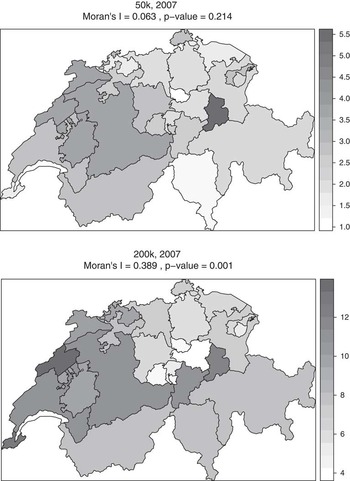
The autonomy of cantons in tax policy is almost unrestricted. Consequently, tax rates vary considerably across cantons. The top panel in Figure 1 shows cantonal income tax rates in 2007 for married persons without children with a taxable annual income of CHF 50,000.Footnote 19 The gray shades illustrate the level of taxation: the darker the shade, the higher the tax rate. Cantonal tax rates vary considerably, between 1.2 per cent in the canton of Zug and 5.3 per cent in the canton of Glarus. Although the gray shades seem somewhat spatially clustered, Moran’s I (a standard measure of spatial correlation) indicates that geographic clustering is weak and far from statistically significant. The bottom panel in Figure 1 shows cantonal tax rates for a taxable annual income of CHF 200,000. People earning that rather high income had to pay more than 12 per cent (that is, more than CHF 24,000) in cantonal taxes in Neuchatel, Geneva and Glarus, while they had to pay less than 5 per cent (less than CHF 10,000) in Schwyz, Zug and Obwalden. Moran’s I indicates that this income category exhibits significant geographic clustering. In sum, cantonal tax rates vary substantially for both low and high incomes, but only the latter are spatially correlated.Footnote 20
Cantonal personal income tax rates in percent for an annual taxable income of CHF 50k (top) and CHF 200k (bottom).

Tax competition is widely believed to occur in Switzerland, and anecdotal examples abound. For instance, in 2011 the cantonal government of Zurich proposed a tax reduction for people earning more than CHF 250,000, but before putting the proposal before the cantonal parliament, the finance minister requested a report from a consulting firm that compared Zurich’s income taxes with those of other cantons. The report supported the proposal: it showed that Zurich has low taxes in general, but relatively higher taxes for very high-income groups. Consequently, in the following parliamentary debate, one of the most important arguments was that Zurich should improve its position in cantonal tax competition for high incomes, and parliament approved the amendment.Footnote 21 Another report, this time commissioned in the canton of Ticino, concluded that a limitation of tax increases is ‘the only practicable solution allowing the canton of Ticino to cope with intercantonal tax competition–which is a matter of fact with which we have to live for at least the next ten years, so that we cannot simply wish it away’.Footnote 22
Beyond anecdotal evidence, some studies found that citizens (in particular rich people) choose their place of residence partly depending on tax rates,Footnote 23 while others – studying micro-level data from the Swiss Household PanelFootnote 24 or the effects of inheritance taxationFootnote 25 – found no evidence of tax-induced migration.Footnote 26 Given the strong belief of most cantonal policy makers that tax competition is an important phenomenon, we expect that changes in the tax rates of a given canton are positively correlated with those of its competitors.
However, the main goal of this study is to go beyond competition. Like that on federalism, the international literature has found support for the argument that countries are influenced by their competitors’ choices, but it has also shown that, at least in part, the domestic political economy counterbalances competitive pressures to cut tax rates.Footnote 27 Various political, institutional and economic constraints narrow governments’ room to maneuver and limit the extent of competition. Many different factors that mitigate the pressure to compete for mobile assets have been studied. These include structural unemployment, public sector debt, the degree of economic openness, national and sector-coordinated capitalistic institutions, the prevalence of societal fairness norms among voters, the ideological distance between veto players and the strength of left parties in government. Furthermore, some authors have pointed out that tax competition has often been accompanied by efforts to strengthen co-operation, such as the Harmful Tax Competition Arena in the European Union and the OECD Global Forum on Transparency and Exchange of Information for Tax Purposes.Footnote 28
We contribute to this literature from the angle of the recent diffusion literature, which has made the case that competition is only one of the forms of interdependence that can cause policies to spread.Footnote 29 Competition is undoubtedly a very important mechanism of diffusion in the study of interdependent tax policy making, but other mechanisms have been largely neglected so far – in particular, we argue, socialization.Footnote 30 In addition to political, institutional and economic constraints, socialization in IGOs may mitigate tax competition dynamics. The next section discusses in detail our conceptualization of this mechanism and how we expect it to matter in the Swiss case.
HOW SOCIALIZATION MAY ATTENUATE COMPETITION
The international relations literature has forcefully argued that IGOs are important venues for socialization. A common argument is that their socialization potential depends on their functions and organizational capacity.Footnote 31 On the one hand, IGOs are seen as more conducive to socialization if they carry out specialized functions in specific fields than if they are general-purpose organizations in broad areas. On the other hand, socialization is understood to be more likely if IGOs have coercive potential (that is, if they are ‘interventionist’) – or at least rely on formalized rules and procedures (that is, they are ‘structured’) – than if they do not have an extensive bureaucracy (that is, if they are ‘minimalist’). Scholars have shown that international organizations influence the behavior of their members through socialization processes. For instance, Bearce and Bondanella found that countries tend to vote more similarly in the United Nations General Assembly if they have interacted in IGOs for many years, which suggests that socialization takes place in international institutions and makes interests converge, at least to some extent.Footnote 32 Greenhill showed that fewer human rights violations take place in countries that participate in IGOs whose members have high human rights standards.Footnote 33 Cao also concluded that IGOs play an important role in shaping domestic economic policies, including capital taxation.Footnote 34
While the literature has convincingly demonstrated the importance of IGOs, their specific connection with socialization is often unclear. In the case of tax competition, we argue that interactions among policy makers may reduce the extent to which jurisdictions compete with one another by setting limits on what is considered appropriate competition. In other words, we consider that policy makers’ interactions within IGOs may lead them to adhere to norms defining what is socially expected and what is not.
We define socialization as the ‘process of inducting actors into the norms and rules of a given community’.Footnote 35 In turn, norms can be defined as ‘standard[s] of appropriate behavior for actors with a given identity’.Footnote 36 A more restrictive definition is provided by Coleman: ‘[A] norm concerning a specific action exists when the socially defined right to control the action is held not by the actor but by others…If a norm exists, it may be generally observed by target actors even though they find it against their immediate interest to do so’.Footnote 37 Similarly, Young understands norms as expectations about the behavior of other actors, and argues that these expectations can shape, for instance, the outcomes of bargaining situations in ways that cannot be explained by actors preferences’ alone.Footnote 38
Why, then, should socialization constrain tax competition, and what is the role of IGOs in this process? Coleman argues that demands for norms emerge when an action has similar externalities for a set of actors, coupled with the actors’ inability to co-ordinate their actions (for example, the prisoner’s dilemma).Footnote 39 The basic tension in tax competition is that lowering taxes might seem appealing to attract taxable resources, but overall, if all act according to this rationale, it could lead to detrimental competition and an underprovision of public goods. Moreover, unconstrained competition may lead some actors to demand tax harmonization (for instance, at the national or supranational level), which creates incentives to tone down the most aggressive practices. In this context, norms define expectations on accepted behavior based on previous experience and social interactions, and create focal points that help create and sustain co-operation.Footnote 40
According to Young, the strength of norms derives from their influence on expectations, which are based entirely on previous experience.Footnote 41 Social interactions create a ‘positive feedback loop’: ‘precedents affect present expectations, which determine current actions, which in turn become future precedents’.Footnote 42 According to this view, IGOs matter simply because, by fostering social relationships, they reinforce this positive feedback loop. However, other authors consider that a condition for the stability of norms is that those who benefit from them are able to impose sanctions to enforce them.Footnote 43 Social relationships play a crucial role here: ‘Because social relationships consist of obligations and expectations, […] and because each actor continues to control some events in which the other is interested, there exists inherently in each social relationship leverage which can be used for the purpose of developing sanctions’.Footnote 44 This is one explanation of why IGOs can be expected to play an important role in enforcing norms. By intensifying and structuring relationships among actors, they strengthen their capacity to withdraw co-operation in other domains and/or in other periods as a response to non-compliance. It is likely, though, that both dimensions matter and support each other. On the one hand, IGOs shape expectations about the behavior of other actors, possibly making some norms self-enforcing.Footnote 45 On the other hand, they enhance sanctioning possibilities if norms are violated.Footnote 46
It is useful to distinguish between two socialization mechanisms: persuasion and social influence.Footnote 47 The former posits that social interactions induce a genuine change of opinions or attitudes. This is what constructivists usually emphasize when they discuss the micro processes of socialization.Footnote 48 However, IGOs are unlikely to affect tax competition dynamics in this way, at least in our case. As mentioned earlier, tax competition per se is not really contested in Switzerland, although there have been repeated attempts to increase the level of tax harmonization between cantons.Footnote 49 Moreover, the primary aim of intercantonal organizations is to defend the prerogatives of cantons, such that attempts to limit their autonomy are not considered appropriate. Yet social influence does not require a change of preferences. Instead, it induces norm-conforming behavior through ‘the distribution of social rewards and punishments’,Footnote 50 which affect status, prestige or reputation. This mechanism is particularly effective when reputation spills over into other arenas,Footnote 51 which is the case for intercantonal organizations because, as we will explain shortly, they have the same composition in different policy areas.
Therefore we expect that tax competition, although it is not fundamentally contested, is constrained by socialization in IGOs, which produces effective norms defining what is acceptable competition and what is not. At this level of abstraction, the argument is still very general and we do not know how interactions within IGOs contribute to producing common norms. Indeed, an insufficient specification of the micro-dynamics of socialization is a common limit of studies looking at the consequences of joint membership in IGOs. Consequently, the remainder of this section explains in detail how the argument applies to our case.
Since 1910, all cantonal finance ministers have met regularly (at least twice a year) in the cantonal conference of finance ministers (CFM), which defends their interests in fiscal policy vis-à-vis the central government. In addition to this national organization, finance ministers also interact within specialized regional conferences. Importantly, the conferences cannot make legally binding decisions, and the raison d’être of the national conference, in which policy coordination is limited, is to defend cantonal tax autonomy.Footnote 52 In the regional conferences, however, the exchange of experiences and the discussion of the relevant financial topics is more intense than in the national meeting.Footnote 53 Cantonal finance ministers elaborate common positions for the national meetings, and discuss specific issues concerning their region. The quite intense collaboration in the regional IGOs also increases face-to-face interaction among the finance ministers, in addition to the formal meetings. There are four different regional conferences: in the Western, Eastern, Central and Northwestern parts of Switzerland; each has a series of ministerial conferences in specific policy areas.Footnote 54 In the former three, the cantonal finance ministers meet regularly, while the cantons in the Northwestern part of Switzerland only participate in a general conference and in those of other policy fields, like education or health.Footnote 55 The composition of the regional conferences of finance ministers is shown in Table 1.Footnote 56 These conferences can be characterized as ‘specialized’ and ‘minimalist’ according to the criteria discussed above, because their tasks are focused on a specific policy area, they have only a basic bureaucracy and they operate with largely informal procedures.Footnote 57
Regional Conferences of Finance Ministers

The composition of the regional conferences has been established historically and is the same across different policy areas. In other words, the finance ministers cannot freely decide whether and which regional conference to join; they automatically participate in the conference to which their canton belongs. This is a major advantage for our purposes, because the fixed composition of the regional conferences can be seen as exogenous to policy makers’ preferences. It is reasonable to assume that participation in these conferences is not a function of the motivation to discuss tax competition matters, because the composition of the regional conferences is the same across various policy areas, is based strictly on geography and no opt-out options are available. This configuration makes it possible to separate the self-selection effect of participation from the effect of participation itself.
The relevance of institutionalized forms of intergovernmental relations emerged in several interviews we conducted with cantonal policy makers. For instance, the former finance minister of a large canton (who was in office for many years until just before our interview) explained that while the conferences are not cartels trying to limit the extent of competition among cantons, tax competition is a recurrent theme, and some cantonal ministers always put forward the argument that competition causes self-inflicted damage.Footnote 58 With reference to the general concepts discussed above, this shows that, among Swiss cantons, there is both some dissatisfaction with the externalities of tax policy decentralization and an unwillingness to increase co-operation because it would constrain cantonal tax autonomy, which is historically one of the most critical cantonal prerogatives. Therefore, the conditions for the existence of a demand for norms, as discussed earlier, are fulfilled in this case.
Furthermore, the same minister explained that while the conferences strive to keep conflicts private and maintain a public image of consensus, internal discussions are often direct and outspoken, which is possible because the interpersonal relationships among ministers are good. Thus in several instances, ministers have expressed their annoyance with aggressive policies put forward in other cantons, such as Obwalden’s attempt to introduce degressive tax rates. In these cases, the goal was not to prevent these cantons from enacting the reforms, but rather to make it clear that they cross the line of what is acceptable so that other cantons would think twice before copying them.
Another dimension of intergovernmental relations, highlighted by the secretary of one regional conference,Footnote 59 is that cantons co-operate on practical matters, such as administrative training, because the small size of some cantons prevents them from delivering high-quality public services autonomously. Hence these cantons compete for taxpayers on the one hand, but co-operate closely on concrete projects on the other. These social interactions among cantonal finance ministers give rise to mutual obligations and expectations.Footnote 60
In sum, the extensive co-ordination and regular exchanges among finance ministers in the regional conferences might create a favorable context for socialization. Social influence within these conferences produces norms on the acceptable intensity of tax competition that might be effectively enforced by the mixture of good interpersonal relationships among the finance ministers, outspoken internal discussions and a public image of consensus. The structure of the regional conferences and the internal working methods might thus create dynamics that attenuate tax competition among cantons. Of course, we do not argue that joint membership in these IGOs would eliminate tax competition altogether. However, socialization within the regional conferences might limit the extent of competitive interaction among cantons by fostering collective awareness about the negative externalities of competition. Therefore, our main hypothesis is the following:
Hypothesis: Tax competition is weaker among cantons that participate in the same regional conference.
The next section discusses the data and methods we use to examine this hypothesis empirically.
DATA AND METHODS
One of the advantages of the Swiss case is the availability of fine-grained data for the dependent variable (tax rates) and the operationalization of competition. Starting with tax rates, there are in principle three options: statutory tax rates, average effective tax rates and effective tax rates calculated for a typical taxpayer. To investigate corporate tax competition, scholars typically use statutory tax rates (that is, top marginal corporate tax rates), but they acknowledge that this measure has serious drawbacks because it neglects exemptions, deductions and loopholes.Footnote 61 The standard alternative to top marginal tax rates is the use of average effective tax rates, which are calculated as ratios of the tax revenue to the relevant tax base.Footnote 62 For personal income taxes, scholars usually estimate the ratio of tax revenue from individuals to the incomes generated by those individuals (that is, wages and salaries). Although substantial progress has been made in specifying such ratios to approximate average income tax burdens,Footnote 63 this operationalization has serious limits. Comparable and reliable data are required to allocate specific tax revenues to selected aggregate tax bases, but they are simply unavailable on a large scale.
In addition to data availability, the problem with personal income tax ratios is that one does not know whether their variation originates from different tax levels, unequal distribution of incomes, differences in the progressivity of the tax systems or, most likely, from a combination of all three. The most informative income tax measures are effective tax rates, which are calculated for a typical taxpayer over different income categories and include the standard deductions.Footnote 64 Thanks to the cantonal tax comparison carried out every year by the Swiss Federal Tax Administration, we were able to compute, for each canton between 1990 and 2007, the effective tax rate for a married person without children in fifteen income categories ranging from CHF 20k to 1,000k. Their geographic distribution in 2007 for two income categories is shown in Figure 1.
In addition to providing an accurate measurement of the dependent variable, the Swiss case also allows us to improve the operationalization of competition. For personal income taxes, a configuration that makes competitive pressures among two cantons particularly strong is one in which a person can change residence without changing jobs. Given the small size of Switzerland (it can be crossed East-West or North-South by train or car in about four hours), this is often a feasible option. While geographic neighborhood is a reasonable approximation of this configuration, there are many cases in which a shared border is misleading.Footnote 65 Moreover, geographic proximity might capture various forms of interdependence in addition to competition. Indeed, this indicator has been used to measure other diffusion mechanisms such as emulationFootnote 66 and learning.Footnote 67 To overcome these problems, we use commuting data from the 1990 and 2000 census, which allow us to compute, for each canton, the number of people commuting from every other canton. The idea is simple: if many people work in canton A but live in canton B, then A is under significant competitive pressure from B because many people living in A could choose to benefit from B’s favorable tax rates without disrupting their professional lives. Thus for our purposes, commuting data allow a more precise operationalization of competition.
Following recent applications of spatial econometrics in political science,Footnote 68 we write our empirical model as follows:
 $$y_{{it}} =\alpha _{{it}} {\plus}\rho Wy_{{t{\minus}1}} {\plus}X_{{it}} \beta {\plus}{\varepsilon}_{{it}} ,$$
where α it is a vector of canton-specific and year-specific intercepts (unit and time fixed effects),Footnote 69 Wy t−1 is the spatial lag with its coefficient ρ, X it is a set of control covariates with the corresponding coefficients vector β and ε it is the error term. The model can, in principle, be estimated using ordinary least squares, which is inappropriate only if the spatial lag is contemporaneous (Wy t ), thus generating endogeneity, in which case Franzese and Hays recommend a spatial maximum-likelihood estimator.Footnote 70 To address serial correlation, we employ a Prais-Winsten correction with panel-specific first-order autocorrelation,Footnote 71 but alternative specifications (including lagged dependent variables) are reported in the online supplementary material.
The most interesting part of the model is Wy
t–1, the spatial lag. It results from the multiplication of a vector of the temporally lagged outcome variable (tax rates) with a connectivity matrix that measures how cantons are connected to each another. The interpretation of the spatial lag is simple: it is the weighted average of, in this case, the tax rates of other cantons, where the weights are constructed according to theoretical consideration. We construct different types of connectivity matrices (W), which we row-standardize.Footnote
72
The first uses simply neighborhood (W
N
): cantons i and j are related if they share a border, in which case
 $w_{{ij}}^{N} $
is 1, and unrelated if they do not, and
 $w_{{ij}}^{N} $
is then 0. In the case of neighborhood, the spatial lag (W
N
y
t–1) is the weighted average of the tax rates of a canton’s neighbors at t−1. This specification assumes that cantonal policy makers are only influenced by their neighbors and that all neighbors matter equally. While this spatial lag certainly captures competition pressures, it is likely that geographic proximity is also associated with other forms of interdependence that are not related to competition. Although it is very difficult to prove it empirically, there are good theoretical reasons to believe that this is the case, as discussed earlier. Thus our main models use a connectivity matrix based on commuting data (W
C
), where
 $w_{{ij}}^{C} $
records the number of people commuting from canton j to i divided by the share of overall commuters working in canton i (through row-standardization).Footnote
73
In sum, we argue that commuter data accurately operationalize competition pressures, while neighborhood likely captures multiple forms of interdependence.
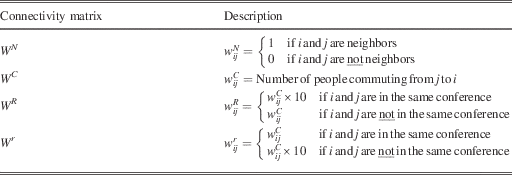
Finally, we create two additional connectivity matrices contrasting competitors that belong to the same regional conference with those that do not. To do so, we multiply
 $w_{{ij}}^{C} $
by 10 if cantons i and j participate in the same regional conference (W
R
) and if i and j do not (W
r
). (After this multiplication, both matrices are row-standardized again.) In other words, the two matrices amplify competitive pressures among cantons that are and are not in the same conference, respectively. In substantive terms, we increase the relative weight of cantons that participate in the same conferences, on the one hand, and those that do not, on the other hand, always taking into account their competitive relationships measured by commuting patterns. We use this procedure to assess the extent to which cantons respond to the competitors with which they interact in the same conference, compared to the competitors that participate in other conferences.
Concretely, if the estimates of the spatial lags based on W
R
and W
r
are roughly the same
 $(\hat{\rho }_{W^{R}} \,\approx\,\hat{\rho }_{W^{r}} )$
, this would indicate that cantons react similarly to all their competitors, regardless of whether they are in the same regional conference or not. Differences between the estimates, however, would suggest that the extent of competition varies as a function of joint membership in regional conferences. Specifically,
 $\hat{\rho }_{W^{R}} \, \lt \, \hat{\rho }_{W^{r}} $
would imply, consistently with our hypothesis, that cantons react more strongly to the policies of competitors with which they do not interact in the same conference. The construction of the spatial lags is summarized in Table 2.Footnote
74
Of course, multiplying by 10 is arbitrary. The robustness checks reported in the online supplementary material show that the results are qualitatively the same if we multiply W
C
by factors between 2 and 20. Moreover, these additional analyses highlight that it is important to select weighting factors that are large enough to clearly separate the groups that are compared.
Coding of the Main Connectivity Matrices Used to Construct the Spatial Lags

We also include several controls, namely unemployment, cantonal debt, spending, deficits and lump-sum grants (the amount the federal government transfers to each canton). The fiscal variables are coded per capita and are not lagged, because policy makers use quite accurate forecasts for the year to which the tax rates apply. The main results of the analysis are not affected by the lag structure of the control variables. Furthermore, we control for partisanship with the share of ministers affiliated with different political parties as well as the party affiliation of the finance minister, lagged one year.Footnote 75 Because of unit fixed effects, we cannot include time-invariant characteristics of cantons, such as their size, closeness to a center with a comprehensive infrastructure or specific features of the political system, which are, of course, relevant. Although it changes only slowly, we include population size (logged). Finally, we control for common shocks by including year fixed effects. While fixed effects are important to avoid overestimating the effects of interdependence and are consistent with our theoretical focus on changes,Footnote 76 we also show models without fixed effects in the online supplementary material.
STATISTICAL ANALYSIS
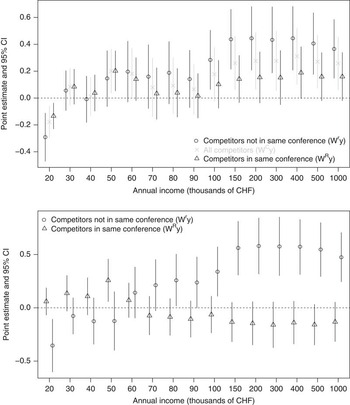
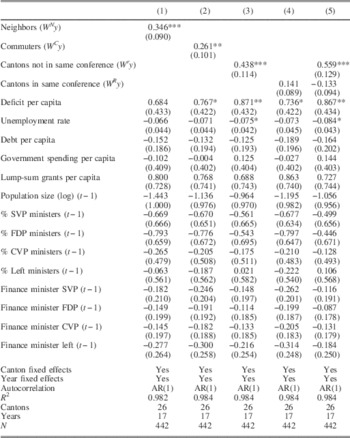
We estimated the model for the effective tax rates in fifteen annual income categories, namely CHF 20k to 100k (at 10k intervals) and 150k, 200k, 300k, 400k, 500k and 1,000k. The results for the CHF 150k income category are displayed in Table 3. Estimates of ρ (the coefficient of the spatial lag) for all income categories and various specifications of the connectivity matrix are presented in Figure 2. Extensive robustness checks with alternative specifications for unit heterogeneity, serial correlation and connectivity matrices (for a total of eighty-one additional models) are presented in the online supplementary material.
Estimates of the coefficients of the spatial lags, based on Table 3, Models 2–4 (top panel) and Model 5 (bottom panel) Note: top panel: each of the three spatial lags is included in a separate model; bottom panel: the two spatial lags are included in the same model.

Personal Income Tax Rates in Swiss Cantons for an Annual Income of CHF 150k.

Note: Prais-Winsten regression estimates with panel-corrected standard errors in parentheses; first-order autocorrelation specified for each panel separately. SVP=Swiss People’s Party; FDP=Liberal Democrats; CVP=Christian Democrats. *p<0.10, **p<0.05, ***p<0.01.
Table 3 shows that in the CHF 150k income category, cantonal tax rate changes are correlated with those of geographic neighbors (W N y, Model 1) as well as with those of cantons from which many people commute into a given canton (W C y, Model 2). This is in line with previous findings, and confirms that competitive pressures are an important determinant of cantonal tax decision making. The coefficient of W N y is larger and slightly more precisely estimated than that of W C y, possibly because the former captures competition plus other forms of interdependence, while the latter does a better job of isolating competitive pressures. Although this difference cannot be explained conclusively, we can confirm that cantons engage in tax competition.
The next models examine the core of our argument, namely, whether the extent of competition is smaller among cantons that interact within the same regional conference (W R y) than among those that do not (W r y). We first include each spatial lag separately (Models 3 and 4) and then together (Model 5), although this raises a collinearity issue, to which we return below. We see that competitive interdependence is stronger when cantonal officials do not interact on a regular basis, which limits the possibilities of social influence and the development and enforcement of norms on the appropriateness of different competition practices. Concretely, the coefficient of W r y (Model 3) is very large and precisely estimated, while that of W R y (Model 4) is smaller and statistically not significant at the 10 per cent threshold. Furthermore, when both spatial lags are included in the same model (Model 5), the former remains strongly positive, while the latter is not distinguishable from zero. The findings thus support the hypothesis that joint membership in regional conferences attenuates tax competition. Turning briefly to the control variables, only two (deficits and unemployment rates) appear to be associated with tax rate changes, although at low significance levels and inconsistently across models.Footnote 77
Table 3 presents the results for the CHF 150k income category, and Figure 2 displays the results of all fifteen income categories. The x-axis represents income categories, while the y-axis shows the estimated coefficients of various spatial lags. Each point represents a spatial lag estimate (
 $\hat{\rho }$
), while lines show 95 per cent confidence intervals. For instance, if we focus on the CHF 150k income category in the top panel of Figure 2, we see that the coefficient of the spatial lag is appreciably larger if the connectivity matrix gives more weight to competitors that are not in the same conference (W
r
y) than if it weighs more strongly competitors that participate in the same conference (W
R
y). If competitors are not differentiated according to this criterion (W
C
y), the spatial lag falls in between the two. Thus formally,
 $\hat{\rho }_{{W^{R} }} \, \lt \, \hat{\rho }_{{W^{C} }} \, \lt \, \hat{\rho }_{{W^{r} }} $
, which corresponds to our expectations. Notice that, for the CHF 150k income category, the information in Figure 2 corresponds exactly to that in Table 3. However, Figure 2 shows that the pattern holds for all income categories above CHF 90k. This means, that, as expected, cantons compete with one another for high-income earners. Competitive interaction unfolds at an income level of CHF 100k or higher. The spatial lag that does not take participation in a regional conference into account (W
C
y) can be interpreted as the baseline measure of competition. Against this baseline, we see that competition is more intense if cantons do not interact in the same conference (W
r
y) than if they do (W
R
y).
These results should be interpreted carefully. Because each coefficient is estimated in a different model, and the models are non-nested, we cannot precisely assess the statistical significance of the differences. However, quite conservative estimates suggest that, for incomes over CHF 100k, the coefficients of spatial lags that give more weight to cantons that are not in the same conference are significantly larger than those in which cantons that are in the same conference carry more weight. Our calculations are explained in the online supplementary material. Overall, the results across income categories support the hypotheses that cantons compete for high-income earners and that competition is attenuated by joint membership in regional conferences. The results for the lowest income category (20k) are difficult to interpret, but the findings of the other fourteen categories are consistent with our theoretical expectations.
Furthermore, the bottom panel of Figure 2 shows the estimates of the two main spatial lags when both are included in the same model. Tax rate changes are significantly correlated among competitors that are not in the same conference, but not among competitors that do not interact regularly in that context. An important caveat is that the two spatial lags are highly correlated (between 0.76 and 0.94), so multicollinearity could be a concern. The online supplementary material shows that this is the case especially when using weights smaller than eight. However, the pattern does not display the most typical problems associated with multicollinearity. That is, standard errors do not change dramatically compared to the models in which the spatial lags are included separately, and the switch in sign of one of the spatial lags is not extreme (coefficients become negative but are not significantly different from zero). Therefore we believe that the pattern is informative, although it should be interpreted carefully. In any case, it corroborates the findings based on the other well-specified models.
Of course, the statistical analysis cannot provide a direct test of the socialization mechanism itself. This is a general problem of quantitative studies of socialization. However, the robust statistical findings show that policy makers compete less intensively with one another if they interact on a regular basis, which is consistent with our arguments and circumstantial qualitative evidence. Social influence within IGOs may emphasize the negative externalities of tax competition, and produce and sustain norms on the acceptable intensity of competition. Our interviews suggest that these can be effectively enforced by a mixture of good personal relations between finance ministers and outspoken internal discussions.
In sum, the statistical evidence supports the theoretical argument that socialization may attenuate tax competition and is consistent with information we gathered from interviews. However, what general lessons and policy recommendations, if any, can we draw from the Swiss case? We turn to this question in the next section.
LESSONS FROM THE SWISS CASE
Of course, the Swiss case is specific and does not lend itself to straightforward generalizations. Our analysis has paid close attention to the characteristics of the regional conferences of cantonal finance ministers, which, like all IGOs, are to a certain extent unique. The socialization dynamics that we have discussed are embedded within this structure, and therefore cannot be easily extrapolated to other contexts. Moreover, our approach was not strongly hypothetico-deductive. On the contrary, our arguments have been informed by our knowledge of the case, which further limits the potential for generalization. However, there are reasons to believe that we can draw some broader lessons from this specific case that can inform our understanding of tax competition and IGOs.
Several aspects of the Swiss analysis make it relevant in more general terms. First, unlike many other socialization studies, we have focused on a policy area in which significant economic interests are at stake, and which is thus certainly not a ‘most likely case’ for finding socialization effects.Footnote 78 Secondly, participation in the IGOs examined here can be considered exogenous to attempts to discuss tax competition matters, because the composition of the IGOs is based on geographic rules that have not changed for decades and that hold across various policy areas. By contrast, much of the literature has considered IGOs in which self-selection is prevalent, which gives rise to serious endogeneity problems. Thirdly, our empirical strategy to increase the weights of joint members within a pre-specified connectivity matrix that models a baseline mechanism of interdependence (in this study, competition) is an innovative approach to studying the effects of IGOs.
What have we learned from the Swiss case? The main result is that tax competition is less intense between units participating in the same IGOs. Social influence within these organizations limits the extent of competition. Moreover, another important finding, which we did not anticipate at the beginning of our project, is that regional conferences seem to matter much more than the federal conference in constraining their members’ competitive behavior. One reason may be that regional conferences are better aligned with tax competition dynamics, which, as we have seen, take place in regional clusters rather than on a national scale. Thus it could be said that regional conferences promote socialization within the relevant subgroups, whereas the national conference groups cantons that are much less directly linked by competitive relationships. In other words, regional conferences (unlike the national conference) structure social interactions among precisely those cantons that compete with one another. Consequently, although we did not expect it, it should be no surprise that regional conferences are more important than the national conference in constraining tax competition.
The lesson that we can draw from these findings is that socialization within IGOs can attenuate tax competition, but only if IGOs are structured in such a way that socialization is targeted to the relevant subgroups of members – that is, those that are more directly competing with one another.Footnote 79 This argument is consistent with previous findings that more focused IGOs are better suited to promote socialization.Footnote 80 This is a potentially important lesson for international tax competition. While extreme cases, such as tax havens, should be addressed on a global scale, tax competition usually takes place among specific subgroups of countries. Our research suggests that regional co-operation can constrain competition more effectively if the organizational structure matches the actual competitive patterns. In the case of the European Union, for instance, recent studies have shown that the creation of the single market has accelerated corporate tax competition and that, despite several efforts, policy makers could not agree on effective political actions to constrain this dynamic.Footnote 81 Our analysis suggests that moving toward more focused institutional co-operation on fiscal affairs within subgroups of countries might be a promising way to deal with the negative externalities of tax competition.
Moreover, in contrast with previous findings,Footnote 82 our analysis has shown that even IGOs that cannot rely on an extensive bureaucracy and do not operate on the basis of strongly formalized rules and procedures can foster socialization. This means that heavy organizational structures might not be a necessary condition for shaping governments’ behavior. In the Swiss case, though, the long history of IGOs and the expectation that they will endure in the foreseeable future probably compensates for the lack of structure. Thus it is likely that newly established ‘minimalist’ IGOs will be conducive to similar dynamics only in the long term.
CONCLUSION
Tax competition is a prototypical case of policy interdependence in which the policy choices of one jurisdiction are influenced by those of others, and influence them in return. The consensus in the literature is that tax competition is a real phenomenon. Jurisdictions anticipate or respond to their competitors’ policies to gain, or prevent the loss of, valuable sources of revenue. However, competitive interactions have not produced a race to the bottom in tax rates because many domestic political-economic factors moderate competitive pressures and contribute to preserving existing differences. In this article, we have developed another argument explaining why the consequences of competition are not as sweeping as many think. We argue that socialization within intergovernmental networks can produce effective norms on appropriate forms of competition. The statistical analysis of personal income tax rates in Switzerland has shown that Swiss cantons react more strongly to their competitors’ policies if they do not participate in the same intergovernmental institutions than if they do. While competition itself enjoys broad support, and stronger policy coordination is not seen as a desirable option, it is not ‘anything goes’. Consequently, tax competition is weaker when institutionalized social interactions provide leverage with which to enforce norms on the appropriate intensity of competition.
This theoretical argument is interesting, we believe, for several reasons. The argument is clearly distinct from what the literature understands in terms of policy co-operation or co-ordination. That is, we do not argue that the attenuation of tax competition follows from deliberate efforts to harmonize policy choices or otherwise piece them together in a more considerate way. Rather, the moderation of tax competition is to be understood as a byproduct of social interactions targeted to other ends, such as, in our case, practical co-operation on day-to-day matters or the development of common strategies to preserve cantonal autonomy. Thus in a sense, our argument points to the unintended, or at least unplanned, consequences of institutionalized co-operation. And, contrary to most (if not all) moderating factors identified in the literature, we highlight an aspect that can be manipulated by policy makers. While general political-economic institutions and constellations must, for all practical purposes, be considered as given, strengthening institutions that foster social interactions among policy makers is possible and can be shaped by policy. Finally, although this study focused on tax competition, the socialization effect we discussed is potentially relevant for competitive dynamics in general.
We offer what we think is quite strong empirical evidence thanks to a number of unique features of the Swiss case: an exceptional degree of financial decentralization, unusually accurate data for tax rates, a more precise measurement of competition through commuting flows and an interesting configuration of intergovernmental institutions. However, while we provided circumstantial qualitative evidence to back up these arguments, it is clear that much more qualitative work is needed in order to show in detail how social influence operates within IGOs and how exactly it leads to an attenuation of competitive dynamics. This holds not only for this study, but for the literature more broadly. We believe our analysis constitutes a fruitful starting point for such work.