Introduction
Host-plant adaptation of phytophagous insects has become a major issue and earned significant attention in recent years (Berlocher & Feder, Reference Berlocher and Feder2002; Drès & Mallet, Reference Drès and Mallet2002; Peccoud & Simon, Reference Peccoud and Simon2010; Loxdale & Balog, Reference Loxdale and Balog2018). This is because the high divergence of this group of insects may result partly from processes that reflect their adaptation to different host plants (i.e. an enhanced ability to feed and reproduce on a particular plant species or species genotype) also called ‘host races’, in other words, host switching. As host switching potentially leads to divergent selection via reproductive isolation (Ferrari et al., Reference Ferrari, Müller, Kraaijeveld and Godfray2001; Peccoud & Simon, Reference Peccoud and Simon2010) such processes are often the first step toward eventual sympatric speciation (Kunert et al., Reference Kunert, Belz, Simon, Weisser and Outreman2010; Peccoud & Simon, Reference Peccoud and Simon2010). It has also been suggested that in herbivorous insects, especially sap sucking species like aphids (Hemiptera: Aphididae), behaviour often initiates the use of a new environment whereupon selection acts differentially within the old and new environment, i.e. host plant (Futuyma & Moreno, Reference Futuyma and Moreno1988).
In the case of aphids, the chemical and/or physical properties of host plant tissues and phloem make them reluctant to accept a new plant. This is due to the fact that selection of a new host includes a trade-off between preference for feeding on the phloem along with the necessity to deal with new secondary plant chemicals, especially toxic ones (Caillaud & Niemeyer, Reference Caillaud and Niemeyer1996). An additional effect in new environments may be the effect of predators; therefore there has also been much discussion as to whether the host plant or predators or both have a significant effect/s on the control of prey populations (e.g. Walker & Jones, Reference Walker and Jones2001; Nosil & Crespi, Reference Nosil and Crespi2006). This concept derives largely from researches assessing variation in tritrophic host plant–herbivore–predator interactions (Schmitz, Reference Schmitz2010; Burghardt & Schmitz, Reference Burghardt, Schmitz, Hanley and La Pierre2015). Continuous predator pressure can evoke population-wide behavioural, morphological and/or physiological adaptation of prey that leads to differential performance and fitness in different environmental contexts (Relyea, Reference Relyea2001; Hawlena et al., Reference Hawlena, Kress, Dufresne and Schmitz2011). When predation pressure changes temporally and/or spatially, for example on a new host plant, those prey individuals that are able to respond flexibly to risk are predicted to have higher survival chances and subsequent fitness advantages (van Veen et al., Reference van Veen, Morris and Godfray2006; Bukovinszky et al., Reference Bukovinszky, van Veen, Jongema and Dicke2008).
In the present study, the assumption that three geographically distant population samples used in the experiments were highly likely to be distinct genotypes and not members of a widely dispersed single clone is strongly supported by the results of an earlier population genetic study of Brevicoryne brassicae (Ruiz-Montoya et al., Reference Ruiz-Montoya, Nunez-Farfan and Vargas2003). In this earlier study, where aphids were collected from two Brassica hosts, the natural weed Brasica campestris L. and cultivated B. oleracea, cv. capitata L. growing sympatrically at four locations in the Highlands of Chiapas, Mexico (range of geographic distances 4–22 km, average 11.3 ± SD 6.9 km.; n = 6) and tested using seven polymorphic allozyme loci, it was found that overall genetic structuring was high (F ST = 0.22), including between geographical localities when samples were taken from the same host plant (F ST = 0.13), rather than from the different hosts locally (F ST = 0.03) (Ruiz-Montoya et al., Reference Ruiz-Montoya, Nunez-Farfan and Vargas2003). Their results infer a restriction of inter-subpopulation gene flow/migration, genetic drift or some kind of local differentiating selection. The authors tend to favour selection as the driver responsible and conclude that ‘Given that general environmental conditions are similar within localities, selection on each host species may produce genetic divergence within and among subpopulations of B. brassicae’. The fact that the geographical distances of our study were mostly considerably greater than those of the Ruiz-Montoya et al. study further adds support to the likelihood that the Iranian samples were distinct genetically (due to allopatric separation and consequent restriction of gene flow, leading to local subpopulation differentiation).
In light of these factors, the present research asked the following questions: (1) Is there any effect of plant species genotype on aphid preference and performance?; (2) Is there any effect of aphid genotypes on performance of aphid parasitoids?; and (3) Is there any indirect effect of plant genotypes on aphid parasitoid performance?
Materials and methods
To test our hypothesis, Canola plants, Brassica napus L. and Radish, Raphanus sativus L. (Brassicaceae) were used as host plants, cabbage aphid, Brevicoryne brassicae (L.) as the herbivore, and a primary aphid endoparasitoid wasp, Diaeretiella rapae (M'Intosh) (Hymenoptera: Braconidae) as the parasitoid in the experiments. The host range for B. brassicae has restricted to plants belonging to the family Brassicaceae, including both cultivated and wild crops (Blackman & Eastop, Reference Blackman and Eastop2006; van Emden & Harrington, Reference van Emden and Harrington2007). However, economically important host crop where significant losses have been recorded is cauliflower, Brassica oleracea (van Emden & Harrington, Reference van Emden and Harrington2007).
For canola, four commonly sown agricultural cultivars were used including cvs. SLM046, RGS003, Talayeh and Sari-Gol, whilst the radish cultivar was cv. Champion. Three different geographically dispersed population samples (=genotypes) of B. brassicae aphids were used in the experiments. The aphids were collected as colonies from single cultivated ornamental cabbage, Brassica oleracea (acephala group) from three different locations in Iran. In each locality, one plant which was infested by one aphid colony was dug out gently and placed in a plastic container and then transferred to the greenhouse, while at the same time, being kept cool. Genotype I was collected from Mahan (Kerman Province, south-eastern Iran, 30°02′N 57°14′E), Genotype II from Shiraz (Fars Province, western Iran, 29°35′N 52°35′E), and Genotype III from Kerman (Kerman Province, south-eastern Iran, 30°17′N 57°04E). The geographical distance between locations was as follows: Genotype I and II = 451 km; I and III = 32 km and II and III = 439 km, average 307 ± SD 239 km.; n = 3 (https://www.nhc.noaa.gov/gccalc.shtml). Thus it was felt that these geographical locations were far enough apart for it to be highly probable that each of the population colony samples collected truly represented a unique genotype, rather than a geographically widespread ‘clone’ sensu lato, i.e. a largely genetically identical population sample descending from a single asexual foundress (Loxdale, Reference Loxdale2008). Aphid parasitoids, D. rapae, were collected as mummies on ornamental cabbage, Brassica oleracea (acephala group) in Sirjan city, Kerman, Province, Iran. All experiments were performed under greenhouse conditions, at an ambient temperature of about 25 °C during the day, 20 °C at night with a relative humidity of 55–65%, and photoperiod of 16 h L:8 h D.
The aphid stock colonies were reared on canola plants (a mixture of all four cultivars) in the greenhouse with the above mentioned conditions. The plants used for aphid rearing were replaced every 7 days with fresh plants.
Experiment I: performance of different cabbage aphid genotypes on different host plant cultivars
Experimental plants and aphids
Host plants, comprising the four canola cultivars and radish were grown from seeds in 3-litre pots in the greenhouse. Plants in the six-leaf stage were used for the experiment. Of the three different aphid genotypes (B. brassicae), an isogenic colony (‘clone’ sensu lato) of each was initiated by placing a single viviparous female foundress on a plant, whereafter its descendants were used for the experiments.
Experimental design
This experiment was performed using a fully-factorial randomized block design with seven blocks (replicates). There were five plants (four canola and one radish) and three aphid treatments each with seven replicates (5 × 3 × 7 = 105). To begin the experiment, each plant was infested with three apterous viviparous females, and then the plant was covered by a hyaline polyethylene cylinder (12.5 cm diam., 34 cm high) with a fine mesh at its top to prevent the escape of the aphids. Thereafter, the aphids were allowed to reproduce for 15 days. At the end of the experiment, the total number of aphids was counted (number of winged (alate) and unwinged (apterous) aphids were counted separately). Aphid-load index was calculated as the total number of aphids divided to dry plant biomass weight (see Supplement).
Experiment II: preference of different winged cabbage aphid genotypes to different host plants
Winged aphids of genotype I and II were used for this experiment. To obtain winged individuals of each aphid genotype, some canola plants were infested with aphids which were then allowed to increase their population such that the number of winged individuals increased (Mehrparvar et al., Reference Mehrparvar, Zytynska and Weisser2013). To begin the experiment, five potted plants (one from each canola cultivar and one radish) were placed on the greenhouse table on the circumference of an imaginary circle of about 100 cm diameter with the same distance from each other. The position of each treatment (plant) was chosen randomly for each replicate. Thereafter, a plant already infested with winged individuals was placed in the centre of the imaginary circle so that the winged aphids were allowed to choose a host plant. All plants were checked after 4, 24 and 48 hours to determine the position of the winged aphids and production of nymphs. In total, ten replicates were run for each aphid genotype.
Experiment III: indirect effects of host plant genotype on aphid parasitoids
Experimental plants and insects
Host plants, consisting of four canola cultivars and radish, were grown from seeds in 3-litre pots in a greenhouse. Aphid genotype I was used for the experiment. Aphid parasitoids, D. rapae, were mass reared using the aforementioned aphid genotype in small mesh cages and then used for the experiment.
Experimental design
Each host plant was infested with 20 apterous viviparous female aphids. In order to prevent the escape of aphids a clip cage was used. The aphids were retained on the plant for 24 h, and then all except 50 first instar nymphs were removed from the plant. At the same time, a pair of newly emerged parasitoids (one male, one female) were placed in a 10 c.c. tube with a 10% honey solution available as food on a cotton wool pad and allowed to mate. After 24 h, each infested experimental plant was placed in a cage (33 × 33 × 50 cm3) covered by a fine mesh and one pair of parasitoids was released into the cage for 24 h. Thereafter, the parasitoids were removed from the cage and the aphid colony allowed to grow. The aphids were checked daily for parasitoid mummy formation and when found, the time of mummification was recorded. The mummies were removed carefully from the cages and kept individually in a transparent gelatine capsule. These were checked daily for the emergence of adult parasitoids. The time of emergence was recorded and then the sex of the parasitoid determined under a stereomicroscope. In this experiment, five treatments (plant cultivars) with ten replicates were used. Variables measured were, including the number of mummies, number of emerged parasitoids, sex ratio, mean mummification time (time from exposure to parasitoids until the formation of a mummy), mean developmental time (time from exposure to parasitoids until the emergence of adults) and percentage of parasitism and emergence rate.
Data analysis
Experiment I: Univariate Analysis of Variance (ANOVA) was used to analyze plant dry biomass, the total number of aphids and aphid-load. For each variable, models included main effects for the plant cultivars and aphid genotypes, as well as interactions. Aphid-load index was transformed as (Sqrt(x)). Generalized linear models using a normal distribution with identity link function were used to analyze the percentage of produced winged aphid individuals. A regression was then performed to determine how the two mathematically independent variables (number of aphids and dry biomass) were related.
Experiment II: Generalized linear models using a negative binomial distribution with log link function were used for the analysis.
Experiment III: Univariate ANOVA was used to analyze the data. Emergence rate was analyzed using the Kruskal–Wallis test.
A backward stepwise removal of non-significant terms was used to obtain the minimum adequate models. In the models, blocks were used as random factor. All analyses were conducted using IBM SPSS Statistics, version 22.
Results
Experiment I: performance of different cabbage aphid genotypes on different host plant cultivars
Total number of aphids
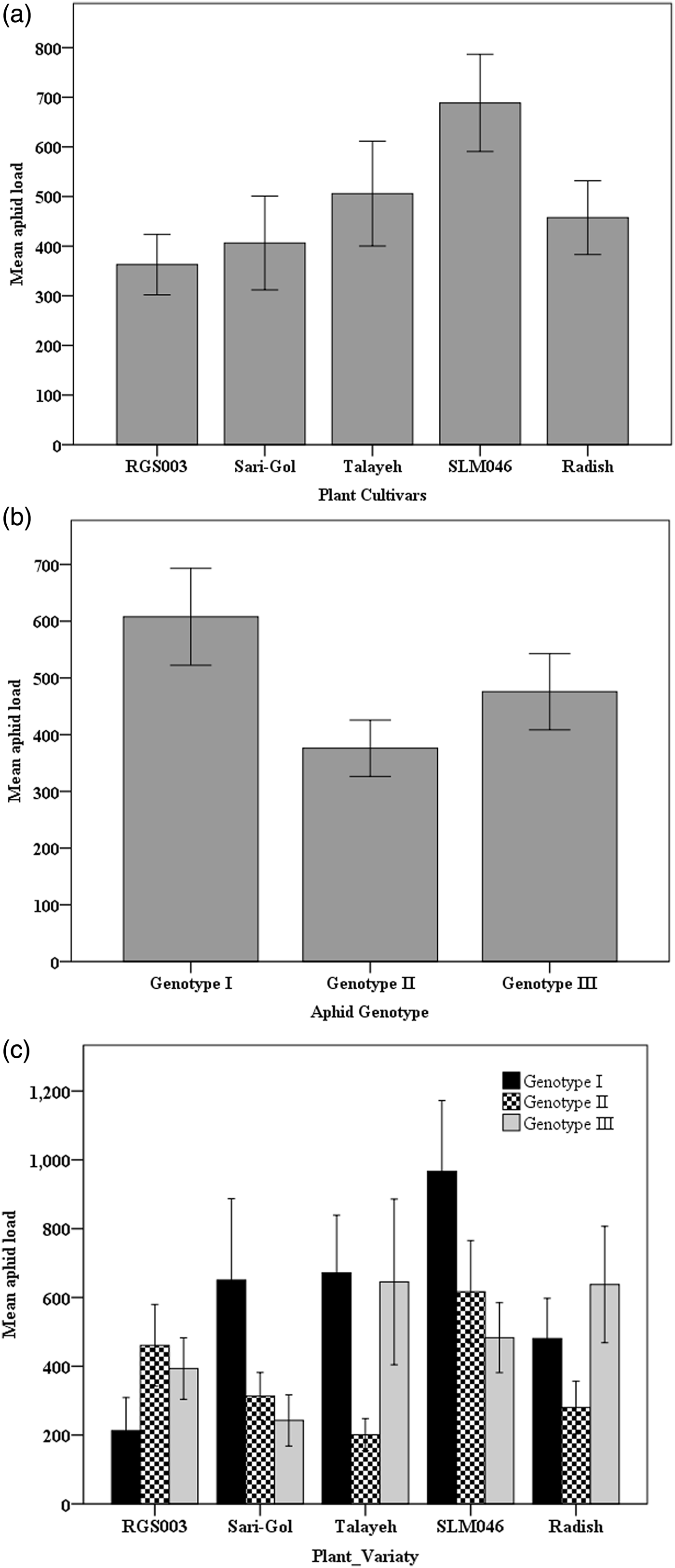
Plant cultivar had a significant effect on the total number of aphids (F = 10.4, df = 4, P < 0.0001), so that the greatest number of aphids was on SLM046, the least on radish and Sari-Gol (fig. 1a). Different aphid genotypes had different capacities in terms of reproductive performance, so that total the number of aphids was statistically different (F = 4.15, df = 2, P = 0.019) (fig. 1b). Aphid Genotype I produced the greatest number of aphids, Genotype II the least (fig. 1b). The interaction between plant cultivar and aphid genotype had a significant effect on the total number of aphids (F = 3.12, df = 8, P = 0.003) (fig. 1c).
(a) mean total number of aphids on different canola cultivars and radish, (b) mean total number of aphids produced by different genotypes, (c) mean total number of aphids produced by different genotypes on different canola cultivars and radish.

Aphid-load
As with the total number of aphids, aphid-load was also significantly affected by plant cultivar (F = 5.12, df = 4, P < 0.001) and aphid genotype (F = 5.31, df = 2, P = 0.007) (fig. 2a, b). The greatest aphid-load was on SLM046, whilst there were no significant differences between the others. The greatest and smallest aphid-loads belonged to Aphid Genotypes I and II, respectively (fig. 2b). The interaction between plant cultivars and aphid genotypes also had a significant effect on aphid-load (F = 4.46, df = 8, P < 0.0001) (fig. 2c).
(a) mean aphid-load on different canola cultivars and radish, (b) mean aphid-load by different genotypes, (c) mean aphid-load by different genotypes on different canola cultivars and radish.

Percentage of produced winged individuals
Plant cultivar, aphid genotype and their interaction had no significant effect on the percentage of winged individuals produced (X 2 = 5.22, df = 4, P = 0.27; X 2 = 0.43, df = 2, P = 0.81; X 2 = 8.9, df = 8, P = 0.34).
Experiment II: preference of different winged cabbage aphid genotypes to different host plants
Host choices by winged cabbage aphid
Host choices by winged aphids were significantly affected by plant cultivar (table 1). Individual winged aphids of the different aphid genotypes chose to differentially settle and feed on the various host plants tested (table 1). It was found that there was no definite preference toward a specific canola cultivar by the different aphid genotypes (table 1). Even so, there was a significant interaction between plant cultivar and aphid genotype affecting aphid preference (table 1). These overall patterns were the same for the various time series, i.e. 4, 24, 48 hours after the start of the experiment when the number of winged individuals was counted.
Host choice and number of nymphs produced by winged morphs of different genotypes of Brevicoryne brassicae on different plants. Bold = P < 0.05.

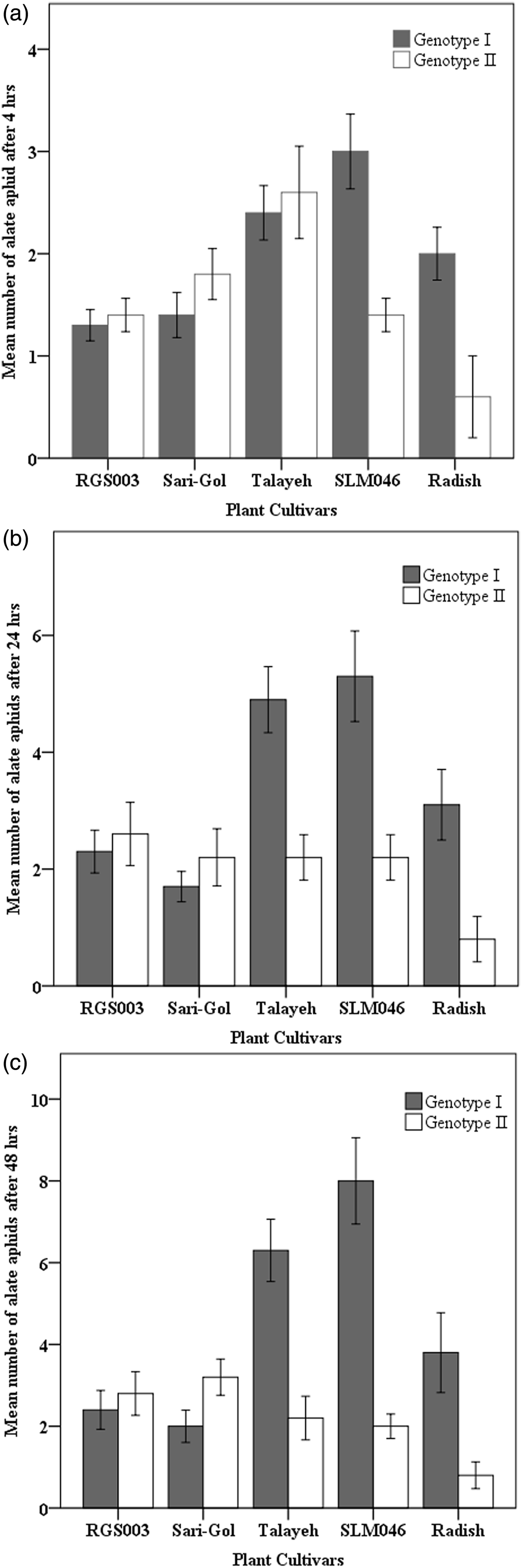
Upon examining the time series, Aphid Genotype I showed a preference toward canola cvs. SLM046 and Talayeh, while cvs. Sari-Gol and RGS003 were chosen less often (fig. 3). There was no clear preference of Aphid genotype II toward canola cultivars but radish was chosen significantly less (fig. 3).
Mean number of alate aphids of Genotype I and II settling on different canola cultivars and radish after (a) 4 h, (b) 24 h, (c) 48 h from the start of the experiment.

Nymph production by winged cabbage aphid
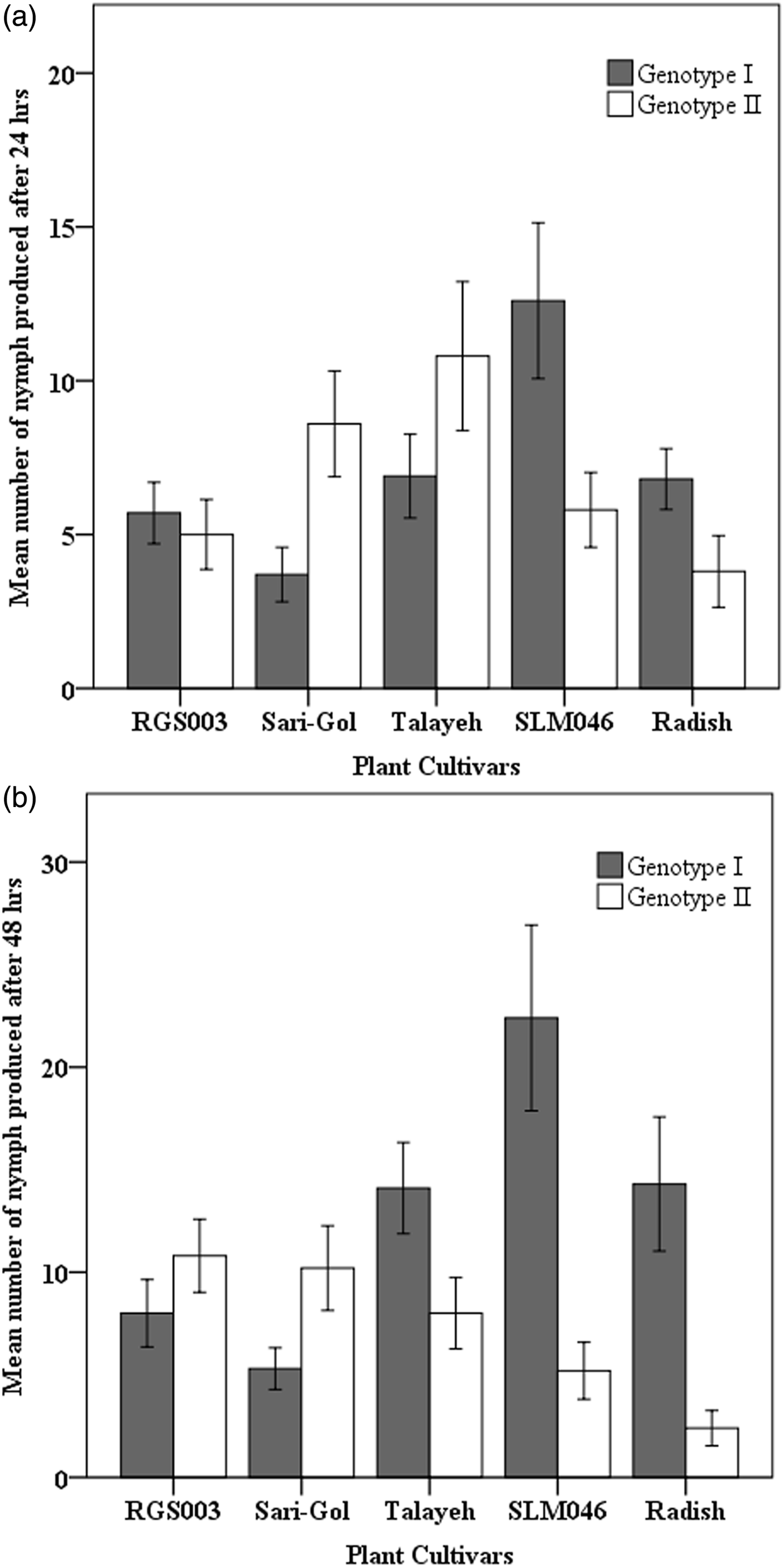
The number of nymphs produced after 24 and 48 h after the start of the experiment was significantly different on the different plant cultivars (table 1, fig. 4). The number of nymphs produced by different aphid genotypes after 24 h was not significantly different (table 1) but was seen to differ after 48 h (table 1). The interaction between plant cultivar and aphid genotype had a significant effect on the number of nymphs produced after 24 and 48 h (table 1). Aphid genotype I produced more nymphs on cv. SLM046 and less on Sari-Gol (fig. 4). Aphid genotype II produced relatively more nymphs on cvs. Talayeh, Sari-Gol and RGS003 and significantly less on radish (fig. 4).
Mean number of nymphs produced by alate aphids of Genotype I and II on different canola cultivars and radish after (a) 24 h and (b) 48 h from the start of the experiment.

Experiment III: indirect effects of host plant genotype on aphid parasitoids
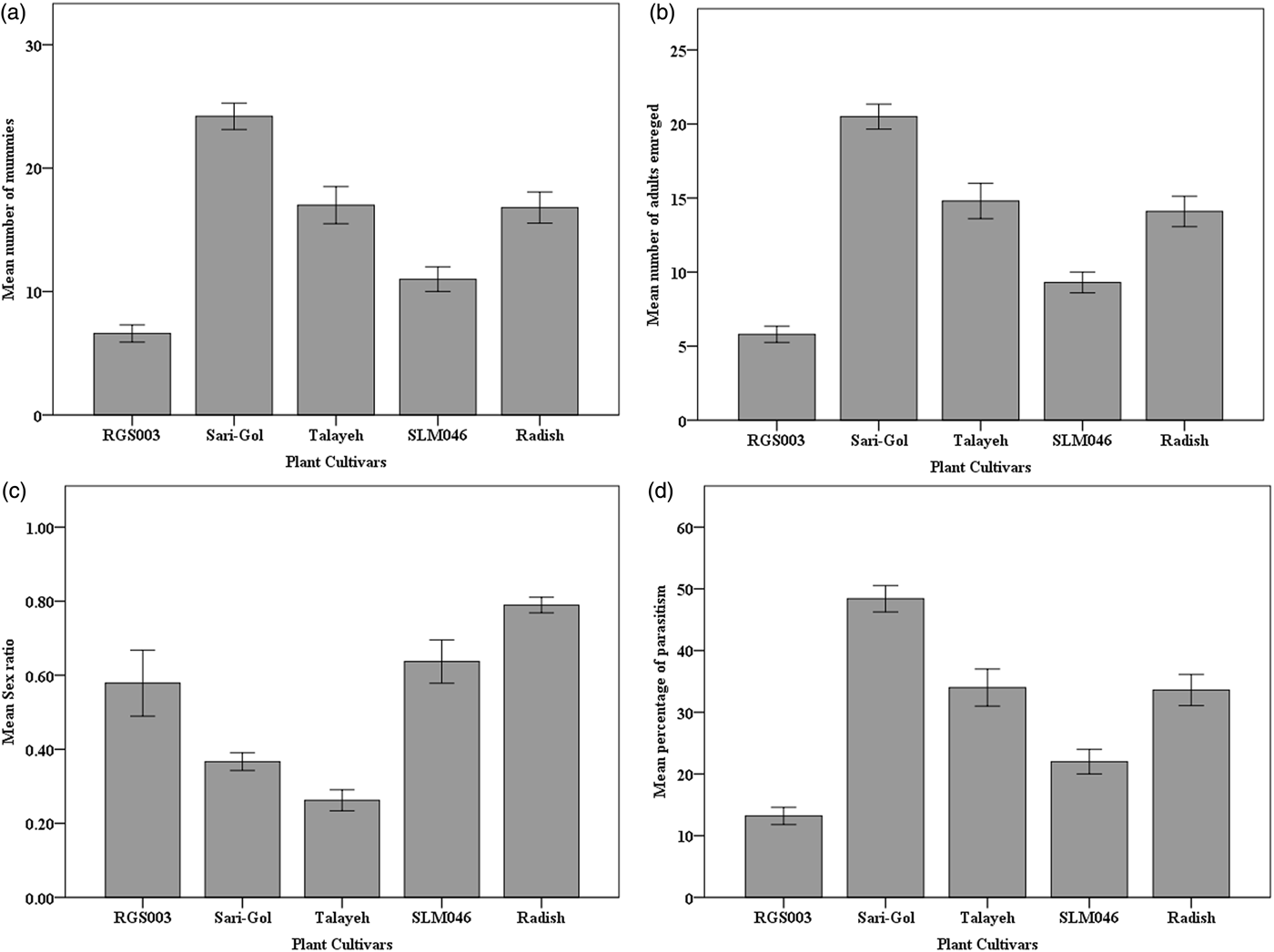
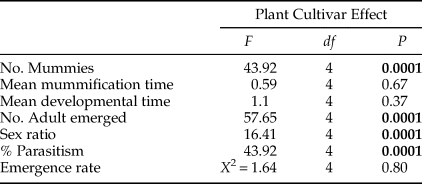
The number of mummies, number of adults emerged, sex ratio, and percentage of parasitism were found to be significantly influenced by plant cultivar (table 2), whilst mean aphid mummification time, mean parasitoid developmental time and emergence rate of parasitoid adults were observed to be no different on the various plant cultivars tested (table 2). The greatest number of mummies, emerged adult parasitoids and percentage of parasitism was found on canola, cv. Sari-Gol, the lowest on canola cv. RGS003 (fig. 5a, b, d). The parasitoid sex ratio was the most skewed towards 1:1 (male: female) on radish and the least on canola cv. Talayeh (fig. 5c).
(a) Mean number of mummies, (b) adult parasitoids emerged, (c) sex ratio and (d) percentage of parasitism of Diaeretiella rapae on canola aphid, Brevicoryne brassicae, on different canola cultivars and radish.

Aphid parasitoid, Diaeretiella rapae, performance parameters on different canola cultivars and radish. Bold = P < 0.05.

Discussion
The results of this study clearly show that plant cultivars have significant effects on the aphid fitness and parasitism rate, here cabbage aphid, B. brassicae and its primary endoparasitoid, D. rapae. Higher number of aphids and the greatest aphid-load was detected on SLM046, while lower aphid numbers and aphid-load were detected on radish and Sari-Gol. Aphid genotypes also performed differently: aphid Genotype I produced the greatest number of aphids, whilst Genotype II the least.
The interaction between plant cultivar and aphid genotype had a significant effect on the total number of aphids. This effect may readily be explained because the same aphid species attacking different host plants are expected to show such enhanced differences in reproductive output when individuals shift their use from a lower to higher quality plant, or begin to adapt and specialize on alternative host plant species, potentially leading to divergent selection via fitness benefits and perhaps ultimately to even reproductive isolation and hence sympatric speciation (Ferrari et al., Reference Ferrari, Müller, Kraaijeveld and Godfray2001; Peccoud & Simon, Reference Peccoud and Simon2010).
Host plant influences on fitness benefits of aphids was also detected in other studies revealing that the clover-race of the pea aphid, Acyrthosiphon pisum Harris have higher fitness when associated with red clover, Trifolium pratense L. rather than the common bean, Vicia faba L. as host plant (also suitable host for all pea aphid races) (Balog & Schmitz, Reference Balog and Schmitz2013).
In aphids, producing more winged individuals (dispersal morph), might be because of unsuitable or low food quality of a host plant which prompts aphids to ‘spread the risk’ by flying to and colonising other plants (Mittler & Sutherland, Reference Mittler and Sutherland1969; Müller et al., Reference Müller, Williams and Hardie2001; Braendle et al., Reference Braendle, Davis, Brisson and Stern2006; Brisson, Reference Brisson2010; Mehrparvar et al., Reference Mehrparvar, Mansouri and Weisser2014). However, and interestingly, the results of the present study showed that there was no significant difference in the percentage of winged aphids produced between plant cultivars and species and even aphid genotypes. This is probably because the quality/condition of plant cultivars and species is not that different to trigger production of winged individuals, and this was the same for all the three aphid genotypes in the present study.
Aphid host plant choice
The results of experiment I were confirmed when aphid host plant choices were tested. Accordingly, winged aphids host choice was significantly affected by plant cultivar (table 1). Thus on canola, aphid Genotype I preferred cvs. SLM046 and Talayeh, while that for cvs. Sari-Gol and RGS003 was low. By looking at the number of nymphs produced, the same pattern with winged aphid choices was observed (figs 3 and 4). There was no clear preference of aphid Genotype II toward canola cultivars but it is clear that Genotype II had a lower preference toward radish, showing that this host plant is not that suitable in comparison with canola; however, this was not true for Genotype I which preferred radish to canola cvs. RGS003 and Sari-Gol.
There was also a significant interaction between plant cultivars and aphid genotypes that significantly affected aphid preference and reproduction (table 1). Another, earlier study (Caillaud & Niemeyer, Reference Caillaud and Niemeyer1996) demonstrated that there is a trade-off between the benefits of gaining food resources on an already common (or natal) host plant and the cost of dealing with other plant structures or secondary plant chemicals encountered while searching for and attempting to feed on new hosts. Therefore, host shifts should arise only when fitness benefits of shifting to a novel host outweigh that of remaining on the common host plant, including interspecific competition (e.g. Pan et al., Reference Pan, Preisser, Su, Jiao, Xie, Wang, Wu and Zhang2016). In the case of cabbage aphid it was shown (these results) that there are particular aphid genotype-related fitness benefits associated with particular canola plant cultivars. This outcome is due to context-dependent, bottom-up-mediated effects of host plants to particular aphid genotypes. Since there are significant interactions between plant cultivars and aphid genotypes which affect a total number of aphids, aphid-load, host choice by winged aphids and their reproduction (e.g. Lushai et al., Reference Lushai, Markovitch and Loxdale2002; Benedek et al., Reference Benedek, Bálint, Salamon, Kovács, Ábrahám, Fazakas, Loxdale and Balog2015), these two factors are seemingly very effective in the structuring of the aphid community.
Parasitism rate
The rate of parasitism was also influenced by the host plant. The highest number of mummies, emerged adult parasitoids and percentage of parasitism was on canola cv. Sari-Gol, whilst the lowest values recorded were on canola cv. RGS003 (fig. 5). In addition, the sex ratio was the highest on radish and the lowest on canola cv. Talayeh (fig. 5c). The mean mummification time, mean developmental time and emergence rate of adults of parasitoids were, however, found not to be significantly different on plant cultivars (table 2). Hence, from this we infer that plant cultivar per se had no effect on growth parameters of the parasitoid wasp, whereas the parameters that are related to parasitoid female egg-laying behaviour are certainly affected by plant cultivar.
Possible reasons for such asymmetry between the parasitism on cabbage aphid on different plant cultivars may include: (i) different habitat complexity of host plant structure; and/or (ii) difference in trait-mediated effects. Differences in the structural complexity of host plants seemingly influence natural enemy behaviour through trait-mediated indirect effects. Many natural enemies use chemical cues emanating from the host plant to search for prey and to locate suitable habitat patch (Eubanks & Denno, Reference Eubanks and Denno2001; Brassil, Reference Brassil2004; Kunert et al., Reference Kunert, Belz, Simon, Weisser and Outreman2010). In some cases the strength and the quality of the cue depend on the species of host plant utilized by the herbivore that could indicate a qualitatively higher prey (van Poecke et al., Reference van Poecke, Roosjen, Pumarino and Dicke2003). Moreover, the canola plants themselves excrete different percentages of extrafloral nectar (Davis et al., Reference Davis, Peterson and Shuel1986), which may actually attract parasitoids. If so, this may explain the high vulnerability of these aphids on particular host plants cultivars compared to other plants.
Overall, based on these results, we deduce that canola cv. Sari-Gol is relatively resistant to cabbage aphid as performance and preference of the aphid is lower on this cultivar and in addition, parasitoid fitness (i.e. mean number of mummies, mean number of emerged adults and percentage of parasitism) is relatively higher compared with the other plant cultivars here tested, so that this cultivar is a potential candidate for use as a resistant cultivar in integrated pest management programs.
Conclusion
In conclusion, our results reveal that cabbage aphid is under different selective pressures arising from both higher (parasitoid) and lower (host plant cultivar) trophic levels. The host plant cultivar – even if relative low genetic differences may exist between the canola cultivars – had a significant effect on both aphid fitness and parasitism rate on particular aphid genotypes. This indicates that host-plant-adapted aphid species can create much context-dependency in the nature and strength of ‘fitness benefits of parasitism’, which may in turn alter the costs and benefits of host specialization. Taken together, these findings mean that for cabbage aphid, both host plants and parasitoids together influence the aphid population growth rate such that the aphid–parasitoid–host plant interaction so formed may have ecological-evolutionary consequences for traits that affect the aphid's tolerances to a different selective pressure and consequently, increased adaptation to a new host plant/s.
Supplementary material
The supplementary material for this article can be found at https://doi.org/10.1017/S0007485319000129
Acknowledgements
This study was financially supported by the Institute of Science and High Technology and Environmental Sciences, Graduate University of Advanced Technology, Kerman, Iran (Grant No. 1.5297).
Author statement
The authors declare that this research was conducted in the absence of any commercial or financial relationships that could be construed as a potential conflict of interest.
Ethical approval
All applicable institutional and/or national guidelines for the care and use of animals were followed.
Author contributions
MM conceived and designed the experiments. MM, AR and MR performed the experiments. MM analyzed the data. MM, AB and HDL discuss the results and wrote the manuscript.