Introduction
The genus Miriquidica was introduced by Hertel & Rambold (Reference Hertel and Rambold1987) for a group of mainly Lecidea-like saxicolous lichens, most of them with non-carbonized apothecia, Lecanora-type asci and frequently with the presence of miriquidic acid and related compounds in the thallus. In the Zahlbrucknerian system, Miriquidica species were formerly scattered in the genera Lecidea, Lecanora, Lecidella, and Aspicilia. Detailed generic descriptions can be read either in the protologue or in the revision of the sorediate taxa (Owe-Larsson & Rambold Reference Owe-Larsson and Rambold2001), or in the regional treatments by Andreev (Reference Andreev2004), Nash et al. (Reference Nash, Kainz, Zedda, Ryan, Rambold, Nash, Ryan, Diederich, Gries and Bungartz2004), and Giavarini et al. (Reference Giavarini, Coppins, Purvis, Smith, Aptroot, Coppins, Fletcher, Gilbert, James and Wolseley2009). The genus is generally accepted in floras and checklists, although its relation to Protoparmelia needs a critical re-evaluation because some of the species in both genera exhibit striking similarities in morpho-anatomical characters and secondary thallus chemistry. The major taxonomic problems in Miriquidica have already been settled by Hertel & Rambold (Reference Hertel and Rambold1987). Since then, additions to the taxonomy of the genus have been published by Rambold & Schwab (Reference Rambold and Schwab1990), Hertel (Reference Hertel1991), Timdal (Reference Timdal1993), Rambold et al. (Reference Rambold, Sipman and Hertel1996), Andreev (Reference Andreev2001, Reference Andreev2004), Owe-Larsson & Rambold (Reference Owe-Larsson and Rambold2001), Hertel & Andreev (Reference Hertel and Andreev2003), Nash et al. (Reference Nash, Kainz, Zedda, Ryan, Rambold, Nash, Ryan, Diederich, Gries and Bungartz2004), Fryday (Reference Fryday2008), Lendemer & Knudsen (Reference Lendemer and Knudsen2008), and Øvstedal et al. (Reference Øvstedal, Tønsberg and Elvebakk2009).
Although most of the specimens collected in the Holarctic should be identifiable with the key compiled by Andreev (Reference Andreev2004), the taxonomy of one of the distinguishable species groups, the taxa around M. griseoatra auct., was not previously well settled. The term ‘M. griseoatra group’ is applied here to include all taxa with a more or less dark grey, areolate, spreading thallus and black apothecia. Although no phylogenetic analysis has been undertaken to date, we are confident that in such a study these species will be shown to belong to one clade.
Commonly, only M. leucophaea (Flörke ex Rabenh.) Hertel & Rambold, with a pale, whitish grey thallus and brown to black-brown apothecia but otherwise similar morphology and anatomy, is easily distinguishable in the group. Even M. griseoatra itself remained unevaluated due to the lack of authentic material accessible to revisers. On the other hand, two names are commonly given as purported heterotypic synonyms of M. griseoatra auct.: Lecidea subplumbea Anzi and Lecidea inserena Nyl., although, as no type material had been available for previous monographers, some doubt remained for these proposed synonymies.
The application of the name Lecidea subplumbea was previously entirely unresolved. Because two chemical strains had been detected within M. griseoatra auct. (in the delimitation of Hertel & Rambold Reference Hertel and Rambold1987), some authors argued that Lecidea subplumbea might be a possible name for strain 2 (chem.: miriquidic, stictic) (Hertel & Rambold Reference Hertel and Rambold1987; Andreev Reference Andreev2004: 23), although they had indicated that the only material of Anzi at their disposal (Anzi, Lich. Rar. Langob. no. 573) pertained to strain 1.
During fieldwork, we regularly came across a lichenicolous Miriquidica, all our attempts at the identification of which failed. Lichenicolous behaviour is well known in Miriquidica (for an overview see Rambold & Triebel Reference Rambold and Triebel1992). Namely, for M. intrudens parasitism was documented by several authors and from many localities (see e.g., Owe-Larsson & Rambold Reference Owe-Larsson and Rambold2001) and in this species it is regarded as more or less obligate. For some additional Miriquidica species, including taxa of the M. griseoatra group, facultative parasitism is occasionally mentioned in the literature. As far as we could trace, the first person who pointed to the presence of a lichenicolous lichen species that would currently be classified in Miriquidica was Minks (Reference Minks1896: 85). He investigated a specimen from Tyrol (Austria) of what he had determined as “Lecidea inserena Nyl.” on “Lecidea cinerea (Schaer.)” [i.e., Sporastatia polyspora (Nyl.) Grummann]. Further notes on lichenicolous growth of taxa in this species group were published by Hertel (Reference Hertel1970: 428, sub Lecidea subplumbea on supposed Lecidea sp.) and Obermayer (Reference Obermayer1993: 130, sub Miriquidica sp. 1 on Sporastatia polyspora).
Recent re-examination of type material of Lecidea subplumbea Anzi and Lecidea plumbea Garov. ex A. Massal. gave us the opportunity to resolve the problem of our unidentified collections of the parasitic Miriquidica sp., along with other problems concerning the nomenclature and delimitation of taxa within the M. griseoatra group. A morpho-anatomical and chemotaxonomic study has thus been carried out, and extended to include further representatives of the genus.
Material and Methods
More than 400 specimens were used for the study. External morphology was examined with a dissecting microscope (WILD M3, 6, ×4 – 40), and anatomical studies of the thallus and the ascomata were carried out using a compound microscope (LEICA DMRE, ×100 – 1000). Sectioning was performed with a freezing microtome (LEITZ, sections of 12–15 mm) but hand-cut sections were also used, especially for ascus analysis. Preparations were mounted in water and, when necessary, treated with lactic acid-cotton blue (MERCK 13741) for added contrast. Amyloid reactions in hymenia were observed both progressively and regressively by the use of Lugol's reagent (MERCK 9261). Conidiogenesis of pycnoconidia was studied in erythrosin B (ALDRICH 19,826-9) in 10% ammonia. Sections were not pretreated with KOH, unless otherwise stated. Measurements refer to dimensions in tap water.
Secondary chemistry was investigated by TLC (Culberson Reference Culberson1972; Culberson & Ammann Reference Culberson and Ammann1979; Culberson & Johnson Reference Culberson and Johnson1982) and substances are noted in square brackets. Other microchemical tests follow Orange et al. (Reference Orange, James and White2001). For identification of lichen substances, the catalogue compiled by Elix & Ernst-Russell (Reference Elix and Ernst-Russell1993) has been used. Chemical analyses were performed by W. Obermayer if not otherwise stated.
Abbreviations for institutional herbaria follow Holmgren et al. (Reference Holmgren, Holmgren and Barnett1990). Author's abbreviations are those proposed by Brummitt & Powell (Reference Brummitt and Powell1992).
Other abbreviations: cs – constictic acid, l – lobaric acid, m – miriquidic acid or miriquidic acid syndrome, n – norstictic acid, p – protocetraric acid, s – stictic or stictic acid syndrome, u – unknown substance, 0 – no lichen substance detected; J. H. – J. Hafellner.
In addition to the specimens cited together with the treated species, the following material has been used for comparision (label data shortened, lichen compounds analysed by TLC):
Miriquidica atrofulva (Sommerf.) A. J. Schwab & Rambold. Austria: Salzburg: Schladminger Tauern, Lungau, Zinkwand, 47°16′10″N / 13°40′55″E, 2300 m, GF 8748/1, 1995, J. H. 50390 & M. Möslinger (GZU) [s]. Steiermark (Styria): Schladminger Tauern, Giglachseen S. Schladming, Vetternkar ESE Ignaz-Mattis-Hütte, Sauberg, 47°16′40″N / 13°40′10″E, 2190 m, GF 8748/1, 1993, J. H. 50146 & M. Möslinger (GZU) [s].
Miriquidica complanata (Körb.) Hertel & Rambold. Austria: Tirol (Tyrol): Ötztaler Alpen, Kaunertal, S. Gepatschhaus, Weg zur Rauhekopfhütte, 2200–2500 m, GF 9130, 1972, J. Poelt (GZU) [m]. Salzburg: Schladminger Tauern, Lungau, Lessachtal, von Lasshofer Hütte zum Landschitzsee, 1300 m, GF 8748, 1981, J. Poelt (GZU) [m]. Kärnten (Carinthia): Hohe Tauern, Kreuzeck-Gruppe, Turgger Alm gegen Schwarzsteinwände, 46°43′N / 13°09′E, 2000–2100 m, GF 9244/2, 1994, J. Poelt (GZU) [m]. Steiermark (Styria): Schladminger Tauern, NW Ignaz-Mattis-Hütte gegen Kampzähne, 2050–2150 m, GF 8747, 1991, J. Poelt (GZU) [m].—Germany: Baden-Württemberg: Schwarzwald, Belchen, W. Belchenhaus, 1300–1350 m, 1967, J. Poelt 4647 & V. Wirth (GZU) [m].—Norway: Telemark: Haukelifjell bei Vågslid, bei Haukeliseter, 1976, A. Buschardt & J. Poelt (GZU) [m]. Note: Thallus infested by Endococcus complanatae.—Great Britain: Scotland: V. C. 97, Westerness, Morvern, below Coire an Lagain, 1992, B. Coppins, B. W. James & J. Poelt Sc 92/230 (GZU) [m].— Greenland: Godhavn, at Arctic Station, N of Lange Kær, 69°15′N / 53°32′W, 40 m, 1952, P. Gelting 18146 (GZU) [m].
Miriquidica deusta (Stenh.) Hertel & Rambold. Finland: Schärenhof um Turku, Korppo / Utterskär, 1965, J. Poelt 1783 (GZU) [l, u].—France: Korsika: Dept. Haute-Corse, Golo Tal, c. 5 km E Ponte Leccia, 170 m, 1993, H. Mayrhofer & J. Prügger (GZU) [l, u].—Italy: Sardinien: Prov. Nuoro, Monte del Gennargentu, Bruncu Spina, Punta Paulinou, 1700–1790 m, 1985, P. L. Nimis & J. Poelt (GZU) [l, u].—Slovakia: Stiavnické Vrchy: Kamenné More, Kamenna bei Vyhne, 330–490 m, 1993, I. Pišút & J. Poelt 93-460 (GZU) [l, u].—Sweden: Uppland: Stockholms skärgård, Runmarö, 1927, E. P. Vrang (GZU) [l, u]. Bohuslän: Koster-Archipel SW Strömstad, Sör-Koster, Straße Bergdalen – Ekenäs, 58°53′N / 11°01′E, 1990, J. Poelt (GZU) [l, u].
Miriquidica garovaglii (Schaer.) Hertel & Rambold. Austria: Vorarlberg: Rätikon, Kreuzspitze, WSW Schruns, 2280–2353 m, 1986, J. Poelt (GZU) [m, s, c]. Kärnten (Carinthia): Gurktaler Alpen, Schoberriegel, SE Turracherhöhe, 2150 m, GF 9049, [host: Aspicilia spec.], 1985, H. Mayrhofer, J. Poelt et al. (GZU) [m, s]. Steiermark (Styria): Seckauer Tauern, Hämmerkogel N Seckau, ober Goldlacke, 47°20′30″N / 14°45′05″E, 2100 m, GF 8654/4, 2001, J. H. 57567 (GZU) [m, s].—Svalbard: Spitzbergen, Adventfjorden, Longyearbyen, Trollsteinen-Gipfelmassiv, 800 m, 1974, H. Ullrich (GZU) [m, s], anal. by S. Kojetinsky.
Miriquidica instrata (Nyl.) Hertel & Rambold. Austria: Kärnten (Carinthia): NP Hohe Tauern, Schober-Gruppe, Gradental W Döllach, bei Ad. Noßberger Hütte, [46°57′20″N / 12°46′50″E], 2500 m, GF 9042/2, [host: Aspicilia spec.], 1988, J. H. 23051 & M. Walther (GZU) [m]. Steiermark (Styria): Gurktaler Alpen, Turracherhöhe, N Turrachsee, 46°55′30″N / 13°52′40″E, 1850 m, GF 9049/3, [host: Aspicilia spec.], 2002, J. H. 64129 (GZU) [m].—France: Korsika: Dept. Haute-Corse: von Corte nach Ajaccio, 1,5 km S Venaco, 460 m, [host: Rhizocarpon subgen. Rhizocarpon spec.], 1993, J. H. 31840 (GZU) [m].
Miriquidica intrudens (H. Magn.) Hertel & Rambold. Austria: Kärnten (Carinthia): Saualpe W Wolfsberg, Sandkogel, Wirtsofen NNE Offnerhütte, 46°51′05″N / 14°41′00″E, 1730 m, GF 9154/1, [host: Rhizocarpon geographicum], 2009, J. H. 75066 & L. Muggia (GZU) [m]. Steiermark (Styria): Wölzer Tauern, Greim 11 km NW Oberwölz, 47°14′50″N / 14°09′05″E, 2470 m, GF 8750/4, [host: Rhizocarpon geographicum], 2006, J. H. 69938 & L. Muggia (GZU) [m].—Italy: Piemonte, Prov. Torino, Alpi Cozie, W Pinerolo, Punta Cialáncia S Perero, 44°53′00″N / 07°07′20″E, 2350 m, [host: Lecidea spec.], 2001, J. H. 69360 (GZU) [m]. Trentino-Alto Adige, Prov. Trento, Central Alps, Ortler-group (Stelvio-group), 8 km N Cógolo, La Cascata S Lago Lungo, 46°25′30″N / 10°41′00″E, 2575 m, [host: Lecanora polytropa], 2006, J. H. 69324 (with L. Muggia & M. Tretiach) (GZU) [m].
Miriquidica leucophaea (Flörke ex Rabenh.) Hertel & Rambold. Austria: Tirol (Tyrol): [Kitzbühler Alpen], Weg zum Roßgrubkogel, 6000 Fuß, [W] Pass Thurn, 1873, F. Arnold (M) [m]. Kärnten (Carinthia): Saualpe W Wolfsberg, zwischen Ladinger Spitz und Gertrusk, Kaiserofen, 46°51′25″N / 14°38′45″E, 2030 m, GF 9153/2, 2012, J. H. 80769 (GZU) [m]. Steiermark (Styria): Gleinalpe, Roßbachalpe S Gleinalmsattel, 1650–1750 m, 1981, J. Poelt (GZU) [m].—France: Dept. Cantal, Auvergne: Monts du Cantal, Puy de Peyre-Arse, 1760 m, 1980, A. Bellemère & J. H. 9475 (GZU) [m]. Dept. Haute Savoie, Montblanc-Gruppe, St. Gervais, Les Contamines-Montjoie, N.D. de la Gorge, gegen Aig. des Glaciers, 1100–1400 m, 1981, J. Poelt (GZU) [m], anal. S. Kojetinsky.—Norway: Hordaland: Insel Sotra SW Bergen, Glesvaer, Gem. Sund, 1976, A. Buschardt et al. (GZU) [m], anal. S. Kojetinsky.—Great Britain: Scotland: V. C. 88, Mid Perthshire, Glen Lochay, Meall nan Subh, Grid 27(NN)/45.39, 770 m, 1991, A. M. Fryday 2106 (E) [m, u].
Miriquidica lulensis (Hellb.) Hertel & Rambold. Sweden: Schwedisch-Lappland: Vassijaure, 68°N, 800 m, 1925, E. Frey (G) [n]; as admixture: Miriquidica nigroleprosa [m].
Miriquidica nigroleprosa (Vain.) Hertel & Rambold var. nigroleprosa. Austria: Kärnten (Carinthia): Saualpe W Wolfsberg, Sandkogel NW Offnerhütte, 46°51′15″N / 14°39′50″E, 2010 m, GF 9153/2, [host: Rhizocarpon geographicum], 2009, J. H. 73440 & L. Muggia (GZU) [m]. Steiermark (Styria): Wölzer Tauern, Rettlkirchspitze NW Oberwölz, NE-Grat SW Neunkirchner Hütte, 47°15′45″N / 14°08′05″E, 2300 m, GF 8750/2, [host: Rhizocarpon geographicum], 2002, J. H. 68146 & J. Miadlikowska (GZU) [m].—Italy: Calabria: Prov. Reggio di Calabria, Aspromonte, Pietra Impiccata, 1700–1750 m, 1988, J. Poelt (GZU) [m].—Switzerland: Kanton Bern: Berner [Bernese] Alps, Grimselpass c. 20 km SE Meiringen, trail to Husegghütte, 46°33′35″N / 08°19′40″E, 2350 m, 2006, J. H. 69316 (GZU) [m].—Canada: British Columbia: Whistler Mountain, Mountain Hemlock zone, 50°07′N / 122°58′W, 1800–2000 m, 1994, T. Goward & J. Poelt (GZU) [m].
Miriquidica pulvinatula (Arnold) Hertel & Rambold. Austria: Tirol (Tyrol): Gurgl im Ötztal, Hohe Mut, 1877, Arnold (M, topotype) [m]. [no stictic!]; ibid., 2350 m, 1878, Arnold = Arnold, Lich. exs. no. 758 sub Lecidella pulvinatula (M, lectotype) [m]. [no stictic!].
Miriquidica ventosa (Vain.) Timdal. Russia: Magadanskaya oblast: Yagodnisnki region, 20 km SSE Orotukan, 62°6′N / 151°51′E, 1992, M. P. Zhurbenko 92152 (GZU) [m].
Sporastatia testudinea (Ach.) A. Massal. Austria: Steiermark (Styria): Seckauer Tauern, Speikbichl S Mautern, 47°21′30″N / 14°49′00″E, 1870 m, GF 8654/2, 2000, J. H. 51653 & A. Hafellner (GZU); Gleinalpe, Speikkogel S St. Michael, 47°13′40″N / 15°02′55″E, 1980 m, GF 8756/3, 2000, J. H. 52103 & A. Hafellner (GZU).
Sporastatia polyspora (Nyl.) Grummann. Austria: Steiermark (Styria): Wölzer Tauern, Greim, 11 km NW Oberwölz, 47°14′50″N / 14°09′05″E, 2470 m, GF 8750/4, 2006, J. H. 67965 & L. Muggia (GZU). – Additionally the host lichen of the following specimens cited under Miriquidica invadens has been used for a screening of lichen compounds: Hafellner 23960, 26169, 57316, 57569, 62326, 75908, 80296. Rechinger 1684, Tretiach 38912.
Results
Miriquidica griseoatra (Flot.) Hertel & Rambold
Mitt. Bot. Staatssamml. München 23: 385 (1987) [non sensu Hertel & Rambold nec sensu auct.].—Lecidea contigua var. griseoatra Flot., Flora (Regensburg) 11: 676 (1828).—Lecidea griseoatra (Flot.) Schaer., Enum. Lich. Europ.: 101 (1850); type: [Czech Republic: Riesengebirge], “im Aupengrunde, 1824, J. v. Flotow” (Flotow Reference Flotow1828: 676).=Flotow, Lich. exs. no. 210, distributed as Lecidea panaeola [sic!] var. griseoatra (UPS—lectotype!, designated here). Secondary chemistry of type specimen: miriquidic acid (by TLC).
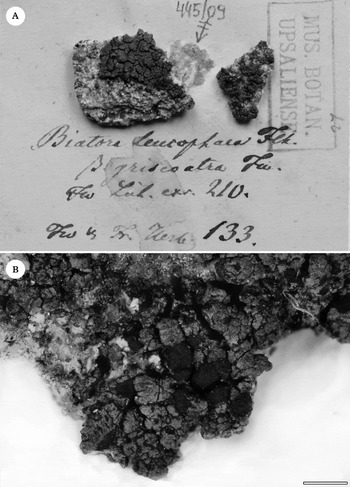
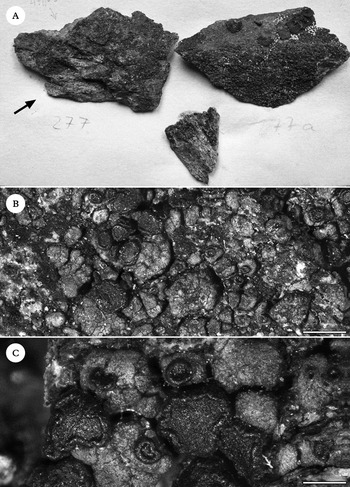
(Fig. 1)
Miriquidica griseoatra. A, lectotype specimen of Lecidea contigua var. griseoatra (UPS); B, close-up of the more richly fruiting piece to the right. Scale: B=1 mm.

Thallus dark grey, sometimes with brownish tinge, areolate, spreading, up to 5 cm diam. Areolae densely arranged, verrucose to subsquamulose, flat to subconvex, c. 0·5–1·5 mm diam., the older ones with a net of shallow fissures subdividing each areole into c. 5–10–20 portions, those c. 0·2–0·3 mm in diam. Hypothallus in between areoles indistinct.
Apothecia subsessile, tightly adpressed or laterally attached to the areoles and then not distinctly protruding above the thallus surface, flat and marginate when young, later more or less convex and virtually immarginate, 0·35–0·80 mm diam., solitary or laterally attached in groups of c. 2–5. Excipulum in the upper parts externally olive green-black and internally paler, basally red-brown to violet-black. Hypothecium red-brown to dark violet-brown, K+ purple-brown. Hymenium hyaline, 70–90 µm high, upper 10–15 µm pale olive to blue-green forming an epihymenial layer; paraphyses mostly simple, c. 70–90 µm long and 1·5–2·0 µm thick; apical cells hardly to slightly enlarged, up to 3 µm diam., embedded in pigmented gel. Asci of Lecanora-type, 8-spored, 50–65×12–15 µm, outer wall layer and tholus except the central body I(Lugol)+ blue; a scospores hyaline, non-septate, ellipsoid, (13–)14–16(–17)×(4·0–)4·5–6·0 µm, length-breadth ratio c. 2·5–2·9.
Secondary chemistry. Cortex K−, P−, C−, medulla K−, P−, C−, containing miriquidic acid (number of specimens investigated: 14).
Notes
The peculiar subdivided areoles and fusing apothecia were perfectly described by Flotow (l. c.:…“Sie hat dunkelgraue geschwollene feinrunzelige und gefaltete oder warzig-geballte Areolen, und sitzende zerstreute oder zusammenfliessende unförmig geballte schwarze Keimfrüchte,…”). His observation (a sufficiently powerful microscope was evidently not available for Flotow at that time) that the apothecia are white inside does not necessarily mean that he saw an unpigmented hypothecium, because he compared the taxon with Porpidia macrocarpa (sub Lecidea contigua) and Amygdalaria panaeola (sub Lecidea p.), both of which have a strongly carbonized exciple.
Because the herbarium of Flotow, originally housed in Berlin, was destroyed in 1943 (Grummann Reference Grummann1974), the only authentic material of Lecidea contigua var. griseoatra is evidently the exsiccate Flotow, Lich. exs. no. 210. Of this exsiccate, the specimen preserved in UPS has been re-examined and is here selected as lectotype. The lectotype consists of two pieces of rock most likely representing fragments of a single thallus. Whereas thallus features are more clearly visible on the left piece, apothecia are better developed on the one on the right. However, the lichen present is not that which is generally understood as Miriquidica griseoatra but is a species with peculiar areole features and semi-immersed, laterally attached apothecia exhibiting a pigmented hypothecium in longitudinal sections (Fig. 1B). A comparable set of characters is recorded for M. obnubila auct. Interestingly, the lectotype of Lecidea griseoatra (Flot.) Schaer. was revised as “M. obnubila sensu Hertel & Rambold” (S. Kojetinsky, on an annotation slip), a synonymization that we also considered for some time. However, after having studied authentic material of Lecidea obnubila Th. Fr. & Hellb., we see enough differences to distinguish the two species (see also below under M. obnubila).
Although the name Miriquidica griseoatra is frequently used in floras and checklists in the sense applied here (compare description above), it is the correct name for a relatively rare species that has seldom been distinguished in the past. Therefore, without a reinvestigation of the specimens, it will be difficult to assign previous records of M. griseoatra to the correct species.
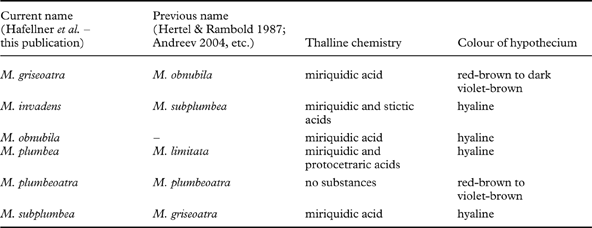
As a consequence of the revised application of the name M. griseoatra, the relatively common species to which this name was previously applied (M. griseoatra sensu auct., apothecia with hyaline hypothecium) needs a new name, and M. subplumbea (Anzi) Cl. Roux (Roux et al. Reference Roux, Masson, Bricaud, Coste and Poumarat2011) is available. Miriquidica subplumbea s. str. has an identical thalline chemistry and is also morpho-anatomically rather similar to M. griseoatra. The distinguishing characters are the, at least partly, red-brown hypothecium of M. griseoatra (hyaline in M. subplumbea), the subdivided thallus areoles of M. griseoatra (hardly divided in M. subplumbea) and the larger ascospores of M. griseoatra. Furthermore, the two species evidently have different ecologies (see the treatments of both species).
Two further Miriquidica species with apothecia exhibiting a pigmented hypothecium are distinguished. Of these, M. plumbeoatra is the only one with a thallus lacking lichen substances in an amount high enough to be detected by TLC (Owe-Larsson & Rambold Reference Owe-Larsson and Rambold2001). However, it is unlikely that M. plumbeoatra represents the lichen substance deficient strain of M. griseoatra s. str., because the ascospore size is significantly different in these two taxa. The other species, the Himalayan M. molybdochroa (Hertel) Hertel & Rambold (not studied by us), shares an identical profile of lichen substances with M. griseoatra, both having the miriquidic acid syndrome without further lichen acids. Miriquidica molybdochroa is similar to M. griseoatra in the shape and position of apothecia, but in the former species the ascospores are reported to be broader and its areoles apparently look different (Hertel Reference Hertel1977).
A strongly pigmented hypothecium is also reported for M. obnubila (Hertel & Rambold Reference Hertel and Rambold1987; Andreev Reference Andreev2004). However, Fries (Reference Fries1874: 459) described the hypothecium of Lecidea obnubila as colourless and this is true for the lectotype studied by us. Miriquidica obnubila s. str. with its scattered flat to convex, basally constricted, not subdivided, areoles and its sessile, basally constricted, distinctly marginate apothecia looks quite different from M. griseoatra (see below).
Ecology
Judging from where the species has been collected, the site characteristics mentioned on the labels, and the autecology of accompanying species found on the specimens, M. griseoatra s. str. is a boreal-montane to temperate-lower alpine species, with a preference for long-time moist habitats, such as rocks close to waterfalls, boulders in or near snow beds, and similar sites.
Accompanying species
The lectotype specimen of M. griseoatra consists only of thallus portions on two small pieces of rock and there is no further lichen species present. On specimens from the Scottish Highlands we noted Rhizocarpon badioatrum and Lecanora leptacina (on Coppins 13822). Many small thalli of Lecanora leptacina, lichenicolous on Miriquidica griseoatra, are also present on the samples of Havaas, Lich. Norveg. Occid. no. 293 studied by us. A similar set of species, including some basiphilous ones, was reported by Gilbert & Fox (Reference Gilbert and Fox1985) from snow beds on the Cairngorm plateau in Scotland.
Distribution
Because we here apply a different species concept from that commonly used, distributional data from the literature are difficult to interpret. We have seen material from the Czech Republic, Norway, Poland, Sweden, and Great Britain (Scotland).
Exsiccata examined. Flotow, Lich. exs. no. 210 sub Lecidea panaeola var. griseoatra (UPS). Havaas, Lich. Norveg. Occid. no. 293 sub Biatora griseoatra (GZU, W). Malme, Lich. Suec. Exs. no. 719 sub Lecidea subplumbea (GZU).
Specimens investigated [non type material, (label data shortened, lichen compounds analysed by TLC)]. Czech Republic: Tatra Magna: in valle Velká Studená dolina, 1950 m, 1935, J. Suza (M) [m].—Norway: Möre, Nordal hd, near Trollstien, 850 m, 1947, A. H. Magnusson (G) [m]. Hordaland: Smøreggfjellet in par. Granvinensi, 700–750 m, 1950, J. J. Havaas=Havaas, Lich. Norveg. Occid. no. 293 (GZU, W) [m].—Poland: Sudeten, Körber (B) [m]; Riesengebirge, Körber (B) [m].—Sweden: Jämtland: Undersåker, Vällista, 1917, G. O. A. Malme & E. P. Vrang=Malme, Lich. Suec. Exs. no. 719 (GZU) [m].—Great Britain: Scotland: (V. C. 87), Westerness: Ben Nevis range, Aonach Mór, Seang Aonach Mór, ridge S of summit, Grid 27/19.72, 1090–1200 m, 1990, B. J. Coppins 13822 et al. (E) [m]; ibid., Creag Meagaidh, Grid 27(NN)/40.87, 1150 m, 1994, A. M. Fryday (E) [m]. V. C. 88, Mid-Perthshire: Ben Lawers, “Crater” gully, Grid 27/637.412, 1180 m, 1986, B. J. Coppins 11446 et al. (E) [m, u]; ibid., N ridge, Grid 27(NN)/63.41, 1150 m, 1989, A. M. Fryday s.n. (E, 2 specimens) [m]. [V. C. 94, Banffshire:] Cairngorm, above Lochan Buidhe, Grid 28/983.015, 1983, B. W. Fox 1915 (E) [m]. [V. C. 96 East Inverness-shire:] Cairngorm, Ciste Mhearad, Grid 38/012.046, 1116 m, 1983, B. W. Fox (E) [m]. V. C. 106, West Ross: 18 km SE Ullapool, Beinn Dearg, NE slope, Grid 28/26.81, 1984, B. J. Coppins 10523 et al. (E) [m].
Lichenicolous fungi. None recorded.
Miriquidica invadens Hafellner, Obermayer & Tretiach sp. nov.
MycoBank No.: MB 804718
Miriquidicae subplumbeae similis sed thallus griseus ad olivaceogriseus ad fuscogriseus. Ceterum ab ea differt ascosporis aliquot minoribus et acidum sticticum ut substantiam alteram continens, ergo medulla Pd+ aurantiaca. Habitat primum constanter supra thallum Sporastatiae (plerumque S. polysporae), ubi insulas magnas format, demum partim solutus.
Typus: Austria, Steiermark (Styria), Steirisches Randgebirge, Stubalpe, Ameringkogel-Massiv E von Obdach, obere Abhänge in das NE-exponierte Kar zwischen Ameringkogel und Größenberg, 47°04′30″N, 14°48′15″E, c. 2050–2100 m, GF 8954/2, Gneisschrofen umgeben von alpinen Rasen, an Steilflächen, auf Sporastatia polyspora, 28 July 1990, J. Hafellner 23960 & W. Obermayer (GZU— holotypus; GZU, CANB, M, NY, UPS, E, G—isotypi=Obermayer, Dupla Graecensia Lichenum no. adhuc ined.). Secondary chemistry of type collection: miriquidic acid, stictic acid, constictic acid (by TLC).
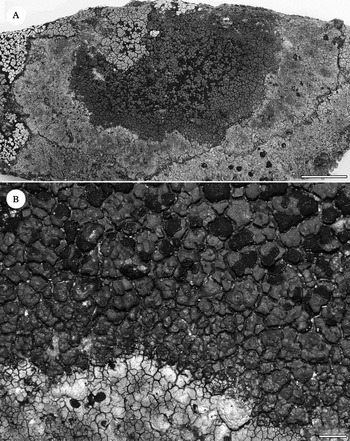
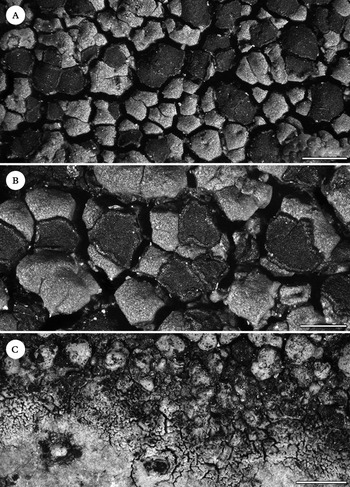
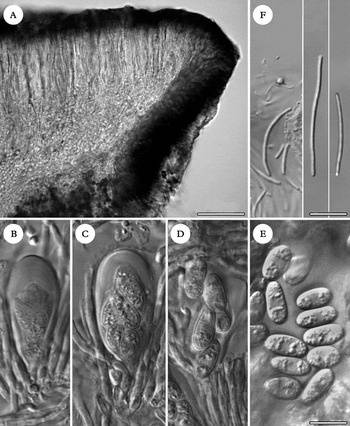
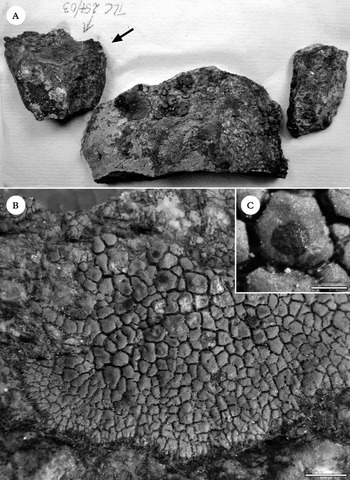
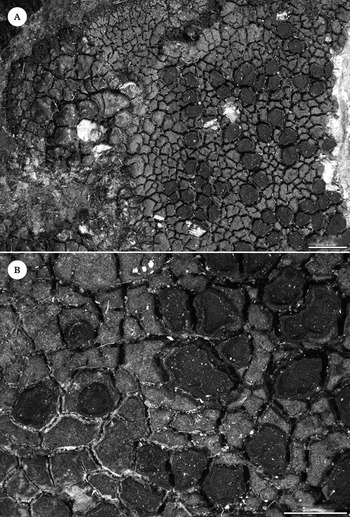
(Figs 2A & B, 3A–C 4A–F)
Miriquidica invadens, holotype (GZU). A, habit; B, close-up of the marginal part with the host (Sporastatia polyspora) at the bottom. Scales: A=1 cm; B=1 mm.

Miriquidica invadens. A & B, close-up of fertile parts of the thallus (holotype, GZU); C, ‘combat zone' of Miriquidica invadens (above) and its host Sporastatia polyspora (below) (Frey 1093, G). Scales: A & C=1 mm; B=0·5 mm.

Miriquidica invadens, holotype (GZU). A, longitudinal section of the marginal part of an apothecium; B, immature ascus; C, semi-mature ascus; D & E, ascospores; F, pycnoconidia. Scales: A=50 µm; B–F=10 µm.

Thallus grey and matt to olive-grey to brownish grey and then somewhat glossy due to the presence of an epinecral layer above the cortex, areolate, spreading, up to c. 6 cm diam. Areolae smooth or superficially somewhat subdivided, subconvex to convex, c. 0·7–1·5 mm diam. Hypothallus indistinct. Invading thalli of Sporastatia; older thalli of M. invadens sometimes starting to crumble from the centre.
Apothecia black, tightly adpressed or marginally attached to areoles and semi-immersed (but not aspicilioid), 0·2–0·5(–0·8) mm diam, plane to subconvex, with persistent thin somewhat glossy margin. Excipulum externally red-brown occasionally with shades of violet, merging to olive-brown in the upper part, internally paler to subhyaline. Hypothecium hyaline (sometimes slightly brownish at the base). Hymenium hyaline, 40–55 µm high, upper 10–15 µm greyish-brownish to dark olive-brown forming an epihymenial layer; paraphyses mostly simple or with few ramifications in the upper part, c. 50 µm long and 1–2 µm thick; apical cells hardly or slightly enlarged, up to 3–4 µm diam., embedded in pigmented gel (“Pigmenthauben-type” sensu Kilias Reference Kilias1981). Asci of Lecanora-type, broadly cylindrical to subclavate, 8-spored, 35–45×12–16(–18) µm, external ascal wall layer and tholus except the axial body I(Lugol)+ blue; a scospores hyaline, non-septate, ellipsoid, 9–11(–12)×4·5–5·5(–6·0) µm, length-breadth ratio c. 2·0–2·4.
Pycnoconidia filiform, curved or straight, 20–30(–40)×c. 1 µm.
Secondary chemistry
Cortex K−, P−, C−, medulla K+ yellow, P+ orange-red, containing miriquidic acid and stictic acid (plus accessory compounds, of which constictic acid is often present in detectable amounts) in the thallus (number of specimens investigated: 71). Coloration of pigmented parts of apothecial sections K+ intensifying. On TLC plates a further spot (5-O-methylhiascic acid) may occur, but belongs to the host (see below under Notes).
Notes
The morpho-anatomical characters of Miriquidica invadens place it in the Miriquidica griseoatra group. As this is a taxonomically difficult group, and type material of some of the species involved had not previously been reinvestigated, we faced a rather confusing situation concerning the applicability of some of the old names.
Initially, we saw a candidate in Lecidea subplumbea Anzi, a view supported by the redescription of this taxon given by Hertel (Reference Hertel1970: 428). However, after a revision of the specimen upon which that description was based and a reinvestigation of the type specimen of Lecidea subplumbea, we now know that Hertel's species treatment refers to Miriquidica invadens and that M. subplumbea is a different species (see below). The host on the collection used by Hertel for his treatment is not a Lecidea, as supposed by him, but sterile Sporastatia polyspora, as indicated by its secondary chemistry and features of the areoles.
Hertel & Rambold (Reference Hertel and Rambold1987: 385) and Andreev (Reference Andreev2004: 23) mention a red-violet or violet-brown lower part of the exciplum and external part of the hypothecium as characteristic for “forms of M. griseoatra [sensu auct.]” called “Lecidea subplumbea” or “Miriquidica griseoatra chemotype 2” by them. At the same time, such specimens should have somewhat narrower ascospores and contain stictic acid in addition to miriquidic acid. Comparative studies of a larger number of specimens of M. invadens have shown that shades of violet are not always detectable in the lower outer part of the exciple (as already admitted by Hertel & Rambold Reference Hertel and Rambold1987) and that the ascospores are not narrower; their size, in general, being somewhat smaller. Therefore a fragmentary specimen of a dark grey Miriquidica (without the edge of the thallus and the host Sporastatia polyspora present on the sample) might be difficult to determine by morpho-anatomical characters alone. The only reliable difference between the morphologically similar M. subplumbea and M. invadens is secondary chemistry (TLC or Pd-reaction), as the medulla is Pd− (stictic acid lacking) in the former species, and Pd+ orange-red (stictic acid present) in the latter. The parasitism of M. invadens was not recognized by previous collectors. This was even the case with such experienced lichenologists as F. Arnold, who collected typical material of M. invadens from at least two localities in Tyrol but in none of the corresponding “Lichenologische Ausflüge” (Arnold Reference Arnold1877: 551, Reference Arnold1893: 379 sub Lecidea inserena var./f. subplumbea) is the parasitism on S. polyspora mentioned.
The first person to report on the presence of a lichenicolous lichen of the genus Miriquidica on Sporastatia polyspora was Minks (Reference Minks1896: 85, sub Lecidea inserena), who recognized this parasitism when he studied a specimen from Tyrol. Later, Obermayer (Reference Obermayer1993: 130, sub Miriquidica spec. #1) pointed to the existence of such a lichenicolous species when working on the lichen flora of the Seetaler Alpen in Styria. At that time we had already studied the rich population at the type locality and were aware of the existence of a further Miriquidica species that we could not then name.
One of the species with which M invadens is confused, M. subplumbea s. str. (syn. M. griseoatra sensu auct.), is occasionally found upon Acarospora fuscata, Lecanora polytropa, Lecidea sp. and Rhizocarpon sp., but finally always becomes independent (Hertel & Rambold Reference Hertel and Rambold1987: 385; Rambold & Triebel Reference Rambold and Triebel1992: 113). The other species with which M invadens is confused, M. griseoatra (Flot.) Hertel & Rambold s. str., has not been reliably reported to occur on other lichens.
Miriquidica invadens occurs in two morphotypes, one with medium to dark grey, matt areoles and semi-immersed apothecia similar to M. subplumbea, and one with olive to brownish grey, somewhat glossy areoles and more or less sessile apothecia recalling those of M. obnubila. As we regularly saw intermediate forms and could not find a clearly discriminating character, we decided to regard this as intraspecific variability. Areole colour and surface characteristics may depend on a variably developed epinecral layer, and the position of the apothecia may vary with thallus age and thickness.
Until recently, gyrophoric acid has been considered as being the main chemical substance in the genus Sporastatia, and this incorrect information is also given in several well-known lichen floras [e.g., Great Britain (Gilbert & Coppins Reference Gilbert, Coppins, Smith, Aptroot, Coppins, Fletcher, Gilbert, James and Wolseley2009: 850), North America (Brodo et al. Reference Brodo, Sharnoff and Sharnoff2001: 659) or south-western Germany (Wirth Reference Wirth1995b : 867)]. By contrast, in the Svalbard flora (Øvstedal et al. Reference Øvstedal, Tønsberg and Elvebakk2009: 340) 5-O-methylhiascic acid is reported as the main secondary compound for S. polyspora (additionally with gyrophoric acid as the second major compound and lecanoric acid in traces), S. testudinea (additionally with gyrophoric acid as minor compound and lecanoric acid in traces), and an undescribed member of the genus (additionally with gyrophoric acid in traces). A first screening of material from the Alps confirms 5-O-methylhiascic acid as being the major compound in both S. testudinea and S. polyspora. Interestingly, alpine material of S. polyspora chemically matches the undescribed Sporastatia sp. from Svalbard.
Ecology
Miriquidica invadens starts its life cycle as a parasitic lichen on thalli of Sporastatia polyspora (rarely upon S. testudinea) when the host grows on (sub)vertical to overhanging siliceous rocks. In very young infections the areolae of M. invadens develop on, or are laterally adpressed to, areolae of the host, rarely also on apothecia. Under the dissecting microscope it can be seen that host areolae are often gradually overtaken by the invader. In an advanced stage the host thalli may be almost completely replaced by M. invadens thalli so that areolae of M. invadens may then be bordered by bare rock or thalli of lichens other than Sporastatia, which we never found attacked by the Miriquidica. In the field it is normally quite easy to demonstrate that the host is still present. In herbarium specimens that do not contain entire thalli, the parasitism may be less obvious. For example, on both duplicates of Arnold, Lich. exs. no. 757 that we restudied, only a few areolae of the host could be detected (and it is possible that other samples of the exsiccata may have no host left), and on the otherwise typical specimen Frey 349 from Piz Nuna there is no host at all.
Accompanying species
Being a constantly lichenicolous species, the host Sporastatia polyspora is almost always present on the rock samples. However, as Sporastatia polyspora usually develops relatively large thalli, the rock pieces frequently do not have further lichen species present.
The type collection consists of one holotype and seven isotypes constituting the exsiccate number cited above. On the entire collection, besides M. invadens and its host, only Aspilidea myrinii, Rhizocarpon geographicum, Lecanora polytropa, Lecidea confluens, Lecidea lapicida coll., and Miriquidica sp. (not yet identified, possibly another undescribed species) grow on the rock pieces. Furthermore, on each specimen we noticed at least several ascomata of Polycoccum sporastatiae as an additional inhabitant of Sporastatia polyspora and some of the thalli of accompanying species are infested with strains of Muellerella pygmaea coll. Diploschistes scruposus, Fuscidea kochiana, Ophioparma ventosa, Parmelia omphalodes, Pertusaria corallina, Tephromela atra, and Varicellaria lactea have been sampled in the close neighbourhood of the type locality (specimens in GZU).
A screening of the selected specimens cited below for additional taxa growing on the same rock pieces resulted in the following list: Bellemerea alpina, Calvitimela armeniaca, Carbonea vorticosa, Fuscidea kochiana, Lecanora alpigena, L. intricata, L. polytropa, Lecidea confluens, L. lapicida coll., Rhizocarpon alpicola, R. geographicum, Tremolecia atrata, and Umbilicaria cylindrica.
Sporastatia polyspora and Lecanora marginata (sub Lecida elata) are the diagnostic species of the silicicolous lichen community Sporastatietum polysporae (nom. mut. for Biatorelletum cinereae Frey Reference Frey1923). Other epilithic crusts present with high reliability are the common species Fuscidea kochiana, Lecidea confluens, Ophioparma ventosa, Protoparmelia badia, Psorinia conglomerata, Rhizocarpon geographicum, and R. alpicola (Klement Reference Klement1955: 49).
Distribution
The species is widely distributed in the Alps and also known from the mountain ranges on the Iberian Peninsula and the Balkan Peninsula. It is so far known from Austria, Bulgaria, France, Italy, Switzerland and Spain. As it constantly starts its development on Sporastatia, a genus with an arctic-alpine distribution pattern, Miriquidica invadens is restricted in Central Europe to high altitudes from the lower alpine to the nival belt, mostly above an altitude of 2000 m, never below 1600 m. On the other hand, both Sporastatia species have a much wider distribution range and are known from the Arctic, as well as many orobiomes on both hemispheres. Therefore, we would not be surprised if it can be shown that M. invadens has a much wider distribution range than so far documented.
Exsiccata examined. Obermayer, Dupla Graec. Lich. no. adhuc ined. (GZU, CANB, M, NY, UPS, E, G) type collection; Hafellner, Lichenicolous Biota no. adhuc ined. (BCN, BR, CANB, E, GZU, LE, M, NY, PRM, UPS) paratype collection; Hafellner, Lichenicolous Biota no. adhuc ined. (BR, CANB, GZU, NY, UPS) paratype collection; Arnold, Lich. exs. no. 757, sub Lecidella inserena (G, 2 specimens, M, 2 specimens, W).
Specimens investigated (paratypes): (label data shortened, all specimens on Sporastatia polyspora unless otherwise stated). Austria: Tirol (Tyrol): [Verwallgruppe], gegen Hochkor [Hochkarspitze] S St. Anton am Arlberg, 1892, F. Arnold (M, 2 specimens) [m, s]; [Ötztaler Alpen], Kaunergrat, Madatschjoch, 3100 m, 1953, J. Poelt (GZU) [m, s, c]; ibid., Hohe Mut, Gurgl im Ötztal, 1877, F. Arnold (M) [m, s, c]; [Stubaier Alpen], ober dem Weißbach, Rosskogel bei Innsbruck, 1875, F. Arnold (M, 5 specimens) [m, s, c]. Salzburg, NP Hohe Tauern, Goldberggruppe, Vorderer Gesselkopf, Westgrat 2950 m, GF 8944/3, 1994, J. H. 33237 (GZU) [m, s, u]. Kärnten (Carinthia): Saualpe W Wolfsberg, Forstalpe, N-Rücken, 46°54′10″N / 14°39′55″E, 1950 m, GF 9053/4, 2011, J. H. 79177 & A. Hafellner=Hafellner, Lichenicolous Biota no. adhuc ined. (GZU) [m, s, c]; ibid., Forstalpe, E-Rücken, Forstofen (Kote 1967), 46°53′25″N / 14°40′10″E, 1955 m, GF 9154/1, 2011, J. H. 78162 & A. Hafellner (GZU) [m, s, c]; ibid., zwischen Kienberg und Forstalpe, Kar über Schmiedbauerhütte, 46°53′30″N / 14°39′00″E, 2030 m, GF 9153/2, 2012, J. H. 80204 & A. Hafellner (GZU) [m, s, c]; ibid., Kienberg, Drei Öfen, 46°53′00″N / 14°38′55″E, 2040 m, GF 9153/2, 2012, J. H. 80296 & A. Hafellner (GZU) [m, s, u]; Saualpe, zwischen Ladinger Spitz und Gertrusk, Kaiserofen, 46°51′25″N / 14°38′45″E, 2030 m, GF 9153/2, 2012, J. H. 80781 (GZU) [m, s]; Koralpe E Wolfsberg, Großes Kar, Bergrücken Großer Speikkogel – Steinschneider, 46°47′35″N / 14°57′55″E, 1950 m, GF 9255/2, 2012, J. H. et al. 80153 (GZU) [m, s, c]; ibid., Großes Kar, Fuß der NE-Hänge des Großen Speikkogel, 46°47′30″N / 14°58′15″E, 1980 m, GF 9255/2, 2008, J. H. 71167 et al. (GZU) [m, s, c]; ibid., 11,5 km NE St. Paul im Lavanttal, Krakaberg SE Koralpenhaus, 46°46′50″N / 14°58′15″E, 2070 m, GF 9255/2, 2007, J. H. 68498 et al. (GZU) [m, s, c]; ibid., Moschkogel, NE über Grillitschhütte, 46°49′25″N / 14°59′25″E, 1800 m, GF 9155/4, 2007, J. H. 70198 & L. Muggia (GZU) [m, s, c]; Karnische Alpen, Raudenspitz E ober Hochweißsteinhaus, Gipfel, 2500 m, 46°38′50″N / 12°45′45″E, GF 9342/4, 1996, J. H. 39002 (GZU) [m, s, c]; ibid., Steinkarspitz[e] über Maria Luggau im Lesachtal, 2450 m, 1967, I. Hertel & H. Hertel 8903 (M) [m, s, c]. Steiermark (Styria), Schladminger Tauern, Zinkwand S Schladming, Nordosthänge SW ober Keinprecht-Hütte, 47°16′25″N / 13°41′20″E, 2100 m, GF 8748/1, 1998, J. H. 45719 (GZU) [m, s, c]; ibid., Deneck S über St. Nikolai im Sölktal, S-Grat, 47°17′15″N / 14°03′05″E, 2420 m, GF 8750/1, 2009, J. H. 74341 (GZU) [m, s, c]; Wölzer Tauern, Rettlkirchspitze NW Oberwölz, NE-Grat SW über Neunkirchner Hütte, 47°15′45″N / 14°08′05″E, 2300 m, GF 8750/2, 2002, J. H. 68159 & J. Miadlikowska (GZU) [m, s, c, u]; ibid., Greim ca. 11 km NW Oberwölz, Gipfel, 47°14′50″N / 14°09′05″E, 2470 m, GF 8750/4, 2006, J. H. 67975 & L. Muggia=Hafellner, Lichenicolous Biota no. adhuc ined. (GZU) [m, s, c]; ibid., Planneralpe, zwischen Franzosenkreuz und Vorderer Gstemmerspitze, 47°25′10″N / 14°11′30″E, 2050 m, GF 8551/3, 1998, J. H. 45644 (GZU) [m, s, c]; ibid., Großer Rotbühel S Planneralpe, Gipfel, 47°23′35″N / 14°12′30″E, 2000 m, GF 8651/1, 2012, J. H. 80091 & L. Muggia (GZU) [m, s, c]; ibid., Hochschwung W Hohentauern, W Vorgipfel, 47°24′30″N / 14°20′10″E, 2180 m, GF 8552/3, 1996, J. H. 50087a, b (GZU) [m, s, c]; ibid., Berge 5 km SW Pusterwald, Schießeck, N Vorgipfel (wo Gipfelkreuz), 47°16′43″N / 14°19′25″E, 2250 m, GF 8751/2, 2009, J. H. & A. Hafellner 73384 (GZU) [m, s, c]; ibid., Rottenmanner Tauern, Großer Bösenstein, Gipfel, 47°26′35″N / 14°24′15″E, 2445 m, GF 8552/3, 2003, J. H. 68226 (GZU) [m, s, c]; Seckauer Tauern, Triebener Tauern, S ober Hohentauern, zwischen Wirtstörl und Geierkogel, 47°24′10″N / 14°29′50″E, 2150 m, GF 8552/4, 1996, J. H. 48962 (GZU) [m, s, c]; ibid., Schleifkogel ENE St. Johann am Tauern, Gipfel, 47°22′10″N / 14°29′55″E, 2060 m, GF 8652/2, 2001, J. H. 57316 (GZU) [m, s]; ibid., Großer Ringkogel NW Knittelfeld, Gipfel, 47°19′15″N / 14°37′20″E, 2270 m, GF 8653/4, 1999, J. H. 49679 (GZU) [m, s]; ibid., Geierhaupt 10 km S Wald am Schoberpaß, Gipfel, 47°22′30″N / 14°38′15′E, 2410 m, GF 8653/2, 1997, J. H. 43683 & A. Hafellner (GZU) [m, s]; ibid., Geierhaupt, NE vom Gipfel gegen Grieskogel, 47°22′40″N / 14°38′15′E, 2350 m, GF 8653/2, 1997, J. H. 43670 & A. Hafellner (GZU) [m, s]; ibid., Hochreichhart NE Ingeringsee, NW Knittelfeld, Gipfel, 2410 m, 47°21′45″N / 14°40′55″E, GF 8654/1, 2001, J. H. 56163 & A. Hafellner (GZU) [m, s, c]; ibid., Brandstätterkogel E Ingeringsee, NW Knittelfeld, Gipfel, 47°21′10″N / 14°42′00″E, 2230 m, GF 8654/1, 1999, J. H. 48490 (GZU) [m, s, c]; ibid., Maierangerkogel E Ingeringsee, NW Knittelfeld, Gipfel, 47°20′55″N / 14°42′45″E, 2350 m, GF 8654/3, 2001, J. H. 57346 (GZU) [m, s]; ibid., 2005, J. H. 64188 (GZU) [m, s]; ibid., Seckauer Zinken N Seckau (SW Mautern), Gipfel, 47°20′20″N / 14°44′10″E, 2395 m, GF 8654/3, 1997, J. H. 43781 & J. Kocourková (GZU) [m, s]; ibid., Seckauer Zinken, NE-Grat, gegenüber Hämmerkogel, 47°20′30″N / 14°44′30″E, 2250 m, GF 8654/3, 1997, J. H. 43846 & J. Kocourková (GZU) [m, s, c]; ibid., Hämmerkogel N Seckau, über Goldlacke, 47°20′30″N / 14°45′05″E, 2100 m, GF 8654/4, 2001, J. H. 57569 (GZU) [m, s, c]; ibid., Schwaigerhöhe N Seckau, Gipfel, 47°20′20″N / 14°46′E, 2150 m, GF 8654/4, 1998, J. H. 45642 & J. Miadlikowska (GZU) [m, s, c]; Gurktaler Alpen, Eisenhut ESE Turrach, Gipfel, 46°57′10″N / 13°55′40″E, 2430 m, GF 9049/2, 2002, J. H. 61548 & A. Hafellner (GZU) [m, s, c]; ibid., Kirbisch 11 km SW Murau, über St. Lorenzen, Gipfel, 47°03′05″N / 14°03′05″E, 2100 m, GF 8950/1, 2003, J. H. 62326 (GZU) [m, s]; Seetaler Alpen, Wenzelalpe, NE-Rücken, Erslstand, 47°06′50″N / 14°32′50″E, 2110 m, GF 8853/3, 2010, J. H. 75908 (GZU) [m, s, c]; ibid., Zirbitzkogel-Massiv SW Judenburg, Kreiskogel, E-exp. Abbrüche, 2200 m, GF 8953/1, 1990, J. H. 26169 & W. Obermayer (GZU) [m, s, c]; ibid., Zirbitzkogel E Neumarkt, Kar zwischen Scharfes Eck und Zirbitzkogel, 2280 m, GF 8953, 1985, J. H. 13487 (GZU) [m, s, c]; Koralpe, Seespitz, SE-Hänge 46°47′20″N / 14°58′45″E, 2050 m, GF 9255/2, 2000, J. H. 53145 & A. Hafellner (GZU) [m, s, c]; ibid., W Deutschlandsberg, Seespitz, E-Hänge gegen Seekar, 46°47′25″N / 14°58′48″E, 2050 m, GF 9255/2, 2008, J. H. 72390 & L. Muggia (GZU) [m, s, c]; Stubalpe, Ameringkogel E Obdach, Gipfel, 47°04′23″N / 14°48′30″E, 2160 m, GF 8954/2, 2005, J. H. 64303 (GZU) [m, s, c, u]; ibid., Ameringkogel-Massiv E Obdach, Weißenstein, S-Hänge, 47°03′55″N / 14°48′30″E, 2100 m, GF 8954/2, 2005, J. H. 65179 (GZU) [m, s, c]; ibid., zwischen Speikkogel und Weißenstein, 2020–2030 m, GF 8954, 1985, K. Kalb & J. Poelt (GZU) [m, s]; Gleinalpe, Speikkogel S St. Michael, N Abhänge, 47°13′40″N / 15°02′55″E, 1980 m, GF 8756/3, 2000, J. H. 52121 & A. Hafellner (GZU) [m, s, c]; ibid., S St. Michael, zwischen Kreuzsattel und Eiblkogel, 47°15′10″N / 15°05′25″E, 1780 m, GF 8756/4, 2001, J. H. 57457 (GZU) [m, s]; Fischbacher Alpen, Stuhleck N Rettenegg, Steinkorb, 47°34′15″N / 15°47′20″E, 1700 m, GF 8460/2, 2000, J. H. 50936 (GZU) [m, s, c]. Niederösterreich (Lower Austria), Steirisches Randgebirge, Wechsel W Mönichkirchen, Hochwechsel, unter Wetterkogler Haus, 1690 m, GF 8461/4, 1995, J. H. 35973 (GZU) [m, s, c].—Bulgaria: Montes Rhodope occidentals [= Rila Mts.], in summo monte Musallah, c. 3000 m [=Musala, 2925 m]. 1930, K. H. Rechinger 1684 (W) [m, s], anal. by S. Kojetinsky.—France: Dauphiné: Lautaret, Pyramide du Laurichard, Gipfel, 2770 m, 1932, E. Frey 1093 & A. Schmidt (G) [m, s, c].—Italy: Piemonte: Prov. Cuneo, Alpi Marittime, Rocca dell' Abisso W Colle di Tenda, N below summit, 44°08'35"N / 07°30'15"E, 2750 m, 2000, P. L. Nimis 34369, 34346 & M. Tretiach (TSB) [m, s, c]; ibid., Alpi Liguri, N ridge of Monte Saccarello, W Monesi, crest N Monumento al Redentore, 44°03'40"N / 07°42′55″E, 2200 m, 2000, P. L. Nimis 33723 & M. Tretiach (TSB) [m, s, c]; ibid., Alpi Cozie, crest SW Colle dell' Agnello, 44°40′50″N / 06°58′30″E, 2900 m, 2000, P. L. Nimis 33126 & M. Tretiach (TSB) [m, s, c]; Prov. Torino, Alpi Cozie, montains W Pinerolo, Punta Cialáncia S Perero, 44°53′00″N / 07°07′20″E, 2350 m, 2001, J. H. 69356 (GZU) [m, s, c]; Lombardia: [Prov. Brescia, Adamello-group], Parco Reg. dell'Adamello, Val Bona, Passo di Vall Fredda, [45°55′30″N / 10°24′10″E], 2400 m, 2006, M. Tretiach 38911, 38913 (TSB, 2 specimens) [m, s, c]; ibid., M. Tretiach 38912 (TSB) [m, s, c, u], Trentino-Alto Adige: Prov. Trento, Ortler-group (Stelvio-group), 8 km N Cógolo, La Cascata S Lago Lungo, summit, 46°25′30″N / 10°41′00″E, 2575 m, 2006, J. H. 69344 (GZU) [m, s, c]. Friuli-Venezia Giulia: Prov. Udine, Carnic Alps, Monte Fleons (Raudenspitz), crest W below summit, 46°38′45″N/12°45′10″E, 2400 m, 1996, J. H. 39060 (GZU) [m, s, c]; ibid., giogaia dei Fleons, sentiero vs. la cima, 2400 m, 26. VII. 1995, M. Tretiach (TSB) [m, s, c]; ibid., Monte Fleons (Raudenspitz), summit, 46°38′50″N/12°45′45″E, 2500 m, 1996, J. H. 38989 (GZU) [m, s, c]; ibid., Mt. Crostis N Comeglians, Grat W Gipfel, 2240 m, 1994, J. H. 39870 (GZU) [m, s, c]; ibid., Monte Crostis, 2200 m, on Sporastatia testudinea (!),1993, M. Tretiach 17851, 17852 (TSB, 2 specimens) [m, s, c].—Spain: Prov. Madrid: Sierra de Guadarrama, Peñalara above Puerto de los Cotos, ober Laguna Grande, 2100–2200 m, 1980, J. H. 10552 (GZU) [m, s, c].—Switzerland: Kanton Bern: Berner Alps, Grimselpass c. 20 km SE Meiringen, trail to Husegghütte, 46°33′35″N / 08°19′40″E, 2350 m, 2006, J. H. 69317 (GZU) [m, s, c, u]; ibid., on Sporastatia testudinea (!), J. H. 69315 (GZU) [m, s, c]. Kanton Graubünden, Silvretta-Gruppe, SW Heidelberger Hütte, Val Fenga, Weg zum Fimberferner, 2400 m, 1967, J. Poelt 9578 (GZU) [m, s, c]; Rhätische Alpen, von Albula Pass-Straße zur Fuorcla Carap alv, 2050–2200 m, 1980, J. Poelt (GZU) [m, s, c]; Rätien, Umbrail, Muranza, Las Plattas, 2400 m, 1927, E. Frey 158/59 (G) [m, s, c]; [Sesvenna Range], Piz Nuna, Gipfelgrat, 3100 m, 1928, E. Frey 349 (G) [m, s, c].
Further specimens investigated (non type material): Austria: Tirol (Tyrol): Kühkampleseck E Gurgl, 2300 m, 1878, Arnold=Arnold, Lich. exs. no. 757 (G, M, W) [m, s, c]. Note: No host may be present on some of the duplicates and then parasitism is not evident. Kärnten (Carinthia): Kreuzeck-Gruppe, Kleines Kreuzeck, 2400 m, 1987, W. Petutschnig (GZU) [m, s, c]. Note: No host present on the piece of rock.
Lichenicolous fungi. The lichenicolous Miriquidica invadens itself seems not to be a very suitable substratum for lichenicolous fungi. Only a strain of Muellerella pygmaea (Körb.) D. Hawksw. has so far been detected on some specimens. Using the key offered by Triebel (Reference Triebel1989), the strain would key as M. p. var. athallina, for which Miriquidica invadens would be an additional host. However, we regard the lichenicolous fungi which key out under this name as a difficult, still unresolved swarm of taxa.
Specimen seen [all on Miriquidica invadens (th.)]. Austria: Kärnten (Carinthia): Saualpe W Wolfsberg, Forstalpe, 46°54′10″N / 14°39′55″E, 1950 m, GF 9053/4, 2011, J. H. 79181 & A. Hafellner (GZU). Steiermark (Styria): Wölzer Tauern, Rettlkirchspitze NW Oberwölz, NE-Grat SW Neunkirchner Hütte, 47°15′45″N / 14°08′05″E, 2300 m, GF 8750/2, 2002, J. H. 68162 & J. Miadlikowska (GZU); ibid., Greim ca. 11 km NW Oberwölz, Gipfel, 47°14′50″N / 14°09′05″E, 2470 m, GF 8750/4, 2006, J. H. 67977 & L. Muggia (GZU); Seckauer Tauern, Maierangerkogel E Ingeringsee, NW Knittelfeld, Gipfel, 47°20′55″N / 14°42′45″E, 2350 m, GF 8654/3, 2005, J. H. 64186 (GZU).
Another good candidate of a fungus capable of attacking M. invadens is Endococcus complanatae Arnold because this species sometimes infests other Miriquidica species. Frequently the host, Sporastatia polyspora, was also infected by Polycoccum sporastatiae (Anzi) Arnold in addition to Miriquidica invadens (e.g., type collection of Miriquidica invadens, specimens Hafellner 43670, 43781, 50087, 52121, 56136, 57346, 62326, Tretiach 38912).
Miriquidica obnubila (Th. Fr. & Hellb.) Hertel & Rambold
Mitt. Bot. Staatssamml. München 23: 389 (1987) sed non M. obnubila sensu Hertel & Rambold.—Lecidea (Biatora) obnubila Th. Fr. & Hellb. in Th. Fr., Lichenogr. Scand. 1: 459 (1874); type: Sweden, Lapponiae lulensis, Njåmmelst, ad rupes duriores, 1864, P. J. Hellbom (M—lectotype, designated here!). Secondary chemistry of type specimen: miriquidic acid (by TLC).
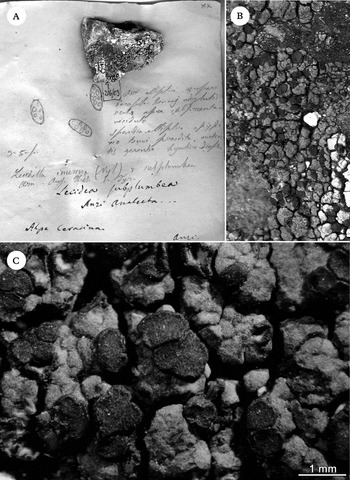
Miriquidica obnubila, lectotype of Lecidea (Biatora) obnubila (M). A, type specimen with the left piece marked by an arrow as lectotype s. str. (for details see text); B & C, close-ups of fertile thallus parts of the lectotype. Scales: B=1 mm; C=0·4 mm.

Thallus grey, areolate, spreading, up to 5 cm diam. Areolae dispersed to moderately densely arranged on a black hypothallus, flattened to convex, basally somewhat constricted, c. 0·4–1·2 mm diam. Hypothallus distinct in between the separated areoles, black.
Apothecia black, sessile, 0·5–1·0 mm diam., with consistently flat discs and persistent prominent margin. Excipulum externally red-brown to purple-brown, internally distinctly paler to subhyaline. Hypothecium hyaline. Hymenium hyaline, 60–70 µm high, upper 10–15 µm olivaceous blue-green to purplish blue forming an epihymenial layer; paraphyses mostly unbranched, 60–70 µm long and 1·5–2·0 µm thick; apical cells slightly enlarged, up to 3 µm diam., embedded in pigmented gel. Asci of Lecanora-type, 8-spored, broadly cylindrical to subclavate, 45–55×14–18 µm, outer wall layer and tholus except the central body I(Lugol)+ blue; a scospores hyaline, non-septate, ellipsoid, 14–17×5–6 µm, length-breadth ratio c. 2·5–2·7.
Secondary chemistry
Cortex K−, P−, C−, medulla K−, P−, C−, containing miriquidic acid in the thallus (by TLC, number of specimens investigated: 1).
Notes
The lectotype in Munich (M) consists of three rock pieces, of which the lichen developed on the piece mounted on the left side and the smaller piece in the middle fit perfectly with the protologue, and these are, therefore, designated as the lectotype. Fries (l. c.) states that the hypothecium is not coloured and this is what we observed on apothecial sections from the lectotype. The piece on the right side evidently belongs to a different species as the apothecia exhibit a brown hypothecium. It may in fact come from a different locality, as the rock texture and mineral content as seen under the dissecting microscope are quite different from the piece on the left side. A specimen with identical label data to the lectotype is housed in Stockholm (S). This specimen agrees morpho-anatomically with that of the specimen on the right side of the lectotype collection, and consequently, as the characters of the specimen are not in accordance with the protologue, is not considered by us as part of the type collection.
As Hertel & Rambold (l. c.) consistently state that the hypothecium of M. obnubila should be pigmented brown, we suppose that their concept of M. obnubila was based on a reinvestigation of the lichen present on the piece of rock mounted on the right side (specimen in M). From our observations we conclude that M. obnubila s. str. is not conspecific with M. obnubila sensu Hertel & Rambold. Here we apply the name in the original sense, whereas M. obnubila sensu Hertel & Rambold (with brown hypothecium; full description in, e.g., Andreev Reference Andreev2004: 31–32) is likely to be identical with M. griseoatra s. str. (non sensu M. griseoatra auct. which is M. subplumbea) (see above under M. griseoatra).
Of the characters visible under the hand lens or a dissecting microscope, the sessile apothecia with their persistently prominent margins appear to be diagnostic compared with other species of the M. griseoatra group. Assuming that these features can be confirmed to be consistent in additional specimens, they would be the best characters to distinguish M. obnubila from the otherwise rather similar M. subplumbea, which has an identical secondary chemistry.
Ecology
Apart from the habitat of siliceous rock under the climatic conditions of northern Scandinavia, nothing else is known about the ecological setting in which the species can be found.
Accompanying species
None recorded, none present on the lectotype s. str.
Distribution
For the reason stated above, distributional data are difficult to interpret. Andreev (Reference Andreev2004) reported the species additionally for Finland, Russia, Greenland and mainland North America but these records may also refer to M. griseoatra s. str.
Exsiccata examined. None
Additional specimens investigated. -
Lichenicolous fungi. None observed and none recorded.
Miriquidica plumbea (Garov. ex A. Massal.) Hafellner, Obermayer & Tretiach comb. nov.
MycoBank No.: MB 804719
Lecidea plumbea Garov. ex A. Massal., Ricerche sull'autonomia dei licheni crostosi: 74 (1852). Garovaglio, Delectus Specierum novarum, Sect. II: 19 (1838) (description without name). Garovaglio, Catalogo di alcune crittogame, Parte II: 49 (1838) (description without name). Garovaglio, Saggio d'un prospetto delle piante crittogame della Lombardia: 335 (Reference Garovaglio and Cattaneo1844) (nomen nudum, no reference to an earlier description). Garovaglio, Della distribuzione geografica dei licheni di Lombardia: 16, 29, (1864) (name and bibliography).
Cited localities: Garovaglio (Reference Garovaglio1838a ), p. 19: “ad rupes micaceas ventis quam maxime obnoxias in Monte Legnone paulo supra dictas Alpi di Delebio”. —Garovaglio (Reference Garovaglio1838b ), p. 49: “M. Legnone”. Massalongo (Reference Massalongo1852), p. 74: “Vive sulle roccie [sic] granitiche schistose nel M. Lineone presso Como”; type: [Italy], ad saxa schistosa in monte Lineone, Garovaglio (VER—lectotype!; VER—isolectotype!, lectotype designated here). Secondary chemistry of type specimen: miriquidic acid, protocetraric acid (by TLC).
Miriquidica limitata Hertel & Rambold, Mitt. Bot. Staatssamml. München 23: 387 (1987); typus: Austria, Tirol, Kühtai (“Kühthei”), “Gneisfelsen zwischen den beiden Finsterthaler Seen, 7000′, VIII. 1872”, F. Arnold (M—holotype!). Secondary chemistry of type specimen: miriquidic acid, protocetraric acid (by TLC).
Miriquidica plumbea, lectotype of Lecidea plumbea (VER). A, type specimen with the left piece marked by an arrow as lectotype; B, habit of the thallus; C, close-up of one areole with immersed apothecium. Scales: B=2 mm; C=0·5 mm.

Miriquidica plumbea, holotype of the heterotypic synonym M. limitata (M). A, part of the thallus; B, close-up of apothecia. Scales: A=2 mm; B=1 mm.

Thallus grey, areolate, up to 3(–5) cm diam., with an attenuated and somewhat effigurate marginal zone where not in contact with other lichens. Areolae flat to subconvex, c. (0·2–)0·4–1·0 mm diam. Hypothallus occasionally distinct on edges without contact with other crustose lichens, mostly black.
Apothecia black, aspicilioid and roundish when young, later lecideoid and semi-immersed at edges of thallus areolae, mostly with polygonal outline, with thin, sharp margin, (more rarely apothecia becoming convex and margin then virtually excluded), 0·6–1·2 mm diam. Excipulum in the upper part externally dark olive-brown, internally hyaline to brownish, inspersed with granules. Hypothecium hyaline. Hymenium hyaline, 50–70 µm high, upper 10–15 µm pigmented in various shades of olive-brown forming an epihymenial layer; paraphyses mostly simple, c. 50–70 µm long and 1·5–2·0 µm thick; apical cells hardly to slightly enlarged, up to 4 µm diam., embedded in pigmented gel. Asci of Lecanora-type, 8-spored, 40–55×12–16 µm, outer wall layer and tholus except the central body I(Lugol)+ blue; a scospores hyaline, non-septate, ellipsoid, (9–)10–13×4–5 µm, length-breadth ratio c. 2·5–2·7 (9–12×3–5 µm sec. Hertel & Rambold Reference Hertel and Rambold1987).
Pycnoconidia filiform, arcuate, 18–25×c. 1 µm.
Secondary chemistry
Cortex K−, P−, C−, medulla K−, P+ orange-red, C−, miriquidic acid, protocetraric acid in the thallus (by TLC, number of specimens investigated: 11).
Notes
Although Massalongo assigned the species to Garovaglio, according to the code (ICN Art. 46.2) the author of the taxon is Massalongo, because the validating description was evidently written by him, whereas Garovaglio contributed the name and the specimen (“Sinon. Lecidea plumbea Garov! secund. specim. missum.”).
The habitus of M. plumbea recalls that of Schaereria fuscocinerea (Nyl.) Clauzade & Cl. Roux, especially when thalli are young and most of the apothecia are still immersed in the areolae and more or less aspicilioid. But these two species are easily separated by hymenial characters (character states of S. fuscocinerea in brackets), such as consistency (elements easily separating in squash preparations) and height (c. 100 µm high) of hymenium, ascus shape (subcylindrical) and construction of ascus tip (tholus lacking or little developed, not distinctly amyloid), epihymenial pigments (green with purple-violet granules), and secondary chemistry of the thallus (gyrophoric acid, C+ red).
A glossy black prothallus, as mentioned in the protologue of M. limitata (Hertel & Rambold, l. c.) and regarded as diagnostic to distinguish M. griseoatra auct. (i.e., M. subplumbea), can only be expected when the Miriquidica-thalli have developed on rock surfaces without contact with other crustose lichen thalli. Edges in contact with other crustose lichen thalli lack such a conspicuous prothallus and this can even be seen on the holotype of M. limitata. We also saw thalli lacking a conspicuous prothallus, the formation of which may depend on how fast a thallus grows.
Ecology
According to the label data of the specimens investigated, M. plumbea is an alpine to subnival species, confined to steep or overhanging faces of hard siliceous rocks often with a high content of iron.
Accompanying species
Only one species is mentioned as growing together with M. plumbea in the literature, Dimelaena oreina: “[…] cum Par. oreina” (Garovaglio Reference Garovaglio1838a : 19); “[…] associato alla Parm. Oreina” (Garovaglio Reference Garovaglio1838b : 49). On the specimens studied by us we noted: Rhizocarpon geographicum on the lectotype of L. plumbea; Tremolecia atrata, Rhizocarpon geographicum agg., Miriquidica garovaglii, Miriquidica sp. (tiny thallus), and Immersaria athroocarpa on the holotype of M. limitata; Lecanora orbicularis, Psorinia conglomerata, Rhizocarpon geographicum, and Umbilicaria cylindrica on Hafellner 30159; Lecanora orbicularis, Pleopsidium chlorophanum on specimen from Mohrenköpfe; Lecanora polytropa, Lecidea lapicida, Miriquidica intrudens, Rhizocarpon geographicum, Schaereria fuscocinerea, Umbilicaria cylindrica on specimen from Rosegtal.
Distribution
The species is so far only known from a few localities in the Alps in Italy, Switzerland and Austria. It is mentioned in neither the checklist for France (Roux Reference Roux2012) nor in that for Switzerland (Clerc Reference Clerc2004). Hence the specimen cited below appears to be a new record for Switzerland.
Exsiccata examined. Anzi, Lich. Rar. Langob. exs. no. 154, sub Lecidea plumbea (MOD, PAV). Material purportedly distributed in: S. Garovaglio, Lichenotheca Italica Ed. I, deca IV, no. 10 (1838) [Note: no printed labels, thus irrelevant for nomenclatural questions (VER)].
Other exsiccata not yet examined. Lichenothec a Italica Ed. II, deca XIII, no. 5 (1846) [fide Garovaglio Reference Garovaglio1838a : 19; Garovaglio Reference Garovaglio1864: 28 (see also Tomaselli Reference Tomaselli1946); Lich. Com. no. 140 [fide Garovaglio Reference Garovaglio1838b : 49]. None of these exsiccates was traced by one of us (M.T.) in Italian herbaria.
Specimens investigated (non type material, label data shortened): Austria: Tirol (Tyrol): Samnaun-Gruppe, Furgler W Serfaus, zwischen Furgler Joch und Gipfel, [47°02′40″N / 10°30′50″E], 2800–2900 m, GF 8929, 1991, J. H. 30159 (GZU) [m, p]; [Tuxer Alpen], Glungezer, Mohrenköpfe, 1899, without collector (W) [m, p].—Italy: Piemonte: Prov. Cuneo, Alpi Marittime, Rocca dell' Abisso W of Colle di Tenda, N below summit, 44°08′35″N / 07°30′15″E, 2750 m, 2000, J. H. 41493 & A. Hafellner (GZU) [m, p]; ibid., Tretiach 34093, 34476 (TSB) [m, p]; [prov. Vercelli], presso l'ospizio della Valdobbia [now Rifugio Ospizio Sottile], 1863, Baglietto (MOD) [m, p]. Lombardia: [Prov. Brescia], Parco Regionale dell'Adamello, Passo di Gallinera, 2006, M. Tretiach (TSB) [m, p]. Friuli-Venezia Giulia: Prov. Udine, [Southern Alps], Alpi Carniche, Monte Crostis, 2200 m, 1993, M. Tretiach (TSB) [m, p]; ibid., giogaia dei Fleons, 2400 m, 1995, M. Tretiach 26470 (TSB) [m, p].—Switzerland: [Kanton Graubünden]: Schweizer Alpen, Rosegtal bei Pontresina, 1900 m, 1913, G. Lettau (B) [m, p].
Lichenicolous fungi. Only a strain of Muellerella pygmaea (Körb.) D. Hawksw. has so far been detected on some specimens (Hafellner 30159).
Miriquidica plumbeoatra (Vain.) A. J. Schwab & Rambold
Rambold & Schwab, Nordic J. Bot. 10: 121 (1990).—Lecidea plumbeoatra Vain., Acta Soc. Fauna Flora Fenn. 10: 82 (1883); type: [Finland], Karelia borealis, Nurmes, ad saxa granitica littoralia in insula Kynsisaari lacus Pielisjärvi, 1875, E. Vainio (TUR—holotype) n.v., reinvestigated by Rambold & Schwab (Reference Rambold and Schwab1990: 121). Note: the type locality is situated in Finland and not in Russia (“USSR”) as Rambold & Schwab (l. c.) had argued.
[Fig. 1F (habitus) (Andreev Reference Andreev2004: 35)]
Thallus dark grey, often rusty or with brownish tinge, areolate, spreading. Areolae dispersed to densely arranged, c. 0·2–1·0 mm diam. Hypothallus obvious between dispersed areoles and at the margin.
Apothecia immersed to semi-immersed, 0·4–1·0 µm diam., plane and with thin margin when young, later slightly convex and margin virtually excluded. Excipulum externally greenish brown, internally brown. Hypothecium reddish brown to violet-brown. Hymenium hyaline, 40–55 µm high, upper 10–15 µm in shades of olive-brown forming an epihymenial layer; paraphyses mostly unbranched, 40–55 µm long and 1·5–2·0 µm thick; apical cells hardly or slightly enlarged, up to 4 µm diam. Asci of Lecanora-type, 8-spored, 40–50×12–15 µm, outer wall layer and tholus except the central body I(Lugol)+ blue; a scospores hyaline, non-septate, broadly ellipsoid, 8–11×4·5–7·0 µm, length-breadth ratio usually<2.
Secondary chemistry
Cortex K−, P−, C−, medulla K−, P−, C−, no lichen substances in the thallus (by TLC, number of specimens investigated: 2).
For detailed descriptions see Rambold & Schwab (Reference Rambold and Schwab1990: 121) and Andreev (Reference Andreev2004: 33).
Notes
The species is the only taxon in the M. griseoatra group lacking lichen substances (at least when analyzed with TLC). It is rather similar to M. griseoatra s. str. both in morpho-anatomy and ecology, but that species contains miriquidic acid in the thallus and exhibits significantly larger ascospores.
Ecology
The species grows on occasionally inundated siliceous rocks near rivers and waterfalls or other long-time moist habitats, such as boulders in or near snow beds.
Accompanying species
None observed.
Distribution
The species has so far only been recorded from a few localities in Fennoscandia, north-western Russia, Kamchatka and North America (Rambold & Schwab Reference Rambold and Schwab1990; Andreev Reference Andreev2004).
Exsiccata examined. Malme, Lich. Suec. exs. no. 947a sub Lecidea plumbeoatra (GZU); Malme, Lich. Suec. exs. no. 947b sub Lecidea plumbeoatra (GZU).
Specimens investigated (non type material, label data shortened): Sweden: Torne Lappmark: Jukkasjärvi, Abiskojokk, 1919, A. H. Magnusson=Malme, Lich. Suec. exs. no. 947a (GZU) [0]; Jukkasjärvi, Vassitjåkko, 1921, A. H. Magnusson=Malme, Lich. Suec. exs. no. 947b (GZU) [0].
Lichenicolous fungi. None recorded. None seen by us.
Miriquidica subplumbea (Anzi) Cl. Roux
Roux et al., Bull. Soc. Linn. Provence, no. spec. 14: 108 (2011).—Lecidea subplumbea Anzi, Atti Soc. Ital. Sci. Nat. 11: 169 (1868); type: “Sulle rupi micaceo-schistose, al termine della vegetazione arborea, nell'alpe Cerasina in Valfurva: rara.” (Anzi Reference Anzi1868: 169). [Italy], Alpe Cerasina, Anzi (hb. Baglietto in MOD—lectotype!, designated here). Secondary chemistry of type specimen: miriquidic acid (by TLC).
Miriquidica griseoatra sensu auct. non (Flot.) Hertel & Rambold (see above).
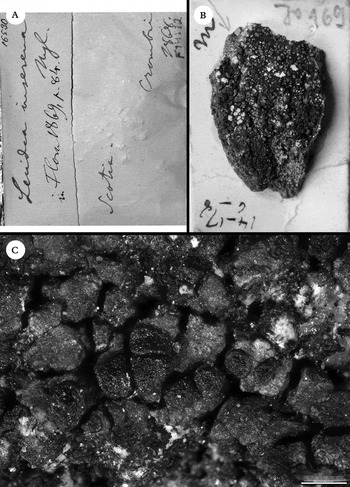
Lecidea inserena Nyl., Flora 52: 84 (1869); type: “at saxa granitosa in Scotia (Crombie)” (Nylander Reference Nylander1869: 84). [United Kingdom, Scotland], Scotia, 1868, J. M. Crombie (H-Nyl. 16530—lectotype!, designated here). Secondary chemistry of type specimen: miriquidic acid (by TLC).
Miriquidica subplumbea, lectotype of Lecidea subplumbea (MOD). A, entire specimen; B, part of the thallus; C, close-up of fertile part of the thallus. Scale: C=1mm.

Miriquidica subplumbea, lectotype of the heterotypic synonym Lecidea inserena (H-Nyl). A, envelope; B, entire specimen; C, close-up of fertile part of the thallus. Scale: C=0·5 mm.

Thallus lead grey to dark grey, matt, areolate, usually rather thick, up to several cm diam. Areolae dense, verrucose, not or only somewhat subdivided, up to 1·5 mm diam, plane to slightly convex. Hypothallus usually indistinct.
Apothecia often not very numerous, black, 0·5–1·2 mm diam., laterally attached to areoles, subsessile, plane and marginate when young, later convex and virtually immarginate. Excipulum externally blue-green to olive-brown, internally brownish to almost hyaline. Hypothecium hyaline. Hymenium hyaline, 55–65 µm high, upper 10–15 µm olive-green to greenish brown forming an epihymenial layer; paraphyses mostly unbranched, 55–65 µm long and 1·5–2·0 µm thick; apical cells hardly or slightly enlarged and then up to 4 µm diam. Asci of Lecanora-type, 8-spored, 40–50×14–18 µm, outer wall layer and tholus except the central body I(Lugol)+ blue; ascospores hyaline, non-septate, ellipsoid, 10–13×5–6(–7) µm, length-breadth ratio c. 2·0–2·3 (see also e.g., Andreev Reference Andreev2004: 22–23 or Giavarini et al. Reference Giavarini, Coppins, Purvis, Smith, Aptroot, Coppins, Fletcher, Gilbert, James and Wolseley2009: 609, both sub M. griseoatra).
Secondary chemistry
Cortex K−, P−, C−, medulla K−, P−, C−, containing miriquidic acid (number of specimens investigated: 39).
Notes
The morphology and anatomy of Lecidea subplumbea was correctly described by Anzi (l. c.). The lectotype of Lecidea subplumbea Anzi consists of one piece of rock bearing a single thallus. The major part shows well-developed, partly fertile areoles with only a few areoles exhibiting a superficially damaged surface due to feeding activity of gastropods or insects. The edge of the thallus is partly present. There is no indication of parasitic behaviour of the species. No areolae of Sporastatia polyspora are discernible on the entire specimen. Accompaning species are Rhizocarpon geographicum and Varicellaria lactea.
As a consequence of our reinvestigation of type specimens of various Miriquidica species, M. subplumbea herewith replaces M. griseoatra auct., that is, it has to be applied to a species in a concept different to that proposed by Hertel & Rambold (Reference Hertel and Rambold1987).
When Hertel (Reference Hertel1970: 428) gave a description of supposed Lecidea subplumbea, that concept was not based on the type or other authentic material but on a specimen collected by Poelt in eastern Switzerland (see above under Miriquidica invadens). The host on this collection is not a Lecidea as argued by Hertel, but Sporastatia polyspora, the typical host of M. invadens.
Lecidea subplumbea sensu Hertel is a different species. It was also called “Miriquidica griseoatra chemotype 2” (miriquidic acid + stictic acid, Hertel & Rambold Reference Hertel and Rambold1987) whereas “Miriquidica griseoatra chemotype 1” (miriquidic acid alone) is the secondary chemistry of both M. griseoatra (Flot.) Hertel & Rambold and M. griseoatra auct. (here treated as M. subplumbea). Lecidea subplumbea has been listed among the synonyms of M. griseoatra by Andreev (Reference Andreev2004: 22), without any indication of doubt. However, Andreev (l. c.) states that “forms with red-violet or violet-brown lower part of the excipulum and the external part of the hypothecium are known as Lecidea subplumbea”. He also noticed narrower ascospores and a secondary chemistry with stictic acid as typical for that “form”. This is obviously based on observations already published by Hertel & Rambold (Reference Hertel and Rambold1987: 385). Although Hertel & Rambold (Reference Hertel and Rambold1987) did not mention a lichenicolous behaviour, according to the given characters and the material studied (e.g., the already mentioned specimen collected by J. Poelt and several further specimens preserved in M) it is almost certain that Lecidea subplumbea auct. (=“M. griseoatra chemotype 2”, Hertel & Rambold Reference Hertel and Rambold1987) is the same as Miriquidica invadens (see above).
Miriquidica invadens is morpho-anatomically similar to M. subplumbea s. str., but can be distinguished from that species by its different thallus chemistry [M. invadens constantly containing miriquidic, stictic, (+ constictic) acids] and its autecology (M. invadens being constantly parasitic on Sporastatia, mostly S. polyspora). Also similar to M. subplumbea is M. griseoatra s. str., which is easily distinguished by either the colour of the hypothecium (brown in M. griseoatra) or ascospore size (larger in M. griseoatra).
The type specimen of Lecidea inserena Nyl., originating from Scotland, has also previously been reinvestigated by Hertel & Rambold (Reference Hertel and Rambold1987), who suggested the synonymization with Miriquidica griseoatra [sensu auct.].
Ecology
Miriquidica subplumbea grows on exposed acidic siliceous rocks in cold environments. According to Wirth (Reference Wirth1995a : 427, sub M. leucophaea var. griseoatra), it prefers stands exposed to wind, light and rain. Its ecology is given as similar to Miriquidica nigroleprosa. From our field studies in the Alps we can confirm this, but find M. nigroleprosa more frequently on steeper rock faces.
The species is occasionally found growing upon Acarospora fuscata, Lecanora polytropa, Lecidea spp. or Rhizocarpon spp., but finally always becomes independent (Hertel & Rambold Reference Hertel and Rambold1987: 385, sub M. griseoatra; Rambold & Triebel Reference Rambold and Triebel1992: 113, sub M. griseoatra). Thus it evidently has no clear association with a specific host lichen. In the material studied by us, we have not detected a clear case where M. subplumbea behaves as a parasitic species.
Accompanying species
Species growing with M. subplumbea on the herbarium material studied by us included: Lecanora intricata, Ophioparma ventosa, Protoparmelia badia, Rhizocarpon geographicum on Hafellner 59161; Brodoa intestiniformis, Lecanora intricata, Rhizocarpon geographicum, Schaereria fuscocinerea on Mayrhofer 1807; Calvitimela armeniaca, Lecidea lapicida, Ophioparma ventosa, Protoparmelia badia, Pseudephebe pubescens, Rhizocarpon geographicum on Hafellner 67954; Calvitimela aglaea, Candelariella vitellina, Lecanora intricata, Lecanora polytropa, Miriquidica leucophaea, Rimularia furvella, Rhizocarpon geographicum, Umbilicaria cylindrica on Hafellner 79721; Lecanora intricata, Miriquidica nigroleprosa, Ophioparma ventosa, Protoparmelia badia, Rhizocarpon geographicum, Umbilicaria cylindrica on Hafellner 80177; Lecanora intricata, Lecanora polytropa, Lecidea lapicida, Rhizocarpon geographicum, and Umbilicaria cylindrica on Fryday 2108.
Distribution
Miriquidica subplumbea s. str. is evidently widely distributed in Eurasia and North America (Andreev Reference Andreev2004, sub M. griseoatra) and seems to be the most common species of the M. griseoatra group. Nimis (Reference Nimis1993, sub M. griseoatra) calls it a boreal-montane species, and Wirth (Reference Wirth1995a , sub M. leucophaea var. griseoatra) gives the geobotanical characteristics as “boreal-central European·high montane”. However, as M. griseoatra s. str. and M. subplumbea have often been confused, literature data are difficult to interpret. Miriquidica subplumbea seems to be much more common in the boreal zone in mid to moderately high elevations (see e.g., Santesson et al. Reference Santesson, Moberg, Nordin, Tønsberg and Vitikainen2004: 211, sub M. griseoatra) than in mid elevations in Central Europe where it is quite frequent in the lower alpine belt (see e.g., Lisická Reference Lisická2005, sub M. griseoatra; specimens cited below). On the other hand, it remains unclear how many of the earlier high altitude records refer to misidentified samples of M. invadens, for which the lichenicolous behaviour was not recognized (see above).
Exsiccata examined. Anzi, Lich. Rar. Langob. exs. no. 573, sub Lecidea subplumbea (PAV, G). Arnold, Lich. exs. no. 714, sub Lecidella inserena var. subplumbea (G, GZU, M, W). Leighton, Lich. Brit. exs. no. 188, sub Lecidea tenebrosa (M).
Specimens investigated (non type material, label data shortened), Austria: Tirol (Tyrol): [Ötztaler Alpen], Ötztal, Gurgl, 1900 m, 1877, F. Arnold=Arnold, Lich. exs. no. 714 (G, GZU, M, W) [m]; ibid., Pitztal, Mittelberg, Mittagskogel, 1875, F. Arnold (M) [m]; [Stubaier Alpen], Kühtai [Kühthei], 1872, F. Arnold (M) [m]; ibid., zwischen Kühtai [Kühthei] und den Finstertaler Seen, 1874, F. Arnold (M) [m]; ibid., Kühtai [Kühthei], Finstertaler Seen, 1872, F. Arnold (M) [m]; ibid., ober Weißbach, Rosskogel bei Innsbruck, 1875, F. Arnold (M, 2 specimens) [m]; ibid., Inzinger Alpe, 1876, F. Arnold (M) [m]; [Kitzbühler Alpen], Kleinen Rettenstein, [W über] Pass Thurn, 1871, F. Arnold (M, 2 specimens) [m]; ibid., Roßgrubkogel, Kleiner Rettenstein, 1871, F. Arnold (M) [m]. Note: assoc. species: Miriquidica nigroleprosa. Salzburg: Hohe Tauern, Glockner-Gruppe, Kleiner Schmiedinger N Schmiedinger Scharte, W Krefelder Hütte, über Kaprun, 2700–2739 m, GF 8742, 1973, J. Poelt (GZU) [m]. Kärnten (Carinthia): NP Hohe Tauern, Schober-Gruppe, Fleckenkopf gegen Egger Wiesen, NW Döllach, [46°59′40″N / 12°50′30″E], 2060–2100 m, GF 9043/1, 1988, J. H. 21133 & M. Walther (GZU); ibid., Gradental W Döllach, SW Graden Alm, [46°58′05″N / 12°48′50″E], ca. 1750 m, 1988, J. H. 21906 & M. Walther (GZU) [m]; Saualpe W Wolfsberg, Geierkogel S Klippitztörl, Gipfelbereich, 46°55′10″N / 14°40′25″E, 1910 m, GF 9054/3, 2012, J. H. 80652 (GZU) [m]; ibid., zwischen Kienberg und Forstalpe, Kar über Schmiedbauerhütte, 46°53′30″N / 14°39′00″E, 2030 m, GF 9153/2, 2012, J. H. 80177 & A. Hafellner (GZU) [m, u]; Stubalpe NE St. Leonhard, Peterer Riegel, 47°02′10″N / 14°50′20″E, 1930 m, GF 8955/3, 2006, J. H. et al. 65970 (GZU) [m]; Koralpe c. 15 km W Deutschlandsberg, Handalpe N Weinebene, 46°50′55″N / 15°01′00″E, 1820 m, GF 9156/3, 2012, J. H. 79721 (GZU) [m]; ibid., E Wolfsberg, Großes Kar, Bergrücken Großer Speikkogel – Steinschneider, 46°47′35″N / 14°57′55″E, 1950 m, GF 9255/2, 2012, J. H. 80154 et al. (GZU) [m]. Steiermark (Styria): Wölzer Tauern, Greim 11 km NW Oberwölz, Gipfelbereich, 47°14′50″N / 14°09′05″E, 2470 m, GF 8750/4, 2006, J. H. 67954 & L. Muggia (GZU) [m]; ibid., Großer Rotbühel S Planneralpe, Gipfel, 47°23′35″N / 14°12′30″E, 2000 m, GF 8651/1, 2012, J. H. 80060 & L. Muggia (GZU) [m]; Triebener Tauern, Griesmoar Kogel SW Wald am Schoberpaß, 47°25′15″N / 14°36′10″E, 1950 m, GF 8553/4, 2002, J. H. 59157, 59161 & J. Miadlikowska (GZU) [m]; Seetaler Alpen, 10.5 km W Obdach, path Großer Winterleitensee – Ochsenboden – Kreiskogel, 47°05′N / 14°33′E, 2000 m, GF 8953/1, 1999, W. Obermayer 7777 (GZU) [m]; Gleinalpe, Roßbachalpe S Gleinalmsattel, 1586–1750 m, GF 8756, 1981, H. Mayrhofer 1807 & J. Poelt (GZU) [m].—France: [Auvergne: Dept. Puy-de-Dôme], Mont-Dore, 1882, E. Lamy (G) [m]; ibid., Mont-Dore, 1879, E. Lamy 1169 (M) [m]; ibid., Rigolet, près du Mont-Dore, 1878, E. Lamy (M) [m]. Dept. Cantal: Auvergne, Monts du Cantal, Puy Mary, gegen Puy de Peyre-Arse, 1600 m, 1980, A. Bellemère & J. H. 9492 (GZU) [m].—Great Britain: Scotland: Mid Perthshire (V. C. 88), Glen Lochay, Meall nan Subh, Grid 27(NN)/45.39, 770 m, 1991, A. M. Fryday 2108 (E) [m]; ibid., Ben Lawers range, Meall Corranaich, Grid 27(NN)/61.40, 950 m, 1991, A. M. Fryday 2169 (E) [m]; ibid., Ben Lawers National Nature Reserve, Creag an Lochain, Grid 27(NN)/59.41, 650 m, 1991, A. M. Fryday 2082 (E) [m]; ibid., Coire Odhar, Grid 27(NN)/61.40, 800 m, 1993, A. M. Fryday 4470 (E) [m]; ibid., Breadalbane Mountains, Creag Mhòr, Coire-cheathaich, Grid 27(NN)/39.35, 600 m, 1990, A. M. Fryday 1067 (E) [m]. England: Shropshire, on Abdon Burf, highest land (1806 ft.), without date and collector=Leighton, Lich. Brit. exs. no. 188 (M) [m].—Italy: [Lombardia: prov. Sondrio], in termino vallis Furva (alpe Calvarána), Anzi=Anzi, Lich. Rar. Langob. exs. no. 573 (PAV).—Norway: Hordaland: Odda: Dyranut W Haukeliseter, 1100 m, 1984, J. H. 11613 & A. Ochsenhofer (GZU) [m].—Poland: Sudeten, Körber (B, as admixture in specimen of M. griseoatra) [m].—Switzerland: Kanton Wallis: Aletschreservat, Riederfurka, 2080 m, 193?, E. Frey 1343 (GZU) [m].—U.S.A.: Alaska: Southeast Alaskan Mainland near Petersburg, Deboer Lake alpine area, small valley NE Deboer Lake between Rodman and Pierce Peaks, 57.10728°N / 132.95177°W, 766 m, 2011, K. Dillman 2011-18 (GZU) [m]. Note: sterile specimen, therefore somewhat uncertain.
Lichenicolous fungi. Of the non-lichenized lichenicolous fungi only Endococcus complanatae Arnold has been seen once by us so far: Austria: Kärnten (Carinthia): Zentralalpen, Saualpe W Wolfsberg, Geierkogel S Klippitztörl, Gipfel, 46°55′10″N / 14°40′25″E, 1910 m, GF 9054/3, host: M. subplumbea, 2012, J. H. 80654 (GZU). The lichenicolous lichen Rimularia furvella (Nyl. ex Mudd) Hertel & Rambold was noticed twice on this host (on Hafellner 59157, 59161).
Discussion
Comparision of Miriquidica species with dark grey thallus
Re-examination of relevant type material during the present study has resulted in the re-application of several names in the genus Miriquidica (Table 1).
Re-application of species names in Miriquidica resulting from the present study, plus important distinguishing characters of the species treated
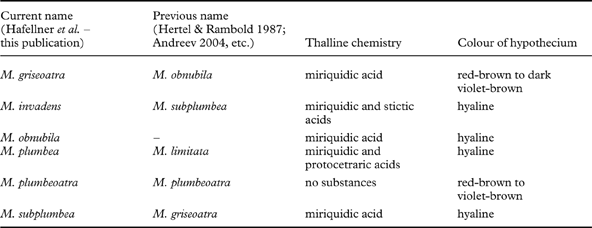
Among the Miriquidica species with a dark grey thallus, the morpho-anatomically closest taxa are M. invadens and M. subplumbea, both with a hyaline hypothecium. Whereas M. invadens exhibits a secondary thallus chemistry with miriquidic acid and stictic acid, M. subplumbea contains only miriquidic acid. Miriquidica griseoatra, also with only miriquidic acid, is easily recognized by the brown hypothecium, significantly larger ascospores and often distinctly subdivided areoles. Miriquidica obnubila, also with only miriquidic acid, is distinguished by sessile apothecia with a persistently prominent margin (recalling apothecia of Farnoldia species), but the consistency of these characters needs to be confirmed by examination of more material. Among this same subset of species, only M. invadens and M. subplumbea show a tendency to parasitism. Whereas M. invadens appears to be an obligate youth parasite with pronounced host specifity, M. subplumbea is only occasionally found lichenicolous as a facultative youth parasite without host specifity (see Rambold & Triebel Reference Rambold and Triebel1992: 113–114, sub M. griseoatra auct.).
Comparision of Miriquidica species containing miriquidic acid and stictic acid
The chemotype miriquidic acid, stictic acid, constictic acid (+/− in traces) is not very common in Miriquidica. In addition to M. invadens, the common and widely distributed M. garovaglii contains this combination of lichen substances. Whereas the lichenicolous M. invadens has an olive-grey to dark grey thallus, that of M. garovaglii is glossy brown and therefore does not belong to the M. griseoatra group as understood here. In the morpho-anatomically very different M. intrudens (areoles brown with greyish margin), a chemical strain with miriquidic acid + stictic acid has been reported by Owe-Larsson & Rambold (Reference Owe-Larsson and Rambold2001) but it seems to be rare. The same chemotype was also reported for M. pulvinatula, but in the type specimen of that species we detected only miriquidic acid.
Comparision of lichenicolous Miriquidica species
Parasitic growth on other lichens is rather frequent in the genus Miriquidica. Facultative lichenicolous behaviour is reported by Rambold & Triebel (Reference Rambold and Triebel1992: 113–114) from M. complanata, M. deusta, M. griseoatra auct. (=M. subplumbea), M. leucophaea and M. nigroleprosa. Additionally, we quite frequently saw M. instrata growing on other lichens.
Among the recognized species of Miriquidica only two species, M. invadens and M. intrudens, are regularly recorded as lichenicolous, but their behaviour is biologically rather different. From field observations we know that M. invadens is rather specialized, as it constantly starts its life cycle on Sporastatia (mostly S. polyspora, rarely S. testudinea), whereas M. intrudens is not host specific, growing on a wide range of crustose lichens, including Rhizocarpon geographicum, Lecanora polytropa, Lecidea confluens, Lecidea lapicida, and others (see also Owe-Larsson & Rambold Reference Owe-Larsson and Rambold2001). On the other hand, mature specimens of M. invadens develop a spreading thallus and contact with the host lichen seems not to be indispensable on all sides of the thallus, thus an older thallus may well have an edge zone on one side without a Sporastatia thallus being the neighbour. Therefore M. intrudens constitutes a good example of youth parasitism. According to Owe-Larsson & Rambold (Reference Owe-Larsson and Rambold2001: 345), older thalli of M. intrudens may also become independent, but in our opinion M. intrudens is an obligately lichenicolous species; that is, it shows lichenicolous growth over its entire life cycle. The consistently small thalli of M. intrudens support this view.
Of the species reported as facultatively or obligately lichenicolous, only M. invadens and M. subplumbea have a medium to dark grey thallus. All the others are either brown or white to cream-coloured. It would be interesting to revise the specimens upon which the observation of lichenicolous behaviour in M. griseoatra is based. Rambold & Triebel (Reference Rambold and Triebel1992: 113, sub M. griseoatra) list Acarospora fuscata, Lecanora polytropa, Lecidea sp., and Rhizocarpon sp. as possible hosts. Interestingly, Sporostatia polyspora is not mentioned, although Rambold & Triebel (Reference Rambold and Triebel1992) understood M. griseoatra in a broad sense that included the species described here as new.
A key to the Miriquidica species with a grey thallus
Based on our comparative studies, a revised key to the taxa of the M. griseoatra group is provided.
N.B.: ‘miriquidic acid’ always means miriquidic acid plus the accessory substances usually present, known as the ‘miriquidic acid syndrome’. Also stictic acid is commonly accompanied by related compounds in detectable amounts.
-
1 Thalli lichenicolous, mostly on Sporastatia polyspora, rarely on S. testudinea, grey to olive-grey to brownish grey, forming patches of various size, chem.: miriquidic acid, stictic acid, +/-constictic acid ... M. invadens
Thalli not distinctly lichenicolous on Sporastatia ... 2
-
2(1) Hypothecium red-brown to dark brown ... 3
Hypothecium hyaline or pale ... 5
-
3(2) Thallus grey to dark grey, often rusty or with brownish or ochre tinge, chem.: no lichen substances ... M. plumbeoatra
Thallus grey, whithout brownish tinge, chem.: miriquidic acid ... 4
-
4(3) Ascospores 4–6 µm wide, areoles subdivided, marginal areoles sometimes sublobate ... M. griseoatra s. str.
Ascospores 6–8 µm wide, areoles not as above; for a detailed description see Hertel (Reference Hertel1977: 313) ... M. molybdochroa (not treated)
-
5(2) Thallus whitish grey to pale grey or beige ... 6
Thallus lead grey to dark grey ... 8
-
6(5) Thallus sorediate, soredia blackish, chem.: miriquidic acid (rarely replaced by lobaric acid) or psoromic acid (var. liljenstroemii); for a detailed description see Owe-Larsson & Rambold (Reference Owe-Larsson and Rambold2001: 346) ... M. nigroleprosa (incl. var. liljenstroemii) (not treated)
Thallus usually fertile, without soralia ... 7
-
7(6) Thallus spreading, chem.: miriquidic acid; for a detailed description see Andreev (Reference Andreev2004: 25)! ... M. leucophaea (not treated)
Thallus small, usually not exceeding 1·5 cm in diam., chem.: norstictic acid; for a detailed description see Andreev (Reference Andreev2004: 28) ... M. lulensis (not treated)
-
8(5) Thallus sorediate ... 6
Thallus usually fertile, without soralia ... 9
-
9(8) Medulla Pd+ orange to orange-red due to presence of protocetraric acid or stictic acid ... 10
Medulla Pd- ... 11
-
10(9) Thallus lead grey, young apothecia aspicilioid, chem.: miriquidic acid and protocetraric acid ... M. plumbea (syn. M. limitata)
Thallus grey to olive-grey to brownish grey, young apothecia not aspicilioid, at least on one side neighboured by Sporastatia polyspora on which it starts as parasite (on smaller specimens the Sporastatia may not be present), chem.: miriquidic acid, stictic acid, +/− constictic acid ... M. invadens
-
11(9) Hypothecium brown, at least in the lower part ... 3
Hypothecium hyaline ... 12
-
12(11) Areoles dispersed, prothallus in between distinct, apothecia sessile with persistent margin ... M. obnubila
Areoles densely arranged, prothallus indistinct ... 13
-
13(12) Thallus lead grey to dark grey, chem.: miriquidic acid ... M. subplumbea (syn. M. griseoatra sensu auct.)
Thallus grey to olive-grey to brownish grey, at least on one side neighboured by Sporastatia (polyspora) on which it starts as parasite (on smaller herbarium specimens the Sporastatia may not be present), chem.: miriquidic acid, stictic acid, +/− constictic acid, recheck Pd-reaction of medulla ... M. invadens
The authors greatly acknowledge valuable support from several colleagues, especially Dr. A. Fryday and two anonymous reviewers for a critical reading of the manuscript, and the curators of B, E, G, H, M, MOD, PAV, UPS, VER, and W for the loan of type specimens and other relevant material.