Introduction
The number of drug prescriptions for older people has risen progressively and has drawn increasing attention worldwide.Reference Hovstadius, Hovstadius, Astrand and Petersson1 While older people are the principal drug consumers, benefits from drug therapy can only be achieved if prescribing is appropriate.Reference Hanlon, Artz and Pieper2 Inappropriate prescribing (IP), defined as a situation where pharmacotherapy does not meet the established medical standards, is associated with negative health outcomes such as adverse drug events, hospitalization, redundant healthcare utilization and untimely death.Reference Hanlon, Schmader, Ruby and Weinberger3 IP is more likely to have its adverse influence on frail older people who often have multiple co-morbidities with signs of impairment in activities of daily living. In frail individuals, their ability to tolerate medications becomes less due to age-related changes in pharmacokinetics and pharmacodynamics, thereby making prescribing a more difficult task.Reference Poudel, Hubbard, Nissen and Mitchell4 Furthermore, the increasing prevalence of chronic illness in frail individuals leads to an increase in the number of total prescriptions.
Several criteria have been developed to identify potentially inappropriate medications (PIMs) in older patients, particularly certain aspects of prescribing such as indication, drug–drug interactions, drug–disease interaction, drug duplication and under-prescribing. PIMs can be detected using explicit (criterion-based) or implicit (judgement-based) prescribing criteria.Reference Poudel, Hubbard, Nissen and Mitchell5 Explicit criteria are derived from expert reports or published reviews. They have high reliability and reproducibility but focus mainly on specific drugs and disease states. In contrast, implicit criteria are person specific and explore patient preferences rather than disease and medications; they rely on evaluator judgement and may have low reliability and low practical utility.Reference Le Couteur, Hilmer, Glasgow, Naganathan and Cumming6 Yet these guides and criteria are applicable only to robust, healthy older adults and cannot be generalized to frail patients.Reference Gnjidic and Hilmer7 Consequently, optimizing prescribing warrants measuring the frailty level of individual patients using clinically validated tools and prescribing criteria that consider a patient's quality of life, functional status, life expectancy and goals of care for optimal choice of drug with the paramount risk–benefit ratio.
We conducted a systematic review to identify studies that measured the prevalence of potentially inappropriate prescribing in older people assessed as ‘frail’, based on the presence of deficits defined as symptoms, signs, disabilities and diseases contributing to frailty.
Methods
Types of studies
Original studies measuring inappropriate prescribing using well-validated tools in a population assessed as frail using at least two indices of frailty were included in the review.
Types of participants
Studies involved individuals aged 65 years and older with an indication of frailty or disability. Patients were included in the study if they met two or more of the following criteria of frailty:Reference Searle, Mitnitski, Gahbauer, Gill and Rockwood8 disability in activities of daily living (ADL) and instrumental activities of daily living (IADL), impairments in general cognition and mobility, history of falls, malnutrition, low level of physical activity, incontinence and depression.
Information sources
The search was conducted using PubMed and EMBASE. Articles published in English between January 1990 and December 2013 were retrieved for analysis.
Search strategies
Keyword searches and MeSH headings were used that included the following terms: frail elderly, inappropriate prescribing, suboptimal prescribing, potentially inappropriate medication, and inappropriate medication. Detailed search strategies are provided in the Appendix.
Study selection
Initial eligibility assessment was performed by a single investigator (A.P.) who reviewed abstracts based on the inclusion criteria and was confirmed by a second reviewer (N.P.). Full articles were reviewed for final inclusion. This systematic review is reported according to the PRISMA guidelines.Reference Moher, Liberati, Tetzlaff, Altman and The9
Data abstraction and risk of bias assessment
For each paper, data extracted included study design, study setting, sample size, participant age, frailty measures, implicit/explicit criteria used and the prevalence of PIM use. An association between PIM use and patient characteristics was also recorded in a specially designed data abstraction tool.
Results
Study selection
The initial search found 466 citations (Fig. 1). Of these, 135 were excluded because of duplication and 284 were excluded after reviewing the abstracts, as they failed to meet the inclusion criteria. After abstract review, full text was sought for 47 articles, from which 28 articles were excluded that did not meet the following criteria: not an original article (n = 1), prescribing criteria not well defined (n = 1), age less than 65 years (n = 1), frailty measurement not well defined (n = 9), studies focusing on particular drug or disease condition (n = 13) and studies on the same population (n = 3). Finally, 25 studies met the inclusion criteria including six additional studies from manual search in bibliographies.
Flowchart of study

Study characteristics
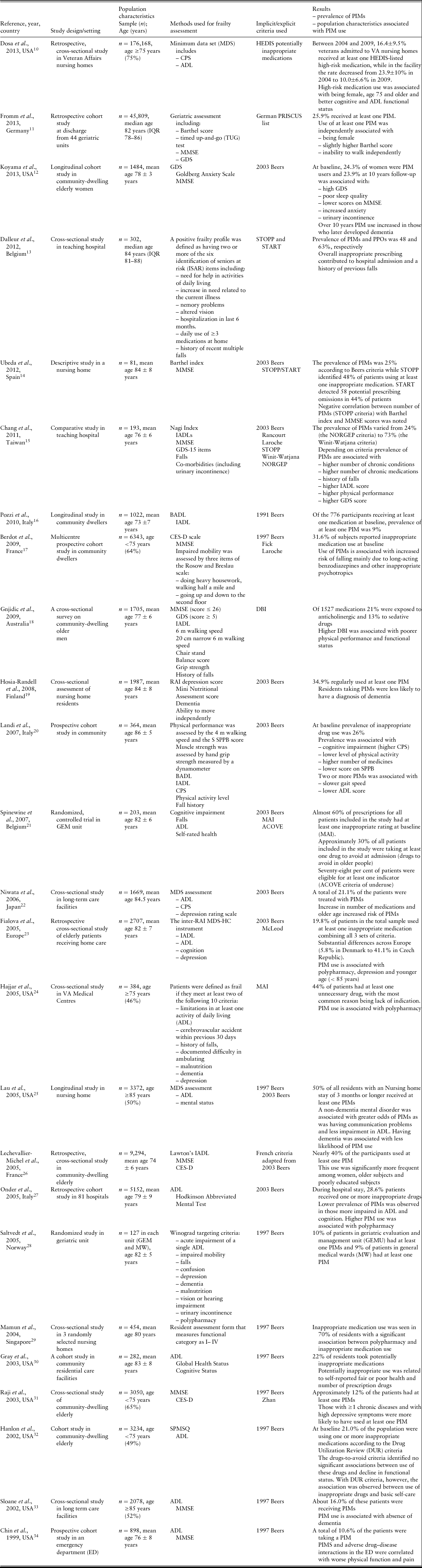
Table 1 summarizes detailed description of reviewed studies. The majority of studies were conducted in the in-patient hospital settings (n = 8), nursing homes or assisted living settings (n = 8) and in community-dwellers (n = 8) with one study in home care. The studies were conducted in Europe (n = 12), USA (n = 9) and Oceania and Asia (n = 4).
Studies evaluating frailty status and describing the criteria for evaluating inappropriate prescribing in frail older individuals
ACOVE: assessing care of vulnerable elders; ADL: activity of daily living; ADR: adverse drug reactions; BADL: basic activities of daily living; CES-D: Centre for Epidemiologic Studies Depression; CPS: cognitive performance scale; DBI: drug burden index; GDS: geriatric depression scale; GEM: geriatric evaluation and management; HEDIS: healthcare effectiveness data and information set; IADL: instrumental activities of daily living; ISAR: identification of seniors at risk; MAI: medication appropriateness index; MDS-HC: minimum data set for home care; MMSE: mini-mental state examination; MW: medical ward; NORGEP: Norwegian General Practice; SPMSQ: short portable mental status questionnaire; SPPB: short physical performance battery; STOPP: screening tool of older person's prescription; START: screening tool to alert doctors to right treatment; VA: veterans affairs.
Synthesis of results
A total of 15 explicit and implicit criteria were used in the 25 studies. Of these, 14 were explicit (Beers, HEDIS, German PRISCUS list, STOPP/START, Rancourt, Laroche, Winit-Watjana, NORGEP, Fick, DBI, ACOVE, McLeod, French criteria adapted from 2003 Beers, Zhan) and only one was implicit (Medication Appropriate Index). The most commonly used criteria were one of the three versions of Beers criteria (1991, 1997 and 2003), which were used in 20 studies (74%). Beers criteria are one of the best known and widely used explicit list of medications for evaluating inappropriate medication use.35 Three studies used Screening Tool of Older Person's Prescriptions (STOPP)/Screening Tool to Alert doctors to Right Treatment (START) criteria to identify inappropriate medications. These latter tools identify, respectively, overuse of inappropriate medications and underuse of potentially appropriate medications. This differentiates them from Beers criteria.Reference Gallagher, O’Connor and O’Mahony36 Two studies used the Laroche approach developed by a French consensus panel that proposed 36 criteria applicable to older people to assess inappropriate medications.Reference Laroche, Charmes and Merle37 More than one criteria was used in 34% (9/27) of the studies to evaluate combined inappropriate medication use. Clear variation among the prevalence of inappropriate medications use was observed that ranged from 10.6% up to almost 92%.
Frailty in patients was measured using different scales. ADLs were assessed in 15 studies, mental status in 14, depression and cognitive status each in 10 studies, falls in eight studies, and IADL and physical performance in six studies. Less frequently, malnutrition was reported in three studies, walking speed in three studies, and incontinence and grip strength in two studies. None of these studies used established frailty measures.
Discussion
In this overview, we compiled studies that measured the prevalence of inappropriate prescribing in older people assessed as frail based on presence of geriatric syndromes. Large variation was observed in the prevalence of inappropriate medications. The study settings, population characteristics and the inter-country differences on availability of some of the listed drugsReference Niwata, Yamada and Ikegami22 might account for this variation. The study setting does not fully explain the differences in the prevalence of PIMs. In NH/institutionalized settings where the population would be expected to be frail, the prevalence ranged from 9.5 to 70%. While the maximum prevalence was lower in community settings where the participants would be expected to be less frail, the prevalence still ranged from 9 to 40%. The age of the population under study might have been a factor in determining prevalence of PIMs. Since polypharmacy increases with frailty and frailty increases with age,Reference Song, Mitnitski and Rockwood38 it might be expected that the younger population has a lower prevalence of PIMs. For example, the prevalence of PIMs was 9% in the community-based study of Pozzi et al. Reference Pozzi, Lapi and Mazzaglia16 with the mean age of 73 years, while in the study of Landi et al. Reference Landi, Russo and Liperoti20 where the mean age was 86, the prevalence of PIMs was 26%.
The criteria used for assessing PIMs might also have a significant role in this variation as some of the studies compared different criteria for prevalence of PIMs in the one population. For example, a study in geriatric out-patients using six sets of published explicit criteria reported the variation of PIMs from 24% (the NORGEP criteria) to 73% (the Winit-Watjana criteria).Reference Chang, Chen and Wen15 The majority of criteria used for identifying inappropriate medications specifically focus on the clinical appropriateness of prescribed drugs. The MAI is the only criterion that goes beyond the pharmacological appropriateness of a drug and explores other aspects of the medication management process.Reference Hanlon, Schmader and Samsa39 The MAI questions whether the dose is correct. The MAI is also the only criterion that includes drug costs.Reference Hanlon, Schmader and Samsa39 Most of these criteria are aimed at a healthy or robust population aged 65 years and older and are probably not appropriate in the frail older population.
Objective measures of physical, cognitive and mental functioning are significant for older people as they predict subsequent adverse health outcomes such as disability, hospitalization, nursing home admission and death.Reference Gnjidic, Cumming and Le Couteur18 Here, frailty in older individuals was measured using different clinical features that included functional status, physical performance, mental status and vulnerability or a combination of these. Generating a composite measure that would meet all the criteria is difficult. Although few studies reported the association between PIMs with the surrogate measures of frailty or the geriatric syndromes, they had diverse findings. Dosa et al. Reference Dosa, Cai, Gidmark, Thomas and Intrator10 reported that the prevalence of PIM was associated with better cognitive and ADL functional status; however, Landi et al. Reference Landi, Russo and Liperoti20 reported lower levels of physical activities and worsening results on ADL score associated with the prevalence of PIMs. Similarly, a study by Fialova et al. Reference Fialova, Topinkova and Gambassi23 suggested that PIM use was associated with younger age (<85 years) while a study by Niwata et al. Reference Niwata, Yamada and Ikegami22 found that older age was associated with increased risk of PIMs. Hence the measures of frailty used in these studies cannot be considered as a gold standard.
Frailty can now be measured objectively, rather than by using surrogate markers. While several different measures have been validated,Reference McMillan and Hubbard40 the frailty index derived from Comprehensive Geriatric Assessment has high potential utility for older in-patients since it does not rely on performance-based tests and, as a continuous variable, has greater granularity for those at the ‘frail’ end of the health spectrum.Reference Hubbard, O’Mahony and Woodhouse41 Assessment of frailty may inform decision making on medication, based on the health status and risk profile of an individual patient.Reference Poudel, Hubbard, Nissen and Mitchell4 Utilization of a clinically validated tool is of utmost importance in identifying frail patients in clinical practice so that their management can be more appropriately determined. Ultimately, such a tool combined with the optimal choice of drug and patients’ preferences should result in better and more cost-effective care.
There were limitations to our study. The literature search was limited to articles published in English, so criteria published in other languages might have been missed. We acknowledge that the search term may not be sufficient, although the most relevant criteria are likely to be included. Although we had a broad definition of frailty we might have missed other criteria of assessing frailty in some studies.
Conclusion
Most of the criteria used for assessing inappropriate medications are explicit, which are applicable only to the robust older population. While surrogate measures of frailty were included in the studies, frailty was poorly defined. Populations were considered frail based on age (such as >75 years) or setting (such as nursing homes). For appropriate prescribing in frail populations, implementing a clinically validated tool (such as frailty index) for assessing frailty as well as a specific tool to assess the appropriateness of therapy that considers patient factors such as quality of life, functional status, goal of care, and remaining life expectancy is warranted.
Conflicts of interest
None
Appendix: search strategy
Database: Medline: 251 articles retrieved
Search ((((frail elderly [MeSH Terms])
AND ‘inappropriate prescribing’)
OR ‘suboptimal prescribing’)
OR ‘inappropriate medication’)
OR ‘potentially inappropriate medication’
Filters: Publication date from 1990/01/01 to 2013/12/31;
Humans;
English;
Aged: 65+ years
Database: Embase: 215 articles retrieved
‘frail elderly’/exp
AND ‘inappropriate prescribing’/exp
OR ‘suboptimal prescribing’
OR ‘inappropriate medication’
OR ‘potentially inappropriate medication’
AND [humans]/lim
AND [embase]/lim
AND [article]/lim
AND [aged]/lim
AND [english]/lim
AND [1990–2013]/py