Introduction
The introduction of the intracytoplasmic sperm injection technique (ICSI) as a variant of in vitro fertilization took place in the early 1990s. At first it was an alternative to classical in vitro fertilization (IVF) with fertilization failure as the sperm was forced to penetrate the oocyte. Years later it was implemented in all IVF laboratories worldwide and was quickly seen as a very beneficial technique in cases in which fertilization was severely compromised (Palermo et al., Reference Palermo, Joris, Devroey and Van Steirteghem1992).
At the beginning of the first decade of the 21st century, ICSI became the only fertilization technique in many laboratories, pushing classical IVF into the background. This was due to the impossibility of foreseeing or ensuring fertilization in classic IVF; couples became distressed in those cases in which the clear indication was classic IVF and the result was a failure of fertilization when these patients were aware of the existence of the ICSI technique. In the following decade, classical IVF began to be implemented again as a complement to ICSI, partly due to the suspicion that ICSI might be invasive and should only be performed when strictly necessary (Peultier et al., Reference Peultier, Fréour, Cazenave and Barrière2015).
The great advantage of IVF is that it is more natural than ICSI and less invasive, as fertilization is similar to that occurring physiologically in spontaneous conception. The ICSI technique has the advantage of ensuring the penetration of a single sperm into the cytoplasm of the oocyte, achieving higher fertilization rates than with classical IVF. Also, if the embryologist morphological criteria for selecting the sperm are correct, there is a greater chance that the genetic endowment of the sperm will be euploid (Rubino et al., Reference Rubino, Viganò, Luddi and Piomboni2016).
The major drawback of the traditional ICSI technique is the disorganization of the cytoplasm due to the necessary aspiration to ensure the rupture of the plasma membrane and the introduction of the sperm into the ooplasm (Verpoest and Tournaye, Reference Verpoest and Tournaye2006). This disadvantage is a consequence of the fact that the same microtools used in traditional ICSI were originally used for other different medical–biological disciplines in the field of micromanipulation. As a consequence, there have been no specific microtools to perform ICSI, instead embryologists have adapted the existing ones (Lacal et al., Reference Lacal, Perona and Feramisco1999). In the beginning, it was the embryologists themselves who manufactured the holding and microinjection pipettes. For this, they had three fundamental devices: the puller, the microforge and the microgrinder, which came from the field of micromanipulation and not from the field of reproduction. For convenience, embryologists began to prefer the injection and holding pipettes that appeared on the market in a more standardized form.
In recent years there has been a desire among embryologists to perform ICSI in a minimally invasive approach, focusing on the reduction of disorganized cytoplasm at the time of microinjection (Dumoulin et al., Reference Dumoulin, Coonen, Bras, Bergers-Janssen, Ignoul-Vanvuchelen, van Wissen, Geraedts and Evers2001). The most important advances in this area are:
-
The PIEZO-ICSI system in which an electrical charge pierces the plasma membrane of the oocyte and the sperm is deposited in the ooplasm without cytoplasmic aspiration, with the inconvenience of requiring the use of mercury or perfluoro-n-octane (Zander-Fox et al., Reference Zander-Fox, Lam, Pacella-Ince, Tully, Hamilton, Hiraoka, McPherson and Tremellen2021).
-
The PiWA-ICSI system, which meets the minimally invasive criteria, with an oocyte-holding pipette without cytoplasmic aspiration (PiWA), one that restrains the oocyte, slightly increasing the turgor of the plasma membrane and therefore achieving the introduction of the spermatozoon through a clean microinjection. The PiWA pipette protects the oocyte structure and sperm injection takes place easily and without cytoplasmic aspiration, therefore avoiding the disorganization of the ooplasm. It is the first holding pipette specifically designed for ICSI in assisted reproduction (Fernández et al., Reference Fernández, Pedrosa, Vergara, Nieto, Quintas, Fernández, Moyano, Fernández and Ponce2020).
Materials and methods
Study design
The study was performed at the clinical laboratory in an assisted human reproduction centre, Clínica Pedrosa, Granada, Spain. The couples included in the study met the ICSI indication according to the criteria of the manual of good clinical practice in assisted reproduction in Spain:
-
(1) Couples under 38 years of age who have completed unsuccessful conjugal artificial insemination (CAI) treatments.
-
(2) Couples with pathological seminogram and no female factor.
-
(3) Couples who have been in a relationship for more than 1 year with an indication of infertility of unknown origin, who go directly to ICSI treatment without attempting CAI treatments.
Those couples who underwent a transfer of two embryos with a different origin of microinjection were excluded.
Two different ways of performing microinjection were studied in each couple undergoing ICSI treatment. In each ICSI cycle, half of the oocytes were microinjected using a traditional holding pipette and the other half using an oocyte-holding PiWA. Oocyte selection was randomized. ICSI was performed by the same embryologist under the same conditions. In cases of even embryo quality, the embryos were transferred randomly and alternately. There were no major important changes to methods after trial commencement. All the generated embryos were vitrified, thawed, and transferred on Day 3 of culture using the Cryotop method (Kitazato Corporation, Shizuoka, Japan) to mitigate the negative effect caused by ovarian hormonal stimulation on the uterine implantation window (Braga et al., Reference Braga, Setti, Figueira, Azevedo, Iaconelli, Lo Turco and Borges2016).
Patients
Between November 2019 and July 2022, 155 patients participated in the study with, in total, 1037 oocytes and 215 embryo transfers.
The authors assert that all procedures contributing to this work comply with the ethical standards of the relevant national and institutional committees on human experimentation and with the Helsinki Declaration of 1975, as revised in 2008. Explicit written informed consent has been obtained from patients. The form of written consent complied with each requirement of all applicable data protection and privacy laws.
Procedures and ICSI
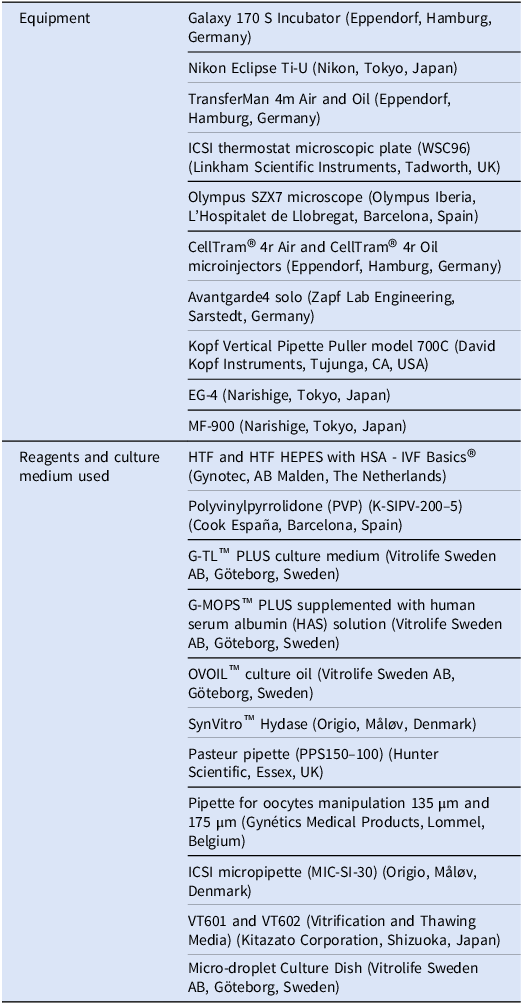
The details of the reagents, materials and embryo culture medium used in the cycle are shown in Table 1. After a follicular puncture, the oocytes were collected in a culture dish with a G-MOPS™ solution (Vitrolife Sweden AB, Göteborg, Sweden) by pipetting with a Pasteur pipette (PPS150–100, Hunter Scientific, Essex, UK). All oocytes were denuded/stripped using SynVitro™ Hyadase (Origio, Måløv, Denmark) (for 30 s) and the cumulus-free oocytes were transferred to a culture plate with G-IVF™ PLUS (Vitrolife Sweden AB, Göteborg, Sweden) and placed in a 37°C incubator in a 6.5% CO2 atmosphere.
Equipment, reagents and culture medium used

The development stage for each oocyte was evaluated, only selecting the mature oocytes that presented the first polar body [metaphase (MII) stage] for micromanipulation. Motile sperm were selected by swim up and subsequent washes with 0.4% HTF/HEPES HSA IVF basics buffer solution (Gynotec). The prepared sperm were kept in G-IVF™ PLUS (Vitrolife Sweden AB, Göteborg, Sweden) in an incubator at 37°C in a 6.5% CO2 atmosphere until microinjection. Three 15-µl drops of polyvinylpyrrolidone (PVP; K-SIPV-200–5, Cook Medical, Bloomington, USA) were placed in the left of the 60-mm culture dish, followed by 1 ml of the prepared semen’s final solution. On the right side of the culture plate, 50-µl drops of G-MOPSTM solution (Vitrolife Sweden AB, Göteborg, Sweden) were added (one for each oocyte).
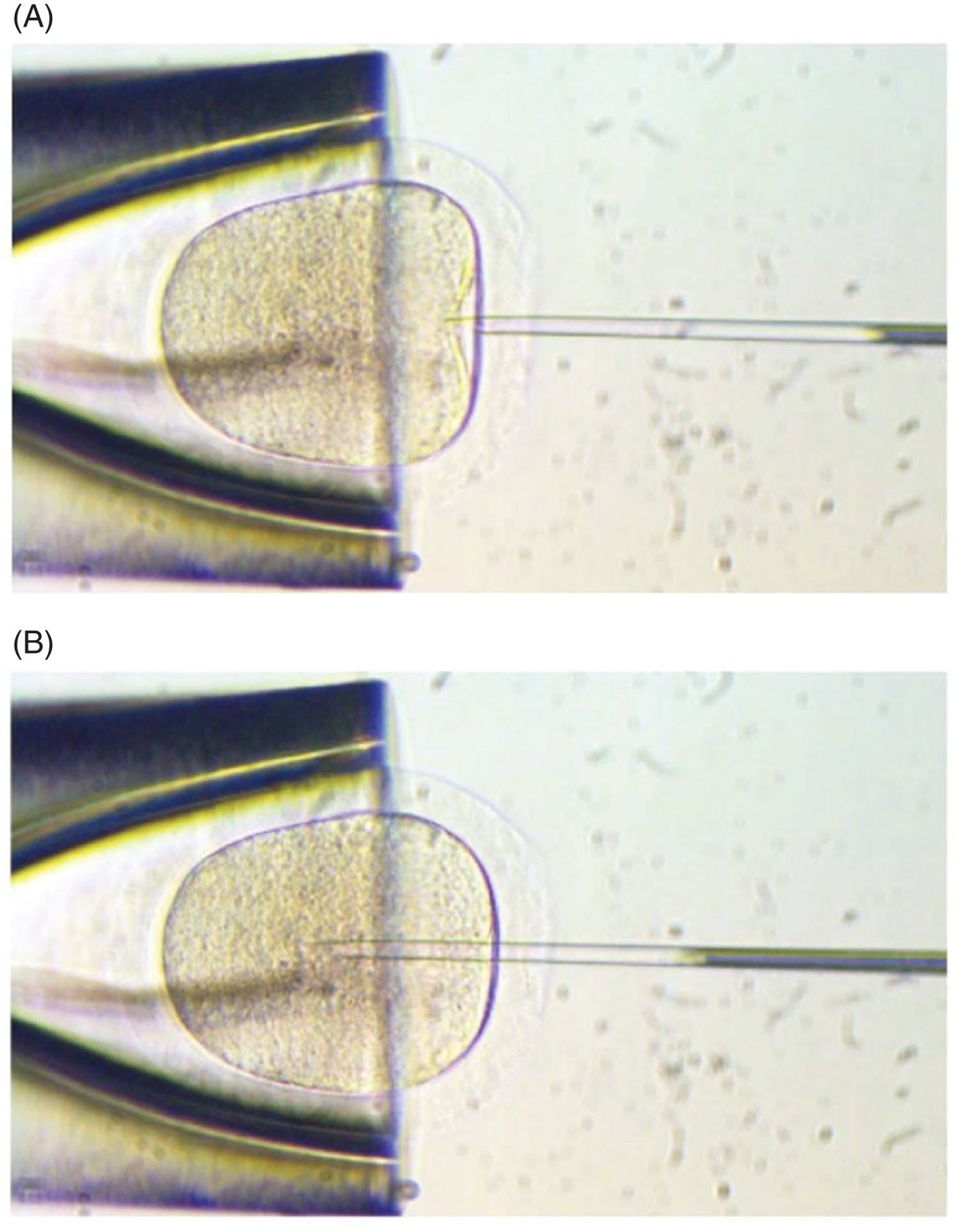
For microinjection, a sperm was immobilized and collected using an ICSI micropipette MIC-SI-30 (Origio, Måløv, Denmark). The oocyte, in turn, was retained using the PiWA. Each pipette was crafted from borosilicate glass within our own laboratory. The glass capillary was stretched using the Kopf Vertical Pipette Puller model 700C (David Kopf Instruments, Tujunga, CA, USA). Subsequently, it was shaped using a microforge (MF-900; Narishige, Tokyo, Japan) and polished with a microgrinder (EG-45; Narishige, Tokyo, Japan). This device consists of a micropipette for holding oocytes with a funnel-shaped working end that defines an internal conical cavity to hold and immobilize the oocyte thanks to the negative pressure that the microinjector system induces, so that the polar body is placed in the 12 o’clock position (Video 1). In this way, membrane rupture is facilitated by slightly increasing the turgor of the oocyte to avoid aspiration and cytoplasmic disorganization. The microinjection pipette and the PiWA were placed on the same focal plane (Figure 1). The injection pipette was inserted from the 3 o’clock position and by piercing the oocyte membrane, the sperm was deposited at the 9 o’clock position. We know that we have ruptured the oocyte cytoplasmic membrane when we visually observe that the contact area of the membrane at the tip of the injection pipette retracts to its natural position.
ICSI by PiWA. (A) The oocyte is partially trapped inside the distal end, causing it to change its shape from spherical at rest to oval. The sperm is placed at the end of the ICSI pipette. (B) The ICSI pipette is inserted, the plasma membrane is broken, and the sperm is introduced.

The embryos were cultured in the wells of a micro-droplet culture dish (Vitrolife Sweden AB, Göteborg, Sweden) in G-TL™ medium (Vitrolife Sweden AB, Göteborg, Sweden) under a layer of oil at 37°C and in a 6.5% CO2 atmosphere in a Galaxy 170 S incubator (Eppendorf, Hamburg, Germany).
All the generated embryos were vitrified, thawed, and transferred on Day 3. For patients who tested positive for the B-HCG hormone, clinical pregnancy was assessed by visualizing the fetal heartbeat 1 month after embryo transfer. Some patients who did not achieve clinical pregnancy, but had additional embryos, would undergo a subsequent transfer.
Statistical analyses
Statistical analysis of all data was performed with advice and a report from BioDatev. All statistical analyses were conducted using ‘R’ v.4.2.1 software,(R Core Team, 2022). The data reading was performed using the xlsx v.0.6.5 package (Dragulescu and Arendt, Reference Dragulescu and Arendt2020). Graphics were generated with ggplot2 v.3.3.6 (Wickham, Reference Wickham2016), ggpubr v.0.4.0 (Kassambara, Reference Kassambara2020) and other functions integrated into the aforementioned packages.
Fertilization and degeneration rates
The analysis of fertilization (Listing 1) and embryo degeneration (Listing 2) rates was performed using a generalized linear mixed effects model (GLMM) with a binomial error distribution and a “logit link” function with the lme4 package v.1.1-30 (Bates et al., Reference Bates, Mächler, Bolker and Walker2015). In both models, the used technique was included as a fixed factor and the patient’s identity as a random factor. The estimated rates were calculated and plotted using the ggeffects package v.1.1.2 (Lüdecke, Reference Lüdecke2018).
To estimate the effect of the oocyte-holding technique on the fertilization rate, a GLMM with a binomial error distribution and a logit link function was fitted. The technique used was included as a fixed factor and the patient’s identity as a random factor.
Pregnancy rate
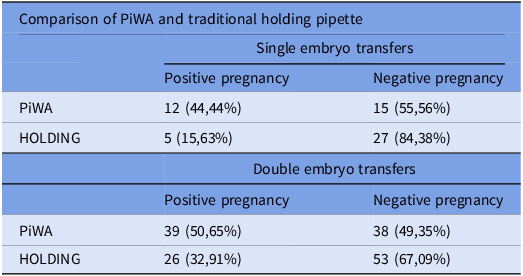
As the fertilizations were performed with both techniques in the same patient, the underlying sources of error were dampened. In this respect, to estimate the effect of the oocyte-holding technique on the pregnancy rate in patients both in single and double embryo transfers (Table 2), two Pearson’s χ2 tests with Yates’s correction for continuity were performed (Agresti, Reference Agresti2003).
Comparison of pregnancy rate with PiWA and traditional holding pipette

Results
Fertilization rate
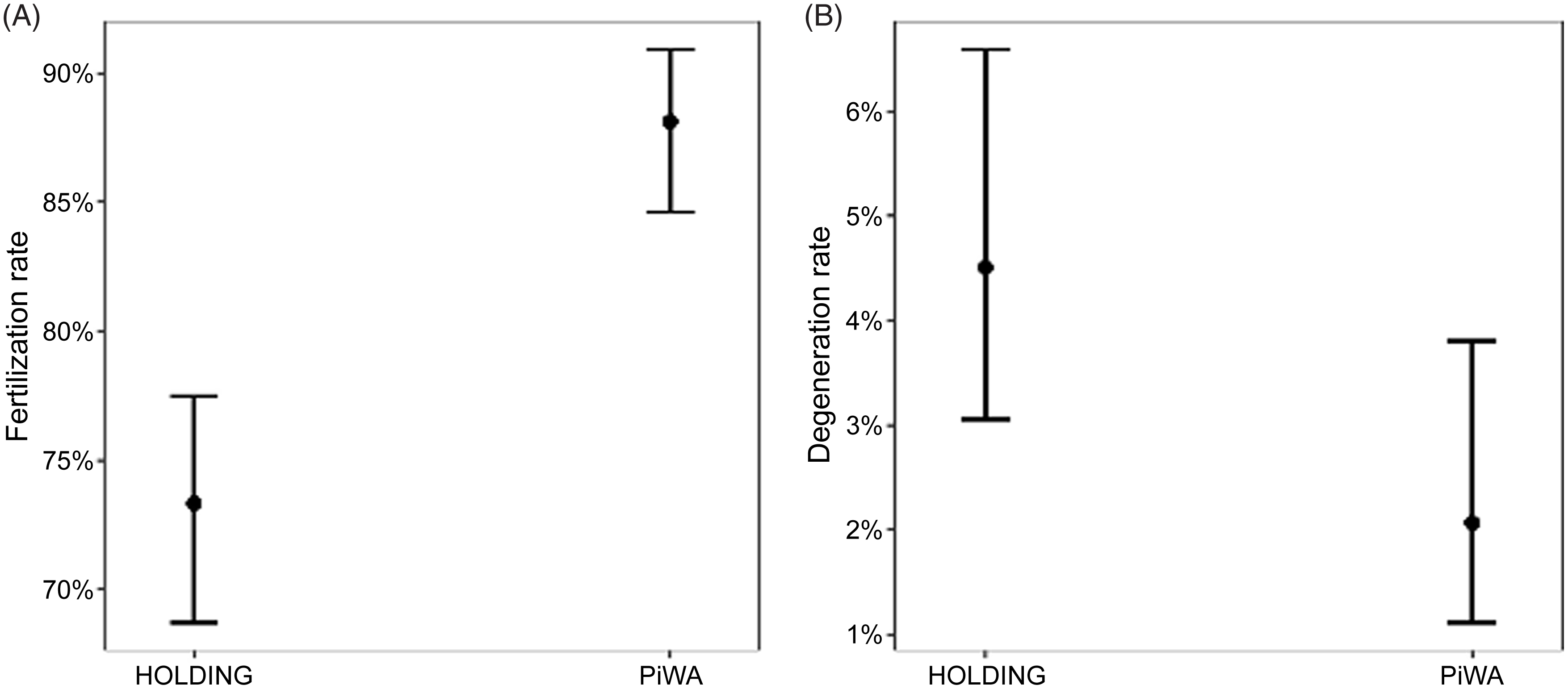
The results showed that the oocyte-holding technique had a significant effect on the fertilization rate (χ2 = 34.353; df = 1; P-value < 0.001). This effect was because the PiWA technique produces a significant increase in the fertilization rate with respect to that produced with the traditional holding pipette [PiWA: 88.12% (95%CI: 84.62–90.92%); holding: 73.33% (95%CI: 68.72–77.49%); Figure 2A].
Estimated fertilization rates (A) and estimated degeneration rates (B).

Embryo degeneration rate
The results showed that the oocyte-holding technique had a significant effect on the embryo degeneration rate (χ2 = 4.495; df = 1; P-value = 0.034). This effect was because the PiWA technique produced a significant decrease in the degeneration rate with respect to that produced with the traditional holding pipette [PiWA: 2.07% (95%CI: 1.11–3.8%); holding: 4.51% (95%CI: 3.06–6.59%); Figure 2B].
Clinical pregnancy rate
The χ2 test results for the pregnancy rate in single embryo transfers (n = 59) showed that it depended on the holding pipette used (χ2 = 4.608; P-value = 0.032). This was because the PiWA technique produced a significantly higher pregnancy rate than the traditional holding technique (Table 2).
The pregnancy rate in double embryo transfers (n = 156), also depended on the holding pipette (χ2 = 4.344; P-value = 0.037). Again, the PiWA technique produced a significantly higher pregnancy rate than the traditional holding technique (Table 2).
Embryo quality
A significant difference in embryo quality was not been observed after performing ICSI with the holding pipette and PiWA-ICSI.
Discussion
The theoretical hypothesis underlying this study was that the PiWA-ICSI system, which preserves the oocyte’s structure by avoiding cytoplasm aspiration and meiotic spindle disorganization, should lead to an increase in the fertilization rate and pregnancy rate.
The results of the statistical study showed that the use of PiWA-ICSI in our clinical laboratory significantly increased the pregnancy rate compared with the traditional oocyte-holding pipette. The fertilization rate was also positively affected, and the embryo degeneration rate was lower. The PiWA-ICSI system is a natural evolution of traditional ICSI in materials and methods; only the design of the holding pipette was changed, but the result at the time of microinjection was markedly different. Conceivably, the results obtained in the present study could be due to the type of membrane rupture, absence of ooplasm aspiration and a less invasive system inside the oocyte.
Different types of breakage have been described in connection to the effect of the sperm deposition site in the oocyte and the mode of membrane breakage in ICSI on fertilization and embryo development rates. The mode of membrane breakage influences the normal fertilization rate (Hiraoka et al., Reference Hiraoka, Tamaki, Matsumura, Kiriake, Uto, Yoshida and Kitamura2012) and affects oocyte survival and embryo development rates (Nagy et al., Reference Nagy, Liu, Joris, Bocken, Desmet, Van Ranst, Vankelecom, Devroey and Van Steirteghem1995). Injection type B (minimum volume of cytoplasm is aspirated prior to sperm injection) and normal breakage (the plasma membrane shows some resistance and ruptures when slight pressure is applied) were observed in all the cases. It therefore increased the reproducibility of PiWA-ICSI compared with traditional ICSI, as mode of membrane breakage or cytoplasmic aspiration are no longer random events for the embryologist. Therefore, using PiWA we would be restricting the possible adverse outcomes associated with the other described types of injections and ruptures during ICSI. In a prospective study, the embryo development rate was found to be significantly different among four ICSI technicians based on the volume of cytoplasm aspirated by each of them during the procedure. When >6 µl of cytoplasm was aspirated into the injection pipette, development to the blastocyst stage was compromised (Dumoulin et al., Reference Dumoulin, Coonen, Bras, Bergers-Janssen, Ignoul-Vanvuchelen, van Wissen, Geraedts and Evers2001). With the PiWA-ICSI system it was not necessary to aspirate cytoplasm in any procedure.
The shape of the PiWA protects the oocyte from deformation during the ICSI process, so that the structure of the cytoskeleton is not compromised. This occurs due to the slight increase in membrane turgor, which does not affect the integrity of the oocyte in any way. In fact, during the decumulation process, the oocytes are pipetted through capillaries of different diameters without affecting their structure (Maldonado Rosas et al., Reference Maldonado Rosas, Anagnostopoulou, Singh, Gugnani, Singh, Desai, Darbandi, Manoharan, Darbandi, Chockalingam, Leonardi Diaz, Gupta, Kuroda, Finelli, Sallam, Wirka, Boitrelle and Agarwal2022). The diameter of the PiWA on the external part is larger and is visually regulated.
Moreover, hypothetically, the fact of not deforming the plasma membrane (stretching it to break it due to loss of elasticity) leads to better oocyte activation at the Ca+2 channel level compared with traditional ICSI (Alvarez et al., Reference Alvarez, Villanueva, Geller, Cetica and Dalvit2018). For the perforation of the oocyte membrane to be considered ‘clean’, it must be 7 microns in diameter (the outer diameter of the microinjection needle) and leave the adjacent area without any structural modification. This microscopic zone is vital for oocyte activation, as it is the epicentre of the depolymerization wave. In the ICSI technique with the traditional holding pipette, the puncture zone is stretched to its limit of elasticity (Figure 1). This increase in surface area occurs at the exact place in which the membrane depolymerization wave originates, disorganizing and separating the Ca2+ channels, which are essential in the oocyte activation processes (Yanagida et al., Reference Yanagida, Katayose, Hirata, Yazawa, Hayashi and Sato2001).
A non-invasive method for microinsemination in ICSI has been sought for many years. The Piezo-ICSI method seemed promising because of the significant increase in the fertilization rate, but its implementation in reproductive laboratories had been slowed down, following its origin in 1996, by the use of highly toxic operating fluids such as mercury (Yanagida et al., Reference Yanagida, Katayose, Yazawa, Kimura, Konnai and Sato1999) or of unknown effects of materials such as perfluoro-n-octane. The obtained results showed that the PiWA-ICSI system increased the fertilization rate and decreased the embryo degeneration rate compared with the traditional holding pipette. Furthermore, the PiWA-ICSI system achieved similar pregnancy rates to Piezo-ICSI, but without the use of toxic substances, and with less technical preparation and simpler equipment.
Differences in embryo quality have not been observed when evaluating embryo morphology after performing both types of ICSI. However, further studies could be conducted by visualizing the embryos under a time-lapse system to assess differences in quality and division kinetics up to the blastocyst stage.
In conclusion, we have demonstrated that PiWA-ICSI significantly increased the clinical pregnancy rate compared with the traditional holding pipette, as well as the fertilization and embryo degeneration rates were increased and decreased, respectively. Despite the current standardization of the technique, it is very important for the established ICSI protocol to be periodically reviewed and its role in the treatment of infertility to be re-evaluated. Based on the current evidence and the results obtained in the present study, improvements should be focused on decreasing the invasiveness of the microinjection itself, by minimizing or avoiding aspiration and cytoplasmic disorganization, as is successfully achieved with the oocyte-holding PiWA.
Supplementary material
To view supplementary material for this article, please visit https://doi.org/10.1017/S0967199423000618
Acknowledgements
The authors thank BioDatev for statistical analysis of all data performed with advice, report, editing the manuscript and editorial assistance. This study is part of the thesis of the predoctoral student Javier Fernández Jiménez, entitled ‘Effect of intracytoplasmic sperm injection using the ICSI-WA oocyte retention pipette (without aspiration) in pre-embryonic development’, in the predoctoral degree in biomedicine from the University of Granada.
Financial support
None.
Competing interests
F. Vergara Alcaide is the patent owner of the PiWA instrument. The remaining authors have no conflict to be disclosed.