





The WHO describes salt iodisation as ‘a safe and effective strategy for the prevention and control of iodine deficiency disorders (IDDs)’(1). There is evidence that salt iodisation policies have been a global public-health success, in terms of prevention of IDDs and improved population iodine status(1,Reference Aburto, Abudou and Candeias2) . This is demonstrated by the reduction in the number of countries classified as iodine-deficient, which had fallen from 113 in 1990 to 20 by 2024 (based on national and sub-national data)(3). As an example, Slovenia introduced mandatory salt iodisation in 1953, and goitre prevalence in schoolchildren fell from 58 % to 12 % by 1991(Reference Žmitek and Pravst4). Globally, it is estimated that iodised salt is consumed by 89 % of the population(5), though this is lower in the European Region(6).
In the UK, there is no salt iodisation policy, and instead, the majority of iodine intake is from milk and dairy products(7–Reference Bath, Verkaik-Kloosterman and Sabatier9). Historically, the UK did not introduce a salt-iodisation policy, despite endemic goitre, partly because of the increased iodine concentration in milk (from iodine supplementation of dairy cows), combined with government initiatives to promote milk consumption(Reference Phillips10). While there was iodine sufficiency in the population for many years, data from the National Diet and Nutrition Survey (NDNS) show that certain population groups are now classified as iodine deficient [using the WHO criteria of a median Urinary Iodine Concentration (mUIC) <100 μg/L, with >20 % of samples with a UIC <50 μg/L(11)]. For the first time since monitoring commenced in 2013, data from 2019 to 2023 classify girls (aged 11 to 18 years), and adult men and women (aged 19–64 years) as mildly iodine deficient, based on mUIC of 95, 90 and 86 μg/L, respectively. For women of child-bearing age (16–49 years) mUIC was lower at 82 μg/L (with 30 % with UIC < 50 μg/L). The decline in mUIC in women is of particular concern given the emerging effects of mild-to-moderate iodine deficiency during pregnancy, including associations with lower verbal IQ and reading age in offspring(Reference Bath, Steer and Golding12).
Consumption of cow’s milk in the UK may no longer provide the same protection against iodine deficiency as in the past. The current iodine concentration of UK cow’s milk is high in relation to other countries (41·3 µg/100 g compared with a global average of 17·3 µg/100 g)(Reference Tattersall, Peiris and Arai13). However, the consumption of cow’s milk is declining (almost 50 % reduction in the purchase of milk between 1974 and 2023)(14), while consumption of plant-based milk alternatives is increasing(15); only 48 % of plant-based alternatives UK market were fortified with iodine in 2024, and unfortified products have a low iodine concentration(Reference Nicol, Nugent and Woodside16). Therefore, the lack of salt iodisation policy in the UK may be of concern and may need to be reviewed(Reference Bath8).
The availability of retail table iodised salt across the UK was last investigated in 2009(Reference Bath, Button and Rayman17) and was found to be low, as it was not sold in the major supermarket chains and was not available in all outlets of each supermarket (market-share-adjusted availability of 21·5 %)(Reference Bath, Button and Rayman17). However, as retail table salt represents just 15 % of total salt intake(18), it is also important to consider whether iodised salt is used by the food industry (i.e. in processed foods) in the UK. If the salt used in the manufacture of these foods is not iodised, processed foods are unlikely to contribute meaningfully to dietary iodine intake (aside from those based on rich sources of iodine, such as dairy, egg or fish-based products). By contrast, in countries implementing salt-iodisation policies (mandatory or voluntary), salt in processed foods can contribute substantially to iodine intake; cereal products contribute 49 % and 53 % of adult iodine intake in Belgium and the Netherlands, respectively, due to the use of iodised salt in bread(Reference Bath, Verkaik-Kloosterman and Sabatier9). Indeed, the contribution of salt to dietary iodine intake from industrially processed foods has been recognised by the Iodine Global Network (IGN), which has developed guidance to facilitate estimates of iodine intake from iodised salt in processed foods(19).
The presence of iodised salt as an ingredient in processed foods in the UK has not been assessed and is currently unknown. Considering a lack of salt-iodisation policy in the UK, it is currently assumed that only foods typically known as iodine sources contribute to UK iodine intake; however, processed foods containing iodised salt may be a ‘hidden’ or overlooked source of iodine. This has implications for dietary analysis and dietary guidance. This project therefore aimed to (i) provide updated data on availability of retail iodised salt in UK supermarkets and (ii) investigate the use of iodised salt as an ingredient in processed foods sold in the UK. We hypothesised that retail iodised salt would still be available in some supermarkets but that processed foods sold in the UK will not include iodised salt as an ingredient.
Methods
Retail iodised salt availability
Search strategy and dates
The availability of retail (i.e. table) iodised salt was evaluated through a market survey of ten supermarket chains, representing 96·7 % of the GB market share(20). Online searches were conducted for nine of the chains [Tesco, Sainsbury’s, Asda, Aldi, Morrisons, Co-op, Waitrose, Iceland and Ocado (which includes Marks & Spencer products)]. The remaining chain (Lidl) was searched in-store owing to the lack of an online store. All searches (both online and in-store) were conducted between 28th February and 4th April 2024. For the online search, we used both the website’s search bar (for ‘salt’) and the drop-down menu for the appropriate category (e.g. ‘condiments’). For comparison, the availability of five other salt varieties (rock salt, Himalayan salt, sea salt, low-Na salt and table/cooking salt) was evaluated using the same method. A ‘product’ was defined as a unique stock item; therefore, different packaging sizes with the same content were considered as separate products. Only pure salt products were included; seasoning products that contain salt, for example, ‘garlic salt’, ‘celery salt’ and spice mixes were excluded.
Data collection and calculations
For each supermarket chain, the number of salt products and their brands were recorded for each salt variety, and the percentage of total salt per chain was calculated. The cost of retail iodised salt and own-brand table/cooking salt (for comparison) was documented (as £/kg), and the average price of both varieties was calculated.
Processed foods containing iodised salt
Search terms and dates
To search for use of the word ‘iodised’ or ‘iodized’ within the ingredient list of processed foods, ‘Google-site’ searches were used for each supermarket website. Searches of the same nine supermarkets as in the retail iodised salt survey were conducted between 28th February and 4th April 2024 (these nine chains cover 88·9 % of the GB grocery market share(20)). The tenth chain (Lidl) was excluded as there was no online grocery store. The search was done by typing ‘iodised’ or ‘iodized’, followed by the word, ‘site:’ and then the supermarket URL (for example, ‘iodised site: groceries.aldi.co.uk’). This generated pages of links to products within supermarket websites that included the word ‘iodised’/‘iodized’.
Definition of processed food
The degree to which foods are processed have been described by Monteiro et al, grouping products into NOVA classifications(Reference Monteiro, Cannon and Levy21): NOVA group 1 foods are ‘unprocessed or minimally processed’ (e.g. fresh vegetables); NOVA group 2 foods are ‘processed culinary ingredients’ (e.g. salt); NOVA group 3 are ‘processed foods’ [‘industrial products made by adding salt, sugar… using preservation methods such as canning and bottling’ (e.g. tinned vegetables in brine)] and NOVA group 4 are ‘ultra-processed foods’ [‘formulations of ingredients, mostly of exclusive industrial use, that result from a series of industrial processes…fractioning, hydrolysis, or hydrogenation, or other chemical modifications’ (e.g. instant soups, formed meats)](Reference Monteiro, Cannon and Levy21). For the purpose of this study, a ‘processed food’ was considered as a food item containing more than one ingredient, based on NOVA classifications 3 and 4(Reference Monteiro, Cannon and Levy21).
Exclusion of products
Processed food products were excluded if they were not available for purchase or were duplicated within a store. For example, if both ‘iodised’ and ‘iodized’ salt appeared within the ingredients list on a single product, then the product appeared in both search results. If the same product was sold in multiple stores, it was included for the calculation of the number of products containing iodised salt per store, but duplicates between stores were then removed when creating the final database of unique products. Iodised table salt was excluded from our survey of processed foods as this is classified as NOVA 2 ‘processed culinary ingredients’(Reference Monteiro, Cannon and Levy21).
Data extraction and visualisation
Our data extraction was in line with the IGN’s Program Guidance on the Use of Iodised Salt in Industrially Processed Foods(19). The IGN Guidance includes various modules and tools to guide the assessment and reporting of iodised salt use by industry. Template spreadsheets (Microsoft Excel) are provided for data extraction, and we used a version that included data on average serving size, salt per 100 g and salt per serving, to ensure that we could estimate iodine content from salt on a per-serving basis(19). In addition, we also extracted data on product ingredients, manufacturer location and country of origin. To categorise products by country, we used the manufacturer location, as the country of origin of the product ingredients was deemed to be less relevant in terms of salt iodisation practice and policies than the country of manufacture(6). Where country information was unavailable or unclear on supermarket websites, individual brands were searched online or contacted for more information.
Data on processed foods across all nine stores were combined to create an overall database of processed foods containing iodised salt, and products were grouped into the following food types: (i) biscuits, buns and pastries, (ii) bread products, (iii) dried soups, (iv) fish and seafood products, (v) gluten-free products, (vi) meat products, (vii) pasta/noodle products, (viii) plant-based alternatives, (ix) potato products, (x) savoury snacks and (xi) stock/sauce/spices/condiments. These categories were based on NDNS food categories and the market data collected in this survey. Given the increased focus on ultra-processed foods (UPF) in the UK, products were further classified according to their NOVA group (i.e. Group 3 and Group 4 for processed or UPF respectively)(Reference Monteiro, Cannon and Levy21,Reference Rauber, Louzada and Martinez Steele22) , indicating the degree of processing in their manufacture(Reference Monteiro, Cannon and Levy21).
Calculation of iodine content of foods containing iodised salt
The salt content per serving was used to estimate the quantity of iodine provided by the iodised salt in each food product. Iodine content from salt was estimated on a per-serving basis to reflect realistic food intake, rather than per 100 g, to compare foods consumed in different quantities – for example, consumption of 100 g of curry powder is unlikely. To calculate the salt content per serving, the suggested serving sizes of the products were used; if this information was missing, the serving size was based on equivalent products or was estimated based on a standard/medium serving(23). Three products were removed from the calculations: two with no nutritional information and one outlier, with a salt content about five times higher than similar products (24·5 v. 5 g/100 g).
The actual iodine concentration of the iodised salt used in the product was unknown; therefore, it was estimated using three scenarios of salt–iodine concentration: Scenario 1: 15 mg/kg – the lowest fortification concentration utilised in Central and Western Europe and the minimum to be considered ‘adequately’ iodised(6); Scenario 2: 24 mg/kg – corresponding to the WHO’s suggested concentration(1) for salt iodisation based on the UK average salt intake (8·4 g in adults(18)) and Scenario 3: 65 mg/kg – the maximum fortification concentration permitted in the Netherlands for bakery salt(24). The iodine per serving was expressed as a percentage of the adult recommended nutrient intake (RNI) of 150 µg/day(11); Scenario 2 was selected for data visualisation as it aligns with WHO recommendations(1) and may be most likely to be implemented; figures were constructed using R (Version 2025.09.2).
Calculating the proportion of processed foods using iodised salt as an ingredient
To calculate the proportion of processed foods that used iodised salt, we needed data on the total number of processed foods on the UK market. We therefore used data from a 2019 study that had identified 57 185 processed foods on the UK (and Irish) market(Reference Clark, Springmann and Rayner25).
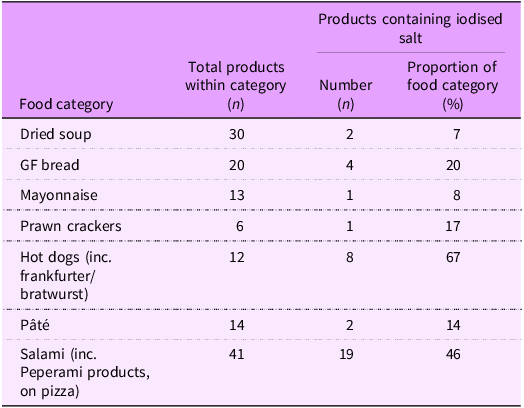
To demonstrate the likelihood of consumers purchasing a product containing iodised salt, we conducted a sub-study, where we examined the proportion of processed foods containing iodised salt within specific food categories (n 7); these categories were dried soup, gluten-free bread, mayonnaise, prawn crackers, hot dogs, pâté and salami. These food items were entered into the supermarket website’s search bar and, where available, identified through the drop-down menus; the total number of each product type was extracted, and those containing iodised salt as an ingredient were calculated as a percentage of the total. For the sub-study, we used the supermarket with the greatest market share (i.e. Tesco, market share 27·3 %)(20).
Results
Retail iodised salt availability
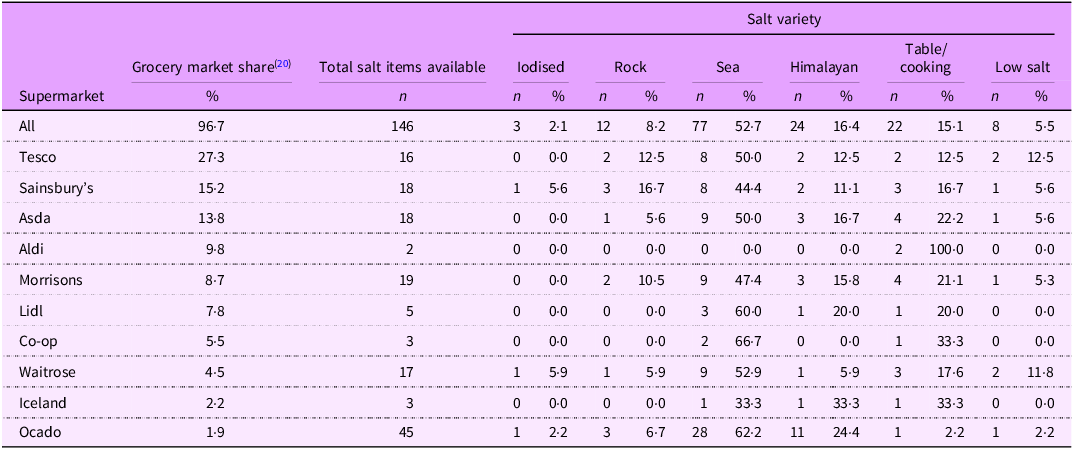
Across the ten supermarket chains, we identified 146 retail salt products, of which only three were iodised salt (2·1 %; Table 1, Figure 1) from one brand (Cerebos). Of the ten supermarket chains, iodised salt was available to purchase in three (30 %), covering 21·6 % of the GB grocery market share in March 2024(20).
Availability and cost of retail iodised salt and five other salt varieties across nine supermarkets

Table 1. Long description
A table comparing the availability of different salt varieties across various supermarkets. The table has 11 rows and 11 columns. The columns are Grocery market share, Total salt items available, Iodised, Rock, Sea, Himalayan, Table/cooking, and Low salt. The rows are labeled as All, Tesco, Sainsbury’s, Asda, Aldi, Morrisons, Lidl, Co-op, Waitrose, Iceland, and Ocado. Each row provides data on the percentage of grocery market share, the total number of salt items available, and the number and percentage of different salt varieties. For example, Tesco has a 27.3 percent grocery market share, 16 total salt items available, 0 iodised, 2 rock, 8 sea, 2 Himalayan, 2 table/cooking, and 2 low salt items.
Grocery market share is reflective of March 2024(20); salt ‘item’ refers to the units available of each salt variety; different sizes or presentations of the same product (e.g. packaged in a box or a salt grinder) were considered as separate units.
Market survey results of six salt varieties available to purchase at 10 UK supermarket chains. Solid bars indicate number of brands sold, and hatched bars indicate frequency of each salt variety.

Sea salt was most widely available across the ten supermarkets (n 77; Table 1), with one retailer stocking twenty-eight sea salt products, including different sizes from the same brand. As well as being the most frequently available salt variety, Figure 1 shows that, out of a total of 55 brands, there were more brands of sea salt items (n 20) than the other varieties: iodised (n 1), rock (n 6), Himalayan (n 15), table/cooking (n 9) and low (n 4).
The iodine concentration of the iodised retail salt was 20 mg/kg (≡ 20 µg/g). The average price of retail iodised salt (n 3) from the three supermarkets was £4·17/kg (range £3·75/kg to £4·50/kg), which was 4·1 times the average price of own-brand table salt (n 10, at £1·02/kg; range £0·86/kg to £1·33/kg).
Iodised salt in processed foods
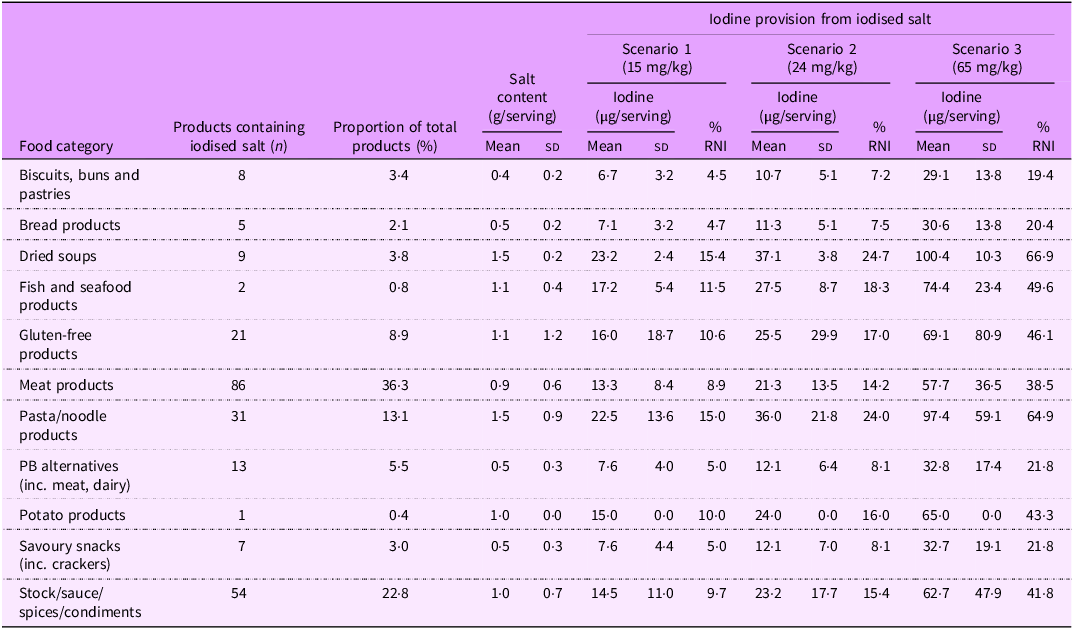
The market survey identified that, across all nine supermarket chains, there was a total of 237 unique processed foods containing iodised salt in the ingredients list. Tesco stocked the greatest number of products containing iodised salt (n 95, 40 %), whilst Co-Op stocked the least (n 8, 3 %).
Food group categories
Table 2 displays the breakdown of the 237 processed foods containing iodised salt by the eleven food groups. The most common food groups containing iodised salt were meat products (including hot dogs, pâté and salami; n 86, 36·3 %), stock/sauce/spices/condiments (n 54, 22·8 %) and pasta/noodle products (n 31, 13·1 %).
Iodised salt in processed foods according to food groups, with estimated iodine content as a percentage of the adult recommended intake

Table 2. Long description
A table comparing iodine provision from iodised salt across different food categories and scenarios. The table has 11 rows and 13 columns. Column headers are: Food category, Products containing iodised salt (n), Proportion of total products (%), Salt content (g/serving) Mean, Salt content (g/serving) SD, Scenario 1 (15 mg/kg) Iodine (µg/serving) Mean, Scenario 1 (15 mg/kg) Iodine (µg/serving) SD, Scenario 1 (15 mg/kg) %, Scenario 2 (24 mg/kg) Iodine (µg/serving) Mean, Scenario 2 (24 mg/kg) Iodine (µg/serving) SD, Scenario 2 (24 mg/kg) %, Scenario 3 (65 mg/kg) Iodine (µg/serving) Mean, Scenario 3 (65 mg/kg) Iodine (µg/serving) SD, Scenario 3 (65 mg/kg) %. Row labels include various food categories such as Biscuits, buns and pastries, Bread products, Dried soups, Fish and seafood products, Gluten-free products, Meat products, Pasta/noodle products, PB alternatives (inc. meat, dairy), Potato products, Savoury snacks (inc. crackers), Stock/sauce/spices/condiments. Each row provides data on the number of products containing iodised salt, the proportion of total products, mean and standard deviation of salt content, and iodine provision under three different scenarios with their respective percentages of the recommended nutrient intake (RNI).
RNI, Recommended Nutrient Intake of 150 µg/day for adults(11).
The majority (n 218, 92 %) of processed foods were defined as NOVA category 4, i.e. as ‘UPFs’(Reference Monteiro, Cannon and Levy21). Those classified as NOVA category 3 i.e. ‘processed foods’ (n 19, 8 %) were either tinned tomatoes or spice mixes.
Country of manufacture
Overall, processed foods containing iodised salt were manufactured in twenty-one countries around the world, including five of six WHO world regions (Africa, Americas, Europe, South-East Asia and Western Pacific). Germany was the most common country of manufacture of processed foods containing iodised salt (n 77, 32 %), followed by the UK (n 69, 29 %). The manufacturing country could not be confirmed for some products (n 15, 6 %). Of the processed foods from Germany (n 77), 74 % (n 57) were meat products, while the majority of processed foods manufactured in the UK (n 66) with iodised salt were in the stock/sauce/spices/condiments group (48 %, n 32).
Estimated iodine content from iodised salt per serving
A summary of the food groups, their average salt content and estimated iodine from salt, based on the three fortification scenarios is displayed in Table 2. The food category with the highest average salt content per serving was dried soups (1·54 g) and therefore the highest estimated iodine from iodised salt. Of all the processed foods in the survey, the highest salt content per serving (4·7 g) was in a gluten-free salami pizza, while a plant-based cream alternative had the lowest (0·03 g).
The estimated iodine from salt in Scenario 1 (15 mg/kg) was 0·5 µg to 70·5 µg per serving (0·3 to 47·0 % adult RNI(11)), Scenario 2 (24 mg/kg) was 0·8 to 112·8 µg per serving (0·5 to 75·2 % adult RNI(11)) and Scenario 3 (65 mg/kg) was 2·1 to 305·5 µg per serving (1·4 to 204·7 % adult RNI(11)). As shown by the sd in Table 2, and box and whisker diagram of Scenario 2 in Figure 2, the spread of results was high, especially in the gluten-free products group.
Box and Whisker diagram of estimated iodine provision of foods in individual food groups representing Scenario ii (salt iodisation at 24 mg/kg aligning with WHO recommendations for UK salt consumption of 8·4 g/day(1,18) ); serving sizes are as indicated on label or of similar product(23); food group ‘Potato Products’ is not displayed as there is only one data point in this category (20 µg/serving).

Proportion of processed foods using iodised salt as an ingredient
As a proportion of processed foods (total n 57 185)(Reference Clark, Springmann and Rayner25), we estimate that approximately 0·4 % of processed foods on the UK market contain iodised salt. All products in the sub-study of processed foods were available with or without iodised salt as an ingredient (Table 3), although the proportion of processed foods containing iodised salt varied across food categories. Most hot dog products (n 8, 67 %) but very few dried soups (n 2, 7 %) were made with iodised salt.
Sub-study within one supermarket chain to investigate the proportion of products in a food category containing iodised salt

Table 3. Long description
A table comparing the proportion of products containing iodised salt across different food categories. The table has 8 rows and 4 columns. The columns are labeled ‘Food category’, ‘Total products within category (n)’, ‘Number (n)’, and ‘Proportion of food category (%)’. The rows are labeled with different food categories: Dried soup, GF bread, Mayonnaise, Prawn crackers, Hot dogs (inc. frankfurter/bratwurst), Pâté, and Salami (inc. Peperami products, on pizza). Each row lists the total number of products within the category, the number of products containing iodised salt, and the proportion of the food category that contains iodised salt. Notable trends include a high proportion of hot dog products containing iodised salt (67%) and a low proportion of dried soups containing iodised salt (7%).
Discussion
Availability of retail iodised salt
In line with our hypothesis, retail iodised salt was still available to purchase in the UK, although its availability had reduced between 2009 and 2024. We found that retail iodised salt was available through 21·6 % of the GB grocery market share (three supermarket chains) in 2024 compared to 33·5 % of the GB market share in 2009 (four supermarket chains)(Reference Bath, Button and Rayman17). The concentration of iodine in iodised salt in the UK has increased from 11·5 mg/kg (in 2009) to 20 mg/kg in our study. This now aligns with the usual fortification of salt with iodine in Western and Central Europe (15 to 60 mg/kg) and is above the minimum concentration to be considered ‘adequately’ iodised(6).
The cost of retail iodised salt in 2024 (£3·75 to £4·50/kg) has increased approximately threefold since the investigation in 2009 (when it was £1·225 to £1·475/kg(Reference Bath, Button and Rayman17)). However, its cost relative to standard table salt has reduced, from approximately five to six times more expensive in 2009 to around four times more expensive in 2024, although this remains misaligned with WHO guidance that indicates the consumption of iodised retail salt ‘does not imply additional costs’(1).
Our study found only one brand (Cerebos) of iodised salt in the UK, compared with multiple brands of non-iodised table salt. In 2009, there were multiple brands of iodised salt on the market but some have since been discontinued, possibly due to lack of knowledge about iodine and therefore insufficient consumer demand(Reference Bath, Button and Rayman17,Reference Kayes, Mullan and Woodside26) . However, it is possible that alternative brands of iodised salt may be available in outlets that we did not include in our study as we restricted our search to main supermarkets. A study investigating the availability of iodised salt on the island of Ireland in 2019 also included international stores(Reference Shaw, Nugent and McNulty27) and found that iodised salt is more frequently stocked (with multiple brands) in those stores than large supermarkets; however, the low market share of international stores means that the majority of the population would not access these outlets.
Sea salt was over twenty-five times more prevalent in supermarkets than iodised salt. There are misconceptions that sea salt is a useful source of iodine, as well as containing trace amounts of minerals including Mg, potassium and Ca; however, sea salt has been shown to contain less than 2 µg/g of iodine (i.e. 2 mg/kg)(Reference Fischer and L’Abbé28), a figure that is ten times lower than the iodised salt available for purchase in the UK. Himalayan salt was sold by fifteen brands across our ten supermarket chains; it is popular due to its pink colour(29) and nutritional claims, including its relatively high Mg and Fe content, although their concentrations do not meet the threshold to be labelled as a ‘source’(Reference Kuhn, Chytry and Souza30). Indeed, to be of meaningful nutritional contribution for such minerals, consumption of around six teaspoons (30 g) of Himalayan salt daily would be required, risking excessive Na intakes and potentially sacrificing iodine intake if chosen over iodised salt(Reference Fayet-Moore, Wibisono and Carr31).
The updated data on availability of retail iodised salt in the UK that we provide in this study is useful for researchers and policymakers. The availability of retail iodised salt is lower in the UK than that of other countries(Reference Žmitek and Pravst4,Reference Machado, Pereira and Roque32–Reference Maalouf, Barron and Gunn34) , where iodised salt products are purchased in preference to standard salt varieties, possibly due to iodine public health promotion(Reference Žmitek and Pravst4). If iodine knowledge and awareness were improved in the UK, iodised salt may be purchased in preference to non-iodised options, as has been seen in other countries(Reference Žmitek and Pravst4,Reference Maalouf, Barron and Gunn34) . Total salt intake in the UK remains high, despite government salt-reduction campaigns and initial salt reduction in the UK between 2005/2006 and 2008/2009; there was no significant change in salt intake between 2009 and 2018/2019(18). However, as over 75 % of total salt consumed in the UK is from processed foods(Reference Bhat, Marklund and Henry35), the contribution of retail iodised (i.e. table) salt to total iodine intake would be negligible even if it were more widely available.
Availability of processed foods including iodised salt
In contrast to our hypothesis that iodised salt would not be in processed foods sold in the UK, we found 237 products where it was listed as an ingredient. Processed foods with iodised salt were available at all nine retailers searched. However, the overall proportion of processed foods containing iodised salt was very low – we estimate at around 0·4 % (based on a total of over 57 000 processed foods(Reference Clark, Springmann and Rayner25)). However, we identified that certain food categories have a higher proportion of products with iodised salt (up to 67 % of hot dogs in our sub-study); this may be because specific brands that manufacture these products cover a wide proportion of the market and/or they were imported from a country that implements salt iodisation. In addition, we found that whole categories of processed foods (for example, breakfast cereals) did not contain iodised salt as an ingredient, highlighting that the proportion of products containing iodised salt is not uniform across food groups.
The items containing iodised salt as an ingredient were largely foods that would otherwise not be considered as a source of iodine, and only a small proportion were iodine-rich foods such as fish and seafood products (<1 % of the processed foods identified). Iodised salt was most frequently found as an ingredient in meat products (>38 % of the processed foods containing iodised salt). The majority of meat products containing iodised salt were from Germany; most industrial salt sold in Germany is iodised, but studies have found that less than half of sausages and under a third of other meat preparations sold in Germany contain iodised salt(24,Reference Gréa, Busl and Werner36) . Meat products are consumed across all ages and account for 18 to 21 % of UK Na intake from the age of 4 years upwards(7). Populations excluding meat from their diet (for example people who are pescetarian, vegetarian or vegan reflecting 3 %, 7 % and 3 % of the UK adult population respectively(15)) would not access iodine from iodised salt in these foods.
In the Netherlands, bakery salt is permitted to be fortified with iodine up to 65 mg/kg(24), represented in this study by Scenario 3. Our searches identified thirteen bread and bakery products that contained iodised salt, including two from the Netherlands, with estimated iodine from salt of 16·3 to 17·9 µg (10·9 to 11·9 % RNI) per serving. In the UK, bread contributes an average of 12 % of adult Na intake; if UK bakery salt were fortified with iodine at 65 mg/kg, bread could provide a substantial source of iodine, which could increase population iodine intake. This is particularly relevant as a plant-source of iodine; indeed, a recent study has estimated that within a plant-based diet (EAT-Lancet), 25 to 92 % of the adult iodine recommendation can be provided through bread products in countries that use iodised salt in bread (i.e. Australia, Denmark, the Netherlands), compared with 10 % in the UK where iodised salt is generally not used in bread(Reference Nicol, Nugent and Woodside37).
Processed foods and implications for iodine intake
Most items retrieved in our online supermarket searches (n 218, 92 %) were identified as UPF, i.e. NOVA category 4. UPF are ‘formulations of ingredients, mostly of exclusive industrial use, that result from a series of industrial processes’(Reference Monteiro, Cannon and Levy21). UPF have been linked to adverse health outcomes including obesity, CVD and type II diabetes mellitus, though it is unclear whether this relates to poor nutritional quality (i.e. high in energy, fat, sugars, salt and/or low in fibre) or processing itself(38). Regardless of their NOVA classification, the foods we identified as containing iodised salt are not typically encouraged as part of healthy eating guidelines (e.g. processed meat products). However, fortifying some processed foods with iodine could be a solution to mild iodine deficiency in certain population groups. For example, adolescents have a low intake of milk (and therefore iodine)(7) but are consumers of UPF (including pre-packaged breads)(Reference Chavez-Ugalde, de Vocht and Jago39). UPF consumption is also greater in low-income and low food-security populations, groups that also have a lower intake of micronutrients, including iodine(Reference Leung, Fulay and Parnarouskis40,Reference Novaković, Cavelaars and Geelen41) . Although UPF have the potential to contribute iodine to UK intake, it is important to note that these foods should not be relied upon as primary sources of iodine, and UPF intake may be falling with public-health campaigns(Reference Chavez-Ugalde, de Vocht and Jago39). Educational interventions play a vital role in enhancing public understanding of iodine nutrition, including awareness of whole foods that serve as good dietary sources.
Plant-based alternatives
As the primary sources of iodine in the UK diet are of animal origin and therefore excluded from vegan diets, iodised salt included in the formulation of plant-based alternatives has the potential to supply iodine to vegans and consumers of plant-based diets who are at risk of inadequate iodine intake(Reference Nicol, Nugent and Woodside16). Plant-based milk-alternatives are infrequently fortified with iodine, and where they are fortified, their iodine content rarely matches levels of UK cows’ milk(Reference Nicol, Nugent and Woodside16,Reference Wall, Clegg and Zou42) . Assuming a salt-iodine concentration of 24 mg/kg (i.e. Scenario 2), the plant-based alternatives that we identified with iodised salt had an average estimated iodine from salt of 12·1 µg (8·1 % RNI) per serving. These products were mainly meat alternatives, which are not usually iodine-fortified and therefore may be important contributors to iodine intake in plant-based diets. The plant-based dairy alternatives with iodised salt were estimated to contain negligible iodine from salt (0·5–3·4 % of the adult RNI) and were not additionally fortified with iodine, thus were not equivalent to their dairy-based counterparts in terms of iodine content.
Implications of our results for dietary analysis and dietary advice
Some processed foods that we identified were estimated to contain up to 75 % of the adult RNI(11) per serving from iodised salt (based on salt-iodine concentration of 24 mg/kg). As such, it may be important to account for iodised salt included as an ingredient in processed foods when conducting dietary analysis, and some of the food table values for a number of processed foods may be inaccurate if iodised salt is not included in the iodine estimate.
Some individuals may be required to follow a low-iodine diet for a short period, such as thyroid cancer patients treated with radioactive iodine. Current low-iodine diet advice is to avoid foods such as seaweed, milk and fish, but little reference is made to processed foods(43). Our study suggests that guidance should be updated to encourage patients following a low-iodine diet to check food packaging for iodised salt.
Implications for policy
A salt iodisation policy has not been implemented in the UK(Reference Ohlhorst, Slavin and Bhide44). A survey of food manufacturers indicated that there was no concern (or unsure) about iodine deficiency in the UK and knowledge may be lacking(Reference Ohlhorst, Slavin and Bhide44); there is no push from manufacturers to integrate iodised salt into processed foods, and cost implications of reformulation may discourage manufacturers from making changes without a mandatory salt iodisation policy.
Iodine status is declining in the UK, possibly because of a reduction in UK milk-iodine concentration(7) and milk intake(14). As a result, milk and dairy products are likely contributing a lesser amount to UK iodine intake than historically(45). In some countries, particularly where milk-iodine concentration is lower, the incorporation of iodised salt into processed foods helps maintain adequate iodine intake, even when accounting for reduced salt intake(Reference Milevska-Kostova, Karanfilski and Knowles33). Therefore, consideration should be given to an iodised salt policy in the UK, including use in the food industry, as a means of improving iodine status in all population groups. This would require modelling, as proposed by the IGN guidance(19), of population dietary patterns to understand the optimal salt-iodine concentration that would minimise the risk of excessive iodine intake, protect against deficiency but align with government salt-reduction guidelines and potential dietary behaviour change. Such a policy should be alongside increasing public knowledge and awareness of iodine(Reference Bath8).
Limitations
While our study is the first to evaluate iodised salt in processed foods in the UK and provides more recent estimates of iodised salt availability, we acknowledge that there are some limitations. We recognise that as a cross-sectional study, our results only reflect the market at a specific time point and because product formulations may change, the results may differ over time. In addition, product availability was difficult to determine, with little to distinguish between items discontinued and those temporarily out-of-stock. Due to time and resource constraints, an in-store investigation of retail iodised salt was not feasible; hence, weighted availability of retail iodised salt (accounting for availability within each supermarket chain, as well as supermarket share) could not be computed or compared with previous data(Reference Bath, Button and Rayman17). It was also not possible to survey the market for a total number of processed foods; therefore, we compared the number of processed foods containing iodised salt in the UK against published data from 2019 in the UK and ROI(Reference Clark, Springmann and Rayner25); seven of nine retailers appeared both in our study and the published study used to estimate total processed foods; we therefore consider that the overall number of processed food products is at least equal to the value that we used in our calculations.
Data were collected predominantly online; only 7 % of UK grocery shoppers purchase groceries exclusively online (whilst 59 % shop exclusively in-store) – the breadth of items identified may therefore not be accessible to the whole population, owing to more limited stock in-store and individual choice of supermarket(46). One supermarket chain (Lidl, 7·8 % GB grocery market share(20)) was searched in-store for retail iodised salt availability only, and only one outlet was visited; the availability of retail iodised salt and different salt varieties may not reflect the whole chain. Furthermore, we could not collect data for all processed foods in-store in this chain, but our study still represents the majority of the grocery market (88·9 % market share(20)).
An important limitation is the fact that the quantities of iodine from salt in the processed foods are estimations only. The actual iodine concentration of the salt used in these processed foods is not known and is likely to vary between products. The processed foods were manufactured across twenty-one countries, which have specific salt-iodisation policies and fortification recommendations based on national salt consumption and estimated iodine losses(1,Reference Bath, Verkaik-Kloosterman and Sabatier9,24) . Some products listed both standard and iodised salt as ingredients, either as complex foods (i.e. salami on a pizza) or within a single food; as proportions of each salt type could not be identified, all salt was assumed to be iodised for the calculations. Our estimations only consider iodine from salt and not from other ingredients (for example, milk powder in a sauce mix); in these situations (i.e. processed foods in which salt is not the main source of iodine), our calculations may underestimate the iodine content of the foods due to iodine contribution from other ingredients. Future work should include laboratory measurements of these processed foods.
Conclusions
Overall, it is unlikely that iodised salt is a meaningful source of iodine in the UK diet. This is due to limited availability and affordability of retail iodised salt, and the fact that less than 1 % of processed foods include iodised salt as an ingredient. Retail iodised salt, though available for purchase in the UK, has limited availability and is sold at fewer retailers than in 2009; it is also less affordable than standard table salt, which is under a quarter of the price of iodised salt. Low availability and affordability may influence consumer choice, especially when considering the lack of knowledge about the nutritional importance of iodine. Despite there being no salt-iodisation policy in the UK, iodised salt is used as an ingredient in foods manufactured and imported by UK retailers, though these products represent a small proportion of the market and are more prominent in certain food types (e.g. meat products); therefore, they may not be accessed by the whole population. However, the incorporation of iodised salt in processed foods could provide a strategy to protect UK iodine status against the effects of changing milk iodine concentration, to which it is currently vulnerable, but modelling work with population-level dietary data would be required to understand the optimal iodine content and vehicles for fortification.
Acknowledgements
We thank Dr Katie Nicol, University of Surrey, for her support and guidance with data visualisation using the software R.
Author contributions
S.C.B and J.K.T designed the study. J.K.T collected and interpreted the data and wrote the first draft of the manuscript. All the authors edited and approved the final manuscript.
Financial support
J.K.T is supported by the Biotechnology and Biological Sciences Research Council (BBSRC) [grant number BB/T008776/1] as part of the Doctoral Training Partnership FoodBioSystems: biological processes across the Agri-Food system from pre-farm to post-fork.
Competing interests
None.



 Open access

