


Introduction
Environmental factors such as “urbanicity” have been associated with increased incidence of schizophrenia (Pedersen and Modersen, Reference Pedersen and Mortensen2001; Sundquist, Frank and Sundquist, Reference Sundquist, Frank and Sundquist2004; van Os, Reference van Os2004). People with a genetic liability to the disorder might be less likely to show adaptive social and cognitive functioning when coping with unsafe and stressful social environments (Weiser et al., Reference Weiser, van Os, Reichenberg, Rabinowitz, Nahon and Kravitz2007). In the case of paranoid delusionsFootnote 1 , insecure attachment and experiences of victimization are argued to contribute to excessive dopamine-mediated threat anticipation, poor theory of mind skills, externalizing biases and a negative sense of self (Bentall and Fernyhough, Reference Bentall and Fernyhough2008; Freeman, Reference Freeman2007).On a day-to-day basis, it is hypothesized that events in the social environment, as well as internal representations, are experienced as salient (Kapur, Reference Kapur2003), while jumping-to-conclusions data-gathering (JTC) biases and safety behaviours, such as avoidance of situations perceived to be dangerous or confrontation of persecutors, contribute to the maintenance of paranoia by preventing belief disconfirmation and shaping the environment (Freeman, Reference Freeman2007; Freeman, Garety et al., Reference Freeman2007).
Despite the consistent epidemiological data pointing to the role of the social environment in psychosis, there has been remarkably little research aiming to understand the ongoing interaction between individual and environment influencing the course of the disorder. A few quantitative studies have started to address the question about the ongoing interplay between self and environment using innovative experimental paradigms. The Camberwell walk study recently showed that brief exposure to a deprived urban environment resulted in increases in anxiety, JTC, negative beliefs about others, and paranoia in people with persecutory delusions (Ellett, Freeman and Garety, Reference Ellett, Freeman and Garety2008). The experience of social threat in daily life has also been shown to be dependent on social context (degree of familiarity with social company) among people who are low or medium in trait paranoia (Collip et al., Reference Collip, Oorschot, Thewissen, van, Bentall and Myin-Germeys2011). However, in the study by Collip et al. (Reference Collip, Oorschot, Thewissen, van, Bentall and Myin-Germeys2011), people high in trait paranoia reported similar levels of social threat either in the presence of familiar or unfamiliar company. Although the experience sampling methodology allows moment-to-moment assessment in normal daily life, Collip et al. (Reference Collip, Oorschot, Thewissen, van, Bentall and Myin-Germeys2011) note that the subjective nature of these reports was a methodological limitation in their study. Without any objective information about the social environment it is not possible to conclude that the perceived higher social threat reported by the high trait paranoia group in relation to “familiar” company (e.g. family members) was unfounded, particularly in light of the literature suggesting associations between paranoia and increased incidence of traumatic interpersonal events (Gracie et al., Reference Gracie, Freeman, Green, Garety, Kuipers and Ray2007).
In the only qualitative study examining interpersonal threat in people with persecutory delusions, Stopa, Denton, Wingfield and Taylor (2012) found vivid accounts of a sense of imminent danger that included affective, sensory and perceptual experiences, as well as coping behaviours initiated in response to threat, including attempts to avoid, escape or control the experience. Although this study provides valuable information about how rich and compelling the experience of interpersonal threat can be, the role of environmental factors was not controlled for, as participants were asked to recount a recent situation involving interpersonal threat that caused distress.
Virtual reality (VR) offers the possibility of complete experimental control as well as ecological validity, as there is extensive evidence showing that people respond to computer-generated characters (avatars) as if they were social agents (Garau, Slater, Pertaub and Razzaque, Reference Garau, Slater, Pertaub and Razzaque2005; Pertaub, Slater and Barker, Reference Pertaub, Slater and Barker2002; Slater, Pertaub, Barker and Clark, Reference Slater, Pertaub, Baker and Clark2006). Crucially, participants’ own mistrustful or unusual behaviour (i.e. safety behaviours) cannot elicit hostile responses from avatars. Therefore if a neutral social situation in VR elicits paranoid appraisals about avatars it is certain that these are unfounded. This technology offers a unique opportunity to investigate the interpretation of events in the same environment in more detail using qualitative methodology. To date, virtual reality has been used to investigate paranoia in the general population (Freeman et al., Reference Freeman, Slater, Bebbington, Garety, Kuipers and Fowler2003; Freeman, Garety, Bebbington, Slater et al., Reference Freeman, Garety, Bebbington, Slater, Kuipers and Fowler2005,; Freeman et al., Reference Freeman, Pugh, Antley, Slater, Bebbington and Gittins2008), in people with an at-risk mental state (Valmaggia et al., Reference Valmaggia, Freeman, Green, Garety, Swapp and Antley2007) and in people with persecutory delusions (Fornells-Ambrojo et al., Reference Fornells-Ambrojo, Barker, Swapp, Slater, Antley and Freeman2008; Freeman, Pugh, Vorontsova, Antley and Slater, Reference Freeman, Pugh, Vorontsova, Antley and Slater2010). Persecutory ideation in VR is predicted by anxiety, worry, interpersonal sensitivity, cognitive inflexibility and perceptual abnormalities (Freeman, Garety, Bebbington, Slater et al. Reference Freeman, Garety, Bebbington, Smith, Rollinson and Fowler2005; Valmaggia et al., Reference Valmaggia, Freeman, Green, Garety, Swapp and Antley2007).
Intriguingly, when people with early psychosis who report persecutory delusions in their everyday lives are presented with an ecologically valid neutral virtual environment, their paranoid appraisals resemble those of non-clinical controls (Fornells-Ambrojo et al., Reference Fornells-Ambrojo, Barker, Swapp, Slater, Antley and Freeman2008). It appears that when not faced with an environment that elicits anxiety, as in the example of the urban exposure to a deprived neighborhood (Ellett et al., Reference Ellett, Freeman and Garety2008), and by not being able to shape the social environment with their own safety-seeking behaviours, the judgement of neutral virtual agents by people with ongoing persecutory ideation who are experiencing their first episode of psychosis is preserved.
The current qualitative study aims to understand the decision making process involved in the formation of unfounded paranoid beliefs in people with psychosis. In particular, we aim to understand the type of evidence provided in favour of and against persecutory ideas, as well as the behavioural choices of people with persecutory delusions while immersed in a neutral social virtual environment. The paper reports a secondary analysis using previously unpublished qualitative data from the sample used by Fornells-Ambrojo et al. (Reference Fornells-Ambrojo, Barker, Swapp, Slater, Antley and Freeman2008).
Method
Design
This study used data from interviews conducted with people with early psychosis and non-clinical participants after exposure to a neutral virtual reality scenario for a quantitative study assessing safety and feasibility of virtual reality use in people with persecutory beliefs (Fornells-Ambrojo et al., Reference Fornells-Ambrojo, Barker, Swapp, Slater, Antley and Freeman2008). The study received approval from a NHS research ethics committee.
Measures
In the main study participants completed measures before and after entering the virtual environment (Fornells-Ambrojo et al., Reference Fornells-Ambrojo, Barker, Swapp, Slater, Antley and Freeman2008). Pre-virtual reality assessment measures included the Positive and Negative Syndrome Scale (PANSS; Kay, Fiszbein and Opfer, Reference Kay, Fiszbein and Opfer1987), a 30-item well established symptom rating scale in schizophrenia research; the Wechsler Test of Adult Reading (WTAR; Ginsberg, Reference Ginsberg2003), which is designed to estimate premorbid intellectual functioning in individuals aged 16 to 89; and the state scale of the Spielberger State-Trait Inventory (STAI; Spielberger, Gorsuch, Lushene, Vagg and Jacobs, Reference Spielberger, Gorsuch, Lushene, Vagg and Jacobs1983), which has 20 items that measure current level of anxiety (e.g. “I feel nervous”) on a 4-point scale. Post-virtual reality assessment included a repeat completion of the state anxiety measure to determine whether the virtual environment had caused any distress (STAI; Spielberger et al., Reference Spielberger, Gorsuch, Lushene, Vagg and Jacobs1983), as well as the State Social Paranoia Scale (SSPS; Freeman, Pugh et al., Reference Freeman2007), a 20-item self-report questionnaire assessing thoughts in relation to the virtual characters on a 5-point- scale, with 10 items measuring persecutory thoughts (e.g. “someone had it in for me”) and 10 items assessing neutral and positive thoughts. Lastly, participants completed a semi-structured interview that is the focus of the current study.
Interpersonal experiences in VR interview
The VR semi-structured interview (Freeman et al., Reference Freeman, Slater, Bebbington, Garety, Kuipers and Fowler2003) was administered to participants at the post-virtual reality assessment stage. This is a 10 minute interview that focuses on interpersonal experiences with computer-generated characters. The interview includes questions about participants’ thoughts regarding the intentionality of the characters and the evidence in favour and against such judgements. The semi-structured format allowed for participants to expand on questions. The interviewer prompted participants to discuss the following aspects of their VR experience: general (e.g. “what did you think of your virtual reality experience?”), interpersonal (e.g. “what did you think of the people in the virtual environment?”, “do you think people in the virtual Tube had intentions towards you?”) and evidence (e.g. “what made you think that?”, “what evidence did you base your thoughts on?”). The interviews were audio-recorded.
Participants
Participants with early psychosis were recruited from two specialist early intervention services in London. The inclusion criteria for the study were: diagnosis of non-affective psychosis; a score of at least moderate severity (4) on the Suspiciousness item (P6) of the Positive and Negative Syndrome Scale (PANSS; Kay et al., Reference Kay, Fiszbein and Opfer1987); and a current persecutory delusion as defined by Freeman and Garety (Reference Freeman and Garety2000). The exclusion criteria were: primary diagnosis of substance misuse or learning disability. Age-matched non-clinical participants were recruited from participant panels at the Institute of Psychiatry, King's College London and University College London (UCL). The inclusion criteria were no previous psychiatric history and a negative screen for psychotic symptoms on the Psychosis Screening Questionnaire (Bebbington and Nayani, Reference Bebbington and Nayani1995). Exclusion criteria for both clinical and non-clinical participants were: poor command of English, and a history of epilepsy.
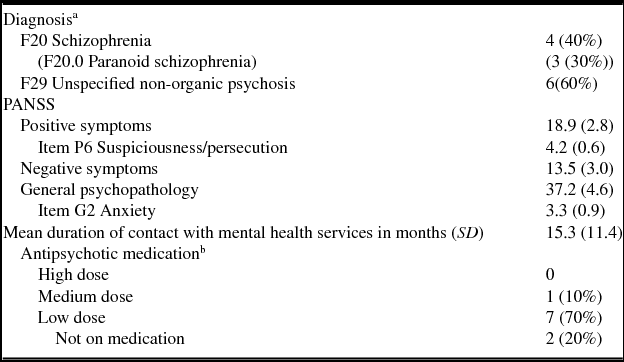
The main study included a sample of 20 participants in each group (Fornells-Ambrojo et al., Reference Fornells-Ambrojo, Barker, Swapp, Slater, Antley and Freeman2008). Following sample size recommendations for phenomenological studies (Creswell, Reference Creswell1998; Morse, Reference Morse, Denzin and Lincoln1994), the tapes of the first 10 non-clinical and the first 10 clinical participants post virtual reality interviews were transcribed. The mean age was 24.2 (SD = 2.3) for the group with persecutory delusions (n = 10) and 23.8 (SD = 2.3) for the healthy volunteers group (n = 10), t (14.7) = 0.3, p = .789). All of the 10 clinical, and eight out of 10 of the non-clinical participants were male. Pre-morbid IQ as assessed by the Wechsler Test for Adult Reading (WTAR; Ginsberg, Reference Ginsberg2003) was significantly lower in the clinical (M = 92.1; SD = 10.1) than in the non-clinical group (M = 107.3, SD = 6.6, t (16) = −3.6, p = .002). Nine out of 10 and 8 out of 10 of the clinical and non-clinical participants were from Black or other ethnic minorities. Table 1 summarizes the clinical characteristics of the group with persecutory delusions.
Clinical characteristics of the persecutory delusions group (n = 10)

a ICD-10 (World Health Organization); b Levels of Chlorpromazine equivalents
Virtual environment
Apparatus
The virtual environment was displayed in an immersive projection system typically referred to as CAVE (Cruz-Neira, Sandin and DeFanti, Reference Cruz-Neira, Sandin and DeFanti1993), specifically a Trimension ReacCTor. Lightweight CrystalEyes LCD shutterglasses delivered a stereo view of the virtual world. Participants had their head position and orientation tracked with an inertial/ultrasonic system (Intersense IS900) that was fitted on top of the glasses. They also carried a joystick. Participants moved around the virtual space with a combination of walking and whole body turning based on the head tracking as well as by using the joystick.
Environment
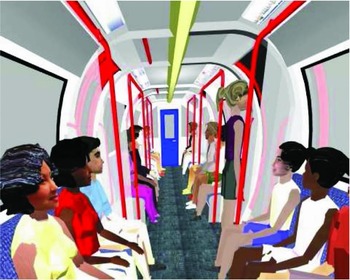
The experimental environment consisted of a virtual train carriage modelled on the London Underground, colloquially known as the Tube (see Figure 1). Participants boarded the virtual train and disembarked after two stops, 4 minutes later. Participants were instructed to explore the environment, and to try to form an impression of the people in the virtual carriage. Background noises associated with being in the London Underground were played (e.g. background rumble of the moving train).
Virtual reality tube image

Avatars
The environment was designed to be neutral. The carriage was populated with 20 computer-generated characters. Both genders and a range of ethnicities were represented. Avatars were programmed to exhibit only neutral behaviour. They glanced up and around the train carriage and occasionally they changed their facial expressions but they did not display any overtly hostile or friendly behaviour. Eight of the 20 avatars had mobility. For avatars that moved, there was an 80% chance of looking in the direction of the head tracker and a 10% chance of looking left or right. Specifically, 80% of avatar movement was contingent on the location of the participant but not to his/her specific behaviour or actions in the virtual carriage (i.e. the avatar looked in the direction of the participant whether he/she was looking at the avatar or not, whether he/she was near or far away).
Qualitative analyses
Thematic analyses (Joffe and Yardley, Reference Joffe, Yardley, Marks and Yardley2004) were conducted on the interviews about the virtual reality experience. The transcripts were analysed one at a time by the first author. The interview covered two main domains: general views about virtual reality, and intentionality appraisals. Only the latter are reported here. Themes about the understanding of other people's intentions were identified using an iterative process. The focus was on the content and the evidence behind persecutory appraisals, the behaviour of the participant in the virtual environment, and interactions with computer generated characters. Themes were generated from the interviews, and emerging themes were constantly compared and grouped intro superordinate themes. The software NVivo-7 (QSR International, 2006) was used to make notes about text, and to create and organize emerging themes. The emerging themes were then cross-checked to ensure that the analysis was grounded in the interviews. Planned credibility checks (Elliott, Fischer and Rennie, Reference Elliott, Fischer and Rennie1999) included assessing correspondence between qualitative and quantitative analyses (e.g. sense of presence questionnaire, distress assessed by anxiety questionnaire, and VR-persecutory ideation assessed by questionnaire) and auditing of two cases by an independent researcher (EH, a trainee clinical psychologist with experience with people with psychosis) who examined the correspondence between the themes that had been extracted and the original source.
Results
Persecutory ideation in VR: thematic analyses
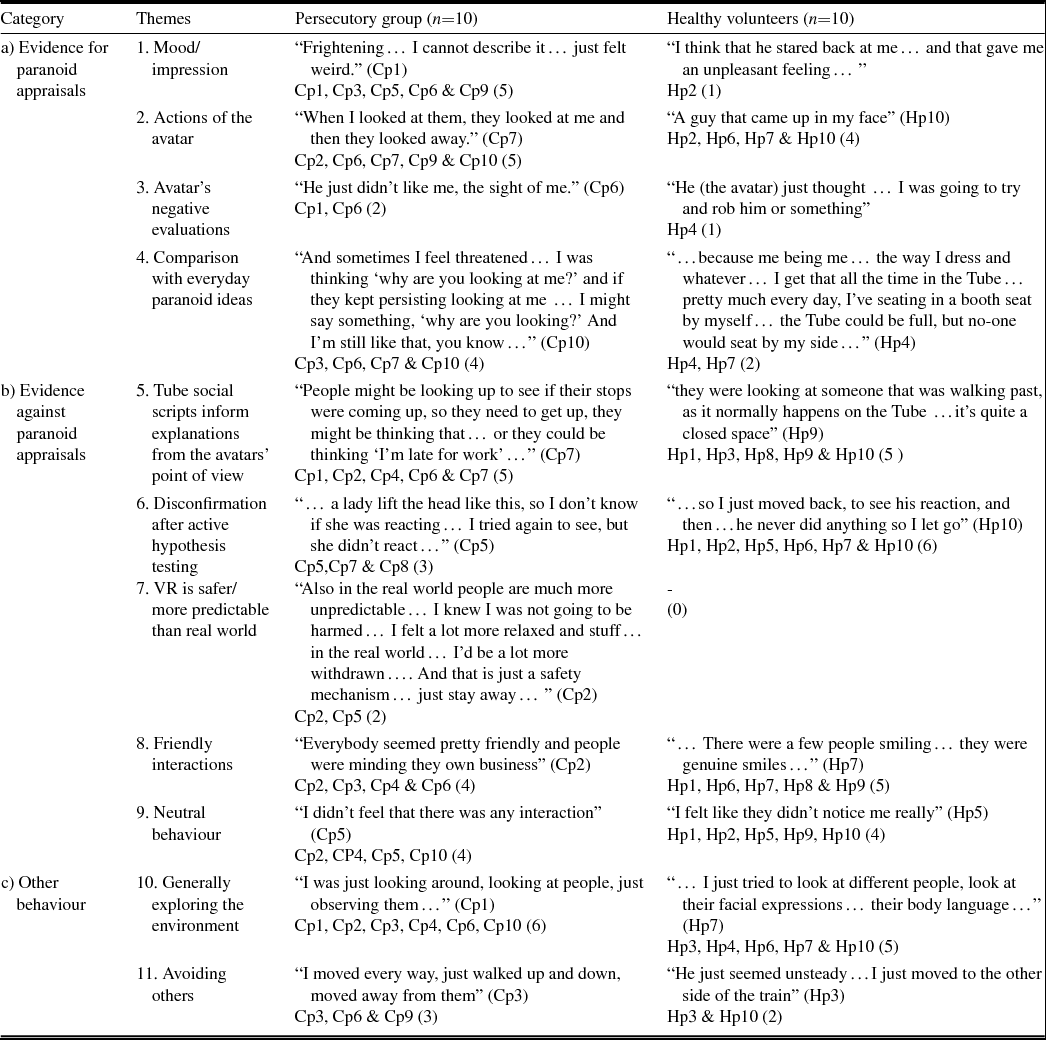
The thematic analyses of the transcripts yielded 11 themes that were grouped into 3 main categories: (a) evidence in favour of paranoid appraisals; (b) evidence against paranoid appraisals; and (c) other behaviour of participants in the virtual environment. The data suggest that all participants appeared to consider a range of alternative explanations in relation to virtual characters (e.g. is behaviour intentionally hostile/friendly/neutral?) and provided evidence of their decision making process. Table 2 shows verbatim excerpts from interviews with participants in each group and the numbers of participants who mentioned each theme.
Themes and quotations for the “intentionality appraisals in VR”

()* Number of participants with the theme in each group
Participants provided four main types of evidence in support of paranoid beliefs in the virtual environment: “mood/impression” evidence refers to descriptions of participants’ negative emotions and negative initial perceptions of avatars (Theme 1); “actions of avatars” include interpretations of the head movement of avatars as evidence of rejection (e.g. avatar turning head “away from me”) or threat (e.g. avatar coming too close) (Theme 2); “negative evaluations” contain comments that suggest the participant believed avatars viewed them in a negative light (Theme 3); and “comparison to everyday paranoid ideas” includes reference to pre-existing beliefs about threat in daily interactions used to anticipate threat in the virtual scenario (Theme 4).
The evidence against paranoid interpretations included three main themes: “social scripts about Tube etiquette” were used by participants to discuss circumstantial explanations for the behaviour of avatars (Theme 5); “disconfirmation after hypothesis testing” involved concluding that avatars were not reacting in relation to one's movements after actively attempting to cause a reaction (Theme 6); “safety of the virtual environment” included comments contrasting the virtual Tube to a less safe and unpredictable real world (Theme 7); “friendly interactions” described positive exchanges with the avatars (Theme 8); and “neutral behaviour” referred to inconsequential behaviour from avatars, not overtly positive or negative (Theme 9).
Lastly, participants engaged in two main types of additional behaviours: “exploration” of the environment without a particular goal (Theme 10); and “avoidance” of avatars that were perceived negatively by staying physically far away from them in the virtual Tube carriage (Theme 11).
Overall, thematic analyses indicate that similar types of evidence and behaviour were reported by clinical participants and healthy volunteers. People with persecutory delusions, like healthy volunteers, showed the ability to take into account the computer characters’ point of view when interacting with them in the virtual Tube (Theme 5).
The data displayed in Table 2, however, indicates that not all themes were equally common in each group. More participants with persecutory delusions discussed evidence in favour of persecutory appraisals in VR that related to affect (Theme 1) or referred to pre-existing (not delusional) beliefs about paranoia in everyday life (Theme 4). On the other hand, active hypothesis testing (Theme 6) was less frequently used by clinical group members.
Quantitative data: anxiety and state paranoia
As in the main study (Fornells-Ambrojo et al., Reference Fornells-Ambrojo, Barker, Swapp, Slater, Antley and Freeman2008), participants in the persecutory delusion group reported higher levels of state anxiety as assessed by the STAI (Mean pre-VR anxiety = 36.9; SD = 6.54) prior to entering the virtual environment compared to healthy volunteers (Mean pre-VR anxiety = 26.9; SD = 5.76, Mann-Whitney U = 10.0, p = .002), but neither of the groups reported an increase in anxiety post-VR (Persecutory group mean post VR anxiety = 36.3; SD = 7.27), Wilcoxon signed-ranks Z = −0.28, p = .779; Healthy volunteers group mean post VR anxiety = 24.9; SD = 3.93), Wilcoxon signed-ranks Z = −1.48, p = .137). Overall, the neutral virtual environment did not cause distress or increased levels of anxiety.
Similarly, the environment was generally perceived as non-threatening, as suggested by frequent reports of positive or neutral appraisals about avatars as assessed by the State Paranoia Scale (SSPS; Freeman, Pugh et al., Reference Freeman2007) in the clinical (M = 23.9; SD = 5.72)) and non-clinical groups (M = 27.8; SD = 6.68). Of interest for the current study is that the mean number of VR-persecution scores as assessed by this scale (SSPS; Freeman, Pugh et al., Reference Freeman2007) did not significantly differ between the groups (Persecutory group mean = 15.6; SD = 6.2; Healthy volunteers group mean = 14.0; SD = 5.83), (Mann-Whitney U = 44.5, p = .663), suggesting that both groups reported similar endorsement of paranoid thoughts about the computer-generated characters. The equivalent figures for the main study are: Persecutory group (n = 20; M = 14.9; SD = 5.56); Healthy volunteers group (n = 20; M = 13.3; SD = 4.56), (Mann-Whitney U = 169.5, p = .414). In sum, the quantitative data for the subset of participants included in the current study are similar to the whole sample reported (Fornells-Ambrojo et al., Reference Fornells-Ambrojo, Barker, Swapp, Slater, Antley and Freeman2008).
Correspondence with quantitative reports or paranoia in VR
Six out of 10 clinical participants (Cp1, Cp3, Cp6, Cp7, Cp9 and Cp10) and 5 out 10 healthy volunteers (Hp2, Hp4, Hp6, Hp7 and Hp10) whose interview is included in thematic analyses had endorsed at least one item of persecutory ideation in the SSPS (Freeman, Pugh et al., Reference Freeman2007) as reported in Fornells-Ambrojo et al. (Reference Fornells-Ambrojo, Barker, Swapp, Slater, Antley and Freeman2008). All the participants who endorsed an item of persecutory ideation in the SSPS questionnaire provided evidence in favour of their belief during the interview (see Table 2), showing correspondence between both types of analyses. However, two clinical participants (Cp2 and Cp5) who did not endorse any item suggesting paranoid ideation in VR in the SSPS (Freeman, Pugh et al., Reference Freeman2007) had entertained the possibility of evidence in favour of persecutory ideas (e.g. see Themes 1 and 2) but discarded it using evidence against paranoid interpretation. In particular, they both argued that VR felt safer than the real world (Theme 7) and provided other additional evidence against paranoid interpretation of events (see Table 2 for details).
Discussion
The present study is the first to investigate how people with persecutory delusions evaluate threat in a controlled social environment using qualitative methodology. The rationale for using an experimentally controlled environment to investigate paranoia is that interpersonal exchanges can be programmed to be neutral. Crucially, the behaviour of participants does not elicit hostile intent in avatars and therefore paranoid thoughts in VR are unfounded. Under these circumstances, people with early psychosis who experience persecutory delusions reported similar levels of paranoia to non-clinical participants (Fornells-Ambrojo et al., Reference Fornells-Ambrojo, Barker, Swapp, Slater, Antley and Freeman2008) and the current qualitative study showed that they are able to use a range of strategies when evaluating potential interpersonal threat. However, the thematic analyses also suggested that people with persecutory delusions are more likely to use their own affect as evidence of persecution and less inclined to use active-hypothesis testing than healthy volunteers when assessing threat. The findings are next discussed in relation to current cognitive and psycho-social models of persecutory delusions, and hypotheses for further research are put forward.
Role of environmental factors in maintaining paranoia
Evaluating evidence of threat in a controlled social environment that does not elicit anxiety
Increases in anxiety have been shown to predict onset of paranoid thinking in daily life (Thewissen et al., Reference Thewissen, Bentall, Oorschot, Campo, van and van2011). Moreover, the Camberwell study (Ellett et al., Reference Ellett, Freeman and Garety2008) showed that exposure to a deprived urban environment results in increases in anxiety and jumping to conclusions (JTC) reasoning biases, which in turn were associated with exacerbations in paranoid thinking among people with persecutory delusions.
However, qualitative analyses in the current study revealed that when anxiety is not raised by the social environment, people with psychosis with current persecutory delusions are able to use a range of strategies when assessing potential threat, as shown by them providing a range of evidence in favour and against paranoid interpretations of the virtual environment. This hypothesized preserved ability to accurately judge the social threat under these circumstances is consistent with experimental evidence that emotional arousal exacerbates reasoning biases in people with psychosis (Dudley, John, Young and Over, Reference Dudley, John, Young and Over1997; McGuire, Junginger, Adams, Burright and Donovick, Reference McGuire, Junginger, Adams, Burright and Donovick2001). Although emotions and reasoning biases have been shown to make independent contributions to delusional conviction (Garety et al., Reference Garety, Freeman, Dunn, Bebbington, Fowler and Kuipers2005; So, Freeman and Garety, Reference So, Freeman and Garety2008) there is also evidence that jumping-to-conclusions data gathering biases (JTC) partly mediate the association between anxiety and paranoia in non-clinical controls (Lincoln, Lange, Burau, Exner and Moritz, Reference Lincoln, Lange, Burau, Exner and Moritz2010).
Both groups reported using previous beliefs about the world and others when making sense of their environment. This is in accordance with cognitive models of persecutory delusions (Bentall, Corcoran, Howard, Blackwood and Kinderman, Reference Bentall, Corcoran, Howard, Blackwood and Kinderman2001; Chadwick, Birchwood and Trower, Reference Chadwick, Birchwood and Trower1996; Freeman, Garety, Kuipers, Fowler and Bebbington, Reference Freeman, Garety, Kuipers, Fowler and Bebbington2002), and also general cognitive theories of non-psychotic disorders (Beck, Reference Beck1976; Gilbert, Reference Gilbert1992; Teasdale and Barnard, Reference Teasdale and Barnard1993) as well as non-clinical social cognitive theories that emphasize the role of the perceiver's pre-existing schemas in forming impressions of others (Baldwin, Reference Baldwin1992; Fiske and Taylor, Reference Fiske and Taylor1991; Schneider, Reference Schneider1973). Circumstantial, as opposed to intentional, explanations of events were provided by both groups, and explicit reference made to social scripts about “Underground behaviour”, which again is in line with general social cognitive theories (Abelson, Reference Abelson1981).
Further research using a virtual environment that raises state anxiety is needed to investigate the hypothesis that the lack of increases in anxiety in the current neutral environment was associated with preserved accuracy of decision making when evaluating interpersonal threat.
Evaluating threat in a controlled virtual scenario in contrast to the malleable and stressful social everyday environment
The virtual environment employed in the current study was programmed to be neutral and the behaviour of participants could not elicit hostility or suspiciousness in avatars. Implications for further research focusing on understanding the impact of safety behaviours and environmental factors in the maintenance of paranoia are discussed next.
It would have been useful to include an assessment of safety behaviours (Freeman, Garety et al., Reference Freeman2007) in the current study in order to ascertain if people with persecutory delusions who did not endorse paranoid items in VR would tend to behave in a manner that might lead to suspicious reactions in other people in the real world, which they could interpret as further evidence of their paranoia. For instance, they might act on their delusional beliefs and display safety behaviours intended to reduce harm (e.g. they might repeatedly look at, or move away from, a person on the street who appears threatening to them) or they might show aggression towards others (e.g. shouting or physical aggression towards people believed to be a threat against the self) (De Pauw and Szulecka, Reference dePauw and Szulecka1988; Freeman, Garety et al., Reference Freeman2007; Link and Stueve, Reference Link, Stueve, Monahan and Steadman1994; Swanson, Borum, Swartz and Monahan, Reference Swanson, Borum, Swartz and Monahan1996) with the unfortunate consequence of eliciting concerned looks or retaliation that could be taken as confirmatory evidence for original threat belief. This they were not able to do in the current controlled virtual environment as avatars remained neutral throughout.
Similarly, the virtual environment depicted in the current study was clearly less threatening than the real environment in which people with psychosis live. Life events involving experiences of humiliation, victimization and powerlessness have been associated with paranoia (Chisholm, Freeman and Cooke, Reference Chisholm, Freeman and Cooke2006; Melo, Taylor and Bentall, Reference Melo, Taylor and Bentall2006; Mirowski and Ross, 1984; Raune, Bebbington, Dunn and Kuipers, Reference Raune, Bebbington, Dunn and Kuipers2006).The theme that VR was “safer” than the real world emerged from the thematic analyses from interviews with the clinical group. For instance, one participant commented that the streets of Brixton were more dangerous than the virtual Tube scenario. This interpretation would support current multifactorial models of persecutory delusions in which adverse life events are proposed to interact with affective and cognitive processes in maintaining paranoid ideation (Bentall et al., Reference Bentall, Corcoran, Howard, Blackwood and Kinderman2001; Freeman et al., Reference Freeman, Garety, Kuipers, Fowler and Bebbington2002). Further research using virtual reality should investigate the role of environmental factors by systematically manipulating aspects of the virtual environment and by evaluating the role of anxiety using randomized controlled designs (Freeman, Reference Freeman2008), as the current virtual scenario, although an ecologically valid representation of a tube journey that is typically characterized by neutral social interactions, was not designed to replicate a socially deprived inner London borough setting, in which potentially threatening events could take place (e.g. street crime, drug or alcohol consumption, gang related activities).
Environmental risk factors could also be controlled in future studies by matching participants on their geographical living arrangements. In fact, non-clinical participants were recruited using participant panels in academic institutions and therefore could be potentially living in any area of London, whereas participants from the clinical group were living in areas of London characterized by high levels of deprivation (Index of Multiple Deprivation, 2004). Further studies should collect information about current socio-economic status and level of deprivation in the borough where participants live. In the only other virtual reality quantitative study looking at paranoia using a clinical sample, Freeman et al. (Reference Freeman, Pugh, Vorontsova, Antley and Slater2010) used an updated version of the current tube scenario with a head-mounted display and showed that people with persecutory delusions from a psychosis sample, not exclusively early episode, reported significantly higher levels of unfounded persecutory ideation than healthy volunteers, demonstrating that virtual reality can be used to validate the groups. Interestingly, non-clinical participants were recruited from the same geographical area as clinical participants using leaflets distributed to local postcodes surrounding local psychiatric services.
Emotion as evidence for persecutory ideation and reduced hypothesis testing
Although both groups reported similar themes in their decision making, the qualitative analyses suggest a trend for two group differences in the type of evidence used in VR appraisals. The group with persecutory delusions provided more “affective” evidence in favour of their paranoid thoughts in VR (i.e. described their own emotion as evidence of intentionality in avatar behaviour), which is coherent with current thinking about psychosis in which affective processes are proposed to be at the core of psychotic symptoms (Bentall, Kaney and Dewey, Reference Bentall, Kaney and Dewey1991; Bentall, Kinderman and Kaney, Reference Bentall, Kinderman and Kaney1994; Bentall et al., Reference Bentall, Corcoran, Howard, Blackwood and Kinderman2001; Birchwood, Reference Birchwood2003; Freeman et al., Reference Freeman, Garety, Kuipers, Fowler and Bebbington2002; Garety, Kuipers, Fowler, Freeman and Bebbington, Reference Garety, Kuipers, Fowler, Freeman and Bebbington2001) and with the notion of aberrant salience (Kapur, Reference Kapur2003), in which a neutral event (e.g. a gesture of an avatar) is “experienced” as an aversive event and elicits a search for meaning. People with persecutory delusions were also less likely to use active hypothesis testing to disconfirm hypotheses about paranoid intentions in VR than non-clinical controls, which fits with evidence on reasoning biases in people with delusions (e.g. Garety et al., Reference Garety, Freeman, Dunn, Bebbington, Fowler and Kuipers2005).
The qualitative findings in the current study are consistent with data from a recent quantitative study in which persecutory ideation was found to be associated with greater use of experiential reasoning, typically defined as “affect as heuristic” (e.g. gut feeling) and reduced use of rational-analytical thinking in a self-report questionnaire (Freeman, Evans and Lister, Reference Freeman, Evans and Lister2012). Dual-processing theory (Evans and Over, Reference Evans and Over1996; Sloman, Reference Sloman1996; Stanovich and West, Reference Stanovich and West2000) may provide a useful framework for cognitive therapy for paranoia in which deliberate analytic reasoning could be promoted to compensate for the reported reliance on intuition and affect, as well as the JTC data-gathering bias typically associated with delusions in empirical studies. Accordingly, Waller, Freeman, Jolley, Dunn and Garety (2011) recently reported a pilot intervention specifically targeting reasoning biases in people with delusions that resulted in improvements in JTC, belief flexibility and reduced delusional conviction.
Limitations and further research
A number of methodological limitations ought to be taken into account when considering the findings. People with persecutory delusions in the current study were living in the community and were engaged with community services, so it is possible that individuals in a more acute state of illness requiring hospitalization might be less sensitive to the ongoing social environment when making threat appraisals, as was the case with the high paranoid group in the experience sampling study by Collip et al. (Reference Collip, Oorschot, Thewissen, van, Bentall and Myin-Germeys2011). Moreover, participants had willingly decided to take part in the research project, presumably because, in spite of their persecutory delusions, they felt it was “safe enough” to do so. However, all fulfilled the criteria of persecutory delusions (Freeman and Garety, Reference Freeman and Garety2000) and had a score of at least moderate severity in the PANSS (Kay et al., Reference Kay, Fiszbein and Opfer1987) and therefore the current research is a valid investigation in the spectrum of persecutory delusions. It is, however, possible that people with a higher degree of severity of persecutory delusions and emotional disturbance (e.g. inpatients) would have been more likely to endorse paranoid thinking and described a reduced range of decision-making strategies than the current sample.
Paranoid thoughts about virtual characters were not assessed as a dimensional experience in the main study (Fornells-Ambrojo et al., Reference Fornells-Ambrojo, Barker, Swapp, Slater, Antley and Freeman2008). This is an important limitation since research investigating the continuum of delusional beliefs has shown that, although non-clinical samples endorse delusional items, they tend to report less conviction, distress and preoccupation than clinical participants (Peters, Day, McKenna and Orbach, Reference Peters, Day, McKenna and Orbach1999; Peters, Joseph and Garety, Reference Peters, Joseph and Garety1999; Peters, Joseph, Day and Garety, Reference Peters, Joseph, Day and Garety2004). Moreover, the instructions prompted participants to form an impression of the computer-generated characters before they entered the VE, and it is possible that healthy volunteers might have been less likely to spontaneously focus on understanding the intentions of others if they had not been instructed to do so (Fornells-Ambrojo et al., Reference Fornells-Ambrojo, Barker, Swapp, Slater, Antley and Freeman2008). However, reports of paranoid ideation in non-clinical samples are consistent with the proposition that paranoia lies on a continuum that runs from normality to the extreme experiences of people suffering from psychosis (e.g. Freeman, Freeman and Garety, Reference Freeman, Freeman and Garety2006). The use of an interview about decision making also relied on participants’ ability to reflect on their own reasoning processes, which often do not involve awareness. This is important in the light of reduced narrative coherence noted by Stopa et al. (Reference Stopa, Denton, Wingfield and Taylor2012) when they interviewed participants about experiences of interpersonal threat. However, it is encouraging that the findings in the current study were coherent with existing findings using quantitative data (Freeman et al., Reference Freeman, Evans and Lister2012).
Another limitation of the current study that warrants further research relates to the lack of an additional virtual environment as a control condition. Manipulations on the visual responsivity of avatars have been shown to have an impact on the sense of personal contact with them when compared to environments in which avatars are static or simply moving (Garau et al., Reference Garau, Slater, Pertaub and Razzaque2005). Eight avatars in the virtual environment used in the current study were programmed to look left or right 10% of the time and to look in the direction of the participant's eyes (i.e. towards the tracker device on their 3D glasses) 80% of the time. Thus, 80% of avatar movement was contingent on the location of the participant but not to his/her specific behaviour or actions in the virtual carriage (i.e. the avatar looked in the direction of the participant whether he/she was looking at the avatar or not, whether he/she was near or far away). Future studies could examine what aspects of the social environment trigger paranoid thoughts by using different virtual environments as well as by extending the work of Ellett et al. (Reference Ellett, Freeman and Garety2008) to learn about the psychological effects of different real urban environments by varying specific aspects (e.g. density, level of deprivation, threatening behaviour).
Clinical implications
VR has the potential to be incorporated into cognitive behavioural interventions for psychosis as has occurred with anxiety disorders (Carlin, Hoffman and Weghorst, Reference Carlin, Hoffman and Weghorst1997; Difede and Hoffman, Reference Difede and Hoffman2002; Emmelkamp et al., Reference Emmelkamp, Krijn, Hulsbosch, de Vries, Schuemie and van der Mast2002; Garcia-Palacios, Hoffman, Carlin, Furness and Botella, Reference Garcia-Palacios, Hoffman, Carlin, Furness and Botella2002; Krijn, Emmelkamp, Olafsson and Biemond, Reference Krijn, Emmelkamp, Olafsson and Biemond2004; Powers and Emmelkamp, Reference Powers and Emmelkamp2008; Rothbaum, Hodges, Smith, Lee and Price, 1995; Wallach, Safir and Bar-Zvi, Reference Wallach, Safir and Bar-Zvi2009). The current study showed that people with persecutory delusions are able to describe the decision making process involved in appraising threat in a virtual encounter, which suggests that VR could be used as a therapeutic tool. A series of virtual scenarios that are increasingly anxiety-provoking could be used while the client is encouraged to continue using a range of strategies to evaluate evidence in favour and against a possible threat (e.g. active hypothesis testing, use of social scripts). This rehearsal process could provide clients with experiential evidence and increase their confidence when evaluating stressful environments in everyday life. Additionally, targeting increases in arousal when facing everyday social situations is likely to be a fruitful intervention strategy as it could enable participants to gather information about the environment and to reach more accurate decisions about levels of threat.
Lastly, when assessing why people make paranoid interpretations in their everyday life, in addition to conducting a thorough assessment of individual factors, such as affective and cognitive processes involved in their decision making, and a functional analysis of the impact of safety behaviours, the role of the ongoing environment in maintaining paranoia should not be underestimated. For instance, when discussing elevated rates of psychosis among the African-Caribbean population in England, Sharpley, Hutchinson, McKenzie and Murray (2001) point out that persecutory delusions are likely to reflect an appraisal of life events in the light of patterns of continuous adversity experienced in relation to an ethnic minority status. As mentioned in the introduction, Ellett et al. (Reference Ellett, Freeman and Garety2008) found that a mere 10 minutes walking in Camberwell, located in Southwark, one of the most deprived inner London boroughs, was enough to exacerbate reasoning biases and increase anxiety and paranoia. It is no coincidence that in an incidence study in South East London, Kirkbride et al. (Reference Kirkbride, Fearon, Morgan, Dazzan, Morgan and Murray2007) found evidence for elevated rates of non-affective psychosis in deprived neighbourhoods, including Camberwell, when compared to less deprived areas. This heterogeneous distribution was present after adjustment for individual factors, supporting the hypothesis that neighbourhood-level environmental risk factors may be relevant to the etiology of non-affective psychoses. One of the recommendations emerging from this study is to conduct a careful assessment of the social environment, including experiences of discrimination and social disadvantage, when conducting further research and in clinical settings.



Comments
No Comments have been published for this article.