Introduction
Market-based health care reforms can only be successful when competition is protected by effective antitrust enforcement. A central issue in antitrust enforcement is measuring market power, which typically requires first defining the product and geographic markets. Though appropriate market definition is a challenging issue in any industry, this is particularly so in the hospital sector. Since hospital prices (both those negotiated by health insurers and those faced by patients) are generally not observed, the standard Small but Significant Non-transitory Increase in Price (SSNIP) test for defining markets is difficult to implement.Footnote 1 Unfortunately, traditional alternative methods for defining hospital markets have proven inaccurate. Courts’ acceptance of those methods, and the large geographic markets they implied, played a significant role in the series of unsuccessful efforts by the antitrust enforcement agencies in the United States (US) to block hospital mergers. Between 1994 and 1999, US antitrust enforcement agencies lost six out of seven consecutive hospital merger cases because the courts accepted the defendants’ overly broad market definition (Gaynor and Vogt, Reference Gaynor, Vogt, Cuyleren en and Newhouse2000). Only recently, in a case involving ex post examination of a consummated hospital merger has a set of merging hospitals failed to prevail in court. In that case, won by the US Federal Trade Commission (FTC), the presiding administrative law judge called the methods traditionally applied to defining hospital markets ‘inapplicable’ (FTC, 2005: 30). This illustrates that antitrust enforcement agencies, both in the US and Europe, are in need of new approaches for hospital market definition.
The aim of our paper is to discuss in general the strengths and weaknesses of several new approaches to hospital market definition that are suggested in the recent economic literature and in particular their applicability to (deregulated) Dutch hospital markets. The paper is organized as follows. In Section 2, we briefly discuss hospital product market definition. Section 3 summarizes the most important shortcomings of the two approaches traditionally used for defining geographic hospital markets: the Elzinga/Hogarty approach and critical loss analysis. The methodological pros and cons of three new approaches to hospital market definition are discussed in detail in Section 4: the time-elasticity approach, the competitor-share approach, and the option-demand approach. Section 5 focuses on how to define hospital markets in The Netherlands. The paper ends with some concluding remarks in Section 6.
Hospital product market definition
Assessing market power typically involves two steps: definition of the product market and definition of the geographic market. The first has not been nearly as contentious as the latter. In US hospital merger cases the product market has typically been defined as a ‘broad group of medical and surgical diagnostic and treatment services for acute medical conditions where the patient must remain in a health care facility for at least 24 hours for recovery or observation’ (DOJ and FTC, 2004). In a recent case, the FTC added the phrase ‘sold to managed care organizations’ to this traditional, aggregate product market (FTC, 2005: 27). This addition emphasizes that, in the US, hospital prices are determined during negotiations over network participation and composition between insurers and hospitals.
Despite the general lack of debate over the relevant product market, Zwanziger, Melnick, and Eyre (Reference Zwanziger, Melnick and Eyre1994) recommend an alternative, disaggregated approach that attempts to capture the fact that inpatient care is differentiated. The key issues in their approach are: (i) the extent to which treatments of two different diseases can be performed with the same personnel and equipment, and (ii) the cost for a hospital to convert from providing one service to another. Since many hospital services do not require highly specialized equipment and/or training, they argue that entry into most disease-specific markets is low cost. For many such markets, a hospital need only add a physician in the appropriate specialty to its staff, along with a modest amount of equipment suitable to that specialty. They therefore suggest treating the physician as the key input into hospital care, and cluster Diagnosis Related Groups (DRGs) into service categories based on the least specialized physician capable of treating that disease. Their initial attempt to define such product markets resulted in 48 service categories, applicable to each local area, and subdivided into primary, secondary, and tertiary categories. Based on their mix of patients, each hospital can then be classified as a primary, secondary, or tertiary hospital. According to Zwanziger et al. (Reference Zwanziger, Melnick and Eyre1994: 439), this provides a method of ‘bridging the disaggregate services categories developed by health services researchers and hospital administrators and the overly aggregate one used in most antitrust cases’. Based on an examination of two hospital markets in the state of California (San Luis Obispo and Sacramento), Sacher and Sylvia (Reference Sacher and Silvia1998) conclude that even a very limited disaggregation of the standard inpatient acute care cluster can provide a fuller understanding of hospital competition. Nevertheless, the precise effect of the level of aggregation on the outcomes of antitrust analyses is unclear.
Traditional approaches to defining geographic hospital markets
Due to the difficulty of implementing the SSNIP test in hospital markets, geographic market definition has historically relied heavily upon two alternative, less formal approaches: the Elzinga/Hogarty approach and critical loss analysis.
Elzinga/Hogarty approach
In many US hospital merger cases, courts relied on patient flow data to define geographic markets, using the method introduced by Elzinga and Hogarty (Reference Elzinga and Hogarty1973). This method is easy to apply and only requires commonly available discharge data. It begins with a narrowly defined market and then expands the boundary until threshold conditions are met for both imports (‘little in from outside’, LIFO) and exports (‘little out from inside’, LOFI) of hospital services:

In various court cases, the analysis focused on identifying geographic areas such that both statistics are either above 75% or above 95% since these thresholds appear in Elzinga and Hogarty (Reference Elzinga and Hogarty1973) as cut-off percentages for a ‘weak market’ and ‘strong market’, respectively (Gaynor and Vogt, Reference Gaynor, Vogt, Cuyleren en and Newhouse2000).
Overstatement and understatement
As detailed by Werden (Reference Werden1989), the Elzinga/Hogarty (E/H) approach suffers from serious methodological shortcomings. As a theoretical matter, use of the LOFI and LIFO criteria could either overstate or understate the true size of geographic hospital markets. Overstatement occurs when hospitals in two areas sell horizontally differentiated products, which induces travel for specific (e.g., tertiary) services between those areas. Although hospital care is in fact highly differentiated by location and other dimensions, the E/H approach would incorrectly conclude that both hospitals are in the same market. In contrast, the E/H approach will understate true market size when hospitals in two different areas are very close substitutes so that there are no patient flows between them. The E/H approach would then incorrectly indicate that the two hospitals are not in the same market. Though use of the E/H approach theoretically may lead to geographic markets that are too small or too broad, empirical evidence indicates that using patient flow data for market definition in practice leads to overly broad hospital markets (e.g., Simpson, 2003).
The silent majority fallacy
Capps et al. (Reference Capps, Dranove, Greenstein and Satterthwaite2001, Reference Capps, Dranove, Greenstein and Satterthwaite2002) argue that the central problem underlying the E/H approach is what they label the ‘silent majority fallacy’: the presence of a set of ‘travellers’ does not necessarily discipline hospitals from exercising market power over the silent majority of non-travelling patients. Said another way, in markets with heterogeneous tastes for different services, the presence of some travellers with one set of needs does not necessarily restrain the pricing of services to non-travelling patients with different needs. Suppose that 30% of all patients in an area travel significant distances to receive care; this does not in any way indicate that the remaining 70% would be willing to similarly travel in response to a price increase – the assumption implicit in using the E/H approach. Hence, price increases are certainly feasible even in the presence of significant patient outflows. Additionally, the use of flow data is even more questionable in a managed care setting where patients select their insurers ex ante, before they fully learn their medical needs. Ex post, some patients will experience conditions for which they are willing to travel – and actually do travel – a great distance to receive care. This, however, in no way indicates that at the time of choosing their health insurance they did not place a high value on having one or more local hospitals in their provider network. That is, patient flows observed ex post cannot be directly translated into insurers’ ex ante bargaining power.
Applicability to antitrust enforcement
Given the shortcomings mentioned above, it is not surprising that the US Department of Justice and the US Federal Trade Commission concluded that ‘[t]o date, the Agencies’ experience and research indicate that the Elzinga/Hogarty test is not valid or reliable in defining geographic markets in hospital merger cases’ (DOJ and FTC, 2004: 26). As already mentioned in the introduction, in a more recent court decision the presiding administrative law judge even concluded that patient flow data and the E/H approach are ‘inapplicable’ to geographic market definition for a differentiated product such as hospital services (FTC, 2005: 30).Footnote 2 One might argue that the use of patient flow data would be less problematic when disaggregated clusters of hospital services that are close substitutes are analysed instead of one aggregate cluster of general acute care inpatient hospital services (Section 2). This, however, would only solve part of the problem, since it incorrectly assumes that the only reason the ‘silent majority fallacy’ exists is that patients’ propensity to travel differs across types of hospital care. There are, however, numerous other reasons why the propensity to travel differs among patients (e.g., unobserved personal preferences). Additionally, selecting a non-arbitrary way to aggregate the results of disaggregated, service-level E/H analyses would also be problematic.
Critical loss analysis
Critical loss (CL) analysis, introduced by Harris and Simons (Reference Harris and Simons1989), is another widely used technique for defining geographic hospital markets. Applying the CL approach to a proposed hospital market involves three steps. The first step is to compute the hospitals’ contribution margins, defined as price minus average variable costs. In the second step, the contribution margin is used to identify the percentage of patients the hospitals could lose before a small price increase – 5% is typically used – becomes unprofitable: this is the ‘critical loss’. The final step is to analyse whether the actual loss of patients would exceed the critical loss if all hospitals in the proposed market implemented a small but significant non-transitory increase in price (SSNIP). If so, then the SSNIP would be unprofitable, indicating that the hypothetical geographic market is too narrow and should be expanded to include more hospitals. The expected actual loss of patients is most commonly assessed using the concept of ‘contestable zip codes’. That is, it is assumed all patients currently choosing one of the hospitals within the proposed market but living in an area where many other patients (e.g., 50%) select hospitals outside the proposed market would switch to those outside hospitals in response to a price increase. Under this assumption, CL analysis suffers from exactly the same ‘silent majority fallacy’ as the E/H approach.
‘Cellophane fallacy’
Using CL to define geographic hospital markets has been widely criticized in the economic literature for several reasons (e.g., Langenfeld and Li, Reference Langenfeld and Li2001; Katz and Shapiro, Reference Katz and Shapiro2003; O'Brien and Wickelgren, Reference O'Brien and Wickelgren2004). Danger and Frech (Reference Danger and Frech2001) detail what is perhaps the most important methodological shortcoming of CL analysis: market definition via the CL approach is highly sensitive to the initial degree of market power. If price is already at the monopoly level, then any further increase in price will by definition result in lower profits. The expected loss is then necessarily greater than the critical loss for any price increase, since the latter is zero. In such a situation, CL analysis would incorrectly lead to an overly broad market. This problem is a variation of the well-known ‘cellophane fallacy’ where reduction of aggregate market demand or replacement with inferior substitutes induced by monopoly prices is confused with substitution that would preclude monopoly pricing.Footnote 3
Applicability to antitrust enforcement
Overall, the pros of applying the CL approach are that it is relatively easy to use and intuitively appealing. The most important cons are that it is only easy to do incorrectly and that the intuition underlying the CL approach is internally inconsistent and may generate false conclusions. Since the cons may well outweigh the pros, ‘the limitations and difficulties of conducting a proper critical loss analysis should be fully considered if this method is used to define a hospital geographic market’ (DOJ and FTC, 2004: 26).
New approaches to defining geographic hospital markets
In recent years, US economists have proposed several new approaches to defining geographic hospital markets. This section discusses the methodological strengths and weaknesses of the time-elasticity approach (Capps et al., Reference Capps, Dranove, Greenstein and Satterthwaite2001, Reference Capps, Dranove, Greenstein and Satterthwaite2002), the competitor-share approach (Capps et al., Reference Capps, Dranove, Greenstein and Satterthwaite2001, Reference Capps, Dranove, Greenstein and Satterthwaite2002), and the option-demand approach (Capps et al., Reference Capps, Dranove and Satterthwaite2003). Since hospital markets in The Netherlands – and in other European countries as well – substantially differ from those in the US, the applicability of these approaches to Dutch hospital markets is analysed separately in Section 5.
Time-elasticity approach
Like all the new approaches to hospital market definition, the time-elasticity approach is an attempt to indirectly estimate the demand elasticity faced by hospitals. When hospital prices are not observed directly or when possible price differences across hospitals are irrelevant to patients, non-monetary factors such as travel time are likely to function as ‘prices’ (Acton, Reference Acton1975).
The key questions underlying geographic market definition – and merger analysis as its primary application – are the degree of substitutability among (i) the merging hospitals, (ii) the merging hospitals and other hospitals in the hypothetical market, and (iii) hospitals inside and hospitals outside of this market. Ideally, one would like to identify the hospital and group-level price elasticities of demand to answer each of these questions. The same questions, however, can also be answered, at least qualitatively, by using time elasticities. Within a logit demand framework, the probability that patient i chooses hospital j is estimated using (i) patient i's characteristics, (ii) hospital j's attributes, and (iii) characteristics specific to the combination of patient i and hospital j, specifically travel time. To solve the ‘silent majority fallacy’, or at least greatly reduce its impact, this approach focuses explicitly on the substitutability of hospitals, taking both patient heterogeneity and hospital differentiation into account.
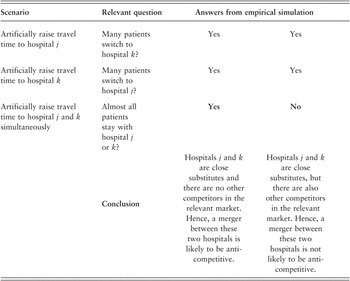
Parameter estimates from a patient choice model are used to simulate the effects of artificially raising travel time from every patient to a particular hospital by a certain percentage (e.g., 5%), holding all other hospital attributes constant. To assess a merger, the effects of increasing travel time to a pair of hospitals simultaneously are compared to the effects of increasing travel time to each hospital individually. If the time elasticity under jointly increased travel times is much lower than under individual travel time increases, then the hospitals are close substitutes and thus more likely to have market power post-merger. Under the simplifying assumption that consumers are willing to trade time for money at a constant rate,Footnote 4 price elasticities are directly proportional to time elasticities.Footnote 5 In conjunction with the inverse-elasticity pricing rule, this implies that marginal price increases resulting from a merger are directly proportional to reductions in time elasticity under joint travel time increases vis-à-vis unilateral travel time increases. Table 1 illustrates how time elasticities can be used to define geographic hospital markets in merger cases. The same methodology is readily adapted to defining geographic markets in non-merger cases. Market definition then requires identifying the smallest set of hospitals such that a simultaneous travel time increase to all hospitals in the set would lead to relatively little substitution to outside hospitals.
Using time elasticities to define geographic hospital markets

Although the assumption of direct proportionality between price and time elasticities underlying the time–elasticity approach is quite strong and has to be tested empirically (e.g., by stated preference research), the approach could definitely serve a useful role in assessing hospital market power. Particularly for hospital markets where patients do not face any monetary prices or where information on actual hospital prices is not readily available. Even when time elasticities would not be directly proportional to price elasticities, it is reasonable to assume that patients are willing to trade travel time for money at an unknown (and possibly non-linear) rate. Therefore, estimated time elasticities are at least indicative of hospitals’ market power.
Competitor-share approach
The competitor-share (CS) approach focuses on the degree of overlap in the type of patients hospitals treat. By definition, this approach uses a less aggregated hospital product market definition than commonly applied in hospital merger cases (Section 2). In contrast to the conceptually similar but reduced form disaggregated approach of Zwanziger et al. (Reference Zwanziger, Melnick and Eyre1994),Footnote 6 the CS approach does have a theoretical underpinning: it builds up from the notion that hospital prices are a function of the underlying service-level demand elasticities. It uses a logit demand framework to derive an exact expression for a hospital's price elasticity, which can be rewritten as a function of other hospitals’ market shares competing for the same patients.Footnote 7 This implies that the increase in price two hospitals can obtain by merging (or colluding) depends on the degree of overlap in patients. Consider the extreme example of a market with three hospitals, each admitting the same number of patients. Further, suppose there are only two types of hospital care patients could need: service 1 or service 2. Under these hypothetical circumstances the anticompetitive effect of a merger between any two hospitals will depend not on their aggregard market shares (33.3% each), but rather on their market shares in the submarkets 1 and 2 as well as the relative sizes of each submarket. The merger would not be anticompetitive if one hospital treats only type 1 conditions and the other only type 2. Alternatively, if the merging hospitals only overlap in type 1 patients but such patients are rare, then the aggregate price effects of a merger may also be negligible. As there are many services in hospital markets, the empirical challenge is to quantify the extent of submarket overlap between a pair of hospitals and then map that into predicted merger effects.
To implement this, each hospital is modelled as setting a different price for each possible submarket – defined as an insurer–hospital service pair. To assess the likely effects of a merger, the difference in demand elasticity two hospitals face when pricing jointly instead of unilaterally is calculated. In general, the elasticity reduction under joint pricing, and therefore the expected price increase, will be greater as the overlap between two hospitals in the various submarkets is greater. This methodology is also readily applicable to defining geographic markets in non-merger cases. Market definition then requires identifying the smallest set of hospitals such that a hypothetical joint price increase would lead to relatively little substitution to outside hospitals.
An important drawback of the CS approach is that it assumes hospitals charge insurers or their patients a different price for each hospital service. In the US and many other countries, this assumption is only partially accurate since hospitals are commonly paid by per diem rates or case rates, rather than fee for service.Footnote 8
Option-demand approach
Whereas both the time-elasticity approach and competitor-share approach assume that patients select their hospitals when they need care, in a managed care setting patients commit to a potentially restricted network of hospitals prior to knowing their medical needs fully. The option-demand (OD) approach was developed specifically to model markets in which managed care organizations (MCOs) contract with hospitals.Footnote 9
Willingness-to-pay
The objective of the OD approach is to calculate each consumer's ex ante willingness-to-pay (WTP) for inclusion of a particular hospital in an MCO's network. This is his WTP for a particular hospital at the beginning of the year when he selects his MCO, but prior to falling ill and requiring hospital care. Consumer i's interim WTP (i.e., after knowing his health status but before evaluating hospital alternatives) for the option to select hospital j from an MCO's network G is computed as his decrease in expected interim utility (VIU) when that hospital is removed from the network: ΔVIUj = VIU(G) – VIU(G/j), where (G/j) denotes network G with hospital j excluded. Converting this difference to monetary terms gives the consumer's interim WTP (i.e., his WTP conditional upon knowing his illness) to retain that hospital as a feasible option. Each consumer's ex ante WTP to include hospital j in the network is constructed as the sum over all possible conditions of the product of (i) his interim WTP for that hospital conditional upon a particular diagnosis, and (ii) the probability that, given his demographics and location, he will draw that particular diagnosis during the coming year. The population's WTP to include hospital j in the network is obtained by summing the ex ante WTP for all individual consumers.
The OD model uses the empirical joint density of the demographics, clinical indications, and locations to determine each patient's distribution of clinical states conditional on his socioeconomic characteristics and the geographical location of his home. Though necessary from an empirical perspective, this assumption may be questionable for two reasons. First, from the risk adjustment literature it follows that patient i's probability of requiring hospitalization in the year to come cannot be predicted accurately by using only his demographics and location (Van de Ven and Ellis, Reference Van de Ven, Ellis, Culyer and Newhouse2000). Second, the assumption itself that each patient is able to ex ante predict his probability of being sufficiently ill during the next year to require hospitalization seems quite strong.
Bargaining power and hospital profits
In deregulated hospital markets, MCOs negotiate with hospitals over prices. Consumers make their choice among competing health plans on the basis of insurance premiums and the value each MCO's network provides to them. The potential gain hospital j and an MCO can obtain and split is the difference between consumers’ ex ante WTP for inclusion of hospital j and the additional costs or benefits its inclusion causes: ΔWTPEA j(G) – ΔCj(G). The proportion of this surplus hospital j captures depends on the relative bargaining power of the hospital and MCO. For example, a favourable location and/or other favourable characteristics give hospitals leverage against an MCO's attempts to negotiate a low price. Although restrictive, Capps et al. (Reference Capps, Dranove and Satterthwaite2003) assume that each hospital captures the fixed proportion α of this gain.Footnote 10 Since economically rational hospitals will only accept an MCO's contract if its price at least covers variable costs, the contribution hospital j earns towards fixed costs and profit from the managed care segment of its business is πj = α[ΔWTPEAj(G) – ΔCj(G)] + uj. Note that πj denotes a hospital's incremental contribution above variable costs.
If consumers’ WTP is indeed an appropriate measure of hospitals’ market power, then it should be strongly positively correlated with profits. Capps et al. (Reference Capps, Dranove and Satterthwaite2003) validated this hypothesis. First, they estimated a logit patient choice model to recover the parameters of the utility function. Second, they used the estimated parameters to construct estimates of the probability that patient i chooses hospital j, which in turn are used to calculate consumers’ aggregate WTP for a hospital. Third, they regressed profits from managed care patients on WTP in order to estimate the parameter α that translates WTP into profits.
Geographic market definition
The WTP measure obtained by estimation of the OD-model can be used to predict how prices will change if two or more hospitals would act as a single entity, holding costs constant. In managed care markets, (merged) hospitals may increase their prices by coordinating their decision to join an MCO. Intuitively, hospitals will do much ‘better’ when acting jointly if their simultaneous withdrawal imposes a much larger decrease in consumers’ WTP for an MCO's network than either could impose unilaterally. Using the WTP measure of market power for antitrust geographic market definition requires two steps.
The first step is to estimate the increase in profit that hospitals can obtain by acting as a single entity. A set of hospitals’ joint WTP is likely to be large when they are close substitutes and consumers do not have an alternative closely substitutable hospital. Under such circumstances, hospitals j and k's joint WTP may greatly exceed the sum of their individual WTPs because losing access to both j and k is then far worse than losing access to either j or k alone. The formula for estimating the profit effect of a merger between two hospitals is Δπj+k = α[ΔWTP EAj+k(G)−ΔWTP EAj(G) − ΔWTP EAk(G)], where α is the coefficient on WTP estimated by regressing hospital profits on consumers’ WTP. The additional leverage two hospitals obtain by working together is the difference between their joint WTP and the sum of their individual WTPs. Because consumers’ ex ante utility (weakly) increases when they have more options for their hospital care this difference is, by definition, equal to or greater than zero.Footnote 11 This difference will be smaller when hospitals j and k are not closely substitutable while other hospitals are, and vice-versa.
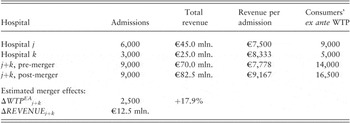
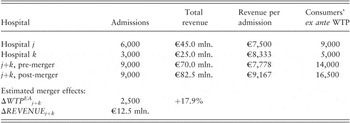
The second step in defining the geographic market is to estimate the associated change in prices. Following the SSNIP guidelines, this exercise is conducted under the assumption that the merger does not affect costs.Footnote 12 As the SSNIP question is generally formulated in terms of prices rather than profits, the expected percentage increase in profits derived from the OD model, is translated into an expected percentage increase in price by assuming quantity is unchanged. This price change reflects the increase in average revenue necessary to generate the predicted increase in profits, under the assumption that (i) the number of patients and (ii) the average cost at each hospital do not change as a result of the merger. In their original paper, Capps et al. (Reference Capps, Dranove and Satterthwaite2003) simply regressed hospital profits on consumers’ ex ante WTP to estimate the dollar value of additional units of WTP. For example, if each unit of WTP is worth an additional 5,000 in profit and for a merger of hospitals j and k ΔWTP EAj+k is estimated to be 2,500, then the merger would increase joint profits by 12.5 million. This additional profit would come about due to higher prices at hospitals j and k. Because most patients’ marginal payment does not depend on which contracted hospital they choose, higher hospital prices charged to third party payers will not affect patients’ hospital choice decisions. This implies that a price increase should not affect quantity. Given this, the effect of a merger on average revenue is computed by dividing the revenue change by the combined number of admissions. Table 2 illustrates this.
Using the OD approach for geographic market definition in merger and non-merger cases is straightforward: identify the smallest set of competitors such that the implied increase in profits should these hospitals set prices jointly exceeds some threshold (e.g., 5%).
Using WTP to estimate the effects of a merger (hypothetical example)
How to define relevant hospital markets in The Netherlands?
In the previous sections we discussed the general pros and cons of several new approaches to hospital market definition. Since the current market-based health system reform in The Netherlands calls for effective antitrust enforcement, we now focus on defining markets for Dutch hospitals.
Hospital product markets
As explained in Section 2, the appropriate level of hospital service aggregation depends on the extent to which hospitals are able to shift personnel, equipment, and other inputs across service categories. Using this concept of ‘substitution in supply’ Zwanziger et al. (Reference Zwanziger, Melnick and Eyre1994) argue that the physician should be considered as the key input into hospital care. Therefore, a key factor for determining the appropriate level of (dis)aggregation of hospital services seems to be the extent to which the hospital management can substitute one type of medical specialist for another.
Contrary to US hospitals, Dutch hospitals have a ‘closed’ medical staff in which the only way a physician can join a hospital's staff is to be accepted by the incumbent medical group and the hospital management.Footnote 13 Most Dutch medical specialists are self-employed entrepreneurs organized in partnerships per specialty, which are represented at the hospital level. Though the hospital board has the formal power to admit new physicians, it is largely dependent on the co-operation of the medical specialists (Scholten and Van der Grinten, Reference Scholten and van der Grinten2002, Reference Scholten and van der Grinten2005). Once accepted, new medical specialists sign an ‘admission contract’ with the hospital. The terms of this contract are based on a uniform model contract, formulated by the national association of medical specialists. Most admission contracts are permanent (valid until the age of 65) and cannot be terminated by the hospital, except for forceful reasons such as malpractice, (mental) illness, or loss of license. As a consequence, most Dutch medical specialists have a lifetime affiliation with a single hospital. The rigid admission contracts make it difficult for hospital management to substitute one type of medical specialist for another. The limited possibilities for physician input substitution imply that two Dutch hospitals offering different services cannot readily compete by adjusting their product mix. Thus, in contrast to the US, a more disaggregated approach to hospital product market definition may be appropriate in the Dutch context. This does not imply, however, that each specialty constitutes a separate relevant product market. From an antitrust perspective, medical specialties may be analysed as a group if ‘there is no compelling reason to believe demand and supply substitution opportunities, entry conditions, or market shares differ significantly’ (Baker, Reference Baker1988: 138).
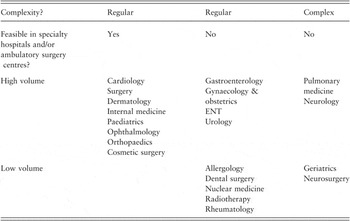
Varkevisser, Van der Geest, and Schut (Reference Varkevisser, van der Geest and Schut2004) apply this pragmatic approach to non-emergency hospital care in Dutch hospitals. Taking into account each medical specialty's complexity, volume of patients, and potential economies of scale and scope, they identify five different economically homogeneous specialty clusters that could be used for antitrust analysis: (1) medical specialties that are or could be provided by general hospitals as well as specialized health providers such as specialty hospitals and/or ‘stand-alone’ ambulatory surgery centres, (2) high-volume complex medical specialties, (3) low-volume complex medical specialties, (4) high-volume regular medical specialties, and (5) low-volume regular medical specialties. The results of their analysis are summarized in Table 3.
Pragmatic approach to economically homogeneous specialty clusters
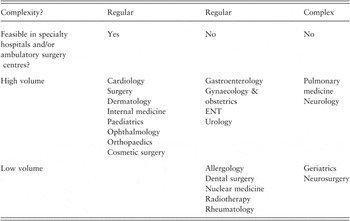
Source: Varkevisser et al. (2004: 80).
Geographic hospital markets
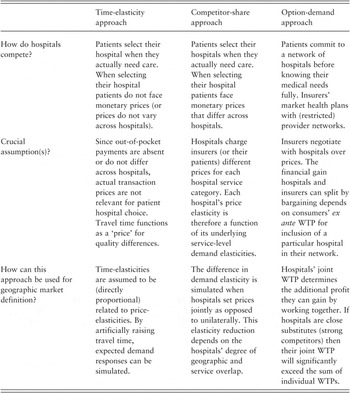
As discussed in Section 4, three new approaches to defining geographic hospital markets are suggested in recent economic literature: the time-elasticity approach, the competitor-share approach, and the option-demand approach. The assumptions underlying each of these approaches, summarized in Table 4, determine their suitability for defining Dutch hospital markets. The two critical factors that determine how well each approach fits with the prevailing market structure are (i) how Dutch health insurers contract with hospitals and (ii) how patients select their hospital.
Key features of three new approaches to hospital market definition

Insurer–hospital contracting in The Netherlands
In a managed care setting, health insurers, rather than individual patients, appear to be the relevant hospital customers from an antitrust perspective. In an environment with managed care and selective contracting, the option-demand (OD) approach accurately depicts hospital competition. Despite the (gradual) introduction of managed competition since 2005 in The Netherlands (Schut and Van de Ven, Reference Schut and van de Ven2005), the OD approach is currently less suitable for defining Dutch hospital markets than it may appear. The new Health Insurance Act allows health insurers to selectively contract with hospitals. So far, however, this option has hardly been used: health insurers do not offer contracts with restricted provider networks. There are several reasons for the absence of selective contracting (Varkevisser, Polman, and Van der Geest, Reference Varkevisser, Polman and van der Geest2006). First, health insurers have very limited experience with bargaining and information about differences in quality and efficiency across hospitals is lacking. Second, due to the absence of reliable performance indicators, consumers seem to distrust any contracting policy that restricts their freedom of choice. Third, insurers are only allowed to negotiate prices for a small minority (about 8%) of total hospital services.Footnote 14
Using the OD approach's WTP measure for geographic market definition may also be problematic from an empirical perspective since it requires an estimate of the increase in profits that hospitals can obtain by acting as a single entity. To estimate hospitals’ monetary value of additional units of consumers’ WTP, hospitals’ profits are regressed on aggregated WTP. In The Netherlands, however, 90% of all hospital care is still price regulated, and all Dutch hospitals have a not-for-profit status. As a result, any empirical relationship between WTP and profits does not (necessarily) reflect differences in hospitals’ attractiveness to either insurers or patients.
Based on the arguments mentioned above, we believe that the OD approach does not accurately depict the current competition in Dutch hospital markets. Except for the likely difficulty obtaining suitable data, however, it could be useful for analysing hospital competition in the deregulated submarket if insurers begin selectively contracting for these services. If the new Dutch health system evolves such that more prices are actually determined during insurer–hospital negotiations over network participation and composition, then the model of OD will become more appropriate.
Patient hospital choice in The Netherlands
Since patients do not commit to a potentially restricted network of hospitals before knowing their medical needs fully, they select their hospital when they actually need medical care. Both the competitor-share (CS) approach and the time-elasticity approach use this assumption. The CS approach further assumes out-of-pocket payments vary by procedure and hospital so that patients are – at least to some extent – price sensitive. However, almost all Dutch citizens are fully insured for hospital care. Only 5% of the population opted for a small voluntary deductible, ranging from 100 to 500.Footnote 15 Moreover, for the Dutch formerly privately insured, Van Vliet (Reference Van Vliet2004) found that the demand for hospital care is minimally affected by the level of deductibles. The CS approach's assumption that hospitals charge different prices for each hospital service category is also inaccurate for The Netherlands. First, most hospital prices are still fixed and therefore not subject to insurer–hospital bargaining at all. Second, in the deregulated part of the hospital market, insurers and hospitals usually bargain one uniform discount for all the hospital services in question (NZa, 2006). In sum, the CS approach – like the OD approach – does not (yet) depict actual competition among Dutch hospitals and is therefore at present not the most appropriate method to define hospital markets.
Since Dutch hospitals compete with each other directly for patients through non-price factors only – such as travel time (i.e., location), hospital waiting time, and (perceived) quality of care – the time-elasticity approach seems at present the appropriate approach to defining hospital markets in The Netherlands. Its application in both merger and non-merger cases is simple in principle: identify the smallest set of hospitals such that a simultaneous and hypothetical travel time increase to all hospitals in the set would lead to relatively little substitution to outside hospitals.Footnote 16,Footnote 17 The time-elasticity approach, however, does require estimating a patient hospital choice model. Though challenging in any hospital market, this is particularly so in Dutch hospital markets since reliable data on patient and hospital characteristics are not (yet) widely available.Footnote 18 The lack of data on (perceived) hospital quality may seriously hamper estimation of a model that correctly predicts patient flows if it is an important determinant of consumer choice (Tay, Reference Tay2003). Varkevisser and Van der Geest (Reference Varkevisser and van der Geest2007) find that hospital attributes reflecting (perceived) quality significantly affect patients’ decisions to visit or bypass the nearest hospital in The Netherlands. Therefore, crucial questions are which quality dimensions do patients recognize and how do they act upon any differences. More research is definitely needed in this area.
Recent hospital merger cases
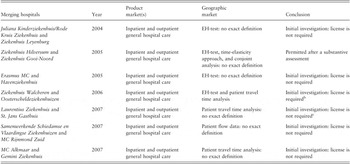
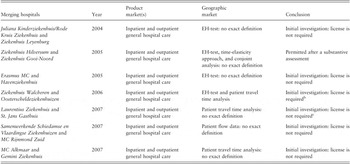
Though the Dutch hospital industry was already quite concentrated (Varkevisser, Van der Geest, and Schut, Reference Varkevisser, van der Geest and Schut2004), Table 5 shows that since 2004 The Netherlands Competition Authority (NMa) has permitted all hospital mergers that required approval – without providing an exact definition of the relevant market. Since there was clearly no need for the defendants to challenge the outcomes, there are no Dutch court decisions on hospital market definition.
Hospital merger cases in The Netherlands since 2004a
Notes:
a Prior to 2004, the NMa did not assess hospital mergers since, according to the competition authority, there was no scope for competition among hospitals.
b After NMa’s initial investigation, the hospitals decided to cancel the proposed merger.
c In the end, the proposed merger was cancelled since both hospitals failed to reach a final agreement.
From Table 5 it follows that only the merger between the two general hospitals Hilversum and Gooi-Noord has been assessed substantively. After an initial investigation in 2004, the NMa concluded that a license was required for this proposed merger since it could restrict actual competition in the Dutch market for hospital care. Following the hospitals’ application for a license, the NMa carried out further research. With respect to definition of the product market, a division into separate markets for inpatient and outpatient general hospital care was assumed. Since it was recognized that the static E/H approach used in previous hospital merger cases was ‘not sufficiently reliable’ for geographic market definition, patients’ revealed and stated preferences were analysed. Stated preferences were investigated by a conjoint analysis and revealed preferences by examining residents’ willingness to travel to alternative hospitals.
The results from these analyses were not unambiguous: the use of stated preference data resulted in a larger geographic market than the use of revealed preference data. It was argued that, although in general greater value should be attached to revealed preferences, patients’ willingness to travel could be expected to increase in the near future due to the increasing availability of transparency information on quality differences within the Dutch hospital sector. As a result, the NMa (2005: 29) stated ‘it is therefore less evident that greater weight should be given to the revealed preferences in the assessment of the present case.’ In the end, in June 2005 the NMa approved the proposed merger since there was ‘insufficient evidence to deem it plausible that a dominant position will arise or be strengthened as a result of the proposed merger on the markets for clinical and non-clinical general hospital care’. This conclusion implies, indirectly, that greater weight was given to consumers’ stated preferences; even though it was admitted that what people say they will do is often not the same as what they will actually do if the hypothetical situation becomes reality. Future analysis of post-merger market performance results may demonstrate whether or not the NMa erred in this specific merger case.
Concluding remarks
Assessing hospital market power is a serious problem for antitrust authorities: the standard method for market definition is difficult to implement in hospital markets and alternative, less formal methods have proven inaccurate. Since an effective competition policy is of crucial importance to countries with a market-based health care system in which hospitals are expected to compete, antitrust enforcement agencies need new approaches to defining hospital markets.
In this paper, we discuss three such approaches suggested in the recent economic literature: the time-elasticity, competitor-share, and option-demand approaches. Since these methods were developed within the context of US hospital markets, we also examine their applicability in the Dutch context, where, since partial deregulation in 2005, health insurers are now allowed to selectively contract with hospitals. We conclude that the suitability of these new approaches to defining geographic markets crucially depends on the hospital industry's prevailing institutions and market structure.
With regard to hospital product market definition, in The Netherlands a more disaggregated definition seems appropriate than in the US because the lifetime hospital staff privileges for Dutch medical specialists make it difficult for hospitals to adjust their product mix. The appropriate approach to defining geographical hospital markets depends on how health insurers contract with hospitals and how patients select their hospital. We conclude that the competitor-share approach and the option-demand approach do not accurately depict the way Dutch hospitals currently compete. Despite the gradual introduction of managed competition in 2005/06, most hospital prices are still fixed, out-of-pocket payments are absent, and most patients do not face restricted hospital networks. Dutch hospitals therefore compete directly for patients through non-price factors only, such as travel time and (perceived) quality. As a result, in the current context, the time-elasticity approach seems to be the appropriate approach to defining hospital markets in The Netherlands. However, if the expected further deregulation of hospital prices is implemented and insurer–hospital negotiations over network participation and composition increase, the option-demand approach may become more appropriate.
Though the focus of this paper is on defining hospital markets, it includes two important lessons for other types of health care as well. First, given their methodological shortcomings, the traditional approaches to defining geographic markets (Elzinga/Hogarty approach and critical loss analysis) are inaccurate and therefore inapplicable. Second, the appropriate approach to market definition in any deregulated health care market depends crucially on (i) how health insurers contract with providers, and (ii) how patients select their provider.