INTRODUCTION
Crop production is a complex process where a number of biotic and abiotic factors are involved. Among the abiotic factors, soil quality is crucial for attaining satisfactory yields of crops. Food production is threatened by the deteriorating soil environment. Intensification to meet food production targets, pressure on non-renewable resources and sustainable agricultural practices provide a long-term focus for soil quality. The concept of soil quality is centred on the ability of the soil to perform specific functions; from an agricultural point of view these include sustaining biological activity; regulating and partitioning water flow; filtering, buffering, degrading, immobilizing and detoxifying organic and inorganic materials and storing and cycling nutrients (Seybold et al. Reference Seybold, Mausbach, Karlen, Rogers, Lal, Kimble, Follett and Stewart1997). The scope of functions encompassed in soil quality does not permit the use of a single soil quality index for the assessment of soil quality. Hence, it is necessary to identify the functions of interest first, then select some set of indicators to observe and measure, thereby inferring the ability of the soil to perform that function. Literature reports sets of soil quality indicators (Doran & Parkin Reference Doran, Parkin, Doran, Coleman, Bezicek and Stewart1994; Sarrantonio et al. Reference Sarrantonio, Doran, Liebig, Halvorson, Doran and Jones1996; Karlen et al. Reference Karlen, Gardner and Rosek1998). A common feature of the proposed indicator sets is that they all include some combination of physical, chemical and biological soil properties, suggesting that for a soil to function effectively, all three components must be addressed.
Pulses (food legumes) have been grown in Asia and Africa for centuries and have the inherent properties of restoring soil fertility and maintaining soil quality. There has been a paradigm shift in crop production systems towards cereal-based cropping systems in order to meet the food requirements of increasing populations (Parayil Reference Parayil1992; Srivastava & Mukhopadhyay Reference Srivastava and Mukhopadhyay1997), but this has resulted in increased concern about deterioration in soil quality and decline in yields of crops. Nutrient imbalances in the soil system have become one of the major reasons for the decline in yields in cereal–cereal cropping systems (Swaroop & Ganeshamurthy Reference Swaroop and Ganeshamurthy1998) and have made the crop production systems unsustainable. The alleviatory effects of legumes on subsequent crop yields in terms of nitrogen economy have long been realized. However, precise mechanisms for quantifying soil quality unrelated to those associated with N have not been systematically characterized. The current consensus is that pulse-based crop rotations increase crop yields and profits, improve soil quality and allow for sustained production (Ganeshamurthy et al. Reference Ganeshamurthy, Ali and Srinivasarao2004). Many of the effects of including a pulse in the rotation responsible for increased yields and sustainability remain unknown. In the present paper, the effects of pulses on soil quality in terms of measurable physical, chemical and biological parameters are described and compared with non-pulse crops and uncultivated fallows.
MATERIALS AND METHODS
Study area
The present study was conducted at the Indian Institute of Pulses Research (IIPR) in the Kanpur district of Uttar Pradesh, India. In 1985 the Institute acquired 300 ha of land, an uncultivated ravine. After levelling, the research farm has been cultivated since 1985 with pulse crops only, grown in a random rotation involving pigeon pea, mung, urd, chickpea, lentil, peas and lathyrus. Farmers' fields, where different crops are grown such as sesame, maize, mustard, wheat, sorghum, etc., surround this area. Farmers generally harvested their crops leaving 30–40 mm of stem above the ground, while the pulse crops were harvested much closer to the ground (20–30 mm). In both cases, the stubble and other organic residues were incorporated into the soil during land preparation. Some uncultivated land is also available adjacent to the research farm. The soils of all the sites are very deep, sandy loam Typic Ustochrepts, developed from the same parent material. This whole land mass presents a uniform topography on alluvial soil for comparing soil quality changes caused by any management differences.
Soil sampling and analysis
Soil quality indicators were assessed after 16 years of continuous pulse cultivation and compared with non-pulse crops grown in adjacent farmers' fields and uncultivated fallow land. Farmers' fields were selected from those farmers who used tractors for cultivation and followed university recommendations for cultivating their crops to ensure that the management levels in farmers' fields and that in the research farm where pulses were grown were fairly similar. Soil cores were taken 2 weeks after first monsoon rains and before incorporation of any amendments from 30 randomly selected spots distributed over an area of 10 ha from each land use using an Edelman corer (70 mm diameter, 200 mm length) from the three land uses viz., continuous pulse crop, non-pulse crops in farmers' fields with non-legume rotations and uncultivated fallow land, where no crop was grown for the duration of the experiment. The samples were cleared of any organic debris and transferred for storage in sealed plastic bags. All samples were collected after removal of undecomposed leaves and other organic matter from the surface. The soils were then sieved (<2 mm), analysed for their moisture content on the day of collection and stored at 4°C for not more than 7 days before analysis. Sub samples for determination of organic C and total N were sieved to pass through a 0·5 mm mesh. Samples were analysed for biochemical properties immediately.
Soil physical properties
Soil bulk density was determined by the method described by Blake & Hartge (Reference Blake, Hartge and Klute1986). Soil compaction was measured using a cone penetrometer (ASAE 1999), infiltration using a falling-head double ring infiltrometer (McKenzie et al. Reference McKenzie, Coughlan and Cresswell2002) and aggregate stability by the wet sieving method (Kemper & Rosenau Reference Kemper, Rosenau and Klute1986). Water content in the middle of the growing season was estimated by the gravimetric method, by sampling to a depth of 1 m (Gardner Reference Gardner and Klute1986).
Soil chemical properties
The soil pH was determined in 1:2·5 soil:water suspension. Total N was determined by the regular Kjeldahl method of Bremner & Mulvaney (Reference Bremner, Mulvaney, Page, Miller and Keeney1982) and organic C by the modified Möbius method (Nelson & Sommers Reference Nelson, Sommers, Page, Miller and Keeney1982). Nitrate (NO3), ammonium (NH4) and total soluble N content were extracted with calcium chloride (CaCl2) and determined through spectrophotometrical analysis. Organic N was calculated as Norg=Ntotal soluble−(NO3+NH4). Available K was determined by the ammonium acetate method (Thomas Reference Thomas, Page, Miller and Keeney1982) and P by using 0·5 m NaHCO3 (Olsen & Sommers Reference Olsen, Sommers, Page, Miller and Keeney1982). Available zinc (Zn), copper (Cu), iron (Fe) and manganese (Mn) were extracted with diethylenetriamine penta acetic acid (DTPA) and calcium (Ca) and magnesium (Mg) were extracted with ammonium acetate (NH4OAc). All these elements were determined using an atomic absorption spectrophotometer. Sulphur (S) was extracted with 0·01 m CaCl2 and determined by the turbidimetric method (Williams & Steinberg Reference Williams and Steinberg1959). Hot water soluble boron (B) was determined by following the azomethine-H method (Gupta Reference Gupta1967).
Soil biochemical properties
Microbial biomass C and N were estimated by the fumigation–extraction method (Vance et al. Reference Vance, Brookes and Jenkinson1987). A factor of K ec=0·45 (Wu et al. Reference Wu, Joergensen, Pommerening, Chaussod and Brookes1990; Joergensen Reference Joergensen1995) was used to convert the C contents to microbial biomass C and K en=0·54 (Brooks et al. Reference Brooks, Landman, Pruden and Jenkinson1985; Joergensen & Mueller Reference Joergensen and Mueller1996) was used to convert the N content to microbial biomass N. Biomass ninhydrin N was calculated from the difference between ninhydrin-reactive N in fumigated and non-fumigated samples (Joergensen & Brookes Reference Joergensen and Brookes1990). For measuring CO2 evolution, 100 g (oven-dry basis) of a moist sample was adjusted to 0·55 of its water holding capacity and pre-incubated for 3 days at 20°C in the dark before CO2 production was measured for another 3 days. The CO2 produced was trapped in 20 ml 0·05 m sodium hydroxide (NaOH) and measured by titration of the excess NaOH with 0·05 m hydrochloric acid (HCl; Salamanca et al. Reference Salamanca, Raubuch and Joergensen2002). Nitrogen mineralization capacity was determined by extracting 10 g soil with 50 ml of 2 m potassium chloride (KCl) for 30 min before and after incubation for 10 days at 30°C. The ammonium–N (NH4–N) and total inorganic N were determined in the extracts by steam distillation (Keeny & Nelson Reference Keeny, Nelson, Page, Miller and Keeney1982).
Urease was assayed by a modified indophenol reaction method (Kandeler & Gerber Reference Kandeler and Gerber1988). Phosphomonoesterase activity was determined by incubating soil at 37°C for 1 h in modified universal buffer with p-nitrophenyl phosphate as the substrate (Tabatabai & Bremner Reference Tabatabai and Bremner1969). β-glucosidase activity was determined by the method described by Eivazi & Tabatabai (Reference Eivazi and Tabatabai1988) and dehydrogenase activity was estimated by the method of Casida et al. (Reference Casida, Klein and Santoro1964).
Statistical analyses
Means and standard deviations of the physical, chemical and biochemical parameters are expressed on oven dry soil basis (105°C). The relationships between different soil variables and biochemical properties were determined by the Pearson's correlation test. Different systems were compared by one-way analysis of variance (ANOVA).
RESULTS
Soil physical properties
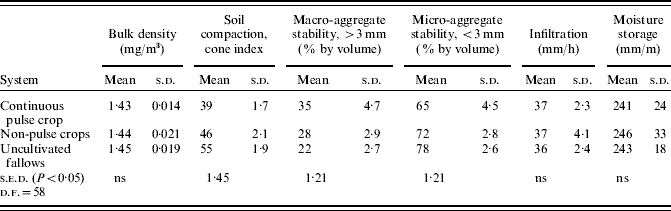
Mean values of soil physical parameters are given in Table 1. Both soil macro and micro aggregates differed significantly between different systems while differences in the bulk density, water infiltration rates and moisture storage were not significant. As a proportion, the highest levels of macro aggregates (>3 mm) were found in soils under pulse crops (0·35), followed by soils under non-pulse crops (0·28) and lowest in uncultivated land (0·22), while levels of micro aggregates (<3 mm) increased in the reverse order. Soil compaction as measured in terms of cone index showed that cultivation of crops reduced compaction. Compared to uncultivated soil, pulse crops reduced the cone index by 16 units, while the other crops reduced it by 9 units.
Mean values of soil physical variables and differences between the samples of different systems

Soil carbon and nitrogen
Soils under continuous pulses exhibited the highest amounts of organic C, total N (sum of organic and inorganic N), microbial biomass C and N and biomass ninhydrin-N (Table 2). The organic C:total N ratio increased under non-pulse crops and uncultivated conditions but all the values were within the stable C:N ratios. Total N:mineralizable N and microbial biomass C:N remained fairly similar under the three situations. The biomass ninhydrin-N, however, was highest under pulse crops, followed by non-pulse crops and uncultivated fields.
Range and mean values of soil carbon and nitrogen variables and differences between the samples of different systems

Soil biochemical properties
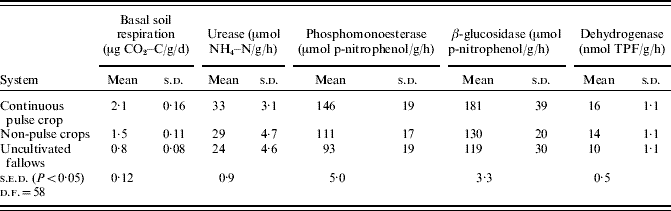
The basal soil respiration, an indicator of soil biological activity, showed significantly higher values under pulse crops than from the soils of non-pulse crops (Table 3). The respiration was about two-fold higher in non-pulse crops over uncultivated fields but it was about two and a half fold higher under continuous pulse crops, over uncultivated fields. The results of all the exo-cellular enzymes assayed in soils differed significantly, with soils under continuous pulse crops recording the highest values followed by soils under non-pulse crops. Although the difference between uncultivated fields and non-pulse crops was greater than the difference between non-pulse crops and continuous pulse fields, it was clear that the soils under continuous pulses had higher enzyme activities over non-pulse crops.
Mean values of soil respiration and enzyme activities of the samples of different systems

Soil chemical properties
Most of the chemical properties assessed differed significantly between different systems (Table 4). Compared to uncultivated soils, pH was about 1 unit lower in soils under continuous pulses, but only 0·4 unit lower under non-pulse crops. Soils under pulses contained appreciably higher total soluble N, NO3–N and organic N than those under non-pulse crops and uncultivated fields; however, there was no significant difference in NH4–N content between different systems. Available P and S accumulated more in soils under pulses than in the soils under non-pulse crops, but CaCl2 extractable Mg, DTPA–Zn and hot water extractable B was depleted in soils under pulses or any other crop. Exchangeable K, Ca and DTPA extractable Fe, Mn and Cu showed no differences between the different systems.
Mean values of soil chemical variables and differences between the samples of different systems

DISCUSSION
The alleviatory effects of legumes on subsequent crop yields have long been realized and documented. However, the precise mechanisms of the effects of pulses have not been systematically characterized. In contrast to earlier studies, where the effects of legumes were studied in crop rotations involving legumes on subsequent crops (Rego & Seeling Reference Rego, Seeling, Ito, Johansen, Adu Gyamfi, Katayama, Kumara Rao and Rego1996; Tamboli et al. Reference Tamboli, Daftardar and Shinde1999; Rego et al. Reference Rego, Seeling, Nageshwar Rao, Pardharardhi and Kumararao2001), the present work compared fields under continuous legumes with those mainly growing non-legume crops and with uncultivated fields in a uniform topography on alluvial soil. The effects of long-term pulse cultivation on the soil quality as determined by physical, chemical and especially biological parameters of the soil were investigated. Yield and yield reductions were not taken into account, since many different crops were involved as well as uncultivated land. However, a polyphasic approach was used to study the soils, combining chemical and physical analysis, culture-dependent and independent biochemical analysis. Often, management practices were common between continuous pulse crop fields and farmers' fields in which non-pulse crops were grown. Many of the measured or calculated soil characteristics were not significantly different between soils under pulses or other crops, emphasizing that the differences between soils under continuous pulse cultivation and soils under non-pulse crops are slow to accumulate.
Aggregate stability is a crucial soil property affecting soil sustainability and crop production. It is an important soil quality parameter, which can be used as an index to compare long-term changes in soil quality (Amézketa Reference Amézketa1999). Crop rotations that include pulses are generally beneficial to aggregate stability and the formation of a favourable soil structure (Kay Reference Kay1990; Robinson et al. Reference Robinson, Cruse, Kohler, Holifield and Karlon1994). Among the soil physical properties tested in the present study, only aggregate stability and soil compaction showed significant differences under the different systems. Though there are no studies to demonstrate the direct effect of pulse cultivation on soil bulk density, some indirect effects are reported. Several workers have reported a reduction in soil bulk density through incorporation of pulse residues to soil in cereal–pulse cropping systems (Singh & Sandhu Reference Singh and Sandhu1980; Hulugalle & Lal Reference Hulugalle and Lal1986; Newaj & Yadav Reference Newaj and Yadav1994). However, in this investigation, after 16 years of cultivation, no significant differences in soil bulk density were detected between the systems. Similarly, water infiltration showed no significant differences between the three systems, because these soils are very friable, loose textured and highly permeable.
In terms of soil quality, soil organic matter content is the most important chemical property. Building up soil organic C in tropical soil is very difficult, due to rapid decomposition. Despite this, cultivation of crops generally results in increased soil organic C. The present study demonstrates that growing pulses results in higher soil organic matter C than samples from other crops (Table 2). Unlike cereals and other crops, pulses add significant amounts of organic residues to soil in the form of root biomass and leaf litter. Singh & Sandhu (Reference Singh and Sandhu1980) and Newaj & Yadav (Reference Newaj and Yadav1994) observed that the organic carbon content of soil increased over the initial level in all the pulse-based cropping systems, but the maximum benefit was found in rotations involving pigeon pea. Several other studies conducted in different agroecological regions have also shown an increase in soil organic C level in rotations involving pulse crops (Hulugalle & Lal Reference Hulugalle and Lal1986; Bhatnagar & Chaplot Reference Bhatnagar and Chaplot1996). As expected, the total N content followed a pattern similar to that of organic C, but a lower C:N ratio under pulse crops (11·7) compared to other non-pulse crops (12·9) indicated the N-richness of the material added to the soil compared to non-pulse crops. Previously published data suggest that the nitrogen content is three-fold higher in pulse residues as compared to cereal residues (Ganeshamurthy et al. Reference Ganeshamurthy, Ali and Srinivasarao2004). Hence, the mineralizable-N content was significantly higher in soils under pulse crops than under other crops or under uncultivated fallows. Microbial variables seemed to be effective, consistent, and early indicators of changes induced by management practices (Kandeler & Murer Reference Kandeler and Murer1993; Alef & Nannipieri Reference Alef and Nannipieri1995; Bending et al. Reference Bending, Turner, Rayns, Marx and Wood2004), whereas organic C proved ineffective in reflecting such changes (Drinkwater et al. Reference Drinkwater, Letourneau, Workneh, Van Bruggen and Shennan1995; Werner Reference Werner1997). Over long periods even organic C proved effective (Ali et al. Reference Ali, Ganeshamurthy and Srinivasarao2002). The present study demonstrates that soils under pulse crops exhibit greater biological activity than the conventional crops and cropping systems or fallow uncultivated land (Table 3). This is also supported by a higher value for biomass C and N and the biomass ninhydrin-N under pulses than under conventional crops or uncultivated fallows. Mader et al. (Reference Mader, Fliessbach, Dubois, Gunst, Fried and Niggli2002) and Van Diepeningen et al. (Reference Van Diepeningen, De Vos, Korthals and Van Bruggen2006) reported that organically managed fields have higher biological activity than conventional fields. Pulse cultivation caused effects similar to those of organic farming on the soil system, hence elevated organic C levels and biological activity were recorded in soils under pulses.
Like microbial variables, enzyme activities respond almost immediately to changes in the soil environment because they are highly correlated with soil biological activity and microbial biomass (Kandeler & Murer Reference Kandeler and Murer1993; Dodor & Tabatabai Reference Dodor and Tabatabai2003). In the current study, the activity of all the four enzymes assayed was significantly higher in soils under pulses than under conventional crops or under uncultivated fallows. The pattern of changes under different systems was similar for all enzyme activities. Urease activity was expected to follow a reverse trend, as growing pulses supplies N and this could depress the activity of urease (Burket & Dick Reference Burket and Dick1998). Contradictory results are also reported in the literature (Klose & Tabatabai Reference Klose and Tabatabai2000; Dodor & Tabatabai Reference Dodor and Tabatabai2003). This is perhaps because NH4–N, a product of urease activity, was lower in soils under pulses than NO3–N, which is not (Table 4). Furthermore, the NH4–N released by the plant might have been fixed by the soil clays as these soils are known to fix high amounts of both NH4–N and K (Ali et al. Reference Ali, Ganeshamurthy and Srinivasarao2002). Differences in microbial species composition and a lower C:N ratio under pulse crops may also be responsible for higher urease activity under pulses. Phosphomonoesterases also should have been suppressed under pulses compared with other systems because the extractable P content was higher in these soils (Table 4). But the values were not so high that it could influence the activity of these enzymes and the plant effect on the enzyme activity exceeded the suppressing effect of phosphates. Moreover, the demand for P by pulse crops is also high, which might keep the solution P level lower than other systems at any given point of time during cropping. The major differences found in the present study between pulse crop systems and other systems were higher nitrate, organic and total soluble nitrogen levels, however, ammonium N did not differ significantly. It is well documented that pulses leave substantial amounts of N in the soil after their harvest. An improvement in the N budget of soils measured by improved soil reserves of readily mineralizable organic N and microbial biomass C and N was reported by many people (Dalal et al. Reference Dalal, Strong, Weston, Cahil, Cooper, Lehane, King, Gaffney and Etchevers1994; Wani et al. Reference Wani, Rupela and Lee1995). Jensen & Haahr (Reference Jenson and Haahr1990) and Herridge et al. (Reference Herridge, Marcellos, Felton, Turner and Peoples1995) found an additional 14 kg N/ha soil NO3 after chickpea and an additional 28–38 kg N/ha after peas than after wheat to a depth of 0·6–1·2 m. Reduced use of NO3 already present in the soil is the reason for this recorded extra NO3 during growth of pulses. As stated earlier, these soils fix NH4–N and hence the concentration of NH4–N and K did not differ significantly between different systems. P and S have shown higher concentrations under pulses than non-pulse crops compared to other nutrients because single super phosphate is regularly used under pulses, whereas farmers growing other crops used both di-ammonium phosphate (DAP) and single super phosphate (SSP). The demand for Ca and Mg by leguminous crops is more than other crops and hence the depletion of both Ca and Mg was more under pulses than non-pulse crops.
In conclusion, the present study indicates that soils under pulse crops have higher biological activity, higher enzyme activities, better aggregate stability, low degree of compaction and higher rates of internal nutrient cycling. All these describe a high quality soil as defined by Van Bruggen & Semenov (Reference Van Bruggen and Semenov2000). These observations confirm that pulses improve soil quality not by just increasing N availability but by improving other physical, chemical and biological traits.