Introduction
The art of portraiture has long been analysed as a form of imaginative interpretation rather than as the documentation of real life. “Portraiture”, art historian Marsha Pointon has suggested, “should be considered a cultural practice that contributed to an imagined and idealised version of how subjects could be situated and represented”.Footnote 1 Similarly, in her work on the subject of portraiture as public performance, Peggy Phelan argues that in posing for a portrait “we imagine what people might see when they look at us, and then we try to perform (and conform to) those images. . .The imitative reproduction of the self-image always involves a detour through the eye of the other”.Footnote 2 The development of various genres of portrait painting during the eighteenth and nineteenth centuries allowed an individual to choose which forms of persona he or she wished to project. Consequently, portraits could convey a complex range of identities, from the traditional or the idealised to the purposefully delusory or contradictory.
In the field of Orientalist portraiture, these subtle dynamics of representation have long been obscured by art historians under the influence of Edward Said's seminal Orientalism (1978). While Said's work was based far more on literary analysis than visual images, art history has been deeply influenced by Said's polarising vocabulary, which pits a monolithic ‘East’ against a monolithic ‘West’, claiming the irreconcilable differences of the two. As Emily Weeks has noted: “In sharp contrast to the theoretical advancements made in other academic disciplines . . . art history has been singularly reluctant to work through the faults of Said's Orientalism and develop more nuanced lenses through which to view the Orientalist paintings that are still, by the unfortunate coincidence of terminology, believed to reflect its tenets”.Footnote 3 Indeed, while it would be imprudent to dismiss Said's work altogether, or to deny that certain elements of his theories are well represented in the visual arts, it remains for historians of Orientalist painting to propose new modes of analysis that take full account of their other, non-Saidian, elements.
This need is particularly urgent in the understanding of Orientalist portraits of European sitters and the complex sartorial codes contained within them. As might be expected, recent scholarship has tended to examine cultural cross-dressing in the visual arts, to quote Mary Roberts, as “an eloquent distillation of the Western Orientalist's desire for power over the Orient”.Footnote 4 In contrast, Christine Riding has recently suggested that “a parallel argument might be proffered that cultural cross-dressing also represents an Orientalist's ‘desire for power’ over a Western audience, as a visual expression of his or her distinct experience, understanding, and authority”.Footnote 5 Hence we may continue to view Orientalist portraiture as yet another medium through which European authority was acted out and performed publicly; however, we must also consider that, in many cases, the audience for this public display stretched beyond the native population and even beyond the East itself, to the spectators of colonialism situated ‘back home’ in Europe. We must also accept that the patrons and painters of the time may have been more concerned with themselves than the ‘Self’, so to speak. In other words, the original motivations of sitter and artist alike – of documentation, narration, commemoration, decoration, and self-promotion – are as vital to the study of Orientalist portraiture as the colonial and post-colonial repercussions produced by such works.
The new modes of analysis presented in this article are made additionally relevant by their application to portraits relating to the Indian sub-continent: a geographical region lying beyond the narrowly defined borders of Edward Said's Orient (and, thus, previously neglected by recent studies and exhibitions of Orientalist painting).Footnote 6
Visual Biographies: Portraits as Commemoration and Exotic Self-Promotion
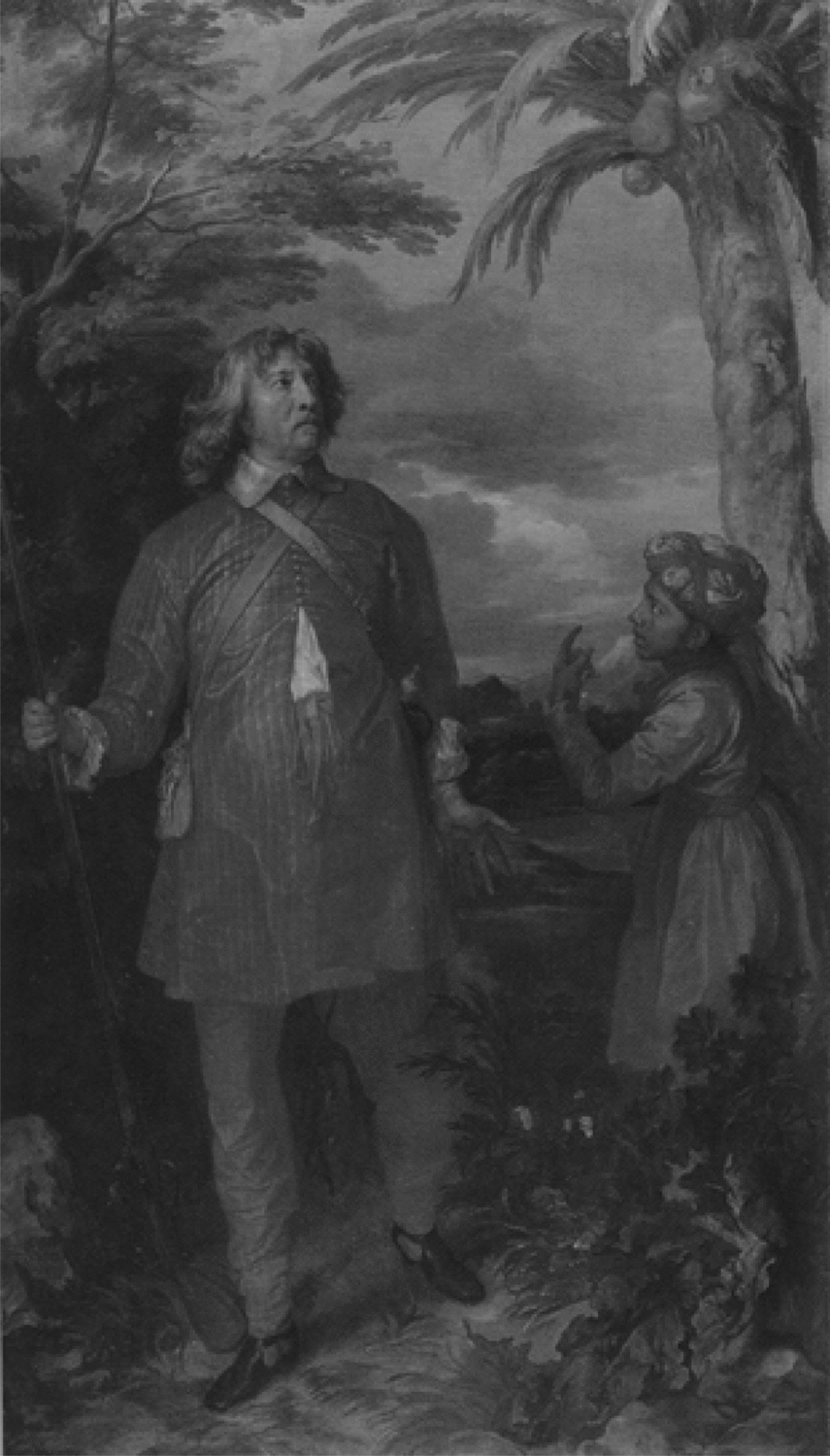
From 1631 to 1633, William Feilding, first Earl of Denbigh, travelled to India and Persia representing Charles I. On his return to Britain in 1633, the Earl brought with him at least one Indian servant, who may have served as his (unnamed) companion in the portrait that he commissioned from Anthony van Dyck after his return (Fig. 1).Footnote 7 The grand format (247.5 × 148.5) and undoubted expense of the work, as well as the selection of Feilding's Oriental mission as a subject, emphasise the commemorative nature of this piece. While the sitters were painted from life in England, their Indian jungle setting bears those imaginative details that one expects, then as now, from van Dyck. The pointing gesture of the Indian attendant leads our eye to a distant landscape which appears more familiarly European than exotic, with its rolling hills, snow-capped mountain and lake. Denbigh is placed nearest to a tree resembling an oak or beech, while his Indian companion is positioned at the base of a coconut palm, graced with a brightly coloured parrot. It is likely that in van Dyck's highly symbolic visual vocabulary, he intended these trees to represent the respective cultural heritages of his subjects. Denbigh's diagonally slung satchel and pouch are painted in the same khaki-gold tones as the oak or beech leaves suggesting, perhaps, his material ties to Europe. Similarly, Denbigh's hair, a mass of loose grey curls, recalls the tones and shapes of the pale dawn or dusk sky hovering between the two figures, a seeming reminder that Denbigh has made the journey between oak and palm, between East and West. In placing both figures between these majestic trees, whose branches and leaves gently overlap and intermingle above their heads, we are reminded of the momentous meeting of their respective cultures.
William Feilding, 1st Earl of Denbigh, Antony van Dyck, Oil on canvas; ca. 1633–36

The dress of these two subjects further blurs the lines between reality and imagination, the everyday and the highly symbolic, the familiar and the foreign, the European and the Oriental. In her analysis of this portrait, Christine Riding describes the Earl's costume as “the pyjama-style clothing that was worn by European men in India”.Footnote 8 Such an unequivocal identification between portrayal and practice risks bestowing upon this work a somewhat misplaced sense of documentary authority. Indeed, while some Orientalist paintings display a sense of hyper-realism that allows them to “resemble archival or documentary photographs, conveying a deliberate impression that they had ‘caught’ the Orient exactly as it was”, this work has no such pretension.Footnote 9 Like his contemporary Velásquez and the slightly younger Rembrandt, van Dyck used purposely visible brush strokes to signal his desire to gesture at the truth rather than forensically reveal it. Moreover, the high level of symbolism present in the landscape surrounding Denbigh and his Indian attendant begs us to interpret the dress of these two figures in equally symbolic terms. While Lord Feilding may well have succumbed to the comforts of such dress in private, as did other contemporary European men in India, it is unlikely he would have appeared publicly in such casual native ‘undress’. How, then, are we to interpret this detailed visual depiction of a European in Eastern dress, which is presented to us in the most public display of all: that of portraiture?
Anthony van Dyck's portrait highlights the subject's Oriental experiences in nuanced ways. During his second English period (1632–1641), van Dyck introduced a new type of costume in his portraits, one which was able to communicate the ideals and experiences of his sitters while simultaneously blurring the boundaries between fact and fantasy. Indeed, van Dyck was known to manipulate the sartorial codes of his day, oscillating between purposefully casual and ‘unbuttoned’ forms of déshabille and sumptuously exaggerated richness and formality.Footnote 10 His bold use of colour, life-size formats, and shameless exploitation of newsworthy subjects made him one of the foremost portrait painters of his time. Van Dyck's portrait of the Earl of Denbigh is one of the earliest depictions of a European sitter in Eastern-inspired dress and displays many of the artist's talents for sartorial manipulation.Footnote 11 Upon first glance, his costume of rich salmon-hued silk with its fine gold stripe renders the Earl's appearance strikingly ‘Oriental’. Yet, upon closer examination, we see that the Earl's dress is an imaginative cultural melange – one that is at best only semi-Orientalised.Footnote 12 The Earl's long trousers are cut in the Indian churidar paijama style and tied with a long cord at the waist, yet are worn with European-style, black leather shoes. Similarly, the long, loose cut of his tunic recalls that of a traditional kameez or kurta, as worn by Mughal gentlemen, yet the tight buttoning of the tunic across the chest and the delicate lace-edged shirt collar, folded down at the neck, give the ensemble an air of fashionable European dress.Footnote 13 The costume of Denbigh's young Indian companion is similarly imaginative. Van Dyck has visually highlighted his presence by clothing him in a lustrous gold robe and an elaborately decorative turban, both of which, in reality, would have been far above his age and station in life. The tones of the young attendant's dress also serve as a foil to the Earl's attire. Denbigh is clothed almost entirely in rose-coloured silk with the exception of his khaki-gold hunting satchel, while the young attendant's attire displays these hues inversely – his sumptuous robe is of khaki-gold and is topped by a turban of rose-coloured silk. This repetition of tones may be read as an effort to represent visually the bond between Denbigh and his attendant. The sartorial experimentation employed here reveals that for van Dyck, portraiture was inherently an act of imaginative interpretation, rather than one of real-life imitation. Accordingly, we cannot identify in the Earl's semi-Orientalised appearance proof that on some deeper level he had ‘gone-native’, nor can we interpret his costume as an unambiguous visual documentary of contemporary European dress in India. Rather, the Earl's dress is best seen as a form of cultural souvenir or visual biography, serving as a symbolic testimony to his Indian experiences.
Like other souvenirs, Indian dress and artefacts were displayed for their decorative value. Michael Fisher's comments on the aesthetic value of Indian servants in Britain remind us of the context in which exotic ‘commodities’ were publicly flaunted: “The relative rarity of Indian servants in Britain during the early period, and their unusual (for Britain) distinctive Indian characteristics, often added to their value in the eyes of their employers or masters. Their exotic identities tended to be highlighted in formal occasions, like paintings or parties, while in mundane settings their masters and the surrounding society pressurised them to Anglicise”.Footnote 14 Thus, during the seventeenth and eighteenth centuries, Indian souvenirs, material artefacts, even servants, were publicly exhibited for their exotic splendour, only to be put away in less formal circumstances. It is in this highly self-conscious, controlled manner that we might envision the first Earl of Denbigh discussing his attire for this portrait. He, like van Dyck himself, was fully aware of the aesthetic effect lent to the composition by his Indian companion and his own exoticised apparel.
In acknowledging the aesthetic appreciation of exotic dress and commodities in Britain we have raised, however, only one half of the issue. Souvenirs of Eastern travels and experiences were (like all commodities valued for their beauty, one might add) also esteemed for their ability to lend status to their possessor. In On Longing, Susan Stewart writes that “removed from its context, the exotic souvenir is a sign of survival – not its own survival, but the survival of the possessor outside his or her own context of familiarity. Its otherness speaks to the possessor's capacity for otherness: it is the possessor, not the souvenir, which is ultimately the curiosity”.Footnote 15 Indeed, Eastern forms of dress, which spoke of exotic experiences abroad, played a vital role in European self-fashioning and self-promotion. By the late eighteenth century, foreign travel had become an established right-of-passage amongst European elites, with professional travellers, amateur scholars and gentlemen tourists venturing out on the so-called grand tour, to Rome, the Near East and even beyond. Simultaneously, late eighteenth-century Britain gave birth to an ever-expanding realm of public exhibition halls, galleries and new forms of visual print and media culture. The annual exhibitions held at London's Royal Academy (founded in 1768), for example, became a gathering place for the urban elite and art-interested public. These new exhibition venues coincided with an era in which portraiture had become the predominant form of contemporary art. Given the overwhelming popularity of portraits and the inevitable competition between portraitists, artists grew increasingly adept at catering to their growing clientèle by highlighting the exotic or celebrity appeal of their sitters. The use of ‘authentic’ Oriental costume simultaneously served the interests of both portraitists seeking to forge their authority as Orientalist painters, as well as sitters striving to publicly commemorate their foreign travels or adopt a fashionably exotic persona.
Pictorial Performances: Cultural Cross-Dressing and the Art of Masquerade
Exotic dress in European portraiture must also be viewed within the context of eighteenth-century fancy-dress and masquerade culture. Originating from the Italian tradition of carnevale, masquerades enjoyed tremendous popularity in mid to late eighteenth-century Britain. In an age renowned for its rigid social hierarchies, one may easily imagine the undoubted frisson felt by those who took part in this accepted form of social transgression. The tremendous vogue for masquerades in Britain gave rise to fancy-dress portraiture, a genre which allowed former travellers and domestic Britons alike to don exotic and foreign styles of dress. The overwhelming popularity of the exotic in masquerades finds roots in the translation of Cesare Vecellio's 1590 monograph, Degli habiti antichi et moderni di viverse parti del mondo (The clothing, ancient and modern, of various parts of the world). Books of costumes had become popular in Europe during the sixteenth century, as the possibility of overseas travel sparked an interest in the clothing of different cultures. Vecellio's work included social commentary and described not only Italians from ancient Rome to the early Renaissance, but the customs and dress of China, India, the Middle East, and Africa. Eighteenth-century works that concentrated on foreign dress drew much from Vecellio's example. Catalogues such as John Tinney's Collection of the Eastern and Foreign Dresses (1750) and Thomas Jeffery's Collection of the Dresses of Different Nations, Ancient and Modern (1757) were “used as source books by masquerade dressmakers, suggesting the prevailing emphasis on the Oriental and the primitive. . .One hoping to pass for an Arabian sultana or a Turkish janissary could find the necessary visual information in such catalogues, as well as a measure of pseudo-anthropological detail suggesting ways to act one's unfamiliar part to perfection”.Footnote 16 The crudeness of these early attempts at ethnographic description has led modern historians to look upon masquerades and the exotic role play they contained with cynicism. Are they not, historians have asked, the very embodiment of imperialist fantasy - a thrilling, yet ultimately safe, means by which to inhabit the space of the ‘Other’?
Indeed, the eighteenth-century popularity of exotic dress in both masquerades and portraiture coincided with an era of unprecedented overseas expansion. One might suggest that wearing exotic clothing within the culturally accepted confines of portraiture and masquerades allowed Europeans to mingle, flirt and come to terms with exotic cultures. As Terry Castle has written, “The pleasure of the masquerade attended on the experience of doubleness, the alienation of inner from outer, a fantasy of two bodies simultaneously and thrillingly present, self and other together, the two-in-one”.Footnote 17 The wearing of foreign clothing in European portraiture and during masquerades thus provided an acceptable means by which to enter into and familiarise oneself with the exotic. Castle has noted that “stereotypical and inaccurate though they often were, exotic costumes marked out a kind of symbolic interpenetration with difference – an almost erotic commingling with the alien. Mimicry became a form of psychological recognition, a way of embracing, quite literally, the unfamiliar”.Footnote 18 The exotic dress worn at masquerades and in eighteenth-century European portraiture became “a significant and compelling means of conveying the Oriental sensibility into the Western domain”.Footnote 19
Yet, some historians have gone further, viewing masquerade culture and the portraits it inspired as a means of dominating or controlling colonial subjects. Beth Tobin Fowkes, for example, has argued that portraiture itself, as a controlled medium “deployed the rhetorical strategies of accommodation, appropriation, exoticisation, and decontextualisation to manage colonial subjects”.Footnote 20 It is particularly the decontexualising of exotic clothing, Fowkes suggests, that rendered the wearing of such clothing by British subjects non-threatening. Fowkes has examined cultural cross-dressing in the context of North America. She cites a painting of the young British soldier, John Caldwell, portrayed in Native American dress, noting that “A close examination of his moccasins, headdress, pipe, tomahawk, and a belt of wampum reveals that he is wearing not an ‘authentic’ chief's costume, but a pastiche concocted from the clothing and accoutrements of various Indian tribes”.Footnote 21 She suggests that what Caldwell achieves with “this pastiche of decontexualised objects is an illusion of Indianness, but it is an Indianness rendered powerless by its incoherence. Caldwell, meanwhile, is made more powerful by his manipulation of the Indian artefacts”.Footnote 22 In Fowkes's view, the deliberate dislocation of native objects from their origins serves to neutralise their cultural force. They lose their ability to seduce, subvert, corrupt or threaten European authority and become subject to the masterful manipulations of their European possessors. It is true that unlike the commemorative portraits we have recently explored, in which the sitters wore authentic costumes brought back from their travels, masquerade portraiture (like masquerades themselves) allowed Europeans to creatively and playfully combine clothing from different cultures and times. The manipulation of native aesthetic codes took place regularly during masquerade balls in India, for example, where it was not unusual to see Europeans dressed to imitate characters as diverse as “the emperor of Morocco – a wandering fakir – [or] a Moolvie delivering his Futwas in the Persian language”.Footnote 23 Echoing the views of Fowkes, Ward Churchill has argued that the process by which native traditions are “lumped together into a single homogeneous and consistent whole, regardless of actual variances and distinctions” creates the effect of rendering the “distinctions between cultural groupings of indigenous people. . .either non-existent (ignorance) or irrelevant (arrogance)”.Footnote 24 For both Fowkes and Ward, the dislocation and manipulation of exotic clothing in European portraiture served simultaneously to empower the wearer as well as to deny authority to the cultures and peoples that produced these artefacts. These historians are likely to suggest that, when donned in the tradition of fashionable fancy-dress or masquerade, Indian dress in European portraiture was rendered culturally benign by its manipulation, dislocation and decontextualisation. For this reason, historians have stressed that such clothing (or costume) must not be seen to indicate private or personal cross-cultural sympathies, nor be taken as an indication that the wearer had ‘gone-native’.
Yet, once again, the superimposing of post-modern, Saidian-style power dynamics on the motivations of individuals operating in the past confuses our ability to understand their possibly varied and complex motivations. Understandably, the hybrid pastiche of different forms of foreign dress worn by Europeans both during masquerades and for fancy-dress portraiture may appear a grotesque travesty of indigenous cultures and a vulgar display of colonial arrogance. Nevertheless, it can also be argued that the mimicry (however crude) of foreign forms of dress represented a sense of admiration, interest or an effort at flattery, even homage. Similarly, we cannot deduce that the confusing of (possibly subtle) distinctions in foreign dress represents a deliberate attempt to decontextualise and manage colonised cultures. Historians who have made such assertions about the nature of fancy-dress portraiture are right, however, in suggesting that one cannot seek proof, in the controlled domain of portraiture, of personal or private sympathies, evidences that the sitter had ‘crossed over’ or ‘gone-native’. Portraiture, as we have concluded previously, is a form of public performance. Much like the commemorative, self-promotional portrait discussed above, fancy-dress portraiture allowed individuals to perform before their own domestic society. The rigid social etiquette of Georgian England was difficult to transgress, and recreational role-play, such as fancy-dress portraiture, allowed individuals a powerful, albeit eccentric, mode of personal expression.
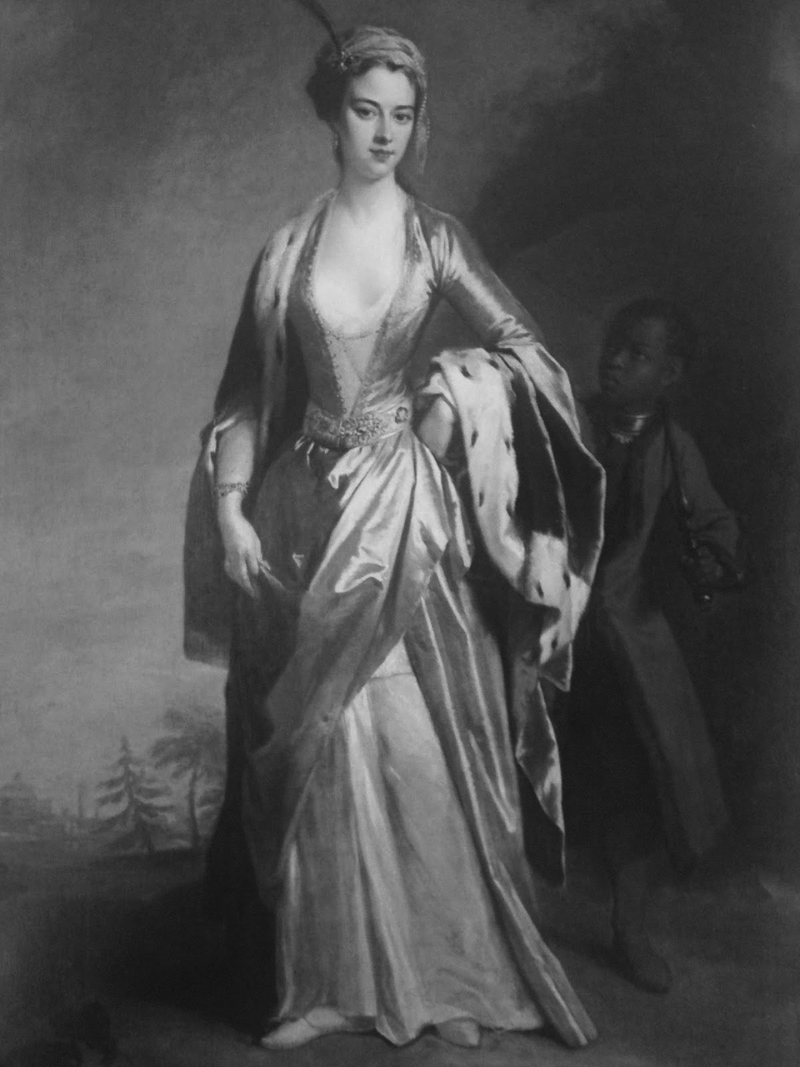
Ottoman styles of masquerade dress were made popular in late eighteenth-century Britain by the published travelogues of Lady Mary Wortley Montagu, who was painted in a hybrid melange of European and Turkish dress in 1725 by Jonathan Richardson (Fig. 2). As a female European commentator, Lady Montagu's accounts offered an unprecedented perspective on the female domains of Ottoman life and culture. Aristocratic women in Europe were dually inspired by the publishing of Montagu's Turkish Embassy Letters (1763) and her adoption of ‘liberating’ Turkish female dress. From the 1760s onwards, Sir Joshua Reynolds created so-called historical portraits, which combined his natural love for Georgian play acting and masquerade culture.Footnote 25 In these works, Reynolds represented aristocratic European women, such as Mrs Jane Baldwin, as characters from classical mythology or depicted them in elaborate forms of Eastern dress. In some cases, authentic Ottoman female dress, especially trouser-style garments, represented a calculated yet risqué departure from accepted female sartorial norms. In fancy-dress portraiture, foreign or exotic forms of dress were used to create a new visual vocabulary, a vocabulary that suggested new realms, liberation from societal restrains or sexual possibility. Yet, while this vocabulary was inspired by the foreign and the exotic, the symbolic dialogue was taking place between the individual and his or her own societal norms.
Lady Mary Montagu by John Richardson.

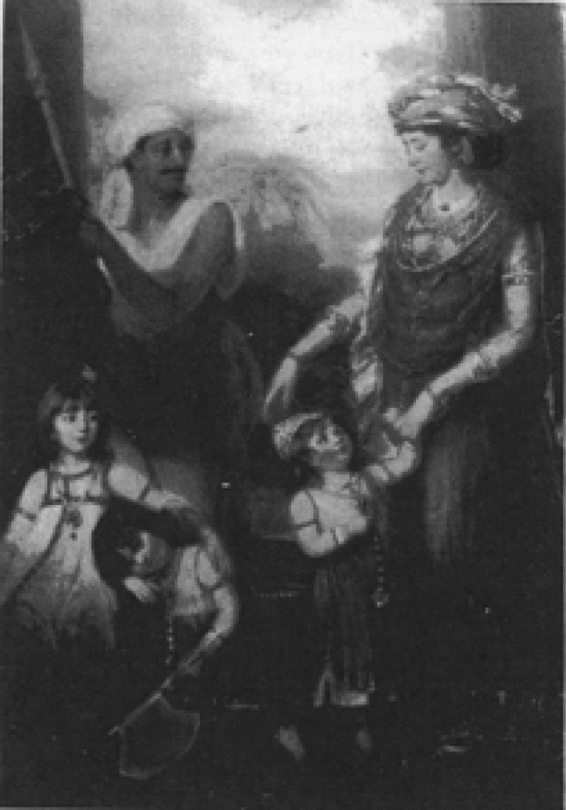
During her time in India, Mrs Elizabeth Sophia Plowden, the wife of an East India Company employee, delighted in cross-cultural costumes as a form of fancy-dress or masquerade. In a letter to her sister Lucy, she described her performance at a musical soiree. She wrote: “My band were all dress'd in Musselman's dresses. . .My dress was made at Lucknow and I wore it first at Middleton's Masquerade where I went as a Persian Girl. . .[my dress] gives me a complete Indostani appearance”.Footnote 26 In a 1797 portrait entitled Mrs. Elizabeth Sophia Plowden and Her Children, by John Russell, the subject is shown dressed in elaborate Eastern attire with three of her young children all wearing Indian dress (Fig. 3). While Mrs Plowden is most probably wearing a costume that she brought back from India, upon close inspection her dress appears not authentically Indian, but rather an amalgam of Eastern and European styles.Footnote 27 Plowden wears a short-sleeved, richly embroidered, muslin choli, or bodice. Yet over this the rich silk of a sari is not draped in Indian fashion but rather sewn into a European style dress. Similarly, Mrs Plowden wears a loosely wrapped and bejewelled turban, typical of many generic Eastern or exotic costumes, notably those of Turkey and the Near East. Much like the masquerade dress she wore in India, the dress worn in this portrait was not intended to imitate life nor to connote a sense of Mrs Plowden's authentic Indian-ness, but rather to perform, to convey, a European image of Eastern exoticism to a European audience. One might imagine that although this portrait was destined for public viewing, it afforded the sitter a sense of private satisfaction, a way to transgress, within the socially acceptable confines of portraiture, the rigid social codes and conventions of her age.
Mrs. Elizabeth Sophia Plowden and Her Children, John Russell, Oil on canvas; 1797

In the late eighteenth century, the fashion for exotic self-promotion and fancy-dress attracted an upwardly-mobile merchant class who had returned to Britain with fortunes made through East Indian trade. ‘Nabobs’, as such men were called, sought to legitimise their newly-gained wealth through participation in traditional forms of social affirmation such as portraiture.Footnote 28 As Almeida and Gilpin have put it: “The taste for art of the English nabobs, regardless of whether they were educated or largely unschooled, quite naturally ran to paintings that could evoke or depict the place where they had achieved their successes and made their fortunes”.Footnote 29 Joshua Reynolds, as van Dyck had done previously, employed a flair for rich sartorial detail to emphasise the celebrity status or exotic appeal of his sitters – making him a natural selection for returned ‘nabobs’, who often displayed a predilection for Indian sartorial splendour.Footnote 30 As a young man, Reynolds studied under respected British portrait artists Thomas Hudson and William Gandy, whose classical, formal style would greatly influence Reynolds's own work. Yet, the young Reynolds's talent was soon seen to surpass even that of his masters. His subsequent departure to Italy in 1749, at twenty-six years of age, marked a new creative era in his career. When he returned to England in 1752, his style had been profoundly influenced by the Venetian Renaissance, as exemplified by his richly golden and glowing colour schemes and the opulent texture of his painting. Reynolds's artistic talents and extroverted nature secured him a wide circle of wealthy and cultured friends as well as a continuous, and at times even overwhelming, stream of commissions. Still, despite his exceeding popularity and high-society clientèle, he sought creative ways to distinguish himself from other successful contemporaries, notably Thomas Gainsborough and George Romney. In doing so, Reynolds revealed the extent to which the Venetian school had left its mark on his style. Often accused of being ‘purely decorative’ or ‘merely ornamental’, the Venetian style of painting adopted by Reynolds placed an inordinate emphasis on colour as well as material (and often sartorial) details. These traits distinguished Reynolds's portraits from those of his contemporaries and garnered him prestigious positions such as first president of London's Royal Academy in 1768. Indeed, Reynolds thrived on his reputed skill for authentic depictions of exotic dress.
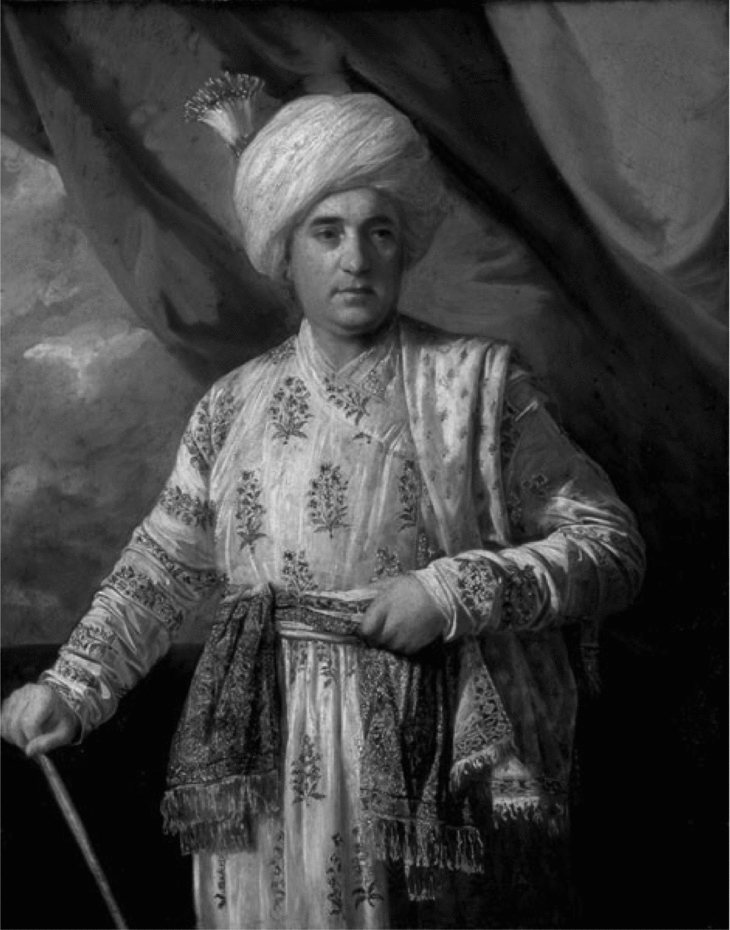
In Reynolds's 1765 portrait of Captain John Foote (a returned ‘nabob’ who was, incidentally, a neighbour and early friend of the artist), the sitter is posed against a heavily draped curtain, a customary backdrop for formal portraits (Fig. 4). The shadowed ground and glimpse of cloudy sky behind the sitter are similarly conventional and are consistent with Reynolds's frequent use of traditional, vaguely neo-classical backdrops: Greek columns, statue busts, and dark greenery. Such conventional artifices serve as an effective visual foil to Reynolds's rich and imaginative depictions of dress. Here, Captain Foote is attired in an elaborate Indian gown, most likely offered to him at a khil'at ceremony during his career in India.Footnote 31 Foote's full-length, high-necked, cotton gown, with its cross-over chest closure and narrow, gathered sleeves is an authentic Indian jama, or tunic-coat. The jama is richly embroidered with traditional Mughal floral motifs, known as buta, in striking threads of metallic silver, deep blue, and yellow silk. Foote's left shoulder is draped with an elegant shawl displaying similarly-coloured embroidery, yet in a more delicate motif than his gown. Foote's waist sash, or patka, is equally ornate with its intricate rose, burgundy, and yellow silk embroidery on a base of hammered-silver thread. The patka is edged with heavy gold fringe. Foote's turban of fine white muslin is elaborately wrapped to display another gold-fringed border, which fans out from one side.Footnote 32 Reynolds's artful rendering of his subject's authentic Indian dress shows off his particular talent for rich sartorial details and sumptuous colours. The choice of Foote's dress was likely a collaborative decision between artist and sitter, the reputation of both being greatly aided by its effects. This portrait serves as a visual biography as well as a flamboyant expression of fancy-dress aesthetics. We can deduce that Foote commissioned it in the intertwined interests of commemoration and self-promotion.
Captain John Foote, Joshua Reynolds, Oil on canvas; ca. 1765

Performance and Self-Promotion in the Era of High-Imperialism
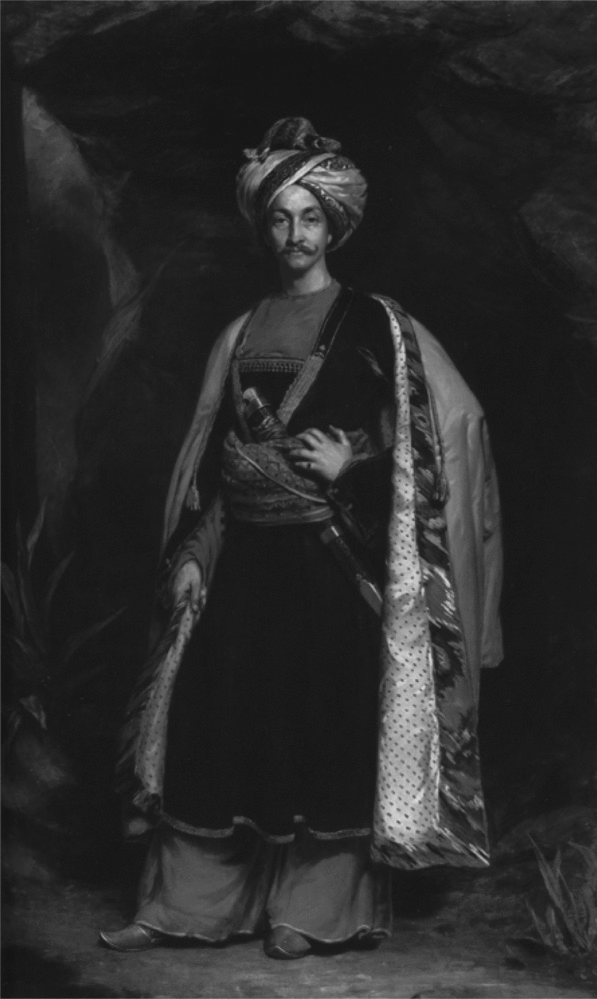
The nineteenth century is widely perceived as the climax of Britain's despotic imperialism in the sub-continent – a time when European art and literature reflected a collective and unequivocal sense of European cultural superiority. However, the motivations we have previously explored – of documentation, narration, commemoration, decoration, and self-promotion – did not cease to influence Europeans operating in the era of high-imperialism. Cultural cross-dressing in nineteenth-century portraits continued to serve an individual, as opposed to strictly imperial, agenda. James Sant's portrait, Captain Colin Mackenzie, Madras Army, lately a hostage in Caubool, in his Affghan dress, was exhibited at the Royal Academy in 1844 (Fig. 5).Footnote 33 In the 1840s, James Sant was beginning his career as a portraitist and struggling, along with other contemporary painters, for exhibition space on the Royal Academy's crowded walls. The prospect of painting Captain Colin Mackenzie presented the young artist with a precious opportunity to showcase his talents on a newsworthy subject with flamboyant aesthetic appeal. Mackenzie was a survivor of the First Afghan War (1838–42), an undisputed disaster by British accounts, marked by the forced retreat of British forces from Kabul to Jalalabad and the massacre of over sixteen thousand British and Indian soldiers and camp followers. In response to this piece, which was displayed at a 2008 exhibition at the Tate Britain entitled ‘The Lure of the East’, Rasheed El-Enany asserted the need to read in Mackenzie's ‘colourful appearance’Footnote 34 not an ambiguous sign of cultural cross-over or proof “that this officer had a genuine interest in the natives”,Footnote 35 but rather an arrogant display of pride in British military and colonial strength.Footnote 36 Unfortunately, El-Enany's analysis, like the Saidian tenets that it reflects, leaves little room for a nuanced analysis of this work. Given that the First Afghan War represented an unmitigated failure for the British, we cannot read in Mackenzie's exotic dress an affirmation of British strength – an appropriation of, and thus mastery over, Afghani culture. Nor, as argued previously, should we interpret exotic dress in European portraiture as necessarily either a sign of personal sympathy and local acceptance or an arrogant display of imperial mastery.
Captain Colin Mackenzie, Madras Army, lately a hostage in Caubool, in his Affghan dress, James Sant, Oil on canvas; 1844

In its richness of colour, grandeur of scale and exploitation of a newsworthy subject, Sant's portrait of Captain Mackenzie directly references the work of van Dyck and was clearly intended for public exhibition. Mackenzie's stance is almost swaggering. From head to toe his elaborate dress delights the eye with its saturated colours, sumptuous textures, and intricate motifs. One pale, bejewelled hand rests loosely on the folds of his waist sash, leading our eye to the gilt sword sheath that hangs diagonally across Mackenzie's body. His vivid green slippers and pale golden moustache point playfully upwards. Beneath his richly embroidered turban and pale brow we meet Mackenzie's eyes, engaging calmly with our own, daring us to comment on his striking appearance. Mackenzie himself was taken prisoner in Kabul by Muhammad Akbar Khan, the son of the former ruler of Afghanistan, Dost Muhammad, who had been deposed by the British. Even in his precarious position, Mackenzie's diplomacy and intimate knowledge of Afghani culture was said to have won him the favour of his captors, assuring his survival even before being released by the so-called Army of Retribution. According to the journal of a fellow hostage, Lady Florentian Sale, Mackenzie was even presented with an honorific Afghan dress by Akbar Khan himself: “Mackenzie and Skinner came in, in handsome dresses presented to them by Mohammed Akbar Khan”.Footnote 37 Mackenzie's own memoirs, published posthumously, contain a proud mention of that occasion,Footnote 38 suggesting that the costume depicted in Sant's portrait is likely to be the exact one received by Mackenzie in Kabul. This portrait serves as a testament to individual rather than imperial glory. Unabashedly self-promotional, it speaks of Mackenzie's strength and skill, his feats, and not those of the British empire.
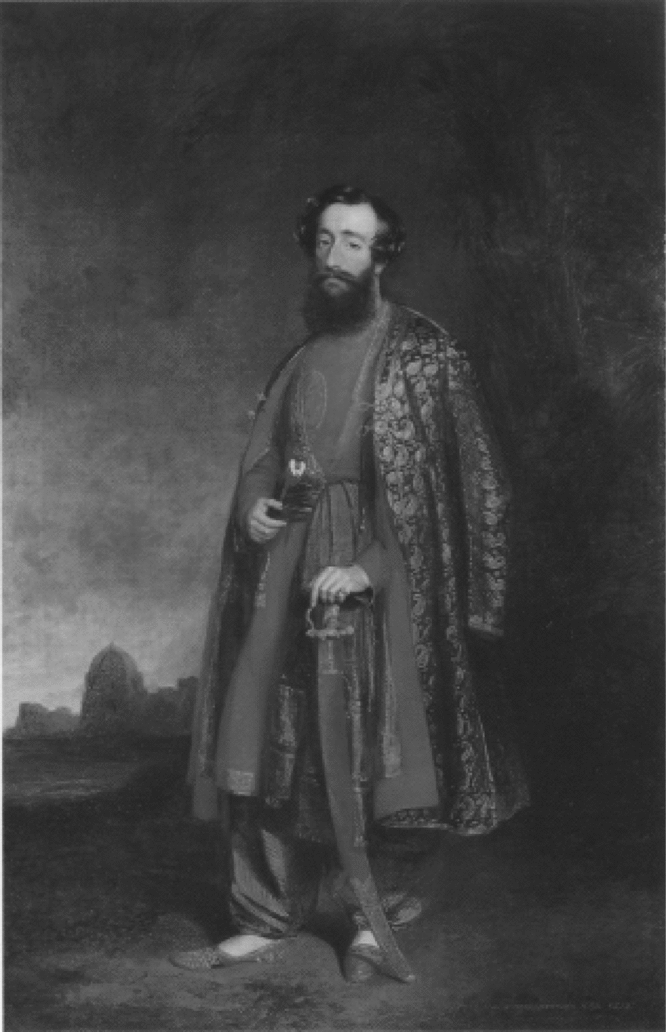
Mackenzie's portrait might be interpreted along the same lines as that of his contemporary, Sir Herbert Edwardes, who arrived in India in 1841 as a cadet in the Bengal infantry (Fig. 6). Henry Moseley, Edwards served as an assistant to Henry Lawrence in the conquest and settlement of the Punjab (1848–58). Known to be particularly knowledgeable about the local population, he was seen to have helped secure a period of stability along the Afghan frontier, in the aftermath of the disastrous campaign of 1838–41. His ‘intimate knowledge’ of the country led Edwardes to a position as Commissioner of the Ambala Division of the Punjab, during which he pushed for strong state-supported evangelical and missionary activity in the region. A note on the canvas of Henry Moseley's 1850 portrait of Edwardes records that his Afghan dress in the portrait is that which he wore at Bunoo (Banu) in 1848–49. With striking resemblance to the pose of Mackenzie, Edwardes looks calmly at the viewer, with one hand placed on a gilt Afghani sword and the other resting upon the folds of his waist sash. Like Mackenzie's Afghan dress, Edwardes's richly-coloured, heavily-embroidered attire was probably a gift from a local ruler and imparts him with a similarly romantic and picturesque appeal. In the distance, recalling the ruins of Romantic landscapes, we can make out the onion-domed skyline of an Afghani city. By 1850, when Edwardes's portrait was completed, the British military men of the northern frontier had gained a reputation in domestic Britain for bravery and heroism. The adoption of Afghani dress in Edwardes's portrait serves as a form of pictorial biography, commemorating his survival and ‘heroic deeds’ in a notoriously harsh region.
Sir Herbert Edwardes, Henry Moseley, Oil on canvas; ca. 1850

Without fully undermining the arguments of recent art historians who implicate Orientalist portraiture in the greater imperialist project of gathering ‘power over the Orient’, the works examined here compel us to consider a parallel point of view: that Orientalist portraits of European sitters and the specific sartorial codes they contain also represent a ‘desire for power’ over a Western audience. Exhibited in European galleries and private residences (removed from the contexts that inspired them) portraits of Britons in exotic dress were intended not to document the Orient, but to perform it – not to contribute to a collective notion of Western power, but to allow individual Europeans to benefit personally from exotic self-promotion.
Conclusions
Interpreters of European cultural cross-dressing in Orientalist portraits have implied that Europeans either sought to dominate Indian culture or were themselves dominated by it.Footnote 39 As this article highlights, a more nuanced and historicised reading reveals that the wearing of exotic dress in European portraiture cannot be universally interpreted as either an attempt to manage the Orient or an indication that the sitter had ‘gone-native’. It makes the case for analysing Orientalist portraits and the sartorial codes that they contain as a form of public performance – a performance staged, in many cases, not to subjugate a colonised population but to engage with and gain power over the domestic European imaginary. This move away from traditional, monolithic binaries of East versus West affords us a more subtle lens through which to view not only the power dynamics of colonial rule but also the social dynamics, aspirations, and tensions inherent to intra-European relations. Crucially, this article has argued that the superimposing of post-modern, Saidian-style power dynamics on the incentives of individuals operating in the past can confuse our ability to understand their possibly varied and complex motivations. The implications of this argument extend far beyond the narrow field of Orientalist portraiture and outside the realm of art history more generally. Given the contemporary rhetoric about a modern ‘clash of civilisations’ and the routine generalisations in the popular press about East and West and Islam and Christianity, the analytical path broken here affords a timely new perspective on historical as well as contemporary East-West relations. Studies following this path will continue to paint a more complex image of Orientalism than that sketched by the broad brush strokes of Saidian binaries.