During the coronavirus disease 2019 pandemic caused by the severe acute respiratory syndrome coronavirus 2, there have been many reports of children hospitalised with an acute febrile illness accompanied by inflammation, gastrointestinal symptoms, vasoplegic shock, and cardiac complications. This syndrome has been named multi-system inflammatory syndrome in children associated with severe acute respiratory syndrome coronavirus 2 infection. Reference Riphagen, Gomez, Gonzalez-Martinez, Wilkinson and Theocharis1–Reference Clark, Sanchez-de-Toledo and Bautista-Rodriguez12 According to the published data, 40–64% of these children presented with severe multi-organ failure, including shock and required intensive care. Reference Whittaker, Bamford and Kenny5–Reference Davies, Evans and Kanthimathinathan10,Reference Clark, Sanchez-de-Toledo and Bautista-Rodriguez12 This syndrome has features similar to those of Kawasaki disease and toxic shock syndrome. Reference Riphagen, Gomez, Gonzalez-Martinez, Wilkinson and Theocharis1–Reference Clark, Sanchez-de-Toledo and Bautista-Rodriguez12 Up to 30% of patients with multi-system inflammatory syndrome meet American Heart Association criteria for Kawasaki disease. Reference Whittaker, Bamford and Kenny5,Reference Dufort, Koumans and Chow6,Reference Bautista-Rodriguez, Sanchez-de-Toledo and Clark13 However, these two entities are different from an epidemiological and clinical point of view. Reference Whittaker, Bamford and Kenny5,Reference Levin11,Reference Bautista-Rodriguez, Sanchez-de-Toledo and Clark13
Few studies have described coronary artery abnormalities and echocardiographic findings in multi-system inflammatory syndrome patients. The detailed strain analysis of cardiac mechanics using deformation parameters is lacking. Deformation parameters are sensitive tools to detect subtle changes in myocardial function. Although general characteristics and the epidemiological, clinical and laboratory differences between multi-system inflammatory syndrome and Kawasaki disease have been reported, Reference Dufort, Koumans and Chow6,Reference Feldstein, Rose and Horwitz7,Reference Clark, Sanchez-de-Toledo and Bautista-Rodriguez12–Reference Valverde, Singh and Sanchez-de-Toledo15 the comparison of multi-system inflammatory syndrome with typical Kawasaki disease is sparse in published data and needs to be studied in greater detail.
The aim of our study was to compare the main echocardiographic findings between a historic cohort of typical Kawasaki disease with coronary artery abnormalities and children diagnosed with multi-system inflammatory syndrome, paying particular attention to the segmental and global longitudinal strain differences by using speckle tracking echocardiography.
Material and method
Study population
This study was conducted in a single tertiary care paediatric cardiology centre at the Royal Brompton Hospital, London. All consecutive children aged 18 years or younger who fulfilled the case definition of multi-system inflammatory syndrome Reference Whittaker, Bamford and Kenny5 between 1st April and 31st July, 2020 were included, regardless of their left ventricular ejection fraction at presentation. The general echocardiographic findings and the segmental strain analysis of the multi-system inflammatory syndrome group were compared with a historic cohort of consecutive non-matched typical Kawasaki disease patients with coronary artery abnormalities and normal left ventricular ejection fraction followed at the Kawasaki clinic between 1st October, 2016 and 30th June, 2019. All children included in the Kawasaki disease cohort fulfilled the American heart association criteria for typical Kawasaki disease. Reference McCrindle, Rowley and Newburger16 Only those with normal left ventricular ejection fraction were included in order to compare the segmental and global longitudinal strain findings between multi-system inflammatory syndrome and Kawasaki disease patients. All images acquired following the Royal Brompton Hospital echocardiography protocol were adequate for off-line analysis, so no patients were excluded. The institutional review committee approved the study.
Patients’ data including age, sex, race, height, weight, and comorbidities were recorded. Obesity was defined as a body mass index at or above the 95th percentile for children and teens of the same age and sex according to the Centres for disease control and prevention. Severe acute respiratory syndrome coronavirus 2 serology was obtained in children with multi-system inflammatory syndrome. Information about outcome measures including admission to intensive care unit, inotropic support, need for mechanical ventilation, renal replacement therapy or Extracorporeal membrane oxygenation were also collected, as well information about medications used to treat these patients.
Echocardiography
Two-dimensional echocardiography was performed using two different ultrasound systems (iE33 xMATRIX Philips Healthcare, The Netherlands and GE E95 Healthcare, Horten, Norway). All data were transferred to a commercially available workstation (Xcelera, R3.2, Philips Healthcare and EchoPAC, GE Healthcare) and analysed offline. The images were obtained by two different technicians following the Royal Brompton hospital echocardiographic protocol. Chamber size and function, coronaries, valvar abnormalities, and pericardial effusion were assessed according to the recommendations of American Society of Echocardiography. Reference Lopez, Colan and Frommelt17 A normal left ventricle ejection fraction was considered >52% by Simpson’s Biplane. All measurements of coronary arteries were converted into Body Surface Area-adjusted Z-scores using published methods. Reference Sluysmans, Colan, Lai, Cohen, Geva and Mertens18,Reference Colan, Lai, Cohen, Geva and Mertens19 We defined different coronary artery abnormalities as follow:
-
Coronary artery dilation: z-score between 2 to <2.5
-
Small aneurysm: z-score ≥2.5 - <5
-
Medium aneurysm: z-score ≥5 to <10
-
Giant aneurysm: z-score ≥10. Reference Manlhiot, Millar and Golding20
Speckle tracking analysis
Myocardial deformation was assessed offline using two-dimensional speckle tracking vendor-independent software (2D CPA 1.3.0.91 TomTec Imaging Systems, Munich, Germany). Speckle tracking analysis was performed by one expert paediatric cardiology echocardiographist, masked to the participant condition. The endocardial border in left ventricle was automatically traced after manually setting the timing of end-diastole and systole in a single loop. The trace was adjusted manually if needed. Global longitudinal strain was calculated as the average of peak longitudinal strain in standard apical four-chamber, three-chamber, and two-chamber views, obtained with a frame rate of 50–80 frames/s, sinus rhythm and ≤10% variability in heart rate. We considered pathologic a global longitudinal strain less than or equal to –16.7% or at least two segments with a peak systolic strain less than or equal to –16.7%. Reference Cantinotti, Scalese and Giordano21,Reference Sabatino, Di Salvo and Krupickova22
Statistical analysis
Continuous variables were summarised as either means and standard deviation or medians with interquartile ranges when appropriate. Student’s t-test, the X2 method, or Fisher’s exact test, Mann-Whitney U, Wilcoxon-tests, and Kruskal–Wallis were performed when appropriate. A p value of < 0.05 was considered as significant. Data were analysed with SPSS Inc. (IBM, v27.0).
Results
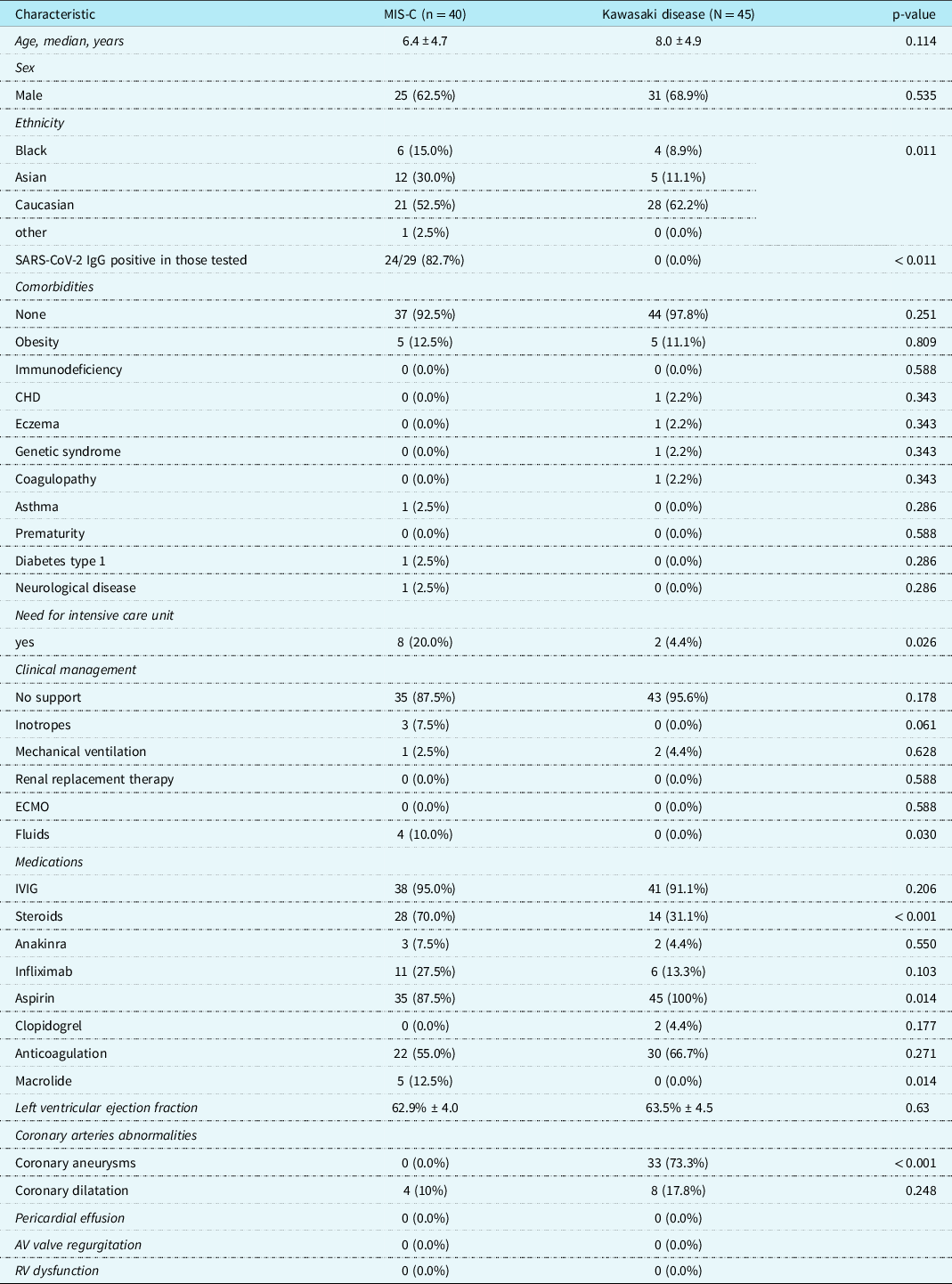
Clinical characteristics of patients [Table 1]
Clinical characteristics

AV= atrio-ventricular; ECMO = Extracorporeal membrane oxygenation; IVIG = Intravenous Immunoglobulin; KD = Kawasaki disease; MIS-C= multi-system inflammatory syndrome in Children; RV= right ventricle; y=years.
A total of 85 patients were enrolled in our study. We included 40 multi-system inflammatory syndrome children (25 males, 62.5%) at a mean age of 6.4 ± 4.7 years old and 45 Kawasaki disease patients (31 males, 68.9%) at a mean age of 8.0 ± 4.9 years old. Severe acute respiratory syndrome coronavirus 2 serology (immunoglobulin G) was positive in 60% of multi-system inflammatory syndrome children. There was a significant pre-dominance of black race and Asian ethnicity in the multi-system inflammatory syndrome cohort (p = 0.011). There were no difference in the rate of comorbidities among both groups (p > 0.05). Only one patient with Kawasaki disease had Noonan syndrome with pulmonary valve stenosis. Obesity between multi-system inflammatory syndrome (5/40, 12.5%) and Kawasaki disease patients (5/45, 11.1%) was not significantly different (p = 0.809).
In the acute phase of the disease access to the ICU was significantly greater in the multi-system inflammatory syndrome group than in patients with Kawasaki disease (p = 0.026), with higher requirement of fluid resuscitation (p = 0.03) but no significant differences in mechanical and/or inotropic support. Intravenous Immunoglobulin was the most used treatment in both groups (38/40, 95.0% in multi-system inflammatory syndrome versus 41/45, 91.1% in Kawasaki disease, p = 0.206). Steroids and macrolides were used significantly more in the multi-system inflammatory syndrome group (p < 0.001 and 0.014, respectively), whereas aspirin was administered significantly more in the Kawasaki disease cohort (p = 0.014).
Standard echocardiography parameters [Table 1 ]
Left ventricular ejection fraction was normal in both multi-system inflammatory syndrome and Kawasaki disease groups (62.9%, SD 4.0 versus 63.5%, SD 4.5; p = 0.63). 4/40 (10%) children diagnosed with multi-system inflammatory syndrome had coronary artery abnormalities: 3 with dilatation of the left main coronary artery and one with dilatation of the right coronary artery. All 45 patients in the typical Kawasaki disease cohort had coronary artery abnormalities: 33 had coronary aneurysms (17 with giant coronary aneurysms), 8 had coronary dilatation and 4 had a history of coronary artery abnormalities in the acute phase, that subsequently normalised. The left main coronary artery was involved in 25 children, the left anterior descending coronary artery in 10 patients, and the right coronary artery in 25. No right ventricle dysfunction, pericardial effusion, or atrioventricular valve abnormalities were detected in either group.
Speckle tracking echocardiography
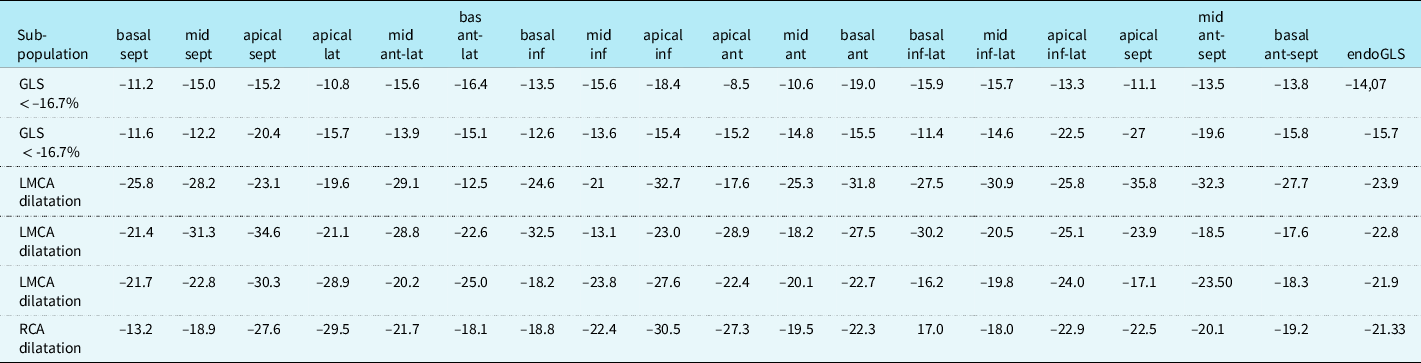
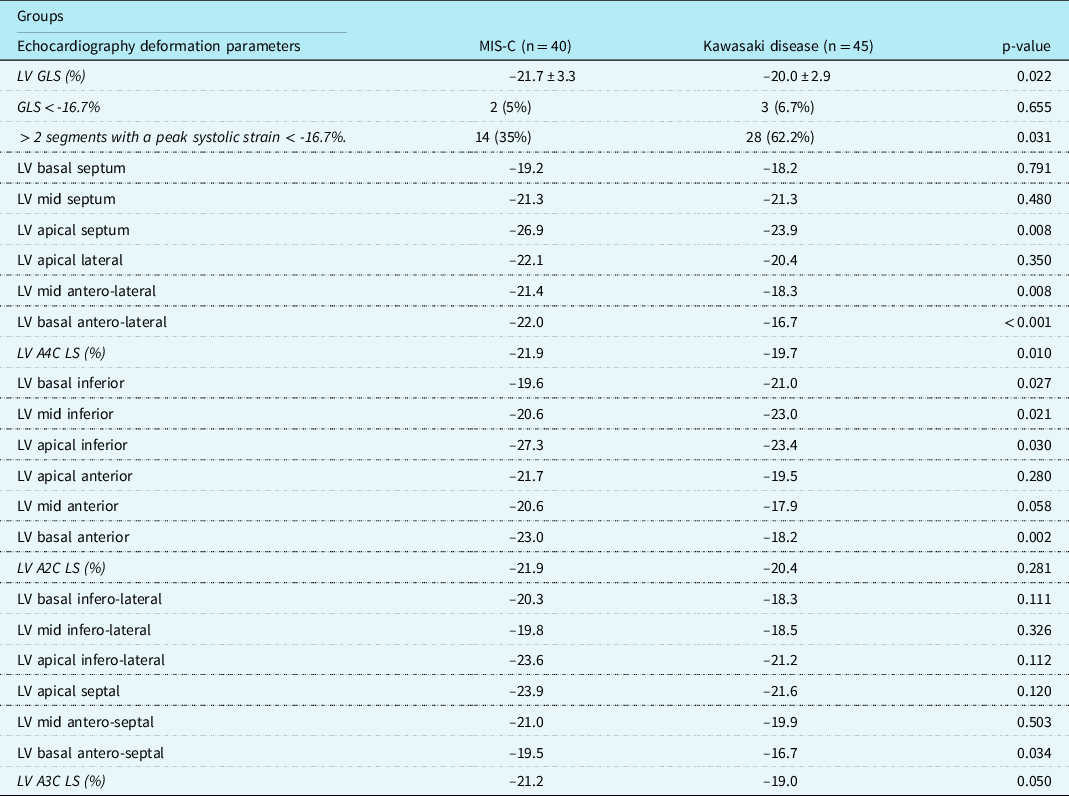
Segmental strain analysis of the multi-system inflammatory syndrome group was performed at a mean of 28.9 days following initial symptoms (range 6–72 days) and compared with typical Kawasaki disease cohort at a mean follow-up of 1741.8 days from the onset of symptoms (range 5–5467 days). Both groups had a global longitudinal strain within normal range, but Kawasaki disease patients had significantly decreased values when compared to multi-system inflammatory syndrome group (–20.0%, SD 2.9 versus –21.7%, SD 3.3; p = 0.02). The proportion of patients with >2 segments with a peak systolic strain < –16.7% was significantly higher in the Kawasaki disease cohort (28/45, 62.2%) when compared to the multi-system inflammatory syndrome cohort (14/40, 35%) (p = 0.031). Only two patients with multi-system inflammatory syndrome had a GLS < –16.7% [Table 2].
Echocardiography deformation parameters MIS-C

GLS = global longitudinal strain; LMCA = left main coronary artery; MIS-C = multisystem inflammatory; RCA = right coronary artery.
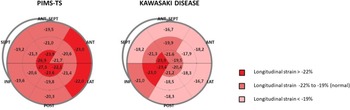
Basal segments were the most affected in Kawasaki disease patients with significant difference in the basal anterior, anterolateral, and anteroseptal strain compared to multi-system inflammatory syndrome patients (–18.2%, SD 6.0 versus –23.0%, SD 6.4, p = 0.002; –16.7%, SD 7.2 versus –22.0%, SD 5.7, p < 0.001; –16.7%, SD 5.6 versus –19.5%, SD 4.9, p = 0.034 respectively). The basal anterolateral and anteroseptal segments in Kawasaki disease patients were the only ones with a pathologic longitudinal strain value (–16.7% both) in line with the greater left main coronary artery involvement in this cohort. Despite the normal left ventricle systolic function, the cohort with Kawasaki disease had a greater anterolateral wall involvement with a significant reduction also in the mid-wall longitudinal strain (–18.3%, SD 5.0 versus –21.4%, SD 4.6; p = 0.008). Apical segments were less involved, with significant difference only in the septal and inferior apical strain (respectively p = 0.08 and p = 0.03) [Table 3 and Fig 1].
Echocardiography deformation parameters – longitudinal strain bull’s eye.

Echocardiography deformation parameters MIS-C and KD

A4C = apical four chambers; A2C = apical two chambers; A3C apical 3 chambers; GLS = global longitudinal strain; KD = Kawasaki disease; LS = longitudinal strain; LV = Left ventricle; MIS-C = multisystem inflammatory syndrome in children.
Discussion
This is the largest echocardiographic study comparing the segmental and global longitudinal strain differences between multi-system inflammatory syndrome and typical Kawasaki disease patients with coronary artery abnormalities. Myocardial deformation assessment in these two groups supports the idea of the transient nature of the cardiac involvement in multi-system inflammatory syndrome, in contrast to the subtle and chronic myocardial involvement in Kawasaki disease children with coronary artery abnormalities, even after years of follow-up. This suggests that the mechanism of myocardial dysfunction in multi-system inflammatory syndrome is not related to coronary involvement.
In the acute phase of the multi-system inflammatory syndrome, Matsubara et al. showed that most patients recovered normal left ventricular ejection fraction but persisted with lower global longitudinal strain and diastolic dysfunction at least 7 days after the onset. Moreover, multi-system inflammatory syndrome patients demonstrated worse left ventricle systolic and diastolic dysfunction when compared with Kawasaki disease patients. Reference Matsubara, Kauffman and Wang14 Our study brings new data regarding the sub-acute phase, as most of our multi-system inflammatory syndrome patients were screened later, after a mean duration of 28.9 days following the onset of the disease. At that point, most of multi-system inflammatory syndrome patients had recovered for the cardiac injury and myocardial deformation parameters were significantly better than patients with Kawasaki disease and coronary artery abnormalities. This supports the idea of a transient cardiac injury in multi-system inflammatory syndrome patients.
In Kawasaki disease, about 25% children develop coronary aneurysms if not treated in the acute phase with intravenous immunoglobulin. Reference McCrindle, Rowley and Newburger16 Moreover, residual abnormal lesions in the myocardium are well-known in Kawasaki disease with aneurysms even after years from the acute phase of the disease, as myocardial biopsies have shown inflammatory cell infiltration, interstitial fibrosis, and disarray. Reference Yonesaka, Takahashi and Eto23 Left ventricle systolic dysfunction in children with Kawasaki disease and coronary artery dilatation is more severe compared to Kawasaki disease patients without coronary involvement, with reduced left ventricle regional and global myocardial strain at > 7 years follow-up. Reference Lin, Zheng, Chen, Ding, Yu and Xia24 Muthusami et al. recently demonstrated using cardiovascular magnetic resonance that myocardial fibrosis occurs especially in region with myocardial hypo-perfusion, caused by macroscopic coronary artery abnormalities and micro-vascular dysfunction in Kawasaki disease patients. Reference Muthusami, Luining and McCrindle25 This contrasts with cardiovascular magnetic resonance findings in patients with multi-system inflammatory syndrome. In a recent study during the sub-acute phase, we did not find major signs of oedema or myocardial fibrosis. Reference Bermejo, Bautista-Rodriguez and Fraisse26,Reference Krupickova, Bautista-Rodriguez and Hatipoglu27 All this correlates with the present study where myocardial deformation assessment in our cohort where left ventricular ejection fraction and global longitudinal strain are overall normal within 28.9 days from the beginning of symptoms. These findings support the absence of long-term sequelae in this patient population.
Multi-system inflammatory syndrome presents with a wide clinical spectrum, including Kawasaki disease-like, life-threatening shock and milder forms with mainly fever and inflammation. More than half of multi-system inflammatory syndrome patients require fluid resuscitation and intensive care management at the time of presentation. This is very uncommon in typical Kawasaki disease patients. Despite multi-system inflammatory syndrome patients being very sick in the acute phase, they mostly recover a normal left ventricular ejection fraction and a normal global longitudinal strain without specific segmental strain abnormalities within 28.9 days from the onset. This suggests that the etiopathogenesis of myocardial involvement in multi-system inflammatory syndrome might be related to severe inflammatory response in contrast to endothelium damage in Kawasaki disease patients among others. However, cautious evaluation and serial follow-up may still be warranted as the left ventricle dysfunction may occur later in the process secondary to post-inflammatory/post-ischemia fibrosis.
Coronary involvement in multi-system inflammatory syndrome and Kawasaki disease
Coronary involvement plays a fundamental role in the global longitudinal strain and segmental strain differences obtained between the two populations. All patients with Kawasaki disease included in our study had significant coronary artery abnormalities which would probably explain the reduced global longitudinal strain as compared to multi-system inflammatory syndrome patients. Moreover, the greater rate of left main coronary artery abnormalities reflects the reduced segmental strain in the antero-septal and antero-lateral basal walls, which was not found in patients with multi-system inflammatory syndrome.
The two multi-system inflammatory syndrome patients with reduced global longitudinal strain did not have coronary arteries involvement. Moreover, the four patients with coronary dilation (three left main coronary artery and one right coronary artery) during the follow-up presented with a normal global longitudinal strain. Consequently, the subtle difference in the echocardiographic findings might be explained only by the different coronary involvements in the two diseases especially because the period of analysis of this study is well beyond the acute phase in both cohorts (28.9 days and 1741.8 days respectively).
Study limitations
This study carries several limitations. First of all, it is a retrospective study on a new disease with small samples for both multi-system inflammatory syndrome and Kawasaki disease patients. Secondly, this work does not report any mid-term follow-up for multi-system inflammatory syndrome. Additionally, some children included in the multi-system inflammatory syndrome cohort with Kawasaki disease-like features could have been true Kawasaki disease patients. Moreover, the images were obtained by two different technicians following the Royal Brompton hospital protocol. Unfortunately, it was not possible to relate the inflammatory and cardiac necrosis markers, with the strain parameters because the management of bloods in the first phase of the disease was managed variably by local hospitals.
Conclusions
Our findings on the segmental and global longitudinal strain are consistent with the transient nature of the cardiac involvement in multi-system inflammatory syndrome, as opposed to the subtle and chronic myocardial involvement in Kawasaki disease children with coronary artery abnormalities. We speculate that the mechanism of cardiac impairment in the few multi-system inflammatory syndrome with reduced global longitudinal strain is not related to coronary artery abnormalities.
Acknowledgements
None.
Financial support
This research did not receive any specific grant from funding agencies in the public, commercial, or not-for-profit sectors.
Conflicts of interest
None.