Those of us from a certain generation may remember our first encounter with the M2 and M3 section of the music libraries in which we began our graduate studies. The groups of large-format tomes with their matching bindings appeared to me like the massive blocks of a great cathedral. Dedicated almost exclusively to the works of dead European men, these critical editions were the literal and figurative embodiments of the ‘old musicology’ against which so many in my generation defined themselves. We may have felt resistance to the positivism and sacralizing impulse that these critical editions represented, but they nevertheless evoked admiration. Each was the product of an enormous exertion of intellectual labour: painstaking archival work and organizational energy. They are monumental in every sense of the word.
The ‘Weberian stone’ of this scholarly cathedral is published by Schott Music. The edition was planned with 56 volumes of music including critical reports, 10 volumes of letters, around 8 volumes of diaries, 2 volumes of writings, a catalogue raisonné and several volumes of documents. Begun in 1991, the project is not yet complete. The digital Carl Maria von Weber Gesamtausgabe (hereafter ‘WeGA’) – which will be the focus of this review – is not a digitization of this Schott edition. As the ‘Project Description’ notes, the goal of WeGA is to present ‘all of Weber’s compositions, letters, diaries and writings in a historico-critical complete edition by the 200th anniversary of Weber’s death in 2026’. In practice (as I will explain below), the emphasis of the WeGA is very much on the textual material (rather than on Weber’s compositions). Although the WeGA is incomplete, it already includes a gigantic corpus of digital material, every bit as monumental as the series of tomes that line the shelves of the M2 and M3 sections. At the same time, it radically extends the notion of the critical edition. The intention is not merely to create an authentic text of Weber’s compositions, but also to establish an authentic record of his life. In this respect, it models a new kind of scholarship: one that is only possible in the hyperconnected digital age. Indeed, the editors of the WeGA describe their project in just these terms.Footnote 1 The WeGA is therefore of interest not only for those of us fascinated by Weber’s life and works. Its successes and failures also illustrate many of the broader challenges and opportunities of contemporary musicology.
The ancestor (if I may speak in such terms) of the WeGA is the ‘chronological-thematic’ index of Weber’s works published by Friedrich Wilhelm Jähns in 1871.Footnote 2 This work – itself a monument of nineteenth-century musicology – is far more than a simple list of Weber’s compositions. For each of Weber’s works – and for each of the individual movements or numbers of larger compositions – Jähns provides a short musical incipit. He follows each of these incipits with extensive commentaries, in which he discusses relevant editions and arrangements, provides accounts of compositional and early performance history, and (where relevant) describes sources for lyrics and/or libretti. While most of these Anmerkungen are very short, Jähns’s commentary on Der Freischütz fills 25 close-packed pages.Footnote 3 Here one can find information not only about the origins of Friedrich Kind’s libretto, but also about early performances of the work in places such as St Petersburg and New York. Jähns discusses metronome markings for the individual numbers of the opera alongside translations and secondary literature. Jähns thus places Freischütz (and Weber’s other works) in the centre of a network of data.
The idea of a network of data is central to the WeGA project. Its ultimate goal (as I noted above) is to include authoritative editions of both Weber’s music and his prose works. Although the WeGA does include some digital scores (which I will discuss below), these are overshadowed by enormous amounts of prose material. In addition to an unfinished novel (Ein Tonkunstlers Leben) and a large number of reviews and other critical writings, Weber left behind nearly 6,000 letters. The WeGA also includes reviews (by other critics) of his works, responses to his letters, and selections from other texts that describe Weber’s life and compositions. Much of this material has already been digitized and uploaded onto the WeGA site, and more documents are being continually added.
The editors have sorted this material into categories (‘diaries’, ‘letters’, ‘documents’ and ‘writings’). Although the distinctions among these categories are not always perfectly clear, the taxonomy provides a useful way to organize this enormous corpus of texts. To help the user navigate this corpus, the WeGA also includes numerous indices. The index of personal names is perhaps the most impressive of these.Footnote 4 Supplemented by names from Robert Schumann’s circle and those from other databases, this index now includes over 10,000 persons. One can use this index not only to discover basic biographical data, but also to access the other sections of the WeGA that reference a particular person. Taken altogether, the ‘Persons’ index probably includes a sizeable percentage of the professional musicians active in Germany during Weber’s lifetime. This makes it an invaluable resource not only for scholars focused on Weber’s life and works, but also for those interested in early nineteenth-century German musical culture more generally. A similar database (‘Works’) indexes all of the compositions mentioned in the WeGA documents.Footnote 5 There are 1,576 of these, only 371 of which are by Weber himself. As with the ‘Persons’ index, the ‘backlinks’ function to discover documents that reference any particular work. It is therefore a tool to explore not only Weber’s compositions, but the network of other works with which they are connected.
In addition to this material, the WeGA also includes 64 ‘thematic commentaries’ written by the editors of the project. These are essentially short essays about different aspects of Weber’s life and works. Some of these – such as the thematic commentary on Weber’s unfinished novel – are focused on specific works, while others describe formative events in Weber’s life. Alongside an essay about Weber’s family history, one can find a commentary on the domestic animals that his family owned, as well as information about the nicknames that Weber used in his correspondence. When I reviewed this website in February of 2026, it included 64 thematic commentaries; it is my hope that more will be added as the project continues to grow.
Navigating through this frankly overwhelming amount of material is facilitated by extremely robust cross-referencing and filtering functions. The search function allows users to filter results according to document type and chronological range. One may (for example) trace the evolution of Weber’s relationship with his wife (Caroline Brandt) or focus on his visits to a particular city. Although much of this material is inevitably banal or recondite, it provides an unparalleled resource for the reception history of Weber’s works.
To give a comprehensive review of this project would be impossible. Instead, I will use my own interaction with the database as a case example of one possible way to explore the WeGA. Such a method, I will admit, is like trying to describe a continent by narrating one’s visit to the nearest town. I nevertheless hope that it will give readers a sense of the project’s potential usefulness.
My abiding interest in the cultural politics of German opera in the early nineteenth century suggested an interesting search topic: the opera Das unterbrochene Opferfest by Peter von Winter. Premiered in 1796, the work was one of the most popular German-language operas of the early nineteenth century, and it formed a large part of Weber’s repertoire during his years as a Kapellmeister in Dresden. The WeGA provides numerous search pathways to investigate Weber’s relationship to the opera. One such pathway begins with the entry on Das unterbrochene Opferfest in the ‘Works’ index that I referenced above. Clicking on Das unterbrochene Opferfest takes me to a ‘basic data’ page, which serves as a portal into the rest of the site. I can access the Wikipedia article on the opera directly from this portal, but it is more interesting to use the ‘backlinks’ function. Clicking here, I see that there are 157 documents that mention Das unterbrochene Opferfest. The ‘filter’ function allows me to narrow my results according to document type. Focusing on the ‘Writings’ database further allows me to search Weber’s reviews, which are typically quite entertaining and informative. This search narrows my results to 55 hits, which are listed chronologically. I am especially interested in the years immediately following the defeat of Napoleon, when questions of German national identity were especially salient. My attention is seized by the ‘Theaterbericht Dresden Das unterbrochene Opferfest’ from January of 1817, in which Weber reviewed a performance of the work that took place during the previous month. Those unfamiliar with operatic performance practice in early nineteenth-century Germany might find it strange that the Das unterbrochene Opferfest was given in Italian translation (as ‘Il sacrifizio interrotto’), but this was not unusual in the court-centred culture of Dresden during these years. Weber’s review is glowing. He especially praises the artistry of the eighteen-year-old Carolina Benelli, who appeared in the title role of Myrrha. The fact that her father portrayed her romantic interest and the lead tenor role elicited no discomfort on Weber’s part and reminds us of the family connections that were so important in the musical life of eighteenth and nineteenth-century Europe. Given Weber’s subsequent lionization (in the writings of Wagner, as well as in other texts) as a champion of German opera, it is perhaps surprising to find no objection to the idea of a German-language work presented (before a German-speaking audience) in Italian translation. Only in the final sentence, in which Weber admonishes Carolina Benelli to remember that ‘modesty is always the true sister of genuine integrity’ do we have an inkling of the moral critique of Italian opera that was to be so important in later critical writings (by Weber and others).
Curious to understand how Weber’s ideas about Das unterbrochene Opferfest might have changed during this period, I again used the ‘backlinks’ function to lead me to other documents. My attention was drawn to a diary entry from 5 November 1811 that seemed to promise a fuller discussion of the work. Here, however, I came to a dead end. This entry is merely a ‘candidate’ for inclusion in the WeGA: it has not yet been digitized and uploaded. Such dead ends are a common feature of the WeGA. As I noted above (and as the editors of the WeGA acknowledge), the project is incomplete.
The fact that the WeGA does not yet contain ‘all of Weber’s compositions, letters, diaries and writings’ is partly due to financial constraints. Although details are obscure, government funding for the project was sharply curtailed in 2015. Digitizing documents and forging the links that make the WeGA so useful is laborious. But the incomplete nature of the WeGA is also a function of the conceptualization of the project itself. The goal of completeness has led to the digitization and categorization of large numbers of documents – including hundreds of receipts – whose importance to music history seems at best tangential. In addition to the voluminous material from Weber’s own pen, the WeGA also includes numerous ‘Weber-adjacent’ documents. A search for ‘Friedrich Wilhelm Jähns’, for example, yields 2,178 hits. Many of these are letters to and from his wife Ida; they contain lots of news (some of it tragic) about family matters, but little about Weber’s life and works. The boundaries of the ‘continent’ of the WeGA (if I may return to the metaphor that I used above) could theoretically be pushed out further, to include more materials from figures such as Friedrich Kind (the librettist for Der Freischütz) or Helmine von Chezy (who wrote the book for Euryanthe). In this context, it is difficult to see how the goal of ‘completeness’ will ever be met.
The huge trove of textual materials in the WeGA provide the opportunity for almost limitless exploration. The treatment of musical materials, however, will no doubt leave many users frustrated. A ‘Contents of Series and Volumes’ link on the home page of the project takes users to a list of the individual volumes of the Schott edition that I referenced above. Users may purchase these volumes directly from the WeGA site, but they cannot view them. In this respect, the WeGA is like the inverse of the Neue Mozart Ausgabe Online. The NMA allows users to directly access high-quality editions of Mozart’s works but includes almost none of the textual material (e.g. reviews, letters, biographical notices etc.) that surround them. The WeGA does exactly the opposite.
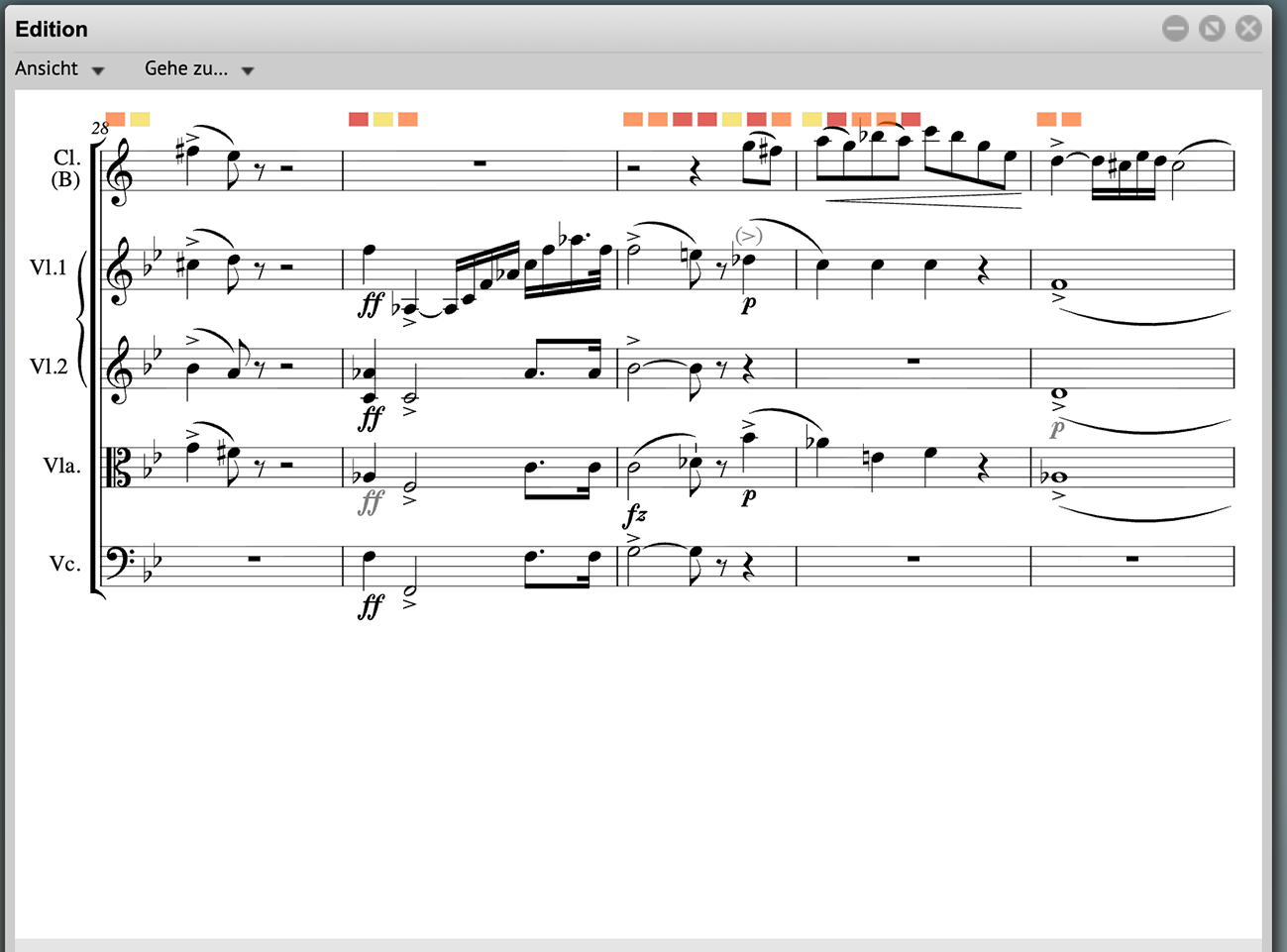
There are a few important exceptions to this latter claim. Under the category of ‘Special Publications’, the WeGa includes a digital edition of Weber’s Op. 34 Clarinet Quintet. As the introductory remarks explain, the first version of the Clarinet Quintet (produced in 2004) was a ‘proof of concept’ for the application of digital methods to music philology. The third edition of the project – included as part of the WeGA – embeds critical notes directly into the musical score. Figure 1 is a screenshot of a section near the beginning of the first movement.
Selection from the digital score of Weber, Clarinet Quintet.

Figure 1 Long description
The image shows a digital score of a musical composition with five staves. The top staff is labeled 'Cl' for clarinet, followed by 'Vl 1', 'Vl 2', 'Vla' and 'Vc' for first violin, second violin, viola and cello, respectively. The score includes various musical notations such as notes, rests, slurs and dynamic markings. The clarinet part features a series of ascending notes and trills. The string parts include a mix of slurred and staccato notes, with dynamic markings like 'p' for piano and 'f' for forte. The layout suggests a section of a classical chamber music piece.
The coloured rectangles above the musical staff indicate the location of textual variants and/or other relevant notes. Clicking on these rectangles will open a pop-up window that includes images and/or textual explanations. Figure 2 is a screenshot of the window that pops up when I click on the rectangle at the beginning of bar 32:
Pop-up screen from the beginning of bar 32 of the digital score for Weber, Clarinet Quintet.

Figure 2 Long description
The image shows a pop-up screen from a digital score for Weber's Clarinet Quintet. On the left, there is text in German: 'Satz 1, Takt 32 Der Akzent wurde von Weber in Kiew ergänzt.' Below, a list with 'Priorität', 'Kategorie', 'Abbildung', 'Kiew' and 'Annotation 94' is visible. On the right, two vertical strips display musical notation with handwritten notes and numbers, labeled 'K. Takt 32' and 'Nach Takt 32'.
To have the critical notes embedded into the score is extremely useful and convenient. But the designers of the digital score are also to be commended for its elegant layout. The coloured rectangles do not interfere with the legibility of the notation, which is clear and easy to read. Performers could play directly from the digital score, and use the coloured rectangles to access information that could inflect their interpretation or add nuance to their realization.
The ‘Special Publications’ tab also opens links to a few other digital scores of fairly obscure pieces by Danzi and Vogler, alongside an alternative version of the Grand Scena and Chorus (Nr. 21) from Oberon. The centrepiece of this part of the WeGA, however, is the ‘Freischütz Digital’ project.Footnote 6 Der Freischütz is Weber’s most famous and influential work, and it is not surprising that it should have a special place in the WeGA. The ultimate goal of the ‘Freischütz Digital’ project is to combine the ‘integrated score’ concept exemplified by the digital score of the Clarinet Quintet with the networked database idea that characterizes the rest of the WeGA. Clicking through various links in this project allows users to pursue countless fascinating topics. One can compare different recordings of the same musical number, for example, or explore digitized images of Weber’s autograph score. There are links to selected publications, to Kind’s libretto, and to enormous amounts of other information. One of the most interesting links takes users to conceptual maps, which present links among various topics as a literal network.Footnote 7 Figure 3 presents the ‘topic map’ for the character Caspar.
‘Topic map’ for Caspar from the ‘Freischütz Digital’ project.

Figure 3 Long description
The image displays a topic map for Caspar, featuring interconnected nodes labeled with names such as Robert, Jäger and Heiratsantrag. Lines connect these nodes, indicating relationships. On the right, there are lists labeled 'Topics' and 'Relationen' with color-coded categories such as 'Hirschfänger', 'Jäger', 'Mare' and 'gehören zu', 'ausgeführt von', 'fällt von'. Each category is associated with a specific color, providing a visual representation of the connections and topics related to Caspar.
Some of the nodes on the topic map are other characters, but others (e.g. the Wolfsschlucht) are locations in the drama. The links in the topic map are colour-coded according to the type of relationship that obtains between the two nodes that they connect. Clicking on the ‘node distance’ expands the network, so that each of the nodes of ‘level one’ is the centre of another network of nodes and links. In this way, the ‘topic maps’ of the ‘Freischütz Digital’ project represent – in visual terms – the same kind of ‘network thinking’ that informs the entire WeGA and, as such, they also embody both the strengths and the weaknesses of the project. They help us to visualize the world of Freischütz in a new way and encourage us to pursue interesting connections that may otherwise not have occurred to us. At the same time, it is easy to imagine other nodes on the topic map, or to question the conceptual distance between the nodes. An oft-neglected part of the libretto, for example, identifies Caspar as one of Agathe’s rejected suitors. Should Agathe then appear on the ‘topic map’ for Caspar? The entire Freischütz story is indebted to the Faust mythology. Should this be a node on the ‘Caspar’ topic map? If so, how could we characterize the relationship between (or among) the nodes? Like the WeGA itself, the topic maps could theoretically spin out virtually endlessly.
The ‘Freischütz Digital’ project is enormously ambitious; but it, too, is incomplete. It suffers, moreover, from some of the technical problems that afflict other extremely large and complex databases. Not all of the pages that I surveyed loaded properly, and navigation through the vast amount of data on the site was not always fluid and intuitive. In this sense as well, the problems with the ‘Freischütz Digital’ project reproduce some of those found in the other parts of the WeGA.
The occasional technical glitches that bedevil the WeGA are annoying, but it is the fact that it contains so little music that most severely limits its usefulness. One can imagine a different trajectory for the WeGA, in which the time and resources that were devoted to digitizing textual material, and to launching the ‘Freischütz Digital’ project, were instead devoted to creating integrated digital scores such as that of the Clarinet Quintet that I described above.Footnote 8 The ‘text-centred’ WeGA that we have today is certainly an invaluable resource for Weber scholars, but a ‘music-centred’ WeGA might have done more to stimulate interest in Weber’s works and facilitate performances of neglected parts of the repertoire.
The explosion of data and the advent of AI in recent years also places projects such as the WeGA in a new context. As we are confronted with an exponentially expanding amount of information, it becomes increasingly difficult to make sense of our world. In this sense, navigating the WeGA recapitulates the problems that attend other aspects of our life. It contains so much information that it is often difficult to see the forest for the trees. Ironically, the expansion of databases such as the WeGA creates the need for other kinds of materials: ones that focus on narrative rather than network. In this context, I think of the great Weber scholar John Warrack. Warrack’s study of Weber, first published in 1968, is still probably the most widely read biography of the composer, and it is an exemplar of the ‘life and works’ genre.Footnote 9 His collection of Weber’s writings on music is equally important.Footnote 10 Warrack’s collection, obviously, contains only a tiny fraction of the material assembled in the WeGA. It is curated and selected, and it inevitably reflects Warrack’s own sense of what is important. Circling back to Warrack’s collection after exploring the materials in the WeGA, I reflect on ways that he foregrounded aspects of Weber’s aesthetics (perhaps his antipathy toward certain features of Italian opera, for example) while diminishing others. But my respect for his scholarship has only increased.
Even in its unfinished state, the WeGA is an enormous achievement. Its robust filtering and cross-referencing allow users to pursue innumerable ‘rabbit holes’ (akin to the one that I pursued for purposes of this review) leading deep into various corners of early nineteenth-century German culture. It is my hope that it will also provide the material for a new generation of scholars who can pick up Warrack’s mantle: not merely to amass more data about Weber’s life and works, but to help us make sense of it.