Introduction
Reduced quality of life has been frequently associated with declines in physical, social and psychological health in old age (e.g. Blank, Gruman and Robison Reference Blank, Gruman and Robison2004). Research investigating factors likely to be protective against these deleterious effects of ageing (e.g. Qualls Reference Qualls2002) has identified environmental mastery to be an important psychological resource (Windle and Woods Reference Windle and Woods2004). Specifically, a sense of self-efficacy or mastery over environmental demands, which reflects a sense of control, has been a robust predictor of psychological health (e.g. achievement, optimism, motivation and personal adjustment). This relationship has been noted as particularly important for older people. For example, studies by Jang, Kim and Chiribogo (Reference Jang, Kim and Chiribogo2006) and by Ong and Bergeman (Reference Ong and Bergeman2004) found that feeling in control appears to increase an older person's positive outlook and generates better mental health.
Ryff and Keyes defined environmental mastery as the ‘capacity to manage effectively one's life and surrounding world’ (1995: 720), while Strauser, Lustig and Ciftci (Reference Strauser, Lustig and Ciftci2008) viewed it as an individual's ability to choose and create environments that meet his or her specific needs. These definitions utilise a eudaimonic rather than the hedonic wellbeing perspective. Eudaimonia is concerned with living in a way, and within an environment, that encourages the expression of one's full potential. A further aspect of experiencing eudaimonia is being able to live in a manner that expresses one's true nature (Deci and Ryan Reference Deci and Ryan2008). The eudaimonic construct emphasises the mechanisms that are associated with healthy human functioning and adjustment, such as personal choice and a sense of belonging. This differs from the typically used hedonic or subjective wellbeing approach (Diener, Lucas and Oishi Reference Diener, Lucas, Oishi, Snyder and Lopez2002), which focuses on perceptions of pleasure, displeasure, satisfaction and happiness (Burns and Machin Reference Burns and Machin2009).
While most researchers agree that there is considerable overlap between eudaimonia and hedonia (e.g. Bauer, McAdams and Pals Reference Bauer, McAdams and Pals2008; Deci and Ryan Reference Deci and Ryan2008), there are very important points of difference. In summary, hedonia refers to the experience of pleasure while eudaimonia relates to the maximisation of one's functional capacity in all of life's domains (Deci and Ryan Reference Deci and Ryan2008). The work of Waterman, Schwartz and Conti (Reference Waterman, Schwartz and Conti2008) using their Personally Expressive Activities Questionnaire provides a clear distinction between the eudaimonic and hedonic aspects of wellbeing. An example of a statement designed to capture the eudaimonic experience through the respondent's level of agreement is, ‘This activity gives me my strongest feeling that this is who I really am’. A similar statement phrased to capture the hedonic content is, ‘This activity gives me my greatest pleasure’. Expanding the construct of subjective wellbeing to include not only the hedonic but also the eudaimonic aspects provides a more comprehensive coverage of the wellbeing construct (Deci and Ryan Reference Deci and Ryan2008). Because eudaimonic wellbeing frames mental health in positive terms of ‘what can be added’ to a person's life circumstance to increase the sense of wellbeing, rather than focusing on dysfunctions associated with ageing such as illness or functional limitations, this approach provides more opportunities to increase an individual's resilience through therapeutic intervention (Akin Reference Akin2008; Ryff and Singer Reference Ryff and Singer2008; Seligman and Csikszentmihalyi Reference Seligman and Csikszentmihalyi2000; Sheldon and King Reference Sheldon and King2001).
While the importance of environmental mastery for the older adult living in the community has been well documented (Jang et al. Reference Jang, Borenstein-Graves, Haley, Small and Mortimer2003; Roberts, Dunckle and Haug Reference Roberts, Dunckle and Haug1994; Schieman and Turner Reference Schieman and Turner1998; Windle and Woods Reference Windle and Woods2004), the relationship between environmental mastery and the mental health of older adults living in residential aged-care facilities has not been investigated. The perceptions that older adults have of their residential situation may well have a considerable impact on their mental health. This is a critical issue to explore, given the documented high prevalence of mental health disorders, particularly depression, among older adults living in residential care facilities (Davison et al. Reference Davison, McCabe, Mellor, Ski, George and Moore2007).
Jang et al. (Reference Jang, Haley, Small and Mortimer2002) noted that mastery enables the individual to manage effectively health-related problems by mobilising resources using problem-focused coping and management skills. Mastery may be retained if an older person is actively involved in choosing their place of residential care; however, an individual who perceives the move to residential care as having been ‘forced’ upon them because of health decline or family pressure may interpret the move as a loss of their capacity to influence their environment. This loss of influence may be felt in the actual decision to relocate to the facility, as well as their perceptions that they have little control or influence over the day-to-day decisions and choices made for them within that environment. Both Ong and Bergeman (Reference Ong and Bergeman2004) and Pham, Taylor and Seeman (Reference Pham, Taylor and Seeman2002) supported this reaction, and identified the importance of self-regulatory control over such things as use of time, long-term planning and goal setting.
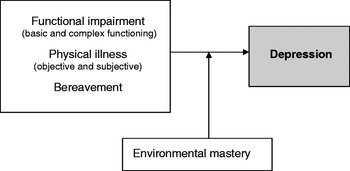
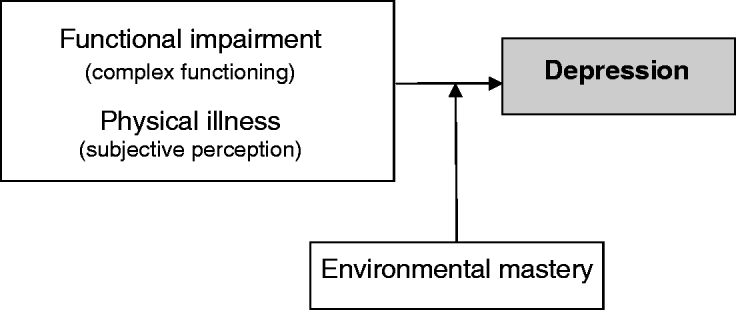
Given the reported association between low environmental mastery and poor mental health in the general population, and the likelihood that mastery is much reduced among older adults in residential care, this relationship needs further exploration. One aim of this study was to examine the degree to which environmental mastery explains depression in aged-care residents. Further, given the complexity of the constructs of interest and the inter-relationships that exist between them, we propose that environmental mastery will play both a direct and a mediating role in this relationship. A further aim of the study was therefore to test a proposed model of resiliency in which environmental mastery is presented as a mediating factor between three major life stressors (functional impairment, physical illness and bereavement) and depression (see Figure 1).
Proposed model of resiliency.

Design and methods
The participants
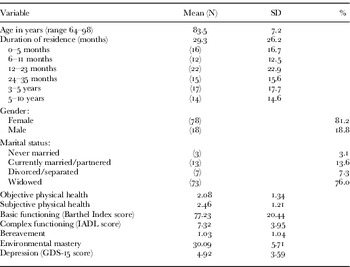
Ninety-six participants aged 64–98 years (mean age 83.5, standard deviation (SD) 7.2) were recruited from 12 aged-care residential facilities in Metropolitan Melbourne, Australia. The mean length of time participants had resided in their care facility was 29 months (SD 24) and the range was from one week to ten years. Sixteen per cent of the participants in the sample had been resident for less than six months, and 25 per cent were diagnosed with depression according to their medical files. Cognitive functioning was assessed using the Structured Mini Mental State Examination (SMMSE) (Molloy, Alemayehu and Roberts Reference Molloy, Alemayehu and Roberts1991). The SMMSE has 30 items and is the most widely used cognitive screening test for older adults (Folstein, Folstein and McHugh Reference Folstein, Folstein and McHugh1975). The version used in the present study has been standardised with detailed scoring guides. The severity of cognitive impairment was assessed using the criteria described by Ward et al. (Reference Ward, Caro, Kelley, Eggleston and Molloy2002). Scores between 25 and 30 indicated normal cognitive function while scores between 19 and 24 indicated mild cognitive impairment. In the current sample, 79 participants were classified as within the normal range, and 17 participants as having mild cognitive impairment.
Measures: the independent variables
Socio-demographic information such as age, gender, date of admission to facility and marital status was collected. Functional impairment was assessed using two measures. The Barthel Index (Mahoney and Barthel Reference Mahoney and Barthel1965) was used to determine impairment in ten basic activities of daily living, such as feeding, dressing and toileting. Level of independent functioning on those ten domains was scored on a scale ranging from 0 to 100 (with higher scores representing greater independence) by the researcher during a semi-structured interview with the older adult. More complex daily functioning was measured using an adapted version of the instrumental activities of daily living scale (IADLs) (Lawton and Brody Reference Lawton and Brody1969). The IADLs are eight items designed to assess an individual's perceived level of independence in performing tasks such as using transport, managing finances and taking medication. The scale was adapted to reflect daily activities relevant to older people in residential settings. Specifically, the item ‘making a hot drink’ was substituted for ‘food preparation’, and the housework item was defined as ‘keeping own room tidy’ and ‘making the bed’. Items were scored on a three-point scale (0 ‘unable to engage in activity’, ‘1’ ‘needs some help’, and ‘2’ ‘completely independent’). Aggregate scores ranged from 0 to 16 points, with a higher score representing greater independence.
The participants rated their physical health on a Likert scale ranging from ‘1’ (poor) to ‘5’ (excellent). This rating formed the single-item measure for self-rated (subjective) physical health. The presence of chronic conditions including diabetes, heart trouble, hypertension, stroke, arthritis and cancer was determined using medical files and the participant's responses. An index of chronic medical ill health was calculated by adding the total number of chronic health problems that were identified, to create a measure of objective physical health. A measure of bereavement was created for this study. Participants were asked to indicate the number of people close to them who had died within the previous five years. Scores ranged from zero to six bereavements.
The dependent variable
The 15-item version of the Geriatric Depression Scale (GDS-15) was used to assess self-rated depressive symptoms (Sheikh and Yesavage Reference Sheikh and Yesavage1986). The GDS-15 has previously been validated for use with an aged-care population (Blank, Gruman and Robison Reference Blank, Gruman and Robison2004; Gerety et al. Reference Gerety, Williams, Mulrow, Cornell, Rosenberg, Chiodo and Long1994; McCabe et al. Reference McCabe, Davison, Mellor, George, Moore and Ski2006), and moderate to good psychometric properties are typically reported. Example items include, ‘Are you in good spirits most of the time?’ and ‘Do you feel that your situation is hopeless?’ The participants may respond either ‘yes’ or ‘no’ to each item, administered verbally by the interviewer. The internal reliability of this instrument in the current sample was high (Cronbach's α=0.83).
The mediating variable
Environmental mastery was measured using a sub-scale with 14 items of Ryff's Psychological Wellbeing Scale (Ryff Reference Ryff1989; Ryff and Keyes Reference Ryff and Keyes1995). The extent to which the participants agreed with each item was recorded using a six-point Likert scale (from ‘1’ ‘strongly disagree’ to ‘6’ ‘strongly agree’) with half the items reverse scored. High scores indicate having a sense of competence in managing one's environment, an ability to control external activities and to select or develop contexts suitable to one's needs. Example items include, ‘I am quite good at managing the many responsibilities of my daily life’ and ‘I am good at juggling my time so that I can fit everything in that needs to be done’. In the current study, Cronbach's α for the environmental mastery sub-scale was 0.72, indicating the scale had an acceptable internal reliability with this residential aged-care sample.
Procedure
Approval for the data collection was given by the University Human Research Ethics Committee prior to commencement of the study. A list of all 220 care facilities for frail older people in Metropolitan Melbourne was generated and 12 facilities randomly selected. The managers of the selected facilities identified the residents whom they believed met the inclusion criteria, namely aged 65 years or older, absence of dementia or cognitive impairment, absence of psychotic illness, and ability to communicate verbally in English. These residents were then approached directly by the researchers and invited to participate in the study. Of the 150 residents approached, 21 residents declined to participate. Informed consent was obtained from the remainder and their suitability for inclusion in the study was determined by a clinical psychologist using an interview format that took particular care to ensure comprehension of all the outcome items. An absence of cognitive impairment was confirmed through administration of the SMMSE (Molloy, Alemayehu and Roberts Reference Molloy, Alemayehu and Roberts1991), with a cut-off score of less than 25 used to determine cognitive impairment (Ward et al. Reference Ward, Caro, Kelley, Eggleston and Molloy2002). Thirty-three residents did not meet the inclusion criteria, in most cases because of impaired cognitive functioning, resulting in a sample of 96 residents in the study.
The analysis
The means and standard deviations of the socio-demographic characteristics, independent, dependent and mediating variables are presented in Table 1. The conventional assumptions for multivariate regression analysis of linearity, equality of variance, independence and multicollinearity were assessed and deemed acceptable. In addition to performing descriptive and correlation analyses, the mediating effects of environmental mastery on the relationship between the independent variables (objective and subjective physical health, functional capacity and bereavement) and the dependent variable depression, were assessed using Baron and Kenny's (Reference Baron and Kenny1986) criteria for mediation. The degree of reduction in regression coefficients resulting from controlling the mediating effects of environmental mastery was assessed using the Sobel test (MacKinnon and Dwyer Reference MacKinnon and Dwyer1993).
Means and standard deviations (SD) for demographic characteristics, risk factors, depression and environmental mastery

Notes: Sample size 96. GDS: Geriatric Depression Scale. IADL: instrumental activities of daily living.
Results
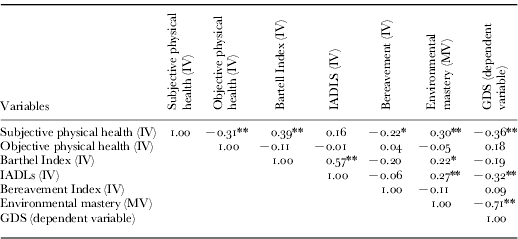
Correlation matrices were generated to establish the relationships among the variables. The bivariate results in Table 2 indicate that a high level of self-rated depression associated with a low level of perceived environmental mastery (r=−0.71). As 50 per cent of the variance in depression was accounted for by environmental mastery, the first hypothesis was supported, that a sense of low environmental mastery associates with depression. The relationships between the predictor variables and environmental mastery were significant: lower subjective physical health and functioning in both the basic and instrumental activities of daily living all significantly associated with a lower perception of environmental mastery (r=0.30 and 0.27, respectively). Neither objective physical health nor bereavement correlated with environmental mastery, and so both these variables were excluded from further analyses – they did not meet the Baron and Kenny (Reference Baron and Kenny1986) criteria for mediation (see Table 2). Subjective physical health and complex functioning measured by the IADL score were both significantly and negatively correlated with depression (r=−0.36 and −0.32, respectively). As basic functioning measured by the Barthel Index did not correlate with depression, it too was excluded from further analysis, leaving subjective physical health and complex functioning in the mediation analysis.
Bivariate correlations between independent, dependent and mediating variables
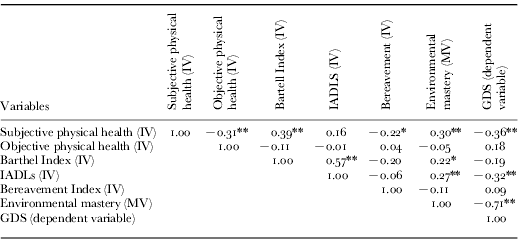
Notes: GDS: Geriatric Depression Scale. IADLS: instrumental activities of daily living scale. IV: independent variable. MV: mediating variable.
Significance levels: * p<0.05, ** p<0.01, *** p<0.001.
Mediation analysis
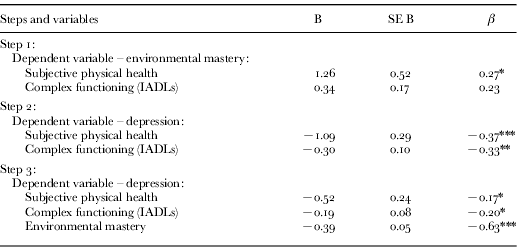
Table 3 presents a summary of the results of the regression of the mediating variable, environmental mastery, with the independent variables, subjective physical health and complex functioning as assessed by the IADL score. The variables subjective physical health and IADL score together significantly predicted environmental mastery and explained 14 per cent of the variance in environmental mastery (R 2=0.14 at Step 1) (see Table 3). The dependent variable (depression) was then regressed on to the two independent predictor variables whereby 21 per cent of the variance in depression was explained (R 2=0.21 at Step 2). The final model is the regression of the dependent variable (depression) on the predictor variables while controlling for the mediator variable (environmental mastery).
The mediation coefficients
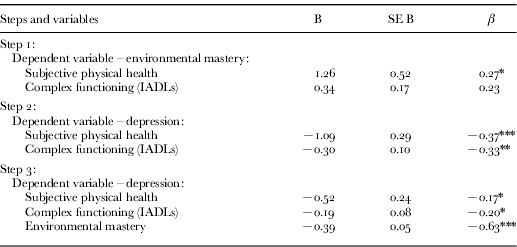
Notes: Step 1: r=0.37, R 2=0.14**; Step 2: r=0.46, R 2=0.21***; Step 3: r=0.75, R 2=0.56***. IADLs: instrumental activities of daily living. SE: standard error. B: constant.
Significance levels: * p<0.05, ** p<0.01, *** p<0.001.
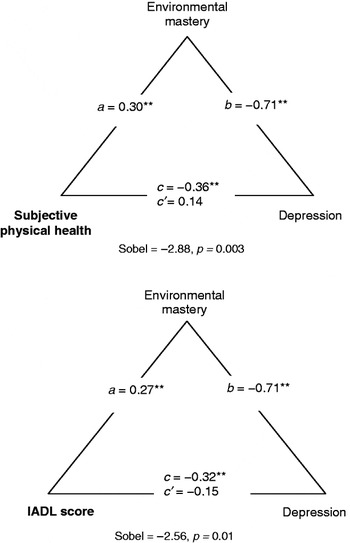
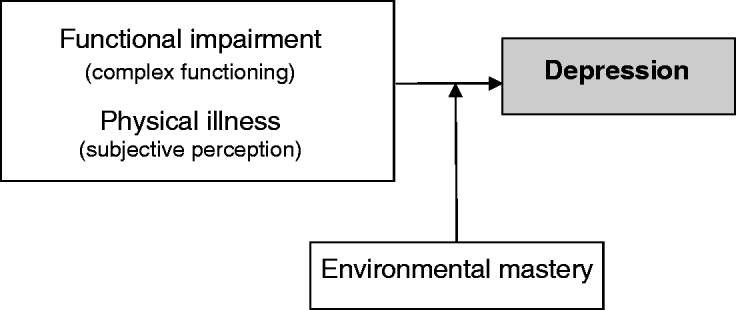
Mediation exists if, in the last path analysis, any significant relationship found between the predictor variables (subjective physical health and IADLs) and the dependent variable (depression) becomes not significant (full mediation) or the strength of the relationship is greatly reduced (partial mediation). The path analysis demonstrated a significant partial mediation effect for environmental mastery in relation to subjective physical health, because the explained contribution to depression dropped from 15 to 2 per cent (Sobel=−2.88, p=0.003). Significant partial mediation also occurred for more complex functioning (i.e. the IADL score) for which the explained variance dropped from 12 to 2 per cent (Sobel=−2.56, p=0.01). The inclusion of environmental mastery as a mediating variable between subjective physical health, complex functioning and depression increased the explained variance in depression from 21 to 56 per cent (see Figure 2). In summary, the path-analytic result is consistent with the hypothesis that environmental mastery mediates the association between the dependent variables physical health and functional capacity and the outcome depression. In summary, the initially proposed model of resiliency outlined in Figure 1 can be simplified to suggest only subjective physical health and complex functioning seem to be moderated in their impact on depression by environmental mastery. This modification is illustrated in Figure 3.
Mediating effects of environmental mastery in the relationship between subjective physical health, complex functioning (instrumental activities of daily living (IADLs)) and depression.

Adjusted model of resiliency.
Discussion
Viewed from the perspective of eudaimonic wellbeing, environmental mastery is argued to be one of several protective or resilience factors believed to promote psychological health. The aims of the current study were to examine the relationship between perceived environmental mastery and depression in older adults living in residential care facilities, and to explore the mediating role environmental mastery might play in the relationship between stressful life events, physical ill health, functional capacity and depression. When considering the direct and independent relationship of environmental mastery with depression, the results indicated that environmental mastery accounted for a significant 50 per cent of the variance in the depression score in the study sample. This result supports Jang, Kim and Chiriboga's (Reference Jang, Kim and Chiribogo2006) and Ong and Bergeman's (Reference Ong and Bergeman2004) finding of a direct relationship between environmental mastery and mental health among older adults living in the community.
Our finding of a relationship between environmental mastery and depression is for a sample of older adults living in residential care. The strong negative correlation between scores on GDS and environmental mastery suggests that environmental mastery is a key criterion of depression in this group. This finding highlights the need for strategies that increase environmental mastery among older adults living in residential care, particularly as its inherent nature may diminish the residents' sense of mastery over their daily lives. Furthermore, this study has provided greater insight into the mediating role of environmental mastery. The direct relationship of subjective physical health and complex functional capacity explained 21 per cent of the variance in depression, but when environmental mastery was considered as a mediator, the explained variance in depression increased to 56 per cent. This finding is particularly important as it identifies an area of potential intervention, which may be conducive to enhancing the mental health of older adults in care. Apart from the pharmacological solution, this has been largely overlooked in earlier research.
Implications for therapeutic intervention
Given that it has been demonstrated that environmental mastery is related to depression among older adults in care, consideration needs to be given to the factors that contribute to an older person's sense of mastery in a supported environment. As the degree to which a person has a sense of environmental mastery is a subjective experience or personal perception, the answer to this question needs to be determined as far as possible for each individual, rather than seeking a ‘one solution fits all’ approach. For some residents, it might relate to their capacity to influence decisions about the timing of the care they receive (e.g. assisted showering at a time of their choosing rather than when dictated by staff schedules). It might involve the opportunity to participate more actively in the organisation of outings for themselves and other residents and in menu planning, or the freedom to contribute to decisions regarding the planting and maintenance of a garden and social activities on site.
When reflecting on these possibilities, Perron (Reference Perron2006) discussed the anomaly of effect and cause. A reduction in environmental mastery could cause somebody to feel disempowered, useless and uninvolved in decisions about their own lives. The implication being that it is an effect indicator for poor mental health. A different interpretation of the living arrangement in which more autonomy and participation is encouraged could lead an individual to feel overwhelmed by responsibilities and to a reduced sense of environmental mastery. The implication in this instance being that it is a cause indicator of poor mental health. Perron's discussion reinforces the need to recognise that environmental mastery is a resilience factor that is evaluated by subjective experience, and consequently needs to be promoted at an individual level.
Future directions
While earlier research investigated the impact of environmental mastery on older adults living in the community (e.g. Ong and Bergeman Reference Ong and Bergeman2004) and the current study involved the assessment of older adults residing in residential care facilities, there is a need to undertake assessments of environmental mastery both pre-transition and post-transition. An important question is whether older adults that perceive high environmental mastery make the transition from community living to residential nursing home care more successfully than others. Other questions that need to be answered include whether the sense of mastery diminishes or is lost over time in a supported-living environment, or whether the deficit occurs at the point of transition from community independent living to dependent supported living. If reduced at the time of transition, then whether the sense of environmental mastery returns spontaneously (dependent on personality) or with appropriate therapeutic structuring of the organisation; and whether specific areas of mastery are deemed relevant by older persons in care are of utmost importance.
Limitations of the study
While this study has shed light on the association between environmental mastery and depression, the findings need to be considered with caution, specifically in relation to causality. With the limited capacity to control the many variables that contribute to depression, and lack of experimental manipulation of environmental mastery, only associations can be confidently reported. Our study involved only 96 participants from relatively few aged-care facilities in Melbourne, Australia, and cannot readily be generalised. To gain a more comprehensive understanding of the impact of environmental mastery on mental health, a longitudinal study designed to assess an individual's perceived environmental mastery and depression status on entry to residential care, and thereafter every six months over four years would be informative. Our recommendations for intervention, based on our findings, also need to be tempered by the reality of the residential care environment, characterised by staff with limited training in mental health care, relatively high staff turnover, and tight finances. Our proposals may nonetheless point to a new model of aged-care.
Conclusions
This research demonstrated the strong and significant contribution that lack of perceived environmental mastery makes to depression among older adults living in hostel or nursing care accommodation. To improve the wellbeing of these residents, efforts need to be made to increase their sense of environmental mastery. Efforts need to be made to find practical and meaningful ways to do this, and further research is required to assist in these efforts.