Introduction
The present article continues the series of papers devoted to descriptions of new arsenate minerals from the Arsenatnaya fumarole at the Second scoria cone of the Northern Breakthrough of the Great Tolbachik Fissure Eruption (1975–1976), Tolbachik volcano, Kamchatka Peninsula, Far-Eastern Region, Russia (55°41′N 160° 14′E, 1200 m asl). Fifteen new arsenates from this locality were characterised in the previous articles of the series: yurmarinite Na7(Fe3+,Mg,Cu)4(AsO4)6 (Pekov et al., Reference Pekov, Zubkova, Yapaskurt, Belakovskiy, Lykova, Vigasina, Sidorov and Pushcharovsky2014a), two polymorphs of Cu4O(AsO4)2, ericlaxmanite and kozyrevskite (Pekov et al., Reference Pekov, Zubkova, Yapaskurt, Belakovskiy, Vigasina, Sidorov and Pushcharovsky2014b), popovite Cu5O2(AsO4)2 (Pekov et al., Reference Pekov, Zubkova, Yapaskurt, Belakovskiy, Vigasina, Sidorov and Pushcharovsky2015a), structurally related shchurovskyite K2CaCu6O2(AsO4)4 and dmisokolovite K3Cu5AlO2(AsO4)4 (Pekov et al., Reference Pekov, Zubkova, Belakovskiy, Yapaskurt, Vigasina, Sidorov and Pushcharovsky2015b), katiarsite KTiO(AsO4) (Pekov et al., Reference Pekov, Yapaskurt, Britvin, Zubkova, Vigasina and Sidorov2016a), melanarsite K3Cu7Fe3+O4(AsO4)4 (Pekov et al., Reference Pekov, Zubkova, Yapaskurt, Polekhovsky, Vigasina, Belakovskiy, Britvin, Sidorov and Pushcharovsky2016b), pharmazincite KZnAsO4 (Pekov et al., Reference Pekov, Yapaskurt, Belakovskiy, Vigasina, Zubkova and Sidorov2017a), arsenowagnerite Mg2(AsO4)F (Pekov et al., Reference Pekov, Zubkova, Agakhanov, Yapaskurt, Chukanov, Belakovskiy, Sidorov and Pushcharovsky2018b), arsenatrotitanite NaTiO(AsO4) (Pekov et al., Reference Pekov, Zubkova, Agakhanov, Belakovskiy, Vigasina, Yapaskurt, Sidorov, Britvin and Pushcharovsky2019a), the two isostructural minerals edtollite K2NaCu5Fe3+O2(AsO4)4 and alumoedtollite K2NaCu5AlO2(AsO4)4 (Pekov et al., Reference Pekov, Zubkova, Agakhanov, Ksenofontov, Pautov, Sidorov, Britvin, Vigasina and Pushcharovsky2019b), anatolyite Na6(Ca,Na)(Mg,Fe3+)3Al(AsO4)6 (Pekov et al., Reference Pekov, Lykova, Yapaskurt, Belakovskiy, Turchkova, Britvin, Sidorov and Scheidl2019c) and zubkovaite Ca3Cu3(AsO4)4 (Pekov et al., Reference Pekov, Lykova, Agakhanov, Belakovskiy, Vigasina, Britvin, Turchkova, Sidorov and Scheidl2019d).
In this paper the new mineral pansnerite (Cyrillic: панснерит), ideally K3Na3Fe3+6(AsO4)8, is described. It is named in honour of Lavrentiy Ivanovich Pansner (1777–1851), the German–Russian mineralogist and geographer (his initial German name was Johann Heinrich Lorenz von Pansner, or, in another spelling, Panzner). Dr. Pansner, a specialist in studies of physical properties of minerals, became the first Ordinary Professor of Mineralogy at St Petersburg University (1819–1822). He was one of the founders of the Russian Mineralogical Society (1817) and its first Director (1817–1824).
Both new mineral and its name have been approved by the IMA Commission on New Minerals, Nomenclature and Classification (IMA–CNMNC), IMA2016–103 (Pekov et al., Reference Pekov, Zubkova, Koshlyakova, Belakovskiy, Vigasina, Yapaskurt, Agakhanov, Britvin, Turchkova, Sidorov and Pushcharovsky2017b). Parts of the holotype specimen (#5402 - see later) are deposited in the systematic collection of the Fersman Mineralogical Museum of the Russian Academy of Sciences, Moscow, with the catalogue numbers 95899 and 95911.
In terms of crystal structure, pansnerite is isotypic to ozerovaite, ideally KNa2Al3(AsO4)4, a mineral recently discovered in another fumarole located at the same Second scoria cone of the Northern Breakthrough of the Great Tolbachik Fissure Eruption (Shablinskii et al., Reference Shablinskii, Filatov, Vergasova, Avdontseva, Moskaleva and Povolotskiy2019). We found a novel, Fe-rich variety of ozerovaite in the Arsenatnaya fumarole and detected the solid-solution series between this mineral and pansnerite. These data have been included in the present paper.
Occurrence, mineral associations and morphology
The Second scoria cone is a monogenetic volcano formed in 1975 as a result of eruptive activity of the Northern Breakthrough of the Great Tolbachik Fissure Eruption. It is located 18 km SSW of the Ploskiy Tolbachik volcano (Fedotov and Markhinin, Reference Fedotov and Markhinin1983). The Arsenatnaya fumarole belongs to the main fumarole field situated at the summit of the Second scoria cone and is still active. The general data on Arsenatnaya and sublimate mineralisation produced by this fumarole have been reported by Pekov et al. (Reference Pekov, Zubkova, Yapaskurt, Belakovskiy, Lykova, Vigasina, Sidorov and Pushcharovsky2014a, Reference Pekov, Koshlyakova, Zubkova, Lykova, Britvin, Yapaskurt, Agakhanov, Shchipalkina, Turchkova and Sidorov2018a).
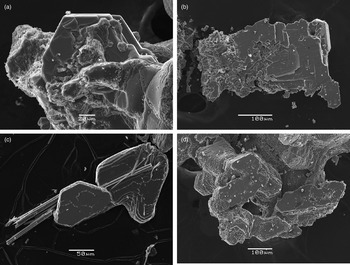
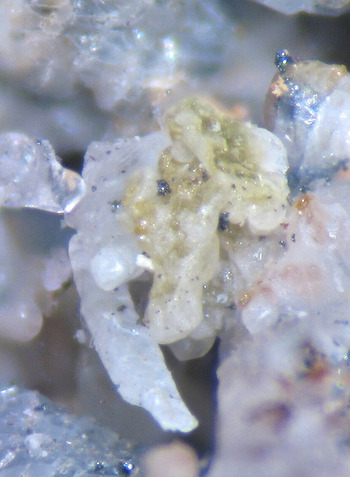
The material from which the holotype of pansnerite (sample #5402) originates was collected by us in July 2016 from a pocket ~1.5 m below the current surface at the northern part of the Arsenatnaya fumarole. The temperature (measured using a chromel–alumel thermocouple) in this pocket at the time of collecting was 430°C. Pansnerite occurs in polymineralic incrustations on basalt scoria altered by fumarolic gas. The new mineral forms tabular to lamellar, usually pseudo-hexagonal crystals flattened on {010}. They are well-shaped or, more commonly, crude and cavernous (Figs 1a,b), typically up to 0.3 mm across, rarely up to 0.2 mm × 0.7 mm × 1 mm. Crystals are usually combined in clusters (Figs 1b and 2) up to 2 mm or open-work aggregates up to 1 cm across. Minerals associated with pansnerite are aphthitalite, hematite, badalovite, calciojohillerite, khrenovite, achyrophanite, ozerovaite, arsenatrotitanite, johillerite, nickenichite, svabite, tilasite, As-bearing sanidine, anhydrite, rutile, cassiterite, and pseudobrookite. The pansnerite sample richest in Al (with Fe ≥ Al, sample #5402d) was also from there.
Morphology of crystals and aggregates of pansnerite and ozerovaite: (a) tabular crystal of pansnerite with aphthitalite crusts (holotype sample #5402); (b) near-parallel intergrowth of lamellar crystals of the Al–richest variety of pansnerite (sample #5402d); (c) tabular crystals of Al-poor pansnerite with acicular katiarsite (sample #6514); (d) crystal cluster of Fe-rich ozerovaite (sample #5443a). Scanning electron microscopy (secondary electron) images.

Yellowish–greenish aggregate of pansnerite (holotype specimen with working number 5402 by I.V. Pekov) partially overgrown by whitish aphthitalite with minor amounts of iron-black hematite and brownish-yellow badalovite. Width of photograph: 1.2 mm. Photo: I.V. Pekov and A.V. Kasatkin.

An iron-rich variety of ozerovaite (sample #5443) was found in the same assemblage and is similar to pansnerite in morphology and size of crystals and aggregates (Fig. 1d) but not in colour.
During our fieldwork in July 2018, an Al-poor variety of pansnerite (samples #6514 and #6515) was found in another pocket, in a slightly different mineral association. It occurs in vesicles and cracks of basalt scoria replaced by rusk-like aggregates of potassic feldspar as the result of alteration by fumarolic gas. In this pocket, pansnerite forms as tabular or lamellar pseudo-hexagonal crystals flattened on {010} (Fig. 1c) up to 0.2 mm across associated with As-bearing potassic feldspar, katiarsite (including its Sn-rich variety), yurmarinite, achyrophanite, badalovite, khrenovite, arsenatrotitanite, tilasite, aphthitalite, anhydrite and hematite.
The main form of crystals of both pansnerite and ozerovaite is the pinacoid {010} (Fig. 1); lateral faces could not be indexed.
We consider sample #5402 as the holotype of pansnerite: the proposal IMA2016-103 approved by the IMA–CNMNC (Pekov et al., Reference Pekov, Zubkova, Koshlyakova, Belakovskiy, Vigasina, Yapaskurt, Agakhanov, Britvin, Turchkova, Sidorov and Pushcharovsky2017b) was based on the studies of only this specimen. Samples #5402d, #6514 and #6515, also described in the present paper, were found and studied later and are not the type specimens of pansnerite.
We believe that pansnerite and ozerovaite were deposited from hot gas as sublimates or formed as a result of the interaction between fumarolic gas and basalt scoria at the temperatures not lower than 430–450°C.
Physical properties and optical characteristics
Pansnerite is transparent in small individuals and translucent in aggregates. Its colour is pale greenish to light green, yellowish–greenish or yellowish (ozerovaite associated with holotype pansnerite differs from it in colour being pale reddish to yellowish–pinkish). Streak is white. Lustre is vitreous. The new mineral is brittle. Cleavage is (010) perfect. The fracture is stepped. The Mohs’ hardness is ~3. Density calculated using the empirical formula is 3.596 g cm–3.
Optical properties were determined for holotype pansnerite. It is optically biaxial (–), α = 1.702(4), β = 1.713(4) and γ = 1.717(4) (589 nm). 2Vmeas = 45(10)° (estimated by the curve of the conoscopic figures on the sections perpendicular to optical axis), 2Vcalc = 62°. Dispersion of optical axes is very strong, r > v and orientation is: X = b; Y and Z lie in the ac plane. In plane-polarised light, pansnerite is non-pleochroic, colourless in thin grains and slightly greenish in thicker grains. With crossed polarisers, pasnerite demonstrates pink and blue anomalous interference colours.
Raman spectroscopy
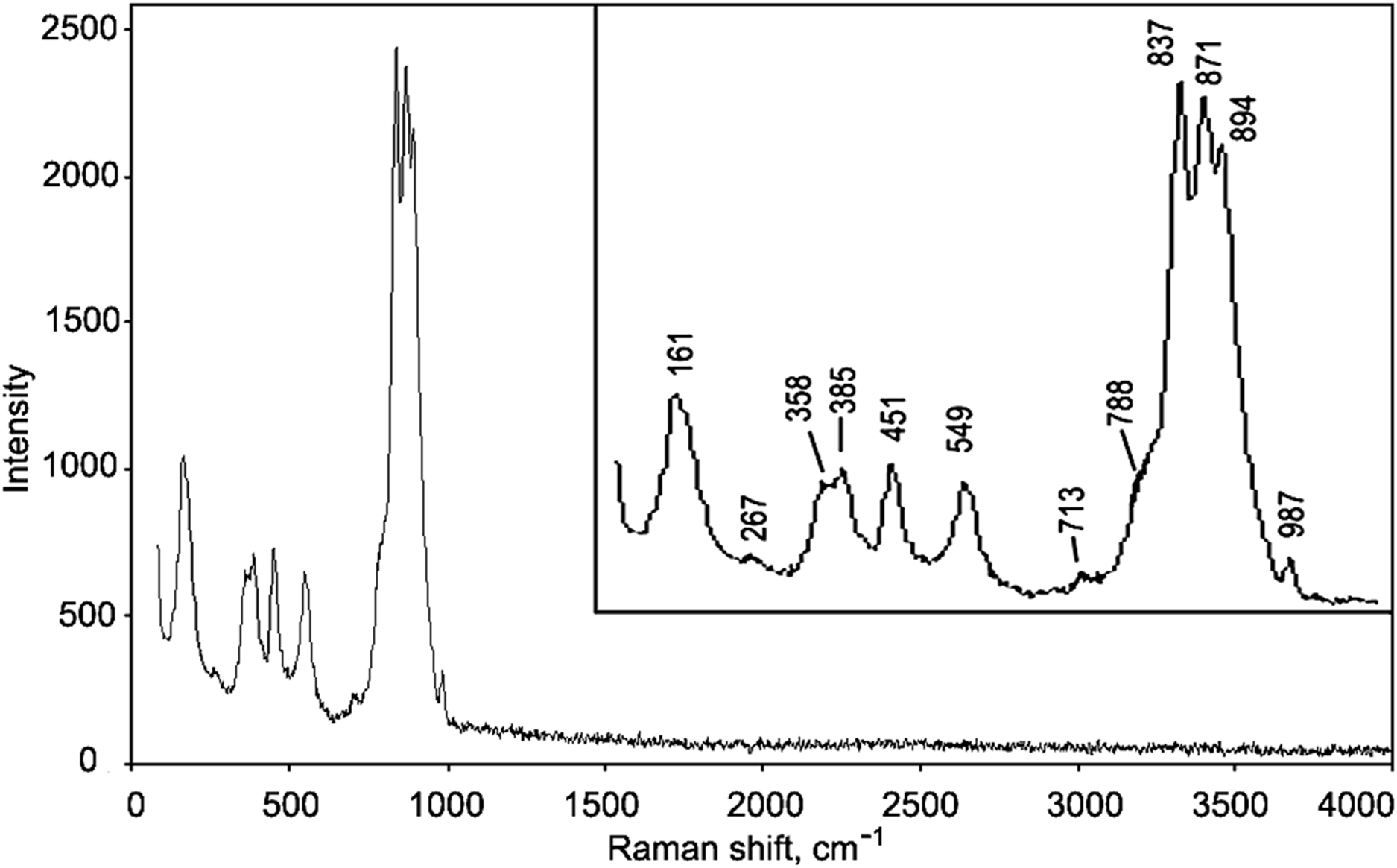
The Raman spectrum of the holotype pansnerite (Fig. 3) was obtained using an EnSpectr R532 spectrometer with a green laser (532 nm) at room temperature. The output power of the laser beam was ~16 mW. The spectrum was processed using the EnSpectr expert mode program in the range 4000 to 100 cm–1 with a resolution of 6 cm–1. The diameter of the focal spot on the sample was ~10 µm. The spectrum was obtained for a randomly oriented crystal.
Raman spectrum of pansnerite (holotype specimen): general view and enlarged low-frequency region.

The bands in the region 700–1000 cm–1 correspond to As5+–O stretching vibrations of distorted (see below) tetrahedral AsO4 groups. The band at 549 cm–1 can be assigned to Al–O stretching vibrations and the band at 451 cm–1 to Fe3+–O stretching vibrations. Bands with frequencies lower than 400 cm–1 correspond to As5+–O bending vibrations of AsO43– anions, Fe3+–O and Al–O stretching vibrations and lattice modes. The absence of bands with frequencies higher than 1000 cm–1 indicates the absence of groups with O–H, C–H, C–O, N–H, N–O and B–O bonds in pansnerite.
Chemical composition
The chemical composition of pansnerite and Fe-rich ozerovaite was studied by electron microprobe in two laboratories. In the Laboratory of Analytical Techniques of High Spatial Resolution at the Department of Petrology of Moscow State University, the chemical compositions of the minerals were determined using a Jeol JSM-6480LV scanning electron microscope equipped with an INCA-Wave 500 wavelength-dispersive spectrometer. In the Fersman Mineralogical Museum of the Russian Academy of Sciences, the samples were studied using a Jeol 733 electron microprobe instrument. In both laboratories the analyses were carried out using wavelength-dispersive spectroscopy mode, with an acceleration voltage of 20 kV, a beam current of 20 nA and a beam diameter of 3 µm.
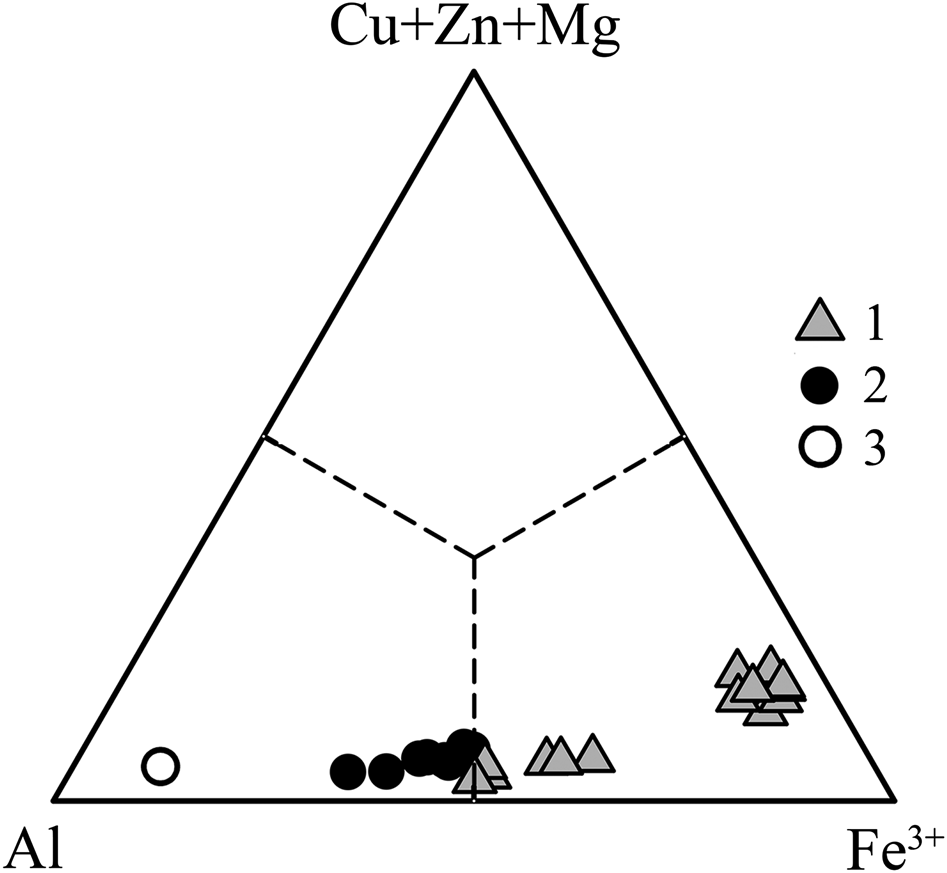
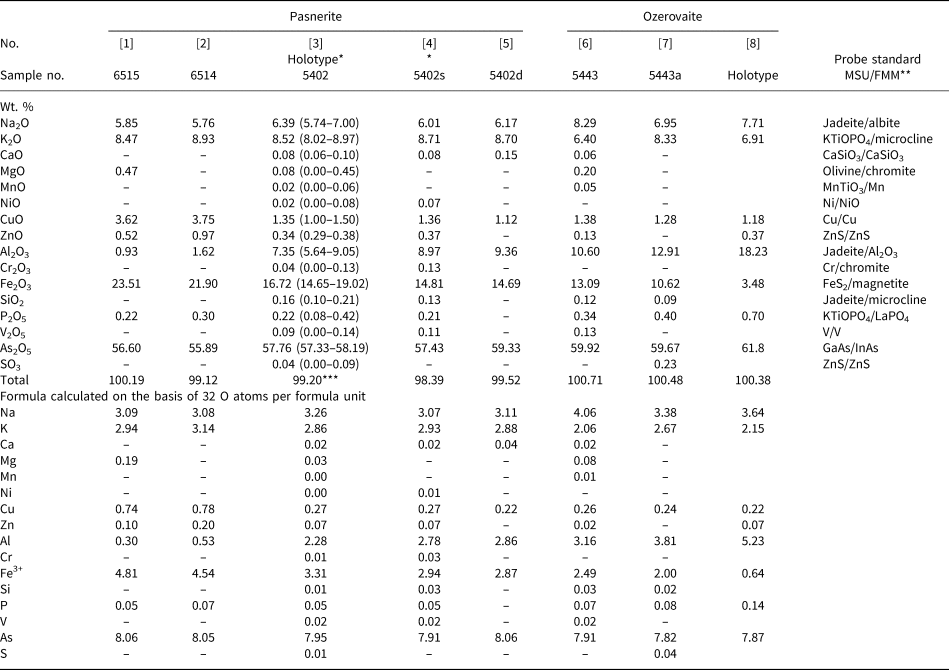
The chemical composition and the standards used for pansnerite and ozerovaite are given in Table 1. Contents of other elements with atomic numbers higher than carbon are below detection limits. Ratios of major octahedrally coordinated cations, Fe3+–Al–(Cu2+ + Zn + Mg) are shown in Fig. 4.
Ratios of main octahedrally coordinated cations in minerals of the pansnerite–ozerovaite series: 1 – pansnerite; 2 – ozerovaite, our data; 3 – ozerovaite, after Shablinskii et al. (Reference Shablinskii, Filatov, Vergasova, Avdontseva, Moskaleva and Povolotskiy2019).

Representative chemical data for minerals of the pansnerite–ozerovaite solid–solution series.

*[3] Holotype specimen: average data for six analyses from three crystals, ranges are in parentheses; [4] crystal extracted from the holotype specimen and used for structure determination.
**Probe standards used at Moscow State University (MSU) and Fersman Mineralogical Museum of the Russian Academy of Sciences (FMM), respectively.
***Total also includes 0.02 wt.% TiO2 (probe standards for MSU/FMM = KTiOPO4/ilmenite).
Analyses are ordered by decreasing Fe:Al ratio; sources: [1–7] our data; [8] Shablinskii et al. (Reference Shablinskii, Filatov, Vergasova, Avdontseva, Moskaleva and Povolotskiy2019); – = below detection limit
The empirical formula of holotype pansnerite (No. 3 in Table 1) calculated on the basis of 32 O atoms per formula unit is: K2.86Na3.26Ca0.02(Fe3+3.31Al2.28Cu0.27Zn0.07Mg0.03Cr0.01)Σ5.97(As7.95P0.05Si0.04V0.02S0.01)Σ8.06O32. The idealised, end-member formula of the new mineral is K3Na3Fe3+6(AsO4)8 which requires Na2O 5.69, K2O 8.65, Fe2O3 29.34, As2O5 56.32, total 100.00 wt.%.
X-ray crystallography and crystal-structure determination details
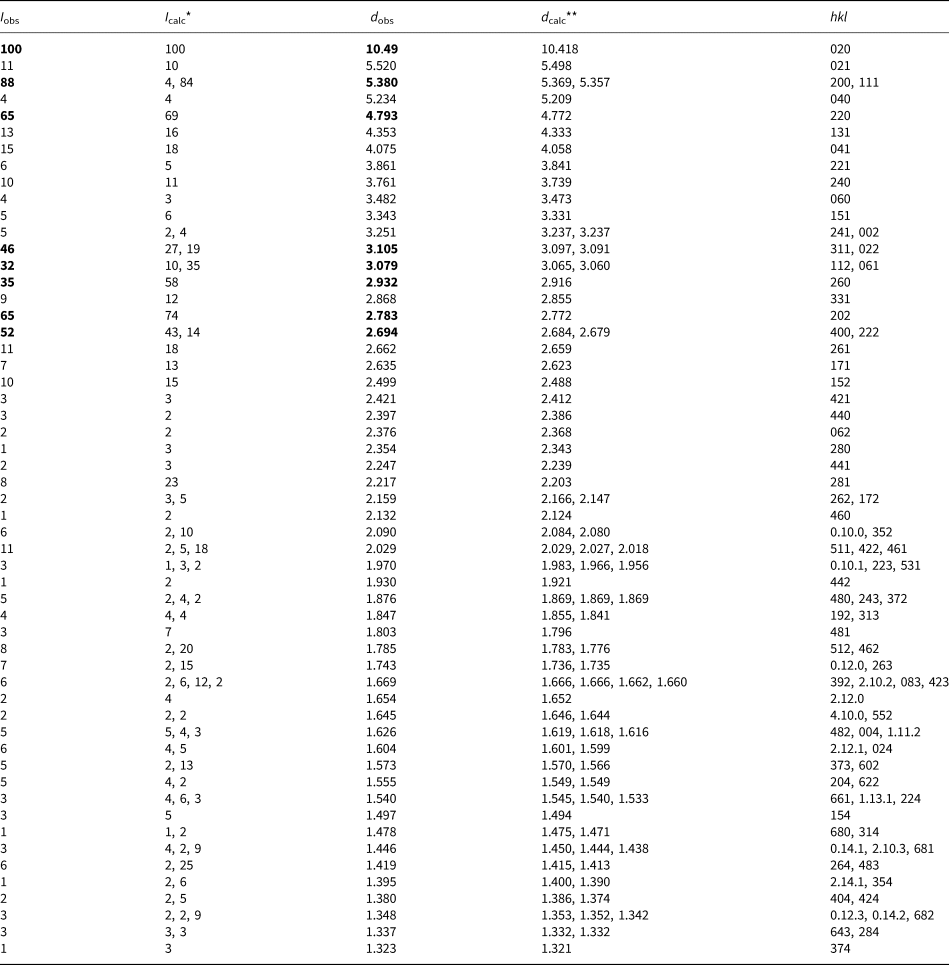
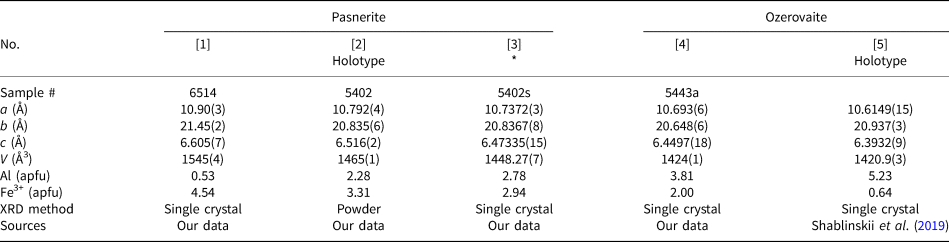
Powder X-ray diffraction (XRD) data of pansnerite (Table 2) were collected with a Rigaku R-AXIS Rapid II diffractometer equipped with a cylindrical image plate detector (radius = 127.4 mm) using Debye–Scherrer geometry, CoKα radiation (rotating anode with VariMAX microfocus optics), 40 kV, 15 mA and an exposure time of 10 min. Angular resolution of the detector is 0.045°2θ (pixel size 0.1 mm). The data were integrated using the software package Osc2Tab (Britvin et al., Reference Britvin, Dolivo-Dobrovolsky and Krzhizhanovskaya2017). Single-crystal XRD studies of pansnerite and Fe-rich ozerovaite were carried out using an Xcalibur S diffractometer equipped with a CCD detector (MoKα radiation). The unit-cell parameters of both minerals are reported in Table 3.
Powder X-ray diffraction data (d in Å) of the holotype pansnerite.

*For the calculated X-ray diffraction pattern only reflections with intensities ≥1 are given; **for the unit-cell parameters calculated from single-crystal data.
The strongest lines are given in bold.
Unit-cell parameters of minerals of the pansnerite–ozerovaite solid-solution series.

*Single crystal extracted from the holotype specimen and used for structure determination.
Samples are ordered by decreasing Fe:Al ratio. For chemical composition of the samples see Table 1. ‘apfu’ = atoms per formula unit.
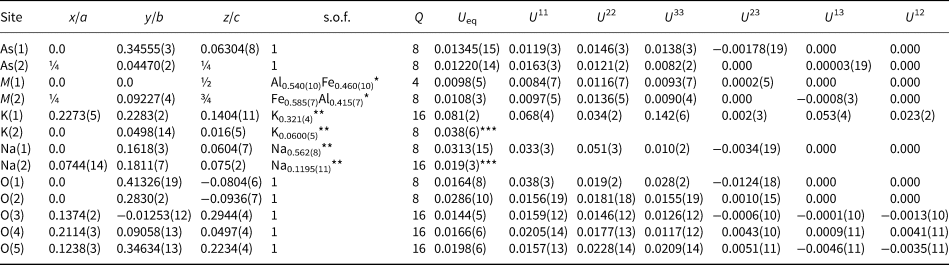
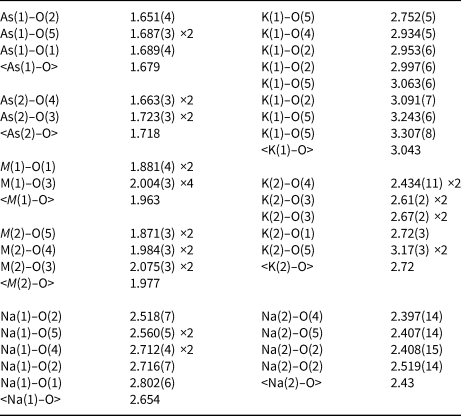
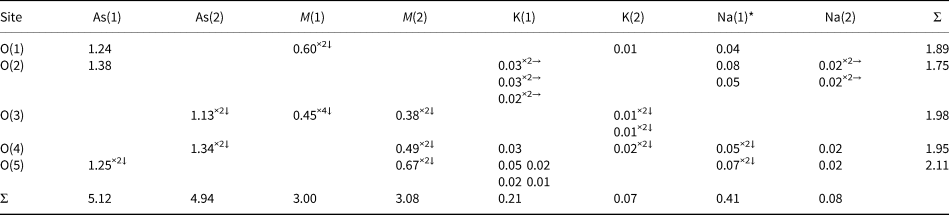
The crystal structure of pansnerite was studied using a single crystal extracted from the holotype specimen. The chemical composition of this crystal is given in Table 1 (No. 4) and the empirical formula corresponding to this analysis is K2.93Na3.07Ca0.02(Fe3+2.94Al2.78Cu0.27Zn0.07Cr0.03Ni0.01)Σ6.10(As7.91P0.05Si0.03V0.02)Σ8.01O32. A full sphere of three-dimensional data was collected. Data reduction was performed using CrysAlisPro Version 1.171.37.35 (Agilent Technologies, 2014). The data were corrected for Lorentz, polarisation and absorption effects. The structure was solved by direct methods and refined with the use of the SHELX-97 software package (Sheldrick, Reference Sheldrick2008) to R 1 = 0.0282 for 939 unique reflections with I > 2σ(I). The crystal data, data collection information and structure refinement details are given in Table 4, atom coordinates, equivalent and anisotropic displacement parameters, site occupancies and multiplicities in Table 5, selected interatomic distances in Table 6 and bond-valence calculations in Table 7. The crystallographic information file has been deposited with the Principal Editor of Mineralogical Magazine and is available as Supplementary material (see below).
Crystal data, data collection information and structure refinement details for pansnerite.

*w = 1/[σ2(F o2) + (0.0194P)2 + 14.6127P]; P = ([max of (0 or F o2)] + 2F c2)/3.
Atom coordinates, site occupancy factors (s.o.f.), site multiplicities (Q) and equivalent and anisotropic displacement parameters (in Å2), for pansnerite.

*Admixed constituents (see No. 4 in Table 1) were ignored during refinement. **Constraints were applied to the site occupancies of Na+ and K+ cations to achieve electroneutrality; distribution of Na and K could be slightly different in case Na is admixed in the K(2) site and K substitutes Na in Na(1); interatomic distances (Table 6) show that such substitutions can be only minor. ***U iso.
Selected interatomic distances (Å) in the structure of pansnerite.

Bond valence calculations for pansnerite.

The parameters were taken from Gagné and Hawthorne (Reference Gagné and Hawthorne2015). Site occupancy factors were taken into account. *The value could be slightly increased taking into account a possible K admixture.
Discussion
Crystal structure
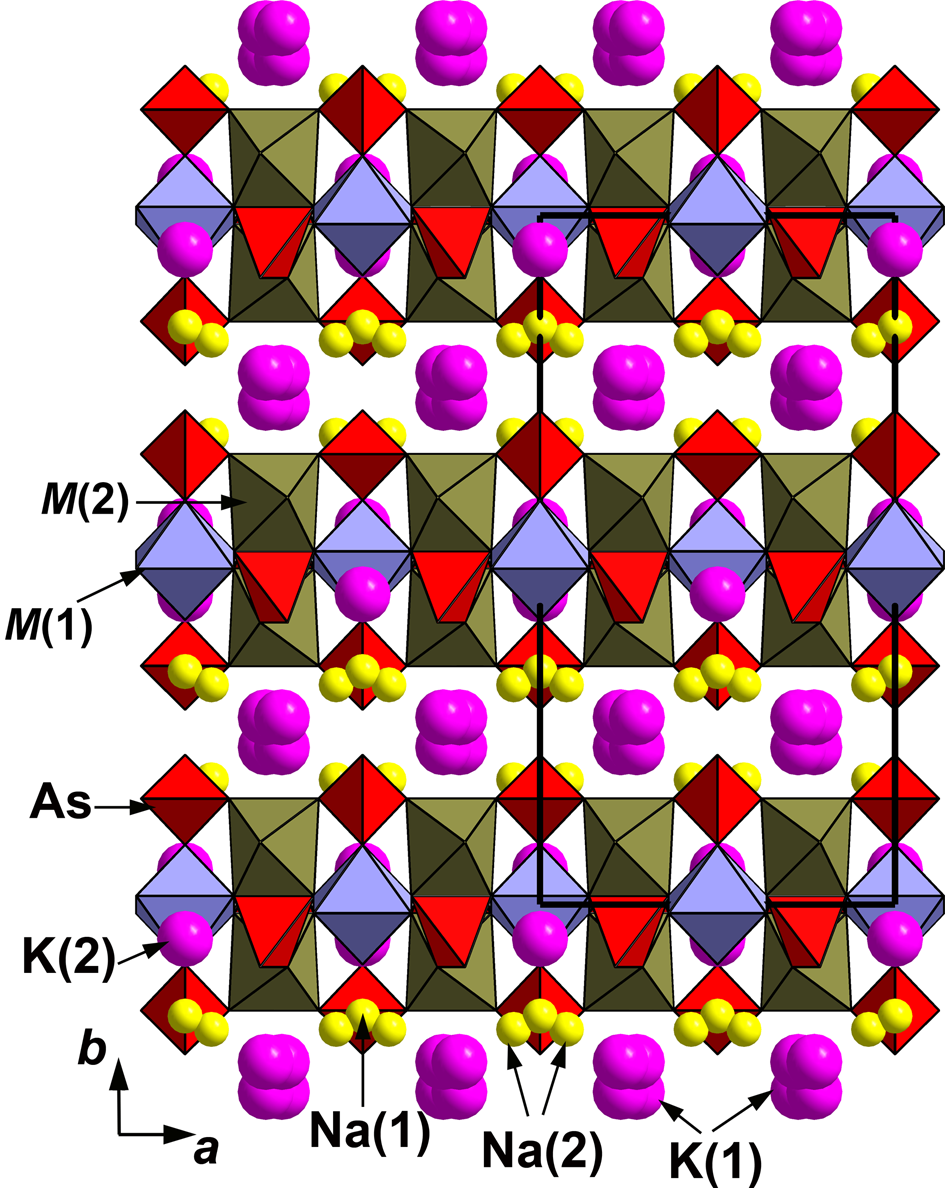
The crystal structure of pansnerite (Fig. 5) is based on heteropolyhedral layers parallel to {010}. They are formed by M(1,2)O6 (M = Fe3+ and Al) octahedra sharing common vertices and connected by AsO4 tetrahedra via common vertices and edges. These layers constitute a structural unit in ozerovaite, ideally KNa2Al3(AsO4)4 (Shablinskii et al., Reference Shablinskii, Filatov, Vergasova, Avdontseva, Moskaleva and Povolotskiy2019), and several synthetic arsenates and phosphates (with M = Cr3+, Fe3+ or Al) isotypic with these two minerals, namely K3Cr3+3(AsO4)4 (Friaa et al., Reference Friaa, Boughzala and Jouini2003), K3Fe3+3(AsO4)4 (Ouerfelli et al., Reference Ouerfelli, Zid and Jouini2005), K3Cr3+3(PO4)4 (Kouass and Boughzala, Reference Kouass and Boughzala2006), Na2.08K0.92Al3(AsO4)4 (Ben Yahia et al., Reference Ben Yahia, Nilges, Rodewald and Pöttgen2010), K1.8Sr0.6Al3(AsO4)4 (Haj Abdallah and Haddad, Reference Haj Abdallah and Haddad2012), Na1.67K1.33Al3(AsO4)4 (Bouhassine and Boughzala, Reference Bouhassine and Boughzala2014) and Na2.77K1.52Fe3+2.57(AsO4)4 (Ouerfelli et al., Reference Ouerfelli, Ben Smida and Zid2015). The arsenate Na2.08K0.92Al3(AsO4)4 (Ben Yahia et al., Reference Ben Yahia, Nilges, Rodewald and Pöttgen2010) is chemically similar to end-member ozerovaite. All these compounds adopt the same space group Cmce (no. 64, formerly designated as Cmca) and in terms of unit-cell parameters they are close to one another and to pansnerite: see an overview given by Shablinskii et al. (Reference Shablinskii, Filatov, Vergasova, Avdontseva, Moskaleva and Povolotskiy2019). In the crystal structure of K3Fe3+3(PO4)4·H2O (with similar unit cell and space group Pnna), the layers formed by FeO6 octahedra and PO4 tetrahedra are topologically the same (Lii, Reference Lii1995). The difference between this phosphate and above-mentioned compounds is the presence of H2O molecules in the interlayer space of the former and different arrangements of the neighbouring layers (Friaa et al., Reference Friaa, Boughzala and Jouini2003). The same topology of heteropolyhedral layers was also found in Na3Fe3+3(PO4)4 (Lajmi et al., Reference Lajmi, Hidouri, Rzeigui and Ben Amara2002) and in KFe3(AsO4)2(HAsO4)2 (Schwendtner and Kolitsch, Reference Schwendtner and Kolitsch2007), which have metrically similar monoclinic unit cells with β = 91.8° and β = 100.42° respectively and space group C2/c.
The crystal structure of pansnerite. The unit cell is outlined.

All alkali–cation sites in pansnerite are only partially occupied. This is typical for the synthetic compounds belonging to this structure family (see references in previous paragraph). The Na(1) and Na(2) sites occur in the interlayer space and are coordinated by oxygen atoms belonging to two neighbouring layers. The Na(1), with an occupancy of 56%, centres a seven-fold coordination polyhedron whereas the additional Na(2) site, with 12% occupancy, is surrounded by four oxygen atoms. Na(1) and Na(2), as well as two neighbouring Na(2) sites, cannot be occupied simultaneously due to their close location (Fig. 5): the Na(1)–Na(2) distance is 0.90 Å and the Na(2)–Na(2) one is 1.60 Å. The K(1) site, filled by K (32%), is also located in the interlayer and is the centre of an eight-fold polyhedron. This site could not be occupied fully due to a short K(1)–K(1) distance: 1.50 Å (Fig. 5). An additional, low-occupancy (6%) K(2) site, found from the difference-Fourier map, is situated in a hole in the heteropolyhedral layer and has nine-fold coordination. Bond lengths in Na- and K-centred polyhedra (Table 6) indicate that the K(2) site could contain some Na whereas Na(1) could contain minor K. There would be no straightforward way to address them in the refinement because of the low partial occupancies of the sites. The highest peak on the difference-Fourier map (1.30 e–/Å3) was also not included in the structure model. It could be assigned to another additional Na site with very low occupancy [this peak has the following coordinates: x = 0.0, y = 0.1272 and z = 0.0616 and is located 0.72 Å from Na(1)].
Interatomic distances in the MO6 octahedra (Table 6) and the presence of the band at 451 cm–1 in the Raman spectrum (Fig. 3) show that iron in pansnerite is trivalent. This is in good agreement with: (1) the stoichiometry of the mineral; (2) the fact that all above-mentioned synthetic arsenates and phosphates structurally related to pansnerite contain only trivalent octahedrally coordinated cations (Al, Cr3+ and Fe3+); and (3) the strongly oxidising conditions of mineral formation in the Arsenatnaya fumarole (Pekov et al., Reference Pekov, Zubkova, Yapaskurt, Belakovskiy, Lykova, Vigasina, Sidorov and Pushcharovsky2014a). The refined number of electrons (e –ref) in the M sites is 20.1 e– that is close to the value calculated from the formula based on the electron microprobe data: 20.3 e–.
Pansnerite–ozerovaite solid-solution series
Pansnerite and ozerovaite, arsenates with the idealised formulae K3Na3Fe3+6(AsO4)8 and KNa2Al3(AsO4)4 [or K2Na4Al6(AsO4)8, with Z = 2], respectively, are isotypic. The main difference between them is the dominance of either Fe3+ or Al. As our data show, these minerals form a solid-solution series in which two significant gaps are observed (Fig. 4). This series is, thus, subdivided into three separated parts: (1) Fe-poor ozerovaite [the holotype ozerovaite described by Shablinskii et al. (Reference Shablinskii, Filatov, Vergasova, Avdontseva, Moskaleva and Povolotskiy2019)]; (2) Al-poor pansnerite (sample #6514 and 6515); and (3) varieties of both mineral species with compositions near the point with equal amounts of Al and Fe (sample #5402 and 5402d). The K:Na ratio is more invariant and closer to 1.0 in Fe-dominant samples (pansnerite part of the series) compared with Al-dominant samples (ozerovaite part of the series) in which the K:Na ratio varies significantly and is relatively higher in Na (Table 1). The unit-cell parameters a and c and the unit-cell volume gradually decrease in the pansnerite–ozerovaite series with decreasing Fe:Al ratio (Table 3).
The isotypism of pansnerite and ozerovaite and the existence of numerous synthetic compounds with analogous structure make it likely that the pansnerite–ozerovaite solid-solution series is, in fact, complete.
Acknowledgements
We thank referees Anthony R. Kampf, Peter Leverett and Uwe Kolitsch and Associate Editor Mike Rumsey for valuable comments. This study was supported by the Russian Foundation for Basic Research, grant no. 17-05-00179. The technical support by the SPbSU X-Ray Diffraction Resource Center in the powder XRD study is acknowledged.
Supplementary material
To view supplementary material for this article, please visit https://doi.org/10.1180/mgm.2019.48