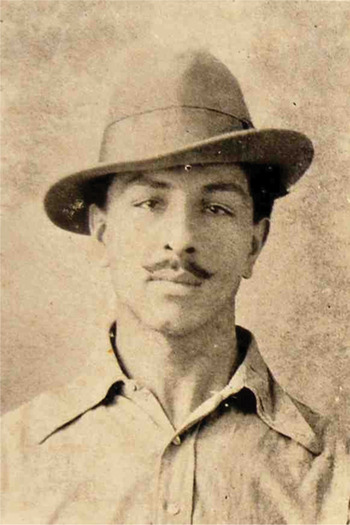
The most enduring image of Bhagat Singh, who was hanged by the British in 1931 for his role in the Lahore Conspiracy Case, is a fairly conventional studio portrait (Figure 1). The young revolutionary – he was just 21 when he posed for the photograph – stares calmly into the camera, as if to defy the empire and the weighty charges that are about to be brought against him, namely, that he had ‘been engaged in conspiracy to wage war against his Majesty, the King Emperor, and to deprive him of the Sovereignty of British India, and to overawe by criminal force or show criminal force, the Government established by law in British India and to collect arms and ammunition and men for, or otherwise make preparation for the said object and purpose.’Footnote 1 Bhagat Singh knew these charges would inevitably lead to a death sentence, yet he stands cool and poised, a felt hat tipped on his head. The photograph has become an icon of defiant nationalism, which continues to be widely referenced in poster art and calendars (Ramaswamy Reference Ramaswamy2008; Pinney Reference Pinney2004). It is a regular feature of the contemporary urban landscape in India, readily encountered in public spaces on cars and hoardings, and in bazaars on posters and books.
Bhagat Singh, posing for Ramnath Photographers in 1929. Courtesy of the Supreme Court Museum, New Delhi.

The ubiquity of the image in contemporary Indian popular culture is such that it is frequently compared to Alberto Korda's famous photograph of Che Guevara (Singh 2008; Lal Reference Lal2007, 11). Bhagat Singh and Che were undeniably photogenic, effectively capturing the romance, idealism and sacrifices required of revolutionary ideology, factors which no doubt make their portraits captivating. Both photographs, too, have been so been so widely appropriated that they have become disconnected from their historical context. In Bhagat Singh's case, this is partly because there is considerable uncertainty about the nature of his portrait's production. Below, I demonstrate that the photograph was taken in the ethos that it should be as widely distributed as possible; this was such a success that the very origins of the image have been obscured.
It is often thought that Bhagat Singh's famous photograph was taken to be fixed to a security pass, enabling him to infiltrate and undermine British institutions; or that the police took the photograph immediately after his arrest in 1929. Neither of these is correct. This article traces the genealogy of the photograph and in doing so, situates it within the context of interwar politics in India, with particular reference to the late 1920s and early 1930s. During this time the image was, simultaneously, memento, propaganda, evidence, and placard. This has relevance for current debates among scholars about Bhagat Singh's extraordinary popularity in India, recently enhanced by celebrations of the centenary of his birth in 2007.
Additionally, the story of the portrait's journey contributes to theories of social communication vis-à-vis the spread of nationalism in the early twentieth century, particularly the question of how ‘political leaders in a poor country with a relatively low rate of general literacy should have been able to create a widely diffused and popular nationalist movement so early’ (Bayly Reference Bayly1996, 2). Sandria Freitag has connected Bayly's information order to popular south Asian visual culture, pointing out that a ‘visual vocabulary works, at least in part, because it bridges the divide between literacy and illiteracy, crosses linguistic boundaries, and possesses sufficient ambiguity to appeal to people in various socio-economic and power positions’ (Freitag Reference Freitag and Davis2007, 94).
Chrisopher Pinney, in his masterful study of the printed image and political struggle in India, has provocatively explored the possibility of a ‘visual history’ – ‘that is, a history constituted by the visual in which the visual was something other than a reflection of something already established “by other means,” to recall Carlo Ginzburg's phrase’ (Pinney Reference Pinney2004, 117). This has been extended by Sumathi Ramaswamy, who appeals to historians to ‘work with pictures in all their denseness and resistant otherness, and fight the urge to immediately translate them into recognisable certitudes of a (textual) history’ (Ramaswamy Reference Ramaswamy2010, 296). While acknowledging the exciting nature of visual methodologies, I wish to resist claims to their autonomy by grounding one of modern India's most popular images amid critical archival research. This article might then be seen as an attempt to bring an awareness of visuality to the task of historical inquiry.
I have argued elsewhere that given the climate of secrecy and censorship within which north Indian revolutionaries operated, the written record is inadequate for reconstructing their histories (Maclean Reference Maclean2012). Below, I aim to supplement the colonial archive of fortnightly reports, proceedings, memos and deciphered intelligence cables with oral testimonies from former revolutionaries and their associates in order to retrieve what has been, necessarily, a secret history. In doing so, I uncover the story of the portrait's journey from a studio photograph to a widely reproduced icon, demonstrating how the image travelled and morphed, defying attempts to arrest it, while sparking animated debates about empire and resistance.
The Image: a Prelude to a Martyrdom
Bhagat Singh's photo-portrait may appeal to different viewers for any of a number of reasons. These might include his youthful handsomeness, his engaging, clear, and steady stare, and his rather fashionable hat, set an angle, just so. But thinking of the photograph in Barthesian terms, ‘that element which rises from the scene, shoots out of it like an arrow and pierces me’ (Barthes Reference Barthes1993, 26) is the knowledge that the dashing young man who meets our gaze will be hanged – and he knows it. The photograph becomes all the more compelling with the realization that Bhagat Singh explicitly had it taken as a political tactic, before provoking the government of British India to seal his fate – to hang him by the neck until dead. The portrait therefore can be seen both a prelude to and a vital ingredient in the public acceptance of him as a shaheed (martyr). This story is largely unknown and is one worth telling, not least because it amplifies the power of the image.
Besides Bhagat Singh's direct eye contact, perhaps the most arresting feature of the portrait is his stylish but obviously western hat. Bhagat Singh had, in order to wear the said hat, renounced his kesh (the uncut hair of a Sikh) and turban, when disguising himself became vital to evading capture, in September 1928 (Kapoor Reference Kapoor1974, 61). After the widespread distribution of the photograph, Bhagat Singh's hat would become his defining attribute. Only relatively recently have images of Bhagat Singh wearing a turban become popular, perhaps as a means of emphasizing the Sikh contribution to the freedom movement (see Fenech Reference Fenech2002, 850). It is important to note, however, that his Sikh heritage was explicitly acknowledged even in the 1930s. He was known as ‘Sardarji’ among friends and was memorialized as such in eulogies, although this was not a communal designation in pre-partition India, as much as it was a polite, and often affectionate, form of address for a Sikh gentleman (see Kapoor Reference Kapoor1974; Venu c. 1931, Figure 8).
Bhagat Singh's Fame: What the Scholars Say
In the course of his anthropological excursions into Indian visual culture, Christopher Pinney has drawn attention to the fact that images of Bhagat Singh are more prevalent than those of Mahatma Gandhi, in both contemporary India and in chromolithographs of the pre-independence era (Pinney Reference Pinney2004, 117). This, Pinney infers, is a stunning anomaly, given the dominance of the Mahatma in written narratives of the nationalist movement. ‘Official history’, Pinney concludes, ‘has diverged so fundamentally from the popular narrative that it has left us with few tools with which to understand a figure such as Bhagat Singh’ (2004, 117). Pinney suggests that visual histories might serve as a corrective to the Congress-centric hagiographies, which continue to dominate narratives of the nationalist movement (see also Lal Reference Lal2003, 88).
Further, Pinney draws attention to and elaborates on observations made by Simeran Gell (Reference Gell1998), suggesting that the power of the Bhagat Singh's portrait lies in its embodiment of that discomforting form of mimicry first described by Homi Bhabha (Reference Bhabha1994, 85–92). In posing as a sahib in modern, fashionable dress, Bhagat Singh closed the racial gulf between ‘Indian’ and ‘European’ which was the basis of the colonial rationale (Pinney Reference Pinney2004, 127–8). Pinney describes how the hat-photograph recalls a well-known incident in Bhagat Singh's life, in which he disguised himself as an Anglo-Indian to escape Lahore in 1928, after taking part in the assassination of a British policeman (for which he was sent to the gallows three years later). Therefore the photograph, alongside Bhagat Singh's revolutionary politics, signals a threat to the imperial order. As an icon of what British intelligence rhetorically referred to as the ‘violence movement’, Bhagat Singh has come to represent Gandhi's other in the Indian political landscape, not least because Gandhi is popularly credited with failing to save Bhagat Singh, when he might have negotiated his clemency as one of the terms of the Gandhi-Irwin pact, concluded in the month before his execution.Footnote 2 Scarcely is it mentioned in such debates that Bhagat Singh, realizing the political effect that his sacrifice would have, was unwilling to be saved.Footnote 3
However in a recent intervention, historian Neeti Nair negates the idea that Bhagat Singh was popular because he was violent, or that, as Pinney would have it, he represented ‘a structural negation of Gandhi's corporeal practices’ (Nair Reference Nair2008, 677). Rather, for Nair, Bhagat Singh's popularity stemmed from his hunger-strike in jail, well-documented in newspapers at the time, for a popular cause: the rights of political prisoners. Nair challenges the prevalent idea of the violent Bhagat Singh by drawing attention to ample evidence which points to a clear hesitation on his part to inflict violence to achieve his aims – to remove British rule, and create the conditions for a more equitable society.
Somewhat provocatively, Nair mounts an argument for closing the longstanding ideological ground between Bhagat Singh and Gandhi, suggesting that ‘with regard to the strategic use of non-violence and the relationship between means and ends, Bhagat Singh was ideologically closer to the Mahatma than the latter cared to acknowledge’ (Nair Reference Nair2008, 676). According to Nair, and indeed the ideology of his party, the Hindustan Socialist Republican Army (HSRA), Bhagat Singh is a satyagrahi, and herein lies his fame (Nair Reference Nair2008, 650). ‘The immediate images that flashed across the minds of Punjabis when they thought of Bhagat Singh’, she concludes, ‘were not of the trilby hat but of the painful ordeal that the young men had undergone for the sake of political prisoners’ (2008, 677). Nair makes a persuasive case, drawing attention to the often-forgotten support in the Congress for the hunger strikers. However, if the hunger strike was critical in popularizing the revolutionaries, then why is it that the Bengali HSRA member Jatindranath Das, who died a slow and horrible death as a result of his hunger strike (Figure 2), does not eclipse Bhagat Singh, who survived several grueling fasts, before he was delivered to the gallows?
Rup Kishore Kapoor, Swatantrata Ki Bhent: Amar Shahid Yatindranath Das (Independence Gift: the Immortal Martyr Jatindranath Das), Shyamsunderlal Picture Merchant, Kanpur, c. 1930s. Jawaharlal Nehru, who had visited the hunger-strikers in jail (Nehru 1936, 144) and supported them in the press, presents the head of Jatindranath Das to Bharat Mata (Mother India). Bhagat Singh and B.K. Dutt stand behind him. Author's collection.

Another rationalization of Bhagat Singh's fame has been recently offered by Shalini Sharma, who writes that Bhagat Singh ‘achieved iconic status because … he was the embodiment of the ideal hero, a brilliant theoretician, a modern man who went to the films, an ardent nationalist and a committed celibate, undistracted by desire in his struggle against the Raj’ (2009, 46). While all of Bhagat Singh's surviving associates confirmed these stellar traits in their respective testimonies (for example Khanna 1976, 68; Gupta Reference Gupta1978, 79–83; Das Reference Das1971, 38), what is less clear is how the details of Bhagat Singh's character were made widely known in the 1930s, given the necessarily secretive nature of revolutionary activity. Additionally, information of this sort has been confounded by a strong hagiographic tendency, which has painted Bhagat Singh in broad, brave brushstrokes. These are not inaccurate, but they are generally oblivious to the nuances of his character. Not many people in the 1930s knew, for example, of his extraordinary hunger for reading, his good humor, or for that matter, his penchant for film-going – his close friends fondly reported his love of cinema, particularly Uncle Tom's Cabin, Charlie Chaplin films, and his repeat visits to see 1928 the silent hit, Anarkali (Kapoor Reference Kapoor1974, 311; Gupta Reference Gupta1978, 77).
Bhagat Singh's celebrity, over and above all other revolutionaries, has been a source of surprise for some time; in the days after Bhagat Singh's execution, Jawaharlal Nehru wondered aloud how it was that ‘a mere chit of a boy suddenly leapt to fame’.Footnote 4 Below I want to add further texture to existing scholarly responses to this question, by drawing attention to the journey of the portrait, which was taken in early April of 1929. Through his portrait, Bhagat Singh became the face of what Avinash Kumar aptly calls ‘thriller nationalism’, which ‘helped sustain the Congress-led mass movement at a popular level’, alleviating it from the ‘dreary routine of ideological diatribes and everyday politics’ that beset practically every level of nationalist organization (Kumar Reference Kumar, Gupta and Chakraborty2008, 178).
A sense of the excitement that Bhagat Singh left in the wake of his death is evident in a reflection in Jawaharlal Nehru's Autobiography: “Bhagat Singh … became a symbol; the act [of violence] was forgotten, the symbol remained, and within a few months each town and village of the Punjab and to a lesser extent in the rest of northern India, resounded with his name. Innumerable songs grew up around him and the popularity that the man achieved was something amazing” (Nehru Reference Nehru1936, 134).
Nehru, writing five years after Bhagat Singh's death, suggests that Bhagat Singh was popular despite his violence.Footnote 5 I argue below that the widespread dissemination of the portrait in its many guises enabled a predominantly illiterate people to imagine Bhagat Singh independently of imperial allegations that he was a terrorist, and to visualize the stories, songs, poems and sayings that quickly grew up around him (see Gaur Reference Gaur2008). Disseminated widely, first in the media, the photograph soon began to travel independently of print. Copied and distributed freely by political interest groups, the portrait proliferated and was soon to be found adorning walls and badges, ‘even in villages’ (Nehru Reference Nehru1931, 505).
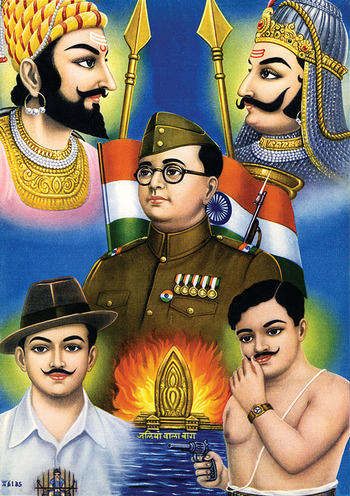
Received in the intense political context of the late 1920s-early 1930s, a period characterized by ongoing post-war negotiations about political reforms, the hubris of and agitation against the Simon Commission, bitter memories of the traumatic imperial violence displayed at Jallianwallah Bagh, and the repression of the Civil Disobedience movement, Bhagat Singh's gentle gaze served to contradict British charges that he was a cold assassin. Indeed, distrust of imperial justice was such that many believed him to be innocent of the charges levied at him, despite his own admission of guilt (Maclean Reference Maclean2012). Those who knew of his guilt were able to ‘forget’ the act of violence, reasoning that he was amply provoked by British oppression: ‘However one may disagree with the methods used by violent revolutionaries, hatred of the British rule had gone down so deep in the Indian heart that there are few Indians who do not acclaim Bhagat Singh and others of the same school of thought as heroes’, as one Congressman argued.Footnote 6 This too has been an enduring concept; relatively recent images of Bhagat Singh frequently reference him in the company of other militant national heroes (including his contemporaries Chandrashekhar Azad and Subhas Chandra Bose), collected around the memorial built in homage to the victims of the Jallianwallah Bagh massacre, the event which serves as their provocation and justification (Figure 3).
Untitled Poster, featuring Shivaji, Rana Pratap, Subhas Chandra Bose (center), Bhagat Singh and Chandrashekar Azad. Purchased in Lucknow, 1998. With permission, J.B. Khanna, Chennai. Author's Collection.

A Short History of Bhagat Singh
Born in 1907 in a family known for its subversive activities, Bhagat Singh was under British surveillance from a relatively young age (Lal Reference Lal2007, 12). By his late teens he was, in police parlance, ‘a well-known suspect’ as a result of his connections with the Hindustan Republican Association (HRA), and his activities in the Punjabi youth organization that he formed, the Nau Jawan Bharat Sabha (NJBS).Footnote 7 The Criminal Investigation Department (CID) had, in 1926, thought it necessary to place on the record that he was of ‘medium height; thin oval face; fair complexion; slightly pock-pitted; aquiline nose; bright eyes; small beard and moustache; wears khaddar.’Footnote 8
Using this description, police tracked down and arrested Bhagat Singh in 1927, suspecting him of bombing a crowd celebrating Dussehra in Lahore. He was innocent on this count, but the police alleged otherwise, charging him with testing a bomb to use in an elaborate plot to free the HRA members accused in the Kakori Conspiracy Case from jail (Singh in Verma Reference Verma2007, 120).Footnote 9 After about a month of imprisonment, the CID was still unable to implicate him, and he was released on the payment of a bond. He continued his organizational activities undeterred, through organizations such as the NJBS (Sharma Reference Sharma2009, 35–46). Bhagat Singh was largely responsible, along with Chandrashekhar Azad, for re-forming the Hindustan Socialist Republican Association (HSRA) from the remains of the HRA in September 1928, this time, with a renewed focus: to undermine the British and work towards the establishment of socialism in India. The party began to look for openings in the Indian political landscape to make a positive impact on public opinion, and it was not long before they found them. ‘Actions’, as they called their strategic attacks on select public officials and targets, were carefully calculated and planned with clear propaganda objectives in mind.
The first of these ‘actions’ took place in December 1928, although its genesis lay in events connected to the Congress-led protests against the Simon Commission, a month earlier. In a peaceful demonstration in Lahore on 7 November, Mr. Scott, the Superintendent of Police in Lahore, had ordered a lathi (baton) charge against protestors, in the course of which the aged Punjabi Congress leader Lala Lajpat Rai was gravely injured. He died ten days later, and was publicly mourned. In a condolence speech, Basanti Debi, the wife of the late Bengali Congressman C.R. Das, issued a challenge: “I, a woman of India, ask the youth of India: What are you going to do about it?” (Chand Reference Chand1972, 44; Khanna 1976, 70). The members of the HSRA saw this as their opportunity to respond, and make a decisive impact. They began to plot to avenge Rai's death (Kapoor Reference Kapoor1974, 80; Khanna 1976, 71).
On 18 December, 1928 Bhagat Singh and Rajguru, the party's Maharashtrian marksman, together gunned down a British police officer in Lahore, J.P. Saunders, and as the pair made their escape, Chandrashekhar Azad fatally shot an Indian constable, Channan Singh, who tried to pursue them. Their intended target was Scott, but the HSRA member delegated to identify him, Jai Gopal, mistook Saunders for Scott, and by the time the mistake was realized, it was too late.Footnote 10 However, as Saunders had also been implicated in the lathi charge on Lala Lajpat Rai, the HSRA was satisfied that they had achieved their objective. They placed posters around Lahore on HSRA letterhead to make their point clear: ‘Saunders is dead. Lalaji has been avenged’.Footnote 11 The HSRA dispersed, and Bhagat Singh, disguised as an Anglo-Indian, left on a train to Calcutta, where he made connections with Bengali revolutionaries, including Jatindranath Das, who taught them how to make bombs (Verma, Reference Verma1972, 74).
Bhagat Singh was arrested again on April 8, 1929 along with his comrade B. K. Dutt. The pair had thrown two low-intensity bombs, fired two shots from a pistol, and scattered propaganda leaflets into the Legislative Assembly in Delhi, before offering themselves for arrest. In doing so, the pair interrupted the passing of twin Bills, which had been the subject of much debate and criticism in nationalist media circles. The Bills were aimed at smothering growing labor unrest and banning members of any Communist Party from coming to India in the interests of ‘Public Safety’. In throwing the bombs as the second of these bills was introduced, the pair registered their protest at the imperial order; their primary aim, according to their leaflets, was ‘to make a loud noise’.
During a long drawn out trial, Bhagat Singh skillfully managed to turn Indian media opinion, which had initially condemned the attack on parliament as an ‘outrage’ committed by ‘lunatics’, in his favor.Footnote 12 Within days of his arrest, he was linked to Saunders' murder, as he knew he would be.Footnote 13 By May 1929, many HSRA members had been incarcerated, and eventually most of the inner circle of the HSRA was sent to trial. Bhagat Singh conducted the subsequent court case with considerable nous, amid enormous suffering, enduring hunger-striking and police violence. In the 23 months it took for the imperial justice system to take him to the gallows, Bhagat Singh became a household name. He did not attend the gallows alone; his friends Rajguru and Sukhdev were hanged alongside him. Yet even in the months before his hanging, the condemned trio was frequently referred to in the press as ‘Bhagat Singh and others’ or ‘Bhagat Singh and his comrades’.Footnote 14
How can we explain his prominence over that of his fellow martyrs, or over equally prominent members of the HSRA, such as Chandrashekhar Azad, who died in an encounter with police in Allahabad in February 1931 (and of whom there is an equally good photograph)?Footnote 15 Bhagat Singh's portrait, and the extraordinary campaign around it – which began with the print media, but quickly migrated to forms of transmission which allowed it to speak independently of the capacity to read – holds some of the answers to these questions.
Memento
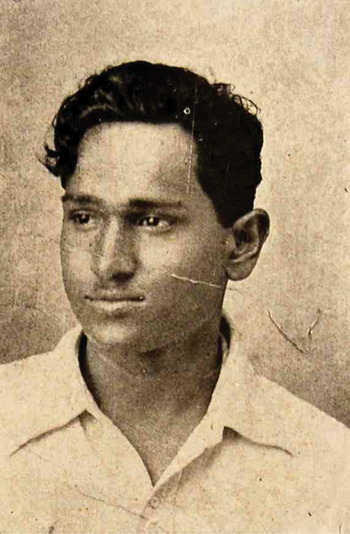
The photograph was taken a few days prior to the ‘action’ in the Legislative Assembly, probably around April 4, in the studios of Ramnath Photographers at Kashmiri Gate in Delhi (Kapoor Reference Kapoor1974, 117; Verma Reference Verma1972, 99). Jaydev Kapoor, the HSRA member who did much of the reconnaissance and planning for the attack, arranged for the photographs to be taken. He specifically asked the photographer to make a memento of Bhagat Singh, specifying that ‘hamare bhai saheb bahar ja rahe hain. Hum unka ek accha photograph chahte hain (our friend is going away, so we want a really good photograph of him’ (Kapoor Reference Kapoor1974, 116-7). B.K. Dutt was photographed on a separate occasion, but with the same instruction (Figure 4).
B.K. Dutt, as taken by Ramnath Photographers, April 1929. Courtesy of the Supreme Court of India.

While the photographs were being developed, Bhagat Singh and Dutt were attending the Legislative Assembly on a daily basis, watching the debate on the Public Safety Bill; their plan was to throw the bombs at the exact moment the President of the House moved to give his ruling. This happened in the morning of April 8. A number of newspaper reporters were present in the Assembly at the time of the bombing, as were many Indian and British political notables – including Sir John Simon himself – which no doubt added to the sense of excitement with which the ‘Assembly Outrage’ was initially carried in the press.
Meanwhile, at Ramnath Photographers, production was running behind schedule and Kapoor was unable to collect the photographs before the ‘action’ took place. By coincidence, Ramnath Photographers were also contracted to take photographs for the police, and they had been summoned to the police station in Old Delhi where Bhagat Singh was taken after his arrest to photograph him (Kapoor Reference Kapoor1974, 117). These police photographs have not yet surfaced, but were almost certainly used in the early investigation of the outrage, as the police ‘ransacked all the hotels in Delhi with photographs of the accused’.Footnote 16
This put the HSRA in a difficult position, as party worker Shiv Verma explained:
Our apprehension was: should we go for the photographs and this fellow is in league with the police, then he may hand us over … but then we could not check our temptation. We took the risk. And Jaidev – with his finger on the trigger of the revolver standing behind – and I went to the photographer, demanded the photographs. That photographer saw me, smiled and handed over the packet to me. I made the payment. Then he brought the negatives also and said: they are no good for me, you take them also. He did not charge anything for the negatives … that is how the photographs were procured (Verma Reference Verma1972, 99).
Jaydev Kapoor remembered it slightly differently:
I was afraid that Ramnath had already given information to the police, and that they would be waiting for me. I had all these concerns, but still, I had to get the photographs. So, about three days after the ‘action’, I went to the shop. At first, he stared at me, but he said nothing. I just threw the money down on the counter and took the photographs. I took the negatives too (Kapoor Reference Kapoor1974, 118).
The HSRA had their mementoes. In the following days, Kapoor became depressed whenever he looked at the photographs. Not only was he imagining the interrogation and torture that his friends were being subject to, but he was aghast at the early media coverage of the ‘action’ (Kapoor Reference Kapoor1974, 128). The Tribune's editor had remarked that it was ‘inconceivable’ that any opinion about the attack could differ from that of the Delhi police – that it was the ‘isolated act of mad men’.Footnote 17 The Hindustan Times, owned by the Moderate Congressman Madan Mohan Malaviya, lectured in an editorial to the perpetrators of the ‘diabolical deed’ that they were
doing more harm than good of the national government. What India needs to-day is not so much coercion of the Government, as constructive national activity, unity, political education and a strong sanction behind national demands … once Indians are politically conscious enough to staunchly stand up for their rights, without the raising of a little finger, without the firing of a single bomb, freedom can be attained.Footnote 18
It was the task of HSRA members Shiv Verma, Sukhdev and Kapoor to turn this coverage to their advantage, and the photographs would be pivotal to this.
Media Campaign
While British investigators saw the actual attack on the Assembly as the moment of subversion, in fact for the HSRA, throwing the bombs was just the beginning, a pretext to be arrested and trialed. As a revolutionary organization dedicated to the spread of socialism, in which the first object was to undermine and remove the colonial power, the HSRA faced major constraints in publicizing its aims and getting public support, which were necessary to form a mass movement. Government censorship acted to constrain sympathetic Indian newspapers from publishing anything that might be construed as seditious, and a paucity of funds made publication of their own propaganda materials difficult. Therefore, the party searched for innovative ways of publicizing its aims and popularizing their ideology. Sukhdev later reflected from his jail cell that both successful HSRA ‘actions’ – the murder of Saunders and the Assembly case – were calculated with these objectives in mind: ‘janta ka dhyan revolutionaries ke aur khinche ke liye (to fix the revolutionaries in the minds of the people’).Footnote 19 The attack on the assembly was planned so that it would position HSRA members in court, where they could pitch their propaganda in the presence of court reporters, who were obliged to report the case in the media (Verma Reference Verma1972, 122).
The cost of this campaign would be high: for Bhagat Singh, this was a death mission, as he would be connected to the Saunders murder once he was arrested; he was already a suspect, although ‘definite evidence against him was lacking’.Footnote 20 The posters used in Lahore (written in his own hand) and the pistol he surrendered at his arrest (which Bhagat Singh had probably used in both cases, although ballistic reports did not conclusively prove this) would connect him to the two incidents.Footnote 21 Bhagat Singh had always known that his struggle against British imperialism would conclude in his early death; thus he had refused to marry, and had a solemn promise from a close friend who was not a revolutionary, Jaidev Gupta, to take care of family members in his absence (Gupta Reference Gupta1978, 29, 39, 89). Bhagat Singh had set himself upon a path of martyrdom, inspired by figures such as the Babbar Akalis, five of whom had been hanged in 1926, and whose sacrifice he had celebrated in an article he wrote for Pratap the same year, ‘Blood Sprinkled on the Day of Holi’.Footnote 22 Bhagat Singh breathed life into existing religiously-informed traditions of martyrdom to make ‘a new category of male patriot’, the shaheed (Ramaswamy Reference Ramaswamy2008, 840).
Bhagat Singh clearly understood the process of martyr-making, and his experience as a journalist – he had also worked for newspapers such as Kirti and Arjun – meant that he cannot have failed to comprehend the utility of photography in bringing texture to a story. He had written several articles for the Hindi journal Chand, and in 1926 assisted in the compilation of a special issue on the death penalty, Chand ka Phansi Ank (Chand's Hanging Edition), funded by his friend, the Kanpur Congress leader and Pratap's editor, Ganesh Shankar Vidyarthi (Verma Reference Verma1972, 23; Kumar Reference Kumar, Gupta and Chakraborty2008). In Chand ka Phansi Ank, Bhagat Singh reconstructed the lives of several revolutionaries, including HRA members who went to the gallows (Verma Reference Verma1972, 25), and he took care to see that their photographs accompanied the text (Gupta Reference Gupta1978, 88).
Bhagat Singh's acute awareness of the social and political power of martyrdom is clear in his response to a letter passed to him shortly before his execution, asking if he would he prefer to live. His response was
My name has become a symbol of Indian revolution. The ideal and the sacrifices of the revolutionary party have elevated me to a height beyond which I will never be able to rise if I live. … If I mount the gallows with a smile, that will inspire Indian mothers and they will aspire that their children should also become Bhagat Singh. Thus the number of persons ready to sacrifice their lives for the freedom of the country will increase enormously. It will then become impossible for imperialism to face the tide of the revolution.Footnote 23
Ramnath Studio's portrait of Bhagat Singh played a major role in the above process, providing a vivid illustration of the legend that he became. At a time when literacy in India was limited,Footnote 24 the image of Bhagat Singh was able to circulate independently of any literate public sphere. His image came to be loaded with a range of interpretations, some of which were inaccurate, but all of which were anti-imperial.
‘It was Bhagat Singh's desire’, Kapoor recalled, ‘and mine also, that after the action the pictures would be published and distributed widely’ (1974, 118). Kapoor reproduced and sent them to major Indian-owned newspapers, in the hope that it would influence their reportage of the event. Fear of being accused of sedition meant that the photographs were not published immediately, according to Kapoor: ‘Later I found out that all the presswallahs were waiting to see who would publish the photograph first’ (1974, 128).
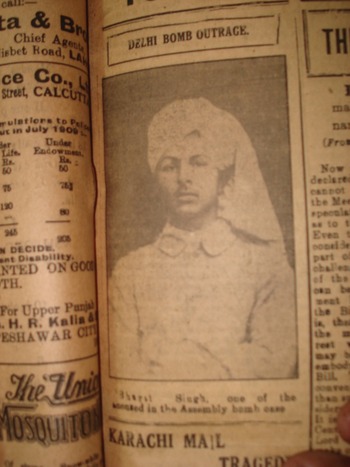
It was the provocative Lahori newspaper Bande Mataram, which obliged, publishing the photographs on April 12, 1929.Footnote 25 The pictures appeared not in the actual pages of the newspaper, but on a loose, one-sided poster issued inside the paper (Figure 5). Although the Bande Mataram was an Urdu newspaper, the poster was published in English. The poster format alone made it clear that the newspaper was sympathetic to the revolutionaries.
Insert from the Bande Mataram, April 12, 1929, courtesy of the National Archives of India. (NAI, Home Political, File 391/1930).

The editor of Bande Mataram, Feroz Chand, was well acquainted with key members of the HSRA. Called as a prosecution witness, Chand conceded that he had known Sukhdev for two years, during which Sukhdev had worked for the newspaper.Footnote 26 Chand conceded that he had agreed to publish the photographs of Bhagat Singh and Dutt, which had been ‘left by somebody at my house during my absence’.Footnote 27 Chand did not mention in court that he was a friend of Bhagat Singh, and had great admiration for him, and his ideology (Chand 1972, 42). Decades later, Feroz Chand would describe the reception of the portrait: “That photograph, by the way, became very popular throughout the length and breadth of this country for, that was the first glimpse that people had of Bhagat Singh in a new outfit with a felt hat – this young Sikh chap with a felt hat on his head. And that was the photograph of Bhagat Singh that remained in circulation ever after (Chand 1972, 75).”
In publishing photographs of Bhagat Singh and Dutt, the Bande Mataram had set a precedent in providing texture to a story that was animating people and the press all over north India. The secrecy maintained by police about the investigations, combined with the refusal of the accused to make any statement, had led to incredible speculation in the capital. The names of the accused had been released, but little more was known about them. An early report had published that ‘Bhagat Singh, it is understood, is a graduate of the National University, the son of Sardar Kishen Singh and the nephew of Sardar Ajit Singh of 1907 fame’.Footnote 28 This much was correct, but within a week ‘bazaar gossip’ reported in the Hindustan Times had it that Bhagat Singh had escaped the police lock-up and run away;Footnote 29 and another report claimed (falsely) that one of the pair had turned government witness.Footnote 30 A curious man of ‘unknown identity’ caused a sensation near a Gurudwara in Majnu ka Tila, when he set up ominous placards proclaiming ‘Saunders’ Murderer is Present'; ‘The British Government is going to end, so help it’; and ‘My Guru knows all’.Footnote 31
Added to this enigma were the statements of public figures who had begun to speculate who was really behind the Assembly attack. The Hindustan Times reported that the London papers had been ‘thrown into a fit of acute hysteria’, placing ‘the most extreme interpretations’ on the incident, linking the perpetrators to Moscow.Footnote 32 Diwan Chaman Lal, a Member of the Legislative Assembly, claimed that the CID was behind attack. According to this theory, the bombing an elaborate ruse to create sufficient fear of the red menace that the Public Safety Bill would find easy passage through the Legislative Assembly (Kapoor Reference Kapoor1974, 131). And in yet another editorial, the Hindustan Times blamed the government for the attack, claiming that ‘their dark record of persistent misdeeds that has given new life to the dying embers of anarchy and revolution in India’.Footnote 33 Michael O'Dwyer, the former Governor of the Punjab, intimated to the Evening News in London that the attack was clear evidence that ‘Indians are beginning to think that we are no longer capable of governing them … this is the direct result of the misguided policy of bestowing representative institutions’.Footnote 34
As the investigation proceeded, unsolicited correspondence, some written on the HSRA letterhead and its trademark scarlet paper, began to be sent to various newspapers. The editor of the Daily Chronicle was sent such a letter, threatening him for publishing an article that was critical of Bhagat Singh and Dutt.Footnote 35 A correspondent claiming to represent ‘the Real Hindustan Socialist Republican Army’ claimed that the organization was not responsible for the Assembly bombing.Footnote 36 Lahore's Senior Superintendent of Police, Mr Scott (the intended target of the HSRA's 1928 shooting in Lahore), received a death threat on red paper; he promptly packed his bags for Bombay, where he set sail on the next steamer.Footnote 37 A spin-off organization calling itself the ‘Bharatiya Republican Association’ posted red handbills around Kanpur, exhorting students to oust the British by force.Footnote 38 This barrage of handbills, similarly-named organizations and death threats confused investigators.
The day after the Bande Mataram went to press with its poster, the Lahore-based English-language, pro-Congress Tribune published a photograph of Bhagat Singh taken some years prior, adapted from a class photograph at Lahore College (Figure 6).
This portrait of Bhagat Singh is a cropped class photograph from Lahore Central College, taken in 1924. Photograph courtesy of Raj Mani, from an exhibit at the Supreme Court of India, of the Tribune, April 13, 1929, p. 1.

On April 18, not to be outdone, the Hindustan Times published Ramnath Studio's photographs of Bhagat Singh and Dutt on its front page, each in an oval frame. This immediately registered in police investigations as suspicious; already the police had taken exception to coverage in the newspaper that betrayed intimate knowledge of the case,Footnote 39 and now the paper had published ‘excellent photographs’.Footnote 40 ‘Where did it get them? And when? Bhagat Singh wore a beard last summer in Lahore but the picture which the Hindustan Times published shows him clean-shaven except for a small moustache, just as he was on the 8th April.’Footnote 41
The HSRA had close links to personnel working for the Hindustan Times, enabling the revolutionaries' propaganda a reasonable airing, inasmuch as censorship and editorial oversight would allow. Kapoor had sent a copy of the leaflet ‘It Takes a Loud Voice’ to a socialist contact, Durga Das Vaid, who worked for the paper (Kapoor Reference Kapoor1974, 128), which perhaps explains why the Hindustan Times had published a legible facsimile of it on the front page of its edition of April 10, 1929, and, for good measure, a full transcription of it on the following page.Footnote 42 The police had information that Bhagat Singh and Dutt had visited a residence owned by Tribhuvanath Singh and one Mr Ghosh, who were ‘known trade unionists’ and assistants on the staff of the Hindustan Times, on the day prior to the attack.Footnote 43
Thus while the newspaper's editorials disapproved of the violence, much of the coverage of the Assembly attack was critical of the government and the investigators. A front-page article mocked the police, caught up in a ‘wild goose chase’, questioning dhobis all around Delhi, in the hope that they might identify the laundry mark on a pair of Dutt's khaki knickers.Footnote 44 By the beginning of 1931, the Commissioner of Delhi had become so suspicious of the sympathies of Chaman Lal, one of the reporters from the Hindustan Times, that his press pass was confiscated, and all of the newspaper's articles were screened thereafter.Footnote 45
Chaman Lal was in fact connected to the HSRA; he was secretary of the Naujawan Bharat Sabha in Delhi and ‘a very close friend of Bhagat Singh’ (Lal Reference Lal1969, 16). He was forewarned of the action in the Assembly explicitly so he could report on it, and he had taken his editor, J.N. Sahni, along with him. Sitting in the press gallery, Chaman Lal pointed out the hat-wearing young man opposite in the visitor's gallery to Sahni: ‘Watch him … That is why I am here … It is my scoop’ (Sahni Reference Sahni1974, 75). Lal slipped out the Assembly before it went into lockdown, and waited outside, while Sahni quickly wrote the scoop. Sahni then rolled into his hat with a weight, and tossed down to Lal from the verandah of the Assembly, who cycled off to the Hindustan Times offices, where the advance report was published that evening (Sahni Reference Sahni1974, 75). Investigators in 1929 had insufficient evidence to prove whether the knowledge Lal had of the case had arisen from his role as a reporter or as a co-conspirator. He later disclosed that he was getting inside information about the case daily from a police inspector, Sardar Chet Singh (Lal Reference Lal1975, 18).
Evidence: Exhibit A/4 (Hat On)
After the publication of the photographs in the Hindustan Times, Jaydev Kapoor fled Delhi, according to a pre-arranged plan. He and Shiv Verma arrived in Saharanpur, the party's new base, established earlier by HSRA member Gaya Prasad. From here the three revolutionaries applied to Azad for permission to attack the Viceroy's hunting party in nearby Dehradun, which Azad duly granted (Kapoor Reference Kapoor1974, 137). While preparing for this, they read in the press that Sukhdev had been arrested in Lahore on April 15. After Sukhdev's arrest, the police recovered a copy of Bhagat Singh's portrait from a photographer in Anarkali, who had been given the task of replicating it.Footnote 46 The presence of photographs in Lahore of the Delhi suspects proved to police long-held suspicions that a broader conspiracy was afoot, and they began to think of the Delhi ‘outrage’ in much larger terms, hence the (second) ‘Lahore Conspiracy Case’ was born.Footnote 47
Kapoor and Verma were arrested in Saharanpur on May 12, 1929. The detailed inventory of items confiscated after their arrest went from the banal (item 70: a pair of ‘chequered stockings made of cotton’) to the damning: a small cache of bomb shells, identical to those thrown in the Legislative Assembly; and a stack of portraits of Bhagat Singh and B.K. Dutt, which police now realized were taken ‘for the express purpose of publication as soon as the deed had been committed’.Footnote 48 The investigators recovered a total of nine photographs and three negatives, including Bhagat Singh's portrait, now named ‘Exhibit A/4 (Hat On)’ (Wariach and Jain Reference Jain2007, 113). There was ample evidence that Kapoor and Verma were orchestrating a major media campaign: envelopes were found addressed to the editors of the Leader, Pratap, Amrita Bazaar Patrika, Indian Daily Telegraph, Hindustan Times, Aj, and Indian National Herald, each with a two-paisa stamp affixed, along with a stack of 875 red sheets bearing ‘exactly the same printed heading as the posters put up in Lahore after the Saunders’ murder and as the Assembly leaflets'.Footnote 49
There were several instances throughout the court case in which it was clear that the portrait of Bhagat Singh was vivid in the minds of many. There was extended, albeit fruitless, cross-examination of witnesses to discern whether Bhagat Singh was wearing a hat at the exact moment of his arrest in the Legislative Assembly, with the most reliable witness recounting that ‘Bhagat Singh asked for his hat which was lying nearby’ as he was being led away.Footnote 50 Mohammed Ali Jinnah, in a debate in the Assembly about Bhagat Singh's hunger-strike over the differential treatment of European and Indian prisoners in Indian jails, referred to a section in the Punjab Jail Manual which defined a European as ‘every European, Eurasian, and American, and every other person (whether a Native of India or not) whose habits and manner of living, in the opinion of the Superintendent, more nearly approach those of the European than those of the ordinary Native of India.’Footnote 51 Jinnah concluded that ‘so far as I know, Bhagat Singh and Dutt wear topees [hats] … therefore, they ought to be treated as Europeans’.Footnote 52
Placard
Why is everyone thinking of Bhagat Singh today? Even children in villages know about him. Many before him have made sacrifices and many more are still doing so. But why is the name of Bhagat Singh on every tongue? Why is his picture adorning walls and why are buttons studded with it? There must be some reason for this (Nehru Reference Nehru1931, 505).
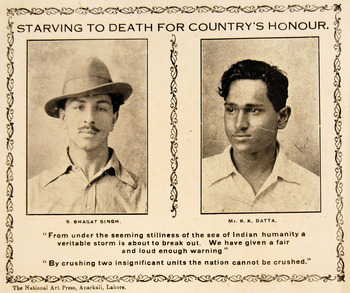
Once the photograph of Bhagat Singh was released in the press, it rapidly began to circulate throughout India. Bhagat Singh's photograph became a placard, which stood first for his own legal struggle against the British, but it subsequently morphed into an emblem of anti-imperialism. It is clear that the Nau Jawan Bharat Sabha initially disseminated it. Many processions and meetings were held in which the photograph was accorded pride of place, and was freely distributed (Figure 7), particularly around the time of the hunger strike in protest at jail conditions for political prisoners, ‘which went on from week to week and created a stir in the country’ (Nehru Reference Nehru1936, 144). After Jatindranath Das died in September 1929, the Intelligence Bureau noted that the Congress in the Punjab had joined forces with the Nau Jawan Bharat Sabha ‘as a means of stimulating interest in Congress matters. … It is significant that, at a meeting held at Lahore on 13th September, to mourn the death of Das, no less than 10, 000 persons were present while at a Congress meeting hold on the 22nd, to stimulate the boycott of foreign cloth, the audience numbered less than 300.’Footnote 53
‘Starving to Death for Country's Honour’, The National Art Press, Anarkali, Lahore. Image: Courtesy of the Supreme Court Museum.

Many of these occasions were accompanied by hartals (strikes), which enjoyed broad support, demonstrating that their appeal had begun to transcend the political spectrum. The Home Department was surprised to learn that Delhi's Anti-Red League (previously thought of as a society of ‘loyal merchants’) objected at the hartal proposed to accompany a planned Bhagat Singh and Dutt Day, but still professed sympathy with the ‘misguided youths sentenced in the Assembly Bomb Case’.Footnote 54 When it was celebrated in Delhi on July 21, 1929, organized by a newly-opened Delhi branch of the NJBS, ‘the proceedings met with more public support than was anticipated’, with a thousand people attending.Footnote 55 The NJBS set about marking the calendar with a series of special-purpose protests: Hunger Striker's Day,Footnote 56 and several All-India Bhagat Singh Days,Footnote 57 most notably on the day of his execution.Footnote 58
Bhagat Singh's example inspired a number of political assassinations. Between 1930 and 1933, violent attacks against British officials increased dramatically, and the Intelligence Bureau discerned a pronounced ‘growth in the spirit of violence’ in youth movements, including the Congress.Footnote 59 In the first three months of 1931 alone, as Bhagat Singh awaited execution, five British officials and three policemen were killed, and there were thirty causalities as a result of ‘attempts on the lives of government officials’.Footnote 60 Many of these attacks were performed with direct reference to Bhagat Singh, in which his photograph served as a calling card or an inspiration. In the weeks before the death sentence was pronounced, the home of one of the investigators of the Lahore Conspiracy Case was bombed. ‘It is significant’, deduced the Director of Intelligence, ‘that shortly before the attack, a cyclostyled Urdu leaflet, on which was pasted a photograph of Bhagat Singh, made its appearance in Lahore’.Footnote 61
So too, Vasudev Balwant Gogate recalled that in 1929, the atmosphere at Pune's Fergusson College was charged with news of the Lahore Conspiracy Case, and that photographs of the accused were widely distributed among students. Their subsequent martyrdom, along with the urging of his mentor V.D. Savarkar, inspired Gogate to shoot the acting Governor of Bombay Sir Ernest Hotson on July 22, 1931, in protest at the Sholapur Martial Law atrocities, in which several satyagrahis were killed (Gogate Reference Gogate1970, 2). Hotson survived – Gogate supposed that his target had been wearing a bulletproof vest at the time (1970, 8), indicative of a new wariness among British officials. For G.B. Nawalkar, ‘the heroic deeds of the revolutionaries like Chandrashekhar Azad and Bhagat Singh, Batukeshwar Dutt and Sukhdev and Rajguru, they were really thrilling and one, in that impressionable young age, would feel that we should do something for our motherland, like these great revolutionaries’ (Nawalkar Reference Nawalkar1970, 2). At least one photography studio offered young men the opportunity to dress up as Bhagat Singh, hat and all, to pose with a revolver for a memento of their own.Footnote 62
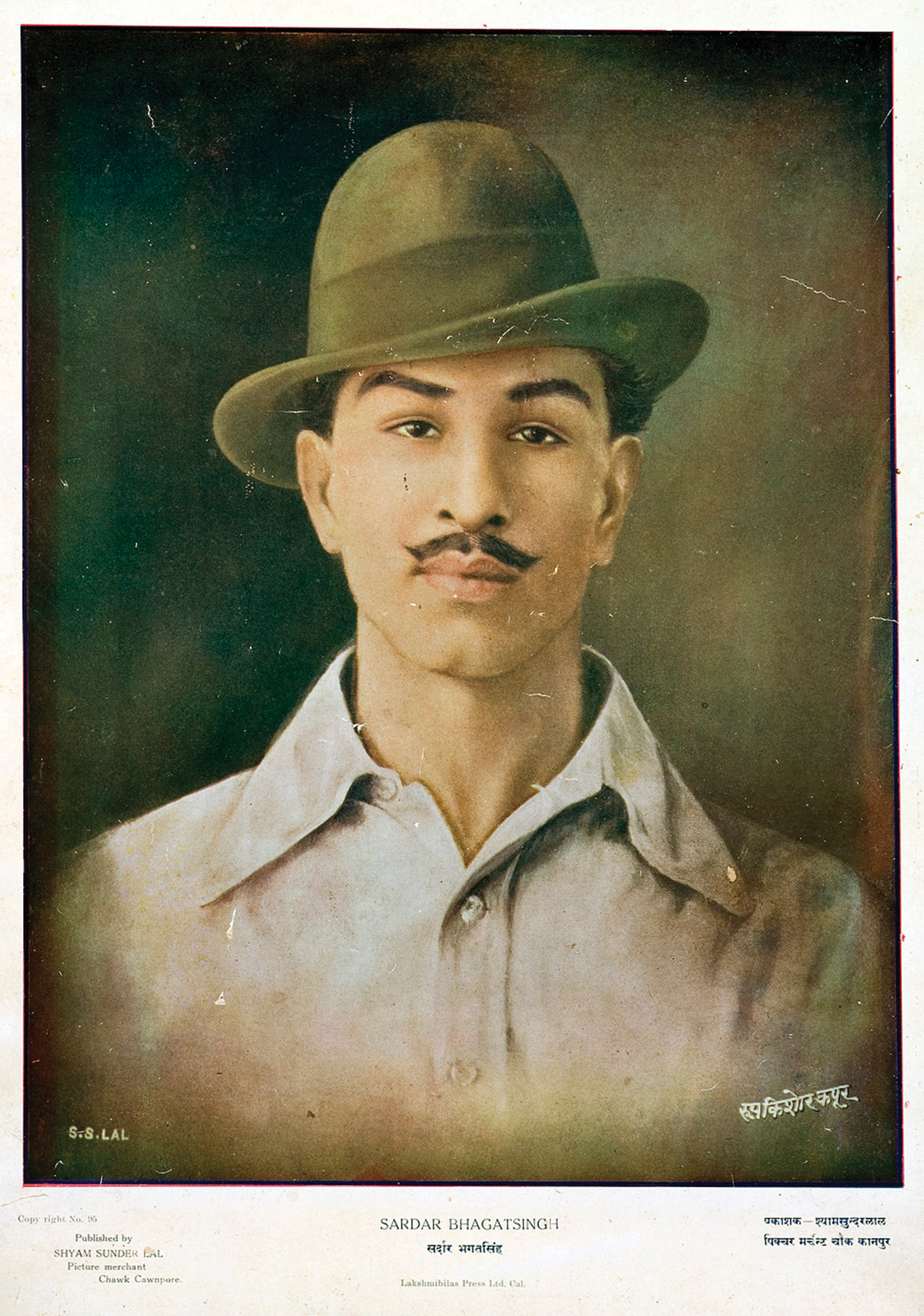
Bhagat Singh's portrait became so frequently photo-mechanically replicated, that as an image, it began to use its clarity.Footnote 63 At some stage, in an effort to retrieve his handsome features, copies of the photograph would be drawn over, narrowing his eyes and somewhat altering his expression.Footnote 64 Using the photograph as a basis, many drawings and paintings were made of Bhagat Singh in the early 1930s, reproduced widely as posters and calendars, significantly enabling the image's mobility. The Government instantly proscribed such pictures. Many of these were produced in Kanpur (Cawnpore), a town known for its leftist activism and a place where Bhagat Singh had many contacts, having lived there in the mid-1920s when he worked for Pratap and Chand. Christopher Pinney has drawn attention to the work of Kanpur artist Rup Kishore Kapoor, himself a revolutionary, who specialized in painting images of Bhagat Singh, and was arrested for his art, serving at least two years in prison (Pinney Reference Pinney2004, 128; see Figures 2, 8).
Rup Kishore Kapoor, Sardar Bhagat Singh. A proscribed image, c. 1931, published by Shyam Sunder Lal of Cawnpore. Author's collection.

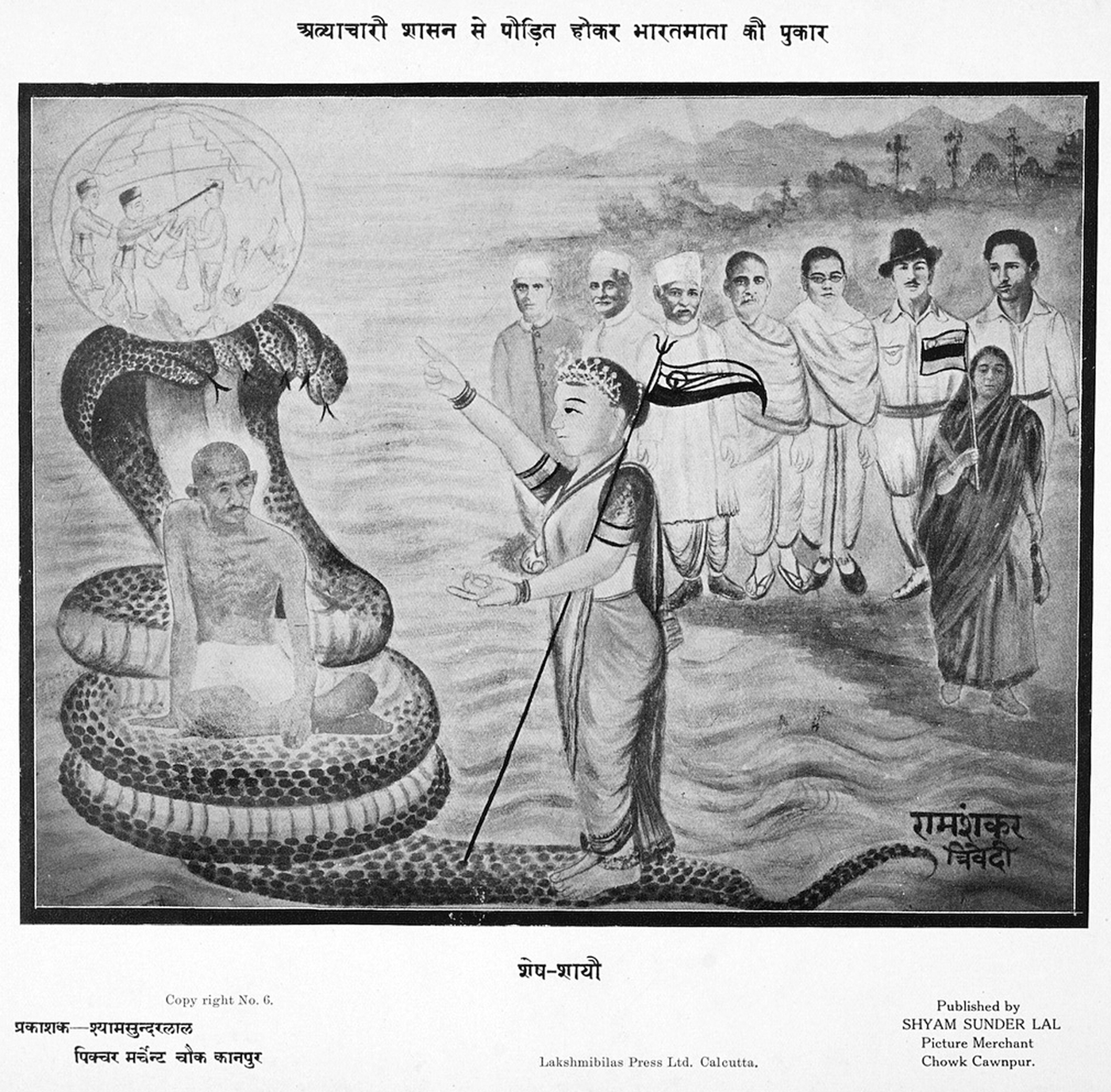
As Bhagat Singh's image migrated from photograph to poster, the hat became his defining feature, as indeed it is today. Artists less skilled than Kapoor were not troubled by the need to depict his fine features with precision, for they were able to cater to the demand for images of Bhagat Singh by simply referencing the photograph, relying on his distinctive hat to signal his identity (see Figure 9). This enabled circulation of Bhagat Singh's image to exist independently of, even as it cited, the photographic image, enhancing its capacity for dissemination.
Ramshankar Trivedi, Bharat Mata ki Pukar (Bharat Mata's Call), Published by Shyam Sunder Lal, Kanpur, c. 1930s. Author's Collection.

The photograph's migration to calendar art meant that it could be reproduced in unimaginable ways and apparently dissonant contexts, such as the one below, in which Bhagat Singh and B.K. Dutt stand behind Sarojini Naidu, in line with Jawaharlal Nehru, Motilal Nehru, Madan Mohan Malaviya, Vallabhbhai Patel, and Subhas Chandra Bose. And yet the image itself is not entirely imagined, at least not in its bringing together of the revolutionaries with several Congress notables. Indeed, many of the Kanpur-created images, particularly those published by Shyam Sunder Lal, betray an intimate knowledge of normally clandestine revolutionary affairs. Bose, Malaviya, and Motilal in particular were criticized in the Anglo-Indian press for their statements in support of Bhagat Singh. Motilal Nehru sparked a frisson of disapproval in the Home Department after he attended the Lahore Conspiracy Case trial one day, and ‘took his seat in the dock with the accused, and held conversations with them’ for half an hour; when he took his leave, he ‘shook hands with each of the accused, and saluted them with folded hands’.Footnote 65
Similarly, Moderate Malaviya, who had been present at and initially condemned the bombing of the Assembly, surprised many when he defended the accused in court, and was quoted describing Bhagat Singh as ‘the leader of youths’,Footnote 66 later proclaiming that ‘we want a million Bhagat Singhs’ (Jenkins Reference Jenkins1970, 5). Bose was frequently overheard ‘inciting impressionable youths’ by invoking Bhagat Singh's memory at public meetings, including an address to the NJBS in Punjab.Footnote 67 Gandhi was also criticized for his statements when they seemed to support Bhagat Singh, for in the aftermath of the executions, the official Congress Party line was to defend Bhagat Singh's bravery while decrying his violence.Footnote 68 The veteran British journalist J.D. Jenkins recalled that Gandhi's initial public statement after Saunders' murder, ‘I condemn the assassin for the act he did, but at the same time, you must look at the motive’, was far too qualified for his liking (Jenkins Reference Jenkins1970, 5). Jenkins took Gandhi to task in the Statesman for this, and a debate ensued between the British-owned press and its Indian rivals over whether the accused were miscreants or martyrs. ‘Such a distinction is too fine to be appreciated by the ordinary public’, opined the government, ‘who can only see in such speeches a glorification of the action of men whose sole object is to overthrow the Government by every possible means’.Footnote 69
Many posters eulogizing Bhagat Singh were proscribed but survive in great numbers today, in archives, libraries and in personal collections, mute evidence to their popularity in the 1930s (see Shaw and Lloyd Reference Shaw and Lloyd1985). More rare is evidence of how they were interacted with before they were captured. A vignette from Shiv Verma gives us a sense of how one chance encounter with a poster in Haridwar led to an impromptu public rally in late 1929. The investigators of the Lahore Conspiracy Case had summoned Verma's mother to visit her son in jail, to implore him to cooperate with the investigation (which he refused to do). On her return from Lahore, accompanied by her brother, she stopped at Haridwar to perform religious rites, officiated by a panda (priest).
One calendar, depicting all the photographs of the Lahore Conspiracy Case accused, was hanging on the wall in the room where the Panda had lodged them. My uncle explained to my mother: This is Bhagat Singh, this is Sukhdev, this is Shiv Verma, this is so and so. The Panda was watching them from behind. The Panda asked: how do you know these people? My uncle said, she is the mother of so and so. He kept quiet and lodged them comfortably. Then he took a tonga [horse and cart], went round the city and announced that the mother of so and so, an accused in the Lahore Conspiracy Case, has come and anyone, who wanted to have darshan [see her], come at 4 o'clock to the Har-ki-podi. At 4 o'clock, he asked my mother and uncle to come out. They came out and found thousands of people gathered there shouting slogans. So that is how these people eulogized our relatives and inspired them (Verma Reference Verma1972, 165).
Just as Bhagat Singh's portrait was extensively photo-mechanically replicated and copied, subtly changing its physical form to infer innocence or intent, so too the message that accompanied the image was received and reinterpreted in divergent ways. Bhagat Singh became an idea ‘thought out and reworked in the popular imagination’, not unlike Shaid Amin's exposition of the reception of Gandhi in Gorukhpur (Amin Reference Amin and Guha1984, 2). Reading through the many fragments relating to Bhagat Singh's life in various archives, it becomes clear that his revolutionary agenda was not well understood, and it emerges that in 1930s India general usage of the term ‘revolution’ was ambiguous. Indeed, where the term ‘revolution’ (inqalab) came to enter public discourse, usually in the form of sloganeering, it seemed to signal a political revolution rather than the more comprehensive revolution of the proletariat that was at the heart of HSRA ideology.Footnote 70
Of course a political revolution – removing the British – was the first step to effecting any kind of social program, but removing the British was popularly presumed the sole aim of Bhagat Singh's politics. An examination of the various speeches, tracts and posters produced in the aftermath of Bhagat Singh's execution reveals that the bulk of eulogies did not reflect his revolutionary program (see Sidhu Reference Sidhu2007; Gaur Reference Gaur2008). Thus the portrait of Bhagat Singh has come to popularly symbolize his defiant and heroic anti-colonialism, which is not inaccurate, but incomplete. The fact that he inspired a range of political actors – such as Gogate, a follower of Savarkar, and the qualified sympathy of the Anti-Red League, to mention just two we have encountered here – is indicative of how broad his appeal came to be.
The British played their own role in making Bhagat Singh a martyr, by conducting themselves just as he predicted. They knew that his execution would create ripples all over India, yet they were unwilling to consider a reprieve, and so they obliged in making him a martyr.Footnote 71 The Home Department was acutely aware of the phenomenon of martyr-making unfolding before them, complaining that ‘the propaganda to which the youth of the country is being subjected is calculated to inflame their minds to an extent which makes it probable that unbalanced persons will commit sporadic acts of violence in order to earn the martyr's crown which they are constantly urged to attain’.Footnote 72
In the months after his death, Bhagat Singh was more popular than ever, the subject of speeches, the object of pujas, the name in which people observed fasts and hartals, and the star character in plays, poems and songs.Footnote 73 The authorities acted to arrest this adulation by enacting further press controls, proscribing literature and monitoring speeches.Footnote 74 They alleged that the terms of the Gandhi-Irwin pact, concluded in the weeks before the execution (which included an assurance from Gandhi that the struggle against the British would continue to be non-violent), was being abrogated daily by Congress workers speaking in support of Bhagat Singh.Footnote 75 In response to this, the President of the Congress, Rajagopalachari, issued a circular with clear behavioral guidelines to all party workers, which included the admonition
We should not make any approving references to acts of violence. Congratulation of bravery and self-sacrifice on the part of persons committing acts of violence are unnecessary and misleading, except when made by persons absolutely pledged to non-violence in thought and deed as Gandhiji.Footnote 76
Conclusion
A close reading of the portrait's journey highlights a number of aspects of revolutionary history in the interwar period. Foremost among these is the extraordinary media savvy and awareness of visuality with which Bhagat Singh operated. This emerged from his own experience as a voracious reader, writer and keen observer of politics, combined with a genuine desire to communicate as broadly as possible. As Sumathi Ramaswamy has recently argued, ‘Pictorial history challenges us to dwell on the overlapping zone between the sayable and the seeable so as to shuttle back and forth between the two. It exhorts us to explore those aspects of the human experience that are unsayable and nonverbalizable, but also correspondingly, to come to terms with those that are unpicturable, even unseeable’ (2010, 849). In the 1930s, much was unprintable and unsayable, but much more could be and was inferred by readers of this polysemic image.
It would however be speculative to suggest that Bhagat Singh deliberately chose the hat as a prop, knowing that it would translate into a powerful tool of self-representation, as it morphed across various visual media. It is clear from contemporary advertising that the hat was a fashionable accessory,Footnote 77 and while the revolutionaries had neither funds nor a penchant for fashion, they did make extensive use of disguises (Kapoor Reference Kapoor1974, 114). Bhagat Singh adopted a ‘coat, pant and hat’ at the end of 1928, knowing that the British were looking for a turbaned, khaddar-clad fugitive in the aftermath of Saunder's assassination (Das Reference Das1971, 33; Kapoor Reference Kapoor1974, 116).
From a series of posters issued by Kanpur's prolific Shyam Sunder Lal Picture Merchant in the early 1930s, it is clear that the inner circle members of the HSRA all had studio photographs taken, which later became the basis of eulogy prints for those who died (see Shaw & Lloyd Reference Shaw and Lloyd1985). None of these, however, achieved the currency of Bhagat Singh's. Jatindranath Das' death was covered extensively in the media, but his studio portrait does not seem to have been reproduced in the press, although a gruesome photograph of his wasted body made the front page of the Tribune.Footnote 78 His death made a major impact on the Indian body politic, serving to briefly bring nationalist activists together, including rival Congress factions, but it also became an important precedent for the crescendo of Bhagat Singh's execution.
While posters referencing the studio portrait of a moustache-twirling Chandrashekhar Azad (cited in Figure 3) come close to the currency of Bhagat Singh's ‘hat-on’ portrait, this is a later phenomenon. While this photograph's genealogy remains unclear, other than it was taken in Jhansi (Kapoor Reference Kapoor1974, 116), it does not appear to have been in media circulation in the aftermath of Azad's death, in a dramatic police encounter on February 27, 1931.Footnote 79 Much less is known about Azad; his final years were spent in hiding and his death was not anticipated in the same way as Bhagat Singh's. Additionally, Azad did not speak English (Chandra Reference Chandra1988, 225; Gupta Reference Gupta1974, 23). Given that Bhagat Singh's polemics with the empire were largely conducted in their language, this is no doubt significant. Bhagat Singh's portrait was part of a sophisticated media campaign, carried over a two-year period, while he continued to defy the British in the courts. His friend Jaidev Gupta recalled that he ‘wanted to be hanged at a time when the country and the whole world might be clamouring for his release’ (1979, 58) and he achieved that, with socialist parties advocating for his release globally.
Shortly after his execution, probably during a condolence meeting in Lahore, unknown but agitated mourners made a blood sacrifice in the memory of Bhagat Singh: by cutting their thumbs and bleeding on the front page of the Tribune of March 25, 1929, which announced Bhagat Singh's death and carried his photograph (Figure 10). In the aftermath of his death, reproduction of his portrait, as with later popular images of martyrs seemed to ‘want’, as Sumathi Ramaswamy suggests, ‘the devotion and worshipful reverence of the Indian citizen. They want action and sacrifice … on behalf of nation and country; they want martyrs’ (2010, 297).
Copy of a bloodstained Tribune, 25 March 1931, exhibited at the Supreme Court of India Museum in 2007. Courtesy: Supreme Court Museum.

In posing for his photograph, Bhagat Singh was providing a pivotal ingredient for a publicity campaign that created a powerful movement around his pending martyrdom. The campaign began with the media, but rapidly moved beyond what was, in the 1930s, a realm of limited reach. The portrait circulated independently of text, in the form of reproductions, facsimiles, posters and even badges, in which the hat served to symbolize Bhagat Singh's imperial challenge. As such the image became the catalyst of urgent discussions about ‘thriller nationalism’, with its unpredictable turns of fate; agonizing hunger-strikes; intrigues inside court-rooms, plotting from without; and beatings and abuses in squalid jails; countered with tales of enduring camaraderie and astounding bravery. The end, too, was unpredictable, with many believing that the trio would be given clemency at the last minute. By the time Bhagat Singh was executed, he had, through his portrait, become known to many. This explains the extraordinary reaction around India after his death, where many adopted a form of mourning – cautha – that they would normally observe for a family member or friend.Footnote 80
Acknowledgements
This article was researched and drafted in my capacity as Professorial Research Fellow at the University of the United Arab Emirates in 2009, with supporting funds from the University of New South Wales. Thanks are due to the archivists of the collections I have drawn on in this research, as well as Geoffrey Batchen, Assa Doron, Robin Jeffrey, Chaman Lal, Philip Lutgendorf, Raj Mani, Jim Masselos, Michael Milne, Christopher Pinney, Rajesh Prasad, Gauhar Raza, A. G. Noorani, Ian Tyrrell, my friends the Sarwals, and the anonymous reviewers of the JAS for their comments.