

1. Introduction
Exploratory activities have revealed extensive mineral deposits on seabeds in many regions of the world. The base metal composition of these deposits is dominated by manganese, cobalt, and nickel; precious metals and rare earth elements are also found on seafloors. Interest in accessing these resources has increased with the decline of accessible, high-concentration terrestrial deposits of base metals, and concerns about the political instability and strategic risks associated with supply regions for cobalt and rare earth elements. Some analysts also expect the market growth of advanced batteries and alternative energy technologies to increase the future demand for cobalt, rare earth elements, and other minerals (e.g., Hund et al., Reference Hund, La Porta, Fabregas, Laing and Drexhage2020). This confluence has pushed the deep seabed mining (DSM) industry toward commercialization.
Seabed minerals are located in international waters known as “the Area,” which the International Seabed Authority (ISA) administers, and are also found in the jurisdictional waters of coastal countries (hereafter, “national jurisdictions”).Footnote 1 In the past two decades, exploratory leasing has significantly increased on the seabeds of both of these regions.Footnote 2 As of this writing, the ISA has granted 30 exploration leases to contractors from countries in Europe, Asia, Cuba, Russia, and the Pacific Islands,Footnote 3 while Pacific Island countries have issued over 300 exploration leases (World Bank, 2017). The ISA has also drafted a mining code, with the finalized regulations scheduled to be issued in late 2020 after review and revision.Footnote 4 Even if the mining code is issued on schedule, regulatory reviews, technology constraints, and financing issues may delay the industry’s start-up (Heffernan, Reference Heffernan2019).
In fact, the commercialization of DSM faces significant challenges. The technology is being adapted from terrestrial equipment that has not been fully demonstrated on deep seabeds. Capital investments must be sunk before mining operations begin. Some analysts expect that future minerals prices will increase, but prices have historically fluctuated widely (Christian, Reference Christian2009). Initial attempts to develop commercial technology will confer a second mover advantage through positive technology spillovers and from the fact that discovered deposits cannot be listed as “reserves” in firms’ asset valuations until extraction technology is demonstrated (Land, 2018. Mining Specialist, World Bank. Personal Communication). Financing risks, and the financial stability of mining firms, are also potential constraints. In 2019, a financial failure halted the first and so far only attempt at exploiting seabed minerals – the Solwara 1 project off the coast of Papua New Guinea.
The prospect of DSM has stirred tremendous debate and concern. Controversies include the potential social impacts on coastal communities (World Bank, 2017, 2018) and the consequences of disturbing deep marine ecosystems (Levin et al., Reference Levin, Mengerink, Gjerde, Rowden, Van Dover, Clark, Ramirez-Llodra, Currie, Smith, Sato and Gallo2016; Le et al., Reference Le, Levin and Carson2017; Dunn et al., Reference Dunn, Van Dover, Etter, Smith, Levin, Morato, Colaço, Dale, Gebruk, Gjerde and Halpin2018; Washburn et al., Reference Washburn, Turner, Durden, Jones, Weaver and Van Dover2019). Exploratory activities have generated information about seabed ecology, but the quality of baseline information is poor and knowledge of the consequences of disturbing seabed environments largely unknown (World Bank, 2017, 2018; Dunn et al., Reference Dunn, Van Dover, Etter, Smith, Levin, Morato, Colaço, Dale, Gebruk, Gjerde and Halpin2018; Washburn et al., Reference Washburn, Turner, Durden, Jones, Weaver and Van Dover2019). The cumulative environmental impacts from commercializing DSM on multiple mining sites over an extended period are of particular concern (Dunn et al., Reference Dunn, Van Dover, Etter, Smith, Levin, Morato, Colaço, Dale, Gebruk, Gjerde and Halpin2018).
A regulatory framework is emerging for addressing the challenges of seabed mining. Contractual mechanisms for risk sharing are an important part of this framework (ISA, 2019). For countries with weak regulatory structures, contracting mechanisms will be especially important to cover contingencies that regulations do not address (Ochoa, Reference Ochoa2020).
While regulations and contracting mechanisms are obviously necessary for the prudent development of DSM, these institutional arrangements are unlikely to be sufficient for managing DSM uncertainties, which are “deep” or “fundamental” as these terms are used in the decision science literature (e.g., Lempert, Reference Lempert, Popper, Groves, Kalra, Fischbach, Bankes, Bryant, Collins, Keller, Hackbarth, Dixon, LaTourrette, Reville, Hall, Mijere and McInerney2013a , Reference Lempert2014). Markets for risk-sharing are incomplete in this context, and when contracts are possible, their enforcement can be difficult in international settings. Attempts by Papua New Guinea to recover $157 million in losses from the failed Solwara project are indicative of this problem.Footnote 5
This article explores the use of benefit–cost analysis as an additional avenue for reducing DSM uncertainties. Specifically, we propose an approach to ex ante benefit–cost analysis that integrates decision science approaches for modeling fundamental uncertainty as a way to evaluate exploitation contract proposals. This BCA framework should improve DSM decision-making, reducing the risks of noncompliance with regulatory requirements or the need to invoke contractual contingency provisions after seabed mining begins. Used in this way, benefit-cost analysis would support and complement the emerging DSM management regime, increasing the chances of socially beneficial development of the DSM industry.
In developing the recommendations for improving the ex ante evaluation of DSM exploitation contracts, we draw on insights from a JBCA symposium “Perspectives on Implementing Benefit Cost Analysis in Climate Assessment,” and reports from the European Union and the World Bank completed as part of a capacity building program with the Pacific Community (SPC) to support DSM decision-making in Pacific Island countries.Footnote 6 We also review literatures on the value of information and robust decision-making (RDM) including Hammit and Lempert (Reference Hammitt, Lempert and Schlesinger1992), Dixit and Pindyck (Reference Dixit and Pindyck1994), Gollier and Treich (Reference Gollier and Treich2003), Farrow (Reference Farrow2004), and Lempert et al. (Reference Lempert, Popper, Groves, Kalra, Fischbach, Bankes, Bryant, Collins, Keller, Hackbarth, Dixon, LaTourrette, Reville, Hall, Mijere and McInerney2013a ,Reference Lempert, Kalra, Peyraud, Mao, Tan, Cira and Lotsch b ). From this review, we fashion recommendations for benefit–cost analysis used for the evaluation of DSM exploitation contracts.
The next section offers background and perspective on the status of deep seabed mining. Section 3 describes the types of uncertainties that can arise in the evaluation of DSM projects. Section 4 overviews different uncertainty evaluation frameworks that can be used in benefit–cost analysis. A review is then conducted of a benefit–cost analysis of deep seabed mining sponsored by the European Union (EU) in conjunction with the Pacific Community (SPC), reported in Cardno (2016) and Wakefield and Myers (Reference Wakefield and Myers2018). As of this writing, this is the only benefit–cost analysis of DSM published in the academic literature. Section 6 makes recommendations for improving benefit–cost analysis in the ex ante evaluation of mining contract proposals. Section 7 offers a conclusion.
2. Background
To provide some perspective, this section describes seabed resources and extraction technology and then considers the developing institutional framework for managing seabed resources. We conclude with the policy challenges DSM faces, and the role that benefit–cost analysis can play in DSM decision-making.
2.1. Seabed resources and extraction technology
Seabed minerals typically occur in three types of formations. Polymetallic sulfides (also known as “seafloor massive sulfides (SMS)”) are found around active and inactive hydrothermal vents. Hydrothermal vents are located on mid-ocean ridges at tectonic plate boundaries at depths of 1000–3500 m. Cobalt-rich crusts (CRCs) are found on the surfaces of seamounts at depths of 800–2500 m. Polymetallic nodules (PMNs, also known as manganese nodules) are scattered on the surface of abyssal plains in deep ocean waters at 4000–6500 m below the ocean surface (World Bank, 2017). It has been estimated that polymetallic nodules on seafloors in the Clarion-Clipperton Zone (CCZ) – a broad expanse in the Pacific Ocean between Hawaii and Baja California – may contain more manganese, cobalt, and nickel than the total known terrestrial deposits of these minerals (Hefferman, 2019). Figure 1 shows the global distribution of seabed mineral deposits and the areas in international waters for which the ISA has granted exploration contracts.
Spatial distribution of deep seabed mining (DSM) resources and locations of International Seabed Authority (ISA) exploration contracts. Sources: Hein et al. (Reference Hein, Conrad and Dunham2009, Reference Hein, Mizell, Koschinsky and Conrad2013), Miller et al. (Reference Miller, Thompson, Johnston and Santillo2018), and ISA (2020).

Given the problems encountered by the Solwara project, which was going to mine SMS, polymetallic nodules in the Clarion-Clipperton zone may now be the most likely target for early seabed exploitation (Heffernan, Reference Heffernan2019). However, SMS deposits are still of great interest (Dunn et al., Reference Dunn, Van Dover, Etter, Smith, Levin, Morato, Colaço, Dale, Gebruk, Gjerde and Halpin2018). Mining on cobalt crusts seems to be a more distant prospect.
DSM will involve several components. A production support vehicle (PSV) will be located on the ocean surface directly above the mine site and remotely control mining robots, adapted to the specific type of mineral deposit, to excavate minerals from the seafloor. A riser/lift system will convey the extracted mixture of minerals, sediments, and water from the seabed to the PSV. At the PSV, a dewatering process will be used to remove minerals from the solution in which they are suspended. The dewatered minerals will then be loaded onto barges and shipped to onshore processing facilities, with the return water pumped back down the riser/lift system. The PSV will control the entire operation (World Bank, 2017).
The extraction periods and mining footprints will vary for the different seabed minerals (World Bank, 2017). The mining of cobalt crusts on seamounts is expected to take place over a 20 year period. For the study site in the BCA sponsored by the EU and the Pacific Community, this 20-year mining operation would leave a footprint of 470 km2.
The areal extent of hydrothermal vents is relatively localized. Mining at any one site will leave a footprint of only 10–20 hectares, and the mining will only last from 1 to 2 years. But multiple sites are likely to be developed over a longer period as part of a single mining contract, as was the case for the Solwara project (AMC, 2018). A mining contract for 20 years could be granted for the development of multiple sites.
The extraction of manganese nodules will leave the largest mining footprint. In the prototypic operation considered in the BCA sponsored by the EU and the SPC, the mining footprint would be 135 km2 of area per year, amounting to an area of 2705 km2 over the 20-year life of the project.
Ecological characteristics differ within and across the three types of formations, and the associated ecosystem processes have different spatial and temporal scales (Dunn et al., Reference Dunn, Van Dover, Etter, Smith, Levin, Morato, Colaço, Dale, Gebruk, Gjerde and Halpin2018). Exploratory activities have turned up rich biodiversity in all of these areas, including abyssal plains which feature low biological productivity (Le et al., Reference Le, Levin and Carson2017).
2.2. Regulatory framework
The commercialization framework for DSM in international waters derives from treaty obligations under the United Nations Convention for the Law of the Sea (UNCLOS). The International Seabed Authority (ISA) was established under UNCLOS to regulate and manage seabed resource development. The objective is to promote seabed development within a regulatory structure that minimizes environmental risks. Promoting seabed development with side environmental policies is also the general strategy for countries with seabed resources in their national jurisdictions.
Draft ISA regulations can be used to exemplify the development objectives regarding seabed resources (ISA, 2019). In these regulations, qualified contractors are required to specify a mining work plan and a financing plan. The work plan must specify a “program of mining operations and sequential mining plans, including applicable time frames, schedules of the various phases of the exploitation activities, and expected recovery rates” (Annex II, paragraph c). Also required is “a detailed production plan showing … .estimated maximum amounts of minerals that would be produced each year under the plan of work” (Annex 2, paragraph f). Regulation 28 requires the contractor to stick to the production schedule in the work plan, but the contractor can petition the ISA for production adjustments or suspensions in the event of environmental harms (Regulation 28(3)) or unfavorable market conditions (Regulation 29). The financing plan requires a … ‘detailed cash-flow forecast and valuation, … indicating applicable regulatory costs” (Annex III, paragraph g) and the “details of the applicant’s resources or proposed mechanisms to finance the proposed mining activities, and details regarding the impact of such financing mechanisms on the cash-flow forecast” (Annex III, paragraph h).
Regulations 22–24 allow contractors to lien or mortgage all or part of their claims in the exploitation contract to raise financing; allow the transfer of rights and obligations of the contract to another party; and allow for ownership changes. The ISA must approve these changes. These are risk sharing mechanisms to enable production to continue in the event of financial constraints. Contractors are also required to post an environmental performance guarantee (Regulation 26).
To address the environmental effects of DSM, environmental impact assessments (EIAs) are generally required in contract applications to the ISA and countries with seabed resources. The purpose of an EIA for DSM is to operationalize regulatory obligations including the application of the precautionary principle (Durden et al., Reference Durden, Lallier, Murphy, Jaeckel, Gjerde and Jones2018). Additionally, the draft mining code issued by the ISA implements the legal obligations established by UNCLOS, including the development of environmental management plans (EMPs) in areas subject to DSM (Regulation 2(e)), and the establishment of mining exclusion zones where “… evidence indicates the risk of serious harm to the environment” (UNCLOS Article 162(2); paragraphs w and x). Determining the mining exclusion areas is the subject of current research (Dunn et al., Reference Dunn, Van Dover, Etter, Smith, Levin, Morato, Colaço, Dale, Gebruk, Gjerde and Halpin2018). EMPs will provide the information needed for monitoring programs to support adaptive management (Ellis et al., Reference Ellis, Clark, Rouse and Lamarche2017). Both the precautionary principle applied through EIAs and adaptive management techniques supported within EMPs are important methods to address the uncertain environmental impacts of DSM.
2.3. Policy challenges and the role of benefit–cost analysis
The regulation and management of seabed mining face daunting policy challenges. The stewardship of DSM in international waters, for which the accounting stance is global, faces a unique set of conditions. From this wide-angle perspective, there are countervailing externalities that suggest a normative stance both in favor of and against more rapid DSM development. Justifying more rapid development are technology spillovers from new DSM technology, and the value of information produced from exploratory activities and environmental monitoring during the course of DSM operations. To the extent that DSM displaces terrestrial mining operations, resource savings, including avoided environmental damages, constitute additional benefits of DSM. On the flip side are the potential negative externalities on marine environments that have been the subject of so much concern and controversy.
It is beyond the scope of this article to suggest how benefit–cost analysis might incorporate these global countervailing effects. Our scope is narrower: to assess the way benefit–cost analysis can address the challenge of uncertainty in the site-specific assessment of the financial returns and financial risks associated with mining contract applications. Even in this narrower sense, the evaluation qualifies as BCA in that resource rents will be distributed to more than one stakeholder. The ISA or countries with seabed resources will obtain a share of the rents through the collection of fees, royalties, and other compensation mechanisms – including corporate income taxes for countries with seabed resources (Van Nijen et al., Reference Van Nijen, Van Passel, Brown, Lodge, Segerson and Squires2019). Mining companies and their shareholders will also appropriate a share of the resource rents as a return on high-risk investment. The distribution of project returns to both of these stakeholders will need to be included explicitly in a BCA of exploitation contracts. This issue is further explored in Section 6.
For mining companies with exploitation contracts granted by the ISA, the citizens of their home countries may take a share of the rents through corporate income taxation.Footnote 7 From a practical perspective, it is not necessary to distinguish this possibility in the evaluation of exploitation contracts. On the other hand, from the national accounting domain perspective of countries with seabed resources, the relevant comparison will be the financial returns from the governments’ share of mining rents against any uncompensated administrative or regulatory costs incurred to manage seabed development. Local environmental impacts will also have to be addressed through domestic environmental regulations and/or environmental impact statements, while at least a qualitative judgment about local social and cultural impacts will also have to be considered in the decision-making. These issues are further discussed Section 6.
We now step towards the task of addressing fundamental uncertainties in a benefit–cost framework for the evaluation of mining lease proposals.
3. Dimensions of DSM uncertainties
In this section, the type and nature of uncertainties associated with DSM decision-making are considered. There are a number of important dimensions to consider (See Table 1).
Types of DSM uncertainty and implications for benefit–cost analysis.

Abbreviation: DSM, deep seabed mining.
a Costs will be sunk if the DSM industry does not develop and stabilize. In a stable industry, equipment can be reused and transported among locations. Some costs will be sunk in exploration and site assessment, to set up operations, and to relocate to new areas.
b At least initially before the production share of seabed mining is significant enough to influence commodity markets.
c These costs occur at the end of the project’s life and will be significantly discounted.
d This refers to financial constraints on firms sufficient to cause project failure.
e This is under the assumption of this article, which assumes environmental costs will be treated through regulatory policy and contracting, with technical, financial, and economic, uncertainties addressed using benefit–cost analysis.
The degree of uncertainty can be classified on many levels. Classically, Knight (Reference Knight1921) distinguished uncertainty levels as “risk,” “uncertainty,” and “ignorance.” “Risk” describes a level of knowledge where components in the model have a known set of possible values, each with identified probabilities (e.g., a probability distribution for mineral prices). “Uncertainty” conveys a lower state of knowledge where probabilities are unknown. Finally, “ignorance” describes situations where even the possibilities are unknown (e.g., a lack of knowledge about what marine species DSM might affect). Most real-world problems are not pure versions of Knight’s classification. For example, the subjective use of a past distribution of mineral prices may not accurately reflect the distribution of future prices when mining technology and economic conditions change.
More recently, the uncertainty evaluation literature has focused on distinctions at the lower knowledge end of Knight’s spectrum, using labels such as “deep uncertainty” or “fundamental uncertainty.” In a taxonomy by Walker et al. (Reference Walker, Lempert, Kwakkel, Gass and Fu2013), “Level 4” identifies a situation in which the probabilities for scenarios can qualitatively be ranked in terms of their likelihood even if quantitatively they remain unknown. In this context, decision-makers may have different views about how to formulate the model, solve it, and attach values to outcomes. In “Level 5,” the analyst knows almost nothing other than their awareness of the unknowns. Lempert et al. (Reference Lempert, Popper and Bankes2003) define “deep uncertainty” to be a situation that “the parties to a decision cannot agree upon (i) the appropriate models to describe interactions among system variables, (ii) the probability distributions to represent uncertainty about key parameters in the models, and/or (iii) how to value the desirability of alternative outcomes.”
Another dimension is the degree to which uncertainties are exogenous to mining activity or endogenously related to mining decisions. Exogenous uncertainties include the future value of mineral commodities and the prices of inputs used in DSM mining (assuming an individual mine’s input demands or output sales constitute too small a market share to influence prices). This kind of uncertainty is sometimes referred to as “market uncertainty” (Mahnovski, Reference Mahnovski2007). Endogenous uncertainties concern the performance and reliability of DSM technology, as well as the environmental impacts associated with DSM operations. The strategic behavior of firms in the DSM industry is another endogenous uncertainty.
Another dimension of uncertainty involves the degree to which impacts are reversible (Krutilla, Reference Krutilla1967; Dixit & Pindyck, Reference Dixit and Pindyck1994; Gollier & Treich, Reference Gollier and Treich2003). Investments in DSM mine sites will be sunk to the extent that the seabed mining as an industry fails, and partially sunk in a stable industry given the transportability of some of the equipment used among different seabed sites. Some of the environmental impacts of DSM could be irreversible. The impacts of mining on dynamically complex marine systems raise the possibility of tipping these systems into different equilibrium states (Perrings et al., Reference Perrings, Folke and Mäler1992; Morgan et al., Reference Morgan, Vaishnav, Dowlatabadi and Azevedo2017). Once the system resides in these new equilibrium states, reverse engineering the system back to the original condition can be extremely difficult (Crépin et al., Reference Crépin, Biggs, Polasky, Troell and de Zeeuw2012).Footnote 8
A related issue is the time frame and observability of uncertainties. The profile of DSM equipment costs over time is highly uncertain, but the current-period costs of DSM technology will be more or less known at the time of a benefit–cost analysis before the mining contract period. In contrast, there will be uncertainties related to the operational performance of the technology and market conditions, and these will be revealed over the contract period. Similarly, regulatory uncertainties can emerge during the contract period. To the extent that these relate to the compliance of an individual contractor (as opposed to a shift in regulatory regime), compliance will be resolved through monitoring and reporting. On the other hand, environmental damages may not become apparent until after thresholds are reached – long after any individual contract period (Crépin et al., Reference Crépin, Biggs, Polasky, Troell and de Zeeuw2012; Liski & Salanie, 2019). Environmental damages are likely to reflect the impact of multiple mining operations should the industry fully develop.
Another dimension is the degree to which information is available for modeling and/or forecasting. For the deeper level of uncertainty, for example, Level 5 in the Walker scheme, it is not possible to construct a model. But at a lesser level of uncertainty, information is available for model specification, but agreement about the model is lacking. In this case, an ensemble of forecasts from different models offers a way to provide information.Footnote 9
The nuances described about the nature of fundamental uncertainty are likely to apply to different aspects of DSM. Table 1 provides a summary of the uncertainties considered and their potential implications for the benefit–cost analysis of seabed mining contracts.
4. Uncertainty evaluation methods
For benefit–cost analysis to address the different levels and kinds of uncertainties described, different uncertainty evaluation perspectives and methods are recommended. In this section, three perspectives/methods are considered. The first are methodologies associated with the “predict-then-act” decision stance commonly used in benefit–cost analysis.Footnote 10 In this decision-framing, economic returns are forecast into the future, and deterministic sensitivity analysis or uncertainty propagation methods are used to address uncertainties. This approach is relevant for evaluations facing uncertainty in the “risk” category described by Knight.
The second evaluation perspective comes from the literature on the value of information. In this framework, the scale and timing of decisions are conditioned on the revelation of new information. Value of information approaches such as “real options” can be used to provide assessments of “risk” as described by Knight, as well as to address more fundamental uncertainty when combined with other methods, such as robustness-based approaches (See Mahnovski, Reference Mahnovski2007).
Robustness-based approaches are the third evaluation perspective. Robustness-based methods, such as robust decision-making (RDM), are used to evaluate decisions facing deep or fundamental uncertainty. Robustness-based methods assess the performance of projects over a wide range of futures and systematically explore vulnerabilities to uncertain contingencies that are essentially impossible to forecast. Project designs are then adjusted to reduce these vulnerabilities in repeated simulations.
Each of these evaluation perspectives/methods are further explored in the following subsections.
4.1. Predict-then-act methods
The predict-then-act decision structure assumes that the decision issue is whether to take action in the present, based on different forecasts or projections of an expected future. In the context of benefit–cost analysis, the question is whether net present value (NPV) is expected to be greater than zero with enough confidence to recommend project initiation. In this setting, analysts have a significant degree of consensus about the structure of the models producing the forecasts but are likely to have doubts about some parameter values. In standard BCA, the uncertain parameters commonly include those that affect the counterfactual state of the world; the project’s performance; and the value of economic parameters such as the discount rate.
When joint probability distributions are available for all relevant parameters, expected value analysis is typically used along with Monte Carlo methods to generate expected outcomes. Using expected values in this context requires the further assumption that decision-makers are risk neutral (that the social value of monetary values is linearly related to social value over their range of possibilities). When downside risks are viewed as more important than upside potentials, there will be a departure from the subjective valuation of an alternative (the certainty equivalent) and the expected value.
Risks can be mitigated by pooling or reallocation, for example, using insurance. Volatility in commodity prices can be hedged using futures or derivatives markets. However, the terms for derivatives are likely to be too short to hedge against risks over typical project horizons, for example, 20–30 years. In some cases, it is possible to undertake longer-term contracts to reallocate some project risks on a bilateral basis with other market actors (Jenkins et al., Reference Jenkins, Kuo and Harberger2019).
As noted, the predict-then-act decision structure is suited to the informational setting described as “risk.” It is has serious limitations when information is not good enough to make convincing predictions, and the consequences of being wrong are substantial and/or irreversible. Uncertainties about technology performance and the cost of DSM operations are likely to be difficult to predict, and the long-run value of minerals prices also difficult to forecast. Thus, the risk analysis methods used in standard benefit–cost analysis are not likely to be suitable for the uncertainty evaluations of proposals for DSM exploitation contracts.
4.2. Real options and the value of information
The “real options” approach is relevant in a decision-making context when choices about the timing and/or the scale of decisions are flexible, and taking actions in the present imposes sunk costs. Consider the exogenous informational setting first. For investments that entail upfront costs having limited salvage value, and which face uncertainty about future input or commodity prices, deferring the investment can avoid the down-side market risks, should they materialize, and the associated loss of investment funds. On the other hand, if market conditions become favorable, the investment project can be initiated (Dixit & Pindyck, Reference Dixit and Pindyck1994; Farrow, Reference Farrow2004). The value of this delay will reflect decision-makers preferences about risk (Gollier et al., Reference Gollier, Jullien and Treich2000; Gollier & Treich, Reference Gollier and Treich2003). The value of being able to choose to defer the decision in this context is similar to that of a financial call option. However, a “real option” does not trade on secondary markets and may be more difficult to value than financial options.
A related value of information perspective involves expected exogenous trends in the value of natural environments, and their associated uncertainties. The relative societal value of undeveloped environments, such as those associated with marine resources, can be expected to rise as they become relatively scarcer in the future (Krutilla, Reference Krutilla1967). The comparatively low substitutability of natural environments in consumption compared to their use as inputs in production, particularly with technical change, implies that the derived demand for natural resources in production should fall relatively overtime. Making a development decision risks irreversibly foreclosing the option for preserving potentially high-valued natural environments in the future, while deferring the decision is not an irreversible action. These circumstances justify a more conservative benefit-cost criterion that incorporates the value of information lost when development is undertaken (Arrow & Fischer, 1974).
In light of these considerations, it is informative to review some mineral price trends and projections. The prices for nickel, copper, and zinc do not show significant rises, past or projected, from the period 2014 to 2030 (see Figure 2). The same is true for the precious metal prices; gold and platinum in Figure 3, and silver in Figure 4. Figure 5 shows a 10-year price history for cobalt. The price of cobalt at the time of this writing is marginally lower than 10 years ago. But the price rose dramatically from a decade low in January of 2016 to a decade high in March 2018 (see Figure 5). The dramatic price jump was stimulated by a perception in the market that the time had arrived for electric vehicles, and thus, that the derived demand for cobalt, which is used in lithium ion batteries, would significantly increase. Additionally, 50% of the terrestrial supply of cobalt is sourced from the Democratic Republic of Congo – a politically unstable country. However, in March of 2018, Elon Musk announced that the batteries for his electric cars would not rely on cobalt. That news stimulated the precipitous decline in cobalt prices from their highpoint to the present period.Footnote 11
World Bank commodities price forecast – Nickel, copper, and zinc (Constant U.S. dollars; unit: $/mt).

World Bank commodities price forecast – Gold and platinum (constant U.S. dollars; unit: $/toz).

World Bank commodities price forecast – Silver (Constant U.S. dollars; unit: $/toz).

Ten-year historical price series – Cobalt (Constant U.S. dollars; unit: $/mt).

Taking into account the value of information does not always delay decisions. Even in the context of exogenous uncertainty, the value of investing in the present period may be large enough to offset the opportunity cost of lost information from taking current-period actions (Dixit & Pindyck, Reference Dixit and Pindyck1994). For endogenous uncertainty, the opportunity cost generally runs in the opposite direction: information is revealed by taking action and observing the results (Adner & Levinthal, Reference Adner and Levinthal2004). For example, the endogenous resolution of technical uncertainties could justify more rapid development of mineral resources (Dixit & Pindyck, Reference Dixit and Pindyck1994). From a societal point of view, the technology spill-over effects associated with DSM would also provide a gain from more rapid development.
In summary, the literature on real options does not offer a theoretical prior on the optimal timing or scale of investments. The value of parameters in the model and the type of uncertainty will influence the decision-making. However, the literature does imply the need for including the timing and scale of projects as alternatives in the evaluation framework, if there is the flexibility to do so. Foreclosing the possibility of adapting the decision-making to the informational environment can reduce the net present value of the project.
4.3. Robustness-based approaches
Robustness-based decision evaluation methods (sometimes called “bottom-up” methods) are recommended in the decision science literature when uncertainty is fundamental. Robustness-based methods include Decision Scaling, Information-Gap, RDM, Many Objective RDM, and Adaptive Dynamic Pathways.Footnote 12 Such approaches have frequently been used to support planning efforts for climate adaptation, including water capacity planning and coastal zone management (Lempert et al., Reference Lempert, Popper, Groves, Kalra, Fischbach, Bankes, Bryant, Collins, Keller, Hackbarth, Dixon, LaTourrette, Reville, Hall, Mijere and McInerney2013a ,Reference Lempert, Kalra, Peyraud, Mao, Tan, Cira and Lotsch b ; Arin & Rozenberg, Reference Arin and Rozenberg2018).
Robustness-based methods start with the premise that the modeling assumptions and probabilistic methods commonly used in “predict-then-act” evaluations cannot be applied with confidence. When uncertainty is fundamental, projects can experience unforeseen vulnerabilities that can undermine or fatally compromise their performance. In the case of benefit–cost analysis, the concern is the possibility of unanticipated contingencies that could cause net present values to be negative (Lempert, Reference Lempert2014).
The first step in robustness-based methods is to identify vulnerabilities and systematically explore their impact on project goals. This allows stakeholders to see the states of the world in which a project or plan is most vulnerable. To do this, “exploratory modeling,” focusing on conjecture and possibility, can be used to produce an ensemble of plausible models. The conjectures surrounding these models may be about a number of attributes including the parameters in the model and the functional forms that link inputs and outcomes. When uncertainty is even greater, several plausible theories about the structure of models can be offered. Different modeling structures can be used to probe and test where outcome uncertainties are greatest and where plans or projects are most vulnerable to poor performance. In this way, modeling experiments are used to produce information.
With this information, stakeholders can review performance in different realizations of the future and learn about the key vulnerabilities of plans or projects. With the insight gleaned from this exercise, adjustments can be made to address the vulnerabilities identified and simulations again conducted. This stress testing can continue iteratively until there is convergence of opinion to the plan or project design that performs best, which reflects the way stakeholders evaluate trade-offs and uncertainties.
Robustness-based decision-making methods have the following key features:
-
(i) They rely on methods for efficiently deriving a range of possible values for uncertain input parameters. This range has to be broad enough to include possible outliers, such as extreme events that could increase the vulnerability of proposed plans or projects.
-
(ii) Based on this sampling, a large number of potential scenarios (combinations of input parameters) is generated. Probability distributions or correlations among scenarios are not considered.
-
(iii) Data mining tools are used to generate a handful of discussable scenarios with respect to vulnerability or any other performance criteria of interest. These scenarios can then be shared and discussed with stakeholders.
-
(iv) By identifying regions where decisions are vulnerable, the stakeholder discussion can generate counterproposals. These new proposals can then be stress tested for robustness in a new round of simulations. This process continues until there is agreement on the desirable course of action.
Robustness-based methods are flexible about the definition of performance measures used to identify regions of interest. They can accommodate dynamic models with sequential decisions, including real options (e.g., Mahnovski, Reference Mahnovski2007) and adaptive management approaches (e.g., Hallegatte et al., Reference Hallegatte, Shah, Lempert, Brown and Gill2012; Lempert et al., Reference Lempert, Popper, Groves, Kalra, Fischbach, Bankes, Bryant, Collins, Keller, Hackbarth, Dixon, LaTourrette, Reville, Hall, Mijere and McInerney2013a ,Reference Lempert, Kalra, Peyraud, Mao, Tan, Cira and Lotsch b ). Although outcomes are generally compared using multicriteria analysis, benefit–cost analysis can also be integrated into these frameworks (Lempert, Reference Lempert2014).
Robustness-based approaches have large data and computational requirements and the need for expertise and financial resources to implement them (Bhave et al., Reference Bhave, Conway, Dessai and Stainforth2016). While data have been available for dry land climate change planning, there is currently little information about the environmental risks of seabed mining. However, the technology, economic, and market risks associated with DSM are likely to be tractable to scenario analysis within a robustness-based framework.
5. Benefit–cost analysis of deep seabed mining
This section shifts gears to assess the methodology and results of a study entitled: “An Assessment of the Costs and Benefits of Mining Deep-Sea Minerals in the Pacific Island Region: Deep-Sea Mining Cost–Benefit Analysis.” This study was sponsored by the EU in conjunction with the Pacific Island Community (SPC). The Cardno consulting firm conducted the analysis (Cardno, 2016). The study is also summarized in Wakefield and Myers (Reference Wakefield and Myers2018). As the first and only benefit–cost analysis of DSM published in the academic literature, this evaluation (hereafter the “The BCA”) offers useful information and insight about the requirements and challenges confronting the benefit–cost analysis of DSM.
We first review the BCA and then offer a brief assessment of the methodology issues it raises. This assessment will help inform the methodology recommendations for the benefit–cost analysis of DSM contract proposals described in Section 6.
5.1. Review of the BCA
The BCA is conducted from the stakeholder perspective of Pacific Island countries that will be sponsoring DSM in their national waters. The BCA uses a conventional predict-then-act decision structure, framing the choice as whether to undertake seabed mining in the present based on assumptions about future conditions. In making this judgment, the BCA relies on information from hypothetical mining prototypes assembled from technology concepts found in reports from mining companies (e.g., Nautilus) and consultants (e.g., SRK Consulting, 2010). Prototypes are described for mining seafloor metal sulfides (SMS) at the Solwara 1 site 16 nautical miles off the coast of New Ireland (Papua New Guinea); for manganese nodules at a site in the Clarion-Clipperton Zone (CCZ) 300 nautical miles off the coast of the nearest Cook Island, and for cobalt-rich crusts at a site located in the CCZ in the national jurisdiction of the Marshall Islands.
The BCA assumes that countries will contract with a mining company to conduct the mining operation and use a combination of corporate taxes, fees, and royalties to recover a share of the profits. If the country takes an equity stake in the mining operation, it will also receive a profit share from its ownership position.Footnote 13
The first step of the BCA is to assess the commercial viability of the mining prototypes from the mining company perspective. The present value of mining profits is computed, less some external costs that the mining firm is assumed to be required to internalize in the exploitation contract.Footnote 14 The revenue side is estimated from assumed output rates, the expected composition of the output (in terms of mixes and concentrations of recovered minerals excavated at each location) and the expected prices of the minerals. The cost side is derived from estimates of the costs of exploration activities (which are assumed to occur for several years before the mine site becomes operational), fixed investment, and operations. The external costs that the mining firm is expected to internalize include the purchase of offsets for the CO2 releases associated with operational fuel consumption; the costs of technology to reduce sedimentation and the risk of nutrient-rich water returns in the water column close to the surface; and insurance for any financial liability that might arise from potential fuel spills or accidents. It is also assumed that the mining contract will require the mining firm to internalize the administrative costs that the host government incurs to develop and issue seabed mining regulations, as well as to monitor and enforce them.
Using this revenue-cost structure, the net present value of mining profits are computed for each seabed site in the study. If the profits are found to be positive, the analysis proceeds to a next step, which assesses the environmental impacts and cultural effects within a larger “social benefit–cost analysis” (Wakefield & Meyers, 2018). In this step, an attempt is made to monetize the environmental costs, while the social costs are treated qualitatively. The burden of these costs is assumed to fall on the host country. Thus, from the host country perspective, the benefit–cost analysis becomes a comparison of the net government revenue share from mining to the cost of local environmental and social impacts.
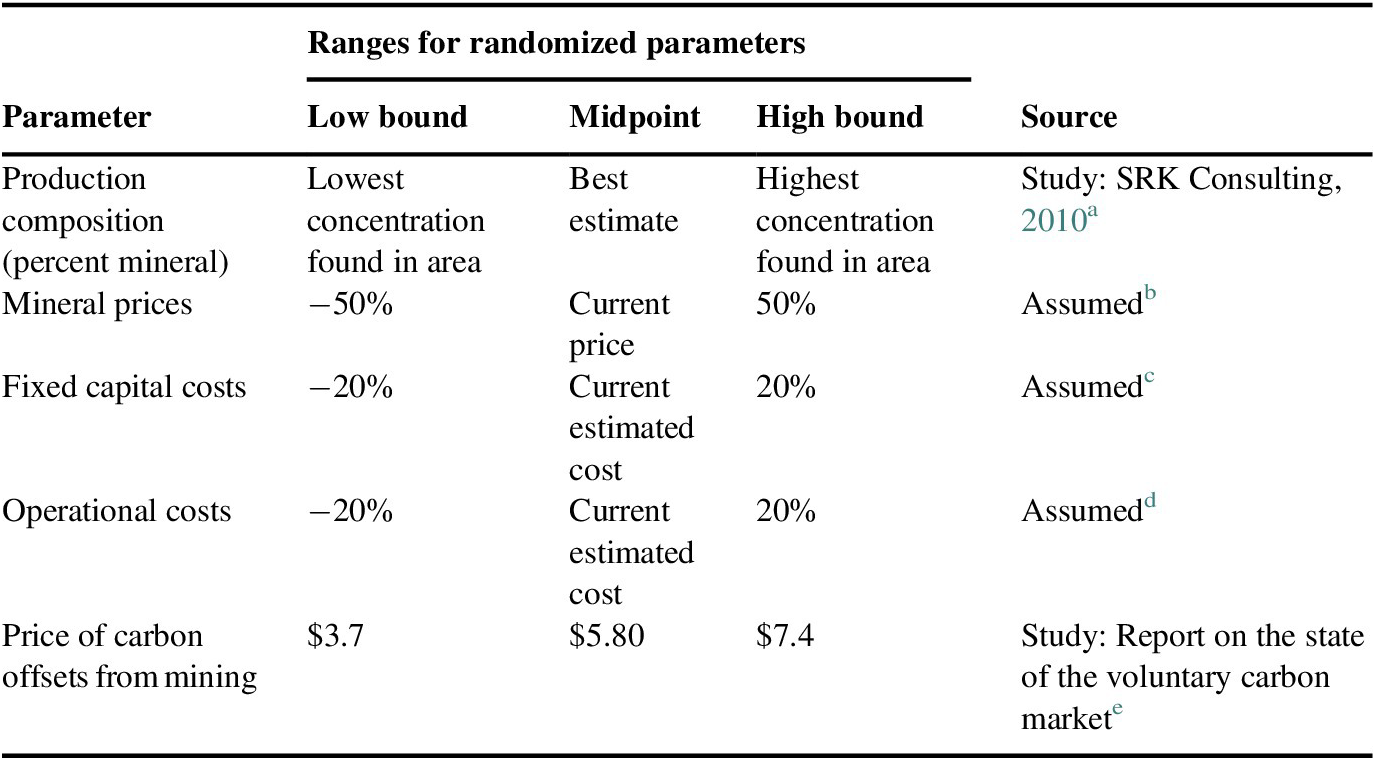
The BCA uses Monte Carlo simulation to characterize parameter uncertainty in the composition of mineral output, the prices of minerals, fixed and operating costs, and the price of CO2 offsets (see Table 2). The economic cost of removing and/or disturbing benthic communities is computed in what is regarded to be a bounding analysis that gives an overestimate of possible losses. This judgment is based on the extrapolation of studies on the costs of disturbing terrestrial habitats that have higher gross productivities than benthic ecosystems. A bounding analysis is also used to characterize the possible damages from low probability, high-impact ecosystem disturbances. In this case, the costs of the Deepwater Horizon accident are taken as the high boundary reference point.
Variables included in the Monte Carlo simulation.

Source: Cardno (2016).
a p. 80.
b p. 79.
c p. 66.
d p. 67.
e p. 117
Using this methodology, the analysis finds that the mining profit earned from extracting SMS deposits and manganese nodules are likely to be positive, while profits earned from cobalt-rich crusts are likely to be negative. Examining the impact on the host countries, the study finds that the present value of the government’s share of returns from SMS mining will range from −$75 to $260 million, with a median value of $80 million (See Table 3). The probability that the government’s receipts from SMS mining are positive is 83%. In the case of manganese nodules, the present value of the government’s income share will range from $150 million to over $1billion, with a median value of $500 million.
Costs and benefits of DSM mining scenarios (in present values).

Abbreviations: DSM, deep seabed mining; SMS, seafloor massive sulfides.
Reproduction of Table 3, pdf p. 8 in Wakefield and Meyers (2018).
These returns are significantly larger than the costs to the countries associated with leasing the mining operations. They include boundary cost estimates for unavoidable ecological impacts to benthic environments caused by mining activities, which are $0.5 million for SMS and $18.3 million for manganese nodules in present value terms (see Table 3). The study also computes the present value costs of unplanned fuel spills as $40,000 and $260,000 for SMS and manganese nodule mining, respectively. These costs are in the form of liability insurance premiums. The possibility of catastrophic environmental damages is bounded using the figure for the worst case oil spill ever recorded – the Deepwater Horizon accident. A liability assessment of $8.8 billion in present value terms was used represent costs in this case. In the event of damages of this magnitude, the costs of DSM would be larger than the benefits.
As noted, the social impacts of DSM are handled qualitatively in the study. These impacts are differentiated by local stakeholder groups including traditional peoples with seabed ownership claims; subsistence fishers potentially impacted by environmental effects; workers potentially affected by employment shifts; and the general population potentially influenced by changes in societal norms.
Regarding ownership claims, the study concludes that for Papua New Guinea, traditional ownership claims extend only to 3 nautical miles, whereas the mining site is 16 nautical miles. Similarly, for the Cook Islands, there are no traditional claims near the mining site. Given this, the study concludes that conflict over territorial claims is not likely.
Similarly, the study assumed that artisanal fishing was not likely to occur in proximity to mining areas, and otherwise, that areas of potential contact between mining supply vessels and traditional fishers were minimal. In the same vein, the study concludes that local workers associated with seabed mining would constitute a small enough share of local labor markets to not noticeably affect labor market conditions.
Last, the study argues that the income generated from SMS would be too small a share of the economy of Papua New Guinea to be noticeable, but the income generated from manganese nodules could be a significant enough share in national income of the Cook Islands (3–30%) to potentially affect societal norms. But the study notes that whether this impact would be positive or negative is unclear.
Overall, the study provisionally concludes that SMS mining and manganese nodule recovery are economically promising from a resource owner perspective. To quote from Wakefield and Meyers (2018), p. 1): “It is expected that the results of these initial analyses can be tentatively extrapolated to other Pacific countries with similar resources until more data become available to warrant additional country-specific analyses.” The study provides caveats that cumulative impacts might differ from those based on site-specific studies; revenue receipts could be misused by the governments that collect them – providing little social benefit – and that the future evolution of technology, scientific information, and markets could affect conclusions.
5.2. Assessment of methodology
The BCA provides useful information about the possible returns from seabed mining, offers insight about the way BCA can be adapted to DSM project evaluation, and reinforces the importance of methodology issues that will arise in the context of DSM project evaluation. We will consider two methodology issues further in this section: the uncertainty modeling within a stakeholder perspective and the monetization of environment benefits.
5.2.1. Uncertainty modeling within a stakeholder framework
The methodology approach in the BCA is commonly used in economic evaluation. Yet, the decision science literature suggests that this approach is not well suited to a decision context facing fundamental uncertainties.
In particular, there is likely to be considerable technical uncertainty associated with DSM operations, given the nascent state of the industry. Production volumes, the composition of output, the durability of the riser-lift system, and the operational reliability of environmental controls (such as those to reduce sedimentation and return water releases) are fundamentally uncertain, at least initially. The BCA does not address this uncertainty. The results are conditional on smooth operational performance.
Financial returns and the financial condition of mining firms will also influence the returns to DSM mining. These are affected by risks that are hard to diversify. Other than gold – a special case – mineral prices decline in response to financial crises and recessions (Christian, Reference Christian2009). The possibility of financial or economic instability over a 20- or 30-year mining lease period cannot be ruled out with confidence.
Financial risks for the ISA and countries with seabed resources are especially significant in the case of joint ventures. UNCLOS establishes a mechanism for joint ventures in international waters (“the Enterprise”; Article 170). Joint ventures are common in countries with seabed resources; for example, the government of Papua New Guinea had an ownership share in the Solwara project.
Because the financial condition of mining firms will have a significant effect on the returns to a mining operation, an assessment of these conditions should be integrated into the uncertainty evaluation. Whether the value of the contract comprises a significant share of the mining company’s portfolio – as was the case with Nautilus in the Solwara project – or a small share of a large and diversified portfolio is an obviously relevant consideration.
Mining firms and/or their supporting governments will not necessarily have the same risk tolerances as the ISA or countries with DSM operations in their national jurisdictions. Private markets may not fully internalize the benefits of precaution (Gollier & Treich, Reference Gollier and Treich2003). Differences in risk tolerances between mining companies and entities granting DSM contracts should be reflected in the uncertainty evaluation.
Discount rates are also likely to differ between mining firms and the ISA or national governments. Firms typically use a weighted cost of capital to establish discount rates, which includes a risk premium (Asian Development Bank, 2015). Tax status will also affect discount rates. These issues should be considered in the assessment of returns to the mining company and how the share of those returns will be perceived by the ISA and countries granting DSM contracts. In short, the stakeholder perspective of the mining firms and the entities granting DSM contracts needs to be clearly specified in the benefit–cost analysis.Footnote 15
5.2.2. Monetizing environmental damages
As is customary in a benefit–cost analysis with environmental components, the BCA makes choices about which environmental effects to monetize and how to monetize them. In this regard, the BCA chose to exclude global willingness to pay for seabed biodiversity and assess local valuations.
The BCA relies on willingness to pay and ecosystem service replacement to value lost ecosystem services from the disruption of benthic communities within the mining footprint. For the willingness to pay evaluation, the study used comparators from terrestrial ecosystems with low productivities that best match the productivity of seabed marine systems, in the view of the authors. These comparators are found in alpine tundra, arctic habitats, and grasslands (the latter for Manganese nodules). Valuations comparable to the values attained from the “highest productivity systems” – like cloud forests for Costa Rican Rainforests – are used to place an upper bound on expected ecosystem losses from benthic habitat disturbance. The ecosystem services replacement estimates in the BCA are extrapolated from the costs of restoring terrestrial wetlands.
The errors associated with these kinds of value transfers are likely to undermine their validity,Footnote 16 but that said, research has found that local valuations of biodiversity tend to be low, unless instrumentally linked to monetized services (Joubert et al., Reference Joubert, Leiman, de Klerk, Katua and Aggenbach1997). In the context of the marine environment, education and outreach might be needed to demonstrate to local publics the importance of seabed biodiversity (Jobstvogt et al., Reference Jobstvogt, Townsend, Witte and Hanley2014).
An alternative would be to use stated preference methods to elicit the global public’s valuation of natural seabed environments. However, using stated preference methods in this valuation context would also face significant methodology challenges.
Given these difficulties, addressing environmental uncertainties through regulation and management protocols – rather than attempting to monetize them in benefit–cost analysis – is a practical approach. This is the thrust of emerging DSM regulations. Regulations might also be adjusted to anticipate or adapt to the cumulative effects of mining that emerge over time, should the DSM industry commence and expand. There is also a normative justification for protecting natural environments like seabeds using “safe minimum standards” (see Toman, Reference Toman1994). The intent of the ISA to develop a patchwork of mining exclusion zones is consistent with this notion.
6. Discussion and recommendation
As of this writing, economic evaluation of DSM projects is based on predict-then-act structures that either do not mention uncertainty explicitly (e.g., the Draft ISA regulations) or do not model uncertainty as fundamental (e.g., the BCA sponsored by the EU and the Pacific Community). As noted, the work plan requirements in the ISA draft regulations are based on the predict-then-act decision approach. They mandate ex ante forecasts of the mining production program, including expected recovery rates and maximum annual minerals production. The contractor is required to fulfill this plan but can petition for adjustments in the face of unexpected environmental harms or deteriorating market conditions. Unanticipated technical problems are not a covered contingency in the draft regulations but would also seem to be a potential constraint on the contractor’s ability to fulfill a work plan. Given the uncertainties involved, it is easy to imagine scenarios where the conditions in work plans are regularly breached, with the need for frequent petitions for ex post adjustments. Such unanticipated scheduling problems could negatively affect the financial returns to DSM projects and impose adjustment costs.
Allowing more flexibility within a contract period for the initiation and scheduling of mining activities would reduce these risks. For example, a contractor could be allowed to obtain a contract and hold it without exploitation for a period of time, enabling production to be scheduled with more information about market conditions, technology, and costs. Draft ISA regulations do allow for contract rights and obligations to be transferred, which provides flexibility. Allowing for production targets to be averaged over several years (rather than set annually) would also allow for adjustments in response to unforeseen circumstances. Exploring the financial implications of flexible contracting mechanisms would be consistent with a real options approach.
A RDM protocol could also be required for the evaluation of mining contract proposals. As one possibility, the contractor’s proposed work plan, cash flow analysis, and financial assessment could be taken as the starting point for exploration. The stakeholders involved – the contractor and the ISA, or the contractor and the representatives of countries with seabed resources – could identify key concerns about the project with respect to start dates, technical performance and costs, regulatory compliance risks, financing and credit risks, difference in risk perceptions and discount rates, uncertainties about mineral prices, and the like. Iterative simulations would then be used to explore the implications of a wide range of variation of these parameters, allowing for the identification of a set of discussable scenarios where NPVs are negative. This process would allow for the identification of the key parameters most likely to lead to negative NPV outcomes. The project design could then be changed to increase the number of positive NPV scenarios. Ultimately, iterative simulation and stakeholder consultation could lead to a decision about the production plan that all parties find to be satisfactory.
Independent experts should supervise this study, but mining contractors should pay for it. Developing a standardized evaluation platform would lower the costs of this assessment and increase its efficiency. The National Investment System in Chile standardizes the evaluation protocol for benefit–cost analysis, and is broadly used to evaluate investment projects in the country (Gómez-Lobo, Reference Gómez-Lobo2012). The Chilean system would be a worthy model for the ISA to emulate for the benefit–cost analysis of DSM contract proposals. The platform could be made available to countries with seabed resources to use in their own DSM project evaluations.
Enabling more flexibility in production scheduling and robustly exploring fundamental uncertainties would reduce the risk of project failures and their associated costs. The value of this exercise would be especially high when the DSM contracting involves joint partnerships. Project failures are especially costly when the entities granting the mining contracts assume part of the project risks.
7. Conclusion
Exploratory activities have revealed mineral-rich deposits on deep seabeds throughout the world. Exploitation regulations are now being drafted to initiate the commercialization of the DSM industry. If all goes well, deep seabed mining will generate income for the ISA and countries with seabed resources. But deep seabed mining faces fundamental uncertainties, and the prospect of DSM has stirred intensive debate and controversy.
Regulatory approaches and contracting mechanisms are important instruments for addressing these uncertainties, and have been the principal focus of the DSM literature. This article advances another, complementary approach for managing DSM uncertainties: the use of ex ante benefit–cost analysis that incorporates a fundamental uncertainty assessment for the evaluation of exploitation contracts. This evaluation would include the key private and public sector actors involved in the decision-making, raising confidence that the NPV of proposed DSM projects would be positive under a range of unanticipated contingencies. This evaluation would improve the chances of socially desirable DSM commercialization, reducing the risks of unanticipated costs, DSM project failures, and the associated costs of otherwise avoidable environmental impacts.
Data and modeling methods are available for integrating a fundamental uncertainty evaluation into the economic assessment of DSM projects. However, this evaluation would be costly to implement. This cost might be viewed as the price paid for a precautionary stance towards the uncertainties associated with DSM projects. An ex ante assessment incorporating fundamental uncertainties could also be viewed as an insurance premium to reduce the risks of regulatory noncompliance or costly contract disputes after seabed mining commences. The optimal trade-off between the costs of better information ex ante and the costs of future regulatory and contractual uncertainty is a topic that deserves further assessment in the literature on DSM policymaking. For now, this article has suggested a practical step for improving the uncertainty evaluation in the benefit–cost analyses of seabed mining contracts.
Acknowledgments
We wish to thank the World Bank for financial support and access to information sources. For helpful comments and/or literature suggestions, we are also grateful to Nicolas Treich and other conferees at the first annual meeting of the European Society for Benefit Cost Analysis, Bryan Land and other participants at a World Bank stakeholder meeting; participants at a seminar at the Ostrom Workshop at Indiana University, and Jonathan Wiener, Cindy Van Dover, John Rupp, Christiana Ochoa, Steve Grimsley, and Chris Coltan. Two anonymous referees also offered insightful comments that greatly improved the article. Carl Brown-Grimm, Shu-Chuan Chiu, and Haley Waldkoetter provided essential research assistance. Notwithstanding the quantity and quality of this input, the authors bear exclusive responsibility for the findings, judgements, and conclusions of the article.